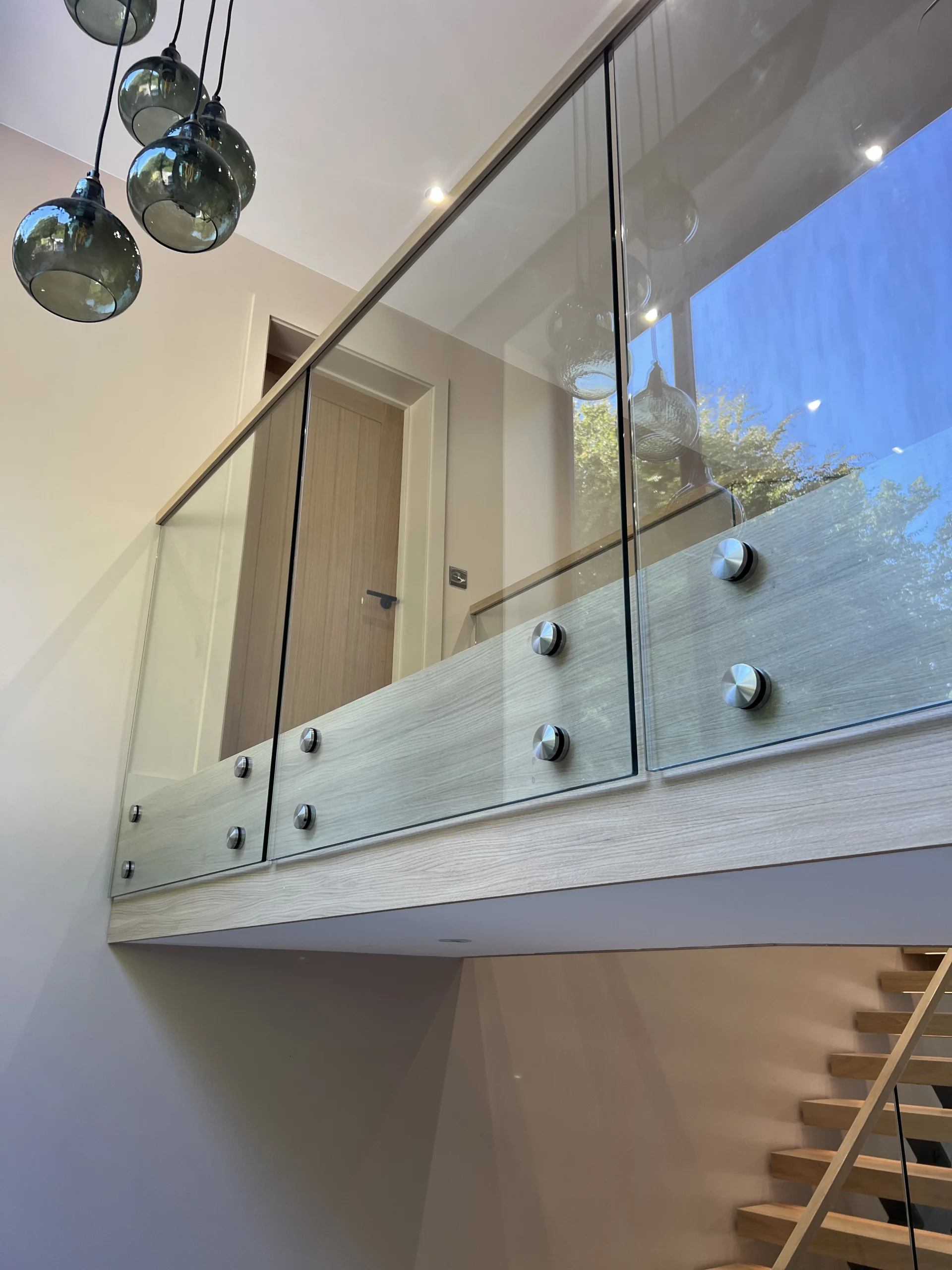

Bespoke Glass Balustrades
Designed, Built & Fully Compliant

Continox designs and installs frameless glass balustrades across the UK — every installation compliant with Part K & BS 6180:2011, with full Building Control documentation included as standard.

Part K
Approved Document
BS 6180
Barrier Standard 2011
BS EN 12150
Glass Safety Standard
Last updated: April 2026  ·  Reflects current Approved Document K & BS 6180:2011

Glass Balustrade Regulations UK 2026 –
Complete Guide to Part K & BS 6180

Whether you're installing a glass balustrade on an internal staircase, a first-floor landing, an external balcony or a roof terrace, your installation must comply with UK Building Regulations. The two key documents are Approved Document K (Protection from Falling, Collision and Impact) and BS 6180:2011 (Barriers in and about buildings). Together they set out when a balustrade is legally required, what height it must reach, which glass types are acceptable, and how much load it must withstand.

This guide covers every requirement you need to know — from minimum heights and glass specifications to load calculations, fixing requirements and planning permission. At Continox, we design and install bespoke glass balustrades fully compliant with all current UK regulations, and we manage all Building Control documentation as standard. For staircase-specific dimensions including rise, going, headroom and handrail heights, see our UK Staircase Building Regulations guide.

Important: These regulations apply in England and Wales. Scotland follows the Technical Handbook Section 4 and Northern Ireland has separate Building Regulations (Northern Ireland). Heights and load requirements are broadly identical, but approval processes differ. See Scotland & Northern Ireland section below. The full official reference document is Approved Document K (PDF, GOV.UK).

Glass Balustrade Requirements at a Glance

Location Min Height Glass Type Min Load (horizontal) Handrail Required?
Internal stairs & landings 900mm 10mm toughened 0.36 kN/m Recommended
External balcony / roof terrace 1100mm 17.52mm toughened laminated 0.74 kN/m Yes (if toughened only)
Juliet balcony 1100mm Toughened laminated 0.74 kN/m Yes
Near window opening 800mm 10mm toughened 0.36 kN/m Recommended
Commercial / public building 1100mm Toughened laminated 1.5 kN/m Yes
Factory / warehouse stairs 900mm stairs / 1100mm landings Toughened or laminated 0.74 kN/m Yes

Sources: Approved Document K (2013 edition, current for England & Wales) · BS 6180:2011 · BS EN 1991-1-1 & UK National Annex · BS EN 12150-1

When Is a Glass Balustrade Required?

Under Approved Document K, a protective barrier — including a glass balustrade — must be installed wherever there is a significant change in floor level that poses a risk of falling. The fundamental trigger is straightforward:

600mm
The primary trigger for a balustrade Any accessible area where the difference in floor level exceeds 600mm requires a protective barrier. This applies to internal and external locations — staircases, landings, balconies, mezzanines, raised decks and roof terraces.

Additionally, a balustrade is required on any staircase with more than two risers, regardless of the total height difference. This means even a short internal staircase of three steps needs a compliant handrail or balustrade on at least one side.

Internal Staircase
Any staircase with more than 2 risers. Balustrade required on at least one side. Height: minimum 900mm from pitch line.
Always required
Internal Landing
Where landing edge is more than 600mm above floor below. Balustrade minimum 900mm high on all exposed edges.
If drop > 600mm
External Balcony
All external balconies regardless of height above ground. Minimum 1100mm high. Laminated toughened glass required.
Always required
Roof Terrace
All accessible roof terraces. Minimum 1100mm. Must withstand higher wind and environmental loads than internal balustrades.
Always required
Mezzanine / Gallery
Open edges of mezzanine floors where drop exceeds 600mm. Glass balustrade minimum 900mm high on all open sides.
If drop > 600mm
Raised Garden Deck
External decking or raised platform where the drop from deck edge exceeds 600mm. Minimum 1100mm externally.
If drop > 600mm
Balustrade Required
  • Internal staircase with more than 2 risers
  • Landing with drop over 600mm
  • Any external balcony or terrace
  • Mezzanine edge with drop over 600mm
  • Raised garden deck over 600mm high
  • Juliet balcony (always 1100mm)
  • Void edge in open-plan interior
Balustrade Not Required
  • Ground-level patio or garden path
  • Single step (1 riser) between rooms
  • Two-step threshold (2 risers max)
  • Raised area under 600mm above adjacent floor
  • Decorative glass screen with no drop risk
Practical tip: The 600mm rule applies to the vertical drop from the accessible surface to the level below — not the overall building height. A mezzanine just 700mm above ground level still requires a compliant balustrade on all open edges. When in doubt, consult your local Building Control authority before installation.

Glass Balustrade Height Requirements UK

The required height of a glass balustrade depends on its location within or around the building and the type of building it is installed in. All heights are measured from the finished floor level (FFL) to the top of the balustrade or handrail. The three primary thresholds are 800mm, 900mm and 1100mm.

Near Window Opening
800mm
Minimum Height
Where a glass balustrade is positioned adjacent to an opening window in a residential property. The reduced height still provides protection while allowing window operation.
Internal – Stairs & Landings
900mm
Minimum Height
Standard height for internal staircases, landings, mezzanines and internal floor edges in residential properties. Measured from the pitch line on stairs, from FFL on landings.
External – Balconies & Terraces
1100mm
Minimum Height
Required for all external balconies, roof terraces, Juliet balconies and external platforms. Also applies to commercial and public buildings regardless of internal or external position.
Location / Building Type Min Height Measured From Notes
Internal stairs – residential 900mm Pitch line Part K, Diagram 3.1
Internal landings – residential 900mm FFL Part K, Diagram 3.1
Near opening window – residential 800mm FFL Part K, K4
External balcony / roof terrace 1100mm FFL Laminated glass required
Juliet balcony 1100mm FFL Full-height panel required
Commercial / office / retail – stairs 900mm Pitch line Part K, BS 6180
Commercial / office / retail – landings & floors 1100mm FFL Higher load also required
Theatre / auditorium – in front of fixed seating 800mm FFL Part K, Diagram 3.2
Factory / warehouse – stairs & ramps 900mm Pitch line / FFL BS 6180:2011
Factory / warehouse – landings & floor edges 1100mm FFL BS 6180:2011

Source: Approved Document K (2013 edition) Diagrams 3.1 & 3.2 · BS 6180:2011 Table 1

How is height measured on a staircase? On stairs, the 900mm height is measured vertically from the pitch line — the imaginary diagonal line connecting the front edges (nosings) of each tread — to the top of the balustrade or handrail. On flat landings and floors, it is simply measured vertically from the finished floor surface.
Continox tip: For open-plan interiors with a glass balustrade at a mezzanine or void edge, we always recommend 1000–1100mm even where 900mm is the minimum — the visual impact is minimal and the safety margin is significantly improved, particularly in properties with children.

Glass Specifications for UK Balustrades

Not all glass is equal when it comes to balustrade compliance. UK regulations specify both the type of glass and the minimum thickness depending on where the balustrade is installed and whether a handrail is present. The two compliant glass types are toughened (tempered) glass and toughened laminated glass.

T
Toughened Glass
BS EN 12150-1 · BS 6206 Class A

Thermally toughened to be 4–5× stronger than standard annealed glass. When it breaks, it shatters into small blunt pieces rather than sharp shards, reducing injury risk.

  • Suitable for internal staircases and landings
  • Minimum 10mm thickness for residential use
  • Must be used with a compliant handrail where drop exceeds 600mm
  • Not suitable frameless on external balconies without handrail
  • Lower cost than laminated option
✓ Internal use with handrail — compliant
L
Toughened Laminated Glass
BS EN 14449 · BS 6206 Class A · BS 6180:2011 §8.5

Two or more toughened glass panes bonded with a PVB or SGP interlayer. If one pane breaks, the interlayer holds the fragments together — the balustrade remains in place as a barrier.

  • Required for all external balconies and roof terraces
  • Required where no handrail and drop exceeds 600mm
  • Required for frameless point-fixed systems externally
  • Typical spec: 17.52mm (8.8.4) or 21.52mm (10.10.4)
  • SGP interlayer recommended for higher-load applications
★ Required externally & frameless without handrail
BS 6180:2011 – Which Glass Type Do You Need?
Internal balustrade with a compliant handrail, drop under 600mm
Toughened only ✓
Internal balustrade with a compliant handrail, drop over 600mm
Toughened only ✓
Internal frameless balustrade — no handrail, drop over 600mm
Laminated required ★
External balcony or roof terrace — any configuration
Laminated required ★
Juliet balcony — full height panel, no handrail
Laminated required ★
Commercial / public building — any location
Laminated required ★
Application Min Thickness Glass Type Standard
Internal residential – with handrail 10mm Toughened BS EN 12150-1
Internal residential – frameless, no handrail 13.52mm Toughened laminated BS EN 14449
External residential – with handrail 15.2mm Toughened laminated BS EN 14449
External residential – frameless, no handrail 17.52mm Toughened laminated BS EN 14449 · BS 6180
Commercial / public – stairs & landings 17.52mm Toughened laminated BS EN 14449 · BS 6180
High-load commercial (1.5 kN/m+) 21.52mm SGP laminated Structural calculation required

Note: Exact thickness must always be confirmed by a structural engineer or glazing specialist based on panel dimensions, fixing method and specific load requirements. These are indicative minimums only.

The handrail rule (BS 6180:2011, Section 8.5.2): Where a glass balustrade protects a drop of more than 600mm and no handrail is present, the glass must be toughened laminated — so that if one pane breaks, the interlayer keeps the panel in place and continues to provide a barrier. Toughened-only glass is permitted without a handrail only where the drop does not exceed 600mm.
Continox specification: We use toughened laminated glass as standard on all our balustrade installations — internal and external — regardless of whether a handrail is present. The marginal cost difference is small, the safety improvement is significant, and it future-proofs the installation against any regulatory changes or change of building use.

Glass Balustrade Load Requirements UK

A glass balustrade must do more than simply stand upright — it must withstand the forces applied to it in real use. UK regulations specify three types of structural load that every balustrade must resist, set out in BS 6180:2011 and BS EN 1991-1-1 (with UK National Annex). The required load values vary by building type and location.

Line Load
Uniformly Distributed Horizontal Load
A continuous horizontal force applied along the full length of the top of the balustrade. Simulates people leaning or pushing against the barrier. Measured in kN per metre (kN/m).
Point Load
Concentrated Load at Any Point
A single concentrated force applied at the most unfavourable point on the balustrade. Simulates the impact of a person falling against it at one location. Measured in kilonewtons (kN).
Infill Load
Distributed Load on Glass Infill Panel
A uniformly distributed load applied across the glass infill panel itself — not just the top rail. Critical for frameless glass systems where the panel is the primary structural element. Measured in kN/m².
Residential – Internal
0.36 kN/m
line load · 0.25 kN point load
Residential – External
0.74 kN/m
line load · 0.74 kN point load
Commercial / Public
1.5 kN/m
line load · structural calc required
Building Use / Location Line Load (kN/m) Point Load (kN) Standard
Residential – internal stairs & landings 0.36 0.25 BS EN 1991-1-1
Residential – external balcony / terrace 0.74 0.74 BS EN 1991-1-1 · UK NA
Office buildings – stairs & landings 0.74 0.74 BS EN 1991-1-1
Retail – stairs 0.74 0.74 BS EN 1991-1-1
Retail – landings & concourses 1.5 1.5 BS EN 1991-1-1
Public assembly – theatres, stadiums 1.5 1.5 Structural calc required
Industrial / warehouse – landings 0.74 0.74 BS 6180:2011
Handrail (all building types) 0.36 0.25 BS EN 1991-1-1

Sources: BS 6180:2011 Table 2 · BS EN 1991-1-1 Table 6.12 & UK National Annex · Approved Document K (GOV.UK)

What does 0.36 kN/m mean in practice? One kilonewton (kN) is roughly equivalent to 100kg of force. A line load of 0.36 kN/m means the balustrade must resist approximately 36kg of horizontal force applied per metre of length — comparable to a person leaning firmly against it. At 1.5 kN/m (public assembly), that rises to ~150kg per metre, reflecting the forces possible in crowded public spaces.
Continox approach: All our glass balustrade systems are independently tested to the relevant load category and supplied with full load test certificates and structural calculations. For commercial projects we engage a structural engineer as standard to confirm compliance with BS EN 1991-1-1 and the UK National Annex before any glass is specified or cut.

Glass Balustrade Regulations – Scotland & Northern Ireland

Building regulations are a devolved matter in the UK. While England and Wales follow Approved Document K, Scotland and Northern Ireland have their own separate regulatory frameworks. The good news is that the key technical requirements — minimum heights, glass specifications and load values — are broadly identical across all four nations. The main differences lie in the approval process and the specific documents you reference.

🏴󠁧󠁢󠁥󠁮󠁧󠁿
England & Wales
Approved Document K (2013)
Internal stairs 900mm
External balcony 1100mm
Approval body Local Building Control or Approved Inspector
Sphere rule 100mm
Key standard BS 6180:2011
Current document: Approved Document K, 2013 edition — available on GOV.UK. Wales uses the same document. No changes to balustrade heights since 2013.
🏴󠁧󠁢󠁳󠁣󠁴󠁿
Scotland
Technical Handbook – Section 4
Internal stairs 900mm
External balcony 1100mm
Approval body Local Authority Building Standards
Sphere rule 100mm
Key standard BS 6180:2011
Key difference: Scotland uses a Warrant system — a Building Warrant must be obtained before work begins, not just notified. Warrant applications go to the local council's Building Standards department.
🇬🇧
Northern Ireland
Building Regulations (NI) 2012
Internal stairs 900mm
External balcony 1100mm
Approval body District Council Building Control
Sphere rule 100mm
Key standard BS 6180:2011
Key difference: NI uses Technical Booklet H (staircases, ramps and balustrades). Administered by District Councils. The technical requirements mirror England & Wales closely.
Requirement England & Wales Scotland Northern Ireland
Governing document Approved Document K Technical Handbook S.4 Technical Booklet H
Internal stairs min height 900mm 900mm 900mm
External balcony min height 1100mm 1100mm 1100mm
100mm sphere rule Yes Yes Yes
Load standard BS EN 1991-1-1 BS EN 1991-1-1 BS EN 1991-1-1
Approval timing Notify before or during Warrant before start Notify before or during
Approval body Local Building Control Local Authority Building Standards District Council
Self-certification available Yes – competent persons Limited schemes Limited schemes

Sources: Approved Document K (GOV.UK) · Scottish Building Standards Technical Handbook (domestic & non-domestic) · Building Regulations (Northern Ireland) 2012 Technical Booklet H

Working in Scotland? The Building Warrant requirement means you must submit plans and receive approval before any work starts — not just notify after completion. For glass balustrade installations as part of a larger project (extension, loft conversion, new build), the Warrant covers the entire scope. Contact the local council's Building Standards department early in the design process.
Continox works across the UK: We install glass balustrades throughout England, Wales and Scotland. Our team manages all Building Control submissions and Building Warrant applications as part of the project — you don't need to deal with the paperwork separately.
<

Fixings, Installation & the 100mm Sphere Rule

Even correctly specified glass will fail to comply if the fixing system and installation don't meet the requirements of BS 6180:2011. The standard covers clip spacing, minimum glass edge cover, substrate requirements and the critical 100mm sphere rule — the opening size limit that prevents children from passing through or becoming trapped in a balustrade.

100 mm
The 100mm Sphere Rule
In any area accessible to children under 5, no opening in a balustrade — including gaps between glass panels, between glass and posts, or between the glass and floor — must allow a 100mm sphere to pass through. This dimension approximates the size of a young child's head and is specified in Approved Document K to prevent entrapment and falling. Horizontal rails must also be avoided where children are present, as they encourage climbing.
01
Clip Spacing
For clipped infill panels (no bolts through glass), clips must be positioned around the full periphery of each panel at a maximum spacing of 600mm. This ensures load is distributed evenly around the panel edge rather than concentrated at isolated points. Max 600mm centres — BS 6180:2011 §8.4.4
02
Minimum Clip Length
Each clip must be not less than 50mm in length to provide adequate bearing on the glass edge. Short or undersized clips concentrate stress at the glass edge and can cause premature failure under load, particularly in high-traffic environments. Min 50mm clip length — BS 6180:2011 §8.4.4
03
Minimum Edge Cover
Clips must provide a minimum glass edge cover of 25mm. This is the depth to which the clip overlaps the glass panel. Insufficient edge cover reduces the glass's resistance to lateral loads and increases the risk of the panel being pushed out of its fixing under impact. Min 25mm edge cover — BS 6180:2011 §8.4.4
04
Base Channel Drainage
For external installations, base channels must incorporate drainage holes or slots to prevent water pooling at the glass base. Standing water accelerates corrosion of fixings, degrades sealants and can cause thermal stress in the glass. Channels should be inspected and cleared at least quarterly. External installations — BS 6180:2011 §9
05
Substrate Compatibility
Fixings must be anchored into a substrate capable of transferring the design loads. Concrete, steel and solid masonry are suitable with appropriate anchors. Timber requires structural grade members (C24 minimum) and correctly specified coach screws or through-bolts. Chemical anchors must be used in hollow block or aerated concrete. Substrate assessment required on all projects
06
Record Keeping
BS 6180 recommends that all concealed fixings are photographed before being covered. Installation records should include anchor types, torque settings, substrate condition and glass batch numbers. This documentation supports Building Control sign-off and provides evidence of compliance in the event of future inspection or insurance claims. Recommended for all installations — BS 6180 §10
Fixing System Internal Use External Use Handrail Required? Notes
Base channel – clamped ✓ Compliant ✓ Compliant Depends on glass type Most common system, clean sightlines
Spigot / core-drilled post ✓ Compliant ✓ Compliant Yes – always Strong, flexible spacing, handrail mandatory
Point-fixed (spider fittings) ✓ Compliant ✓ With calc Laminated glass required Structural calc needed, premium aesthetic
Standoff / patch fittings ✓ Compliant ✓ With calc Yes – always Industrial look, requires engineer sign-off externally
Frameless topless (no rail) With laminated ✗ Not recommended No – glass must be laminated Only where drop < 600mm externally

Source: BS 6180:2011 · Approved Document K · BS EN 1090 (structural steel components)

Common compliance failure: Using components from multiple untested sources — for example, glass from one supplier, channels from another, and posts from a third — creates a system that has never been tested as a whole. BS 6180 requires that the complete system (glass, fixings, channels and posts together) is tested to the relevant load class. Mixing untested components voids compliance and creates liability risk.
Continox installation process: We photograph all concealed fixings and base channel anchors before finishing, provide torque records for all structural bolts, and supply a full installation pack including material certificates, load test data and Building Control submission drawings as standard on every project.

Do You Need Planning Permission for a Glass Balustrade?

Building Regulations and planning permission are two separate processes. Building Regulations (covered in the sections above) ensure the installation is structurally safe and compliant. Planning permission controls whether you are allowed to make the change to your property at all. Most glass balustrade installations fall under Permitted Development and do not require planning permission — but there are important exceptions.

Usually No Permission Needed
Permitted Development applies
  • Internal glass balustrade on a staircase or landing
  • Replacement of existing balustrade like-for-like
  • Ground-level or low-level garden balustrade
  • Internal mezzanine balustrade within existing building
  • Frameless balustrade on existing ground-floor extension roof
  • Any internal installation not affecting the building's external appearance
!
Check First – May Need Permission
Permitted Development may not apply
  • New balcony with glass balustrade on an existing house
  • Roof terrace conversion with new external balustrade
  • Balustrade visible from a public highway or neighbouring property
  • Property in a Conservation Area
  • Listed building — any external or internal alteration
  • Flat or maisonette (Permitted Development rights often removed)
  • Property with an Article 4 Direction removing PD rights
Scenario Planning Permission Building Regs Notes
Internal staircase balustrade – residential Not required Required Building Control notification needed
External balcony – existing house Usually required Required New balcony = material change to building
Replacement balustrade – same position Not required Required Like-for-like replacement covered by PD
Listed building – any alteration Listed Building Consent Required Both consent and regs always needed
Conservation Area – external visible work Check with LPA Required Depends on exact location and visibility
Roof terrace conversion Usually required Required Creates new amenity space — material change
Commercial property – any external work Check with LPA Required Commercial PD rights differ from residential
Flat / apartment Check with LPA Required PD rights often removed by lease or condition

LPA = Local Planning Authority. Always verify with your local council before starting external work.

Listed buildings: If your property is listed (Grade I, II* or II in England), you need Listed Building Consent for any works that affect its character — including internal alterations such as replacing a traditional balustrade with glass. This is a separate application from planning permission and is administered by the local planning authority. Failure to obtain consent is a criminal offence.
Not sure if your property has restrictions? Check the Planning Portal (planningportal.co.uk) to see if your property is in a Conservation Area or is listed. Your local council's planning department can also confirm whether any Article 4 Directions apply to your area — these are local orders that restrict Permitted Development rights in specific streets or zones.
Continox pre-project check: Before any balustrade project we carry out a planning status check as standard. If planning permission or Listed Building Consent is required, we advise you early in the process and can recommend planning consultants where needed — avoiding costly delays after work has started.

Do You Need Planning Permission for a Glass Balustrade?

Building Regulations and planning permission are two separate processes. Building Regulations (covered in the sections above) ensure the installation is structurally safe and compliant. Planning permission controls whether you are allowed to make the change to your property at all. Most glass balustrade installations fall under Permitted Development and do not require planning permission — but there are important exceptions.

Usually No Permission Needed
Permitted Development applies
  • Internal glass balustrade on a staircase or landing
  • Replacement of existing balustrade like-for-like
  • Ground-level or low-level garden balustrade
  • Internal mezzanine balustrade within existing building
  • Frameless balustrade on existing ground-floor extension roof
  • Any internal installation not affecting the building's external appearance
!
Check First – May Need Permission
Permitted Development may not apply
  • New balcony with glass balustrade on an existing house
  • Roof terrace conversion with new external balustrade
  • Balustrade visible from a public highway or neighbouring property
  • Property in a Conservation Area
  • Listed building — any external or internal alteration
  • Flat or maisonette (Permitted Development rights often removed)
  • Property with an Article 4 Direction removing PD rights
Scenario Planning Permission Building Regs Notes
Internal staircase balustrade – residential Not required Required Building Control notification needed
External balcony – existing house Usually required Required New balcony = material change to building
Replacement balustrade – same position Not required Required Like-for-like replacement covered by PD
Listed building – any alteration Listed Building Consent Required Both consent and regs always needed
Conservation Area – external visible work Check with LPA Required Depends on exact location and visibility
Roof terrace conversion Usually required Required Creates new amenity space — material change
Commercial property – any external work Check with LPA Required Commercial PD rights differ from residential
Flat / apartment Check with LPA Required PD rights often removed by lease or condition

LPA = Local Planning Authority. Always verify with your local council before starting external work.

Listed buildings: If your property is listed (Grade I, II* or II in England), you need Listed Building Consent for any works that affect its character — including internal alterations such as replacing a traditional balustrade with glass. This is a separate application from planning permission and is administered by the local planning authority. Failure to obtain consent is a criminal offence.
Not sure if your property has restrictions? Check the Planning Portal (planningportal.co.uk) to see if your property is in a Conservation Area or is listed. Your local council's planning department can also confirm whether any Article 4 Directions apply to your area — these are local orders that restrict Permitted Development rights in specific streets or zones.
Continox pre-project check: Before any balustrade project we carry out a planning status check as standard. If planning permission or Listed Building Consent is required, we advise you early in the process and can recommend planning consultants where needed — avoiding costly delays after work has started.

Glass Balustrade Regulations – Frequently Asked Questions

Heights & Dimensions
It depends on location. For internal staircases and landings in residential properties, the minimum height is 900mm measured from the pitch line or finished floor level. For external balconies and roof terraces, the minimum is 1100mm. Near an opening window, the minimum is 800mm. These heights are set by Approved Document K and BS 6180:2011.
On a staircase, height is measured vertically from the pitch line — the imaginary diagonal line connecting the front edges (nosings) of each tread — up to the top of the balustrade or handrail. On flat landings and floors, it is simply measured vertically from the finished floor surface (FFL).
Yes. A Juliet balcony (a full-height glass panel in front of a door opening with no walkable platform) must be at least 1100mm high and must be constructed from toughened laminated glass. It must also withstand the relevant horizontal loads specified in BS EN 1991-1-1. No handrail is typically required on a Juliet balcony as the panel itself is the barrier.
Glass Type & Specification
Minimum thickness depends on location and whether a handrail is present. For internal residential use with a handrail, 10mm toughened glass is generally acceptable. For external or frameless applications without a handrail, toughened laminated glass of at least 17.52mm is typically required. Exact thickness must always be confirmed by a structural engineer based on panel dimensions and fixing method.
Only in limited circumstances. Under BS 6180:2011 Section 8.5.2, where a balustrade protects a drop of more than 600mm and no handrail is fitted, the glass must be toughened laminated — so that if one pane breaks, the interlayer holds the panel in place and continues to provide a barrier. Toughened-only glass without a handrail is only acceptable where the drop does not exceed 600mm.
Toughened glass is thermally treated to be 4–5× stronger than standard glass. When it breaks, it shatters into small blunt fragments. Toughened laminated glass consists of two or more toughened panes bonded with a PVB or SGP interlayer. If one pane breaks, the interlayer holds the fragments together and the panel stays in place as a barrier — making it the safer and more compliant choice for external and frameless applications.
Regulations & Approval
Yes — any new glass balustrade installation that forms a protective barrier (required where drop exceeds 600mm or on any staircase with more than 2 risers) must comply with Building Regulations. For most domestic projects you notify Building Control before or during the work. In Scotland, a Building Warrant must be obtained before starting. A building control officer will inspect and sign off the completed installation.
Most internal balustrade installations and like-for-like replacements do not require planning permission and fall under Permitted Development. However, you may need planning permission if you are creating a new balcony on an existing house, installing a visible external balustrade, or if your property is in a Conservation Area, is a listed building, or has had Permitted Development rights removed by an Article 4 Direction.
The 100mm sphere rule, specified in Approved Document K, requires that in areas accessible to children under 5, no gap in a balustrade — including between panels, between glass and posts, or between glass and floor — must allow a 100mm sphere to pass through. This dimension approximates the size of a young child's head and is designed to prevent entrapment and falling. Horizontal rails must also be avoided as they encourage climbing.
BS 6180:2011 is the British Standard for barriers in and about buildings. It covers the design, specification and installation of all types of balustrades and barriers, including glass systems. While Approved Document K sets the legal minimum requirements, BS 6180 provides the detailed technical guidance used to achieve compliance — covering load values, fixing requirements, glass specifications and handrail rules. All Continox balustrade installations are designed and installed in accordance with BS 6180:2011.
Free Design Consultation
Get a Compliant Glass Balustrade Quote
Free design consultation & 3D visuals included — see your glass balustrade before we build it. No obligation, no call-out charges. All installations fully compliant with Part K & BS 6180:2011.