

Faux Cantilever vs True Cantilever Staircase: The Honest Difference
Most "cantilever" staircases sold in the UK are technically faux cantilever — and that's not a problem. This engineer-led guide explains the real structural difference, why it costs £8,000-£18,000 vs £15,000-£30,000+, and which fits your wall, your budget and your project.
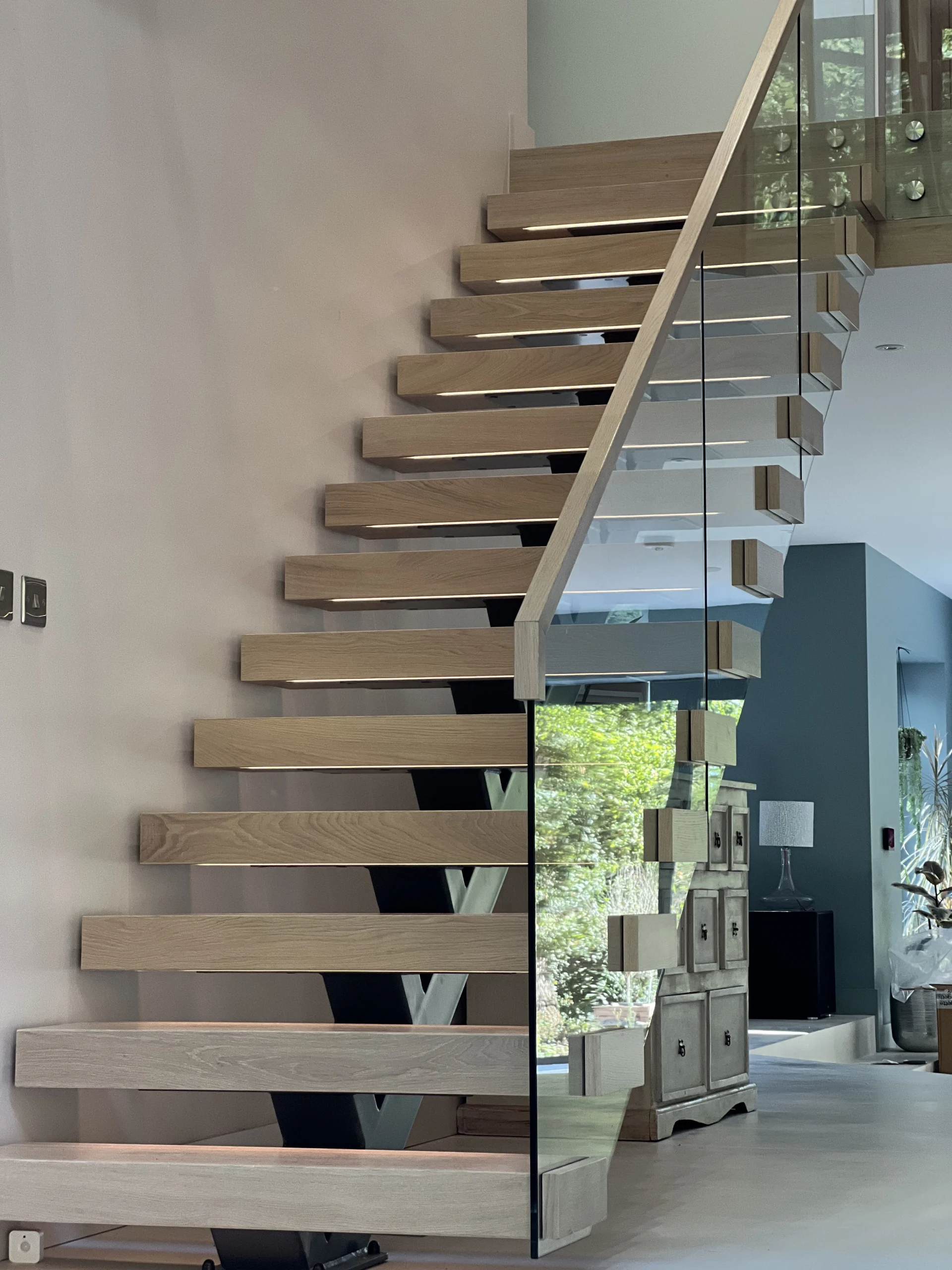
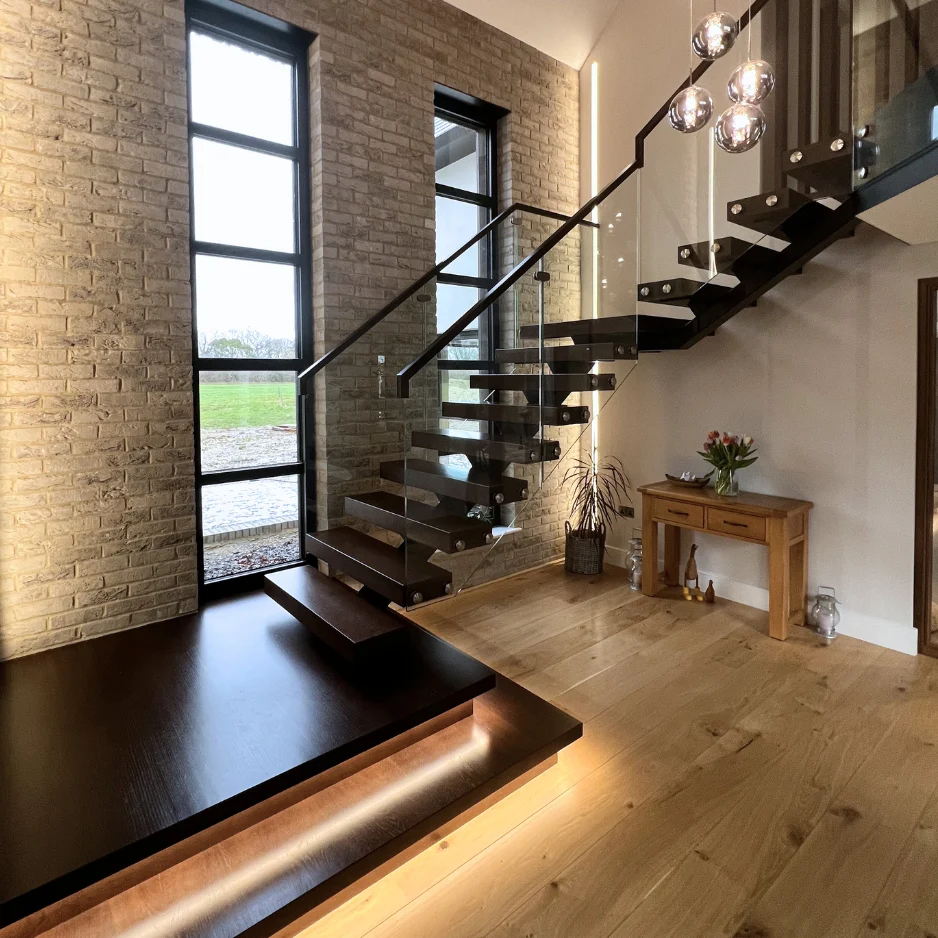
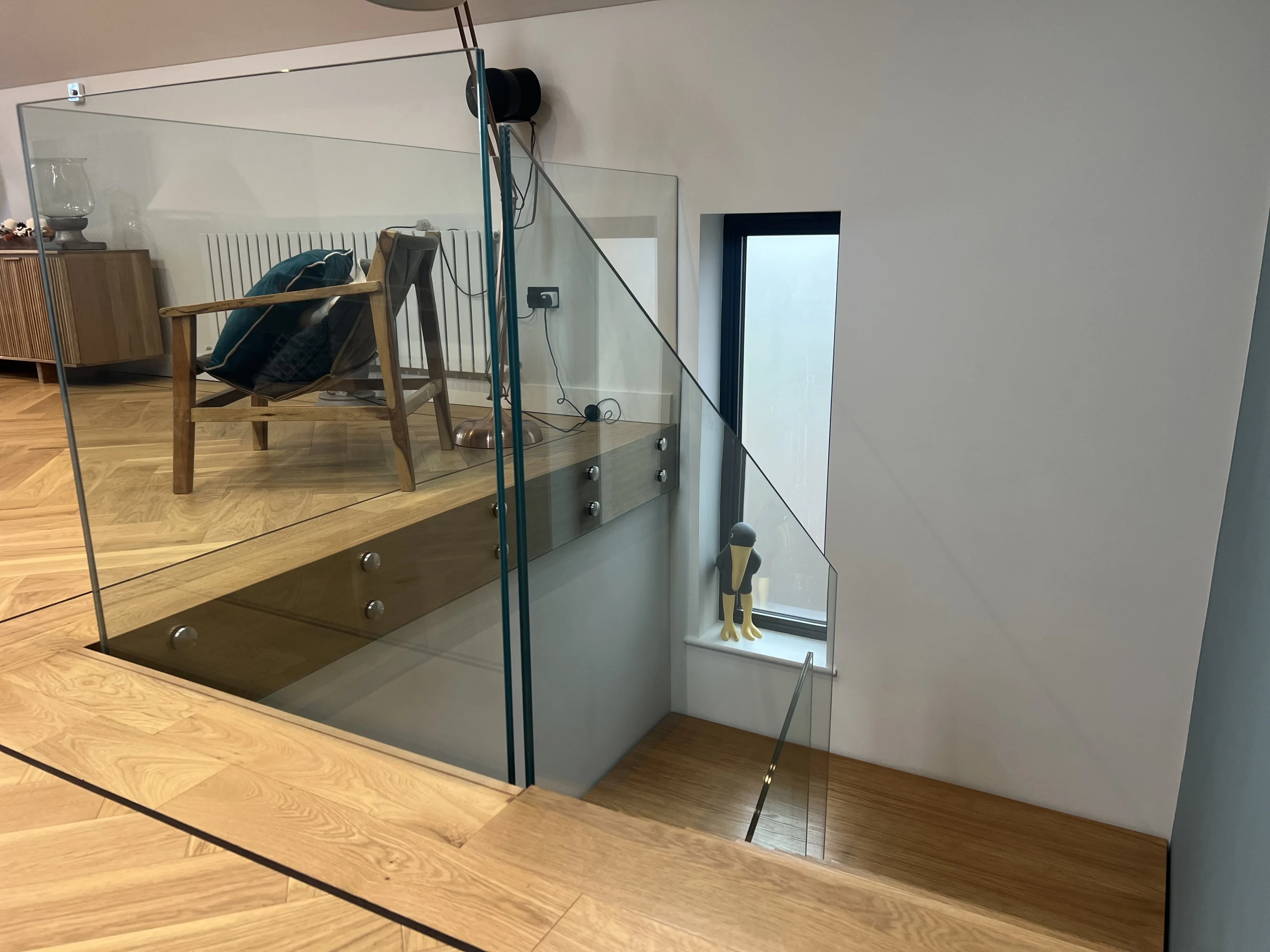

What's the difference between true and faux cantilever staircases? A true cantilever staircase has each tread independently mounted into a load-bearing masonry wall (minimum 215mm thick), with steel pins anchored 100-150mm deep into the wall structure. A faux cantilever staircase achieves the same floating visual effect using a hidden steel stringer or spine concealed within the wall or running internally, with treads supported off this concealed structure rather than the wall itself.
Is faux cantilever weaker than true cantilever? No. Both can be engineered to the same UK Building Regulations standards (BS EN 1991-1-1 loading 1.5 kN/m², BS EN 1090-1 EXC2 steel certification). The difference is the load path, not the load capacity.
Which should you choose? Most UK homeowners (~95%) end up with faux cantilever — because their walls aren't 215mm solid masonry, true cantilever costs £15,000-£30,000+ vs £8,000-£18,000 for faux, and the visual result is identical. Continox floating staircases from £11,999 use hybrid wall-mounted faux cantilever construction with EN 1090-1 EXC2 certified steel.
Here's the uncomfortable truth most UK staircase suppliers won't tell you: roughly 95% of staircases marketed as "cantilever" or "floating cantilever" in the UK are faux cantilever. They look identical to true cantilever from the front, they're structurally compliant, and they're often the right engineering choice for the building. But they're not, technically, cantilevers.
This isn't a scandal — it's just how the UK market evolved. Most domestic walls aren't built thick enough for true cantilever construction, the cost difference is significant (£15,000-£30,000+ vs £8,000-£18,000), and the visual result is identical. This guide explains the real engineering difference so you can make an informed choice — and recognise when a supplier is selling you faux while implying true.
What Is a Cantilever Staircase? The Foundation
The word "cantilever" comes from structural engineering, where it refers to a beam supported at one end only — think diving boards, balconies projecting from a building, or aircraft wings. Apply this principle to a staircase tread, and you get the iconic floating staircase aesthetic: treads emerging from a wall with no visible support beneath, no stringer along the open side, no spindles or balusters on the structural side.
In strict engineering terms, only a true cantilever staircase is, technically, a cantilever. But in the UK market — and increasingly worldwide — the word "cantilever" has come to describe the visual aesthetic rather than the strict structural method. This is where the confusion starts, and where buyers can end up disappointed if they don't understand what they're actually purchasing.
Pure Structural Definition
Each tread is an individual cantilever element — a steel pin or bracket anchored deep into a load-bearing masonry wall, with the tread extending out from this single fixing point. No hidden stringer, no concealed spine. The wall itself is the structural element.
Visual Aesthetic Definition
Treads appear to float identically to true cantilever — but the load is carried by a concealed steel stringer or spine running behind the treads (often hidden within the wall or running as a continuous beam). The wall is decorative cladding, not structural.
Why the Confusion Exists in the UK Market
Three factors created the current confusion. First, true cantilever is genuinely difficult and expensive in typical UK housing — most internal walls aren't load-bearing solid masonry of the required thickness. Second, faux cantilever can produce visually identical results at a fraction of the cost. Third, the marketing language drifted over time — "cantilever" came to mean the look rather than the method.
The result: a UK homeowner browsing "cantilever staircases" online will encounter products at £8,000, £15,000 and £35,000 — all visually similar, all called "cantilever" — without anything in the marketing to explain why one costs four times another. This guide fixes that.


True Cantilever Staircase Explained
How True Cantilever Engineering Actually Works
In a true cantilever staircase, every individual tread becomes a structural cantilever element. The engineering process for each tread runs as follows:
True Cantilever Construction Method
Wall Preparation
Solid masonry wall (215mm+ brick or concrete). Pocket cut at each tread position, depth 100-150mm, sized for steel pin or bracket.
Steel Pin Anchoring
RHS or solid steel pin (typically 80×40×8mm or larger) chemically anchored or grouted into wall pocket. Each pin individually engineered.
Tread Mounting
Solid hardwood tread (typically 80-105mm thick) with internal steel reinforcement plate, slid onto pin and bonded.
Load Verification
Each tread + pin + wall pocket structurally certified for 1.5 kN/m² imposed load + 0.5 kN point load + 1.4 safety factor.
Wall Construction Requirements
True cantilever places enormous demands on the wall. Each tread typically transfers 1.5-2.5 kN of load (from imposed loads + tread self-weight) plus a bending moment of around 0.6-1.2 kNm at the wall face. This bending moment is what tries to rotate the tread downward, and it's what the wall must resist — through the depth of the steel pin embedment and the wall's own structural integrity. Suitable wall types include:
- Solid concrete — ideal substrate, allows precise pin embedment, predictable load capacity. Common in modern new builds.
- Solid brick (minimum 215mm thick, double-skin) — acceptable for true cantilever where mortar joints are sound and bricks are engineering-grade. Requires careful surveying.
- Reinforced masonry — solid block work with vertical reinforcement bars allows true cantilever in modern walls.
Walls that cannot support true cantilever include single-skin brick, stud partition walls (timber or metal frame), insulated cavity walls without concrete inner leaf, lightweight concrete blocks (Aircrete, Thermalite), and any plasterboard-faced wall without confirmed structural backing. This is the majority of internal walls in UK housing built after 1980.
Steel Specifications for True Cantilever
True cantilever steel work is significantly more demanding than faux cantilever, because each pin acts as an independent structural element. Typical specification for a residential UK true cantilever:
- Pin material: Solid steel S355 (higher grade than typical S275) or stainless steel SS 316 for premium projects
- Pin section: 80×40mm RHS, 8mm wall, or solid round bar 50-60mm diameter
- Embedment depth: 100-150mm into wall (depending on wall material and load)
- Anchoring method: Chemical resin (Hilti HIT-RE 500 or equivalent) or expansive grout
- Welding standard: BS EN 1090-1 EXC2 with full penetration welds at any pin-to-bracket connection
- Engineering certification: Each pin individually calculated under BS EN 1991-1-1 loadings + Eurocode 3 (BS EN 1993-1-1) member design
Limitations & Realities of True Cantilever
True cantilever is not always the right answer, even when budget allows. Real-world limitations include:
- Lateral stiffness — true cantilever treads can flex slightly under side loading (someone pushing sideways while climbing). Not unsafe, but noticeable. Faux cantilever with hidden spine is typically stiffer.
- Wall renovation impact — if you ever replaster, redecorate or move utilities through that wall, every tread becomes a constraint. Future flexibility is reduced.
- Vibration — heavy footfall on a true cantilever generates a more noticeable "spring" than faux cantilever. Some homeowners prefer this; others find it unsettling.
- Repair complexity — if a tread ever needs replacement, the wall must be opened and the pin replaced. With faux cantilever, treads can usually be removed from the hidden stringer.
- Cost reality — typical UK true cantilever runs £15,000-£30,000+ for a residential staircase, reflecting wall preparation, individual pin engineering and specialist installation.
Faux Cantilever Staircase Explained
How Faux Cantilever Achieves the Floating Look
The visual trick of faux cantilever depends on hiding the structural element in plain sight. Two main approaches dominate the UK market:
Faux Cantilever Construction Method (Wall-Side Hidden Stringer)
Steel Stringer
Continuous steel beam (typically RHS 150×100×5mm or larger) runs along the wall side from floor to ceiling, fixed at top and bottom only.
Wall Concealment
Stringer is plastered into the wall finish (cuts pocketed in wall surface) or sits proud of wall and is plasterboard-clad.
Tread Brackets
Welded brackets at each tread position cantilever from the hidden stringer. Treads mount to brackets — they appear to float from the wall.
Total Load Path
Tread → Bracket → Hidden stringer → Top + bottom fixings → Floor structure. Wall does no structural work.
The Two Faux Cantilever Variants
Faux cantilever appears in the UK market in two distinct forms, each with different aesthetic and structural characteristics:
- Wall-side hidden stringer — the steel beam runs vertically along the wall side, hidden in the wall finish. Visually identical to true cantilever from the front. The most common faux cantilever method in UK premium bespoke (this is the Continox floating staircase approach).
- Central spine cantilever — the steel beam runs along the underside centre of the staircase, with treads cantilevering left and right from the spine. Visually different from true cantilever (you can see the spine if you look from below) but allows free-standing positioning without a wall. This is the Continox central spine approach.
Both are structurally faux cantilever — the visual cantilever effect is achieved through hidden engineering rather than through actual wall anchoring. Both are fully compliant with UK Building Regulations Part K, BS EN 1991-1-1 loading and BS EN 1090-1 EXC2 steel certification.
Wall Fixing Requirements (Much Simpler)
Because the wall does no structural work in faux cantilever construction, wall requirements are dramatically reduced. The hidden stringer needs only top-and-bottom fixings — typically anchored into the floor structure at the bottom and into the ceiling joists or steel header at the top. The wall itself can be:
- Stud partition (timber or metal frame) — fine, stringer fixings bypass it
- Insulated cavity wall — fine, stringer is fixed at floor + ceiling, not the wall
- Single-skin brick — fine, no individual pin embedments required
- Plasterboard finish — fine, the stringer sits behind it
This is the practical reason faux cantilever is so dominant in the UK market: it works in almost any building, including 1930s semis, post-war housing, modern new builds with cavity walls, loft conversions and barn conversions where wall structure varies dramatically.
Why Most "Cantilever" Staircases in the UK Are Faux
Three structural realities of UK housing make faux cantilever the dominant construction method:
- UK wall construction — only ~5-10% of UK housing has the load-bearing solid masonry walls (215mm+) needed for true cantilever in the chosen staircase position. New builds often use timber frame; period properties often have lath-and-plaster on stud or single-skin brick on cavity.
- Building Control practicality — true cantilever requires per-tread structural certification which is significantly more complex than a single hidden-spine certification. Approvers prefer the simpler load path documentation.
- Cost and risk — true cantilever risks future wall problems (cracking, settlement), is more expensive to repair, and costs £7,000-£15,000+ more for typical residential project. Most homeowners reasonably choose faux at half the price for the same visual outcome.
Side-by-Side Technical Comparison
The 12-attribute comparison below covers everything that actually matters when choosing between true and faux cantilever for a UK residential project. Every figure is from real engineered projects — true cantilever specifications based on solid concrete substrate, faux cantilever based on Continox standard build.
| Attribute | True Cantilever | Faux Cantilever |
|---|---|---|
| Construction method | Each tread anchored to load-bearing wall | Hidden stringer / spine carries load |
| Wall requirement | 215mm+ solid masonry / concrete | Any wall type (stud, cavity, single-skin OK) |
| Visual appearance | Floating treads, no visible support | Floating treads, no visible support (identical) |
| UK availability (% of homes) | ~5-10% (wall-dependent) | ~95% (works in almost any home) |
| Steel specification | S355 or stainless 316, individual pins | RHS 150×100×5mm S275 stringer |
| UK certification | BS EN 1090-1 EXC2 + per-pin calc | BS EN 1090-1 EXC2 + stringer calc |
| Lateral stiffness | Some flex under side loading | Very stiff (continuous spine) |
| Vibration / spring | More noticeable "give" under footfall | Minimal vibration, solid feel |
| Building Control complexity | High — per-tread sign-off needed | Standard — single structural cert |
| Future repairability | Difficult — wall must be opened | Easier — treads remove from stringer |
| Lead time | 10-16 weeks (specialist install) | 6-8 weeks (standard install) |
| UK price range | £15,000-£30,000+ | £8,000-£18,000 |
Key takeaway from this tableTrue cantilever and faux cantilever are not "cheaper version vs proper version" — they're two different engineering solutions to the same visual goal. Faux cantilever has measurable advantages (lower cost, better repairability, less vibration, works in any wall), and true cantilever has measurable advantages (architectural purity, slightly more dramatic floating effect when wall is showcase). Choose based on building, budget and priorities — not because one is "real" and the other isn't.
Structural Engineering: What Architects Need to Know
Load Path & Moment Calculation Differences
From a structural engineering perspective, the most important distinction is the load path — the route through which forces travel from the user's foot down to the building foundations:
- True cantilever load path: User → Tread → Steel pin (bending moment ~0.6-1.2 kNm at wall face) → Wall masonry (vertical compression + horizontal shear at pin embedment depth) → Wall foundations
- Faux cantilever load path: User → Tread → Hidden bracket → Stringer beam (continuous bending) → Top + bottom fixings (point loads at floor + ceiling) → Floor/ceiling structure → Building foundations
The true cantilever path concentrates loads at small wall pockets — making each pocket a critical structural failure point. The faux cantilever path distributes loads through a continuous beam — making the entire system redundant (single point failure is much harder to achieve). For most UK residential applications, faux cantilever is structurally more forgiving.
Wall Substrate Requirements (Real-World UK Audit)
Before specifying true cantilever, architects must audit the proposed wall against three criteria. If any one fails, faux cantilever should be specified:
- Material: Solid concrete or solid masonry (215mm+ brick, dense concrete block). Aircrete blocks fail this test even at 215mm thickness.
- Construction: No cavity behind the embedment zone; no plasterboard layer; no services or pipes within 200mm of pin positions.
- Condition: Sound mortar, no cracking within 1m of pin positions, no historic damp ingress in the wall fabric.
This audit is best done by a structural engineer with a borescope (to verify wall internal construction). Where doubt exists, the conservative specification is faux cantilever.
BS EN 1090-1 EXC2 — Same Standard, Different Application
Both true and faux cantilever staircase steel must be manufactured under BS EN 1090-1 to Execution Class 2 (EXC2) — this is non-negotiable for UK structural steelwork. However, the application differs:
- True cantilever: Each individual pin and bracket assembly is a discrete structural element requiring individual EXC2 certification, traceability and Declaration of Performance (DoP).
- Faux cantilever: The continuous stringer assembly is a single structural element with single EXC2 certification covering the whole staircase steelwork package.
For tender documentation, this changes how the steelwork specification reads. Continox provides full EXC2 documentation for both approaches — see our Staircase Specification Guide for Architects for NBS-compatible clauses.
When True Cantilever Is Impossible — and What to Do
In many UK projects, true cantilever is genuinely impossible due to wall construction, regardless of budget. Common scenarios:
- New-build timber frame — no masonry to anchor to. Faux cantilever or different staircase typology required.
- Loft conversion — knee wall or kingpost roof structure usually has insufficient mass. Faux cantilever or central spine is the only viable approach.
- Open-plan renovation — wall has been removed or replaced with a steel goalpost. Central spine cantilever often the only option.
- Cavity wall outside skin — even if outer leaf is solid brick, the cavity prevents structural pin embedment. Faux cantilever required.
In all these cases, the architect's job is to specify faux cantilever clearly to avoid contractor confusion or cost surprise. The visual outcome is identical; only the specification language differs.
Visual Differences: How to Spot Each in the Wild
The Three Reliable Visual Tests
If you're trying to determine whether a "cantilever" staircase you're viewing is true or faux, three inspection points give the answer:
- Wall thickness check at tread level — true cantilever requires the wall to be visibly 215mm+ thick at every tread level. If the wall is plasterboard-faced or visibly cavity construction, the staircase is faux cantilever (regardless of marketing language).
- Underside inspection — viewed from below, faux cantilever often reveals the hidden stringer (a continuous steel beam visible at the wall corner or running centrally under the treads). True cantilever shows individual pins at each tread position with no continuous beam.
- End-tread test — at the bottom and top of the staircase, true cantilever requires the wall to extend below floor level and above the top tread (because each tread is anchored to wall). Faux cantilever stringer connects to floor and ceiling structure, so the wall can stop at the top tread.
The "No Visible Support" Test (and Why It Doesn't Work)
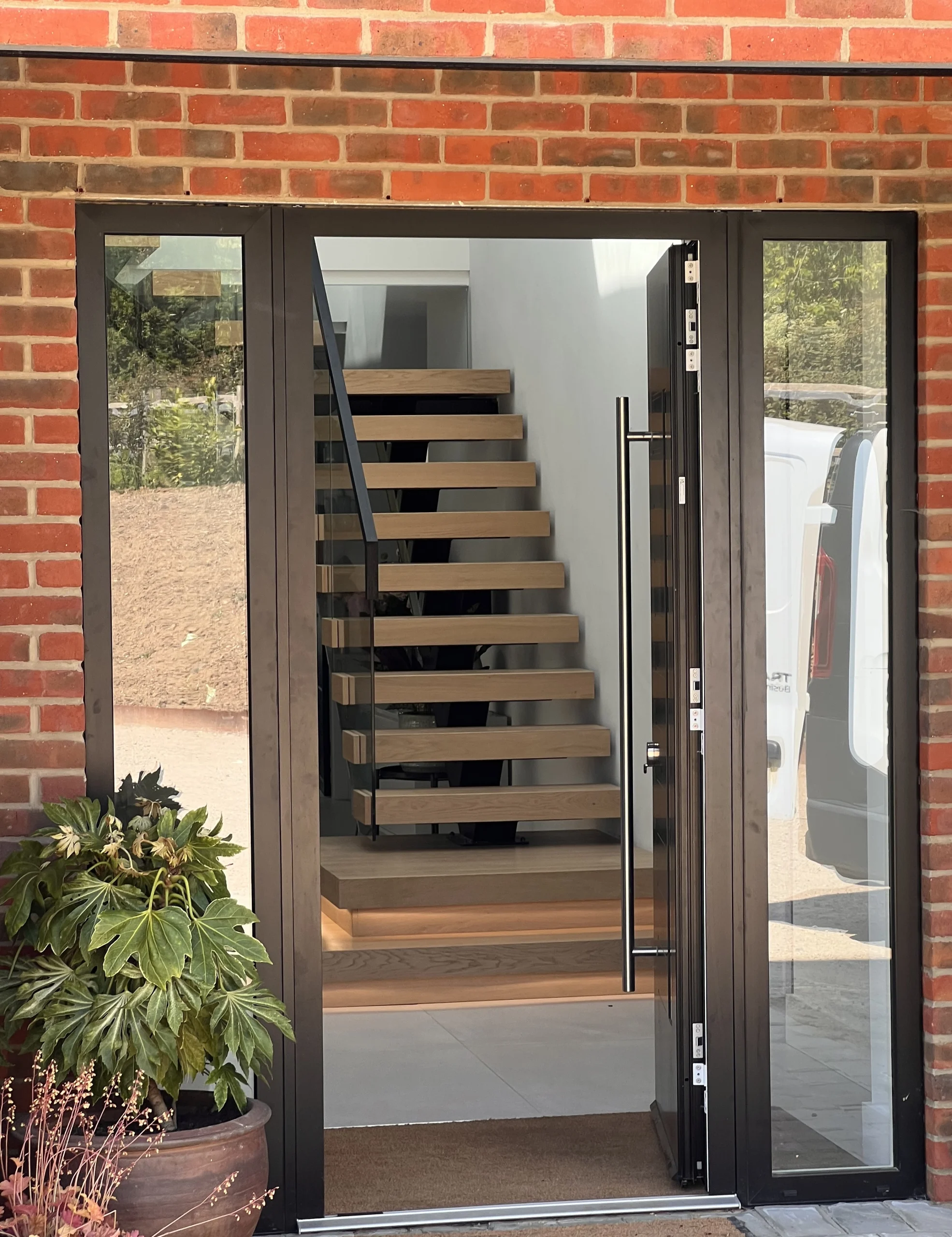
The most common test homeowners apply — "if I can't see any support, it must be true cantilever" — is simply wrong. Both true and faux cantilever have no visible support from the front. That's the entire visual goal of both methods. Don't trust marketing photographs to distinguish them; ask the supplier directly for the construction method documentation.
Tread Thickness Tells Tales
A subtler indicator is tread thickness. Treads in true cantilever staircases tend to be thicker (typically 80-105mm) because they need to integrate the steel reinforcement that extends back to the wall pin. Faux cantilever treads can be thinner (50-80mm typical) because the structural work is done by the hidden stringer behind. Continox standard is 105mm for both methods — which is why our floating staircases achieve a particularly substantial visual effect even though they're faux cantilever construction.
UK Market Reality: Pricing & Availability
True Cantilever Pricing Reality
For UK residential projects requiring true cantilever construction, expect the following cost components on top of standard staircase fabrication:
- Wall preparation — £2,000-£5,000 for pocket cutting, embedment preparation, and any necessary wall reinforcement
- Per-tread structural calculation — £1,500-£3,000 for individual pin engineering across typically 13-18 treads
- Specialist installation — £3,000-£6,000 for skilled installers with masonry experience and chemical anchoring qualifications
- Extended Building Control process — additional £500-£1,500 in inspection fees and engineer attendance
- Project timeline impact — typically 10-16 weeks vs 6-8 weeks for faux cantilever, with associated contractor cost implications
For typical UK residential projects, this means true cantilever total cost of £15,000-£30,000+ compared to faux cantilever total of £8,000-£18,000 — a £7,000-£12,000 gap for the same visual outcome.
Faux Cantilever Pricing (Including Continox)
Faux cantilever pricing varies based on specification level rather than construction method. Three indicative price points across the UK market:
- Mid-market faux cantilever: £8,000-£12,000 — engineered oak treads, 12mm toughened glass, single steel stringer, 1-2 year warranty. Common in UK semi-bespoke market.
- Premium bespoke faux cantilever (Continox): £11,999-£18,000 — solid 105mm European oak treads, 17mm toughened laminated glass, RHS 150×100×5mm S275 hidden stringer, 5-year warranty, EN 1090-1 EXC2 certified. See our UK Staircase Price Bands guide for full market context.
- Designer / architect-led faux cantilever: £18,000-£35,000 — same construction method, premium brand and showroom premium.
Why the Price Gap Exists
The £7,000+ gap between true and faux cantilever isn't a "bespoke vs cheap" gap — it reflects three real cost drivers. Engineering complexity: per-pin calculations + masonry coordination cost £4,500-£8,000 of professional time. Installation skill: chemical anchoring qualified installers + masonry experience cost £40-£60/hour vs standard staircase installers at £25-£35/hour. Project risk: true cantilever installation has zero tolerance for wall surprises, requiring contingency budgets of 10-15%. These costs are real, justified, and not optional for genuine true cantilever projects.
Which Is Right for Your UK Project?
Wall Audit
Is the proposed wall solid masonry 215mm+ at every tread position? If NO → faux cantilever (true is impossible). If YES → continue to step 2.
Aesthetic Purity
Is "structural authenticity" a non-negotiable for your project? Architect-led design with structural exposure → consider true. Visual outcome only → faux is the smart choice.
Budget Reality
Is the £7,000-£12,000 premium for true cantilever justified by your project value? £3M+ properties or signature commissions → yes. Standard residential → faux delivers identical look.
Long-term View
Future renovation flexibility, repairability and damping all favour faux cantilever. True cantilever locks in wall configuration; faux can be removed and reinstalled.
The 95/5 Rule
For approximately 95% of UK residential projects, faux cantilever is the correct engineering choice — based on wall construction, budget reality and aesthetic outcome. For approximately 5% of projects — typically signature architectural commissions on solid masonry walls in £3M+ properties — true cantilever may be justified for architectural purity. Both methods can deliver visually identical, structurally compliant, beautifully crafted staircases.
Common Misconceptions (Myth-Busting)
Myth 1: "Faux cantilever is structurally weaker than true cantilever"
Both can be engineered to identical UK Building Regulations standards (BS EN 1991-1-1 imposed loads, BS EN 1990 safety factors, BS EN 1090-1 EXC2 steel certification). Faux cantilever is often structurally more redundant because the continuous stringer distributes loads, while true cantilever concentrates loads at individual wall pockets.
Myth 2: "True cantilever is always better quality"
Quality depends on engineering and craftsmanship, not construction method. A premium-spec faux cantilever (105mm solid oak, 17mm laminated glass, EN 1090 EXC2 steel, 5-year warranty) is measurably higher quality than a poorly-executed budget true cantilever. Method ≠ quality.
Myth 3: "You can convert a faux cantilever to a true cantilever later"
The two methods are fundamentally different from the wall up. Converting requires removing the entire faux cantilever staircase, structural assessment of the wall, possible wall reinforcement, and complete refabrication. It is essentially a new staircase project.
Myth 4: "If you can see fixing bolts, it's faux cantilever"
True cantilever can show visible aesthetic fixings (decorative bolt heads where the pin enters the wall) for design effect. Faux cantilever can be entirely hidden with no visible fixings. Bolts are not a reliable diagnostic.
Myth 5: "Glass balustrade + floating treads = cantilever staircase"
Glass balustrade and floating treads are aesthetic features that appear in many staircase types — including conventional stringer construction with hidden risers. A true cantilever specifically refers to wall-anchored individual treads. Don't conflate visual style with structural method.
Continox Approach: Honest Engineering at £11,999
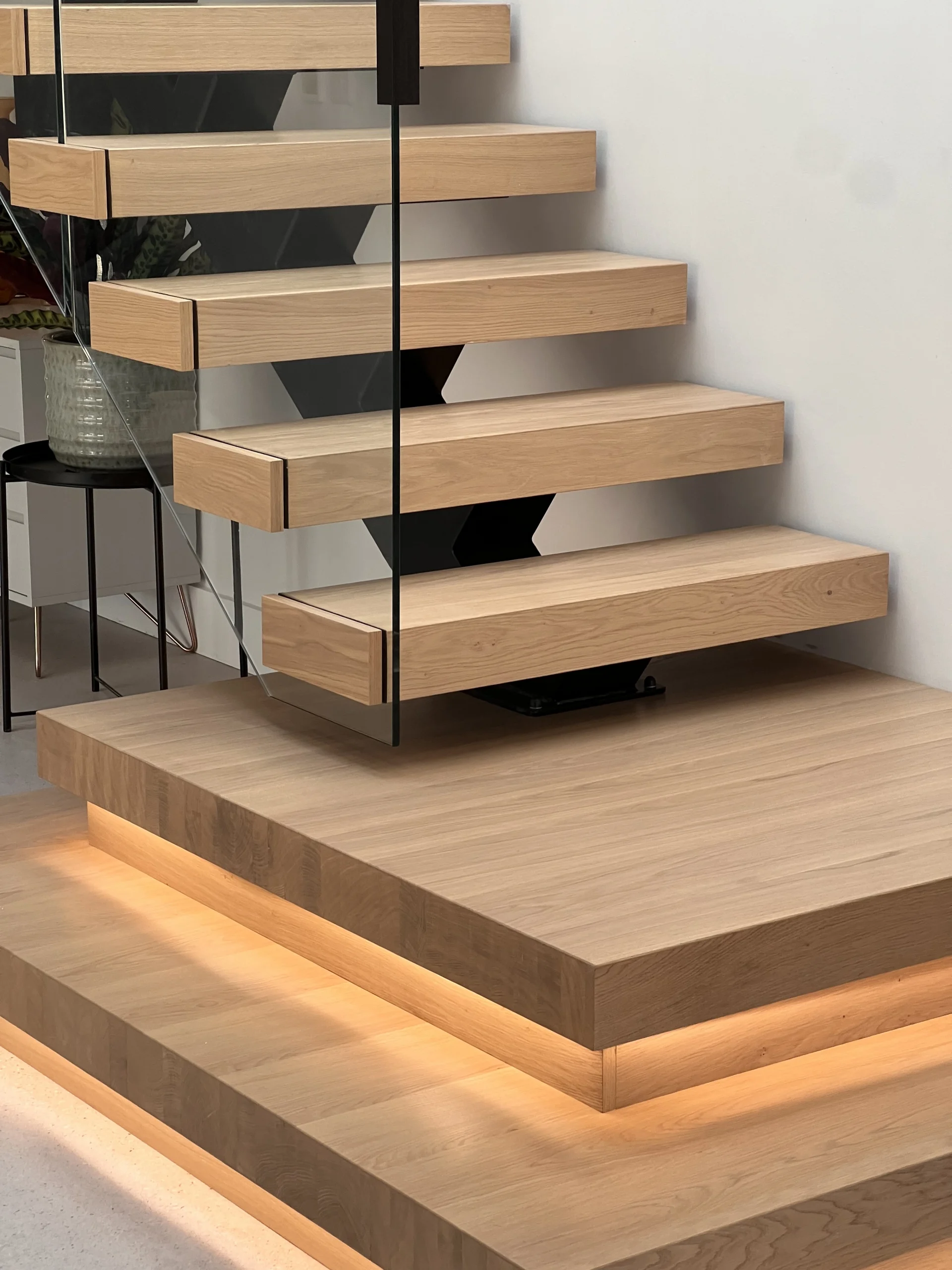
Continox builds floating staircases using wall-side hidden stringer faux cantilever construction. We're transparent about this — the visual cantilever effect is achieved through a concealed RHS 150×100×5mm S275 steel beam plastered into the wall finish, not through individual tread anchoring. The structural certification is BS EN 1090-1 EXC2, the same standard as any true cantilever staircase, and the visual outcome is identical.
We use this method because it works in the broadest range of UK homes (any wall type), delivers the same aesthetic at half the cost of true cantilever, requires standard Building Control documentation rather than per-tread certification, and produces a measurably stiffer staircase under lateral loading. From £11,999 fully installed, we deliver the visual cantilever effect that 95% of UK homeowners want — without the engineering compromises that come with forcing true cantilever onto a building that wasn't designed for it.
People Also Ask
The most common questions UK homeowners and architects ask when researching cantilever staircases — direct answers below, with deeper detail in the FAQ section.
Is faux cantilever as safe as true cantilever?
Yes. Both must comply with BS EN 1991-1-1 imposed loading (1.5 kN/m² + 0.5 kN point), BS EN 1090-1 EXC2 steel certification and UK Building Regulations Part K. Construction method does not determine safety — engineering does.
How can I tell if a "cantilever" staircase is faux?
Three checks: (1) wall thickness at tread level (true requires 215mm+ solid masonry), (2) underside inspection (faux often shows a continuous stringer), (3) ask the supplier for construction method documentation in writing.
Why do faux cantilevers cost less than true cantilevers?
Three real cost drivers: faux requires no wall preparation (saves £2,000-£5,000), no per-tread structural calculation (saves £1,500-£3,000), and uses standard installation skills (saves £3,000-£6,000). Total saving £6,500-£14,000.
Can I have a true cantilever in a 1980s UK house?
Usually not — most 1980s UK housing uses cavity wall construction with insufficient solid masonry depth. Faux cantilever is the standard solution for this housing stock and delivers identical visual results.
Does Continox build true or faux cantilever staircases?
Continox floating staircases are faux cantilever using hidden wall-side steel stringer construction. We're transparent about this — same visual result as true cantilever, lower cost, works in any UK wall type, EN 1090-1 EXC2 certified.
What's the cheapest way to get a cantilever staircase look?
Mid-market faux cantilever from £8,000-£12,000 (engineered oak, 12mm glass). Premium bespoke faux cantilever from Continox at £11,999 (solid oak, 17mm laminated glass, 5-year warranty, fully installed) is the value sweet spot.
Cantilever Staircase FAQ
Detailed answers to the most common technical and commercial questions about true and faux cantilever staircases in the UK market.
Faux cantilever construction with hidden RHS 150×100×5mm S275 steel stringer — visually identical to true cantilever, EN 1090-1 EXC2 certified, fully installed across the UK with 5-year warranty. No gimmicks, no marketing dressing — just transparent engineering at the right price.