

The 2026 UK Staircase Cost Index
A definitive reference to the price of replacing or installing a new staircase in the United Kingdom in 2026 — by type, by material, by region, by lead time. Compiled from real installation data, public price guides, and government material indices.
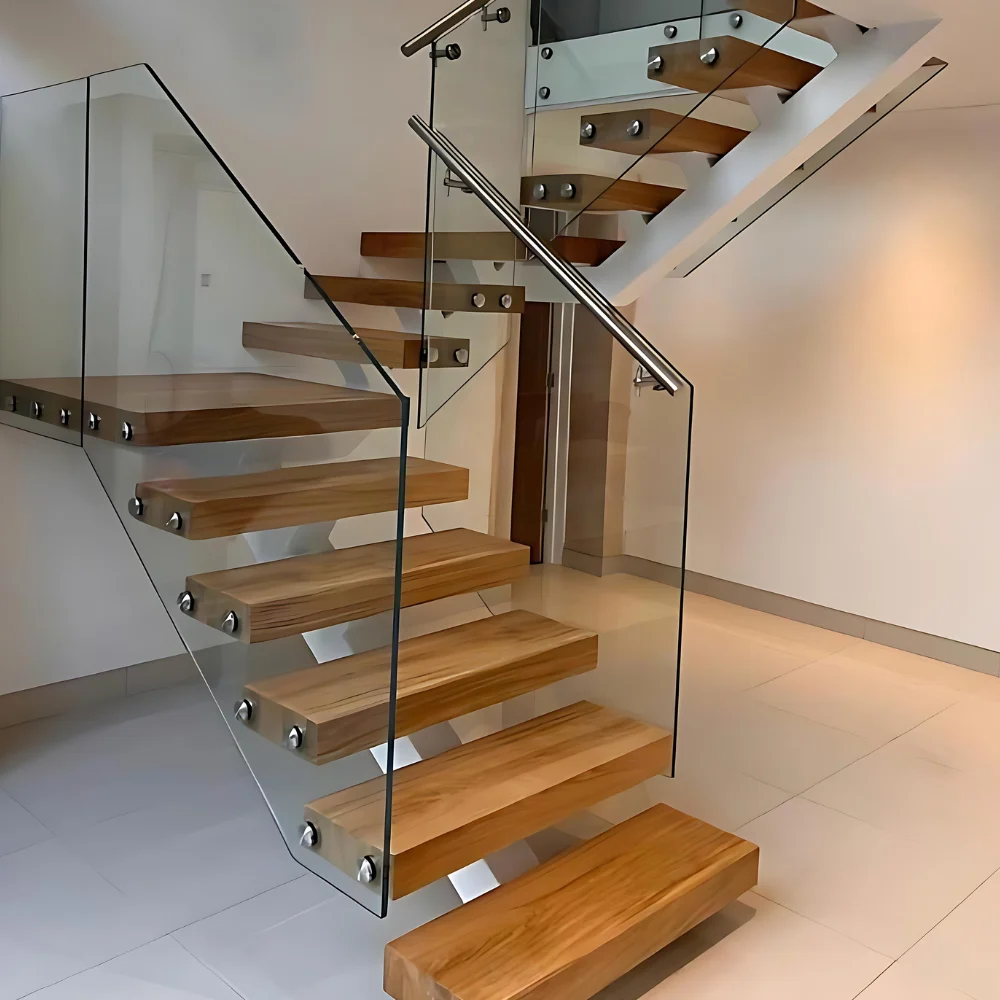


How much does a staircase cost in the UK in 2026? A new or replacement staircase in the UK costs anywhere from £800 to over £80,000 in 2026. The most common bands are £1,200–£3,000 for an off-the-shelf softwood replacement, £9,500–£15,000 for a bespoke modern staircase with steel spine, oak treads and glass balustrade, and £20,000–£80,000 (UK average around £50,000) for a true cantilever floating staircase.
What's driving 2026 prices? UK staircase prices are flat-to-slightly-down in real terms versus 2025 after a turbulent five years. Underlying material indices remain elevated: softwood is +22%, oak +38%, and architectural glass +42% vs 2020. Most analysts expect upward pressure on materials to return as UK construction demand recovers through late 2026 into 2027.
Most "how much does a staircase cost" guides on the UK web give you a single number — usually somewhere between £1,500 and £4,000 — and leave you with the impression that's where most projects land. In reality, that figure describes a very specific type of project: a like-for-like swap of a softwood staircase in a standard two-storey home, fitted by a general carpenter.
The moment any of those assumptions changes, so does the price. This index is structured to let you build a realistic budget for your project, by stacking the relevant factors: type + material + balustrade + region + hidden costs. Each section gives you the 2026 cost range plus the sources behind it, so you can defend the figure when you're talking to a builder, an architect, or a partner.
Headline Numbers · 2026
Softwood Straight Staircase, Supplied & Fitted
Made-to-Measure Hardwood Replacement
Bespoke Modern (Steel Spine + Oak + Glass)
True Cantilever / Floating Staircase
Helical or Curved Architectural Staircase
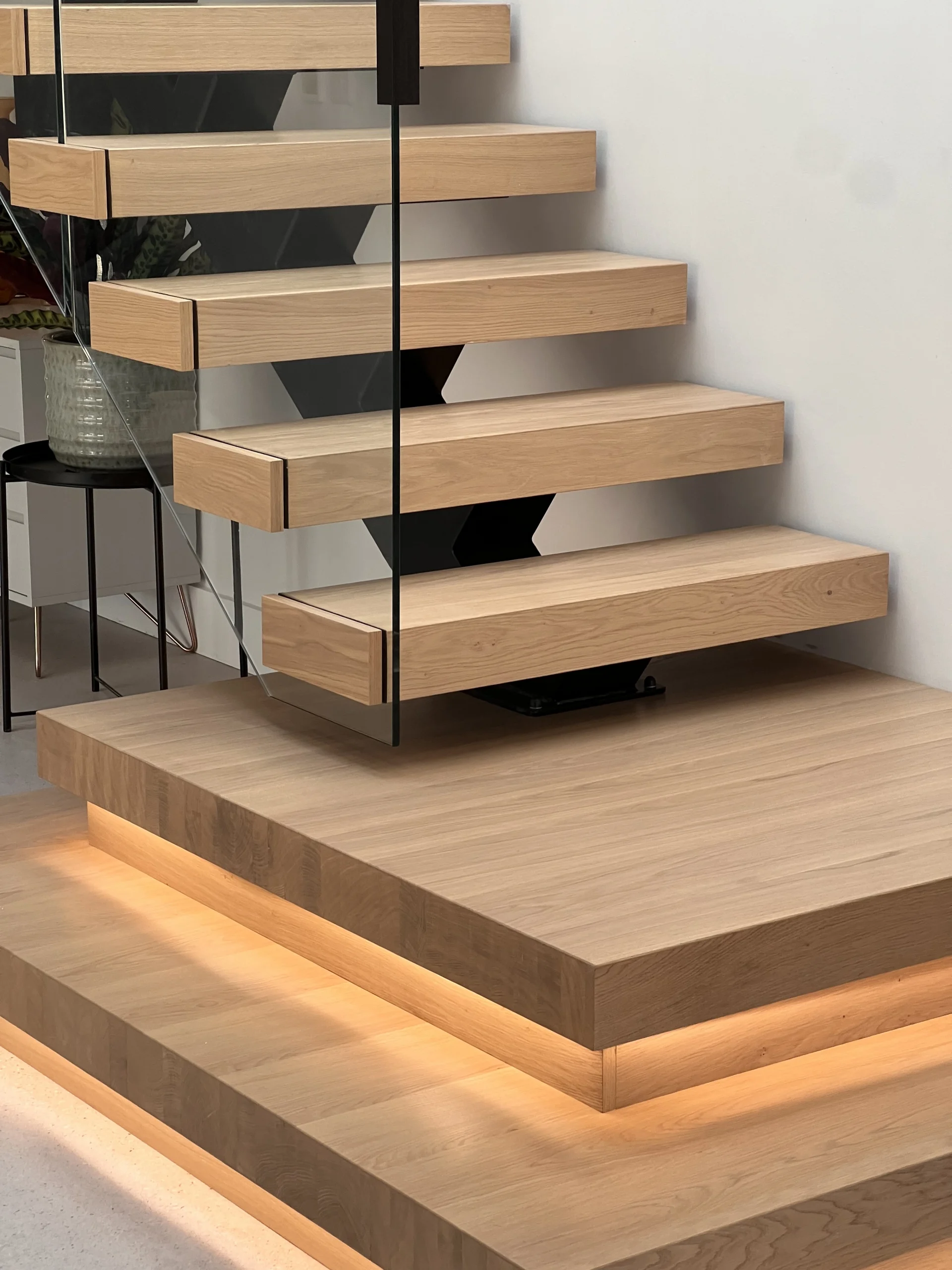
Central-Spine Staircase — Modern Open-Tread
The Six Factors That Move UK Staircase Prices
Every UK staircase quote in 2026 is the sum of decisions across six variables. The type decision usually doubles or triples the headline figure, the material decision adds a premium on top, and region scales the labour portion of the bill.
Type
Straight (cheapest) → Helical / curved (most expensive).
5–20× impactConstruction
DIY softwood kit → Bespoke steel-spine fabrication.
8–15× impactMaterial
Pine → Walnut, stone, specialist hardwood.
3–8× impactBalustrade
Timber spindles → Frameless toughened glass.
2–4× impactFloor Height
13 risers (standard) → 16+ risers (tall ceilings).
1.2–1.5× impactRegion
North England / Scotland → Central London.
1.2–1.5× labourCost by Staircase Type
Straight Staircase
The default in UK semis, terraces, and most new builds. A single uninterrupted flight from one floor to the next, usually with 12–14 treads. Easiest to design, easiest to fit, cheapest to buy.
- Supply only (softwood): £400–£1,500
- Supply only (hardwood): £800–£4,000
- Floor space needed: ~3.5–4m linear
- Sources: MyBuilder / Checkatrade 2026
L-Shape (Quarter-Turn) Staircase
A staircase with a 90° turn, usually with a quarter-landing or three winder treads. Common in Victorian and Edwardian terraces where a straight flight won't fit the hallway depth.
- Standard supply & fit: £2,000–£5,500
- Bespoke supply & fit: £6,500–£12,000
- Floor space needed: ~2.5–3m depth
- More components, more cuts, more set-out
U-Shape (Half-Turn) Staircase
Two flights connected by a half-landing, going back on themselves. Used in tall hallways and townhouses where a straight or L-shape won't deliver the headroom. Takes 3–4 days to install vs 2 days for a straight flight.
- Standard supply & fit: £3,500–£8,000
- Bespoke supply & fit: £8,500–£18,000
- Best for floor-to-floor over 4m
- Half-landing simplifies headroom
Winder Staircase
A staircase that uses angled (winder) treads instead of a landing to negotiate a turn. Frequently used in loft conversions and tight Victorian terraces because it saves significant floor area.
- Supply & fit (2026): £2,500–£5,500
- Watch out for Part K winder rules
- Min tread width at narrow end critical
- Building Control fee ~£200
Spiral Staircase
A compact, vertically-stacked design with treads winding around a central column. The most space-efficient layout — fits inside a 1.4m diameter footprint. Most modern spirals are installed as secondary or loft-access stairs.
- Wooden spiral: £2,500–£15,000
- Metal spiral: £4,000–£17,500
- 1.4m diameter possible
- Compliance at inspector's discretion
Helical (Curved) Staircase
A spiral's elegant cousin — a continuous curve without a central column. Almost always bespoke, almost always a feature piece in the property's main hallway. Helical stairs push the upper end of the floating-staircase price scale.
- Supply & fit (2026): £25,000–£150,000+
- Lead time: 12–20 weeks
- CNC fabrication required
- Site templating typically needed
Floating (Cantilever) Staircase
The defining modern UK staircase trend of the last decade — treads that appear to project from the wall with no visible support. True cantilever requires reinforced wall and structural calculations; "faux cantilever" uses hidden internal central spine.
- True cantilever: £20,000–£80,000
- UK average: ~£50,000
- Central-spine "floating-look": £9,500–£15,000
- Structural engineer mandatory
Bespoke Designer / Architectural
Custom one-off pieces — sculptural, mixed-material, or integrated into a feature wall. Typically delivered by specialist studios working alongside the architect on flagship residential or commercial projects.
- Supply & fit (2026): £30,000–£250,000+
- Lead time: 16–28 weeks
- Architect-led design process
- Often listed buildings or new-builds

Cost by Material
| Material | 2026 Supply Price (Straight Flight) | Notes |
|---|---|---|
| Pine (softwood) | £400–£900 | Standard kit material; carpets or paints well; least durable |
| Engineered softwood + hardwood treads | £700–£1,400 | Common compromise — softwood string and risers, hardwood treads |
| European oak | £1,200–£3,500 | UK's default mid-premium hardwood; durable, classic, widely available |
| American black walnut | £2,800–£6,000 | Premium dark hardwood, often used as treads with painted strings |
| Ash, beech, maple | £1,400–£2,800 | Mid-range hardwoods, often specified for contemporary projects |
| Powder-coated steel | £2,500–£9,500 | Industrial / contemporary aesthetic; precise fabrication required |
| Glass treads (toughened laminated) | £600–£1,200/tread | Significant structural specification needed; per tread basis |
| Concrete (precast or in-situ) | £8,000–£25,000+ | Common in commercial and high-end residential; long lead times |
| Stone (limestone, marble) | £15,000–£60,000+ | Reserved for high-end and heritage projects |
Cost by Balustrade Specification
| Specification | 2026 Price/m (Supply & Fit) | Compliance Reference |
|---|---|---|
| Timber spindles (pine) | £120–£200 | BS 6180:2011 — 0.36 kN/m residential |
| Timber spindles (oak) | £180–£320 | BS 6180:2011 |
| Metal spindles (powder-coated) | £180–£360 | BS 6180:2011 |
| Stainless steel cable / wire | £220–£420 | Bar restrictions for child safety |
| Toughened glass + handrail (post-fixed) | £320–£550 | BS 6180 + BS EN 12600 (impact) |
| Frameless toughened laminated glass | £450–£850 | BS 6180 + BS EN 14449 |
| Channel-fixed structural glass (commercial) | £600–£1,200 | BS 6180 + structural calc to BS EN 1991-1-1 |
Why Glass Balustrade Is Now Standard in UK Premium Projects
Across mid-to-high-end UK staircase installations in 2026, glass balustrade is now specified more often than spindles. The drivers: visual openness (glass keeps light moving through the stairwell — critical in narrower UK hallways), compliance simplicity (a properly specified glass system meets all relevant UK codes in a single component), and property value (estate agents consistently report better marketing photography on staircases with glass).
The trade-off is cost: a frameless toughened glass system on a typical domestic staircase adds £2,000–£4,000 versus an oak-spindle balustrade. For technical specification details see our glass balustrade range.
The 2020–2026 UK Staircase Materials Index
Material Costs · 2020 = 100 · May 2026 Reading
Compiled from Forest Research, TDUK Structural Timber Price Index, IBISWorld, BCSA, and UK Steel data, weighted to staircase manufacturing.
Vertical line at 50% of bar = 2020 baseline (index 100). Bars beyond baseline show nominal price increase to May 2026.
Structural Softwood — The Most Volatile Input
UK structural softwood has had what Timber Development UK described as "five of the most volatile years in recent history." The TDUK Structural Timber Price Index ran from 100 in early 2020, spiked to around 130 during the post-Covid construction frenzy of 2021–2022, retreated to a low of 98 in January 2024, recovered to 107 by year-end 2024, and surged to 130 by mid-2025 before settling at 125 by Q3 2025.
Government data confirms the picture: the Softwood Sawlog Price Index was 32.7% higher in real terms in the six months to March 2025 versus the same period a year earlier, with the spruce sub-index up 40.4%. By September 2025, average prices had eased to £59.70 per cubic metre overbark — down from £77.55 six months earlier.
Architectural Glass — The Largest Movement
Glass costs have risen most consistently of any staircase material since 2020, driven by energy input costs at float-glass manufacturing plants and by tightened post-Brexit conformity requirements. The combined toughened-and-laminated specification used in modern frameless balustrades has been particularly affected — the underlying float-glass cost has roughly doubled the share of total system cost it occupied in 2020.
What This Means for Buyers in 2026
Two things stand out from the six-year picture: (1) Materials cost more than they did in 2020 — across the board, expect to pay 20–40% more for the input materials than a homeowner would have paid for an equivalent staircase six years ago. (2) The relative stability is misleading — underlying log prices across Scandinavia, the Baltics, and Central Europe remain elevated even where finished-goods pricing has softened. Sawmill capacity has been removed from the European system through 2024–2025; when UK construction demand recovers, expect a rapid bounce-back in prices.
Regional Cost Variation Across the UK
| Region | Adjustment vs UK Average | Why |
|---|---|---|
| Central London (Zones 1–2) | +18% to +28% | Highest day rates; access constraints; ULEZ; concierge access |
| Outer London & M25 belt | +12% to +18% | London labour rates with easier access |
| South-East (Surrey, Hants, Kent, Sussex) | 0% to +6% | UK baseline · Continox home region |
| South-West (Somerset, Devon, Dorset) | -2% to +2% | Roughly baseline |
| East of England (Essex, Cambs) | 0% to +4% | Roughly baseline |
| East Midlands | -3% to -7% | Lower trade rates; quicker access |
| West Midlands (Birmingham) | -3% to -7% | Lower trade rates |
| Yorkshire & Humber | -5% to -10% | Notably lower labour rates |
| North-West (Manchester, Liverpool) | -4% to -8% | Lower labour, rising in central Manchester |
| North-East | -7% to -12% | The lowest labour rates in England |
| Scotland (Central Belt) | -5% to -10% | Comparable to North England |
| Scotland (Highlands & Islands) | -2% to +8% | Lower labour, but transport adds cost |
| Wales | -5% to -10% | Lower labour; logistics premium for North Wales |
| Northern Ireland | -5% to -8% | Lower labour, additional shipping for GB-sourced materials |
London-Specific Cost Factors
Working in central London adds three things that don't appear in headline quotes: parking and Congestion / ULEZ (£15–£25/day per vehicle for the duration of the project), access surveys for tower blocks, mansion blocks, and listed buildings (£200–£600), and out-of-hours installation where building management requires installation outside business hours (25–40% premium on labour).
Lead Times in 2026
| Construction Route | Typical Lead Time (2026) | Bottleneck |
|---|---|---|
| Off-the-shelf softwood kit + carpenter | 1–2 weeks | Stock-held by UK merchants; depends on installer availability |
| Standard hardwood made-to-measure | 4–6 weeks | Joinery shop, not the installer |
| Modern central-spine (steel + oak + glass) | 6–10 weeks | Includes design, structural validation, fabrication |
| True cantilever with structural calcs | 10–16 weeks | Structural engineer adds 3–5 weeks at the start |
| Helical / sculptural feature | 14–24 weeks | CNC programming, prototype tread, on-site templating |
| Concrete staircase (precast) | 12–20 weeks | Mould creation, cast, cure, finish, transport |
| Stone staircase | 16–32 weeks | Stone selection, slab cutting, dry-fitting, finishing |
The Hidden Costs Most UK Homeowners Forget
Removal & Disposal of Existing Staircase
A general builder will remove and dispose of an existing staircase in a single day. Higher end for hardwood treads or concrete; includes skip hire.
£250–£800Building Control Fees
A new staircase or material alteration requires Building Control approval. Failure to gain approval can affect future property sales. Most UK local authorities charge in this band.
£175–£250Structural Engineer (Where Required)
Required for: loft conversions; cantilever staircases; any project that involves cutting joists or relocating the staircase. Signed calculations for Building Control.
£300–£1,000Making Good the Surrounding Decoration
Replacing a staircase almost always damages surrounding plaster, paint, and floor finishes. Reinstating the wall-line and flooring around the new staircase.
£400–£900Floor Protection & Access
For an occupied home, the installer expects access at agreed times plus floor protection. Reputable bespoke installers include this in the quote; most kit installers do not.
£150–£400Carpet, Runner, or Finish
A new staircase frequently triggers a refit of the carpet or floor runner above and below. Premium wool runners run to £900+. Stair carpet alone in this band.
£150–£900LED Lighting Upgrades
Modern open-tread staircases are typically specified with integrated LED. Factory-routed LED solution at the lower end; separately installed by electrician higher.
£600–£2,400Total Realistic Addition
For a typical mid-market UK staircase replacement project. For high-end projects, hidden costs scale with complexity and can reach 15–20% of the headline price.
£1,200–£3,500DIY Kit vs Off-the-Shelf vs Bespoke
DIY Kit
Standard rises and goings; generic finish quality; often non-compliant with current Part K when retrofitted into older houses.
- Rental properties
- Short-hold owners (under 5 years)
- Basement / loft secondary stairs
- Holiday lets
- Strict budget projects
Off-the-Shelf Made-to-Measure
Conventional patterns; bespoke balustrade and feature options limited; typically softwood-stringer with hardwood-tread upgrades.
- Typical UK family homes
- Like-for-like replacements
- Functional but not focal point
- Mid-market sale-prep projects
- 3–4 week lead time
Bespoke (Continox)
Steel-spine fabrication; full design control; structural calculations; EN 1090-1 EXC2 manufacture; 5-year warranty.
- Visual centrepiece of entrance hall
- Properties at upper-end of local market
- Failing Part K compliance
- Coordinated with kitchen / hallway design
- 6–8 week lead time
The cleanest test: if your staircase will be in the photograph estate agents use to market the house, it deserves bespoke. If it won't, off-the-shelf is fine.
Cost vs Property Value: What Does a Staircase Add?
UK estate agents and surveyors consistently rank the staircase among the top three "first impression" features of a property — alongside the kitchen and the front door. The Royal Institution of Chartered Surveyors does not publish formal property-uplift figures for staircase replacements, but several patterns are well-established in UK valuation literature.
Replacement of a Tired or Non-Compliant Staircase
Replacing a worn, dated, or non-compliant staircase with a like-for-like modern equivalent typically returns close to its installation cost in property value — particularly when sold within 3 years. The staircase itself doesn't add a premium, but its absence (a creaky, dated, or visibly damaged staircase) can subtract £5,000–£15,000 from a typical UK home's perceived value through buyer hesitation.
Upgrade to a Feature Staircase
In the £600,000+ UK property bracket, a well-executed feature staircase (typically modern, with glass balustrade and either oak or hardwood treads) consistently improves marketing photography, sale time, and final selling price. Anecdotal data from London and South-East estate agents in 2025–2026 suggests a 1–2% selling premium on properties with feature staircases — equivalent to £6,000–£15,000 on a £700,000 home.
When the Staircase Doesn't Pay Back
Highly bespoke, sculptural, or extreme-spec staircases (true cantilever, helical, stone) rarely return their full cost in resale value. They appeal to a narrow slice of buyers and may even narrow the buyer pool. Owners who install £40,000+ feature staircases should expect to enjoy the staircase rather than amortise it.
Forecast: Where UK Staircase Prices Go in 2027
Softwood
Most likely flat to slightly up through Q3 2026, with sharper pressure if construction demand recovers. Medium-term picture is set by reduced European sawmill capacity, slow to reactivate.
Hardwood (Oak, Walnut)
Steady upward pressure through 2026–2027. UK demand has held up better than softwood, and supply chains have less spare capacity to absorb increases.
Steel
Energy-input-driven. Expect 3–6% upward pressure if energy markets normalise; sharper movements if they don't. UK fabricators particularly exposed.
Architectural Glass
Continues to rise faster than other materials, driven by energy costs at float plants and tightened post-Brexit specification requirements. Expect another 4–7%.
Labour
UK construction labour rates rose 5–8% in 2024 and 4–6% in 2025. Apprenticeship numbers below replacement. Expect labour to continue rising at 4–6% per year through 2027.
Compliance & Regulation
2026–2027 regulatory pipeline contains no expected changes that would materially move staircase costs. EN 1090-1 EXC2 certification has become de facto requirement for any structural-steel staircase.
Methodology & Data Sources
This index is compiled from four data streams:
- Public UK price guides. Cross-referenced across Checkatrade, MyBuilder, MyJobQuote, BookABuilderUK, GreenMatch, and HomeHow. We disregard outlier prices (top and bottom 5%) and report the central range.
- Continox installation data. Internal data from real Continox quotes and installations across the South-East and London regions in 2024–2026 — granular pricing on materials, fabrication, and installation labour for the bespoke central-spine and floating staircase categories.
- UK government and trade body indices. Material cost trends are anchored to public data from Forest Research's Timber Price Indices, Timber Development UK's Structural Timber Price Index, and IBISWorld's UK timber price index. Steel pricing is anchored to UK Steel and BCSA data.
- Regional variation analysis. Calculated from average tradesperson day rates published by Federation of Master Builders, NICEIC, and CIPHE, weighted by typical staircase project labour content.
Limitations. This index reports price ranges, not single-point estimates, because UK staircase pricing has a genuinely wide distribution within each category. The index does not cover commercial, public-sector, or hospitality staircase installations. Updated twice a year — May and November. Figures published valid as of May 2026.
Citable Statistics · Free to Use With Attribution
For journalists, bloggers, and researchers writing about UK home improvement costs in 2026. All figures from this index are free to cite with attribution to The 2026 UK Staircase Cost Index, Continox. Methodology and underlying data available on request.
Headline Figures
- A new or replacement staircase in the UK costs between £800 and £80,000+ in 2026, depending on type, material, and region
- The UK average for a like-for-like staircase replacement in 2026 is £1,500–£4,000
- A bespoke modern staircase (steel spine, oak treads, glass balustrade) typically costs £9,500–£15,000 supply-and-install in 2026
- A true cantilever floating staircase in the UK averages around £50,000, with a range of £20,000–£80,000
Materials Cost Movements, 2020–2026
- UK structural softwood prices in May 2026 are 22% above 2020 levels
- European oak prices in May 2026 are 38% above 2020 levels
- Architectural glass prices in May 2026 are 42% above 2020 levels — the largest movement of any staircase material
- The UK Structural Timber Price Index spiked from 100 (2020) to a peak of 130 in mid-2025 before settling at 125 by Q3 2025
Regional Variation
- Installing a staircase in central London costs 18–28% more than the UK national average
- Installing in the North-East of England costs 7–12% less than the national average
- Materials cost the same across the UK; the variable is labour, trade overheads, and access
Lead Times
- An off-the-shelf softwood staircase can be supplied and fitted in 1–2 weeks
- A bespoke modern staircase has a 6–10 week lead time in 2026
- A true cantilever with structural calculations has a 10–16 week lead time
- Lead times in 2026 are notably shorter than 2022–2023 peaks
Hidden Costs & Compliance
- Hidden costs typically add £1,200–£3,500 to a UK mid-market staircase replacement project
- Building Control inspection in the UK costs around £175–£250 for a staircase
- Structural engineer fees range £300–£1,000 for residential staircase calculations
Construction Trends
- Glass balustrades are now specified more often than spindles in UK mid-to-high-end staircase projects in 2026
- A frameless toughened glass balustrade adds £2,000–£4,000 to a typical UK domestic staircase versus oak spindles
People Also Ask
How much does a new staircase cost in the UK in 2026?
A standard staircase replacement in the UK in 2026 costs £1,500 to £4,000 supply-and-install. A bespoke modern staircase costs £9,500 to £15,000. A true cantilever floating staircase costs £20,000 to £80,000 with an average around £50,000.
Is it cheaper to repair or replace a staircase?
If structurally sound and failing only minor compliance points, repair (handrail, balustrade, treads) costs £600–£2,500 versus full replacement at £1,500–£4,000+. Repair is rarely the right call when the structure itself is failing or non-compliant.
Why are floating staircases so much more expensive than they look?
A true cantilever requires significant structural reinforcement of the wall — typically a steel-reinforced concrete blockwork wall designed by a structural engineer. The visible "floating" treads are the cheapest part; the hidden engineering is the expensive part.
What does a glass balustrade add to a staircase cost?
Frameless toughened glass in 2026 costs £450–£850/m supply-and-fit, versus £180–£320/m for oak spindles. On a typical 4m balustrade run, that's £1,000–£2,500 over the spindle alternative.
Will a new staircase add value to my UK home?
Like-for-like replacement of a tired staircase typically returns close to installation cost within 3 years. A feature staircase in a £600,000+ home can return a 1–2% selling premium — equivalent to £6,000–£15,000 on a typical home in this bracket.
What's the cheapest legitimate way to get a modern-look staircase?
A central-spine "floating-look" staircase (steel spine, oak treads, glass balustrade) from £10,999 supply and install in 2026 delivers the modern open-tread aesthetic at a fraction of true-cantilever pricing — without the structural reinforcement requirements.
UK Staircase Cost — FAQ
Common questions from UK homeowners researching staircase costs in 2026 — direct answers below.
Use the figures from this index to build your budget — then let us turn it into a fixed-price quote. Free on-site survey, photorealistic 3D visuals of your exact staircase, and a fixed-price quotation within 24 hours. Bespoke modern staircases from £10,999 fitted across the UK.