

Swiss Building Code & SIA Standards for Staircases — The Complete Regulatory Framework
A practical guide for Swiss architects and Bauingenieure to the regulatory framework governing modern staircase design — federal SIA standards, cantonal Bauordnung, dimensional requirements, fall protection, accessibility and how Continox documentation maps to the Baubehörde dossier.
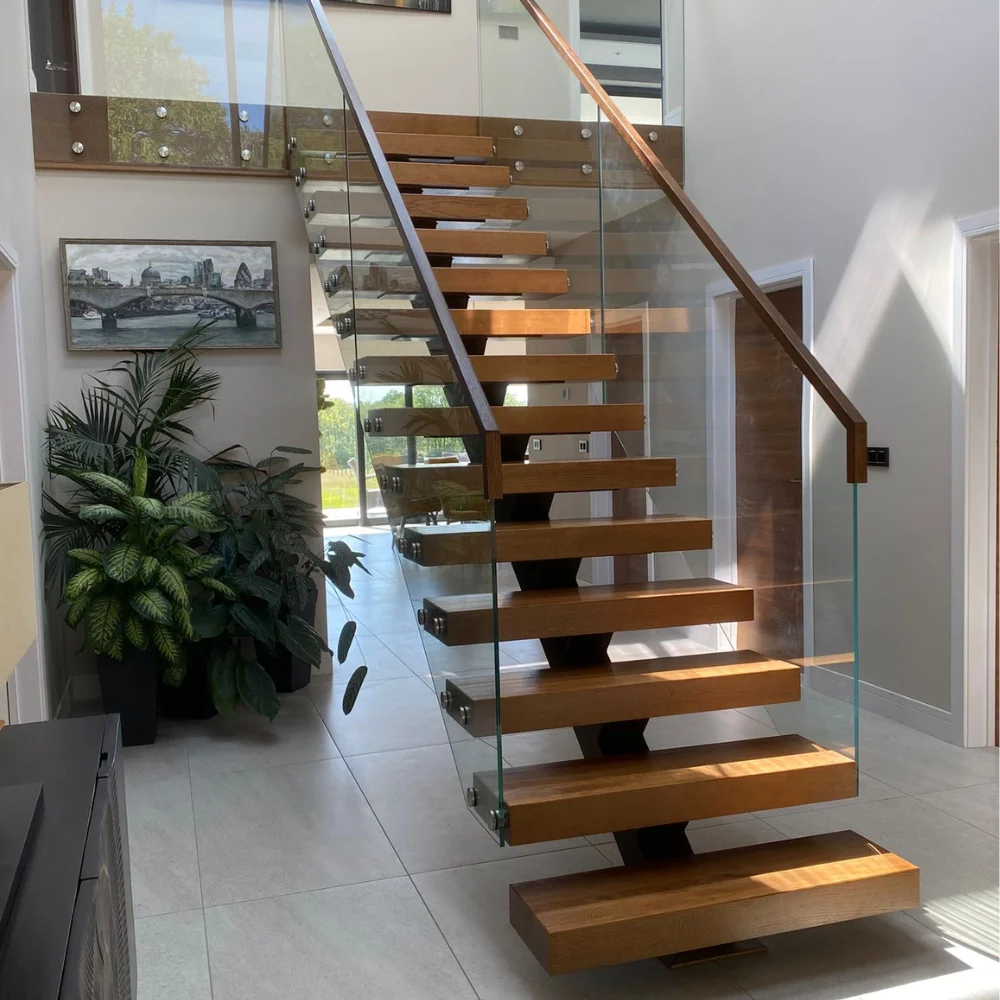
SIA 358-compliant central spine staircase with frameless glass balustrade — minimum 1.0 m guard height, tempered laminated glass infill, designed to the Swiss federal framework supplemented by cantonal Bauordnung.
Switzerland's regulatory framework for staircase design operates on two levels: federal SIA standards issued by the Schweizerischer Ingenieur- und Architektenverein (Swiss Society of Engineers and Architects) and cantonal Bauordnung (building regulations) administered by each of the 26 cantons. The federal SIA framework is technically authoritative — a staircase that complies with SIA 358, SIA 500 and Eurocode-aligned structural calculations will satisfy the technical core of any cantonal Baubehörde review. The cantonal layer adds local procedural requirements (Baugesuch dossier format, neighbour notification, heritage zone rules) but rarely modifies the technical specification itself.
This guide is the practical regulatory framework for Continox Switzerland projects — covering the SIA standards every staircase must meet, the cantonal Bauordnung overlay, dimensional requirements (rise, going, headroom, guard height), structural loading, glass balustrade specification and how Continox documentation maps to the typical Baubehörde dossier. We supply floating cantilever, central spine and fully bespoke configurations alongside glass balustrades, balcony railings and external staircases across all 26 Swiss cantons.
Swiss staircase regulation centres on SIA 358 (Geländer und Brüstungen — guards and balustrades, minimum 1.0 m height for fall protection above 1.0 m drop), SIA 500 (Hindernisfreie Bauten — barrier-free design, accessibility), SIA 260/261 (basis of structural design and actions, aligned with Eurocode), and SIA 118 (general conditions for construction works, contract framework). On top of the federal SIA layer, each canton's Bauordnung applies — adding local procedural rules but rarely modifying the technical specification. The step formula 2R + T = 600–630 mm applies (same Blondel-style as France/Germany). Maximum riser 20 cm for residential, 17 cm for accessible / public access. Minimum tread 24 cm.
- The Two-Level Framework — Federal SIA + Cantonal Bauordnung
- SIA 358 — Balustrades, Guards & Fall Protection
- SIA 500 — Barrier-Free Design & Accessibility
- SIA 260/261 — Structural Design & Actions
- Dimensional Requirements — Rise, Going, Headroom
- Cantonal Bauordnung — What Adds on Top
- Continox Documentation Pack for Swiss Projects
- Frequently Asked Questions
The Two-Level Framework — Federal SIA + Cantonal Bauordnung
Three things distinguish Swiss staircase regulation from the rest of Europe:
Federal SIA Standards Are Technically Authoritative
The Schweizerischer Ingenieur- und Architektenverein (SIA) publishes the technical norm framework applied throughout Switzerland. The four standards most relevant to staircase design are: SIA 358 (Geländer und Brüstungen), SIA 500 (Hindernisfreie Bauten), SIA 260 (Grundlagen der Projektierung — basis of design), and SIA 261 (Einwirkungen auf Tragwerke — actions on structures). Together these form the technical core that every cantonal Baubehörde reviews against.
26 Cantonal Bauordnung Adds Procedural Layer
Each Swiss canton — Zürich, Genève, Bern, Basel-Stadt, Vaud, Ticino, Graubünden and 19 others — administers its own Bauordnung (building regulations) and Baugesuch (planning permission) procedure. The cantonal layer typically affects: dossier format and submission process, neighbour notification rules (Anrainerinformation), heritage zone restrictions (Ortsbildschutz), façade modifications, and accessibility verification. The technical specification of the staircase itself is governed by the federal SIA framework — cantons rarely override SIA technical requirements.
Eurocode Compatible Throughout
Swiss SIA structural standards (SIA 260, 261, 263, 264) are aligned with the European Eurocode framework. SIA 261 actions on structures parallels Eurocode 1 (EN 1991); SIA 263 steel structures parallels Eurocode 3 (EN 1993). For Continox, this means our standard EN 1090-1 EXC2 + Eurocode structural calculation pack is directly compatible with SIA documentation requirements — a Swiss-aligned cross-reference schedule is supplied alongside.
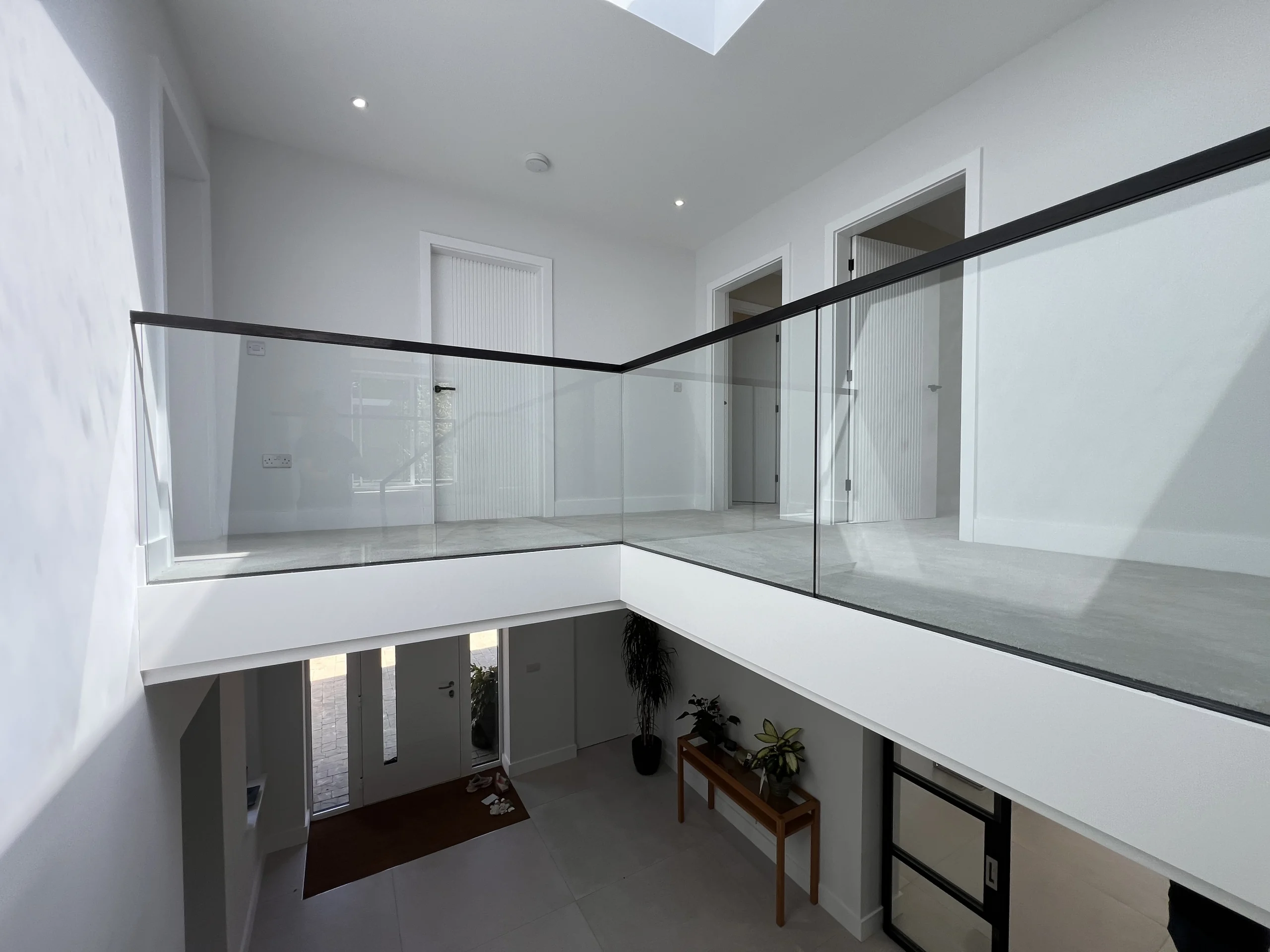
SIA 358-compliant glass balustrade at 1.0 m guard height — the standard fall-protection specification for residential landings and balconies above the 1.0 m fall threshold per the Swiss federal framework.
SIA 358 — Balustrades, Guards & Fall Protection
SIA 358 (Geländer und Brüstungen) is the dimensional and loading standard for guards, balustrades and parapets in all Swiss buildings. It defines minimum heights, opening sizes, infill rules and applied loads.
| Parameter | Residential (private) | Commercial / public access | SIA 358 reference |
|---|---|---|---|
| Fall threshold (when guard required) | Drop > 1.0 m | Drop > 1.0 m | SIA 358 §1 |
| Guard height — staircase flight | 0.90 m from nosing line | 0.90 m from nosing line | SIA 358 §3.1 |
| Guard height — landing & balcony | 1.00 m | 1.00 m (1.10 m if drop > 12 m) | SIA 358 §3.1 |
| Horizontal load (handrail level) | 0.8 kN/m | 1.0 kN/m (or higher for crowded spaces) | SIA 261 §8.4 |
| Maximum opening (where children present) | 120 mm sphere passage rule | 120 mm sphere passage rule | SIA 358 §3.2 |
| Climbable elements (0–60 cm zone) | Prohibited if children present | Prohibited if children present | SIA 358 §3.2 |
| Glass infill — minimum spec | Tempered laminated, EN 14449 + EN 12150, impact 1B1 | As residential, plus heat-soak recommended | SIA 358 + SIA 358/1 |
Swiss SIA 358 specifies 1.0 m guard height for landings (vs France 1.0 m, Germany 0.90–1.10 m depending on use). The 0.90 m guard height applies only along the staircase flight measured from the nosing line. The fall-threshold trigger is also slightly different from neighbouring countries — fall protection is required for any drop exceeding 1.0 m (regardless of building type), versus the typical European 0.6–1.0 m thresholds.
SIA 500 — Barrier-Free Design & Accessibility
SIA 500 (Hindernisfreie Bauten) is the Swiss barrier-free design and accessibility standard — Switzerland's equivalent to UK Part M, French PMR or German DIN 18040. It applies to public buildings, multi-family residential common areas, workplace stairs and any project receiving public funding.
| Requirement | SIA 500 specification | Application |
|---|---|---|
| Maximum riser (accessible flight) | 17 cm | Multi-family common stairs, public buildings, workplaces |
| Minimum tread (accessible flight) | 28 cm | As above |
| Step formula (accessible) | 2R + T = 620–640 mm | Tighter range than residential 600–630 mm |
| Handrails — both sides | Mandatory if width > 100 cm | Always for SIA 500 accessible flights |
| Handrail height | 0.85–0.90 m above nosing line | Both sides, continuous through landings |
| Handrail extension | 0.30 m horizontal extension at top & bottom | Tactile cue for visually impaired users |
| Tactile warning strip | Required at top of accessible flight | Visual + tactile contrast nosing |
| Nosing contrast | Visual contrast on each tread leading edge | Aids partially-sighted users |
SIA 500 is mandatory for: public buildings, ERP-equivalent commercial spaces, multi-family residential common areas (treppenhaus), workplace stairs, and any project receiving public funding. SIA 500 is not required for private residential staircases inside individual apartments or single-family homes — though many architects voluntarily apply the standard for future-proofing aging-in-place. For Continox projects, we confirm at quotation stage whether SIA 500 applies and supply the relevant compliance schedule.
SIA 260/261 — Structural Design & Actions
The structural design framework for Swiss staircases follows the SIA 260 series, which is aligned with the European Eurocode framework. The specific standards for staircase work:
Continox Swiss Project — Standard Structural Spec
- SIA 260 — Grundlagen der Projektierung: basis of design — parallels Eurocode 0 (EN 1990); load combinations, partial factors, design philosophy
- SIA 261 — Einwirkungen auf Tragwerke: actions on structures — parallels Eurocode 1 (EN 1991); permanent loads, imposed loads, snow, wind, seismic
- SIA 263 — Stahlbau: steel structures — parallels Eurocode 3 (EN 1993); design rules for structural steel including staircase steelwork
- SIA 264 — Stahl-Beton-Verbundbau: composite steel-concrete — for staircases interfacing with concrete substrate
- Imposed load (residential staircase): 3.0 kN/m² per SIA 261 (slightly higher than UK 1.5 kN/m² and similar to France 2.5 kN/m²)
- Imposed load (assembly / public): 4.0–5.0 kN/m² per SIA 261
- Horizontal load on guards: 0.8 kN/m residential, 1.0 kN/m commercial, up to 3.0 kN/m for crowded assembly
- Snow load (external steps): per SIA 261 + cantonal annex; varies from ~1.5 kN/m² lowland to 8+ kN/m² high alpine
- Continox structural pack: Eurocode-based calculations + Swiss SIA cross-reference schedule, signed by IStructE Chartered Engineer
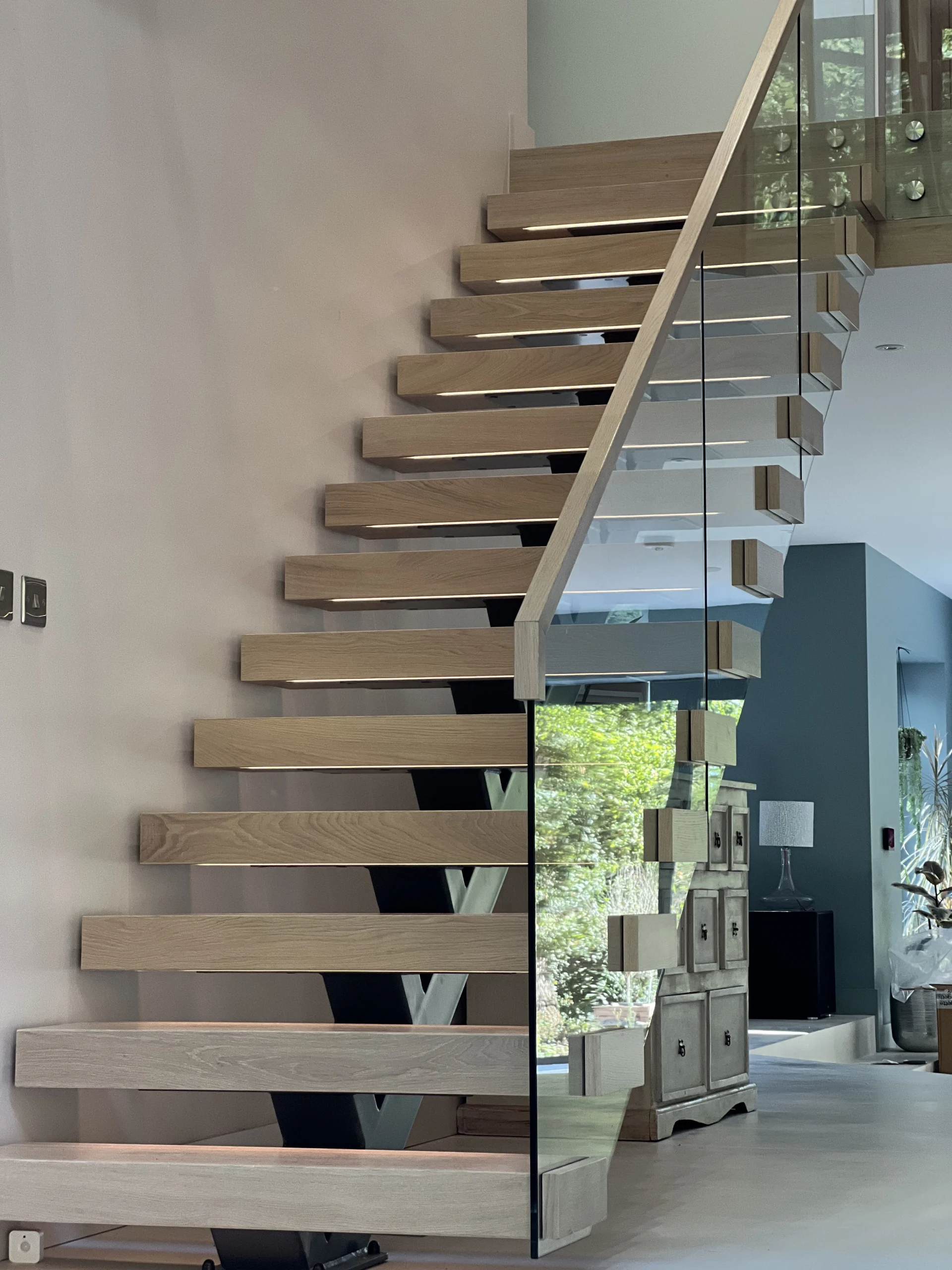
Single spine staircase engineered to SIA 260/261 structural framework — Eurocode-aligned design with Swiss SIA cross-reference schedule for kantonale Baubehörde dossier.
Dimensional Requirements — Rise, Going, Headroom
The Swiss dimensional framework follows the standard European Blondel-style approach with the step formula 2R + T = 600–630 mm. Specific values vary by application:
| Parameter | Private residential (single-family / inside apartment) | Multi-family common (treppenhaus) | Public / SIA 500 accessible |
|---|---|---|---|
| Maximum riser | 20 cm | 18 cm | 17 cm |
| Minimum going / tread | 24 cm | 26 cm | 28 cm |
| Step formula (2R + T) | 600–630 mm | 610–630 mm | 620–640 mm |
| Minimum width (clear) | 0.80 m | 1.00 m | 1.20 m |
| Minimum headroom | 2.00 m vertical above nosing line | 2.10 m | 2.20 m |
| Handrail required | One side (both if width > 1.20 m) | Both sides | Both sides + 30 cm extensions |
| Maximum flight length (without landing) | 18 risers | 16 risers | 16 risers |
| Tread surface | Slip-resistant under wet conditions where applicable | Slip-resistant standard | Slip-resistant + visual contrast nosing |
For typical Swiss residential projects, Continox specifies 17–18 cm riser with 27–28 cm going (giving step formula ~620 mm — comfortable mid-range). This deliberately falls within the SIA 500 accessible range, future-proofing the staircase for aging-in-place without additional cost. Width minimum 90 cm for villa projects; 80 cm only used for compact apartment duplex insertions where stairwell footprint is genuinely constrained.
Cantonal Bauordnung — What Adds on Top
The cantonal Bauordnung overlay typically adds procedural rather than technical requirements. Key cantonal touchpoints for staircase projects:
| Cantonal layer | What it affects | Continox involvement |
|---|---|---|
| Baugesuch (planning permission) | Dossier format, submission process, fees | We supply CAD files + structural pack; your architect assembles dossier |
| Anrainerinformation (neighbour notification) | Required for some cantons; 14–30 day public review | Not affected — handled by your architect / local Bauverwaltung |
| Ortsbildschutz (heritage zone) | Restrictions in protected village cores (Bern Altstadt, Vieille-Ville Genève, etc.) | Pure-internal staircase rarely affected; we supply 3D for heritage architect coordination |
| Brandschutz (fire safety) | Fire-rated stairwells in multi-family + commercial; specific to canton + use | We supply structural elements; fire-rated enclosure is your appointed Brandschutzplaner's responsibility |
| Erdbebensicherheit (seismic) | Eurocode 8 / SIA 261 seismic verification — varies from low (Mittelland) to moderate (Wallis, Engadin) | Continox supplies structural calculations including seismic load schedule per project zone |
| Cantonal accessibility law | Some cantons (Genève, Vaud) extend SIA 500 obligations | We confirm at quotation; SIA 500 schedule supplied if required |
Each canton's Baubehörde reviews the Baugesuch dossier against its specific Bauordnung. The technical core (SIA-compliant staircase) is universally accepted. The cantonal layer (procedural format, neighbour notification, heritage rules) is verified by your project's appointed Swiss architect or Bauingenieur, who knows the local Baubehörde's review process. Continox supplies the technical evidence; your local architect assembles the cantonal Baugesuch dossier.
Continox Documentation Pack for Swiss Projects
Every Continox Switzerland delivery includes a complete documentation pack mapped specifically to the Swiss SIA framework. The pack matches what a Swiss-domestic fabricator would supply:
Continox Switzerland — Standard Documentation Pack
- SIA 358 Compliance Schedule: dimensional & guard-height verification with §-by-§ cross-reference; supplied bilingually (English + DE/FR/IT depending on canton)
- SIA 500 Compliance Schedule (where applicable): barrier-free verification — accessible-flight dimensions, handrail extensions, tactile warnings, nosing contrast
- SIA 260/261 Structural Calculation Pack: Eurocode-aligned calculations with SIA cross-reference; signed by IStructE Chartered Engineer
- EN 1090-1 EXC2 Certificate + DoP: CE marking + Declaration of Performance; identical EU harmonised framework recognised by Swiss Baubehörde
- Material Certificates (EN 10204 type 3.1): mill certificates for all structural steel batches
- Glass Documentation: EN 14449 lamination + EN 12150 tempering + EN 12600 1B1 impact + heat-soak records (NF EN 14179) for external installations
- Powder-Coat / Galvanising: RAL specification, DFT (dry film thickness), salt-spray test records
- Swiss Customs Pack: EUR1 origin certificate, T1 transit document, MWST schedule for Swiss border clearance
- Bilingual Installation Manual: assembly drawings in EN + DE/FR/IT, anchor torque sequence, snagging checklist
- 5-Year Warranty: conforming to Swiss consumer goods law; transferable to first end-user
- Baubehörde Summary: 2-page bilingual document specifically structured for cantonal review — references all SIA standards by §
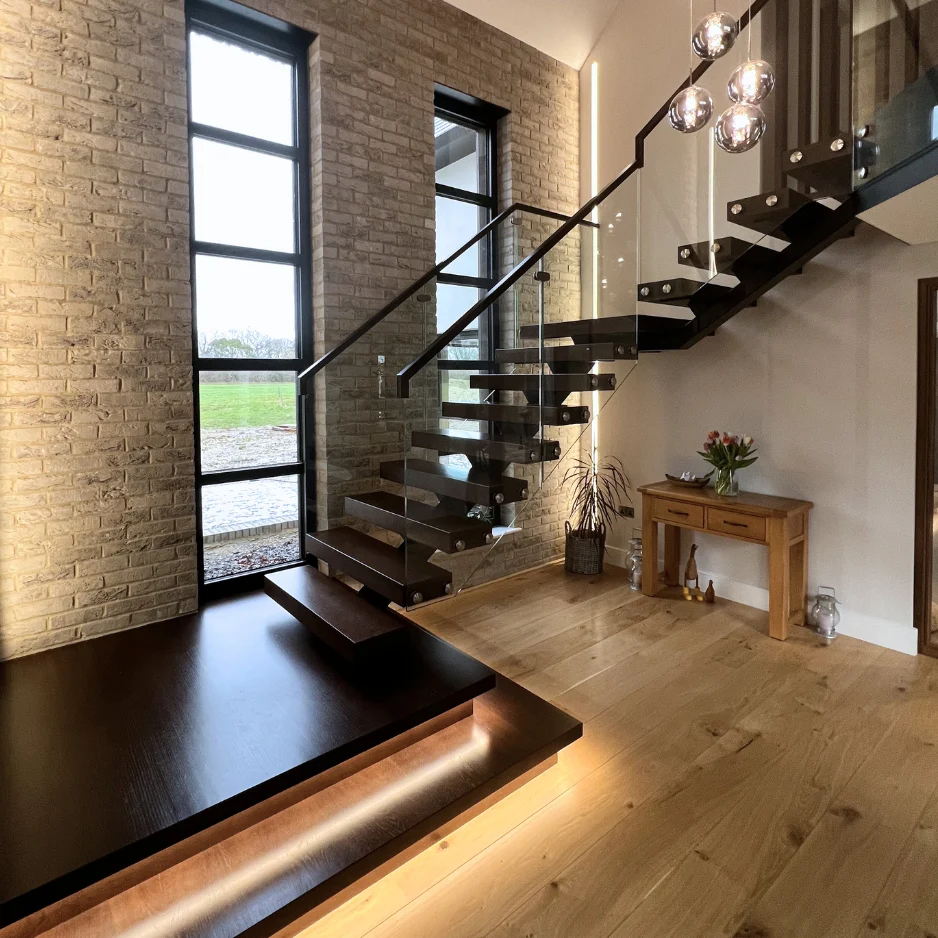
Premium central spine staircase delivered with full SIA-compliant documentation pack — bilingual cross-referenced compliance schedule for the kantonale Baubehörde dossier.
Specify Your SIA-Compliant Swiss Project
Free 3D visualisation, full SIA 358 + SIA 500 + Eurocode documentation pack, fixed-price quote in CHF or EUR within 48 hours. Delivered to anywhere in Switzerland in 4–6 days.
Get Free QuoteFrequently Asked Questions
Is SIA 358 the only standard I need to follow?
For balustrades and fall protection — yes, SIA 358 is the primary standard. But a complete staircase project also requires SIA 260/261 (structural design and actions, parallels Eurocode 1), SIA 263 (steel structures, parallels Eurocode 3), and where applicable SIA 500 (barrier-free design). Continox supplies a documentation pack mapped to all four standards plus the EN 1090-1 EXC2 + Eurocode framework.
What's the minimum guard height for a Swiss staircase?
Per SIA 358: 0.90 m along the staircase flight (measured from the nosing line) and 1.00 m at landings and balconies. For drops exceeding 12 m, the landing guard rises to 1.10 m. Fall protection is required for any drop exceeding 1.0 m regardless of building type. The 1.0 m landing minimum is consistent across Swiss residential and commercial applications.
What's the difference between SIA 358 and SIA 500?
Different scope: SIA 358 covers fall protection (guards, balustrades, parapets, minimum heights, opening sizes, structural loads). SIA 500 covers accessibility (barrier-free design, dimensions for ambulant disabled users, handrail extensions, tactile warnings, nosing contrast). Both apply concurrently — SIA 358 always; SIA 500 specifically for public buildings, multi-family common stairs and workplaces.
Does each canton have its own staircase rules?
The technical specification of staircases is governed by the federal SIA framework — applied uniformly across all 26 cantons. Each canton's Bauordnung adds procedural requirements (Baugesuch dossier format, neighbour notification, heritage zone rules, fire safety enclosure) but rarely modifies the technical specification itself. A staircase compliant with SIA 358 + SIA 500 will be accepted by any cantonal Baubehörde from Genève to Graubünden.
What's the maximum riser for a Swiss residential staircase?
Maximum 20 cm for private residential (inside apartment, single-family home), 18 cm for multi-family common stairs (treppenhaus shared with other tenants), 17 cm for SIA 500 accessible applications. Continox standard configuration is 17–18 cm riser with 27–28 cm going, giving step formula ~620 mm — falls within all three categories simultaneously, future-proofing for aging-in-place.
Is the Eurocode framework accepted in Switzerland?
Yes. Swiss SIA structural standards (SIA 260/261/263/264) are aligned with the European Eurocode framework. Continox supplies Eurocode-based structural calculations (EN 1990, EN 1991, EN 1993) with a Swiss SIA cross-reference schedule. This is universally accepted by cantonal Baubehörden — there is no requirement to repeat the calculations in pure SIA notation.
Do I need handrails on both sides?
Per SIA 358: handrail required on at least one side for any staircase regardless of width. Both sides required for: (a) flights wider than 1.20 m, (b) multi-family common stairs (treppenhaus) regardless of width, (c) SIA 500 accessible flights regardless of width. For Continox typical residential villa specification (90–120 cm width), handrail one side is sufficient; ERP-equivalent commercial requires both sides plus 30 cm horizontal extensions at top and bottom.
Are there special rules for alpine resort projects?
The SIA 358 + SIA 500 + dimensional rules are uniform across Switzerland regardless of altitude. The differences for alpine projects come from: structural calculations (Eurocode 1991-1-3 snow loading per altitude — significantly higher than lowland), steel grade (S355J0 cold-resistant per EN 10025-2 above 1,500 m altitude), and thermal expansion clearances (6–8 mm vs 4 mm standard). All included automatically in Continox alpine projects at no extra cost.
Does Continox handle the cantonal Baugesuch dossier?
No — the Baugesuch dossier is assembled by your project's appointed Swiss architect or Bauingenieur, who knows the local cantonal Baubehörde's review process and submission format. Continox supplies the technical evidence (SIA-compliance schedules, structural calculations, CAD files, EN 1090 + DoP, glass and powder-coat certificates) which your architect inserts into the cantonal dossier. We supply the contents in formats compatible with all major Swiss canton submission systems.
What about Swiss seismic verification?
Switzerland is divided into seismic zones Z1 (low) to Z3b (highest, Wallis and parts of Engadin). Per SIA 261 with its seismic annex (parallels Eurocode 8), residential staircases (importance category II) typically require seismic verification of anchor connections rather than full dynamic analysis. Continox supplies the seismic load schedule with the structural calculation pack — applying the project's specific zone classification. For high-zone projects (Wallis, Graubünden), additional anchor specification is calculated automatically.
Start Your Swiss SIA-Compliant Project
From €8,999 / CHF 9,500 supply-only. Free 3D visualisation, full SIA 358 + SIA 500 + Eurocode documentation pack, EN 1090-1 EXC2 structural certification. 4–6 day delivery to all 26 Swiss cantons with customs handled.
Get Free Quote