
Cost to Replace a Staircase UK — Free Calculator + Price Guide
The cost to replace a staircase in the UK ranges from £800 for a basic timber kit replacement to £25,000 for a fully bespoke floating or central-spine design, with most homeowners spending £3,500–£14,000. The exact figure depends on staircase type, materials, balustrade specification, removal of the existing stair, and regional labour rates. This guide includes a free interactive calculator that gives an instant estimate based on your specifications, plus a full breakdown of what drives the price up or down — based on real UK pricing data and 15 years of Continox installations.
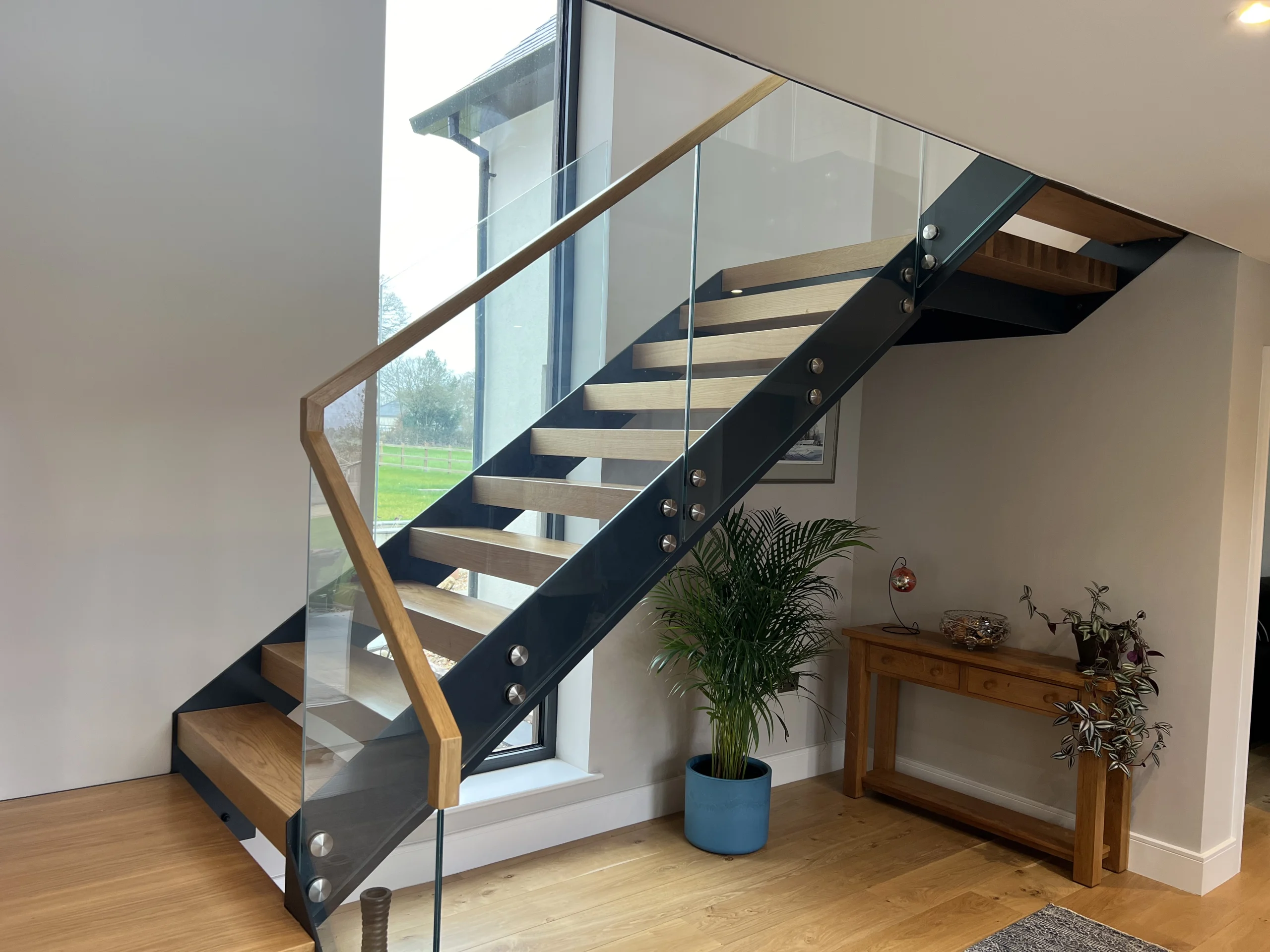
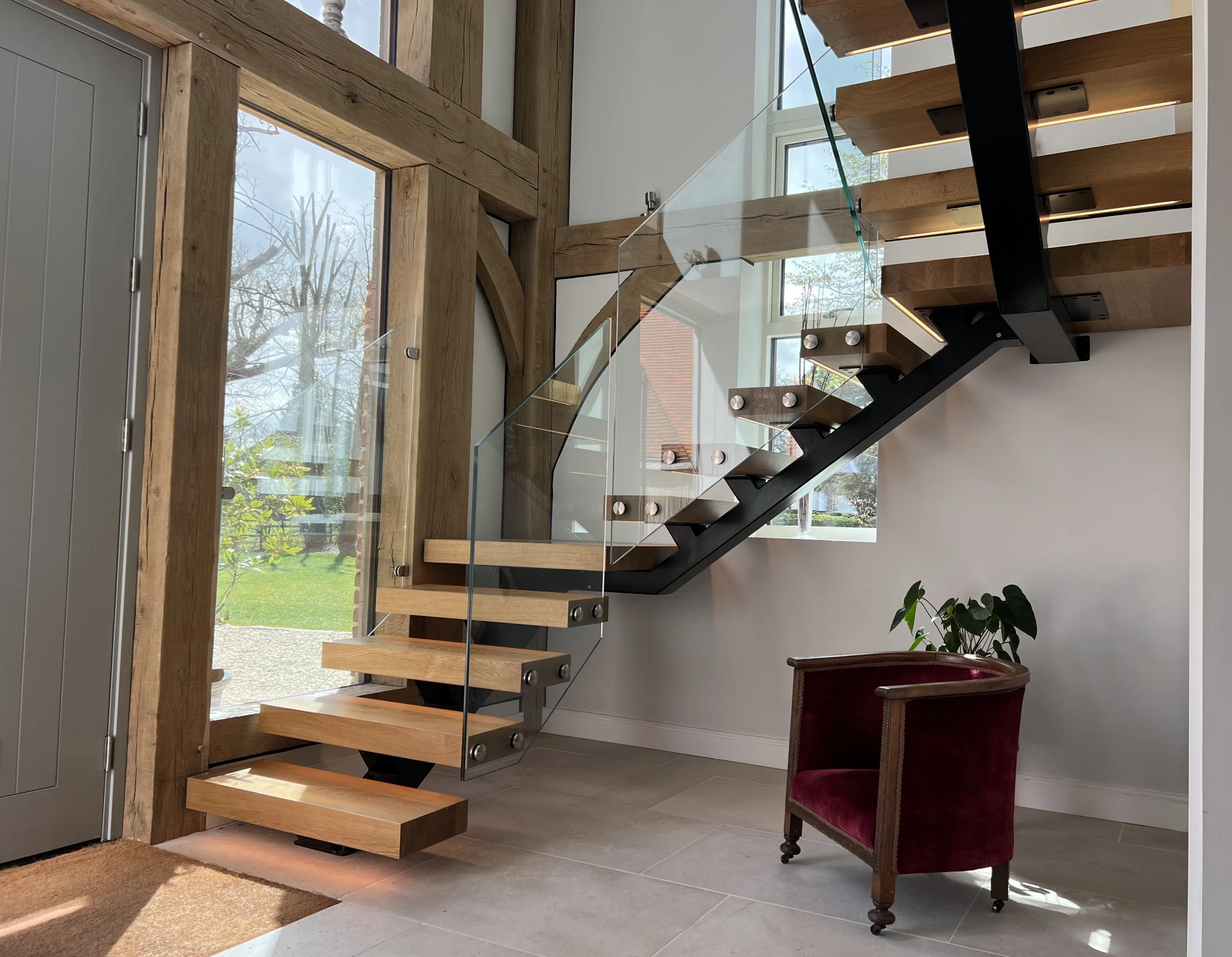
Bespoke central-spine staircase replacement by Continox — typical project cost £10,999–£15,000 including removal, fabrication, glass balustrade and installation.
Staircase Replacement Cost Calculator
Adjust the options below — the price updates instantly. Based on UK supply & install rates.
Replacing a staircase in the UK costs £800–£25,000, depending on six main factors: type (straight cheapest, helical most expensive), construction (DIY kit £800+ vs bespoke central spine £10,999+), material (pine cheapest, walnut/stone most expensive), balustrade (timber spindles £180/m, frameless glass £450/m), floor-to-floor height (more risers = more material), and region (London +12–18%, North/Scotland −5–10%). For a typical UK home replacing a tired timber staircase with a modern oak-and-glass design, expect £6,500–£14,000 supply-and-install.
What Drives the Cost — 6 Factors That Matter
The same headline question — "how much does a new staircase cost?" — has six different answers depending on which variables you change. Each factor below shows the typical UK cost impact, based on real installation data.
Straight flights are the cheapest because they need the simplest jig setup and the fewest specialised parts. Once you introduce turns — quarter-turn (L-shape), half-turn (U-shape) or winder treads — fabrication time roughly doubles. Curved and helical staircases require CNC-formed strings, full 3D modelling and specialist installation, which is why they sit at the top of the price range.
| Type | Typical UK Range | Why |
|---|---|---|
| Straight | £800 – £8,500 | Simplest fabrication, fewest parts |
| L-shape / Quarter-turn | £2,500 – £13,500 | Adds platform or winder treads |
| U-shape / Half-turn | £3,500 – £16,500 | Two platforms, larger footprint |
| Winder | £3,200 – £12,000 | Tapered treads cost more to cut |
| Spiral | £1,800 – £10,000 | Pre-fabricated kits exist; bespoke pricier |
| Helical / Curved | £12,000 – £25,000+ | CNC-formed strings, full bespoke |
This is the single biggest cost lever. A flat-pack DIY kit replacing an identical timber staircase can come in under £1,000 supplied and £1,500 fitted. A bespoke floating staircase with wall-hidden steel substructure, LED-routed treads and frameless glass balustrade starts at £11,999 and climbs from there. The middle ground — a joiner-built timber staircase with simple spindles — sits at £3,500–£6,500.
What "bespoke" actually means in pricing: A bespoke staircase is designed and fabricated to the exact site dimensions, with full structural drawings and individually engineered components. The price premium over a kit reflects design time (typically 6–12 hours), CAD drawings, structural calculations for building control, custom CNC-cut treads and a one-off site fit. For our modern staircase range, central-spine designs start at £10,999 and floating staircases at £11,999 — the floating premium reflects the precision required for the wall-hidden structural system.
The tread material is the most visible part of the staircase, and pricing varies by an order of magnitude. Pine and MDF are cheapest but show wear quickly. Solid oak is the UK default for premium replacements — durable, refinishable, and broadly liked by future buyers. Solid walnut is roughly 2× the price of oak. Stone-clad treads (limestone, marble) on a steel substructure are the most expensive option, both for material cost and for the additional structural engineering needed to carry the weight.


The balustrade is often a quarter to a third of the total project cost. Traditional timber spindles are cheapest at £150–£200 per linear metre installed. Metal balusters and stainless cable run £200–£280/m. Glass balustrades — the dominant specification on contemporary replacements — start at £350/m for framed (post-and-rail with glass infill) and £450/m for frameless (channel-fixed). Pricing details for each balustrade type are on our glass balustrade page.
For a typical UK staircase replacement with around 6 linear metres of balustrade, the difference between timber spindles (£900–£1,200) and frameless glass (£2,700) adds roughly £1,500 to the final figure — but typically returns more than that in property value uplift on resale.
UK domestic floor-to-floor heights typically range from 2,400mm (older terraces) to 3,200mm+ (modern self-builds and Victorian period homes). Higher floor-to-floor means more risers, more treads, and more balustrade — each adding linearly to the cost. A 2,400mm flight needs 12 risers and 11 treads; a 3,200mm flight needs 16 risers and 15 treads. That's roughly 35% more material and labour for the taller staircase, even before any design changes.
Labour and overhead rates vary by 25–30% across the UK. London and the M25 commute belt are the most expensive — installation labour and trade overheads run 12–18% above national average. The South-East and South-West are close to baseline. The Midlands and Northern England run 5–10% below baseline; Scotland and Wales similar. Materials cost the same everywhere; the variable is labour, transport and trade rates.
Hidden cost — access & protectionReplacing a staircase in an occupied home almost always costs more than the headline figure suggests. Floor protection, dust sheets, scaffold access for upper landings, temporary handrails during the swap, and final making-good of plaster and decoration around the new staircase typically add £400–£900. Our quotes always include access and protection — kit-system suppliers usually don't.
Real-World Cost Scenarios
Three typical UK staircase replacement projects, with full breakdowns. These are based on real Continox enquiries and recent installations.
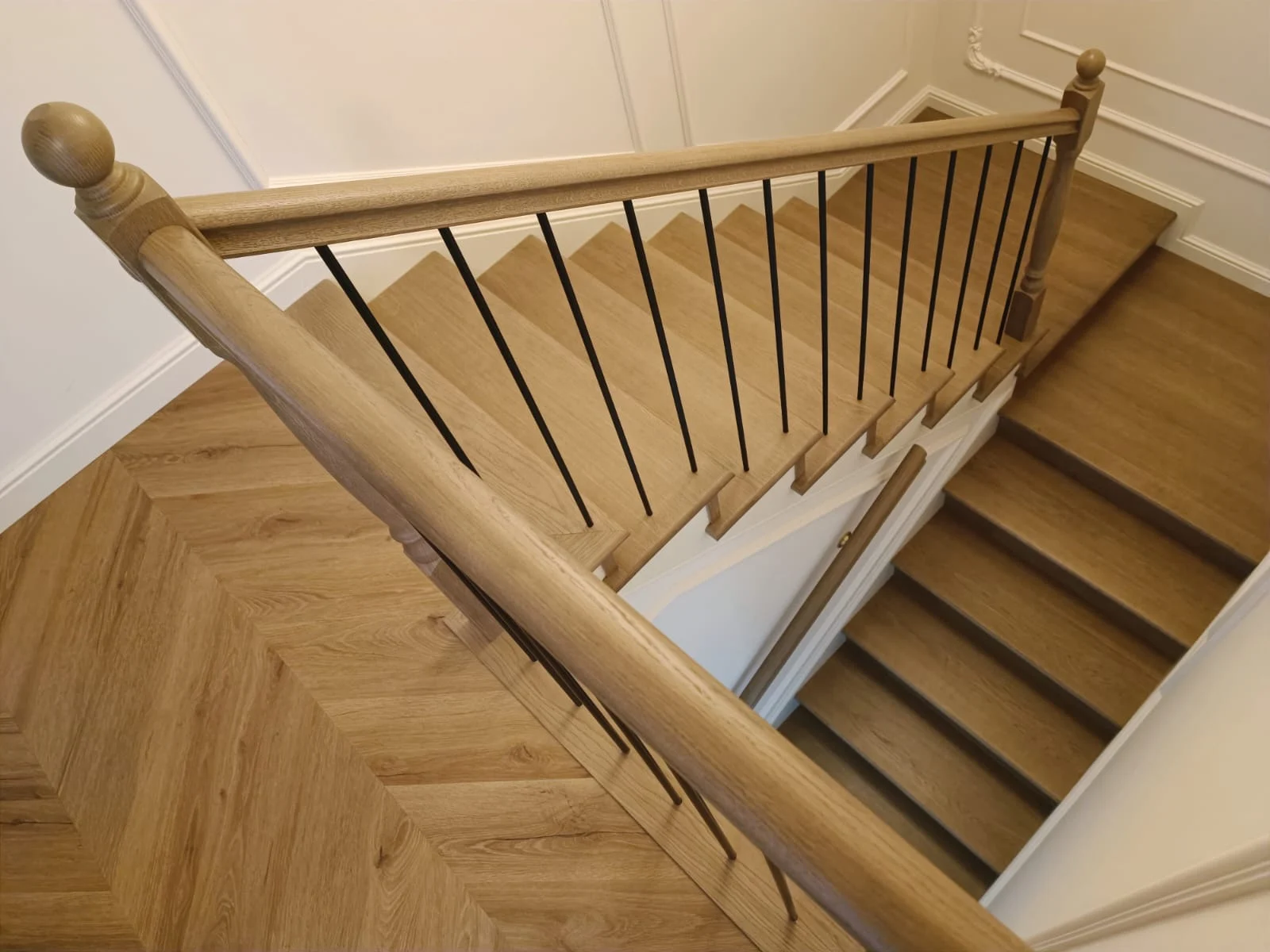
Straight pine staircase swapped for an identical pine staircase by a local joiner. Timber spindles, no design changes, building regs same as before. Includes removal and basic making-good.
Standard L-shape staircase replaced with solid oak treads, painted strings and 6m of framed glass balustrade. Most common UK premium replacement specification.
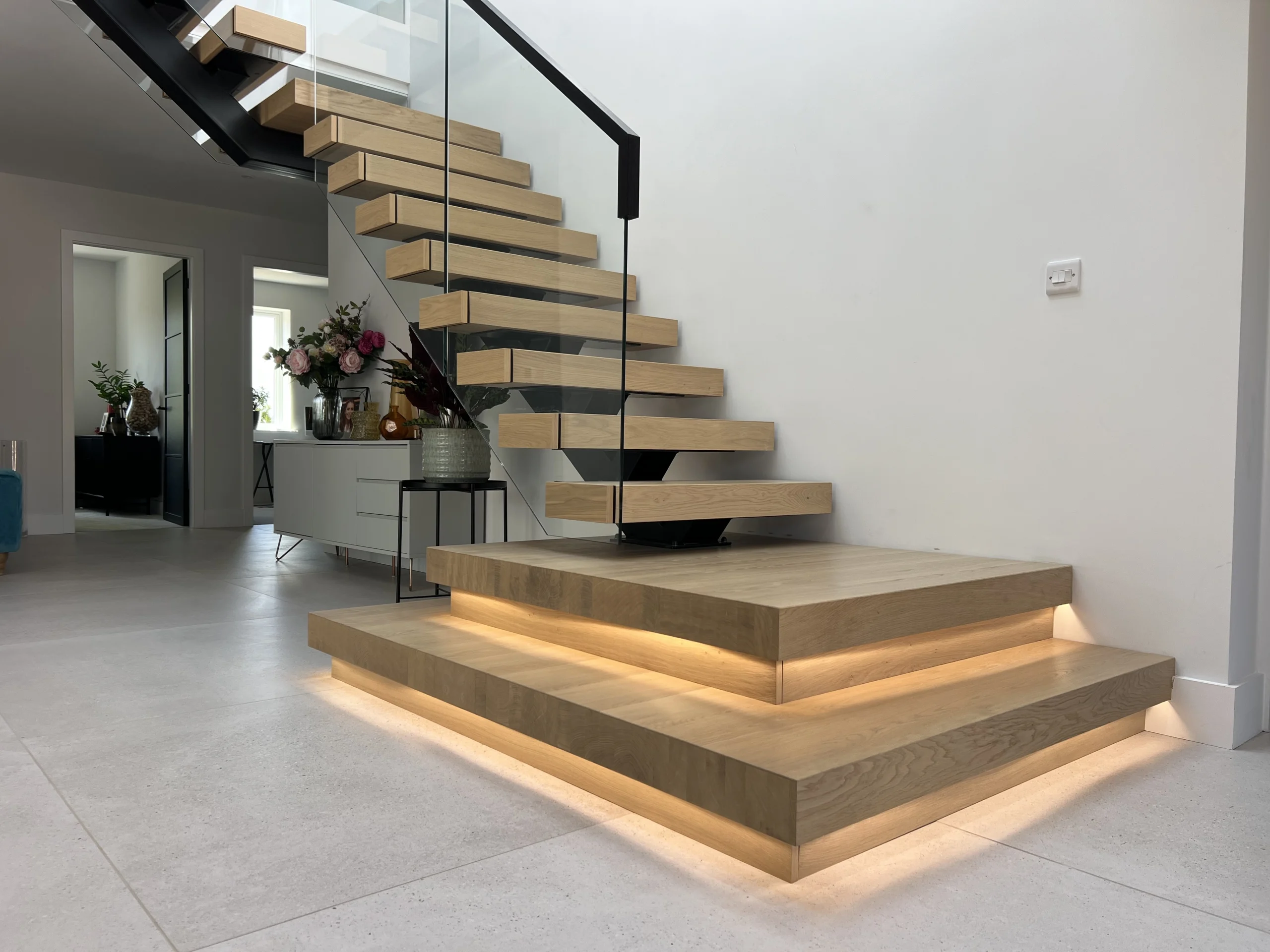
L-shape floating staircase with wall-hidden steel structure, 100mm solid oak treads, 12mm toughened frameless glass, LED-lit oak platform — like our Romsey case study.
DIY Kit vs Bespoke — The Real Comparison
The sharpest pricing question is whether to buy an off-the-shelf kit at £800–£2,500 or commission a bespoke staircase at £10,999+. Both have a place — the right answer depends on the property and what you need from the staircase.
| Criterion | DIY Kit | Standard Joiner | Bespoke Continox |
|---|---|---|---|
| Starting price (supply) | £500 | £2,800 | £8,500 |
| Installed price | £800–£2,500 | £3,500–£8,000 | £10,999–£25,000 |
| Site survey | None | Basic | Full + 3D design |
| Material grade | Pine / MDF | Pine / oak | Oak / walnut / stone |
| Building reg drawings | None | Sometimes | Full pack |
| Glass balustrade option | No | Add-on | Integrated |
| Lifetime | 5–15 years | 15–30 years | 30+ years |
| Resale value uplift | Neutral | Modest | +3–7% property value |
When DIY kits make sense: Rental properties, secondary staircases (loft, basement) where the staircase is rarely the focal point, or short-hold properties where the owner doesn't intend to stay 5+ years. When bespoke makes sense: Family homes where the staircase is the visual centrepiece of the entrance hall, properties being marketed as premium, or any project where the existing staircase is structurally non-compliant (failing Part K headroom, rise, or guarding).
Hidden Costs — What the Headline Price Misses
Replacement staircase quotes vary widely in what they include. The five items below are the most common omissions on cheap quotes — they're real costs, and they always end up on the homeowner's invoice somewhere.
| Hidden Cost | Typical Range | What It Covers |
|---|---|---|
| Removal & disposal | £300 – £800 | Stripping out the old staircase, skip hire, waste removal |
| Building Control fees | £250 – £600 | Local authority sign-off (regulated work — Part K, structural) |
| Structural calculations | £200 – £500 | Engineer's load calcs for cantilevered or unusual designs |
| Plaster / decoration making-good | £300 – £900 | Repairing walls and skirting around the new staircase |
| Carpet / flooring meeting | £150 – £450 | New nosings, threshold strips, flooring re-fit at top & bottom |
Continox quotations include all five categories as standard — supply, fabrication, removal, install, building control liaison and making-good are itemised on a single fixed-price quote, with no add-ons during the project. For the full process, see our free quotation page.
Don't Forget — Building Regulations Cost Impact
Replacing an existing staircase in a UK home is regulated work under Approved Document Part K. The new staircase must meet the current standard — even if the staircase being replaced was non-compliant. The four key requirements that affect cost:
Maximum 42° pitch — if the existing stair is steeper, the new one will need a longer footprint or a turn, which can change the price. Minimum 2,000mm headroom — measured at every point on the pitch line; tight Victorian stairwells often fail this and need design workarounds. Maximum 220mm rise / minimum 220mm going — these dictate the riser count. 900mm minimum guarding height — domestic; 1,100mm at landings and balconies. The 2R+G comfort formula (550–700mm) is recommended best practice. Read more in our 2R+G stair formula guide.
Replacement vs new — the regulatory lineLike-for-like replacement of an existing staircase (same position, same type) is "exempt" from full Building Regulations only if the design is identical to the original AND the original was compliant. In practice almost all replacement staircases trigger Part K compliance, and the work needs Building Control sign-off. Bespoke installers like Continox include this liaison in the project price; DIY kits and pure supply-only quotes don't.
Staircase Replacement Cost — FAQ
Common questions from UK homeowners about staircase replacement pricing.
Free Survey + Fixed-Price Quote
Free on-site survey across the UK, photorealistic 3D visuals of your new staircase in your space, fixed-price quotation within 24 hours. No add-ons mid-project, no hidden costs. Central spine from £10,999, floating from £11,999 — designed, manufactured and installed by Continox.