

Modern Staircase Marbella & Costa del Sol — Supply Guide for Architects
Modern staircases supplied to luxury villa projects across Marbella, Estepona, Sotogrande, Benahavís and the wider Costa del Sol. Designed by Continox in the United Kingdom, manufactured at our EN 1090-1 EXC2 certified facility near Kraków, Poland, and delivered as intra-EU supply — no Brexit customs, no import duty, lead times under eight weeks. Floating, central spine and bespoke designs from €7,999 supply-only. Pre-fabricated kits with full technical pack for architect-led installation.
Continox supplies modern staircases to Marbella and Costa del Sol villa projects on a supply-only basis, working directly with architectural studios and main contractors. Staircases are designed in the UK and manufactured at our EN 1090-1 EXC2 facility near Kraków, Poland, then delivered to Marbella, Estepona, Sotogrande, Benahavís and the wider coast as intra-EU supply — typically 4–6 days transit, €900–€1,500 delivery. Three core systems start at €7,999 (floating), €8,999 (central spine) and €10,000 (bespoke); a typical Sierra Blanca-class villa project lands around €14,500 supply for a central spine L-shape with walnut treads and frameless glass. Every staircase is engineered to satisfy CTE DB-SUA dimensional requirements and supplied with structural calculations, CAD drawings and a dimensional reference schedule. Final compliance acceptance and Certificado Final de Obra remain the legal responsibility of the project's Spanish-registered architect of record.
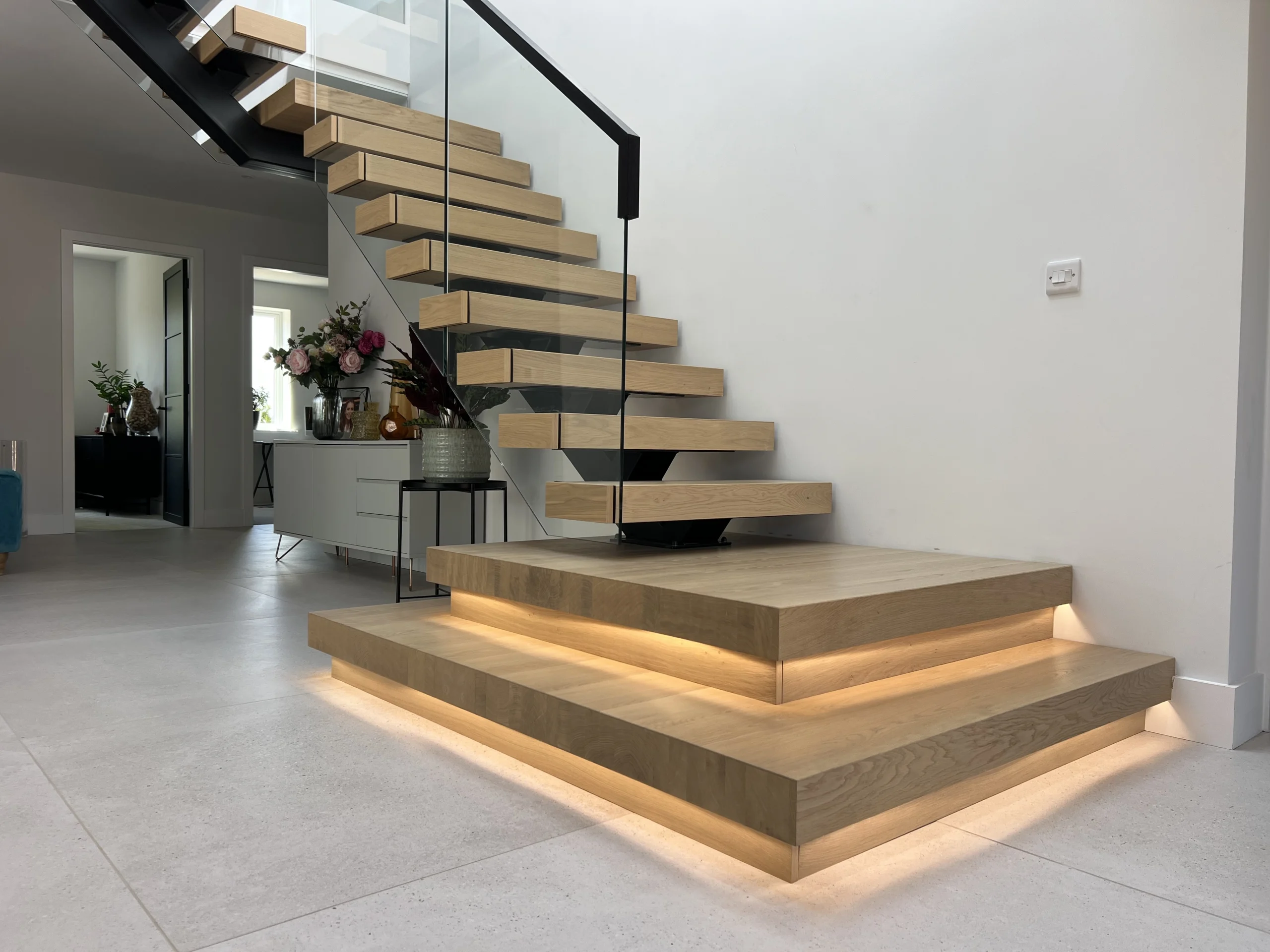
Continox modern staircase — supplied to Costa del Sol villa projects from our EN 1090-1 EXC2 facility
Modern Staircase Supply for Costa del Sol Villa Projects
Marbella's luxury villa market has set the pace for contemporary residential architecture across southern Europe for the past two decades. Project values typically range from €1.9 million for a tailor-made coastal villa to €15–20 million and beyond for an ultra-prime property in La Zagaleta, Sierra Blanca or Cascada de Camoján. Within projects of this scale, the staircase is rarely a routine specification line item — it sits at the heart of the open-plan double-height living spaces that define Marbella's contemporary villa typology, and it is one of the architectural elements where leading studios consistently invest in bespoke fabrication rather than off-the-shelf product.
Continox supplies modern staircases for these projects on a supply-only basis — designed by our UK studio, manufactured at our EN 1090-1 EXC2 certified facility near Kraków in Poland, and delivered to the Costa del Sol as intra-EU supply for installation by the project's main contractor or architect's nominated installer. The model is built around the realities of how Marbella villa projects work: an architect-led design phase, a long build cycle (typically 16–22 months), a main contractor managing multiple specialist trades on site, and a technical architect (arquitecto técnico) carrying the legal responsibility for final compliance certification. Continox sits inside this structure as a coordinated supplier of one specialist element — not as the prime contractor or compliance authority.
For full pricing structure, technical pack contents, regulatory framework and delivery terms, see our modern staircase Spain hub page. For Costa del Sol-specific considerations — premium area characteristics, regional architectural trends, logistics from Kraków to the coast, and Andalucía-level regulatory overlay — read on.
Costa del Sol Premium Areas Continox Supplies
The Costa del Sol's luxury residential market is concentrated in a relatively small number of premium areas, each with a distinct architectural character that influences staircase design. The list below covers the areas where Continox has either supplied projects or is actively working with architectural studios, with brief notes on the typical staircase context in each. This is not a marketing exercise — area characteristics genuinely affect specification choices, from the level of weather exposure (relevant for material durability) to the typical stairwell geometry (relevant for system selection between floating, central spine and bespoke configurations).
La Zagaleta
Europe's most exclusive gated community, with plots typically 3,000–10,000 m² and villa values from €5 million to €40 million+. Staircase typology favours sculptural and helical designs as architectural statements — bespoke geometry is the norm, not the exception. Security protocols at the gate require coordinated delivery scheduling.
Sierra Blanca
Established luxury enclave on the slopes above Marbella centre, with double-height living spaces oriented toward sea and La Concha mountain views. Central spine staircases work well in the open-plan villa typology characteristic of the area, providing structural transparency for sightlines from upper levels to the Mediterranean.
Cascada de Camoján
Mature gated estate behind Marbella's old town, with a mix of established 1990s villas undergoing refurbishment and contemporary new builds. Refurbishment projects often replace dated timber staircases with bespoke modern systems; new builds favour central spine and floating designs with walnut or oak treads.
Monte Mayor
Master-planned community with strict design controls emphasising landscape integration, biophilic design and sustainability. Staircase specifications often pair sustainably-sourced timber treads with low-iron glass and powder-coated steel finishes that minimise reflective glare against natural surroundings.
Golden Mile & Marbella Centro
Premium apartment and branded residence territory — Epic Marbella, the established beachfront estates between Marbella centre and Puerto Banús, and the new wave of fashion-house branded developments. Internal staircases in penthouse units and duplex configurations are typically floating or central spine in compact configurations.
Sotogrande
The original Costa del Sol luxury estate further south near Gibraltar, characterised by larger plots, polo and golf orientation, and a more restrained architectural register than central Marbella. Staircase specifications lean toward warmer materials — solid oak with bronze-finished steel — rather than the higher-contrast finishes favoured further north.
Benahavís
Inland hillside municipality immediately above Marbella, with view-orientation as the primary design driver. Many villa staircases here are positioned against full-height glazing facing the sea, requiring careful coordination between the staircase and the curtain wall — a single-source supply (Continox) materially simplifies this interface compared to splitting the work across separate carpinterías.
Estepona & New Golden Mile
The fastest-growing premium residential market on the western Costa del Sol, with a high proportion of newly-built contemporary villas. Estepona's design language tends toward clean geometric minimalism — the natural fit for floating staircase systems with frameless glass and oak or walnut treads.
Continox also supplies projects in Nueva Andalucía / Puerto Banús (investment-grade apartments and townhouses), Real de la Quinta (the new master-planned resort community above Benahavís), El Madroñal (mature gated estate south of Benahavís) and El Paraiso (established coastal community west of Marbella). The full Costa del Sol delivery footprint extends from Sotogrande in the west to Nerja in the east. For projects further afield in Andalucía — Sevilla, Córdoba, Granada — the same supply terms apply with adjusted delivery scheduling.
Why Marbella Architects Specify UK-Designed Staircases
Spanish architects working on the Costa del Sol have access to a strong local supply chain for most construction trades — but bespoke modern staircases are one of the categories where leading studios increasingly look outside the local market. The reasoning is consistent across the projects we work on, and centres on three specific factors that distinguish UK-engineered staircase supply from the typical local Spanish manufacturing offer.
Cantilever Engineering Capability
Cantilever and floating staircase design has a deep heritage in UK structural practice — driven by Victorian and Edwardian residential architecture where stone cantilever staircases were standard, and continued through the modern bespoke segment over the past two decades. The engineering principles transfer directly to contemporary applications: a steel cantilever arm fixed into a structural wall, supporting a tread that appears to float without visible support beneath. Continox engineers cantilever connections to EN 1993 (Eurocode 3) with deflection limits of L/500 — significantly more conservative than the L/250 typically applied on continental projects — producing staircases that read as solid structures even at 200mm tread depth, with no perceptible deflection under foot traffic. The structural calculations supplied with every project are signed by a UK Chartered Structural Engineer (IStructE) and remain valid throughout the staircase's design life.
Single-Source Steel, Timber and Glass
A typical Marbella villa project handles the staircase across three separate trades: a carpintería metálica for the steel structure, a carpintería de madera for timber treads, and a glazier for the balustrade panels. Each trade has its own supplier relationships, lead times, dimensional tolerances and quality control standards. The architect or main contractor coordinates the interfaces — and bears the risk when the interfaces don't quite line up on site. Continox supplies all three elements as a single coordinated package: steel, timber and glass pre-fabricated and dimensionally matched at our facility, supplied against one technical pack, with one accountability route. For the architect, this means one specification, one delivery, one warranty and a single point of dimensional control. The cost difference is typically modest; the project management saving is significant.
Intra-EU Supply Without Brexit Complications
Continox is a UK-based brand, but our European manufacturing is in Poland — at our EN 1090-1 EXC2 certified facility near Kraków. For Spanish projects this matters in concrete, practical ways. The supply route is intra-EU B2B supply from Poland to Spain — the simplest possible cross-border procedure inside the EU. There are no customs procedures, no import duty, no EUR 1 movement certificate, no Brexit-related complications. The invoice is zero-rated for VAT at origin under EU intra-community supply rules, and Spanish IVA (currently 21%) is accounted for by the customer on their own IVA return under standard reverse-charge mechanism. Transit time to Marbella from Kraków is typically 4–6 working days by dedicated freight. Compared to UK-direct supply, this removes both the regulatory friction and roughly 2–4 working days of transit. The structural engineering and design heritage remain UK-based; the manufacturing and logistics are EU-based.
 Sierra Blanca-class double-height open plan
 Y-shape central spine — Estepona contemporary
The 2026 "Moody Mediterranean" Trend in Marbella Interiors
Marbella's interior design language has shifted noticeably during 2025–2026. The previous decade was dominated by what local studios refer to as the "Beach Club Aesthetic" — high ceilings, smooth white walls, beige and sand palette, wicker accents, deliberately neutral and tranquil. The 2026 evolution, increasingly visible across new villa projects in Sierra Blanca, Cascada de Camoján and Estepona, is a more saturated and tactile direction: "Moody Mediterranean". Dark walnut woods, brushed brass and bronze hardware, deeper olive and terracotta accents, arched architectural details, and a deliberate move away from sterile neutrality toward emotional warmth.
Modern Staircases for the Moody Mediterranean
The shift from beach-club neutrality to deeper, warmer tones puts the staircase squarely in focus as one of the largest material moments in a contemporary villa. The combinations Continox is currently specifying for Marbella projects reflect this directly: walnut treads in place of oak for warmer tonal weight, bronze-finished steel structures in place of the standard RAL 9005 jet black, low-iron glass for the cleanest possible balustrade transparency, and integrated warm-white LED detailing in handrails and under-tread channels for evening atmosphere.
The walnut upgrade adds €800–€1,200 to a typical project against the standard oak specification. Bronze finish on steel adds €400–€800 against standard powder-coat. Low-iron glass on a typical 8–10 metre balustrade run adds €600–€900 against standard float glass. None are exotic specifications; all are routine options on Marbella villa projects in 2026.
For a fuller treatment of contemporary staircase materials and finish options, see our modern staircase range page and our glass balustrade specification guide. For completed project examples in Hampshire and Greater London at comparable specification, see the project gallery.
Three Staircase Systems for Marbella Villas
Continox supplies three core staircase systems to Marbella projects, each suited to a different villa typology. The configuration choice is typically driven by stairwell geometry and the surrounding architectural context — open-plan double-height spaces favour central spine, wall-side configurations favour floating, and statement villas with sculptural ambitions favour bespoke geometry. Pricing below is supply-only ex-works EU (Kraków facility); add €900–€1,500 for delivery to Marbella.
Floating Staircase
Best suited to villas where the staircase runs along a structural wall — common in Estepona's compact contemporary villa typology and in many Benahavís hillside designs. Cantilevered treads with internal steel cores fixed into the wall substrate, frameless glass on the open side. Most cost-effective system.
- Wall fixing — concrete or steel substrate
- 100–120mm solid oak or walnut treads
- 17.5mm laminated glass (EN 14449)
- LED under-tread channel optional
Central Spine Staircase
The natural fit for Sierra Blanca, Cascada de Camoján and Zagaleta-class double-height open-plan villas. Single structural steel spine with treads cantilevering both sides, frameless glass on both faces — the staircase reads as a sculptural element in the room rather than a circulation feature.
- Top + bottom anchor plates, no wall fixing
- S275 or S355 structural spine
- Frameless glass both sides
- Straight, L-shape, U-shape configurations
- EN 1090-1 EXC2 + CE marked
Bespoke Staircase
For statement projects in La Zagaleta, branded residences and ultra-prime villas where the staircase is conceived as a primary architectural feature. Helical, Y-shape, sculptural curves, dual-flight central landings, mixed material configurations. Engineered individually from the architect's design intent.
- Helical, Y-shape, curved geometry
- Mixed timber + steel + glass
- 3D photorealistic renders pre-fabrication
- Individual structural engineering
- DWG, PDF, STEP files for BIM coordination
For detailed system specifications, configuration variants and material upgrade pricing, see our floating staircase page, central spine staircase page and the modern staircase Spain hub.
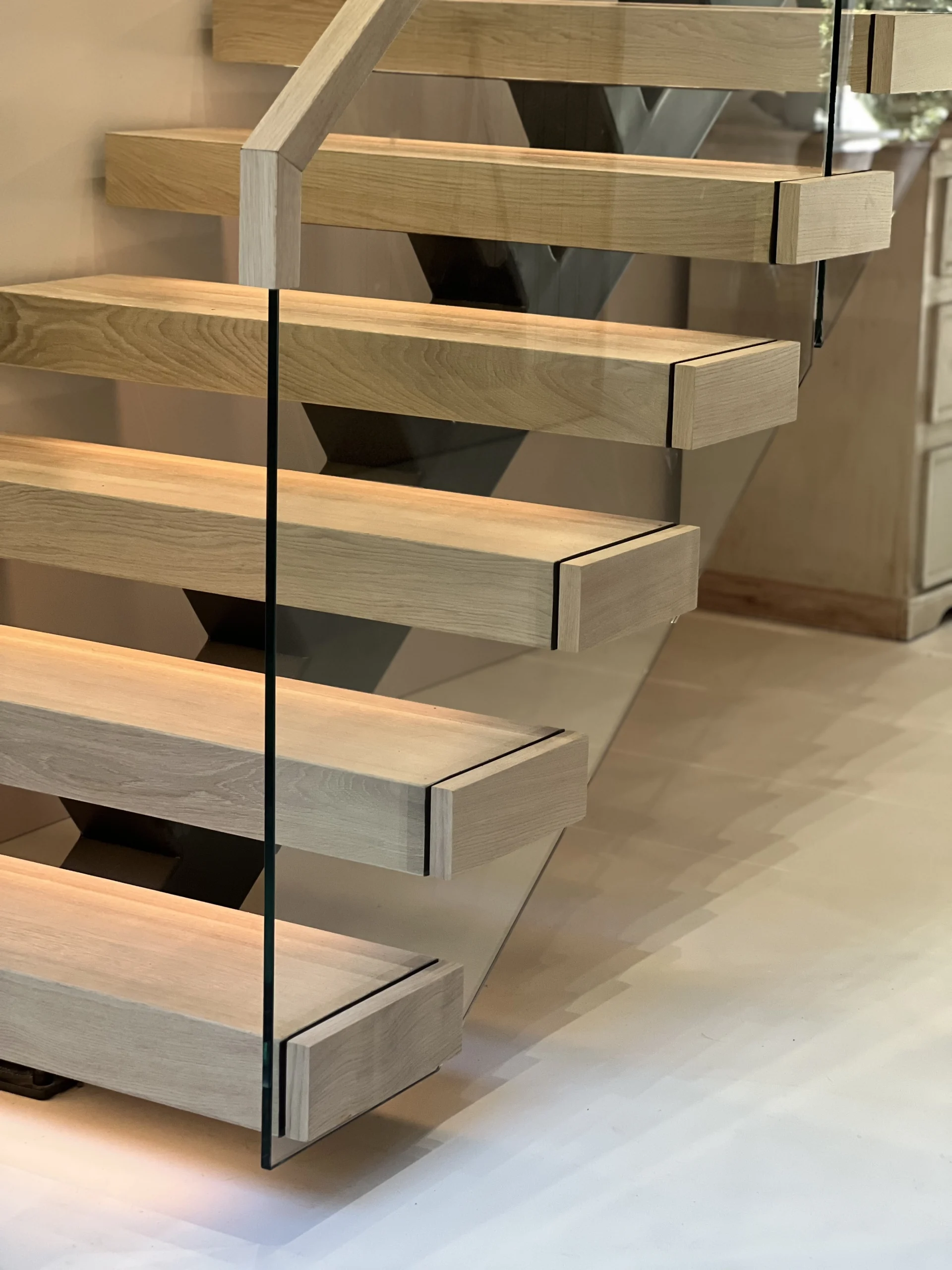 Floating — wall-fixed, LED under-tread
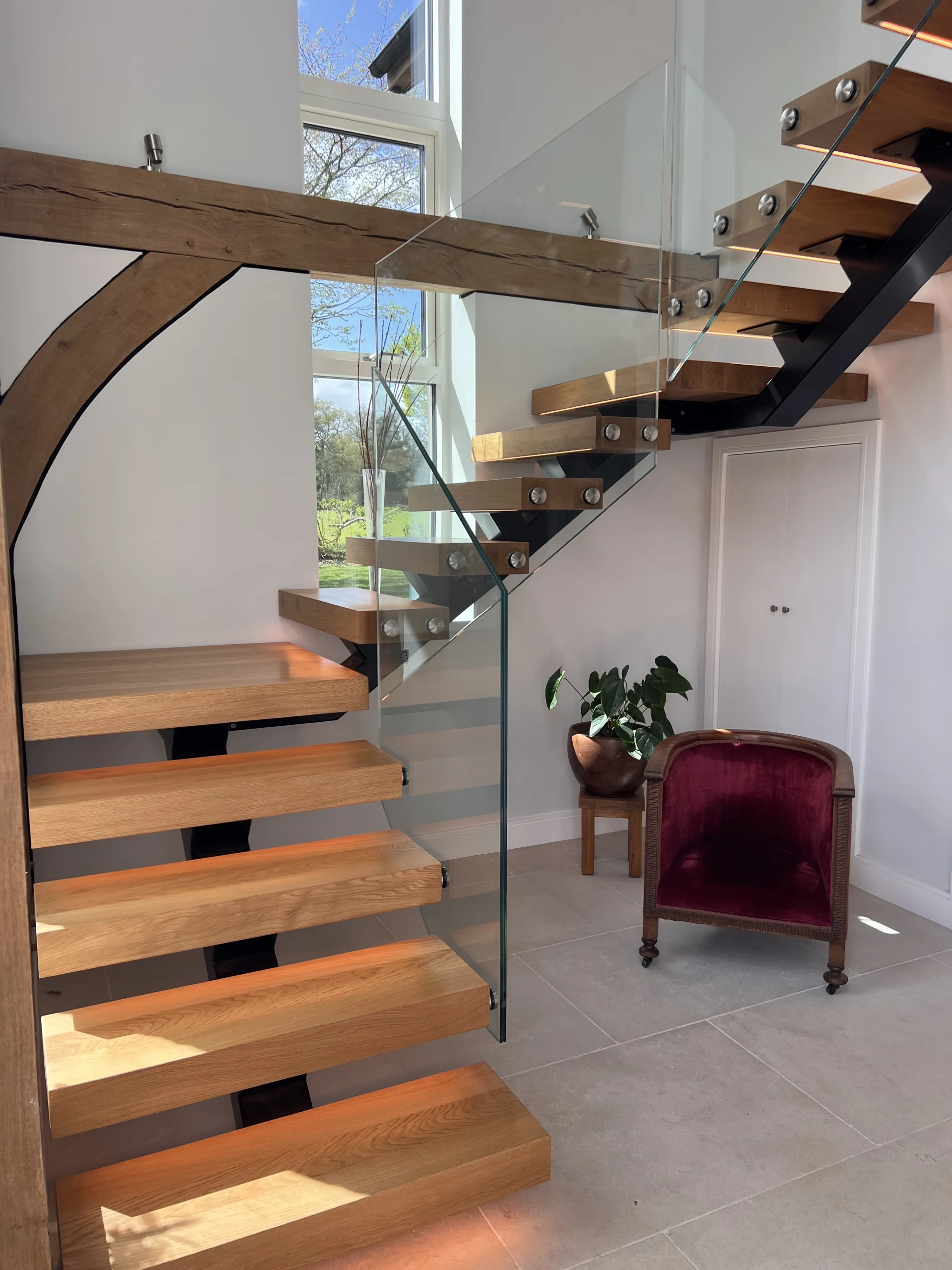 Central spine — open both sides
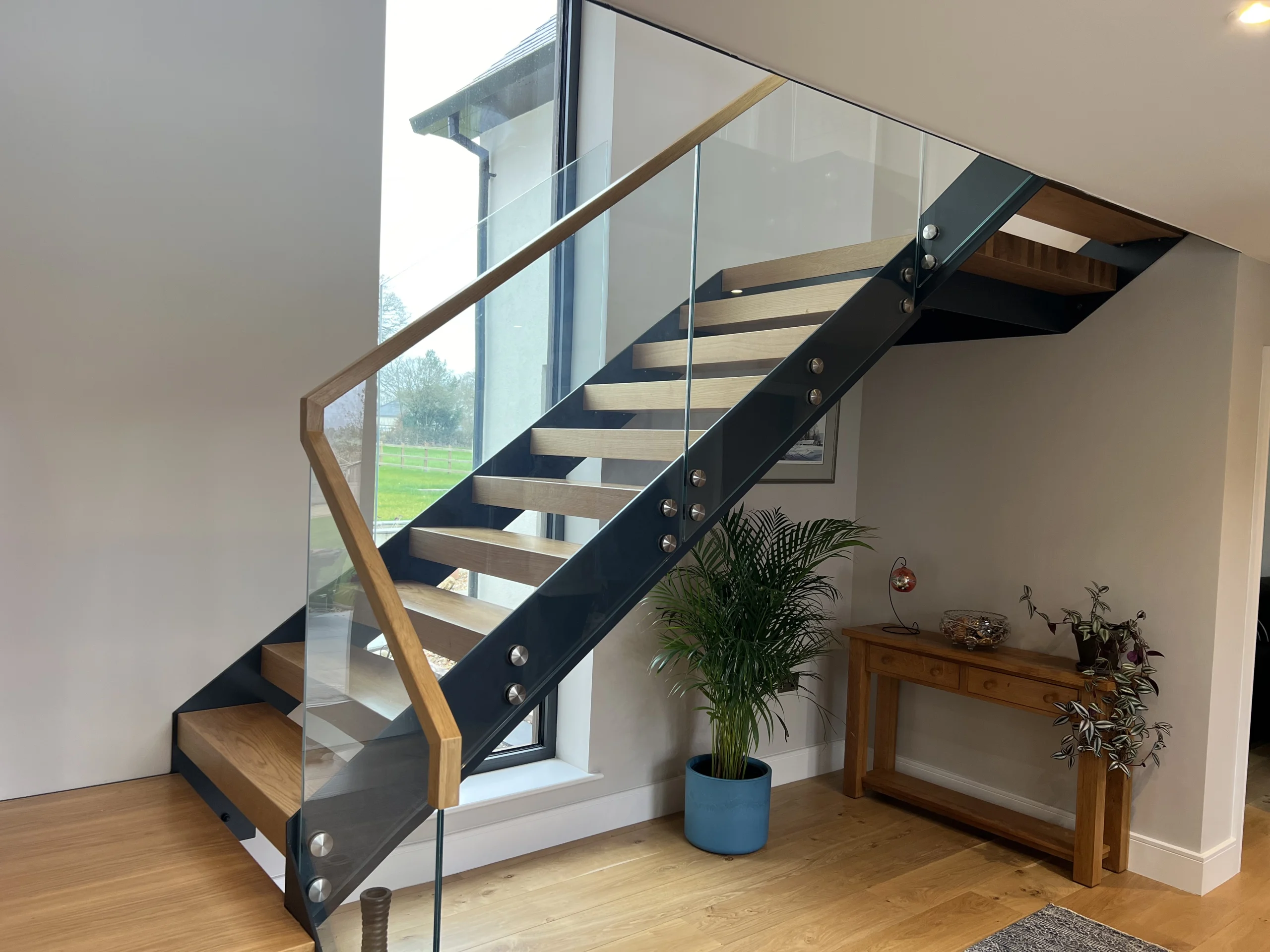 Bespoke — sculptural geometry
Worked Example — Sierra Blanca Villa, 2025
The breakdown below is from a recent Continox supply project to a Sierra Blanca villa completed during 2025. The specification is representative of the upper-mid range for a Marbella luxury villa: a central spine L-shape staircase forming the architectural focus of a double-height living space, with walnut treads in keeping with the project's overall warm-toned interior, frameless low-iron glass balustrades both sides for cleanest possible transparency to the sea view, and integrated warm-white LED detailing for evening atmosphere. The figures are the actual supply price ex-works EU at the time of the order; delivery to Sierra Blanca was quoted separately at €1,150. Installation was carried out by the main contractor's metalwork team over four working days.
Walnut Treads · Low-Iron Glass · Bronze Finish · LED
Excludes IVA (Spanish IVA accounted for by customer under EU intra-community reverse-charge) and delivery (€1,150 to Sierra Blanca). Excludes site installation, structural substrate verification and final commissioning — these are the responsibility of the main contractor's metalwork team. Fixed price following design sign-off; no post-fabrication additions.
Project values across recent Marbella supplies have ranged from approximately €9,500 (a compact floating staircase in an Estepona apartment refurbishment) to €23,800 (a fully bespoke helical staircase for a La Zagaleta new build). The Sierra Blanca worked example above sits roughly in the middle of that range and represents the typical specification level we see on contemporary villa projects in the €3–7 million sale-value bracket. For ultra-prime villas above €10 million, the bespoke geometry, premium material upgrades and complex glass specifications routinely take supply costs above €18,000.
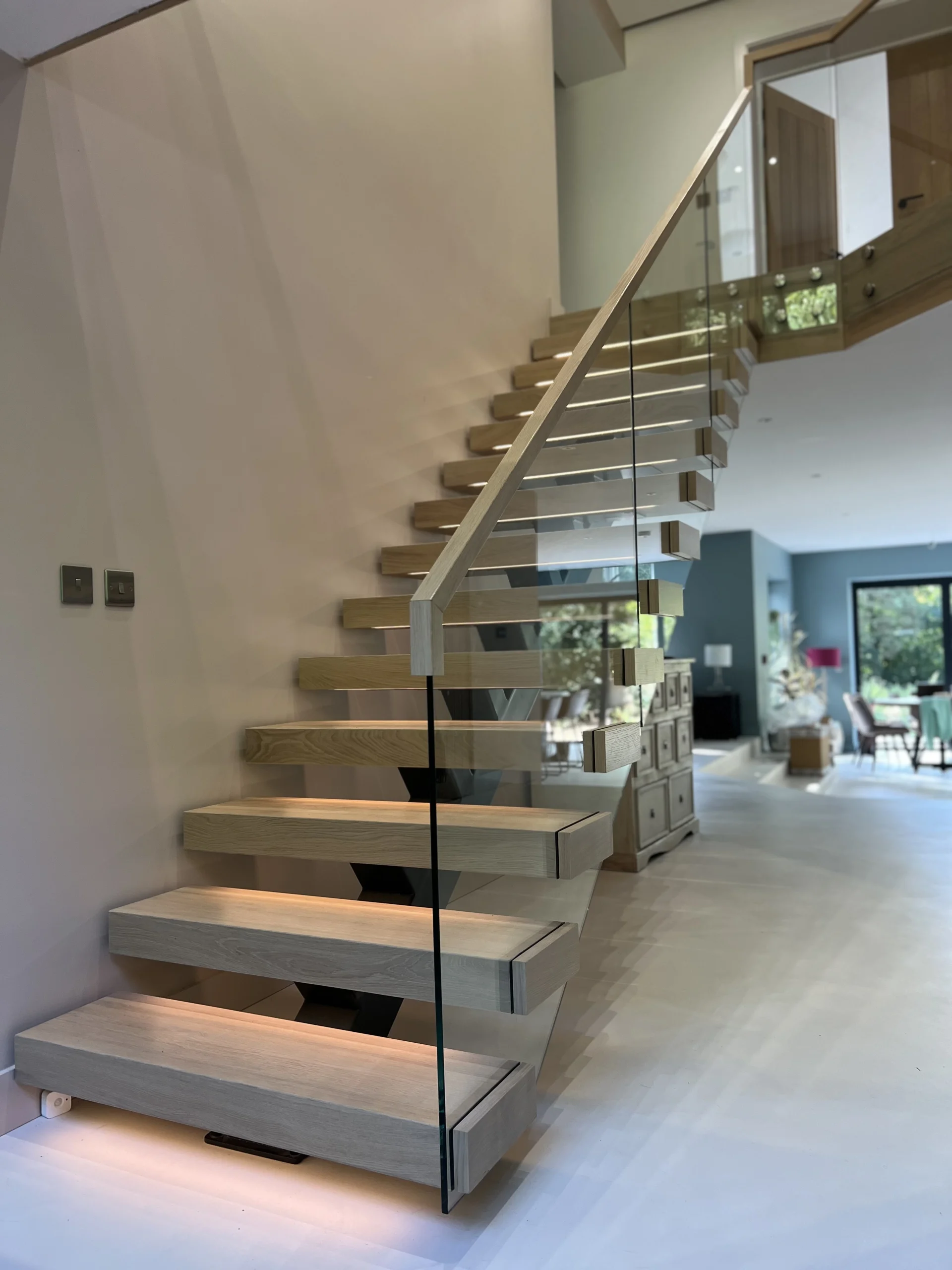 Walnut spine + LED — typical Sierra Blanca specification
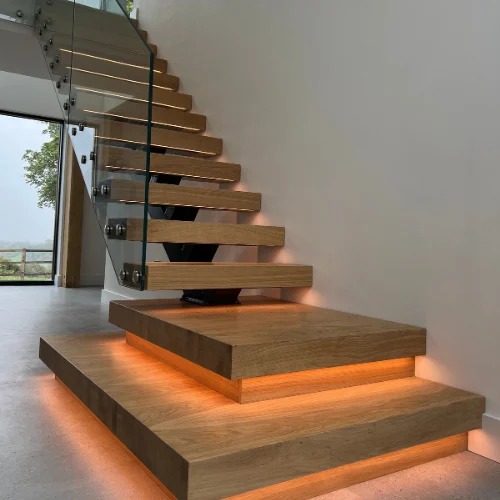 Central spine with platform — open plan villa
CTE DB-SUA + Andalucía Regulations for Marbella Villas
The regulatory framework governing staircase design in Marbella has three tiers: the national Código Técnico de la Edificación, Documento Básico de Seguridad de Utilización y Accesibilidad (CTE DB-SUA), the regional Decreto 60/2010 — Reglamento de Disciplina Urbanística de Andalucía, and the local Plan General de Ordenación Urbanística de Marbella (PGOU) with its specific zoning controls. The CTE DB-SUA covers staircase geometry and safety requirements (huella, contrahuella, balustrade height, ergonomic ratio, sphere rule); the Andalucía and PGOU layers primarily affect licensing procedure, project classification and habitability standards rather than staircase dimensional design directly.
CTE DB-SUA Geometry — The Operative Layer
The CTE DB-SUA Sección 1 sets the dimensional requirements for the staircase itself. For a private villa interior staircase classified as uso restringido (the standard classification for a single-occupancy villa), the requirements are: huella minimum 22 cm (going), contrahuella maximum 20 cm (rise), anchura minimum 80 cm (width). For staircases serving any communal zone, hotel, or commercial element of the project — relevant for branded residence developments and some larger family compound projects — the uso general classification applies: huella minimum 28 cm, contrahuella 13–18.5 cm (17.5 cm where no lift alternative exists), and the ergonomic relation 54 ≤ 2C + H ≤ 70 cm. Continox engineers each staircase against the project's specific use classification, confirmed at the technical pack stage.
Andalucía and Marbella PGOU — The Procedural Layer
The Andalucía-level Decreto 60/2010 governs licensing procedure (Licencia de Obra Mayor, Licencia de Obra Menor, Declaración Responsable de Obra) and the documentation required for each project class. Marbella's PGOU adds zoning controls (UE classifications, height limits, plot ratio limits) and area-specific design controls relevant to certain estates — La Zagaleta, for example, operates additional internal architectural review through its design committee, which can affect material and finish choices on visible elements including staircases. Both layers are the architect of record's responsibility; Continox supplies the staircase to the dimensions and specifications confirmed at design sign-off, with the architect verifying that those dimensions satisfy the project's licensing requirements.
Continox engineers and fabricates each staircase to satisfy CTE DB-SUA dimensional and safety requirements as understood at the time of design, and supplies full structural calculations, CAD drawings, CE documentation and a dimensional reference schedule to support the architect's compliance review. The accuracy of all site dimensions provided to Continox — floor-to-floor height, stairwell opening width and length, structural substrate condition, finished floor build-up — is the responsibility of the architect or main contractor. Continox manufactures against the dimensions confirmed in the architect-approved 3D design.
Final compliance verification, Building Control acceptance, the Certificado Final de Obra and any subsequent Inspección Técnica de Edificios remain the legal responsibility of the project's Spanish-registered architect of record (arquitecto director de obra) and technical architect (arquitecto técnico / aparejador). Continox supplies components and supporting documentation; the project's Spanish professional team carries the legal certification role.
Logistics — Delivery from Kraków to the Costa del Sol
Delivery from our Kraków manufacturing facility to the Costa del Sol is handled by dedicated freight as intra-EU supply — no customs procedures, no import duty, no EUR 1 documentation. Transit time is typically 4–6 working days from the Kraków dispatch point to a Marbella site, depending on the specific destination and current freight schedules. Delivery cost ranges from €900–€1,500 for the Costa del Sol coastal strip from Estepona to Marbella east, with adjustments for restricted-access locations or out-of-area destinations such as Málaga centre or Nerja.
Transit + Lead Time
Total order-to-delivery: 4–8 weeks. Breakdown: 1 week for design sign-off, 3–6 weeks fabrication at Kraków, 4–6 days transit to Marbella by dedicated freight as intra-EU supply.
No customs delays — no EUR 1 movement certificate, no import duty processing, no Brexit-related complications.
Gated Community Access
Delivery into La Zagaleta, Sierra Blanca, El Madroñal and other gated estates requires advance coordination with the security gate. We provide pre-delivery vehicle details, driver identification and consignment manifest to the main contractor 48 hours before arrival.
Site access surveys for crane lifting or restricted streets are quoted as additional services where required.
Coastal Climate Considerations
Costa del Sol's salt-air exposure is relevant for steel finish specification. Standard powder coat (60 micron) is suitable for most internal applications; for staircases positioned within 200m of the coast or in projects with significant outdoor exposure (terrace stairs, pool houses), we specify marine-grade powder coat (80 micron) or Class C5-M corrosion protection per ISO 12944.
Indicative delivery cost ranges across the wider Costa del Sol (May 2026, for reference only — actual cost confirmed at quotation): Estepona / San Pedro / Marbella west €900–€1,200, Marbella centre / Sierra Blanca / Cascada de Camoján €1,000–€1,300, La Zagaleta / Benahavís / El Madroñal €1,100–€1,500, Sotogrande €1,200–€1,500, Málaga centre / east Costa del Sol €1,200–€1,600. Delivery includes dedicated transport (no consolidated freight, to avoid handling damage in transit), full insurance during transit, and unloading at site with tail-lift where vehicle access permits.
 U-shape configuration — multi-level Marbella villa
 Frameless glass + oak handrail — landing detail
Working With Marbella Architectural Studios
The leading Marbella architectural studios — and the established main contractors that build their projects — operate within a relatively well-defined project structure that Continox is set up to integrate with. The Spanish villa project workflow has its own conventions, particularly around licence application timing, technical architect involvement and main contractor selection, and the supply-only model has been deliberately structured to fit cleanly into this workflow rather than to disrupt it.
Design Phase Integration
The earliest useful point for Continox to enter a Marbella villa project is during the proyecto básico phase — once the building footprint, internal layout and double-height space organisation are confirmed, but before the proyecto de ejecución detailing is finalised. At this point we can produce 3D photorealistic visuals of the staircase in the architect's actual stairwell, with the proposed material palette, glass specification and lighting scheme. The visuals are produced specifically for design review with the client, and feed directly into the architect's interior specification documentation. Two revision rounds are included in the supply quote.
Technical File Formats and BIM Coordination
The full technical pack supplied with every project covers all the file formats Spanish architectural workflows require: DWG and PDF for the standard architectural drawing exchange, STEP files on request for Revit and other BIM coordination workflows, structural calculations as signed PDF from the UK Chartered Structural Engineer, and a dimensional reference schedule as a separate compliance document. For projects running native BIM coordination, we can produce the technical pack with IFC export from our internal Tekla model — useful where the architect is running clash detection across multiple disciplines including the staircase.
Main Contractor Coordination
The main contractor manages the on-site sequence — substrate verification before delivery, lifting and positioning of the steel structure, tread fitting, glass installation, handrail and LED commissioning. Continox supplies a detailed installation manual covering each phase, with photographs, torque values, safe-lifting weights per component, and a structured method statement. Free remote technical support from our engineering team is available throughout the installation phase via WhatsApp, email and scheduled video calls — typical response time during European working hours is under two hours. Where the architect or main contractor requests a Continox engineer on site for design verification or commissioning sign-off, this is quoted separately on a day-rate basis plus travel.
Spanish Project Schedule
The typical Marbella villa project runs 16–22 months from licence approval to completion. The staircase is normally installed during the fase de acabados (finishings phase), once the structural shell is complete, the solera (concrete substrate) at both upper-floor and ground-floor levels has cured, and the finished floor build-up is confirmed. Continox lead time of 4–8 weeks from order means the staircase should be ordered during the structural shell phase to align with the finishings programme — typically 6–10 weeks before the planned installation date. We coordinate with the main contractor on the specific delivery window during the manufacture phase.
Modern Staircase Marbella — FAQ
Common questions from Costa del Sol architects, main contractors and project managers about modern staircase supply for Marbella and wider Costa del Sol villa projects. Answers reflect Continox's current practice as of May 2026.
How much does a modern staircase cost for a Marbella villa?
Marbella villa staircase supply costs typically range from €7,999 for a compact floating staircase in an apartment or smaller villa, to €14,000–€18,000 for a central spine L-shape with walnut or oak treads and frameless glass — the typical Sierra Blanca or Cascada de Camoján specification — and up to €20,000–€25,000+ for fully bespoke helical or sculptural staircases in La Zagaleta-class projects. The figures are supply-only ex-works EU; add €900–€1,500 for delivery to Marbella. Installation is carried out by the main contractor's metalwork team and is not included in the supply price. For full pricing structure across all systems and material upgrades see our modern staircase Spain hub.
Can Continox deliver to gated communities like La Zagaleta or Sotogrande?
Yes — Continox supplies projects in La Zagaleta, Sotogrande, Sierra Blanca, El Madroñal, Cascada de Camoján and other gated communities across the Costa del Sol on a routine basis. Gated community delivery requires advance coordination with the security gate: we provide pre-delivery vehicle details, driver identification and a consignment manifest to the main contractor 48 hours before arrival, which the contractor then registers with the community security office. La Zagaleta in particular operates a specific delivery scheduling system through its security control — we coordinate directly with the contractor to align with the community's accepted delivery windows. Restricted-access plots requiring crane lifting are surveyed in advance and quoted as additional services if needed.
Do you work with leading Marbella architectural studios?
Yes. Continox supplies projects led by a number of established Marbella architectural studios as well as international architects working on Costa del Sol villas. The supply-only model is specifically designed for architect-led workflows: we integrate with the studio's design phase via 3D photorealistic visuals and CAD drawings, supply the technical pack in DWG, PDF and STEP formats for the architect's BIM coordination, and provide remote technical support during installation. The architect remains the design authority and the legal certifying professional throughout — Continox supplies one specialist element within the wider project, not the whole project. We do not publish individual studio relationships out of respect for the discretion that characterises the Marbella high-net-worth residential market.
Is the staircase suitable for Costa del Sol's coastal humidity and salt air?
Standard Continox staircase specification — 60-micron powder coat on the steel structure, hardwax-oil-finished European oak or walnut treads, EN 14449 laminated glass — is suitable for typical interior installation in any Mediterranean climate. For projects within 200 metres of the coast or in villas with significant outdoor staircase exposure (rooftop terrace access, pool house staircases, semi-external positions), we specify marine-grade 80-micron powder coat or Class C5-M corrosion protection per ISO 12944. Glass specification can be upgraded to anti-spalling laminated for elevated humidity environments. Walnut and oak treads are sealed with marine-grade hardwax oil for these specifications. The relevant upgrades add approximately 8–12% to the standard supply price and are confirmed at the design specification stage.
What lead time should we plan for a Marbella project starting now?
Plan for 4–8 weeks from order confirmation to delivery on site in Marbella. Breakdown: 1 week for design sign-off (3D visuals + architect approval), 3–6 weeks for fabrication at our Kraków facility (steel, walnut/oak treads, glass production runs concurrently), 4–6 working days for transit by dedicated freight as intra-EU supply. The staircase is normally installed during the fase de acabados (finishings phase) of a Marbella villa build, once the structural shell is complete and finished floor build-ups are confirmed. We recommend ordering during the structural shell phase — typically 6–10 weeks before the planned installation date — to align with the finishings programme. Delivery scheduling is coordinated with the main contractor during the manufacture phase to hit the specific installation window.
Can you supply matching glass balustrades for terraces and pool areas?
Yes. Continox manufactures the full glass balustrade system range alongside the staircase — frameless balustrades for terraces, pool surrounds, mezzanines, balcony railings and rooftop access — in matching specifications and finishes. For Marbella villa projects this is a routine package: the staircase balustrade, the upper floor mezzanine balustrade, the terrace edge balustrade and the pool perimeter all supplied as a coordinated set with consistent glass specification, fixing system and detailing. Same EN 14449 + EN 12150 standards, same low-iron upgrade option for ultra-clear finish, same standoff or channel fixing systems. Combining the staircase and balustrade supply into a single order also typically reduces overall delivery cost compared to separate orders. See our glass balustrade range page for full system options and our balcony railings page for external applications.
How do you handle Marbella PGOU and Andalucía-specific regulations?
CTE DB-SUA establishes the national baseline for staircase geometry and safety (huella, contrahuella, balustrade height, ergonomic ratio) and applies uniformly across Spain. Continox engineers every staircase to satisfy CTE DB-SUA against the project's specific use classification. Andalucía-level regulation (Decreto 60/2010 — Reglamento de Disciplina Urbanística) and the Marbella PGOU primarily affect licensing procedure and zoning rather than staircase dimensional design directly — these are the architect of record's responsibility, not Continox's. Where a project falls within a specific architectural review framework — La Zagaleta's internal design committee, for example, or a heritage protection zone in central Marbella — the architect specifies any consequent staircase finish or material constraints at brief stage, and we engineer to those constraints. The dimensional compliance schedule supplied with the technical pack maps the staircase against CTE DB-SUA; project-specific licensing compliance is verified by the architect against the Andalucía and PGOU framework.
Who is responsible for site dimensions and final compliance acceptance?
The architect or main contractor is responsible for supplying accurate site dimensions to Continox — floor-to-floor height, stairwell opening width and length, structural substrate condition, finished floor build-up at both levels. Continox engineers and fabricates the staircase against the dimensions provided in the architect-approved 3D design. If site-measured dimensions differ from supplied dimensions at installation, the resulting non-fit is the responsibility of the party who supplied the dimensions. We provide a dimensional verification template and require a final dimensional sign-off before manufacturing begins. Final compliance verification, Building Control acceptance, the Certificado Final de Obra and any subsequent Inspección Técnica de Edificios remain the legal responsibility of the project's Spanish-registered arquitecto director de obra and arquitecto técnico — Continox supplies components and supporting documentation; the project's Spanish professional team carries the legal certification role.
Do you supply branded residence projects on the Costa del Sol?
Yes. The Costa del Sol's branded residence segment — Epic Marbella, the Karl Lagerfeld and Dolce & Gabbana developments, and the wider category of fashion-house and luxury-brand-aligned residential projects — operates with internal staircase specifications similar in scale and quality expectation to high-end private villa projects. Continox supplies these on the same supply-only basis: through the development's appointed architectural studio or interior designer, with the supply contract typically held by the main contractor or the development's project management entity. Bespoke geometry, premium material upgrades (walnut, low-iron glass, bronze finish) and sculptural design are routine specifications in this segment. Design and material reviews integrate with the brand's internal design control where applicable. Pricing follows the standard structure plus appropriate uplift for material upgrades and design complexity — typical branded residence staircase supply ranges €15,000–€28,000 depending on geometry and specification.
What's the cost difference between Marbella supply and full UK install service?
Supply-only is approximately 20–28% lower than equivalent supply-plus-install pricing for a UK domestic project — the difference reflects the on-site labour, site supervision, accommodation and travel costs that don't apply in the supply-only model. For a typical Marbella central spine staircase the supply price is €14,000–€16,000; the equivalent UK supply-plus-install would be €17,500–€20,500. The supply-only model is specifically designed for Spanish projects where the main contractor has an established metalwork team and the project's overall labour costs are managed through the contractor's own subcontractor relationships — bringing UK installation crews to Spain for an isolated staircase rarely makes financial or logistical sense. The supply-only model also gives the main contractor full control of the on-site sequence and scheduling, integrating the staircase installation into the overall finishings programme on the contractor's terms.
Modern Staircases for Costa del Sol Villa Projects
Pre-fabricated kits with full technical pack, structural calculations and CTE DB-SUA dimensional reference schedule. Designed in the UK, manufactured at our EN 1090-1 EXC2 facility near Kraków, delivered to Marbella in 4–6 days as intra-EU supply. From €7,999 supply-only, fixed price following design sign-off.