

CTE DB-SUA Staircase Regulations Spain — The Complete Architect's Guide
Everything Spanish architects, main contractors and project teams need to know about CTE DB-SUA Sección 1 staircase compliance — geometric requirements, use classifications, balustrade rules, ergonomic formula and recent regulatory updates.
The Código Técnico de la Edificación, Documento Básico SUA Sección 1 governs all staircase design in Spain. Two use classifications apply: uso restringido (villa interiors — huella ≥22cm, contrahuella ≤20cm, anchura ≥80cm) and uso general (public/commercial — huella ≥28cm, contrahuella 13–18.5cm, ergonomic ratio 54 ≤ 2C+H ≤ 70cm, anchura ≥100cm). Balustrade height ≥90cm with Ø10cm sphere rule. Updated July 2024 with new accessibility comments.
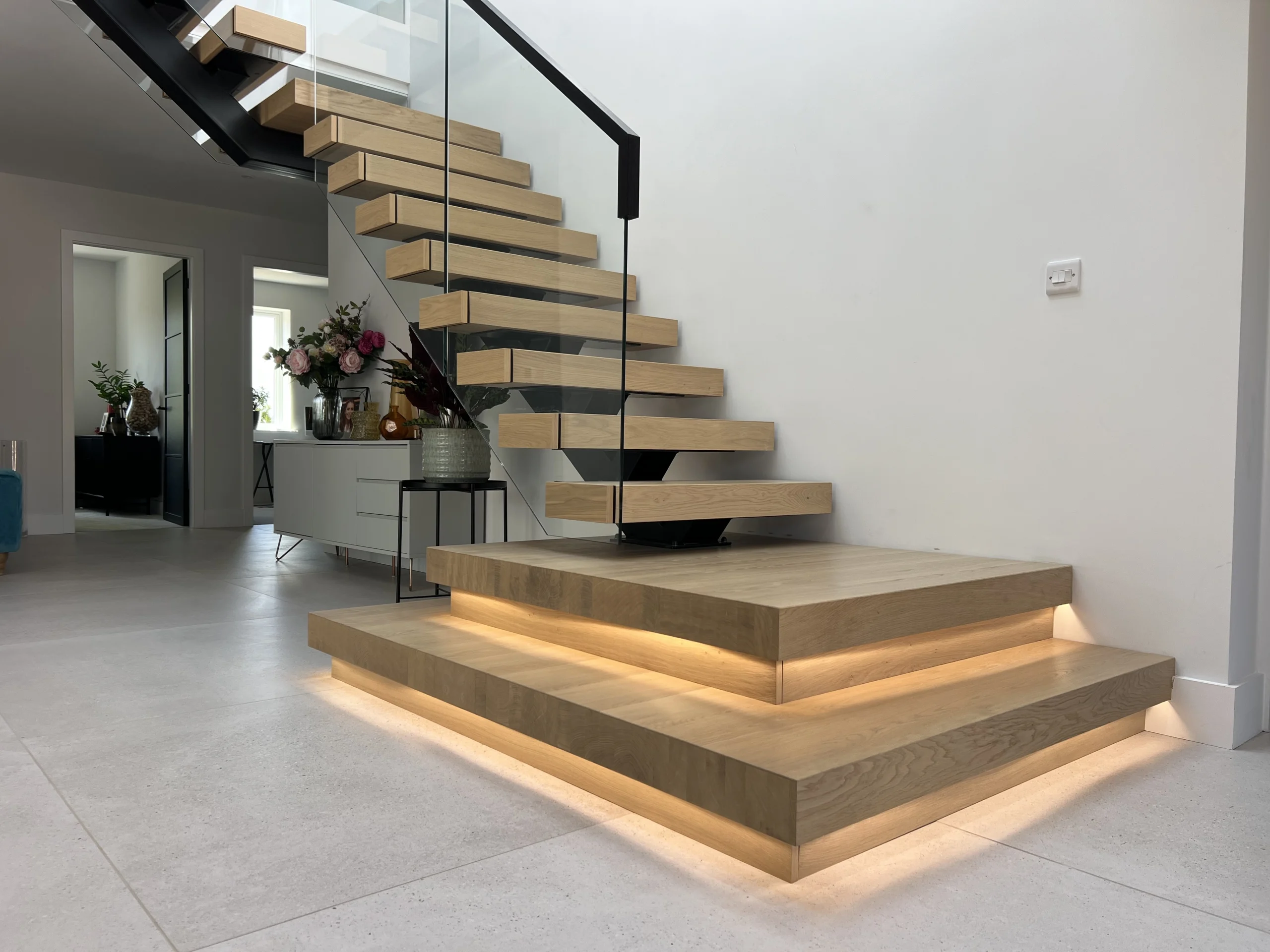
Continox central spine staircase engineered to CTE DB-SUA Sección 1 — uso restringido configuration, frameless glass balustrade 90cm height, oak treads 100mm thick
Spanish staircase design lives or dies by the CTE DB-SUA. Every modern staircase, balustrade and handrail in Spain — whether in a Marbella villa, a Madrid apartment building, a Barcelona office tower or a Mallorcan finca conversion — must satisfy the geometric, structural and accessibility requirements of Documento Básico SUA Sección 1 (Seguridad de Utilización y Accesibilidad — Sección 1: Seguridad frente al riesgo de caídas).
This guide covers everything Spanish architects and building professionals need to know: the two use classifications and how they affect dimensional limits; the regla de oro ergonomic formula and where it applies; balustrade height, sphere rule and climbability requirements; handrail (pasamanos) rules including when both sides are required; curved-tread geometry; and the major July 2024 update that introduced new accessibility comments currently in force.
For background on Continox's supply-only B2B model for Spain, see our Modern Staircase Spain hub. For region-specific pricing and project examples, see our Marbella & Costa del Sol guide. For the wider UK product range, see /modern-staircase/, /glass-balustrade/ and /external-staircase/.
What CTE DB-SUA Is — and Why It Governs Spanish Staircase Design
The Código Técnico de la Edificación (CTE) is Spain's national building code, established by Real Decreto 314/2006 of 17 March 2006 and modified multiple times since. Within the CTE, Documento Básico SUA — Seguridad de Utilización y Accesibilidad (Basic Document on Safety in Use and Accessibility) sets out the safety and accessibility requirements that buildings must satisfy to be granted Building Control approval.
Sección 1 of DB-SUA is dedicated to Seguridad frente al riesgo de caídas — the protection of building users against fall risks. This section governs not just staircases but also ramps, fixed ladders, mezzanine guarding and balcony balustrades. For staircase design specifically, the relevant articles are:
- Article 4.1 — staircases of uso restringido (restricted use)
- Article 4.2 — staircases of uso general (general use), including geometric, dimensional and operational requirements
- Article 3.2 — balustrades (barreras de protección) including height, climbability and sphere-rule provisions
- Article 4.2.4 — handrails (pasamanos)
Legal Framework — Why Compliance Is Non-Negotiable
CTE compliance is not optional, advisory or aspirational. Real Decreto 314/2006 establishes CTE as obligatory technical regulation for all buildings in Spain — new build, renovation, change of use, extension. Without demonstrated CTE compliance, a Spanish-registered arquitecto director de obra cannot sign off the Certificado Final de Obra, which means the building cannot be legally occupied, registered, or sold.
For staircases, this translates into a hard requirement: every step of every staircase in every Spanish building must satisfy DB-SUA Sección 1 dimensional limits. There is no "tolerance band". A huella of 21.5cm in a uso restringido application is non-compliant — even though it falls only 0.5cm short. The architect of record bears full legal responsibility for this verification.
Continox supplies bespoke staircases manufactured at our EN 1090-1 EXC2 facility near Kraków, Poland, delivered as intra-EU supply across Spain. Every staircase is dimensionally engineered to the specific use classification of the project — the technical pack we supply includes a CTE compliance schedule that the Spanish architect of record uses as evidence in the Building Control submission. See our Modern Staircase Spain hub for full system overview.
How DB-SUA Relates to Other CTE Sections
DB-SUA does not exist in isolation. For a complete staircase compliance schedule, an architect typically references:
- DB-SUA (Safety in Use & Accessibility) — geometric and balustrade requirements, this guide's focus
- DB-SI (Safety in Case of Fire) — Sección 3 governs evacuation widths; staircases serving as fire escape routes have stricter width requirements based on occupant load
- DB-SE (Structural Safety) — load combinations, including Eurocode-aligned variable loads on stair treads (typically 3.0 kN/m² uniformly distributed for residential, 4.0 kN/m² for commercial)
- DB-HR (Acoustic Protection) — relevant where staircases penetrate floor slabs in residential buildings
Use Classifications — Uso Restringido vs Uso General
The single most important decision in CTE staircase design is determining whether the staircase falls under uso restringido or uso general. The dimensional limits, ergonomic requirements and balustrade rules differ substantially between the two.
Uso Restringido — Restricted Use
An escalera de uso restringido is a staircase whose use is limited to a small, defined group of users in a private or controlled context. The most common application is the interior of a single dwelling (vivienda) — the staircase connecting ground floor to first floor inside a Marbella villa, a Madrid duplex or a Mallorcan finca falls into this category.
Other typical uso restringido applications:
- Service staircases (escaleras de servicio) — used only by maintenance or staff, not the public
- Internal staircases in commercial offices connecting two floors used by the same tenant (some interpretations apply)
- Mezzanines within a single dwelling
The dimensional requirements per DB-SUA Article 4.1 are:
Uso Restringido — Dimensional Limits
- Anchura mínima (minimum width): 80 cm
- Contrahuella máxima (maximum riser): 20 cm
- Huella mínima (minimum tread): 22 cm
- Ergonomic relation: NOT mandatory (recommended but not required)
- Open risers: PERMITTED (provided projection of upper tread overlaps lower by ≥2.5 cm)
- Curved sections: huella ≥5 cm at narrow side, ≤44 cm at wide side
- Min steps per flight: 3
Uso General — General Use
An escalera de uso general is a staircase serving a building zone open to the public, to multiple tenants, or to undefined groups of users. This includes:
- Communal staircases in apartment blocks (zonas comunes de uso Residencial Vivienda)
- All staircases in commercial, sanitary or public buildings
- All staircases in schools, kindergartens and care facilities
- Staircases in hotels, restaurants, retail and public concurrence venues
- External public staircases serving more than one dwelling
The dimensional requirements per DB-SUA Article 4.2 are substantially stricter:
Uso General — Dimensional Limits
- Anchura mínima (minimum width): 100 cm (residential common); 120 cm (commercial & public concurrence); 120–140 cm (sanitary)
- Contrahuella: 13 cm minimum, 18.5 cm maximum (17.5 cm where no lift alternative exists)
- Huella: 28 cm minimum (straight flights)
- Ergonomic relation: 54 ≤ 2C + H ≤ 70 cm (mandatory)
- Open risers: NOT permitted in general use; risers must be continuous, no bocel
- Curved sections: huella ≥28 cm at 50 cm from inner edge, ≤44 cm at outer edge
- Min steps per flight: 3
- Max rise per flight: 3.20 m (with lift alternative); 2.25 m (public zones, no lift alternative)
Why the Distinction Matters in Practice
For a typical Marbella villa staircase, uso restringido applies — the staircase is internal to a single dwelling, used by the family and guests of that household only. This is why Continox can supply floating central spine staircases with open treads, slim 100mm tread profiles and frameless glass balustrades in luxury villa applications: the open-riser configuration that would be illegal in a uso general staircase is fully compliant under uso restringido.
For a Madrid apartment building common stair, uso general applies — the staircase is used by residents of multiple dwellings plus visitors, postal workers, delivery personnel etc. This means closed risers, ≥28 cm tread depth, ergonomic ratio compliance, and minimum 100 cm width. Most modern villa-style floating staircases cannot be specified in uso general applications.
The classification depends on how the staircase is used, not where it is located physically. A staircase inside a luxury villa serving only the homeowners is uso restringido. The same physical staircase, placed in a hotel suite where guests rotate, becomes uso general. Continox engineers determine classification jointly with the project's architect of record before design begins.

U-shape central spine staircase configured for uso restringido — huella 26 cm, contrahuella 17.5 cm, anchura 110 cm, frameless glass balustrade 90 cm
Geometric Requirements — Huella, Contrahuella & Ergonomic Formula
The geometric heart of CTE DB-SUA is the relationship between huella (tread depth — the horizontal walking surface) and contrahuella (riser height — the vertical face between treads). The dimensional limits and the ergonomic formula together define what a "comfortable, safe staircase" means in Spanish regulation.
Measurement Conventions per Article 4.2.1.1
How huella and contrahuella are measured is itself regulated. Common errors arise from mismeasurement:
- Huella is measured in the direction of travel — the horizontal projection of the foot's path on each tread
- Huella does NOT include the projection of the upper tread — overhang from the step above does not count toward the dimension below
- Contrahuella is measured vertically — from finish surface of one tread to finish surface of the next
- Width is measured between walls or balustrades — handrails do not reduce the measured width provided they protrude no more than 12 cm into the space
- In curved sections, huella is measured at the staircase axis if width <1 m, or at 50 cm from the narrow edge if width ≥1 m
The Ergonomic Formula — Regla de Oro
For uso general staircases, the relationship between contrahuella (C) and huella (H) must satisfy:
54 cm ≤ 2C + H ≤ 70 cm
This is the legal range. Some Spanish technical sources cite a tighter "regla de oro" of 60 ≤ 2C + H ≤ 64 cm as best practice — this is the comfort range that minimises trip risk and matches average adult stride length, but the legally enforceable limit is 54–70 cm.
The formula is grounded in human gait research: 2C + H approximates one stride length. A stride that's too short (2C+H < 54) produces excessively shallow steps and increased perceived exertion. A stride too long (2C+H > 70) creates risers too tall for a single comfortable step, increasing fall risk especially when descending.
Worked Examples — Spanish Villa Staircases
Two real Continox project specifications illustrating CTE-compliant geometry — see our Marbella supply guide for additional Costa del Sol project examples and pricing:
| Parameter | Sierra Blanca Villa (Marbella) | Pedralbes Apartment Block (Barcelona) |
|---|---|---|
| Use classification | Uso restringido | Uso general (residential common) |
| Huella (H) | 26 cm (≥22 OK) | 30 cm (≥28 OK) |
| Contrahuella (C) | 17.5 cm (≤20 OK) | 17 cm (13–18.5 range OK) |
| 2C + H | 61 cm (in golden range, recommended) | 64 cm (in golden range, mandatory) |
| Anchura | 110 cm (≥80 OK) | 120 cm (≥100 OK) |
| Risers | Open (Continox floating central spine — permitted) | Closed (continuous risers — required) |
| Tread thickness | 100 mm solid oak (Continox standard) | 100 mm solid oak (Continox standard) |
Both projects supplied by Continox — supplied as intra-EU B2B from EN 1090-1 EXC2 facility near Kraków
Consistency Within a Staircase
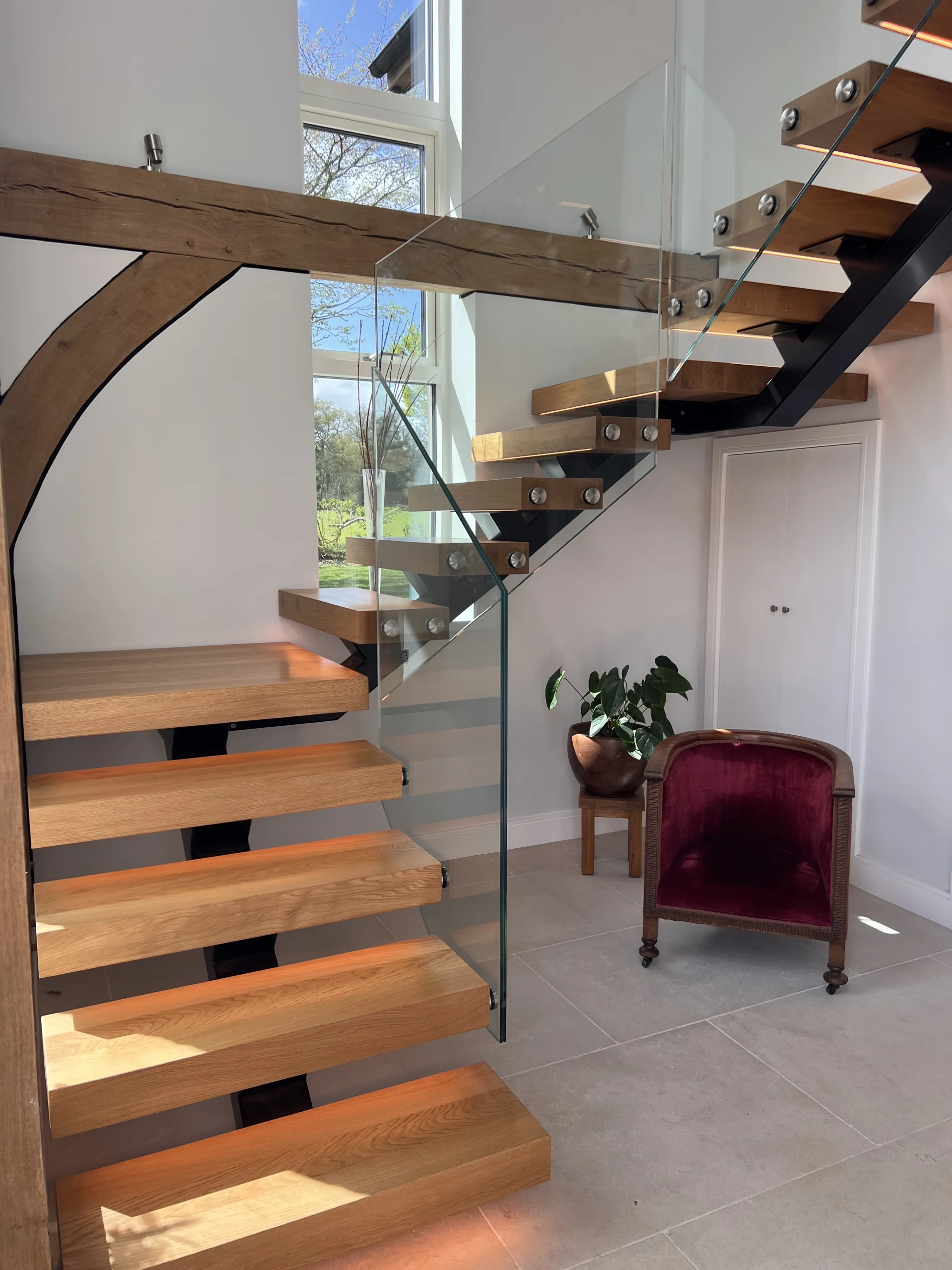
CTE-compliant central spine staircase with uniform geometry — huella and contrahuella consistent across all flights per Article 4.2.2
DB-SUA Article 4.2.2 requires uniformity within and between flights:
- All steps in straight flights must have identical huella
- All steps in a single staircase must have identical contrahuella
- Between two consecutive flights serving different floors, contrahuella variation must not exceed 1 cm (effectively requiring identical risers throughout multi-storey staircases)
- In mixed straight-curved flights, the huella measured on the axis in curved sections must not be less than the huella in the straight sections
Width, Pitch & Maximum Rise per Flight
Minimum Widths by Use
The minimum useful width (anchura útil) of a staircase tramo (flight) is determined by occupant evacuation requirements per DB-SI Sección 3, plus the minimums in DB-SUA Article 4.2.2.4 Tabla 4.1:
| Use Type | Minimum Width | Notes |
|---|---|---|
| Uso restringido (villa interior) | 80 cm | Single dwelling internal use only |
| Residential common (apartment block stairs) | 100 cm | Standard zonas comunes |
| Commercial & public concurrence | 120 cm | Retail, hospitality, offices with public access |
| Schools (primary & secondary) | 120 cm | Plus straight flights only |
| Sanitary (clinics, hospitals) | 120–140 cm | 140 cm in hospitalisation/intensive treatment zones |
Source: CTE DB-SUA Sección 1 Tabla 4.1 (with cross-reference to DB-SI Sección 3)
For evacuation calculations, the actual width may need to be larger than the table minimum — the architect of record performs the DB-SI evacuation flow calculation based on occupant load and confirms which figure governs.
Maximum Rise per Flight
DB-SUA Article 4.2.3 limits the height a single tramo (flight, between landings) may climb:
- 3.20 m maximum in general cases — i.e. when a lift is provided as alternative to the staircase
- 2.25 m maximum in public zones, in schools (primary/secondary), and whenever no lift alternative exists
- 2.10 m maximum in kindergartens, primary schools and buildings primarily used by elderly people
For taller stair runs, intermediate mesetas (landings) are required. Each landing must be at least the width of the staircase, with depth ≥1 m for straight runs (≥1.20 m if a 180° turn occurs, ≥1.60 m in hospitalisation zones with 180° turns).
Minimum Steps per Flight
Each flight must contain at least 3 peldaños (steps). Single-step or two-step flights are not permitted because they create an unexpected level change that significantly increases trip risk. Where a level change is small, ramps or single steps with high-contrast nosing must be used instead, designed under separate ramp provisions.
Tread Edge Treatment — No Bocel
DB-SUA Article 4.2.1.4 prohibits bocel — the rounded or projecting edge profile sometimes added decoratively to step nosings. Treads must have a square or chamfered edge with no projection beyond the riser plane.
For uso general and evacuation staircases, risers must be continuous and vertical (or inclined ≤15° from vertical). Open-tread (no riser) configurations are not permitted in evacuation routes.

L-shape staircase with quarter landing — meseta dimensions per Article 4.2.3 (≥1.20 m for 180° turns), max rise per flight 3.20 m
Balustrade Requirements — Height, Sphere Rule & Climbability
Balustrades (barreras de protección) are governed by DB-SUA Article 3.2. The provisions cover height, structural resistance, sphere-rule penetration and — critically — climbability prevention in residential and child-frequented buildings. Similar provisions apply to balcony railings and external staircases serving primary access roles.
Minimum Height
Balustrade height is measured vertically from the walking surface (or, on a staircase, from the line of inclination connecting the tread nosings) to the top of the protective barrier:
| Application | Minimum Height |
|---|---|
| Standard staircase & landing balustrade (fall <6 m) | 90 cm |
| Balustrade where fall ≥6 m | 110 cm |
| Window protection (specific provisions in Article 3.2.1) | varies |
For most domestic and commercial staircase applications, the 90 cm minimum balustrade height applies. This is the dimension Continox designs to as standard for villa applications. For luxury villas with double-height stairwells where the ground-to-balcony fall exceeds 6 m, balustrades upgrade to 110 cm minimum.
Sphere Rule — Maximum Opening
DB-SUA Article 3.2.3.1.b is the famous "Ø10 cm sphere rule". No opening within a balustrade may admit a sphere of diameter greater than 10 cm. This regulation exists to prevent small children from passing their head through balustrade openings — the head, being the body's largest fixed-diameter element, is the limiting factor.
The rule applies throughout the balustrade: between vertical balusters, between horizontal rails, between the bottom rail and the floor, between mid-rails, and between the top rail and any wall or ceiling. The 10 cm diameter is checked using a physical or digital sphere model at every accessible opening.
The triangular opening formed by the underside of the handrail, the contrahuella and the huella (the gap between the bottom of the staircase balustrade and the steps below) is exempt from the Ø10 cm rule, provided the distance between the handrail's lower edge and the inclined line of the staircase does not exceed 5 cm. This exception accommodates standard staircase geometry where the balustrade follows the stair pitch.
Climbability Prevention
In residential buildings, schools and zones frequented by children, balustrades have additional design requirements per DB-SUA Article 3.2.3.1.a — they must not be "easily climbable":
- In the height band 30–50 cm above floor level (or stair line of inclination), there must be no points of support or projections greater than 5 cm
- In the height band 50–80 cm, there must be no projections with a substantially horizontal surface greater than 5 cm in depth (which a child could stand on)
This rule is why horizontal balustrade bars are typically prohibited in residential applications — they create a "ladder" effect children can climb. Vertical balusters or full-height frameless glass panels are the compliant alternatives.
Glass Balustrade Specifications
For frameless glass balustrades (Continox's signature villa specification), the glass itself must be:
- Tempered laminated glass — typically 2× 8mm tempered with 1.52mm SGP or PVB interlayer (16+ mm total) for free-standing applications
- Compliant with EN 14449 (laminated glass) and EN 12150 (tempered glass)
- Engineered to withstand horizontal line load per DB-SE-AE Article 3.2.1 (for residential balustrades, 0.8 kN/m horizontally applied at handrail height)
- Detailed with structural calculations signed by a Chartered Structural Engineer — Continox supplies these as part of the technical pack for every project
For more on frameless glass balustrade engineering, see our Glass Balustrade page covering frameless from £450/m, framed from £350/m, and external from £450/m.

Frameless glass landing balustrade with oak handrail — 90 cm height per DB-SUA Article 3.2, no climbable horizontal projections, Ø10 cm sphere rule satisfied throughout
Need a CTE-Compliant Staircase for Your Spanish Project?
Continox supplies bespoke modern staircases manufactured at our EN 1090-1 EXC2 facility near Kraków, delivered as intra-EU supply across Spain. Every staircase ships with a full CTE compliance schedule.
Get Free QuoteHandrail (Pasamanos) — When Required, Height & Continuity
Handrail provisions in DB-SUA Article 4.2.4 govern when a handrail is required, on which side(s), what height it must be installed, and how it must be detailed for grip, continuity and end conditions.
When a Handrail Is Required
- All staircases of uso general — handrail mandatory on at least one side
- Staircases with anchura > 120 cm — handrail mandatory on both sides
- Accessible itineraries (staircases serving as part of an accessible route per DB-SUA Article 1.1.9) — handrail mandatory on both sides regardless of width
- Staircases with anchura > 4 m — additional intermediate handrails required, max 4 m separation between handrails
- Uso restringido (villa interior) — handrail recommended but not strictly required by code; in practice always specified
Height & Geometry
Pasamanos — Dimensional & Detail Requirements
- Height: 90 cm to 110 cm above the line of inclination (tread nosings)
- Wall separation: minimum 4 cm clearance between handrail and wall
- Continuity: handrail must be continuous through landings and changes of direction
- End extension: handrail must extend 30 cm horizontally beyond the top and bottom of the staircase (to give users a continuous reference point)
- Profile: the section must be "easy to grip" — typically circular or oval, ~4–5 cm diameter, ergonomically shaped
- Surface: smooth, no sharp edges or interruptions; mounting brackets must not interfere with grip
- Wall protrusion limit: pasamanos can protrude maximum 12 cm into the staircase width without reducing the calculated useful width
Accessible Staircases — Stricter Requirements
For staircases forming part of an itinerario accesible (accessible route), handrails have additional provisions:
- Handrail on both sides regardless of staircase width
- Two-height handrails recommended — one at 90–110 cm (standard adult), one at 65–75 cm (children, wheelchair users)
- Strong contrast between handrail and surrounding wall/balustrade
- Tactile indication at start and end of staircase (Braille or embossed signage)
Curved Staircases & Special Configurations
Curved-Tread Geometry
For curved staircases, the variable tread depth across the width creates a geometric challenge. CTE DB-SUA addresses this in Article 4.2.1.3:
- Minimum huella at narrow side: 5 cm (uso restringido) or governed by the use general formula evaluated at the measurement axis
- Maximum huella at wide side: 44 cm
- Measurement axis: at the centreline if the staircase width is <1 m; at 50 cm from the inner edge if width ≥1 m
- The ergonomic formula 54 ≤ 2C+H ≤ 70 must be satisfied at 50 cm from both extreme edges of the curved section (uso general)
- Useful width on curves: zones where the tread is <17 cm at the inner edge are excluded from the useful width calculation
For Continox spiral and curved-tread designs, this typically means the inner radius is dimensioned so that the 17 cm tread depth is achieved at a comfortable wall offset — for villa applications, this usually requires inner radius ≥40 cm depending on tread width.
Mixed Straight-Curved Flights
Where a flight transitions from straight to curved (a common configuration in U-shape staircases at a quarter or half landing), the huella measured at the staircase axis on the curved portion must be ≥ the huella on the straight portion. This prevents users from encountering a sudden shallowing of the tread at the transition point.
Spiral Staircases — Tipo Caracol
Pure spiral staircases (tipo caracol) — where every tread is curved, rotating around a central pole — are highly restricted in CTE applications:
- Permitted in uso restringido (villa interior) within geometric limits
- Permitted as escaleras de servicio (service staircases used by limited authorised personnel)
- NOT permitted as the primary staircase in uso general applications
- NOT permitted as a fire evacuation route per RD 486/97
Continox does not specify spiral staircases for villa applications because the geometric constraints rarely produce a comfortable, safe staircase by modern luxury residential standards. Our central spine systems achieve the visual lightness clients want from a "spiral" without the regulatory restrictions.

Y-shape central spine staircase — La Zagaleta-class villa specification with curved-transition flights satisfying Article 4.2.1.3 (huella ≥5 cm narrow side, ≤44 cm wide side)
Recent Updates — DB-SUA July 2024 Comments & Coming Changes
The CTE DB-SUA was significantly updated in July 2024 with new official commentary clarifying ambiguous provisions. The 15 July 2024 update is currently the operative legal reference point, supplemented by the public consultation (audiencia pública) on the Real Decreto modifying DB-SUA, which was open until 9 December 2025.
July 2024 Update — Key Clarifications
The July 2024 update did not change the dimensional limits but added official Ministry of Transport, Mobility and Urban Agenda commentary on application questions that had created interpretation disputes. Key clarifications:
- "Lift alternative" definition — for the contrahuella ≤17.5 cm rule, "lift as alternative to staircase" does not require the lift to be physically adjacent; it must merely be usable as an alternative under normal conditions
- Open-riser exemption boundary — confirmed that the Ø10 cm sphere rule does NOT apply to open-tread gaps in uso restringido staircases (subject to the 2.5 cm projection overlap)
- Curved-tread axis measurement — clarified that the 1 m width threshold for measurement-axis selection is measured perpendicular to the line of motion, not absolute
- Handrail extension at top of stairs — the 30 cm horizontal extension applies even where a wall or column makes physical extension difficult; alternative compliant detailing is required
UNE-EN 81-70:2022+A1 — Lift-Stair Coordination
From 21 February 2025, UNE-EN 81-70:2022+A1 became applicable for lifts in residential buildings. While not directly modifying DB-SUA staircase rules, it tightens the relationship between lift accessibility and staircase requirements — particularly affecting the "lift as alternative" provision discussed above.
Coming Changes — RD Modifying DB-SUA (Audiencia Until December 2025)
A Real Decreto modifying DB-SUA was in audiencia pública (public consultation) until 9 December 2025. This RD transposes EU Directive 2024/1275 (energy performance of buildings recast) and includes some accessibility-related accompanying changes. Publication of the modifying Real Decreto is expected following the conclusion of the audiencia pública review.
Key proposed changes affecting staircases:
- Strengthened accessibility requirements for renovations (obras de reforma) in residential buildings being upgraded for energy performance
- Clearer integration of staircase compliance with the Libro del Edificio (Building Logbook) requirements
- Possible introduction of mandatory two-height handrails in additional contexts
Continox monitors all CTE updates and adjusts our standard compliance schedule accordingly. Architects working with us are advised on any provisions affecting their specific project at the design phase.
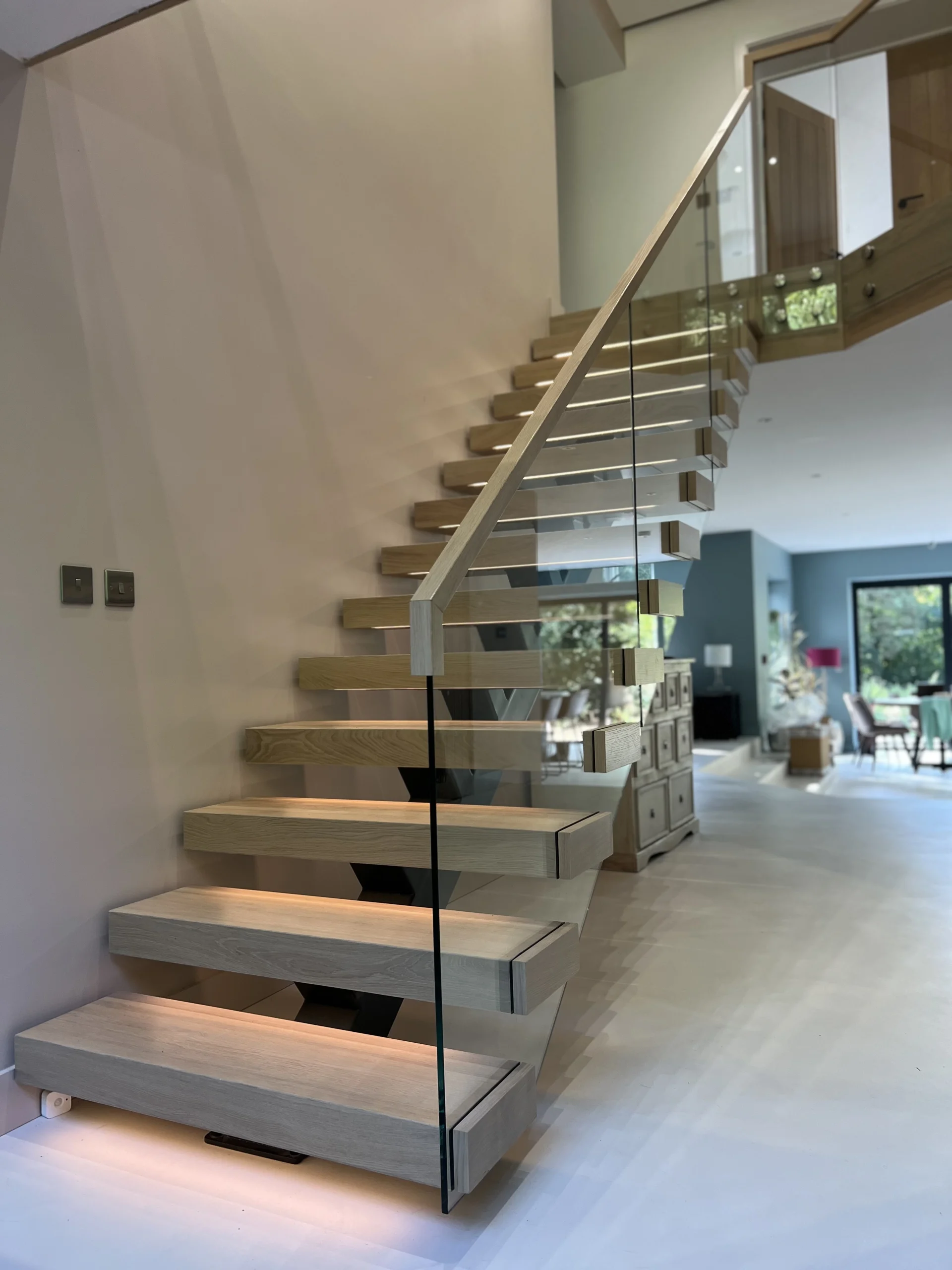
Bespoke oak spine staircase with LED tread lighting — engineered to current CTE DB-SUA July 2024 update, ready for any compliance updates following the recent audiencia pública review
CTE DB-SUA vs UK Approved Document K — Comparison Table
Continox is a UK-based design studio supplying staircases across Spain. Architects sometimes ask how the Spanish CTE DB-SUA differs from the UK Approved Document K (Buildings Regulations Approved Document K — Protection from falling, collision and impact). The comparison below covers the key dimensional and detailing differences:
| Parameter | CTE DB-SUA (Spain) | UK Approved Document K |
|---|---|---|
| Private dwelling — min huella/going | 22 cm (uso restringido) | 22 cm (private staircase) |
| Private dwelling — max contrahuella/rise | 20 cm (uso restringido) | 22 cm (private staircase) |
| Public — min huella/going | 28 cm (uso general) | 25 cm (public, Cat 1) / 28 cm (Cat 2) |
| Public — max contrahuella/rise | 18.5 cm (uso general, with lift) | 17 cm (public) |
| Ergonomic formula | 54 ≤ 2C+H ≤ 70 cm (mandatory uso general) | 2R+G between 550 and 700 mm (recommended) |
| Min width — private dwelling | 80 cm | 800 mm (effectively same) |
| Min width — public | 100 cm (residential common) / 120 cm (commercial) | 1000 mm (commercial & institutional) |
| Balustrade height — staircase | 90 cm minimum | 900 mm (effectively same) |
| Sphere rule | Ø10 cm | 100 mm (effectively same) |
| Open risers permitted | Uso restringido yes (with 2.5 cm overlap); uso general no | Yes (with 100 mm sphere rule applied to riser gap) |
| Max rise per flight | 3.20 m (with lift) / 2.25 m (no lift) | 16 risers max (commercial) |
| Min steps per flight | 3 | 3 (recommended) |
| Handrail height | 90–110 cm | 900–1000 mm (effectively same) |
Comparison: CTE DB-SUA Sección 1 vs UK Approved Document K Section 1 (private & common staircases)
Key Practical Differences
For an architect transitioning from UK practice to Spanish projects, the main practical differences to internalise:
- The two-class system (uso restringido vs uso general) is cleaner than the UK's three-category system (private / utility / general access — Cat 1, 2, 3)
- The ergonomic formula is mandatory in uso general CTE applications, where the UK equivalent is recommendation only
- Spanish risers are permitted slightly higher in private dwellings (20 cm CTE vs 22 cm UK — actually CTE is stricter here)
- Spanish public stair tread is 28 cm minimum vs UK 25 cm minimum (Cat 1) — Spain is stricter
- Open risers in uso general are categorically prohibited in Spain; UK allows them under sphere-rule compliance

Premium Continox specification — UK design heritage combined with CTE DB-SUA engineering for Spanish market, manufactured at our EN 1090-1 EXC2 facility near Kraków
How Continox Engineers Staircases to CTE Compliance
Every Continox staircase supplied to Spain is engineered to satisfy CTE DB-SUA Sección 1 from the design phase. The process integrates dimensional engineering, structural calculation and documentation into a single compliance package:
Step 1 — Use Classification Confirmation
At the project enquiry stage, Continox engineers confirm with the architect of record whether the staircase is uso restringido (villa interior, single dwelling) or uso general (residential common, commercial, public). This drives all subsequent geometric decisions. See our project portfolio for completed villa and commercial examples.
Step 2 — Geometric Design
Using the project's stairwell dimensions and floor-to-floor height, our engineers calculate the optimal huella/contrahuella combination satisfying the applicable CTE requirements. For uso general projects, we deliberately design within the regla de oro 60 ≤ 2C+H ≤ 64 cm comfort range rather than just the legal 54–70 envelope.
Step 3 — Structural Calculation
All Continox staircases are structurally engineered by a UK Chartered Structural Engineer (IStructE), working to the Eurocode framework (EN 1990, EN 1991, EN 1993) which is fully recognised in Spain. The structural calculations cover:
- Variable load on treads (3.0 kN/m² residential, 4.0 kN/m² commercial)
- Concentrated point load on treads (2.0 kN at midspan)
- Horizontal balustrade line load (0.8 kN/m residential, 3.0 kN/m public concurrence)
- Frameless glass balustrade engineering per EN 14449 and EN 12150
- Connection design including substrate fixing schedule
Step 4 — Manufacturing & CE Marking
Steel components are fabricated at our EN 1090-1 EXC2 certified facility near Kraków, covering CE marking and Declaration of Performance per EU Construction Products Regulation 305/2011. Every staircase ships with the marcado CE plate fitted and the DoP packaged with the technical pack.
Step 5 — Technical Pack with CTE Compliance Schedule
Each project ships with a technical pack containing:
- 3D visualisations (DWG, PDF, STEP for BIM coordination)
- Detailed shop drawings with dimensional schedule
- Structural calculations signed by IStructE
- CTE DB-SUA compliance schedule — line-by-line confirmation of how each provision is satisfied
- CE marking documentation and Declaration of Performance
- Glass certificates (EN 14449 & EN 12150 compliance)
- Material certificates for steel and timber components
Step 6 — Liability Separation
Continox supplies components and supporting technical documentation against the architect-approved 3D design and project-supplied dimensions. Final compliance verification, Building Control acceptance and Certificado Final de Obra remain the legal responsibility of the project's Spanish-registered arquitecto director de obra and arquitecto técnico. The CTE compliance schedule provides evidence; the certifying architect signs the formal compliance statement.
FAQ — Architect Questions Answered
What is CTE DB-SUA Sección 1 and why does it matter?
CTE DB-SUA Sección 1 (Documento Básico, Seguridad de Utilización y Accesibilidad — Sección 1: Seguridad frente al riesgo de caídas) is the Spanish building code section that governs staircase, ramp and balustrade safety. It sets dimensional minimums, ergonomic requirements and balustrade rules that every staircase in every Spanish building must satisfy. Compliance is verified by the architect of record before the Certificado Final de Obra can be signed.
What's the difference between uso restringido and uso general?
Uso restringido covers staircases used by a small, defined group — typically the interior of a single dwelling. Limits: huella ≥22 cm, contrahuella ≤20 cm, anchura ≥80 cm, no mandatory ergonomic formula, open risers permitted. Uso general covers staircases serving the public or multiple groups (apartment commons, commercial, hospitality). Limits: huella ≥28 cm, contrahuella 13–18.5 cm, anchura ≥100 cm, mandatory ergonomic ratio 54 ≤ 2C+H ≤ 70 cm, no open risers.
Does the ergonomic formula 2C+H apply to villa staircases?
Strictly, no. The 54 ≤ 2C+H ≤ 70 cm formula is mandatory only for uso general staircases. For uso restringido (villa interior), it is recommended but not required by code. In practice Continox always designs to the formula's comfort range (60–64 cm) regardless of classification, because it produces measurably more comfortable staircases that clients perceive as higher quality.
Are open-tread floating staircases legal in Spain?
Yes — in uso restringido applications (villa interiors, single dwellings). DB-SUA Article 4.1 explicitly permits open risers provided the projection of the upper tread overlaps the lower tread by at least 2.5 cm. This is why Continox can supply our floating central spine staircases with open treads to Marbella, Sotogrande, Mallorca and other villa markets. In uso general (apartment commons, commercial), open risers are not permitted.
What is the minimum balustrade height in Spain?
90 cm minimum for standard staircase and landing balustrades where the fall height is less than 6 m. For balustrades where the fall exceeds 6 m (typical of double-height stairwells in luxury villas), the minimum increases to 110 cm. The Ø10 cm sphere rule applies throughout: no opening anywhere in the balustrade may admit a sphere of 10 cm diameter. The triangular gap between handrail underside and stair pitch is exempt provided clearance is ≤5 cm.
Can I use horizontal bars in a residential balustrade?
Generally no, in residential applications and zones frequented by children. DB-SUA Article 3.2.3.1.a prohibits balustrade configurations that are "easily climbable" — specifically, between heights of 30 cm and 50 cm above the floor (or stair line of inclination), no projections greater than 5 cm are permitted. Horizontal bars create a ladder effect that fails this test. Vertical balusters or full-height frameless glass panels are the compliant alternatives.
When is a handrail required on both sides of a staircase?
DB-SUA Article 4.2.4 requires handrails on both sides when the staircase width exceeds 120 cm, or when the staircase forms part of an accessible itinerary regardless of width. Below 120 cm width and outside accessible routes, a single handrail is permitted. For uso restringido (villa interior), handrails are not strictly mandated by code but are universal in practice. Continox supplies handrail-ready interfaces on all systems.
Does the CTE specify what tread thickness is required?
No — CTE DB-SUA does not specify tread thickness directly. Tread thickness is governed by structural requirements under DB-SE and Eurocode. For Continox solid oak or walnut treads, our standard is 100 mm (occasionally 120 mm for extra-long cantilevered configurations) — a thickness chosen for structural robustness, acoustic performance, and the visual heft expected in luxury villa applications. Thinner treads (40 mm steel-plate composite) are sometimes specified by other suppliers; Continox does not supply these as standard.
What's the maximum height a single flight can climb?
3.20 m maximum where a lift is provided as alternative to the staircase. 2.25 m maximum in public zones, in primary and secondary schools, and wherever no lift alternative exists. 2.10 m maximum in kindergartens and buildings primarily used by elderly people. For greater heights, intermediate landings (mesetas) are required. Each flight must contain at least 3 steps (single-step or two-step flights are not permitted).
How does Continox handle CTE compliance for Spanish projects?
Every Continox staircase supplied to Spain ships with a CTE DB-SUA compliance schedule prepared by our structural team — line-by-line confirmation of how each provision is satisfied. The technical pack includes 3D visualisations, structural calculations signed by a UK Chartered Structural Engineer (IStructE), CE marking documentation per EU Reg 305/2011, glass certificates per EN 14449 and EN 12150, and material certificates. Final compliance verification and Certificado Final de Obra remain the legal responsibility of the project's Spanish-registered arquitecto director de obra and arquitecto técnico.
Specifying a Modern Staircase for Your Spanish Project?
Continox supplies CTE DB-SUA-compliant bespoke modern staircases across Spain — designed in the UK, manufactured at our EN 1090-1 EXC2 facility near Kraków, delivered as intra-EU supply. From €7,999 supply-only. Free 3D visualisation, fixed-price quote within 48 hours, full technical pack with structural calculations and CTE compliance schedule.
Get Free QuoteCitations & References
- Real Decreto 314/2006 of 17 March 2006 approving the Código Técnico de la Edificación (modified subsequently)
- Documento Básico SUA — Seguridad de Utilización y Accesibilidad, 15 July 2024 update with comments — Ministerio de Transportes, Movilidad y Agenda Urbana
- DB-SUA Sección 1, Articles 3.2 (Balustrades) and 4.1, 4.2 (Staircases)
- DB-SI Sección 3 — Evacuation route requirements (cross-reference for staircase widths)
- DB-SE-AE — Variable loads on staircases and balustrades
- EN 1090-1 — Execution of steel structures, EXC2 certification
- EN 14449 — Glass in building, laminated glass
- EN 12150 — Glass in building, thermally toughened soda lime silicate safety glass
- EU Construction Products Regulation 305/2011 — CE marking framework
- UNE-EN 81-70:2022+A1 — Lift accessibility (applicable from 21 February 2025)