

Private vs Multi-Family vs Commercial Staircase in Switzerland — Classification & What Changes
The three-tier classification that drives Swiss staircase specification — Wohnbau privat, Treppenhaus mehrfamilienhaus, and Öffentlich zugängliche Bauten. How dimensional rules, fire safety (Brandschutz), accessibility (SIA 500) and Baubehörde inspection differ across the three categories.
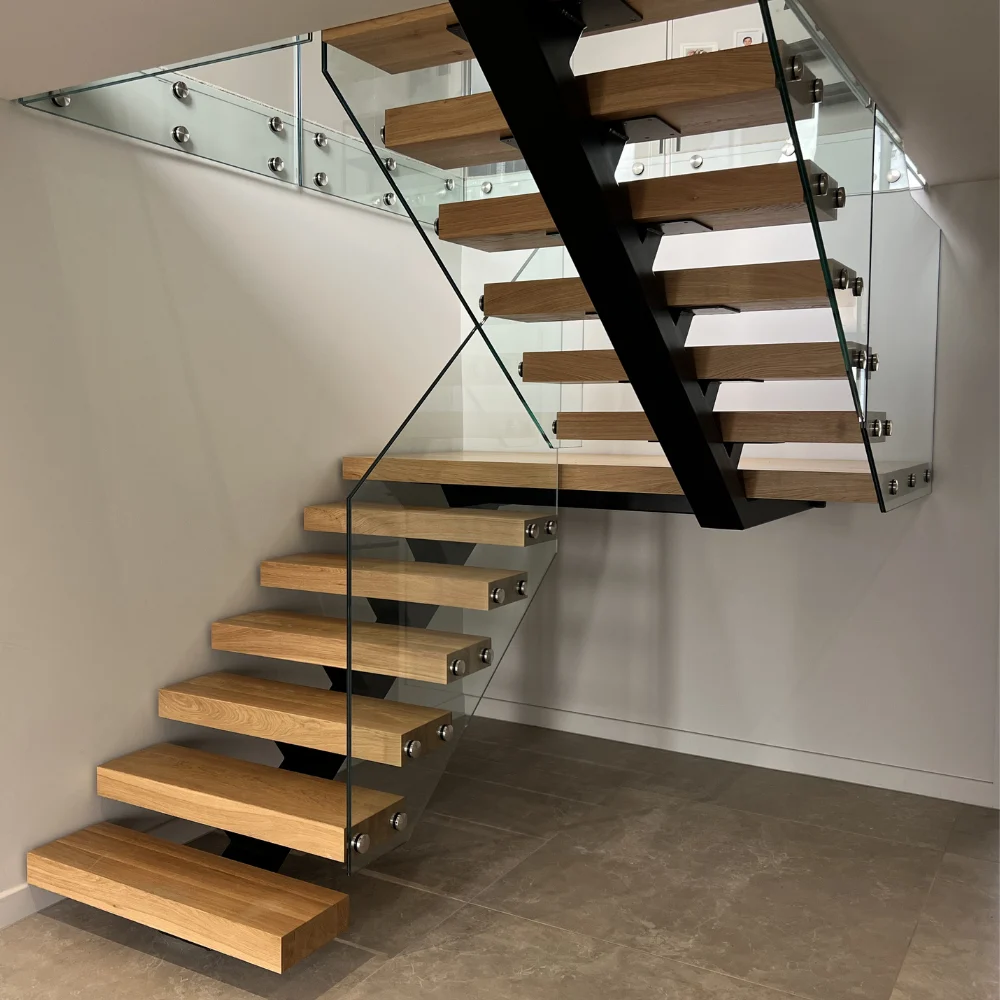
U-shape central spine staircase suitable for multi-family Treppenhaus (common stair) — 1.0 m clear width, both-side handrails, SIA 500-compatible 17 cm riser specification.
The single most important question that drives Swiss staircase specification is not "what does it look like?" or "what does it cost?" but: what is the building's classification? The answer determines almost everything else — dimensional rules, fire safety enclosure (Brandschutz), accessibility obligations (SIA 500), inspection process and Baubehörde dossier requirements. The same villa can sit happily within the residential framework while a project across the street with shared common stairs falls under tighter multi-family rules; a boutique commercial space adjoining the same block follows a third, stricter framework again.
This guide is the practical decision framework for Continox Switzerland projects across the three classification tiers — covering when each applies, the dimensional and structural differences, fire safety implications, and the documentation pack needed for each. For the broader regulatory framework see our SIA standards guide. We supply floating cantilever, central spine and fully bespoke configurations across all three classifications, along with matching glass balustrades, balcony railings and external staircases.
Three Swiss staircase classifications: Wohnbau privat (private residential — single-family villa or inside individual apartment, max riser 20 cm, min width 80 cm, single handrail sufficient), Treppenhaus mehrfamilienhaus (multi-family common stair — max riser 18 cm, min width 100 cm, both handrails, fire-rated enclosure required, SIA 500 typically applies), and Öffentlich zugängliche Bauten (public/commercial — max riser 17 cm, min width 120 cm, both handrails plus 30 cm extensions, full SIA 500 + Brandschutz BSV/AEAI compliance). Continox supplies all three classifications with class-specific documentation pack.
- The Three-Tier Classification Framework
- Wohnbau privat — Private Residential
- Treppenhaus mehrfamilienhaus — Multi-Family Common
- Öffentlich zugängliche Bauten — Commercial & Public
- Side-by-Side Comparison Table
- Fire Safety (Brandschutz BSV/AEAI)
- When SIA 500 Triggers
- Decision Framework — Practical Walkthrough
- Frequently Asked Questions
The Three-Tier Classification Framework
Swiss staircase classification operates on three tiers — each with its own dimensional rules, structural loading, accessibility obligations and Brandschutz requirements:
Wohnbau privat
- Application: single-family villa, inside individual apartment
- Riser max: 20 cm
- Tread min: 24 cm
- Width min: 80 cm
- Handrails: one side
- SIA 500: not mandatory (voluntary)
- Brandschutz: minimal — household alarm only
- Imposed load: 3.0 kN/m²
Treppenhaus mehrfamilienhaus
- Application: multi-family common stair (shared)
- Riser max: 18 cm
- Tread min: 26 cm
- Width min: 100 cm
- Handrails: both sides
- SIA 500: mandatory in most cantons
- Brandschutz: fire-rated enclosure (Brandabschnitt)
- Imposed load: 3.0 kN/m² + service load
Öffentlich zugängliche Bauten
- Application: commercial, public, office, retail
- Riser max: 17 cm
- Tread min: 28 cm
- Width min: 120 cm
- Handrails: both sides + 30 cm extensions
- SIA 500: mandatory
- Brandschutz: full BSV/AEAI compliance + escape route certification
- Imposed load: 4.0–5.0 kN/m²
Wohnbau privat — Private Residential
Wohnbau privat covers single-family villas (Einfamilienhaus) and the staircase inside an individual apartment in a multi-family building. The defining characteristic is that the staircase is used exclusively by one household and is not shared with neighbours.
Defining Characteristics
Wohnbau privat applies when: (a) the staircase is inside a single-family villa, (b) the staircase is inside an individual apartment unit (e.g., duplex insertion within a single Wohnung), or (c) the staircase serves the private rooms of a residential property without giving access to areas shared with other tenants.
Dimensional Latitude
Wohnbau privat allows the most generous dimensional latitude: riser up to 20 cm (steepest of the three categories), tread minimum 24 cm, width minimum 80 cm. Step formula 2R + T = 600–630 mm. Headroom minimum 2.00 m. Maximum flight 18 risers without intermediate landing. One handrail sufficient (both sides only if width exceeds 1.20 m).
Brandschutz & Inspection
Brandschutz requirements minimal — typically only a smoke detector in the staircase area as part of household fire safety. No fire-rated enclosure (Brandabschnitt) required for the staircase itself within a single-family or single-apartment context. SIA 500 accessibility not mandatory but voluntary. Inspection: standard architect sign-off plus the cantonal Baubehörde Schlussabnahme at project completion.
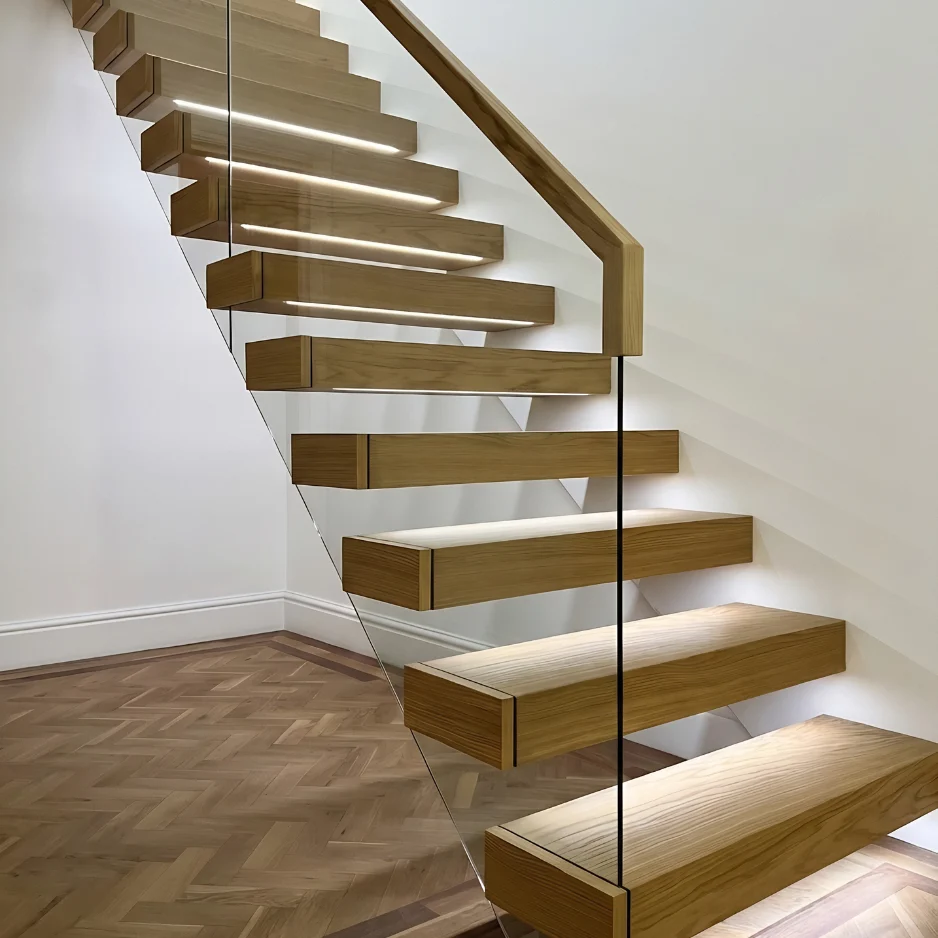
Floating cantilever staircase in a Swiss single-family villa — Wohnbau privat classification with dimensional latitude and minimal Brandschutz requirements.
Treppenhaus mehrfamilienhaus — Multi-Family Common
Treppenhaus mehrfamilienhaus covers the shared staircase in a multi-family residential building (Mehrfamilienhaus, MFH) — the staircase that gives access to multiple separate apartments. This is a fundamentally different regulatory beast from the private staircase inside an individual apartment.
Defining Characteristics
The Treppenhaus is the shared vertical circulation in a multi-family building — connecting the entrance lobby (Eingangshalle) to multiple apartment doors on each floor. Used by all tenants, visitors, postal workers, deliveries. Acts as the primary fire escape route for the entire building. Subject to Stockwerkeigentum (condominium law) for shared maintenance and modifications.
Dimensional & Geometric Rules
Tighter dimensional framework: riser maximum 18 cm (vs Wohnbau privat 20 cm), tread minimum 26 cm, width minimum 100 cm clear between handrails and obstructions. Step formula 2R + T = 610–630 mm. Headroom minimum 2.10 m. Both sides require continuous handrails. Maximum 16 risers per flight without intermediate landing.
Brandschutz Mandatory
Treppenhaus must be a fire-rated Brandabschnitt (fire compartment) per BSV/AEAI Brandschutzvorschriften. Typical specification: R 90 fire resistance for structure, EI 30 fire-rated apartment doors opening into the stairwell, natural or mechanical smoke ventilation (Rauch- und Wärmeabzugsanlage, RWA), and fire-resistant materials on stairs and handrails. Continox supplies structural elements; the Brandabschnitt enclosure is the responsibility of your appointed Brandschutzplaner.
SIA 500 Accessibility Mandatory
SIA 500 barrier-free requirements typically mandatory in most cantons for new-build multi-family buildings (≥ 4 apartments threshold common). This adds: handrail extensions 30 cm at top and bottom, tactile warning strip at flight head, contrasting nosings, riser-tread relationship within accessible 620–640 mm step formula range. Renovation projects sometimes exempted; new builds nearly always covered.

U-shape steel plates configuration — typical Treppenhaus mehrfamilienhaus specification with 100 cm clear width, both-side continuous handrails and SIA 500 accessible riser/tread proportions.
Öffentlich zugängliche Bauten — Commercial & Public
Öffentlich zugängliche Bauten (publicly accessible buildings) cover commercial and public-access spaces — offices, retail, hotels, restaurants, healthcare, education, cultural institutions. The strictest of the three classifications, with full SIA 500 + Brandschutz BSV/AEAI compliance plus elevated structural loading.
Defining Characteristics
Any building or part of a building open to the public — whether continuously (retail) or by appointment (medical, professional services). Subdivided in Switzerland by occupancy density and risk: Versammlungsstätten (assembly buildings — theatres, churches, schools, conference halls) carry the strictest rules; Verkaufsräume (retail) and Beherbergungsbetriebe (hotels) sit slightly lighter. Continox typical clients: boutique commercial fit-outs, medical practices, hotels and serviced offices.
Strictest Dimensional Framework
Riser maximum 17 cm — significantly shallower than Wohnbau privat 20 cm. Tread minimum 28 cm. Width minimum 120 cm clear between handrails and obstructions (some assembly applications require 140 cm or more depending on occupancy density). Headroom minimum 2.20 m. Step formula 2R + T = 620–640 mm — within SIA 500 accessible range. Maximum 16 risers per flight without intermediate landing.
Full Brandschutz BSV/AEAI Compliance
Full compliance with the Brandschutzvorschriften (Swiss fire protection regulations) administered by the BSV/AEAI (Vereinigung Kantonaler Feuerversicherungen) — including escape route certification, smoke ventilation, fire-rated materials, and where applicable Rauchabzug (smoke extraction) and emergency lighting. Specific requirements scale with occupancy density and floor area.
Full SIA 500 Accessibility
Full SIA 500 mandatory: handrails on both sides with 30 cm horizontal extensions at top and bottom, tactile warning strip at flight top (bande d'éveil de vigilance equivalent), contrasting nosings on every tread leading edge for visually-impaired users, step formula within 620–640 mm accessible range, handrail height 0.85–0.90 m above nosing line continuous through landings.
Continox Öffentlich zugängliche Bauten — Standard Configuration
- System: Central spine staircase or U-shape steel plates, 120 cm clear width minimum
- Tread material: Oak with non-slip nosing or perforated steel grating; visual contrast on every nosing edge
- Riser: 17 cm maximum; closed risers (no open-back gaps)
- Going: 28 cm minimum
- Handrails: 316 stainless steel both sides, 0.85–0.90 m height, 30 cm horizontal extensions at top and bottom, return-to-wall detail
- Tactile warning strip: contrasting bande d'éveil de vigilance at flight top, 60 cm depth
- Glass balustrade: heat-soaked tempered laminated, NF EN 14449 + NF EN 12150 + NF EN 12600 1B1, sized for ERP horizontal load 1000–1700 N/m
- Brandschutz: structural elements R 90 fire resistance, intumescent coatings or fire-rated steel grade as required by BSV/AEAI
- Documentation: SIA 358 + SIA 500 compliance schedule, BSV/AEAI fire safety reference, Eurocode structural pack with elevated imposed load
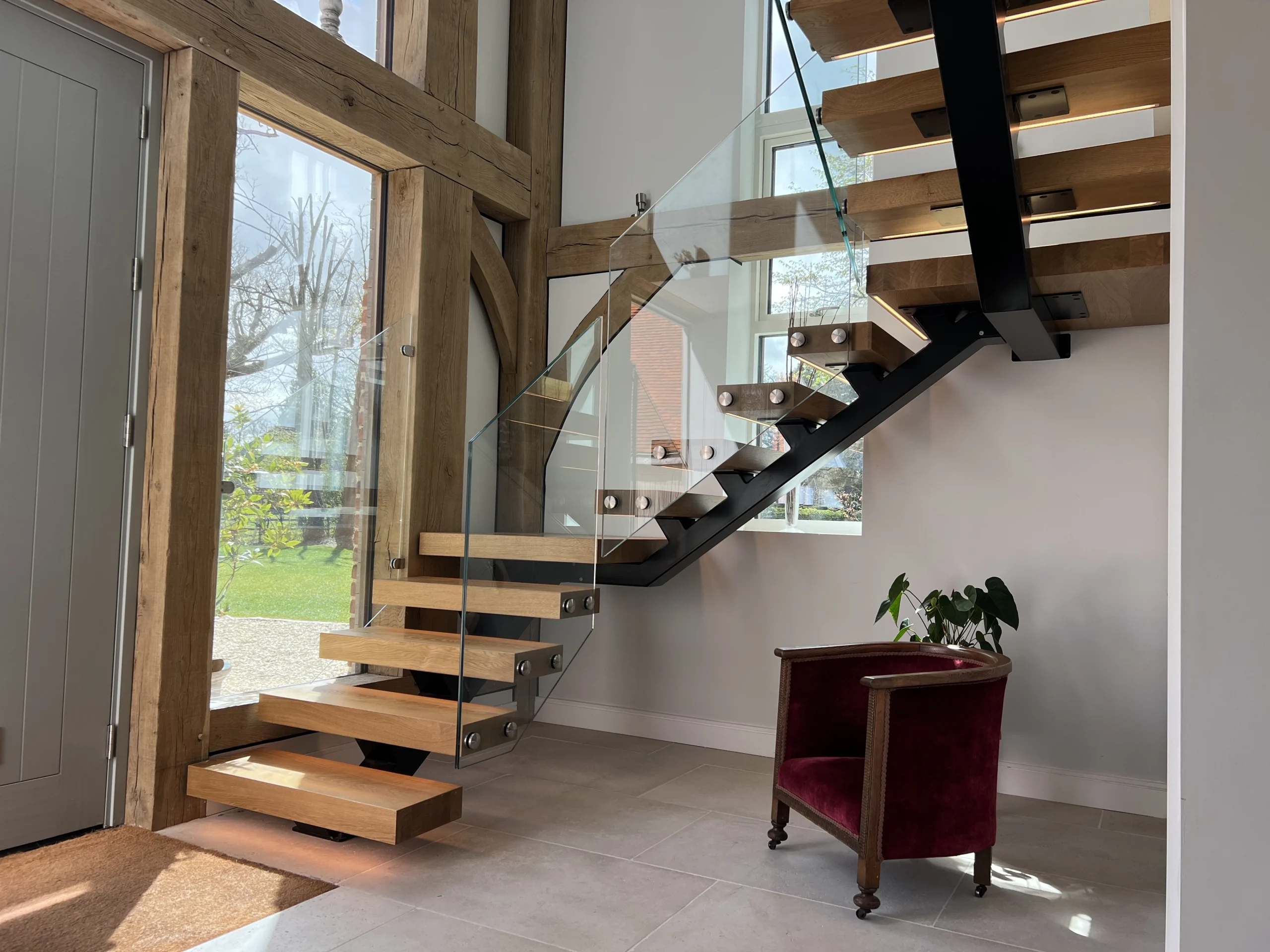
Commercial-spec central spine — 120 cm clear width, double handrails with 30 cm extensions, contrasting nosings and full Brandschutz BSV/AEAI compliance for Swiss public-access fit-out.
Side-by-Side Comparison Table
| Parameter | Wohnbau privat | Treppenhaus MFH | Öffentlich zugänglich |
|---|---|---|---|
| Maximum riser | 20 cm | 18 cm | 17 cm |
| Minimum tread | 24 cm | 26 cm | 28 cm |
| Step formula range | 600–630 mm | 610–630 mm | 620–640 mm |
| Minimum width (clear) | 0.80 m | 1.00 m | 1.20 m (1.40+ for assembly) |
| Minimum headroom | 2.00 m | 2.10 m | 2.20 m |
| Maximum flight (no landing) | 18 risers | 16 risers | 16 risers |
| Handrails | One side (both if > 1.20 m) | Both sides | Both sides + 30 cm extensions |
| Handrail height | 0.85–1.00 m above nosing | 0.85–0.90 m | 0.85–0.90 m + return-to-wall |
| Guard height (landing) | 1.00 m | 1.00 m | 1.00 m (1.10 m if drop > 12 m) |
| SIA 500 accessibility | Voluntary | Mandatory (most cantons) | Mandatory full |
| Brandschutz | Smoke detector only | R 90 Brandabschnitt + EI 30 doors | Full BSV/AEAI compliance |
| Imposed load (SIA 261) | 3.0 kN/m² | 3.0 kN/m² + service | 4.0–5.0 kN/m² |
| Horizontal balustrade load | 0.8 kN/m | 1.0 kN/m | 1.0–3.0 kN/m (crowd dependent) |
| Tactile warnings + contrast | Not required | Recommended | Required |
| Inspection | Architect sign-off + Baubehörde Schlussabnahme | + Brandschutzplaner sign-off + SIA 500 verification | + Feuerpolizei + cantonal Bauinspektorat |
| Continox typical pricing (supply) | €7,999–€16,500 | €11,500–€18,000 | €14,000–€25,000+ |
Fire Safety — Brandschutz BSV/AEAI
Swiss fire protection regulations are administered by the Vereinigung Kantonaler Feuerversicherungen (BSV/AEAI) — a cross-cantonal body that publishes the unified Brandschutzvorschriften. The framework is technically separate from the SIA standards but applied in parallel for any project beyond Wohnbau privat.
Continox supplies the structural staircase elements with material certifications and Eurocode-aligned structural calculations. The Brandabschnitt enclosure (fire-rated walls, doors, smoke ventilation) and the BSV/AEAI compliance verification are the responsibility of your project's appointed Brandschutzplaner (fire safety specialist) coordinating with the Feuerpolizei. We provide the structural reference data your Brandschutzplaner needs to complete their dossier.
When SIA 500 Accessibility Triggers
SIA 500 (Hindernisfreie Bauten) is mandatory when the building is publicly accessible or accommodates a public-equivalent function. Specific triggers vary by canton but typical thresholds:
| Building Type | SIA 500 Trigger | Continox Action |
|---|---|---|
| Single-family villa | Voluntary — owner choice | Standard 17–18 cm riser configuration future-proofs at no extra cost |
| Multi-family 2–3 apartments | Often exempted (canton-dependent) | Confirm at quotation; specify accordingly |
| Multi-family 4+ apartments | Mandatory in most cantons | SIA 500 schedule supplied as standard |
| Renovation existing MFH | Often exempted — proportionality test | Confirm with cantonal Baubehörde |
| Office > 100 m² | Mandatory | Full SIA 500 compliance pack |
| Retail / hospitality | Mandatory | Full SIA 500 + BSV/AEAI |
| Healthcare / education | Mandatory + cantonal extensions | Full SIA 500 + cantonal accessibility law |
| Public-funded project | Mandatory regardless of size | Full SIA 500 + cantonal accessibility law |
Decision Framework — Practical Walkthrough
Three questions the architect should answer before sending the project brief to Continox:
Question 1 — Who Uses the Staircase?
If only one household (single-family villa or inside one apartment) → Wohnbau privat, lightest framework. If multiple households share the staircase (Treppenhaus MFH) → mid-tier framework with Brandabschnitt and SIA 500. If members of the public (commercial, hotel, retail, office) → strictest framework with full Brandschutz and SIA 500.
Question 2 — Is the Staircase a Required Escape Route?
If yes → Brandabschnitt is non-negotiable. The staircase becomes a fire compartment with R 90 structural fire resistance, EI 30 doors opening into the stairwell, and Rauchabzug provisions. Architect coordinates with appointed Brandschutzplaner. If no (alternative escape route exists) → Brandabschnitt provisions can sometimes be relaxed; verify with the Feuerpolizei.
Question 3 — Does SIA 500 Apply?
Cross-check the cantonal accessibility law and the building type. If SIA 500 mandatory → max 17 cm riser, min 28 cm tread, both handrails with 30 cm extensions, tactile warnings, contrast nosings. If voluntary → owner can elect either way; many architects voluntarily apply for future-proofing.
Need Help Determining Your Classification?
Continox supplies the right specification once your architect has confirmed the classification. Send the building type, number of apartments and intended use — we return a fixed-price quote with the correct documentation pack.
Get Free QuoteFrequently Asked Questions
Which classification applies to my villa staircase?
If your staircase is inside a single-family villa (Einfamilienhaus) used exclusively by your household — Wohnbau privat. Maximum riser 20 cm, minimum width 80 cm (Continox typical 90 cm or wider for villa projects), one handrail sufficient, no fire-rated enclosure required. SIA 500 voluntary; Continox standard configuration (17–18 cm riser) future-proofs for accessibility at no extra cost.
What about my apartment duplex insertion?
A duplex insertion within a single apartment is Wohnbau privat — the staircase is internal to one Wohnung and not shared with neighbours. The shared multi-family Treppenhaus serving the building lobby and apartment doors is a separate Treppenhaus mehrfamilienhaus question — but that's not what you're modifying. Your duplex internal staircase follows the lighter Wohnbau privat framework.
Does the Treppenhaus need to be a Brandabschnitt?
Yes — the multi-family Treppenhaus serves as the building's primary escape route and must be a fire-rated Brandabschnitt per BSV/AEAI Brandschutzvorschriften. Typical specification: R 90 fire resistance for structure, EI 30 fire-rated apartment doors opening into the stairwell, natural or mechanical smoke ventilation (RWA), and fire-resistant materials on stairs and handrails. Continox supplies the structural staircase elements; the Brandabschnitt enclosure is your appointed Brandschutzplaner's responsibility.
Does SIA 500 apply to all multi-family buildings?
SIA 500 is mandatory in most cantons for new-build multi-family buildings with 4 or more apartments. Below this threshold (2–3 apartment buildings), exemption is canton-dependent. Renovation projects of existing buildings often qualify for proportionality-test exemption — full SIA 500 retrofit may be impractical relative to the project scope. Continox confirms applicability at quotation stage and supplies the SIA 500 schedule when required.
What about boutique commercial fit-outs in residential buildings?
If you're inserting a commercial fit-out (boutique, medical practice, professional office) in part of a residential building — the commercial portion follows Öffentlich zugängliche Bauten framework. Riser maximum 17 cm, width minimum 120 cm, both handrails with 30 cm extensions, contrasting nosings, full BSV/AEAI Brandschutz. The residential portion of the building keeps its own classification. Mixed-use projects often need two separate staircases or staircase zones with different specifications.
Can a Continox staircase be reclassified later?
Reclassification (e.g., changing a private residential to a commercial use) requires full Baubehörde verification against the new classification's framework — including dimensional, Brandschutz and SIA 500 compliance. A Wohnbau privat staircase typically cannot satisfy Öffentlich zugängliche requirements without modification (riser too steep, width too narrow, no Brandabschnitt). It's far more practical to specify the correct classification at design stage. Continox supplies a Wohnbau privat-spec staircase that can be retrofitted toward Treppenhaus MFH spec if planning permits future change of use.
Who carries out the Schlussabnahme inspection?
The cantonal Baubehörde (or local Bauinspektorat) carries out the Schlussabnahme — the final acceptance inspection — typically a few weeks after installation completion. They verify the constructed building matches the approved Baugesuch dossier. For Treppenhaus MFH and Öffentlich zugängliche projects, additional inspections include Brandschutzplaner sign-off for fire compartmentation and Feuerpolizei verification of escape route certification. Continox supplies the technical documentation; your appointed Swiss architect coordinates the inspection process.
Are there any cantonal exceptions I should know about?
Cantonal Bauordnung adds procedural requirements but rarely overrides the technical SIA framework. A few cantonal-specific extensions to be aware of: Genève often applies extended SIA 500 obligations to smaller buildings; Zürich has its own Brandschutzauflagen for high-rise residential beyond BSV/AEAI baseline; Graubünden Engadin and Wallis alpine cantons impose elevated seismic and snow-load verifications. Continox's standard documentation pack covers the federal SIA + Eurocode baseline; cantonal-specific extensions are verified by your appointed Swiss architect.
How does the Treppenhaus specification differ between cantons?
The technical specification of the Treppenhaus itself is governed by the federal SIA framework — uniform across all 26 cantons. What differs by canton: (a) the Baugesuch dossier format and submission process, (b) neighbour notification (Anrainerinformation) windows, (c) SIA 500 trigger thresholds (some cantons apply to all new MFH; others to ≥ 4 apartments), (d) Stockwerkeigentum (condominium) approval requirements for renovation works affecting shared staircases.
What's the price difference between the three classifications?
Continox supply pricing typical ranges: Wohnbau privat €7,999–€16,500 (most-specified configurations central spine €8,999, premium spine €11,500), Treppenhaus MFH €11,500–€18,000 (wider 100 cm minimum, both handrails, SIA 500 spec), Öffentlich zugängliche €14,000–€25,000+ (120 cm minimum width, full Brandschutz, contrasting nosings, double handrails with extensions). Wine-region château or top-end villa Wohnbau privat projects with fully bespoke geometry can also reach €18,000–€35,000 — the classification doesn't strictly cap upside.
Specify Your Swiss Project — Right Classification
Free 3D visualisation, classification-specific documentation pack, fixed-price quote in CHF or EUR within 48 hours. SIA 358 + SIA 500 + Eurocode + BSV/AEAI compliance documented from day one.
Get Free Quote