

External Staircase for a Garden Room — Complete UK Guide
A practical guide to commissioning external access stairs for garden rooms, studios, garden offices and raised platforms — costs, configurations, building regulations, foundation options, and the design choices that turn an awkward step-up into an integrated outdoor feature.
Updated May 2026

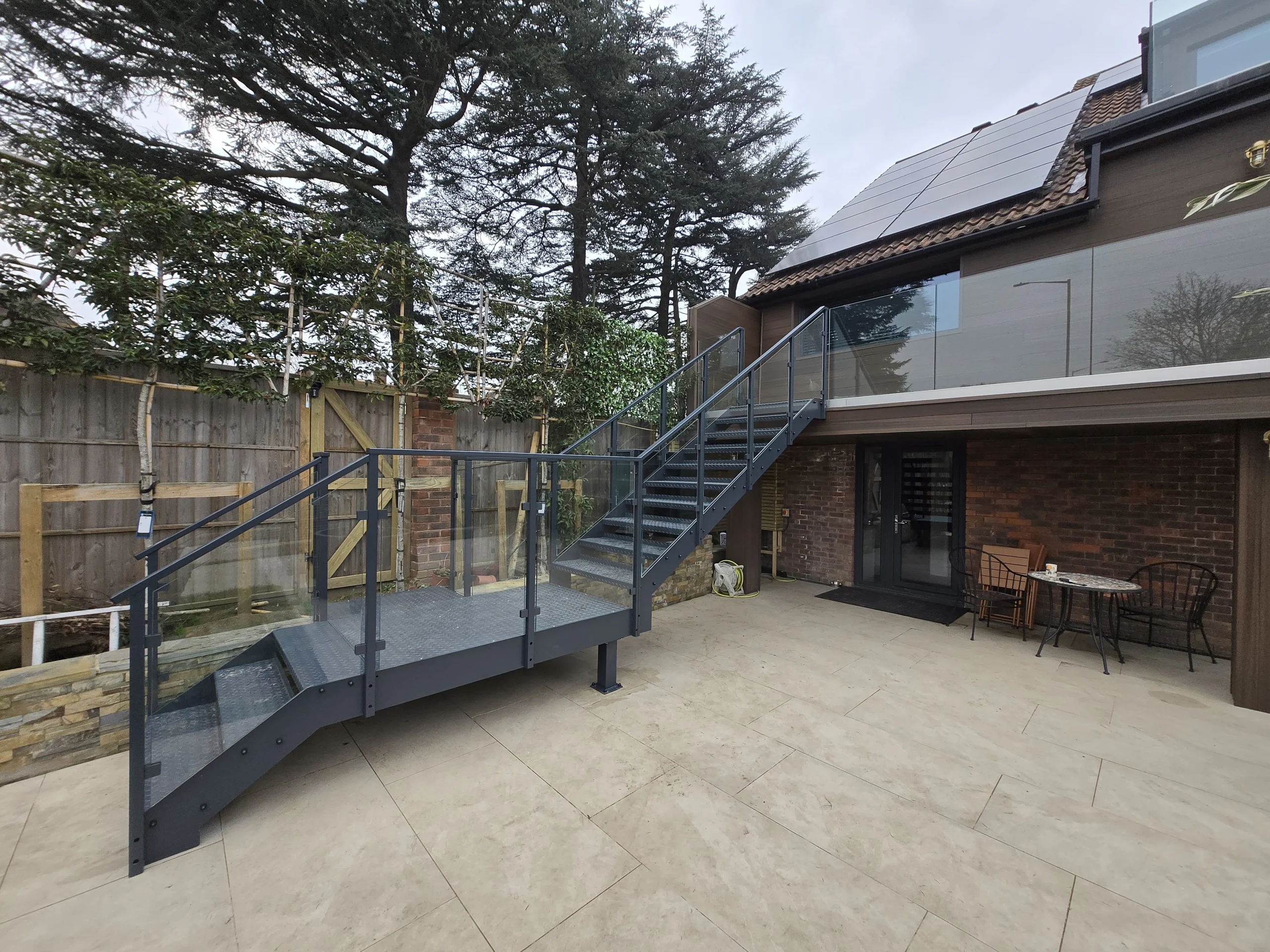

External staircases for garden rooms typically cost from £3,500 for a short 2–3 step access to £8,500+ for a wider mid-flight access with hardwood treads or glass balustrade. The most common project — a 4–6 step galvanised access stair to a 600–900mm raised garden room — sits in the £3,500–£5,500 band fully installed.
Three things drive most of the price variation: height of the garden room above ground (more steps = more material), whether you want a landing platform at the door, and balustrade specification (mild bar vs. mesh vs. glass). The steel itself is not the variable — finishes and platform geometry are.
Most garden room access stairs fall under permitted development alongside the garden room itself, but the staircase still needs to comply with Approved Document K for rise, going, balustrade and pitch — even though Building Control sign-off is often light-touch for small-flight garden access.
The UK garden room boom has changed how people use their outdoor space — garden offices, studios, gyms, yoga rooms, summerhouses and pool houses are now standard features on a substantial share of UK gardens. Most are raised above ground level by 300–900mm to accommodate ventilation, drainage and floor build-up. That raised threshold needs an access staircase. This guide covers the cost, configuration and specification of garden room external stairs — from the simple 3-step galvanised access at £3,500 through to the architectural deck-and-staircase combination at £15,000+. It also covers the building regulations that apply, the permitted-development considerations specific to garden rooms, and the design choices that determine whether the staircase reads as an integrated outdoor feature or an afterthought.
Why Garden Room Stairs Are Different from Other External Stairs
Most external staircase content online treats garden room access as a footnote alongside fire escapes and balcony stairs. The reality is that garden room stairs have their own specific characteristics:
Short flights, not full storeys
Garden rooms typically sit 300–900mm above natural ground level. That's 2–6 risers — not the 12–14 risers of a full storey-height external staircase. The cost, design and foundation requirements scale accordingly. A 4-riser galvanised access stair is closer in price to a quality landscape feature than to a structural assembly.
Visible from the house
Unlike a fire escape or a basement lightwell stair, the garden room staircase is part of the daily-use garden composition. It's visible from kitchen windows, used multiple times a day, and frequently photographed alongside the garden room when the homeowner shares the project. This pushes specification toward design-led options — frameless glass balustrade, hardwood treads, integrated lighting, custom RAL finishes.
Light foundations work
A 4-riser garden access stair doesn't need the engineered concrete pads required for a 3-storey fire escape. Many garden room access stairs sit on simple concrete pads, ground screws, or extended sleeper foundations matching the garden room's own substructure. This keeps installation fast and reduces excavation cost.
Often part of a wider deck or platform
Around 60% of UK garden room projects include some form of raised deck or platform around the garden room — often serving as outdoor seating area or transition zone. Where this exists, the staircase needs to integrate visually and structurally with the deck. Specifying the staircase before the deck is designed often leads to clumsy proportions and a clear "added on" reading.
The Six Most Common Garden Room Stair Configurations
Simple Step-Up
1–2 risers serving a 200–400mm raised threshold. Often a single landing-style step or a pair of steps. Galvanised steel, mild balustrade if any. Suitable where the garden room sits very close to ground level and only needs a transition step.
Short Flight Access
3–4 risers serving a 450–700mm raised threshold. The most common UK garden room configuration. Galvanised steel + powder-coat, single-side balustrade. Typically 800–1000mm tread width. Easy access, design-friendly proportions.
Mid Flight
5–6 risers serving a 700–1000mm raised threshold. Where the garden room sits on engineered foundations with significant ventilation gap, or where ground falls away from the structure. Both-side balustrade often specified for safety.
Flight + Landing Platform
Stair plus integrated landing/deck at the door — typically 1.2 × 1.5m or larger. Useful where the door swings outward, where seating is desired at the threshold, or where multiple doors share access. Premium integration option.
Integrated Deck Staircase
Staircase + extended deck or terrace around the garden room, all on the same structural system. Often the same hardwood or composite material on treads, deck and fascia. Reads as a single architectural element, not staircase + deck.
Premium Architectural Feature
Designer specification — hardwood treads, frameless glass balustrade, custom RAL or anodised finish, hidden structural connections, integrated LED lighting. For garden rooms that are part of a high-end residential composition.
Garden Room Stair Cost — at a Glance
The table below summarises typical UK pricing bands for garden room external stairs. All figures are all-in installed cost — manufacture, finish, transport, foundation work and installation, with structural advice and Building Regulations compliance included where needed.
| Configuration | Specification | Price Band (Installed) | Lead Time |
|---|---|---|---|
| 1–2 step entry | Galvanised, mild handrail or none | £1,800 – £3,500 | 3–5 weeks |
| 3–4 step access ★ | Galvanised + powder-coat, mild balustrade | £3,500 – £5,500 | 4–6 weeks |
| 5–6 step mid flight | Galvanised + powder-coat, both sides balustrade | £4,500 – £7,000 | 4–6 weeks |
| Flight + landing platform | Stair + 1.5×1.2m platform, mesh or glass | £5,500 – £8,500 | 5–8 weeks |
| Integrated deck staircase | Stair + wraparound deck, single design | £7,000 – £14,000+ | 6–10 weeks |
| Premium architectural ★ | Hardwood treads, frameless glass, LED | £10,000 – £18,000+ | 8–12 weeks |
These bands assume reasonable garden access for delivery, standard ground conditions for foundations, and integration with an existing or planned garden room. Wet ground, sloped sites, or restricted access (terraced housing with side passage only) can each add £400–£1,200 to installation cost.
Building Regulations & Permitted Development
Permitted development rules for outbuildings
Most garden rooms in the UK are built under permitted development rights as outbuildings incidental to the main dwelling. The rules cap building heights, restrict use, and specify proximity to boundaries. The key consideration for the staircase is the raised platform rule: any deck, terrace, steps or base that lifts users above natural ground by more than 300mm is treated as a raised platform, and where it qualifies, the platform's upper surface becomes the height reference for the whole outbuilding. This means a substantial deck-and-staircase combination can push the garden room out of permitted development if it's not carefully designed.
External step dimensions under Approved Document K
Approved Document K applies to external steps and stairs forming part of the building or providing access to it. Key dimensional requirements for residential garden room access:
- Rise (private dwelling): 150–220mm; consistent across all steps in a flight.
- Going: minimum 220mm internal stairs / 280mm external stairs with tapered treads, depending on type. For external garden access, design typically targets 250–300mm going.
- Maximum pitch: 42° for general access; lower pitch (40°) often preferable for outdoor use to accommodate wet conditions.
- Tread width: minimum 800mm for residential access; 900mm preferred for comfort. Many garden room stairs are specified at 1000mm to match the door width and feel generous.
- Headroom: 2000mm minimum where any structure passes overhead. Rarely a constraint for open garden access stairs.
- Balustrade: required on any stair where the rise is more than 600mm above ground level on either side. Spindles must not allow a 100mm sphere to pass through. Handrail height 900–1000mm above pitch line.
When is Building Control involvement needed?
For a small-flight access stair (4 risers or fewer) integrated with a permitted-development garden room, Building Control involvement is typically light — the staircase is treated as part of the outbuilding rather than as a separate structure. For larger flights (5+ risers), or where the garden room is itself notifiable (above thresholds for size or use), the staircase becomes part of the Building Control submission. For any project where the garden room is used as a habitable annexe or self-contained accommodation, full Building Regulations approval is required, and the staircase must be specified as compliant from the design stage.
Permitted development for outbuildings caps height at 4.0m (dual-pitched roof) or 3.0m (flat or mono-pitch), measured from natural ground level. Any deck or stair landing more than 300mm high counts as a raised platform, and the platform surface becomes the new reference point. A garden room that's compliant with a 3-step access (≤450mm) can become non-compliant with a 600mm-high integrated deck. Plan deck and staircase together at design stage.
The 8 Cost Drivers in Garden Room Stairs
Number of Risers
The biggest baseline variable. A 2-riser entry stair is ~40% the cost of a 6-riser flight — material, balustrade run and structural cost all scale roughly linearly with riser count.
Highest impactTread Width
800mm domestic-baseline width is the budget option. 900mm adds modest cost, 1000mm noticeably more, and 1100mm+ becomes architectural specification. Garden rooms typically read better with 1000mm width matching the door.
High impactBalustrade Specification
Mild steel vertical bar (~£200/m) is the budget option. Where rise is under 600mm above ground, balustrade may not be required at all. Frameless laminated glass balustrade for a short garden flight is often £1,500–£3,000 add-on.
High impactFinish System
Galvanising is included as standard. Standard powder-coat black (RAL 9005) adds £300–£600. Custom RAL (anthracite RAL 7016 popular) adds £500–£900. Specialty finishes more again. Garden rooms benefit visually from a finish-coat over plain galvanised. See galvanised vs powder-coated for finish guidance.
Medium-highTread Material
Galvanised plate is baseline. Open grating slightly higher. Hardwood treads (oak, IPE, thermally-modified ash) add £1,200–£3,000 across a typical short flight. Composite decking material to match the deck adds modest cost. Hardwood is the highest-value visual upgrade.
Medium-highFoundation Type
Concrete pads are standard (£300–£600 typical for garden access). Ground screws save excavation but add fixing cost — net similar. Where the staircase shares foundations with the garden room itself, costs are absorbed into the wider build.
MediumSite Access
Easy garden access via a gate or driveway: standard install. Through-property only (terraced houses, no rear access): manual handling adds time. Crane access for restricted sites is rare for short garden flights but adds £1,000+ where needed.
VariableDeck Integration
A standalone staircase serving a finished garden room: simple. A staircase designed alongside an integrated deck: more design coordination, more material, but visually superior result. Deck integration typically adds £2,500–£8,000 depending on platform size.
Often missedThree Worked Examples — Real Project Costs
- 3-step access to 600mm raised garden office
- 900mm tread width
- Galvanised + black powder-coat (RAL 9005)
- Single-side mild bar balustrade
- Galvanised plate treads with anti-slip nosings
- Concrete pad foundations × 2
- Suburban Hampshire, easy garden access
- Steel manufacture: £1,950
- Galvanising + powder-coat: £400
- Structural advice: £150
- Transport: £180
- Foundation work (2 pads): £450
- Installation (1 day, 2 fitters): £900
- Sundries + permits: £120
- 5-step access to 850mm raised garden studio
- 1000mm tread width
- Galvanised + RAL 7016 anthracite
- Both-side perforated mesh balustrade
- Open grating treads, slip-rated
- Integrated 1500×1200mm landing platform at door
- Concrete pad foundations × 4
- Surrey, suburban site
- Steel manufacture: £3,400
- Galvanising + custom RAL: £750
- Landing platform structure: £950
- Mesh balustrade panels: £450
- Structural design: £300
- Transport + permits: £280
- Foundation work (4 pads): £700
- Installation (2 days, 2 fitters): £1,200
- 4-step access + wraparound deck (4×3m)
- 1100mm tread width
- Galvanised + custom RAL 7016 anthracite
- 40mm IPE hardwood treads, oil-finished
- 17mm laminated frameless glass balustrade
- Stainless point fixings, hidden brackets
- Integrated LED lighting in stringers
- Cotswolds, premium villa garden
- Steel manufacture (precision spec): £4,800
- Galvanising + RAL 7016: £900
- Wraparound deck structure: £2,200
- 40mm IPE treads + deck boards: £2,400
- 17mm laminated glass + point fixings: £2,100
- Integrated LED + electrics: £600
- Structural design + engineering: £450
- Transport + access: £280
- Installation (3 days, 3 fitters): £1,800
Four Common Mistakes on Garden Room Stairs
Mistake 1: Order before garden room foundation cure
Buyers commission the staircase as soon as the garden room is ordered, then discover the threshold height is different from the original drawing once the garden room is sitting on its actual foundations. The stair is then either too short or too long. Fix: confirm finished threshold height after the garden room is installed and foundations are set. Better still: have the same supplier coordinate both, or design the staircase with adjustable bracket fixing at the top connection.
Mistake 2: Under-specifying tread width
An 800mm-wide staircase serving a 900mm-wide garden room door reads as awkward — the stair looks pinched relative to the threshold. Fix: match tread width to door width or go one increment wider. 1000mm is the sweet spot for most garden rooms with a single 900mm door; 1100mm where the garden room has French doors or sliders.
Mistake 3: Skipping balustrade where it's required
Approved Document K requires balustrade where any side of the stair is more than 600mm above ground level. A 4-step access to a 700mm-raised garden room needs balustrade on at least one side — often missed because "it's only a few steps." Fix: confirm balustrade requirement with the manufacturer at quote stage, not during install.
Mistake 4: Ignoring deck integration at design stage
The staircase is commissioned, manufactured and delivered. Then the homeowner decides to add a deck around the garden room, and the staircase no longer fits the new deck geometry. Result: bespoke deck-stair junction, awkward proportions, sometimes a partial re-make. Fix: decide deck-or-no-deck at the start. Even if deck is "maybe later," size and orient the staircase to accommodate future deck integration.
Why Garden Room Stairs Deserve Engineering Standard
Continox manufactures garden room access staircases to the same EN 1090-1 EXC2 standard we apply to commercial and architectural work. The reason is simple: a garden room is a daily-use structure, the stair carries family members multiple times a day, and the relatively short flight doesn't justify a lower engineering standard. Our garden access work uses the same hot-dip galvanising, the same powder-coat process, and the same in-house structural advice as our larger external projects. Pricing reflects materials and finishing complexity, not a different quality system. Standard 3–4 step access from £3,500; premium architectural from £10,000+; same 5-year warranty across the range.
Garden Room Stair Common Questions
How much does a garden room access staircase cost?
A standard 3–4 step galvanised access stair to a UK garden room typically costs £3,500–£5,500 fully installed. Premium specifications with hardwood treads or glass balustrade run £8,500–£15,000. The figures include manufacture, foundations, finish and installation.
Do I need planning permission for garden room stairs?
Usually not — garden room access stairs typically fall within permitted development alongside the garden room itself. However, where the staircase or integrated deck exceeds 300mm in height, the garden room's permitted-development compliance may need rechecking.
What height does a garden room sit above ground?
Most UK garden rooms sit 300–900mm above ground level — the variation depends on foundation type, ventilation gap, drainage, and ground level. A 400–600mm raised threshold is most common, requiring 2–4 step access.
Should the stair use the same material as the garden room?
Visually preferable, but rarely practical. Garden rooms are typically timber or cedar-clad; staircases are usually steel for structural performance. The match comes from finish — RAL 7016 anthracite stair frame with hardwood treads matches most garden room aesthetics.
Can I use treated softwood for the staircase?
Steel is strongly preferred for structural performance, longevity (25+ years vs 8–12 for treated softwood), and consistency. Hardwood treads on a steel structure give the best of both — wood feel and visual warmth, with steel's structural reliability. See our external staircase lifespan guide for material comparison.
How long does installation take?
Standard 3–4 step garden access: 1 day on site once foundations are cured. Larger flights with integrated decks: 2–3 days. Lead time from order is 4–6 weeks for standard, 8–10 weeks for premium specifications.
Do I need balustrade on a 3-step access?
Approved Document K requires balustrade where any side of the stair is more than 600mm above ground. A 3-step stair with 600mm rise often needs balustrade on at least one side; 4 or more steps almost always does.
What about lighting on the staircase?
LED strip lighting in the stringer or under the nosing is increasingly popular and adds £400–£900 to a standard project. Best done at design stage so wiring routes through the steel frame rather than retro-fit.
Garden Room External Stair — Detailed FAQs
How much does an external staircase for a garden room cost in the UK?
A UK garden room external staircase typically costs £3,500–£5,500 for a standard 3–4 step galvanised access, £5,500–£8,500 for a 5–6 step flight with integrated landing platform, and £10,000–£18,000+ for premium architectural features with hardwood treads, frameless glass balustrade and integrated lighting. All ranges include manufacture, hot-dip galvanising and powder-coat, foundations, transport and installation. The single biggest cost variable is height — the number of risers needed to span from ground level to the garden room threshold.
Do I need planning permission for a garden room access staircase?
Usually not. Garden room access stairs typically fall within permitted development as part of the outbuilding rather than as a separate structure requiring planning permission. There are two scenarios where planning may be needed: (1) where an integrated deck or staircase landing exceeds 300mm in height, the platform is treated as a "raised platform" and counts toward the garden room's overall height for permitted-development purposes; (2) where the property is in a conservation area, designated landscape, listed building curtilage, or subject to Article 4 directions, permitted development rights may be removed and planning is required. Always confirm with the local authority before building.
What dimensions must garden room stairs meet under Building Regulations?
Approved Document K applies to external steps and stairs. For private residential garden access: rise 150–220mm consistent across all steps; going minimum 220mm internal / typically 250–300mm external; maximum pitch 42°; tread width minimum 800mm (900mm recommended); headroom 2000mm where any structure passes overhead. Balustrade is required where any side of the stair is more than 600mm above ground, with maximum 100mm gap between spindles and handrail height 900–1000mm above pitch line. Where the garden room is used as habitable annexe accommodation, full Approved Document K applies; where it's an outbuilding incidental to the main dwelling, light-touch compliance is typical.
What's the best foundation for a garden room staircase?
Three options work for garden room access stairs. Concrete pads are the most common — typically 600×600×400mm pads with rebar, cast at the same time as the garden room foundations. Total cost £300–£600 for a typical 2–4 pad set. Ground screws avoid excavation and concrete cure time, screwed into the ground with steel brackets attaching the staircase. Slightly more per fixing but faster install. Shared structural fixings with the garden room itself — where the stair attaches to the garden room frame and shares its foundations. Cleanest visually but requires coordination at design stage. For most projects, concrete pads remain the default unless ground conditions or schedule favour ground screws.
Should the staircase be integrated with a garden deck?
Where the garden composition includes a deck or terrace around the garden room (around 60% of UK projects), integrating the staircase with the deck design typically delivers a substantially better visual result than commissioning them separately. Integration means: shared structural system, matching tread and deck materials, single design language, no awkward step-down between platform and stair landing. Cost premium is £2,500–£8,000 over a standalone stair, but the result reads as one architectural feature rather than two. Where there's no deck, a standalone staircase with a small landing at the door is more economical and works well visually. Where balustrade is needed for the deck or platform itself, see our balcony railings page for matching specification.
How long do garden room steel stairs last outdoors?
A hot-dip galvanised steel garden access stair lasts 25–40 years depending on exposure environment. Powder-coat over galvanise extends life further by protecting the zinc layer from UV and abrasion. The finish coat typically needs touch-up after 8–12 years where exposed to direct weather; the underlying galvanised structure remains protected for the full 25+ years. Hardwood treads with proper end-grain sealing and UV-stable hardwax oil finish typically last 15–25 years before refurbishment. Stainless steel components (point fixings, balustrade brackets) last indefinitely under normal UK garden conditions. See our external staircase maintenance guide for the full schedule.
What's the difference between a garden room and a garden annexe — does it affect the staircase?
Yes, materially. A garden room is an outbuilding incidental to the main dwelling — used for office, studio, gym, hobby, garden storage. It typically falls within permitted development and requires only light-touch Building Control. A garden annexe is intended as habitable accommodation — a granny flat, a self-contained living space — and has different planning treatment plus full Building Regulations approval. For an annexe, the access staircase must comply with full Approved Document K including all dimensional and balustrade requirements, plus Approved Document M for accessibility, plus potentially Approved Document B if means of escape applies. Costs typically run 20–40% higher to satisfy the additional compliance overhead.
Can I get LED lighting integrated into the staircase?
Yes — and it's a popular addition for garden room access where the stair is used after dark. Two common approaches: stringer-integrated LED strip running along the side of each step (most common, looks clean, easy to install at fabrication stage); under-nosing LED with strip lights mounted under the front edge of each tread (more architectural reading, slightly more complex wiring). Cost £400–£900 typical for stringer integration, £700–£1,400 for under-nosing. Always specify at the design stage so wiring routes through the steel frame rather than retro-fit. Power supply is typically a 12V or 24V DC transformer; weatherproof IP65 minimum for outdoor use.
What's the lead time for a garden room staircase?
Standard 3–4 step galvanised garden access: 4–6 weeks from signed order to installed staircase. The breakdown is roughly 1 week design and engineering, 2–3 weeks manufacture, 1 week galvanising and powder-coat, plus a scheduled installation slot. Premium specifications with hardwood treads or laminated glass balustrade extend to 8–10 weeks. Where the staircase is being commissioned alongside the garden room itself, schedule the staircase to be ready 1–2 weeks after the garden room foundation cure date — this allows the threshold height to be confirmed accurately before final manufacture. For full project timing detail see how long does it take to design, build and install an external staircase.
Does Continox manufacture garden room staircases at the same standard as larger external work?
Yes. The same EN 1090-1 EXC2 workshop manufactures our garden access work as our commercial and architectural external staircases. Same hot-dip galvanising, same powder-coat process, same in-house structural advice, same 5-year warranty. The reason is simple: a garden access stair carries family members multiple times a day, sits visible from the house, and a relatively short flight doesn't justify cutting corners on engineering or finishing. Pricing reflects materials and finishing time, not a different quality system. See the external staircase range and project portfolio for examples across all configurations.
Get a Fixed-Price Garden Stair Quote
Send us your garden room dimensions, threshold height and a few photographs — we'll return a fixed-price quote with full specification, EN 1090-1 EXC2 certification, and a 5-year manufacture warranty. From £3,500 standard 3-step access to £18,000+ premium architectural integration.