
How long will an external staircase actually last? "Decades" is the answer usually given — which is useless for anyone planning a commercial refurbishment budget or specifying a residential installation they expect to outlast the mortgage. The honest answer depends on material, finish specification, exposure category and maintenance regime — and the realistic service life range is wide: from 10 years for a poorly specified timber staircase in a coastal environment, to over 70 years for a correctly specified duplex-finished steel staircase in a rural setting. This guide provides the real numbers, the five factors that determine where your staircase sits within that range, and the warning signs that indicate replacement is overdue.
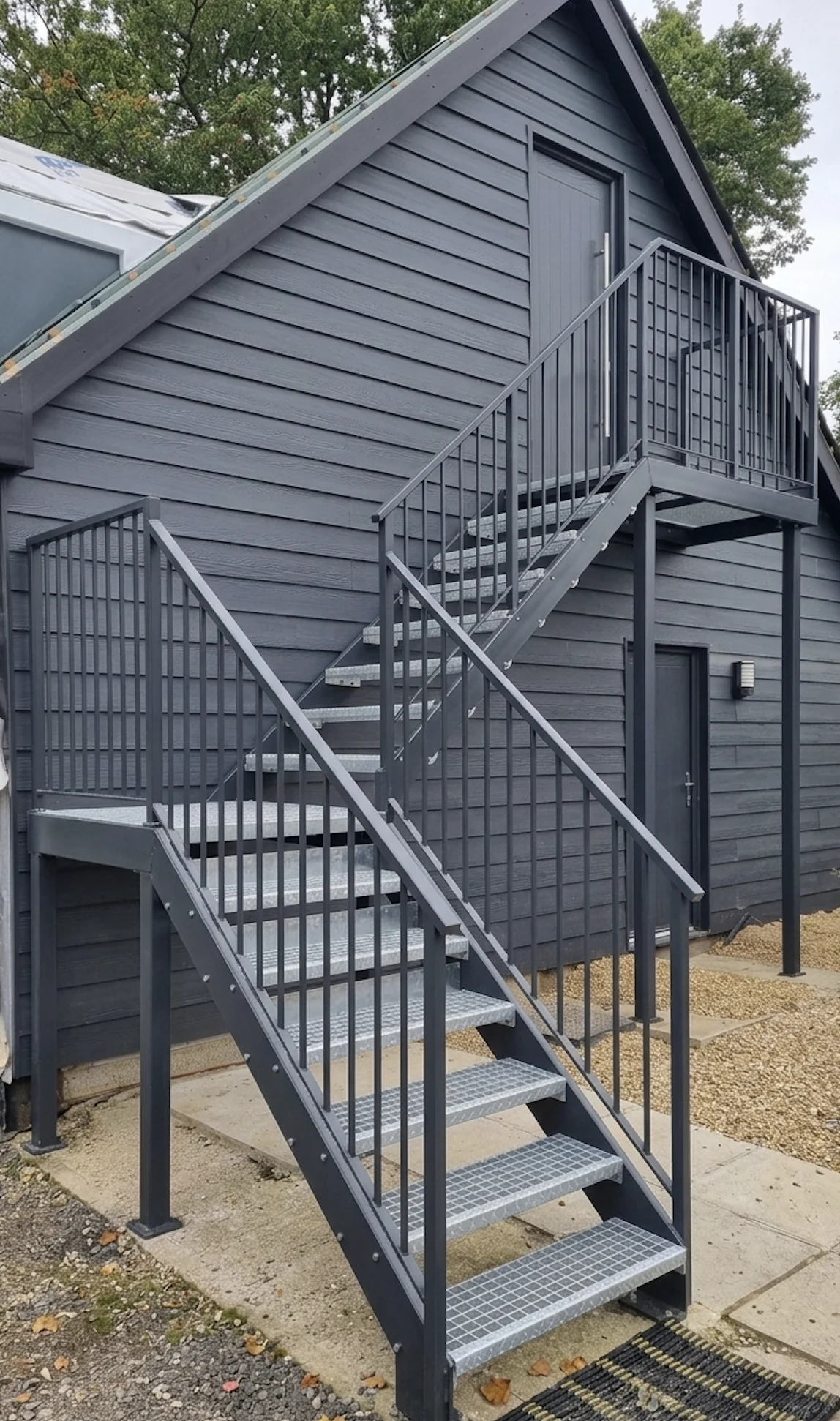
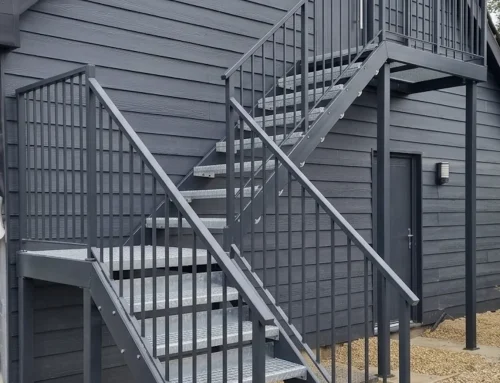
External staircase by Continox — duplex finish (hot-dip galvanised + powder coat), engineered for 40–60 year service life in typical UK conditions.
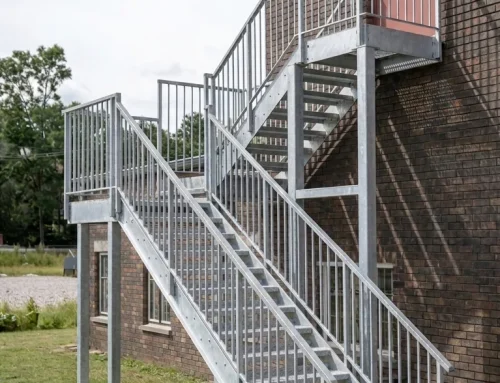
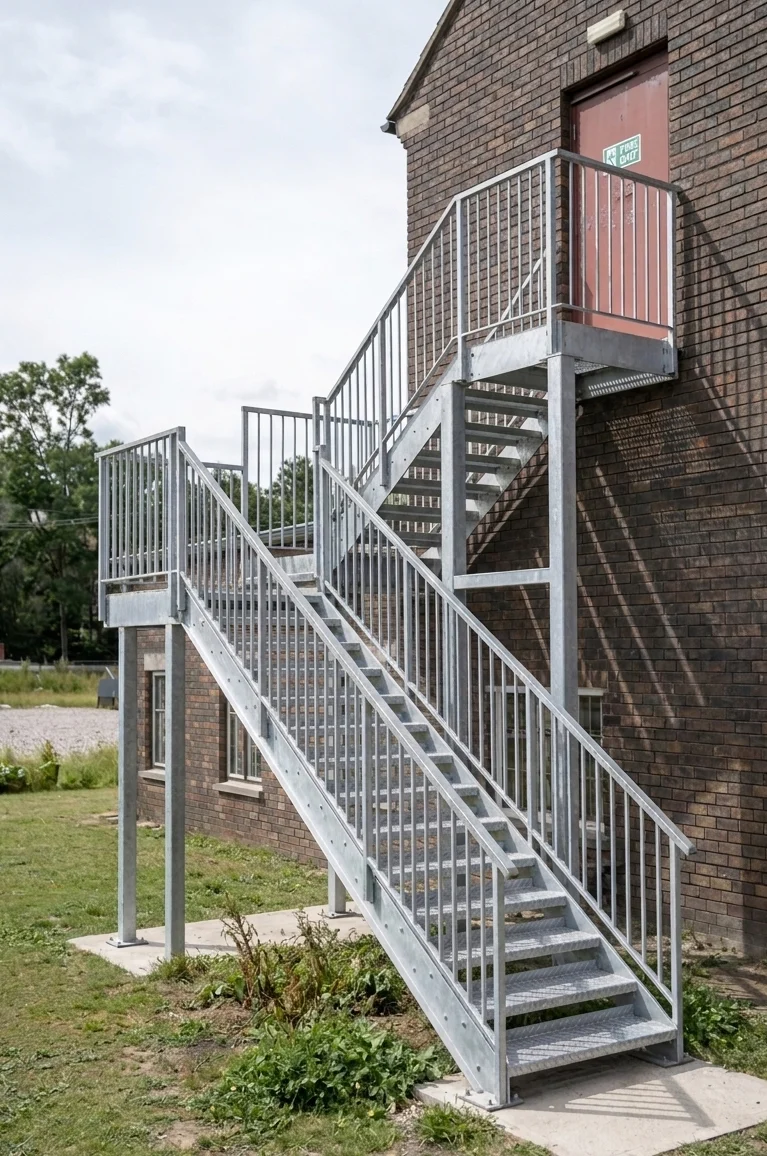
In typical UK conditions, a hot-dip galvanised steel external staircase will serve for 40–70 years before significant refurbishment is needed. A duplex-finished steel staircase (galvanised + powder coated) lasts 30–50 years before topcoat refresh. Timber external staircases have the shortest service life at 10–25 years, heavily dependent on species, treatment, and exposure. Aluminium sits between at 30–50 years. Coastal installations (within 5km of sea) reduce all metal lifespans by roughly 30–40%.
External Staircase Lifespan — By Material
| Material & Finish | Typical Service Life | Primary Failure Mode |
|---|---|---|
| Hot-dip galvanised steel | 40–70 years | Zinc layer depletion |
| Duplex coated steel (galv + powder) | 40–60 years | Topcoat degradation first, substrate lasts longer |
| Stainless steel (304 grade) | 50–80 years | Pitting in coastal environments |
| Stainless steel (316 marine grade) | 60–100 years | Very rare failure in UK conditions |
| Aluminium (anodised) | 30–50 years | Galvanic corrosion at fixings, oxide wear |
| Timber (hardwood, treated) | 15–25 years | UV degradation, moisture ingress, rot |
| Timber (softwood, treated) | 10–18 years | Rot, insect damage, fastener loosening |
| Concrete (reinforced) | 50–100+ years | Reinforcement corrosion, spalling |
Why the wide ranges? A 40–70 year range on galvanised steel is not imprecision — it's the real impact of exposure category. A rural Hampshire installation (ISO 12944 Category C2) reaches the upper end; an industrial Portsmouth installation (C4) sits at the lower end; a coastal Bournemouth seafront (C5) reduces further still. Material matters, but the environment it lives in matters equally.
5 Factors That Determine Actual Lifespan
The largest single determinant. Duplex-coated steel to BS EN ISO 1461 delivers 3–4× the service life of bare powder-coated steel, and 5–7× the life of untreated timber. Specification is made at design stage; getting it wrong costs decades.
Rural (C2), urban (C3), coastal/industrial (C4), or marine (C5). A staircase that would last 60 years in a rural setting may last 25 years in a seafront property. For detailed environmental classification see our powder coat vs galvanised guide.
A private residential external staircase used occasionally lasts longer than a commercial or HMO fire escape used daily by multiple occupants. Heavy usage accelerates tread wear, handrail degradation, and fastener fatigue.
Annual visual inspection and periodic touch-up of minor damage can extend service life by 30–50%. Neglected maintenance accelerates all failure modes — a small scratch through powder coat left unattended becomes a 100mm rust patch in five winters.
Welds ground smooth, drain holes correctly positioned, fasteners compatible with substrate material, galvanising properly vented. Budget fabrication shortcuts show up as premature failure at 10–15 years, regardless of paper specification.
How the staircase meets the building substrate determines whether water can pool at joints, whether galvanic corrosion can occur at dissimilar metals, and whether flexural stresses are correctly resolved. Poor installation halves the service life of even premium fabrications.
Material Deep Dive — How Each Ages
Galvanised steel ages predictably. The zinc layer consumes slowly through atmospheric reaction — approximately 1–3μm per year in typical UK urban conditions, rising to 5–8μm per year on coastal exposure. Starting from a typical 100–150μm zinc thickness, this means the protective layer is depleted somewhere between 30 and 70 years, at which point steel corrosion begins.
Galvanised steel is the default specification for commercial fire escapes, industrial platforms, and any application where aesthetic finish is secondary to functional longevity. The raw silver-grey appearance weathers to a matte grey within months and stays visually stable thereafter.
Duplex systems combine galvanising beneath with powder coat on top, and the service life reflects two separate ageing profiles. The topcoat (powder coat) degrades first — UV causes gradual chalking and colour shift over 15–25 years in typical UK exposure. The galvanised substrate is essentially untouched during this period, because it's protected by the powder layer. When topcoat refresh is needed, only the surface is refreshed — the galvanising underneath has another 20–30 years of protection still available.
This is why duplex is the default Continox specification for premium architectural external steelwork: it delivers both aesthetic finish AND structural longevity in a single system.
Stainless steel external staircases deliver the longest service life of any metal option. Grade 304 (standard architectural) suits inland and urban installations; Grade 316 (marine grade, with added molybdenum) is required for coastal or pool-adjacent applications where chloride exposure would cause pitting in 304. Stainless is significantly more expensive than duplex steel — typically 60–80% premium on fabrication cost — but requires almost no maintenance.
Stainless external staircases are specified where both longevity and a bright, polished or brushed architectural finish are required — luxury residential, commercial frontages, marine installations. Continox fabricates stainless steel balustrade components and external assemblies on request.
Aluminium external staircases are lighter than steel, non-magnetic, and naturally corrosion-resistant through the formation of a protective oxide layer. However, aluminium in UK external conditions faces two failure modes: galvanic corrosion at dissimilar-metal fasteners (steel bolts in aluminium structure will drive accelerated corrosion at contact points), and gradual oxide wear from traffic and weather that reveals fresh metal to re-oxidise.
Anodised aluminium — with an electrochemically thickened oxide layer — performs noticeably better than mill-finish aluminium. Typical UK service life is 30–50 years for a correctly detailed anodised aluminium external staircase with compatible stainless fasteners. Aluminium alone is rarely specified for UK structural staircases; it's more common as an infill or cladding material.
Timber external staircases face the most challenging environment of any material. UV exposure breaks down lignin at the surface causing greying and embrittlement. Rainfall drives moisture into end-grain and joint details; freeze-thaw cycles widen checks; insects (particularly woodworm) enter through any unprotected surface. UK climate is particularly aggressive to exterior timber because of the combination of temperature cycling, persistent dampness, and limited drying days.
Hardwood species (oak, iroko, teak, ipê) at 40mm+ thickness, pressure-treated and regularly oiled/stained, achieve 15–25 years. Softwood (pine, Douglas fir) even when treated rarely exceeds 10–18 years. Timber is not the right specification for commercial fire escapes or long-service applications — for these, steel is the durable answer.
Timber maintenance is NOT optionalThe "15–25 years" figure for hardwood assumes annual inspection, 3–5 year staining/oiling cycles, and immediate repair of any mechanical damage. Neglected timber external staircases can become structurally unsafe within 8–12 years. If you have a timber external staircase older than 10 years, an annual structural inspection by a qualified surveyor is strongly advised.


Warning Signs — When Replacement Is Overdue
Even without reaching material-theoretical end of life, external staircases can become structurally unsafe through localised failure or cumulative damage. These warning signs indicate professional inspection is needed immediately — and in several cases, continued use is unsafe until assessment is complete.
Structural Warning Signs — Professional Inspection Required
Extending Lifespan — Maintenance Calendar
The difference between a 40-year staircase and a 65-year staircase is typically not the original specification — it's the maintenance regime. Planned, routine maintenance is inexpensive; deferred maintenance becomes replacement cost.
For practical maintenance guidance specific to external staircases see our external staircase maintenance guide.
Repair vs Replace — The Economic Threshold
When significant damage is identified, the decision between repair and full replacement is usually economic rather than technical. A rule of thumb used in industry: if estimated repair cost exceeds 40% of replacement cost, replacement is the better long-term investment — you pay slightly more now but reset the service life clock for another 40+ years.
For structural repair (welding corroded sections, replacing tread brackets, re-anchoring to building) on a commercial fire escape: repair cost commonly runs £1,500–£4,500 depending on extent. Full replacement of a 3-storey fire escape staircase starts from £5,500 — making the economic threshold sharper than most building owners expect. For residential external staircases, replacement from £3,500 often beats major repair cost.
One factor that isn't purely economic: Compliance. External staircases installed pre-2010 may not meet current Part K (private), BS 9991 (fire escape), or BS 9999 (commercial) standards. Major repair on a non-compliant staircase typically triggers "consequential improvement" — requiring the whole staircase to be brought up to current code. In practice this usually means full replacement is cheaper and delivers compliant result.
Continox External Staircase — Engineered Lifespan
Every Continox external staircase is engineered for a 40+ year service life as a minimum design target. This is achieved through specifications developed over fifteen years of UK installations: S275 or S355 structural steel (BS EN 10025), hot-dip galvanising to ISO 1461 (typically 140–180μm zinc coating), duplex powder coat topcoat where architectural finish is required, stainless steel fasteners to prevent galvanic corrosion, and correctly detailed drainage to prevent water ponding at welds and joints.
Starting prices reflect the specification: £3,500 for residential external staircases, £5,500 for commercial or multi-landing installations. For full range and specification details see our external staircase range or fire escape stairs for BS 9991-compliant fire escape designs.
External Staircase Lifespan — FAQ
Common questions from UK property owners planning external staircase installation, refurbishment, or replacement.
Free Survey + 40-Year Design
Free on-site survey across the UK, fixed-price quotation within 24 hours. All Continox external staircases engineered for 40+ year service life — S275/S355 steel, ISO 1461 galvanising, duplex finish as standard. Residential from £3,500, commercial from £5,500.