

Floating vs Central Spine Staircase in Switzerland — Which Configuration Is Right for Your Project?
A practical decision framework for Swiss architects and Bauingenieure choosing between floating cantilever and central spine modern staircases — structural implications, Swiss heritage context, SIA 358 compliance, CHF/EUR pricing and the project profiles each system suits best.
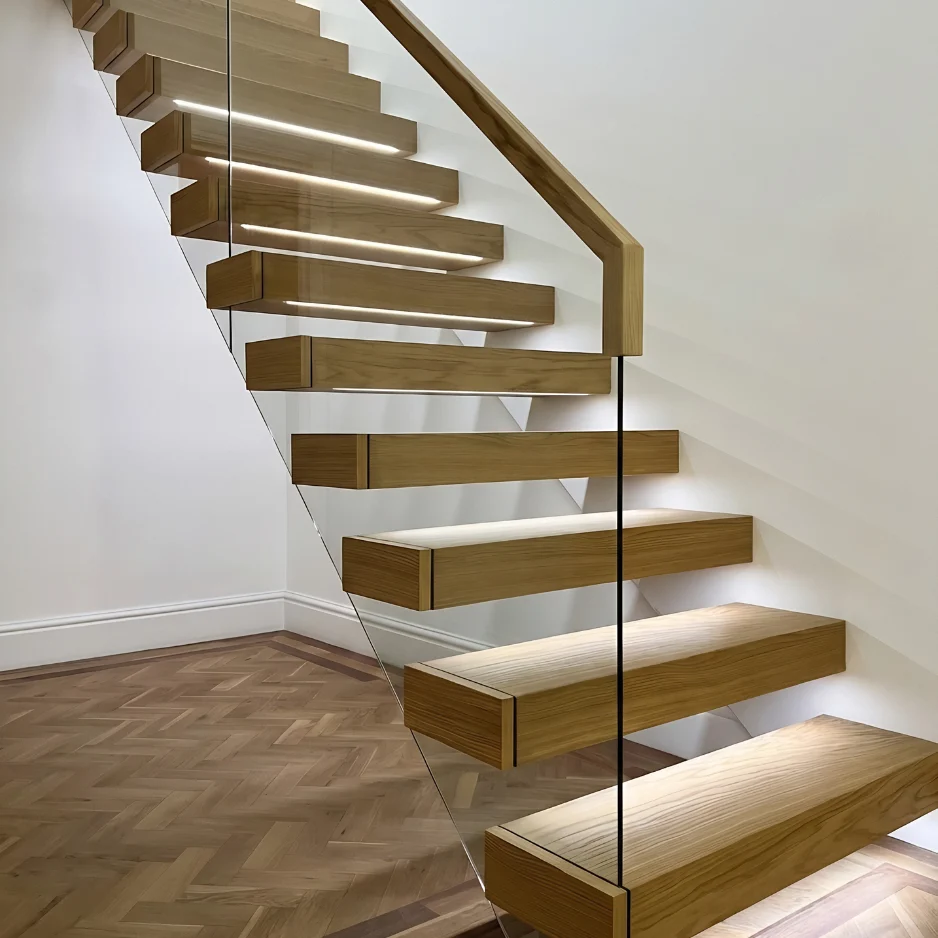
Floating cantilever staircase — treads visually appear unsupported, projecting from a structural wall behind. The most architecturally striking Continox configuration for Swiss new-build villa projects.
The two most-specified Continox configurations in Switzerland are the floating cantilever staircase (treads visually unsupported, projecting from a hidden wall structure) and the central spine staircase (treads supported by a single steel beam running through the centre underneath). Both achieve the same compliance against Swiss SIA 358 requirements; both can be specified in oak or walnut treads with frameless glass balustrade. The choice between them is driven by structural context (what the host building can carry), aesthetic preference, project budget, and — importantly — what's already happening in the surrounding Swiss architecture.
This guide is the practical decision framework for Swiss architects and Bauingenieure who've narrowed the choice to these two systems. We cover the structural implications (which one needs a more capable substrate), the dimensional constraints (footprint, headroom, riser/tread math), the aesthetic context (where each system reads better in Swiss heritage and contemporary architectural settings), the cost and lead-time differences, and which Continox configurations within each family suit specific Swiss project profiles. For the broader regulatory framework see our SIA standards guide, classification details in the private vs commercial guide, glass specification in the glass balustrade regulations guide, and regional context across our Zürich, Zug & Goldküste, Geneva & Lac Léman, Bern, Basel & Aargau, St. Moritz, Engadin & Davos and Gstaad, Saanenland & Valais guides. We supply both system families plus matching glass balustrades and balcony railings via intra-EU + Swiss customs delivery. Visit the Continox Switzerland hub for the complete system catalogue including floating and central spine product pages.
Choose floating cantilever if you want maximum architectural drama, the wall behind can carry significant moment loads (reinforced concrete or structural steel — not Swiss heritage rubble masonry without reinforcement), the budget supports €9,500 / CHF 10,200+ supply, and the surrounding architecture is contemporary new-build (Goldküste, Cologny, Zug, Davos contemporary). Choose central spine if structural flexibility is needed (the spine is self-supporting — the host walls don't carry the staircase), the budget is €8,999 / CHF 9,500 entry, the project is a Bern Altstadt UNESCO renovation, Zürich Vieille-Ville townhouse, Engadin heritage chalet or any Swiss heritage envelope where wall reinforcement isn't desirable, or you want a staircase that reads as deliberately structural rather than visually weightless. Both systems comply identically with Swiss SIA 358 — the choice is structural and aesthetic, not regulatory.
- How Each System Works — Structural Diagrams
- Side-by-Side Summary — At a Glance
- Structural Requirements — What the Host Building Needs
- Aesthetic Context — When Each System Reads Better in Swiss Architecture
- Dimensional Constraints & SIA Compliance
- Cost & Lead Time (CHF / EUR)
- Swiss Project Profiles — Which System Suits
- The Decision Framework — A Practical Walkthrough
- Frequently Asked Questions
How Each System Works — Structural Diagrams
Floating Cantilever — Treads Project from a Hidden Structure
In a floating staircase, each tread is a cantilever beam — supported only at one end (where it meets the wall) and projecting freely into space. The visible treads appear unsupported because the structural connection is hidden inside the wall. Behind the visible wall finish, a substantial structural steel sub-frame (typically 200–300 mm deep) anchors each cantilever back to a load-bearing structure — reinforced concrete, structural steel column, or a heavily reinforced studwork stub-wall.
The structural challenge is moment loading: every kilonewton of vertical force on a tread creates a multiple-times-larger horizontal moment on the anchor connection. This is what makes floating staircases demanding on the host structure — the wall behind isn't just supporting weight, it's resisting rotational forces.
Central Spine — Treads Supported by a Steel Beam Beneath
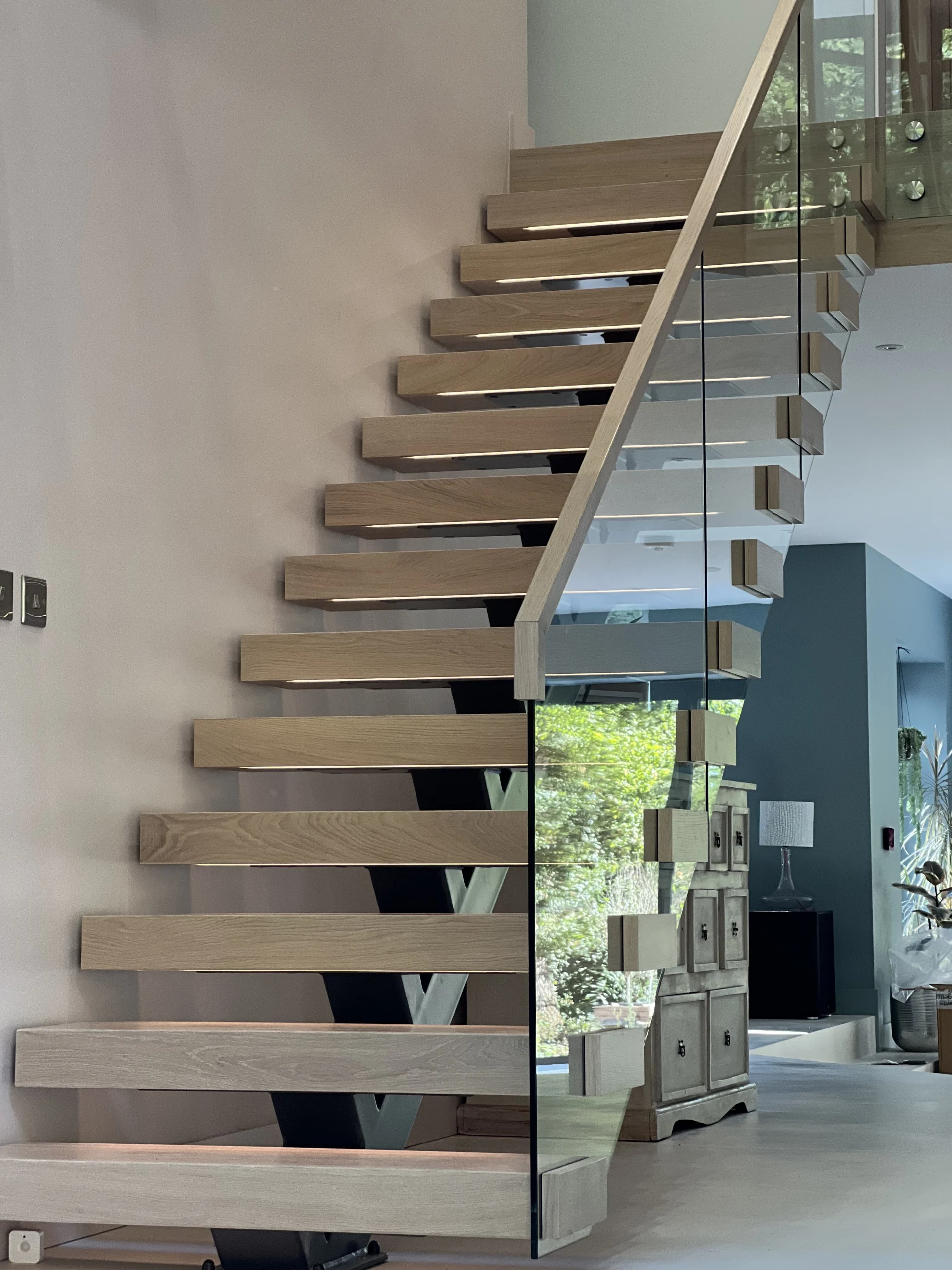
In a central spine staircase, the structural element is a single steel beam (or paired beams) running diagonally through the centre underneath the treads. Each tread sits on (or bolts to) this spine via a steel bracket. The spine carries all loading — vertical service load, dynamic load, balustrade horizontal load — back to fixings at the top and bottom of the flight. The treads themselves don't transfer load to the side walls.
This makes central spine structurally self-supporting within the flight footprint. The host walls don't need to carry significant load; only the top and bottom landings (or floor slab) need to anchor the spine end-fixings. Easier to retrofit into existing Swiss heritage buildings without disturbing protected envelope.
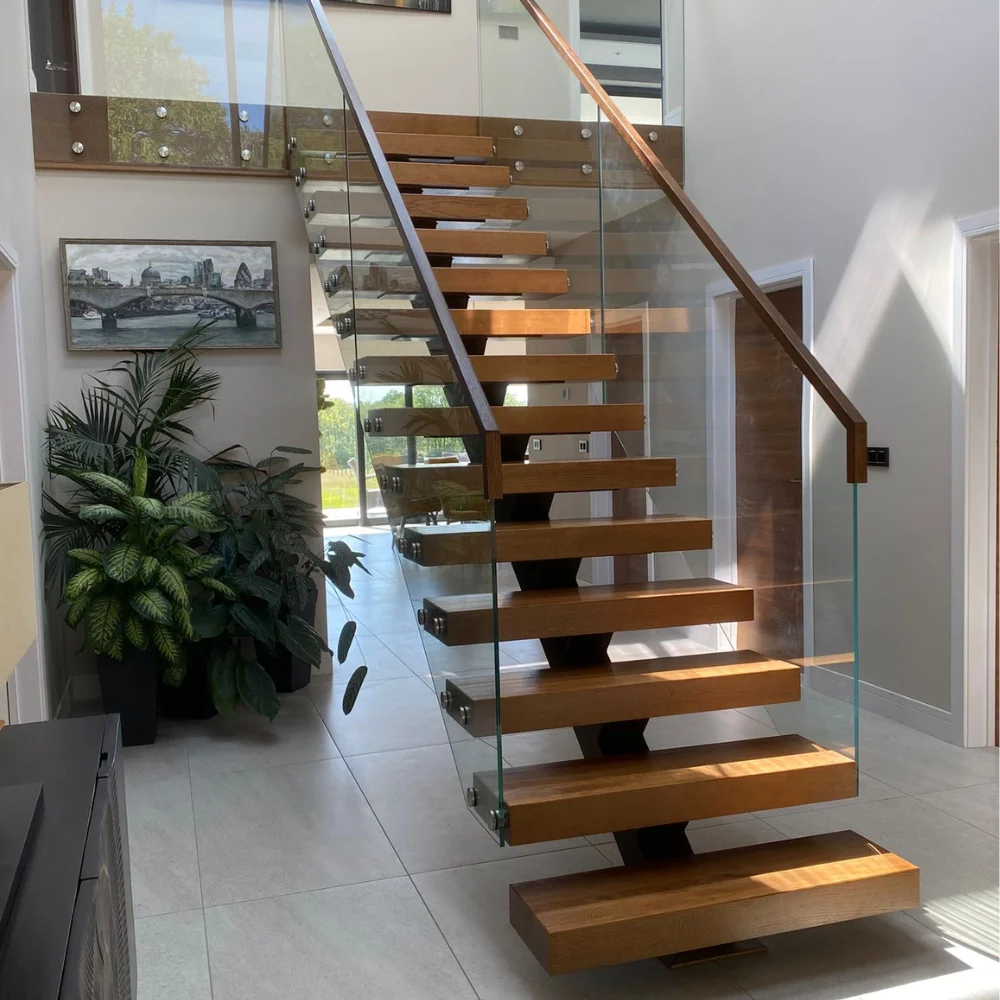
Central spine staircase — treads supported by a single visible steel beam running through the centre underneath. Self-supporting within the flight footprint, no host-wall reinforcement needed — the standard Continox configuration for Swiss heritage renovations.
Side-by-Side Summary — At a Glance
Visually weightless drama
- Visual effect: treads appear unsupported, project from a wall
- Structural demand: high — host wall must carry moment loads
- Substrate required: reinforced concrete, structural steel column, or reinforced studwork
- Footprint: spine-free underneath — opens visual space below
- Tread-to-wall connection: hidden steel sub-frame, 200–300 mm depth
- Best for Swiss: Goldküste new-build, Zug contemporary, Cologny, Davos contemporary, Verbier RC-frame chalets
- Continox supply from: €9,500 / CHF 10,200
- Lead time: 5–7 weeks fabrication (alpine 6–8 weeks)
Structural honesty & flexibility
- Visual effect: visible steel beam reads as the structural element
- Structural demand: moderate — only end-anchors carry significant load
- Substrate required: floor slab anchorage at top and bottom; side walls non-structural
- Footprint: spine occupies space underneath but allows tread orientation flexibility
- Tread-to-spine connection: visible bracket or hidden welded joint
- Best for Swiss: Bern UNESCO Altstadt, Zürich Altstadt, Geneva Vieille-Ville, Engadin heritage villages, Solothurn 18e, Basel Innenstadt renovations
- Continox supply from: €8,999 / CHF 9,500
- Lead time: 4–6 weeks fabrication (alpine 5–7 weeks)
Structural Requirements — What the Host Building Needs
This is the single most important practical difference. Floating cantilever staircases impose significant moment loading on the host wall; central spine staircases don't.
| Loading Type | Floating Cantilever | Central Spine |
|---|---|---|
| Vertical service load (per tread) | 1.5–2.0 kN at tread tip | 1.5–2.0 kN at tread (transferred to spine) |
| Tread-end moment on host wall | 0.5–1.0 kN·m per tread (significant) | Negligible — load goes to spine |
| Cumulative wall moment (full flight) | 10–18 kN·m at base anchor zone | Not applicable — flight is self-supporting |
| Top & bottom slab anchorage | Standard (carries flight self-weight only) | High — carries cumulative spine reactions 8–15 kN |
| Horizontal balustrade load (SIA 358) | 0.8 kN/m at handrail; transferred to wall | 0.8 kN/m at handrail; transferred to spine |
| Substrate types compatible | RC concrete (preferred), structural steel column, heavily reinforced studwork | Most floor-slab types: RC concrete, suspended timber with reinforcement, beam-and-block |
| Substrate types incompatible | Bern Altstadt rubble masonry, Engadin Sgraffito-clad heritage walls, lath-and-plaster, lightweight studwork — all without reinforcement | Suspended hollow-pot floors with no reinforcement, lightweight modular slabs |
Many Swiss renovation projects involve protected heritage buildings — Bern UNESCO Altstadt 18e townhouses, Zürich Vieille-Ville and Niederdorf 19e apartments, Basel Innenstadt mixed-period stock, Engadin Sgraffito-decorated farmhouses, Solothurn 18e Baroque townhouses, Geneva Vieille-Ville. These have load-bearing rubble masonry walls that aren't naturally suited to floating cantilever moment loading. Reinforcing such a wall to take the cantilever moments is technically possible but expensive (typically CHF 8,000–CHF 18,000 in additional structural works) and disruptive to the protected envelope, often requiring cantonal Denkmalpflege approval. Central spine sidesteps this entirely — the spine is self-supporting and only needs floor-slab anchorage. This is why central spine dominates the Swiss heritage renovation market while floating dominates contemporary villa new-build (Goldküste, Cologny, Zug, Bruderholz, Davos).
Practical Substrate Decision — Swiss Renovation Context
- Bern UNESCO Altstadt townhouse (rubble masonry): central spine recommended — avoids wall reinforcement and Denkmalpflege complications
- Zürich Altstadt / Niederdorf apartment renovation: central spine — preserves heritage envelope
- Geneva Vieille-Ville townhouse: central spine — typically the architect's preference for sympathetic insertion
- Basel Innenstadt mixed-period apartment: central spine — sympathetic insertion, structural sensitivity
- Engadin heritage village (Zuoz, Bever, S-chanf): central spine — preserves Sgraffito-decorated envelope
- Solothurn 18e townhouse: central spine — heritage stone walls, sympathetic Baroque insertion
- Lausanne Belle Époque apartment: central spine — original masonry, copropriété structural sensitivity
- Goldküste new-build villa (RC frame): floating cantilever — concrete frame easily supports moment loads
- Cologny / Vandoeuvres villa (RC frame): floating cantilever — diplomatic-grade architectural drama
- Zug contemporary new-build: floating cantilever — RC frame standard, contemporary aesthetic
- Bruderholz villa (1960s+ RC frame): floating cantilever — pharma-executive premium
- Davos contemporary (RC core): floating cantilever — modern aesthetic, RC frame
- Verbier 4 Vallées contemporary chalet: floating cantilever — RC-frame chalet structure
- St. Moritz Suvretta ultra-luxury (RC frame): either — typically Y-shape central spine for sculpture-piece reading
Aesthetic Context — When Each System Reads Better in Swiss Architecture
Beyond the structural question, each system carries an aesthetic signature that suits some Swiss contexts better than others.
Floating Reads as Architectural Drama
Floating cantilever is the most visually striking of all modern staircase configurations. The treads appear to defy gravity; the eye fills in the missing structural support, creating implicit tension. The empty space underneath becomes part of the composition — often emphasised with hidden LED uplighting or a contrasting feature wall. Floating reads as contemporary, sculptural, expensive — and it works best when the surrounding Swiss architecture supports that reading.
Best for: contemporary villas where the staircase is intended as a centrepiece (Goldküste, Cologny, Vandoeuvres, Bruderholz, Riehen), double-height living spaces where the visual lightness preserves spatial drama (Zug shoreline, Genfersee waterfront), gallery-style new-build apartments where the staircase functions almost as installed art (Bahnhofstrasse premium, La Défense-equivalent contemporary). Risk: forced into a context that's mismatched (sympathetic Bern UNESCO Altstadt renovation, Engadin Sgraffito heritage chalet), the floating staircase reads as gratuitous rather than dramatic.
Central Spine Reads as Structural Honesty
Central spine doesn't hide its structural element — the spine is the visible element. This reads as structurally honest, deliberate, modernist in the Swiss Modernist lineage (Le Corbusier's Swiss roots, Max Bill, Mario Botta). The spine itself can be expressed: black powder-coat for contrast, walnut-clad for warmth, custom RAL for a colour statement. The overall composition reads as an integrated structural system rather than a visually weightless object.
Best for: Swiss heritage renovations where contemporary insertion needs to acknowledge weight and structure (Bern UNESCO Altstadt, Zürich Altstadt, Geneva Vieille-Ville, Engadin Zuoz, Lausanne Belle Époque), architectural contexts where structural honesty is part of the design language (Bauhaus-influenced Swiss contemporary, restored industrial-loft conversions, Limmat valley contemporary), and projects where the budget supports premium specification but the brief is "tasteful and considered" rather than "dramatic statement" — typical of Swiss premium without being ostentatious.
Dimensional Constraints & SIA Compliance
Both systems comply identically with Swiss SIA 358 + SIA 500 + SIA 261 requirements — the regulatory framework doesn't distinguish between them. The dimensional differences come from the structural geometry.
| Dimension | Floating Cantilever | Central Spine | Swiss Compliance Note |
|---|---|---|---|
| Minimum tread width | 800 mm (Wohnbau privat) | 800 mm (Wohnbau privat) | SIA minimum same for both |
| Tread thickness (Wohnbau privat) | 50–60 mm typical (cantilever requires depth) | 30–40 mm typical (sits on spine bracket) | Both SIA 358 compliant |
| Riser (Wohnbau privat) | 17–20 cm (step formula 600–630 mm) | 17–20 cm (step formula 600–630 mm) | Identical compliance |
| Going (Wohnbau privat) | 24–28 cm (step formula 600–630 mm) | 24–28 cm (step formula 600–630 mm) | Identical compliance |
| Headroom (clearance above) | 2.00 m minimum | 2.00 m minimum | Identical compliance |
| Footprint (excl. landings) | Standard for the run length | Standard for the run length | Equivalent |
| Wall depth required | 200–300 mm hidden sub-frame depth (in addition to wall finish) | 0 mm — wall depth not affected | Affects available room width on flight side |
| Maximum unsupported span (single tread) | 1.4 m typical (limited by cantilever bending) | 1.6 m typical (limited by spine size) | Both well above SIA 358 minimum |
| Cold-climate alpine spec | S355J0 above 1,500 m, larger sub-frame for thermal expansion | S355J0 above 1,500 m, standard spine sizing | Both upgrade automatically for Engadin / Saanenland / Valais |
Cost & Lead Time (CHF / EUR)
| Item | Floating Cantilever | Central Spine |
|---|---|---|
| Continox supply from | €9,500 / CHF 10,200 | €8,999 / CHF 9,500 |
| Premium variant from | €12,500 / CHF 13,400 (oak + integrated LED) | €11,500 / CHF 12,300 (premium walnut + LED) |
| Bespoke variant from | €15,000+ / CHF 16,100+ (top-end villa) | €12,999+ / CHF 13,900+ (fully bespoke geometry) |
| Fabrication time (standard) | 5–7 weeks | 4–6 weeks |
| Fabrication time (alpine cold-climate) | 6–8 weeks | 5–7 weeks |
| Substrate works (additional) | CHF 8,000–CHF 18,000 (heritage rubble masonry reinforcement) | CHF 500–CHF 2,000 (slab anchor verification) |
| Installation time on site | 3–5 days (precision required for cantilever alignment) | 2–3 days (spine + treads sequence) |
| Total programme order to delivery | 5–9 weeks (alpine 6–10 weeks) | 4–8 weeks (alpine 5–9 weeks) |
The supply prices above show floating €9,500 / CHF 10,200 vs central spine €8,999 / CHF 9,500 — a small difference. But for Swiss heritage renovation projects, the substrate cost often dominates: floating cantilever in a Bern UNESCO Altstadt apartment may require CHF 8,000–CHF 18,000 of wall reinforcement before the staircase can be installed (plus Denkmalpflege approval delay); central spine in the same apartment requires only CHF 1,000–CHF 2,000 of slab anchor verification. The total project cost difference can be CHF 7,000–CHF 16,000 — not the CHF 700 supply-price difference. Always factor substrate works when comparing in Swiss heritage contexts.
Swiss Project Profiles — Which System Suits
Project profiles where floating wins
- Goldküste lakeside villa (Küsnacht, Zollikon, Erlenbach): RC frame supports moment loads, premium budget, double-height living
- Cologny / Vandoeuvres diplomatic-grade: RC frame, Lake Geneva orientation, sculptural centrepiece brief
- Zug contemporary new-build: RC frame standard, commodity-trading wealth, modern aesthetic
- Bruderholz pharma-executive villa: 1960s+ RC frame, Basel premium, walnut + integrated LED
- Riehen / Bottmingen villa belt: RC frame, premium specification standard
- Davos contemporary chalet: RC core, modern WEF-driven international aesthetic
- Verbier 4 Vallées contemporary: RC-frame chalet structure, mountain panorama
- Limmat valley new-build (Aargau): RC frame, contemporary Mittelland
Project profiles where central spine wins
- Bern UNESCO Altstadt townhouse: medieval rubble masonry, strict Denkmalpflege protocol
- Zürich Altstadt / Niederdorf apartment: 19e townhouse, compact stairwell, heritage envelope
- Geneva Vieille-Ville townhouse: protected heritage, Office des autorisations review
- Basel Innenstadt apartment: mixed-period heritage, sympathetic insertion
- Engadin heritage village (Zuoz, Bever, Sils Maria): Sgraffito-decorated envelope, cantonal Graubünden Denkmalpflege
- Solothurn 18e Baroque townhouse: heritage stone walls, sympathetic Baroque insertion
- Lausanne Belle Époque apartment: original masonry, copropriété structural sensitivity
- Lavaux UNESCO terraced vineyard: heritage envelope, restrained insertion
- Gstaad village heart traditional chalet: Saanenland-Gstaad style code, vieux-bois aesthetic
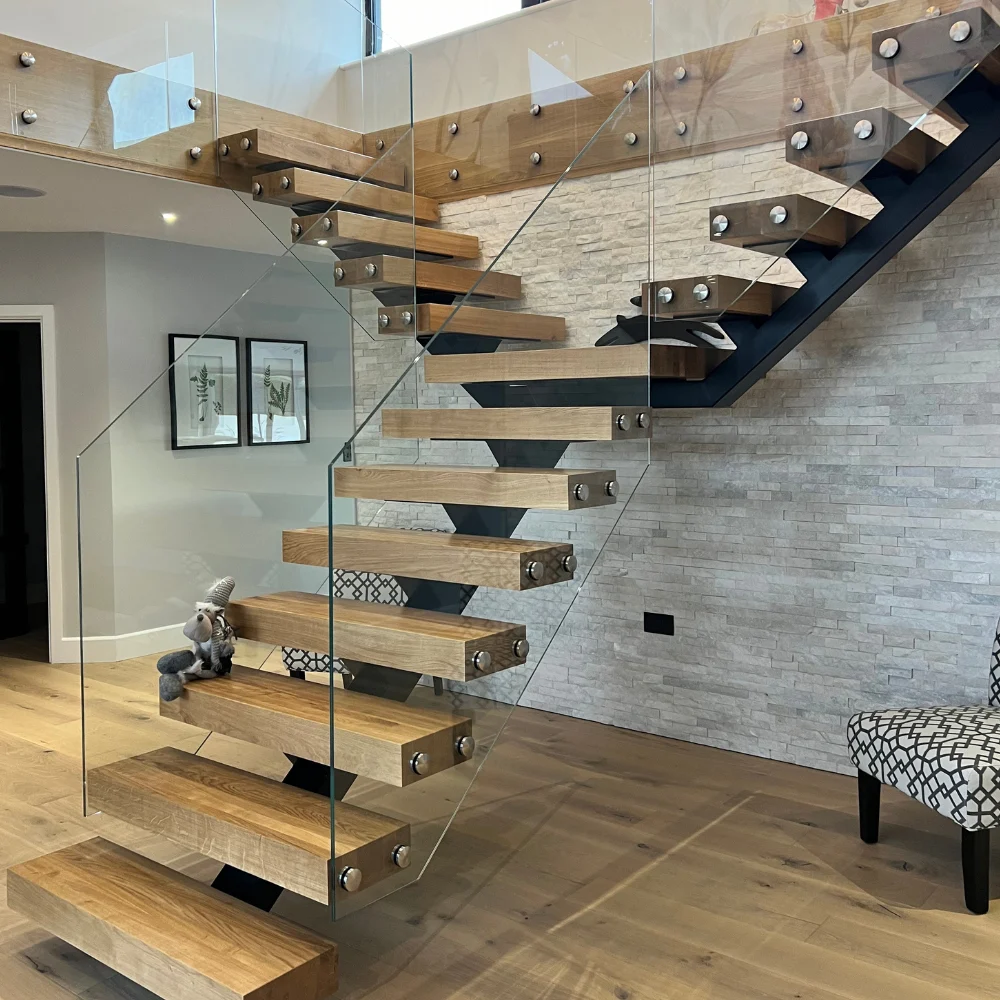
Y-shape central spine — the architectural sculpture-piece variant of the central spine family, often specified for Cologny, Vandoeuvres, St. Moritz Suvretta, Bruderholz and Gstaad ultra-luxury chalet centrepieces where structural-honesty aesthetic meets architectural drama.
The Decision Framework — A Practical Walkthrough
For Swiss architects narrowing the choice, work through these four questions in order:
Question 1 — Can the host wall carry moment loads?
If yes (RC frame, structural steel column, reinforced studwork) → both systems are options, proceed to question 2. If no (Bern Altstadt rubble masonry, Engadin Sgraffito heritage walls, Zürich Vieille-Ville original construction, Geneva 19e townhouse, lath-and-plaster, lightweight studwork without reinforcement) → central spine is the practical choice. Wall reinforcement to enable floating cantilever is technically possible but typically adds CHF 8,000–CHF 18,000 and disrupts protected heritage envelope (often requiring cantonal Denkmalpflege approval).
Question 2 — What does the surrounding Swiss architecture want?
If contemporary new-build (Goldküste, Cologny, Zug, Bruderholz), gallery-style interior, double-height living, or sculptural centrepiece brief → floating cantilever reads stronger. If sympathetic Swiss heritage renovation (Bern Altstadt, Zürich Vieille-Ville, Engadin Zuoz, Solothurn 18e, Gstaad village heart), structural-honesty aesthetic, or Swiss Modernist lineage (Botta, Bill, Le Corbusier-influenced contemporary) → central spine reads stronger. If neutral on either → proceed to question 3.
Question 3 — What's the budget envelope?
If €8,999–€10,500 / CHF 9,500–CHF 11,300 for the staircase → central spine entry is the natural fit (floating starts at €9,500 / CHF 10,200 with substrate costs added on top in heritage contexts). If €11,500–€15,000 / CHF 12,300–CHF 16,100 → both systems available; floating cantilever fully suited where substrate supports it. If €15,000+ / CHF 16,100+ → both systems available in premium and bespoke variants; choice driven by aesthetic context (question 2).
Question 4 — Alpine cold-climate?
If alpine project above 1,500 m altitude (Engadin, Davos, Saanenland Schönried/Saanenmöser, Verbier, Crans-Montana, Zermatt, Saas-Fee) → both systems automatically include S355J0 cold-resistant steel grade, increased thermal expansion clearances, and Eurocode 1991-1-3 snow-loaded external steps where applicable. Central spine often easier to coordinate with traditional Savoyard chalet aesthetic (vieux-bois treads, exposed structural element matching wrought-iron tradition). Floating cantilever works for contemporary alpine new-build with RC-frame substrate (Verbier contemporary, Davos Dorf modern). Cold-climate spec adds 1–2 weeks fabrication regardless of system choice.
Need Help Choosing? Free 3D Visualisation
Continox provides free 3D visualisation of both system options before you decide. Send your project dimensions, classification and aesthetic brief — receive comparison visuals within 5 working days.
Get Free Quote & 3DFrequently Asked Questions
Which is more expensive — floating or central spine?
Continox supply prices: floating from €9,500 / CHF 10,200, central spine from €8,999 / CHF 9,500. The CHF 700 supply difference is small. The bigger cost factor is substrate works — floating cantilever often requires CHF 8,000–CHF 18,000 of wall reinforcement in Swiss heritage renovation contexts (Bern Altstadt, Zürich Vieille-Ville, Engadin), while central spine requires only CHF 500–CHF 2,000 of slab anchor verification. For new-build with RC frame, substrate cost is similar; for renovation, central spine is typically CHF 7,000–CHF 16,000 cheaper overall.
Can I install a floating cantilever in a Bern UNESCO Altstadt apartment?
Technically yes, but requires significant wall reinforcement plus cantonal Denkmalpflege approval. Bern Altstadt medieval rubble masonry walls aren't naturally suited to cantilever moment loads (typically 0.5–1.0 kN·m per tread, cumulative 10–18 kN·m at base). Reinforcement options include: bonded concrete-and-rebar overlay (CHF 10,000–CHF 18,000), structural steel column hidden in the wall (CHF 12,000–CHF 22,000), or bonded carbon-fibre strengthening (CHF 8,000–CHF 14,000). Most architects choose central spine instead for Bern Altstadt — avoids the disruption, the cost, and the Denkmalpflege complication.
Do both systems comply identically with Swiss SIA regulations?
Yes — both floating cantilever and central spine comply identically with SIA 358 (1.0 m landing guard height, 0.90 m flight guard height, 0.8 kN/m horizontal load minimum), SIA 500 where applicable (barrier-free design, handrail extensions), SIA 260/261 (basis of design, actions on structures, parallels Eurocode 0 and 1), SIA 263 (steel structures, parallels Eurocode 3) and the EN 14449 + EN 12150 + EN 12600 1B1 framework for glass infill. The Swiss regulatory framework doesn't distinguish between systems — only between dimensional and material outcomes.
Which is faster to install?
Central spine is faster — 2–3 days on site vs 3–5 days for floating cantilever. The reason: floating cantilever requires precision alignment of every tread to the hidden sub-frame, with iterative checking and adjustment. Central spine assembles in sequence (spine first, then treads in order), which is more linear and faster. Both timelines are exclusive of any substrate works (which precede the staircase install) and Swiss customs clearance (which adds 4–8 hours at Basel border).
Which has the better resale appeal in the Swiss market?
It depends entirely on the property and market. Floating cantilever in a contemporary Goldküste villa, Cologny new-build or Zug premium apartment is a clear value-add — sculptural centrepiece, photographable, supports premium positioning at CHF 25,000+ per m² locations. Central spine in a Bern UNESCO Altstadt or Engadin heritage renovation reads as deliberate contemporary intervention — also a value-add, often preferred by buyers who specifically want a sympathetic restoration. Mismatched (floating in a sympathetic Bern Altstadt, or budget central spine in a top-end Cologny villa) can read as compromise rather than choice.
Can the spine be hidden — making central spine look more like floating?
Partially yes — Continox supplies "hidden spine" variants where the spine is enclosed in the lower wall finish, leaving only the brackets visible. This reads visually closer to floating but isn't structurally floating (treads still bolt to a spine, just one that's wall-clad rather than free-standing). The aesthetic is a compromise between the two systems — not as dramatic as true floating, but more sculptural than visible spine. Premium configurations from €11,500 / CHF 12,300.
What about Y-shape and double spine — are these floating or central spine variants?
Y-shape and double spine are central spine family variants — they use the same self-supporting spine principle but with branched (Y-shape) or paired (double spine) geometry for sculptural effect. Y-shape central spine (from €10,999 / CHF 11,800) is the architectural sculpture-piece variant typically specified for Cologny, Vandoeuvres, St. Moritz Suvretta, Bruderholz and Gstaad ultra-luxury villa centrepieces. Same structural advantages as standard central spine — self-supporting, retrofit-friendly, no wall reinforcement needed.
Does Continox supply both systems with matching glass balustrade?
Yes — both systems support frameless glass balustrade infill to SIA 358 + EN 14449 + EN 12150 + EN 12600 1B1 specification. For floating cantilever, glass typically attaches via point fixings to the wall side and channel base on the open side. For central spine, glass channel-fixes to the spine on one or both sides. Both systems can be supplied with oak, walnut or stainless Handlauf (handrail). Combined supply (staircase + glass balustrade + matching balcony railings) typically reduces overall project cost vs separate orders by 8–12%.
Can floating cantilever work for Öffentlich zugängliche Bauten?
Technically yes but rarely specified for Swiss commercial/public projects. Öffentlich zugängliche horizontal loading is 1.0–3.0 kN/m (vs 0.8 kN/m Wohnbau privat) — significantly higher, requiring proportionally larger cantilever sub-frames and more capable host walls. Öffentlich zugängliche also requires double Handlauf both sides plus 30 cm horizontal extensions, harder to integrate cleanly with floating cantilever aesthetic. Central spine is the standard Öffentlich zugängliche choice — accommodates double handrails naturally, scales to higher loading without aesthetic compromise. See our classification guide for Öffentlich zugängliche specifics.
Final question — which system does Continox recommend most often in Switzerland?
Central spine is the most-supplied system across the Continox Switzerland market — typically 65–75% of total annual project volume. The reason: Switzerland has a very high proportion of heritage renovation projects (Bern UNESCO Altstadt, Zürich Vieille-Ville, Geneva, Lausanne Belle Époque, Engadin Zuoz, Solothurn 18e, Gstaad traditional chalet) where central spine is structurally appropriate. Floating cantilever dominates the contemporary new-build segment (Goldküste, Cologny, Zug, Bruderholz, Davos contemporary) but is a smaller share of total volume. The choice is project-specific, not preference-based — both systems are first-class Continox products with identical SIA + EN compliance.
Specify Your Floating or Central Spine Staircase
From €8,999 / CHF 9,500 supply-only. Free 3D visualisation comparing both system options, full SIA 358 + SIA 500 compliance documentation, EN 1090-1 EXC2 structural certification. 4–6 day intra-EU + Swiss customs delivery to all 26 Swiss cantons.
Get Free Quote