
DIY Kit Staircase vs Bespoke — Real Cost & Quality Comparison UK 2026
Replacing a UK staircase comes down to three realistic paths: a flat-pack DIY kit at £800–£2,500 fitted, a standard joiner-built timber staircase at £3,500–£8,000, or a fully bespoke design at £7,900–£25,000. Each option has its place — but the right answer for any specific home depends on how visible the staircase is, how long you'll own the property, and whether the existing layout is Part K compliant. This guide compares all three paths across 15 specific criteria with honest cost and quality assessments. For instant pricing on any tier, use our UK staircase cost calculator.
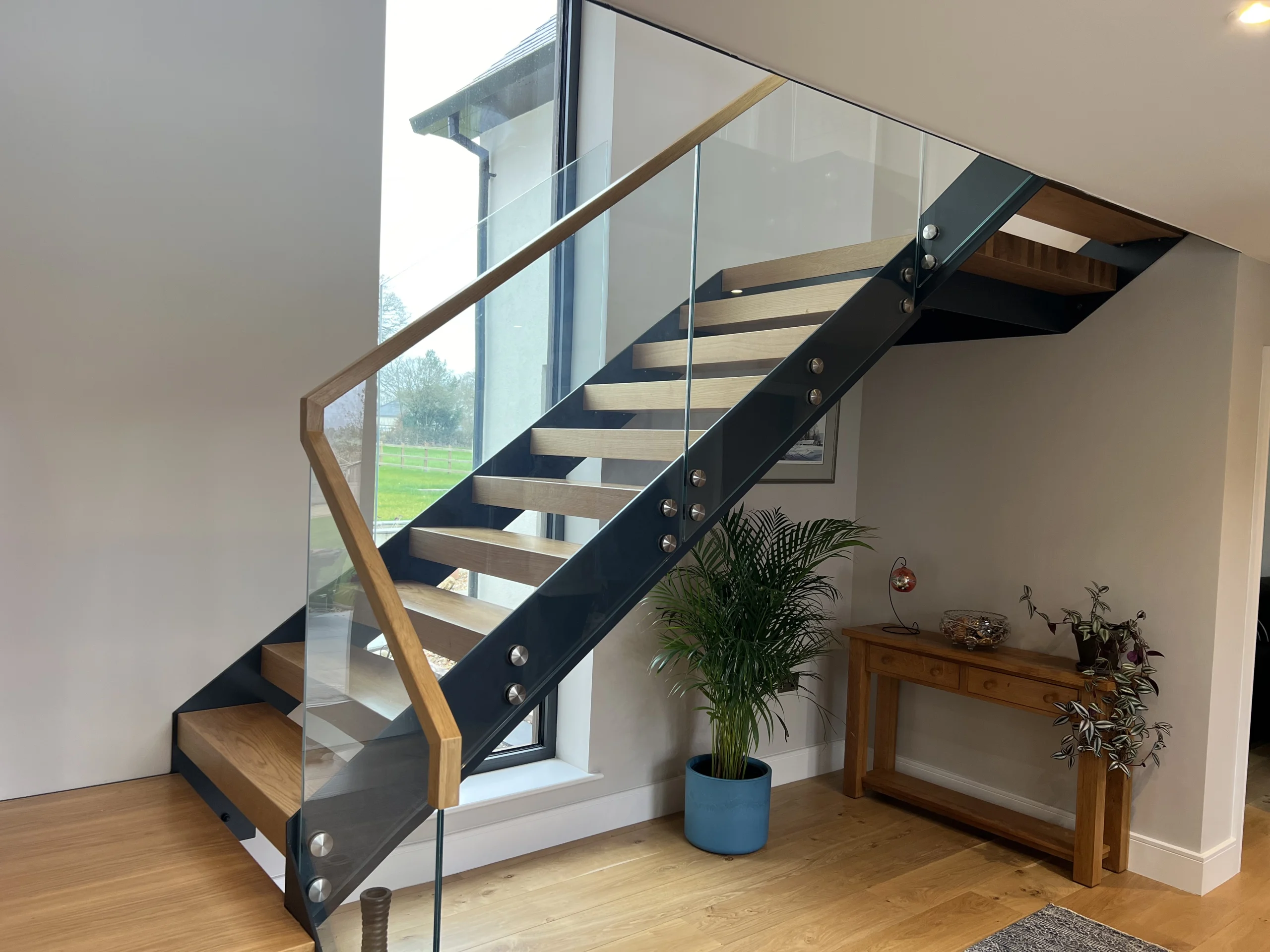
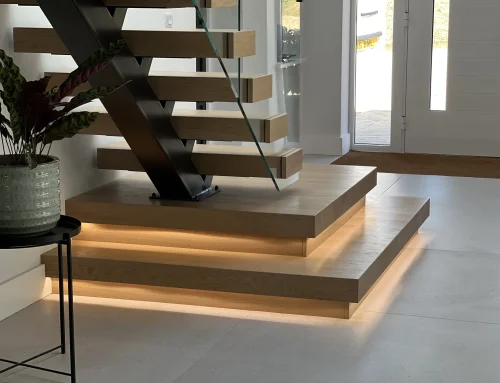
Bespoke central spine staircase by Continox — the premium tier in the UK staircase market, typical investment £9,500–£18,500.
The three UK staircase replacement paths in 2026: DIY kit (£800–£2,500 fitted) is best for rentals, secondary stairs and short-hold properties. Standard joiner (£3,500–£8,000) suits most family homes where the staircase is functional but not the visual centrepiece. Bespoke (£7,900–£25,000) makes financial sense when the staircase is visible from the entrance hall, when the existing geometry fails Part K, or when the property value uplift (3–7% for premium designs on resale) covers the additional cost. Lifetime: DIY kit 5–15 years, joiner 15–30 years, bespoke 30+ years.
The Three Paths — At a Glance
Three tiers, three different value propositions. The middle tier is the most popular for UK homeowners replacing functional staircases that aren't a focal point — but the bespoke tier delivers measurably better resale economics when the staircase is on display.
- Stock dimensions, fixed design
- Pine or MDF treads (carpet over)
- Standard square spindles
- 1–2 day install
- 5–15 year lifespan
- No structural calculations
- No 3D design or visuals
- Made-to-measure timber staircase
- Pine or oak treads
- Choice of spindle/handrail style
- 2–3 day install
- 15–30 year lifespan
- Basic structural sign-off
- 2D drawings (no 3D)
- One-off design for your space
- Steel substructure + solid hardwood
- Glass balustrade integrated
- 3–5 day install
- 30+ year lifespan
- Full structural calcs + Part K
- 3D photorealistic visuals
15-Point Comparison Table
The table below compares all three tiers across the criteria UK homeowners actually care about — from upfront price through to resale value impact. The "best in row" cells are highlighted in gold.
| Criterion | DIY Kit | Standard Joiner | Bespoke Continox |
|---|---|---|---|
| Starting price (supply only) | £500 | £2,800 | £6,500 |
| Installed price range | £800–£2,500 | £3,500–£8,000 | £7,900–£25,000 |
| Total time (order to handover) | 1–2 weeks | 3–5 weeks | 5–8 weeks |
| Site survey | None | Basic | Full + 3D scan |
| Design freedom | None — stock only | Limited (style choices) | Total — one-off |
| 3D photorealistic visuals | No | No | Yes, included |
| Tread material grade | Pine / MDF | Pine or oak | Oak / walnut / stone |
| Glass balustrade option | No | Add-on £350+/m | Integrated, frameless |
| Steel structure option | No | Limited | Standard (RAL 9005) |
| LED integration | Retrofit only | Retrofit only | Factory-integrated |
| Building Reg drawings | None | Sometimes | Full pack |
| Structural calculations | None | Basic | Full engineered calcs |
| Part K compliance verification | Buyer's responsibility | Joiner verifies | Designed to comply |
| Typical lifespan | 5–15 years | 15–30 years | 30+ years |
| Resale value impact | Neutral / slight | Modest (1–3%) | Premium (3–7%) |
Tier 1 — DIY Kit Staircase
The DIY kit is what most UK builders' merchants stock for budget projects: a softwood or MDF straight-flight staircase, pre-cut to standard floor-to-floor heights (typically 2,600mm or 2,700mm), supplied flat-packed for site assembly. It's the cheapest replacement option and the fastest — order Monday, fitted by Friday.
What you actually get
A pine or spruce flight (12–14 treads), MDF risers, painted softwood spindles, and a standard pine handrail. Everything is stock dimensions — there's no flexibility on width, rise, going, or any other parameter. If your floor-to-floor height doesn't match the kit's standard, the joiner adjusts the bottom or top tread, which is acceptable for small variations but starts to fail at meaningful differences.
When DIY kits make sense
Three clear scenarios. First, rental properties — buy-to-let landlords replacing tired but functional staircases where tenants won't notice or care about premium specification. Second, secondary staircases — basement stairs, loft access for storage rooms, anywhere the staircase is purely utility and rarely seen. Third, short-hold properties — homeowners planning to sell within 3 years, where the resale economics don't favour bespoke investment.
Where DIY kits failIf the existing staircase is non-compliant on Part K (rise > 220mm, going < 220mm, pitch > 42°, or insufficient headroom), a stock DIY kit will reproduce the same compliance failure — Building Control will reject it. DIY kits also fail when the floor-to-floor height is non-standard (under 2,500mm or over 2,800mm), in period properties with characterful but irregular geometry, or when the staircase is the visual centrepiece of an open-plan home. Read more on the underlying UK staircase regulations.
True total cost
The headline kit price is rarely the full picture. A £600 DIY kit becomes £1,500 fitted by the time you add a joiner's day rate (£250–£300), removal of existing staircase (£200), skip hire (£150), making good (£200), and any small adjustments on site. For more on the costs that quotes typically miss, see our UK staircase cost calculator with the removal toggle enabled.
See What Each Tier Costs
Switch construction type from DIY kit through joiner-built to bespoke floating — the calculator updates instantly with realistic UK 2026 pricing.
Tier 2 — Standard Joiner-Built
The mid-market tier. A local joiner or small staircase manufacturer takes site measurements, builds a custom timber staircase to those dimensions in their workshop over 2–3 weeks, and installs it on site. The result fits your specific home (unlike a kit) but uses standard timber-staircase construction techniques — pine or oak treads, painted strings, traditional spindle balustrade.
What you actually get
A made-to-measure timber staircase with your choice of tread material (pine baseline, oak as upgrade), riser style (closed riser standard, open riser for £200–£500 extra), balustrade design (square spindles, turned spindles, or barrel spindles), and finish (painted, stained, oiled). Standard 2D plan drawings rather than 3D photorealistic visuals.
When standard joiner makes sense
This is the default tier for most UK family homes. The staircase is functional, looks appropriate to the property, will last 15–30 years, and represents reasonable value for money. It's the right call when the staircase is enclosed within walls (so visual impact is limited), when budget is meaningful but not constrained, and when the design will broadly match the rest of the home's traditional finish.
Limitations vs bespoke
Three meaningful limitations. First, no steel structure option — joiner-built staircases are timber-on-timber, so floating designs and central spine designs are out. Second, limited glass balustrade integration — adding glass typically costs £350+/m as an aftermarket addition rather than an engineered part of the design. Third, no 3D visualisation — you sign off on 2D plans, then see the staircase for the first time during installation. Most joiners get this right; the few who don't deliver something functional but slightly different from what you imagined.


Tier 3 — Bespoke (Continox)
The premium tier — a staircase designed, engineered and fabricated as a one-off for your specific property. At Continox, bespoke staircases start at £7,900 for a floating design with solid oak treads on a powder-coated steel structure, climbing to £25,000+ for fully helical designs with frameless glass balustrade and integrated LED. Browse our modern staircase range for current specifications.
What "bespoke" actually means
Five things that distinguish bespoke from joiner-built. First, steel substructure — RAL 9005 powder-coated structural steel as the load-bearing backbone, not timber strings. Second, 3D photorealistic visualisation — you see exactly what your staircase will look like in your space before fabrication starts. Third, full structural engineering — calculations submitted to Building Control, not basic carpenter sign-off. Fourth, premium materials — solid hardwood treads (40–100mm thick), toughened glass balustrade, factory-integrated LED. Fifth, installation by the manufacturer's own team — not subcontracted, so no information lost between design and fit.
When bespoke makes financial sense
Bespoke isn't always the right answer — but in three scenarios it consistently is. First, visible from the entrance hall — when the staircase is the first thing visitors and buyers see, the £5,000–£8,000 premium over standard joiner work returns 3–7% property value uplift on a £350,000+ home (£10,500–£24,500). Second, existing geometry fails Part K — non-compliant rise, going, or headroom requires bespoke design to resolve, not a kit reproduction. Third, forever home — when you'll own the property for 15+ years, the cost-per-year of bespoke (£333/year on a £10,000 staircase over 30 years) is meaningfully lower than the cost-per-year of joiner-built (£333/year on £5,000 over 15 years).
Our Romsey L-shape floating staircase project is a real-world example of the bespoke tier — full project documentation including structural drawings, materials breakdown and project timeline.
The Numbers — 5/10/20-Year Cost of Ownership
Headline price isn't the right comparison. UK homeowners typically own a staircase for 10+ years, and the cost-per-year of each tier diverges sharply over the lifetime of the asset. The table below shows realistic 20-year ownership costs including expected maintenance, repair and replacement.
| Time Horizon | DIY Kit | Standard Joiner | Bespoke Continox |
|---|---|---|---|
| Year 0 — install | £1,500 | £5,500 | £10,000 |
| Years 1–5 — maintenance | £200 (paint touch-ups) | £200 (refinish nosings) | £0 |
| Years 5–10 — repair likelihood | £500 (squeaks, loose treads) | £300 (refinish) | £0 |
| Years 10–15 — replacement risk | £3,500 (full replace likely) | £0 (still serviceable) | £0 |
| Years 15–20 — replacement risk | £0 (recently replaced) | £500 (refurb balustrade) | £0 |
| 20-year total spend | £5,700 | £6,500 | £10,000 |
| Resale uplift contribution | Neutral | +1–3% (£3,500–£10,500) | +3–7% (£10,500–£24,500) |
| Net 20-year cost (uplift minus spend) | £5,700 | £0 to −£4,000 | £500 to −£14,500 |
The counter-intuitive economics: Over 20 years on a £350,000 UK home, bespoke is the only tier where the property value uplift can fully cover or exceed the staircase cost. DIY kit is the most expensive in absolute spend (because of mid-life replacement) and adds no resale value. The "cheapest" tier becomes the most expensive over the typical UK ownership horizon.
Right Tier For You — 4-Question Selector
The right tier depends on your specific situation — visibility, ownership timeline, design preference and budget. Answer the four questions below and the selector recommends the tier most likely to fit your project.
Tier Recommendation Tool
Click an option for each question — recommendation appears below.
Answer all 4 questions above to see your recommendation.
Choosing a Bespoke Manufacturer
If the bespoke tier is the right answer, the next decision is which manufacturer. UK bespoke staircase manufacturers vary widely in capability — from one-person joiner shops calling themselves "bespoke" to fully integrated steel-and-timber operations with in-house design teams. Six things to look for:
1. In-house design team with 3D visualisation. A bespoke project should start with a 3D photorealistic render of the staircase in your space — not a 2D sketch. If the manufacturer can't produce 3D visuals, they're effectively selling joiner-built work at bespoke prices.
2. Steel fabrication capability. True bespoke designs (floating, central spine, helical) require structural steel substructures. Manufacturers without in-house steel fabrication subcontract this work, which adds cost and adds risk of coordination errors. Continox fabricates steel in-house at our Hampshire workshop.
3. Full structural calculations. Building Control approval requires engineered structural calculations, not generic specifications. A bespoke manufacturer should provide signed-off calculations as part of the project — not as an extra-cost add-on.
4. Real project portfolio. Ask for case studies with full documentation — drawings, materials specifications, project timelines, post-installation photos. Generic stock photos are a red flag. Our Romsey case study is an example of full documentation expected at bespoke level.
5. Installation by their own team. Manufacturers who subcontract installation can deliver excellent fabrication and disappointing fit — the trade partner who installs has no investment in the design intent. Continox uses our own installation team across Southern England.
6. Transparent fixed-price quotation. Bespoke quotes should itemise design, fabrication, materials, install, removal, building control liaison and making good. A single lump-sum figure makes comparison impossible. Our free quotation process includes itemised pricing as standard.
Get an Instant Cost Estimate
Whichever tier matches your project — DIY kit, joiner-built, or bespoke — our calculator gives realistic UK 2026 pricing in 30 seconds.
DIY Kit vs Bespoke — FAQ
Common questions UK homeowners ask when choosing between staircase replacement tiers.
Free Survey + Honest Tier Recommendation
Continox surveyors give honest tier recommendations — if joiner-built is the right answer for your project, we'll tell you. If bespoke makes sense, we'll show you exactly why with 3D visuals and a fixed-price quote. No pressure, no upselling. Free on-site survey across Southern England.