

Glass Balustrade Regulations Spain — CTE DB-SUA & DB-SE-AE Compliance
Complete technical guide for Spanish architects specifying glass balustrades — heights, line loads, sphere rule, climbability, EN 14449 laminated glass certification, EN 12150 tempered glass, residential vs public concurrence, and how Continox supplies the full compliance pack.
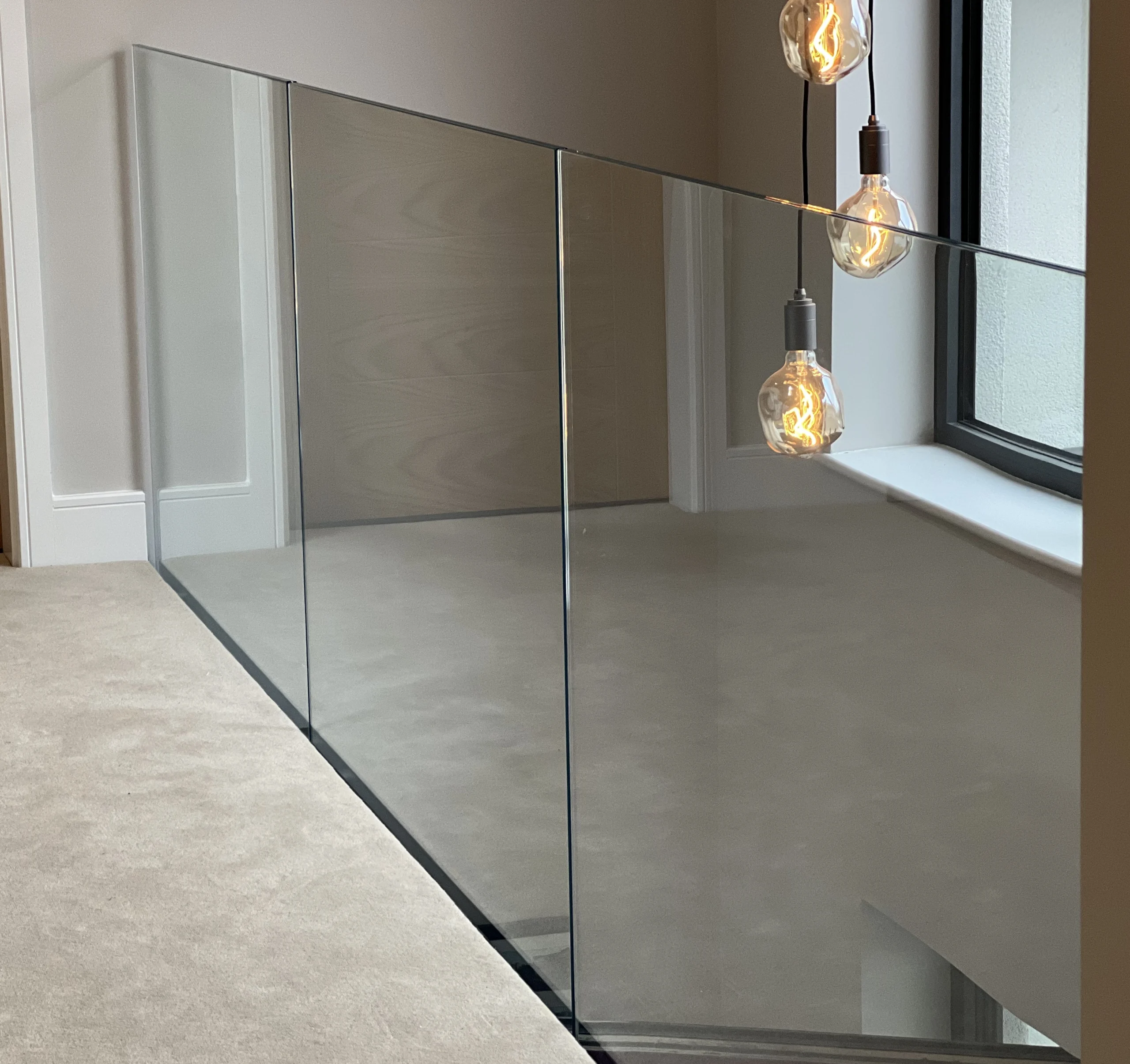
Frameless glass balustrade engineered to Spanish CTE DB-SUA Sección 1 — 90 cm height, Ø10 cm sphere rule satisfied throughout, EN 14449 laminated and EN 12150 tempered glass certificates supplied with the technical pack
Spanish glass balustrade regulations sit at the intersection of two CTE documents — DB-SUA Sección 1 (Seguridad de Utilización y Accesibilidad — geometric and protection requirements) and DB-SE-AE (Seguridad Estructural Acciones en la Edificación — structural line loads). Add the European glass standards EN 14449 (laminated glass — VSG) and EN 12150 (tempered glass — ESG), the climbability rule, the sphere rule, and the public-vs-residential height distinction, and the result is a regulatory landscape where small specification errors can render an entire balustrade non-compliant. This guide covers all six factors that govern compliance, the line-load calculations Spanish architects need to specify correctly, the differences between residential and public-concurrence applications, and how Continox supplies the full compliance documentation pack as part of every project. For the wider regulatory framework see our CTE DB-SUA Staircase Guide; for the Spanish market overview see our Modern Staircase Spain hub; and for the full UK product range see /glass-balustrade/, /balcony-railings/, /modern-staircase/ and /work/.
Spanish glass balustrades must satisfy: (1) Minimum height 90 cm residential / 110 cm public concurrence with drop >6 m; (2) Sphere rule Ø10 cm — no opening anywhere through which a sphere of 10 cm diameter can pass; (3) Climbability rule — no horizontal elements between 30–50 cm above floor that aid climbing; (4) Line loads per DB-SE-AE Article 3.2.1 — 0.8 kN/m residential, 3.0 kN/m public concurrence applied horizontally at handrail height; (5) Glass specification — EN 12150 tempered (ESG) and/or EN 14449 laminated (VSG), with VSG mandatory wherever glass acts as a guarding element with potential fall on the protected side; (6) Fixing certification — channel-fix, point-fix or spigot fittings tested and certified for the calculated load. Continox supplies all six elements as a single compliance pack with structural calculations signed by a UK Chartered Structural Engineer (IStructE) under Eurocode framework.
- Regulatory Framework — Which Codes Apply & Why
- Factor 01 — Balustrade Height (90 cm vs 110 cm)
- Factor 02 — Sphere Rule (Ø10 cm) & Climbability
- Factor 03 — Line Loads & Structural Calculations (DB-SE-AE)
- Factor 04 — Glass Specification (EN 14449 VSG / EN 12150 ESG)
- Factor 05 — Fixing Systems (Channel-Fix, Point-Fix, Spigot)
- Factor 06 — Handrail (Pasamanos) Integration
- Common Spanish Applications & Specifications
- Spain CTE vs UK Approved Document K — Glass Balustrade
- How Continox Engineers & Documents Compliance
- FAQ — Spanish Architects Ask
Regulatory Framework — Which Codes Apply
Spanish glass balustrade compliance pulls from five regulatory layers, each addressing a different aspect of the balustrade. Understanding which document governs which requirement is essential — many compliance disputes between architects and main contractors arise from confusion between the geometric rules (DB-SUA) and the structural rules (DB-SE-AE).
| Document | What It Governs | Key Articles for Glass Balustrades |
|---|---|---|
| CTE DB-SUA Sección 1 | Geometric requirements, height, sphere rule, climbability | Article 3.2 Barreras de protección |
| CTE DB-SE-AE | Structural line loads, point loads, dynamic loads | Article 3.2.1 Cargas en barandillas y elementos divisorios |
| EN 12150-1/-2 | Tempered (toughened) glass — ESG | Heat treatment, fragmentation pattern, mechanical strength |
| EN 14449 | Laminated glass — VSG | Interlayer specification, post-breakage retention |
| EN 1991-1-1 | Eurocode 1 — Imposed loads (where used in conjunction with CTE) | Reference for line load calculations |
| Real Decreto 314/2006 | Approval framework for CTE | Establishes mandatory compliance for all building work |
| Regional habitability decrees | Catalonia (141/2012), Balears (20/2007), Comunitat Valenciana (DC-09) | Reference CTE; rarely modify balustrade rules |
Hierarchy: CTE DB-SUA sets the geometric requirements (heights, openings, climbability). DB-SE-AE sets the structural loads the balustrade must withstand. The European glass standards (EN 12150, EN 14449) certify the glass material itself can deliver those loads safely. The fixing system manufacturer's calculations close the loop — proving the channel/point/spigot can transfer the load from the glass into the substrate without failure. Each layer matters; missing any one of them creates a compliance gap.

Frameless glass balustrade configuration most commonly specified in Spanish villa projects — full panel height with slim oak handrail, channel-fixed at base, satisfying CTE DB-SUA Article 3.2 throughout
Balustrade Height — 90 cm vs 110 cm
The minimum balustrade height under CTE DB-SUA Article 3.2.1 depends on two variables: the use classification (residential vs public concurrence) and the fall height on the protected side. Confusing these two values is the most common Spanish balustrade compliance error.
| Application | Fall Height (Δh) | Min Balustrade Height | Where Specified |
|---|---|---|---|
| Residential — single dwelling interior | Δh ≤ 6 m | ≥90 cm | Villa staircases, mezzanines, internal landings |
| Residential — single dwelling interior | Δh > 6 m | ≥110 cm | Double-height entry hall mezzanines (rare) |
| Residential common — apartment building | Δh ≤ 6 m | ≥90 cm | Communal apartment staircases, lifts, landings |
| Residential common — apartment building | Δh > 6 m | ≥110 cm | High-rise apartment internal communal voids |
| Public concurrence — commercial, hospitality | Δh ≤ 6 m | ≥90 cm | Hotel staircases, restaurant mezzanines, shop fits |
| Public concurrence — commercial, hospitality | Δh > 6 m | ≥110 cm | Hotel atrium voids, retail mall mezzanines |
| External — terraces, balconies | Δh ≤ 6 m | ≥90 cm | Villa terraces, balconies, pool surrounds |
| External — terraces, balconies | Δh > 6 m | ≥110 cm | Apartment building balconies above 2nd floor |
Measurement Convention
Balustrade height is measured from the finished floor surface to the top of the upper handrail or top edge of the glass panel — whichever is the upper protection element. For glass-only balustrades (no top handrail), this is the top edge of the glass. For glass with cap rail or top handrail, this is the top of the rail. Spanish architects must verify that the finished floor reference is used, not the structural slab or screed level — final flooring (parquet, stone, tile) reduces the effective height.
A balustrade installed at 90 cm above the structural slab can become 87 cm above the finished floor once 30 mm parquet is laid — pushing it below the CTE DB-SUA minimum. Continox always specifies and quotes balustrade heights against the architect's finished floor level (FFL), with installation height adjusted at site to match the actual FFL after flooring is complete.
The 6 m Threshold — Where It Applies
The 110 cm requirement triggers when the fall height (Δh) on the protected side exceeds 6 m. This is measured from the floor on the balustrade side to the floor below the protected edge. For most Spanish villa applications this threshold is not reached — typical villa floor-to-floor is 2,800–3,300 mm, double-height entry halls 4,500–5,500 mm. The 110 cm requirement primarily affects high-rise apartment communal voids, hotel atriums, and certain mezzanine applications in larger commercial buildings.
Sphere Rule (Ø10 cm) & Climbability
Two protective rules govern openings and grip points on the balustrade:
The Ø10 cm Sphere Rule
CTE DB-SUA Article 3.2.3 requires that no opening anywhere on the balustrade can pass a sphere of 10 cm diameter. The rule protects against children's heads and limbs becoming trapped between balusters, between glass panels, or between the balustrade and adjacent surfaces (floor, walls, handrails). The 10 cm dimension corresponds to roughly the head-circumference threshold for an infant, providing a safe margin.
For glass balustrades the sphere rule applies most critically at:
- Bottom edge of glass panels — if the glass starts above the floor (channel-fix systems often have a 5–8 cm gap below glass), the gap must be <10 cm
- Vertical joints between adjacent glass panels — typical frameless installation uses 6–10 mm joints, well within the rule
- Junction between glass and adjacent walls or columns — joints here must be <10 cm or sealed with a cover strip
- Junction between glass and handrail — if the handrail sits above glass with a gap, the gap must be <10 cm
- Stair geometry — between glass panel and tread/string — particularly on cantilevered floating staircases where glass starts above the tread surface
The Climbability Rule
CTE DB-SUA Article 3.2.3 also prohibits horizontal or near-horizontal elements between 30 cm and 50 cm above floor level that could be used as climbing aids by children. This rule primarily affects traditional balustrade designs (horizontal rails, decorative cross-pieces) but also applies to glass balustrade hardware: any horizontal mounting bar, support frame, or stiffener at the prohibited height creates a climbing point.
Frameless glass balustrades inherently satisfy the climbability rule — the glass panel face is vertical and offers no grip points. Framed glass systems (with horizontal top rail and bottom rail) need careful detailing at the bottom rail, which often sits within or adjacent to the prohibited zone. Continox specifies framed systems with concealed bottom channel (flush with floor) rather than visible bottom rail to satisfy the rule.
Sphere Rule Compliance Check
- Bottom-of-glass gap: ≤ 10 cm at any point along the balustrade run
- Vertical joints between panels: ≤ 10 cm (typical 6–10 mm)
- Wall and column junctions: ≤ 10 cm or sealed
- Handrail-to-glass gap: ≤ 10 cm if handrail is detached from glass top
- Stair-glass interface: ≤ 10 cm at every point along the rake
- No horizontal climbable elements 30–50 cm above floor
Line Loads & Structural Calculations (DB-SE-AE)
The structural loads a Spanish glass balustrade must withstand come from CTE DB-SE-AE Article 3.2.1 — the document specifying imposed loads on guarding elements. The relevant loads are applied horizontally at the top of the balustrade (handrail height) and represent the worst-case crowd pressure or accidental impact.
| Use Category | Horizontal Line Load | Where It Applies |
|---|---|---|
| Category A — Domestic, residential dwelling interior | 0.8 kN/m | Villa staircases, internal mezzanines, single-dwelling apartment |
| Category B — Office | 1.0 kN/m | Commercial office staircases, mezzanines |
| Category C1 — Restaurants, cafés | 1.6 kN/m | Hospitality interior balustrades |
| Category C2 — Theatres, conference rooms (fixed seating) | 3.0 kN/m | Public assembly with potential crowd surge |
| Category C3 — Retail, museums, areas without obstacles | 3.0 kN/m | Public concurrence, large gathering areas |
| Category C4 — Sports venues, dance halls, gyms | 3.0 kN/m | Active public concurrence |
| Category C5 — Crowds (concerts, sports events) | 3.0–5.0 kN/m | Maximum crowd loading |
| Category D — Retail (small) | 1.6 kN/m | Small retail with limited capacity |
| Category E — Storage, industrial | 1.6–3.0 kN/m | Industrial mezzanines |
Practical Application — Residential vs Public
For typical Spanish villa staircase and balustrade applications, the relevant line load is 0.8 kN/m residential (Category A). This is the load the architect specifies in the proyecto de ejecución and the load Continox engineers use for structural calculations. For mixed-use buildings (apartments above commercial), the staircase serving the residential dwellings remains 0.8 kN/m, while commercial-zone balustrades step up to 1.0–3.0 kN/m depending on use.
For communal apartment building staircases the classification depends on the number of dwellings served and the building's overall use category. Most communal stairs in apartment buildings serving fewer than 50 dwellings remain at 0.8–1.0 kN/m. Larger residential developments, hotels, and any building with dedicated public-access staircase fall into Category C with 3.0 kN/m.

Glass balustrade with oak handrail — line load applied horizontally at handrail height; residential application at 0.8 kN/m per CTE DB-SE-AE Article 3.2.1
Point Load Requirement
In addition to the distributed line load, DB-SE-AE Article 3.2.1 also specifies a point load (concentrated load) of 1.0 kN applied at any single point on the balustrade, considered separately from the line load (not in combination). For glass balustrades this point load typically governs the glass panel design — a 1.0 kN point applied to the centre of an unsupported glass panel creates the highest bending moment in the panel.
Combined Action — When to Add Loads
The line load and point load are not combined — the engineer designs for the worse of the two, considered separately. However, additional loads must be combined where applicable: dead load of the glass and fixings, wind load on external balustrades (DB-SE-AE Article 3.3), and where relevant earthquake load (DB-SE-AE Article 3.7 for areas with seismic acceleration >0.04g, which excludes most of Spain but covers parts of Andalusia, Murcia and the Pyrenees).
For external glass balustrades (terraces, balconies, pool surrounds), the line load combines with wind load per DB-SE-AE Article 3.3. Coastal villa locations on the Costa del Sol, Costa Blanca and Balearic Islands typically design for wind characteristic pressure 0.6–0.9 kN/m² (Zone B–C per DB-SE-AE Annex D). For a 110 cm tall glass panel exposed to coastal wind plus 0.8 kN/m line load, the resultant loading meaningfully exceeds the line-load-only case — Continox structural calculations include the wind combination for all external Balearic and Costa Blanca projects.
Glass Specification — EN 14449 (VSG) & EN 12150 (ESG)
The glass itself must be certified to European standards. Two products dominate Spanish balustrade applications: tempered (toughened) glass certified to EN 12150 — known as ESG (Einscheiben-Sicherheitsglas in DIN nomenclature), or vidrio templado in Spanish — and laminated glass certified to EN 14449 — known as VSG (Verbundsicherheitsglas), or vidrio laminado.
Tempered Glass (ESG / Vidrio Templado)
EN 12150-1 certifies tempered float glass, heat-treated to put the surface into compression and the core into tension. The result: 4–5× the bending strength of annealed glass, fragmentation into small dice (rather than long shards) on impact, and excellent thermal shock resistance. Tempered glass alone is suitable for non-fall-hazard applications — pool fences (where the protected side is water, not a drop), low-rise patio screens, and reinforcement panels behind structural glass.
Laminated Glass (VSG / Vidrio Laminado)
EN 14449 certifies laminated glass — two or more glass plies bonded by a polymeric interlayer (typically PVB — polyvinyl butyral, or SGP — SentryGlas Plus for higher strength). After breakage, the interlayer retains the broken pieces, preventing fall-through and maintaining residual structural capacity for evacuation. Laminated glass is mandatory wherever the balustrade protects a fall hazard — staircase sides, mezzanines, terraces, balconies, pool surrounds with deck-side fall.

Laminated glass balustrade — two glass plies bonded by PVB interlayer per EN 14449, providing post-breakage retention required for fall-protection applications
Combined ESG-VSG (Toughened Laminated)
The Spanish balustrade default is two layers of tempered (ESG) glass laminated with PVB interlayer — combining the bending strength of tempered glass with the post-breakage retention of laminated. Continox specifies 17.52 mm as the standard makeup: 8.0 mm + 1.52 mm PVB + 8.0 mm tempered, certified to both EN 12150 and EN 14449. For double-height applications and very wide panels, 21.52 mm (10.0 + 1.52 + 10.0) is specified for additional bending capacity.
| Application | Glass Specification | Standard Reference |
|---|---|---|
| Villa interior staircase balustrade | 17.52 mm tempered laminated (8+1.52+8 PVB) | EN 12150 + EN 14449 |
| Villa interior mezzanine | 17.52 mm tempered laminated | EN 12150 + EN 14449 |
| Villa external terrace (residential) | 17.52 mm tempered laminated, marine-grade fittings if <1 km from coast | EN 12150 + EN 14449 |
| Villa pool surround (deck-side fall) | 17.52 mm tempered laminated | EN 12150 + EN 14449 |
| Pool fence (water-side, no fall) | 10–12 mm tempered (ESG only) | EN 12150 |
| Apartment communal staircase | 17.52 mm or 21.52 mm tempered laminated | EN 12150 + EN 14449 |
| Hotel atrium / commercial mezzanine | 21.52 mm tempered laminated (10+1.52+10) | EN 12150 + EN 14449 |
| Public concurrence with crowd loading (3.0 kN/m) | 21.52 mm tempered laminated minimum, may upgrade to SGP interlayer | EN 12150 + EN 14449 |
| Juliet balcony / French balcony (window guard) | 13.52 mm tempered laminated (6+1.52+6) | EN 12150 + EN 14449 |
CE Marking & Declaration of Performance
All glass supplied by Continox carries the CE marking required under EU Construction Products Regulation 305/2011. Each panel ships with a Declaration of Performance (DoP) citing the specific EN standard, the production batch reference, the impact classification (1B1 minimum for laminated balustrade glass per EN 12600), and the relevant performance values. The DoP is part of the technical pack supplied to the architect of record for the licencia de obras submission.
Fixing Systems — Channel-Fix, Point-Fix, Spigot
The fixing system transfers the line load and point load from the glass panel into the substrate (floor slab, edge beam, structural wall). Three fixing types dominate Spanish frameless glass balustrade installations, each with different visual impact, structural capacity and substrate requirements.
Channel-Fix (U-Channel Continuous Base)
A continuous aluminium or stainless steel U-channel runs along the floor edge, with the glass panel inserted into the channel and clamped by side wedges or chemical resin. Channel-fix systems are the most common Spanish villa specification — clean continuous base line, no visible fixings on the glass face, structural capacity easily handles 0.8–1.6 kN/m loadings.
Substrate requirement: Reinforced concrete floor slab ≥150 mm thick (for typical M10 anchor depth), or steel substructure with adequate fixing detail. Channel-fix is unsuitable for timber floor decking — the cantilever loading transferred to the channel exceeds the bearing capacity of typical timber substructures.
Point-Fix (Discrete Stud Connections)
Glass panel held by 4 (or sometimes 6) discrete stainless steel studs passing through pre-drilled holes in the glass corners. The studs anchor into structural slab edges, embedded plates, or wall returns. Point-fix is the most architecturally minimal system — the glass appears entirely floating with only small visible disc-shaped fittings.
Substrate requirement: Each fixing point requires a calculated load path — point-fix concentrates the load into 4 small areas rather than spreading it along a channel. This means structural slab edges with embedded plates are typically required; standard concrete edge cannot be drilled retrospectively for adequate anchor capacity. Point-fix demands more design stage coordination than channel-fix.
Spigot (Side-Fixed Standoffs)
Stainless steel spigots project horizontally from the floor edge or vertical wall, supporting the glass via clamp plates. Spigots are most common in external pool surround and balcony applications where the glass needs to clear the floor surface (allowing water drainage, concealed lighting, or thermal expansion gaps).
Substrate requirement: Each spigot requires a precise embed plate or chemical anchor in structural concrete. Like point-fix, spigot installations need design-stage coordination — retrofitting spigots into existing finished surfaces is rarely practical.
Continox Default Fixing Selection
- Villa interior staircase / mezzanine: Channel-fix (concealed flush base, slim profile)
- Villa external terrace: Channel-fix or spigot (depending on architect's drainage detail)
- Pool surround: Spigot (allows water flow under glass)
- Apartment communal stair: Channel-fix (most reliable load path through slab edge)
- Public concurrence (3.0 kN/m): Channel-fix with reinforced anchor detail
- Architectural statement / minimal aesthetic: Point-fix (discrete fixings only)
Handrail (Pasamanos) Integration
CTE DB-SUA Article 3.2.1 requires a handrail (pasamanos) on at least one side of any staircase with a flight height greater than 55 cm, and on both sides where the staircase width exceeds 1.20 m. The handrail must be continuous along the entire flight, ergonomically graspable (typically 4.0–5.0 cm diameter or equivalent), and positioned between 90 cm and 110 cm above the stair pitch line.
Handrail Integration Options for Glass Balustrades
Glass-Top Handrail (Continox Standard)
Solid timber (oak or walnut) handrail mounted directly to the top edge of the glass panel via concealed brackets or top-cap channel. The handrail forms the upper protection line and serves as the structural cap rail for the glass. This is the default Continox specification — visually clean, ergonomically continuous, satisfies all DB-SUA handrail rules.
Wall-Mounted Handrail (Floating Cantilever Adjacent)
For floating cantilever staircases where one side has a wall (rather than glass), the handrail mounts directly to the wall via brackets at 90 cm above pitch line. The glass-side handrail (where glass exists) follows the glass-top approach above. Most common configuration on Eixample apartment renovations and Palma Old Town townhouse retrofits.
Detached Handrail Above Glass
Some architectural specifications call for a handrail positioned above the glass with a visible gap. This is permissible only if the gap between the top of the glass and the underside of the handrail is <10 cm (sphere rule), and the handrail is structurally independent of the glass. Continox supplies this configuration on request but defaults to glass-top handrail for cost and aesthetic reasons.
Handrail Material & Finish
Spanish villa specifications dominantly use solid hardwood handrails — oak, walnut, ash, or iroko for external applications. Stainless steel handrails (304 internal, 316L external/coastal) are also common, particularly in commercial and apartment communal applications. Continox supplies both with full material certificates as part of the technical pack.
Common Spanish Applications & Specifications
Six application categories cover the vast majority of Spanish glass balustrade projects. Each has a typical specification path that satisfies CTE DB-SUA + DB-SE-AE without over-engineering.
Villa Interior Staircase Balustrade
Specification — Villa Staircase
- Use class: Uso restringido (Category A, single dwelling)
- Height: ≥90 cm (CTE DB-SUA Article 3.2.1)
- Line load: 0.8 kN/m horizontal at handrail (DB-SE-AE Article 3.2.1)
- Glass: 17.52 mm tempered laminated (8+1.52 PVB+8) — EN 12150 + EN 14449
- Fixing: Channel-fix base, concealed flush detail
- Handrail: Solid oak or walnut, glass-top mounted, 4.0 cm diameter equivalent
- Sphere rule: ≤10 cm at all interfaces (typical 6–10 mm joints, well within rule)
- Climbability: N/A (frameless glass face inherently compliant)
Villa External Terrace & Pool Surround
For external staircase and balcony applications — terraces, balconies, pool surrounds with deck-side fall — additional considerations apply beyond the interior baseline:
Specification — External Coastal Villa
- Use class: Residential external (Category A)
- Height: ≥90 cm (≥110 cm if drop >6 m)
- Line load: 0.8 kN/m + wind combination per DB-SE-AE Article 3.3
- Glass: 17.52 mm tempered laminated; SGP interlayer for high-wind coastal
- Fittings: Marine-grade 316L stainless if <1 km from coast
- Fixing: Channel-fix or spigot (architect's preference based on drainage detail)
- Salt-spray testing: Per ISO 9227 for powder-coated components

Modern Spanish villa interior with frameless glass balustrade integration — typical specification for La Moraleja, Marbella, Bendinat, Pedralbes and Jávea villa projects
Apartment Communal Staircase
Specification — Apartment Communal
- Use class: Uso general (residential common, Category A)
- Height: ≥90 cm (≥110 cm if internal void Δh >6 m)
- Line load: 0.8–1.0 kN/m depending on dwelling count
- Glass: 17.52 mm or 21.52 mm tempered laminated
- Fixing: Channel-fix with reinforced anchor detail
- Risers: Closed (no open risers under DB-SUA Article 4.2 uso general)
- Compliance: Plus regional habitability decree (Decret 141/2012, Decret 20/2007, DC-09 etc)
Public Concurrence — Hospitality, Retail, Gym

Glass balustrade in commercial gym installation — public concurrence Category C4 application requiring 3.0 kN/m line load and upgraded glass specification
Specification — Public Concurrence (Cat C2-C4)
- Use class: Uso general (public concurrence)
- Height: ≥90 cm (≥110 cm if Δh >6 m — common in hotel atriums)
- Line load: 1.6–3.0 kN/m depending on Category C subclass
- Glass: 21.52 mm tempered laminated minimum (10+1.52 PVB or SGP+10)
- Fixing: Channel-fix with reinforced anchor detail and structural slab edge
- Climbability: Particular attention — public spaces have higher child density
- Inspection: Annual inspection regime typically required by hotel/retail operator
Juliet Balcony / French Balcony (Window Guard)
Specification — Juliet Balcony
- Use class: Residential external (Category A)
- Height: ≥90 cm (≥110 cm if window above 2nd floor)
- Line load: 0.8 kN/m + wind combination
- Glass: 13.52 mm tempered laminated (6+1.52+6) typically sufficient
- Fixing: Side-mounted spigots or face-fixed clamps to wall reveals
- Width: Typically equals window opening width plus 50–100 mm overlap
Spain CTE vs UK Approved Document K — Glass Balustrade
Spanish architects working on UK projects (or vice versa) often need to compare CTE requirements against the UK Approved Document K (ADK) framework. The two regulations cover the same protective intent but differ in load magnitudes and specification details.
| Parameter | Spain CTE DB-SUA + DB-SE-AE | UK Approved Document K + BS 6180:2011 |
|---|---|---|
| Domestic min height | 90 cm (Δh ≤6 m) | 900 mm (internal); 1100 mm at landings/balconies external |
| Public min height | 110 cm (Δh >6 m) | 1100 mm (external public) |
| Sphere rule | Ø10 cm | Ø100 mm (identical) |
| Climbability rule | 30–50 cm prohibited horizontals | Similar prohibition under ADK |
| Domestic line load | 0.8 kN/m | 0.74 kN/m (BS 6180) |
| Public line load (max) | 3.0 kN/m | 3.0 kN/m (identical) |
| Glass standard (laminated) | EN 14449 | EN 14449 (identical) |
| Glass standard (tempered) | EN 12150 | EN 12150 (identical) |
| Common specification | 17.52 mm tempered laminated | 17.52 mm tempered laminated (identical) |
| Structural framework | Eurocode (EN 1990, EN 1991, EN 1993) | Eurocode (post-Brexit retained) |
The dimensional rules are essentially identical between the two regulatory frameworks — both adopt the 90/110 cm height threshold, the Ø100 mm sphere rule, and the same 3.0 kN/m public concurrence line load. The Spanish 0.8 kN/m residential load is slightly higher than the UK's 0.74 kN/m, but both fall within the same engineering specification envelope. A balustrade designed to satisfy CTE DB-SUA + DB-SE-AE will satisfy UK ADK + BS 6180 in nearly all cases, which is why Continox's UK-engineered design pack is directly applicable to Spanish projects.
How Continox Engineers & Documents Compliance
Every Continox Spanish project ships with a complete glass balustrade compliance pack as part of the standard technical documentation:
Continox Glass Balustrade Compliance Pack
- Dimensional schedule — height, sphere rule verification at every interface, climbability check, handrail position per CTE DB-SUA Article 3.2
- Structural calculations — line load (0.8 kN/m residential or higher per DB-SE-AE), point load (1.0 kN), wind combination for external (DB-SE-AE Article 3.3), all signed by UK Chartered Structural Engineer (IStructE)
- Glass certificates — EN 14449 laminated DoP and EN 12150 tempered DoP, batch-specific, including impact classification per EN 12600
- Fixing system data sheet — channel-fix, point-fix or spigot system tested capacity, anchor specifications, substrate requirements
- EN 1090-1 EXC2 Declaration of Performance — for steel components (handrail brackets, structural connections), with marcado CE plate fitted
- Handrail material certificate — solid hardwood traceability or 316L stainless steel certification
- Installation drawings — DWG, PDF and STEP files for BIM coordination
- Cross-reference to regional habitability decree — where Catalonia Decret 141/2012, Balears Decret 20/2007, or Comunitat Valenciana DC-09 apply
The compliance pack supports the arquitecto director de obra's licencia de obras submission — the Continox documentation provides line-by-line evidence the architect can incorporate into the project's proyecto de ejecución. Final certification responsibility remains with the Spanish-registered architect of record.
Continox certifies that the supplied balustrade satisfies CTE DB-SUA Article 3.2 and DB-SE-AE Article 3.2.1 for the load category specified at order. Continox does not certify the architect's choice of load category — that decision (uso restringido vs uso general, Category A vs C4) remains the architect of record's professional responsibility. Architects specify the use category at enquiry stage; Continox engineers design accordingly.
Specifying a Glass Balustrade for Your Spanish Project?
Continox supplies frameless and framed glass balustrades to Spanish villa, apartment and commercial projects with the full CTE DB-SUA + DB-SE-AE compliance pack. Free 3D visualisation, fixed-price quote within 48 hours, intra-EU supply with no Brexit customs.
Get Free QuoteFAQ — Spanish Architects Ask
What is the minimum height for a glass balustrade in Spain?
Per CTE DB-SUA Article 3.2.1, the minimum height is 90 cm for residential and most public applications where the fall height (Δh) on the protected side is 6 m or less, increasing to 110 cm where Δh exceeds 6 m. The threshold applies regardless of glass type or fixing system. Height is measured from finished floor level (FFL) to the top of the upper protection element — typically the top of the handrail, or top edge of the glass for handrail-less designs.
Do I need laminated glass or is tempered glass enough?
Wherever the balustrade protects a fall hazard — staircase sides, mezzanines, terraces, balconies, pool surrounds with deck-side fall — laminated glass (EN 14449, VSG) is mandatory. The polymeric interlayer retains broken pieces after impact, preventing fall-through and maintaining residual capacity. The Continox standard specification is 17.52 mm tempered laminated — combining tempered glass strength (EN 12150) with laminated retention (EN 14449). Tempered-only glass is permissible in limited applications: pool fences (water-side, no fall), low-rise patio screens, and reinforcement panels behind structural glass — but never as the primary fall-protection element.
What line load applies to my villa staircase balustrade?
For Spanish villa interior balustrades (uso restringido, Category A residential), CTE DB-SE-AE Article 3.2.1 specifies 0.8 kN/m horizontal line load at handrail height, plus a 1.0 kN point load applied separately at any single point. The greater of the two governs the structural design. For external balustrades, wind load combinations apply per DB-SE-AE Article 3.3 — particularly relevant for coastal villas in the Costa del Sol, Costa Blanca, and Balearic Islands. Continox structural calculations include all applicable load combinations as part of the technical pack.
What is the Ø10 cm sphere rule and where does it apply?
CTE DB-SUA Article 3.2.3 prohibits any opening on the balustrade through which a sphere of 10 cm diameter could pass. The rule protects against children's heads or limbs becoming trapped. For glass balustrades, the rule applies most critically at: bottom edge of glass panels (gap between floor and glass ≤10 cm), vertical joints between adjacent panels (typically 6–10 mm), junctions with walls and columns, and the gap between glass top and detached handrails. Frameless glass installations using channel-fix systems satisfy this rule by default with 6–10 mm panel joints.
What is the climbability rule for Spanish balustrades?
CTE DB-SUA Article 3.2.3 prohibits horizontal or near-horizontal elements between 30 cm and 50 cm above floor level that could be used as climbing aids by children. For glass balustrades, frameless designs inherently satisfy this rule — the vertical glass face offers no grip points. Framed glass balustrades with visible bottom rail need careful detailing: Continox specifies framed systems with concealed flush bottom channel rather than visible bottom rail to satisfy the rule.
Can I have glass balustrade without handrail?
For staircase applications, no — CTE DB-SUA Article 3.2.1 requires a handrail (pasamanos) on at least one side of any staircase with flight height >55 cm. The handrail must be ergonomically graspable (4.0–5.0 cm diameter equivalent) and continuous along the entire flight. For non-staircase applications (mezzanine edges, terrace edges, Juliet balconies), the top edge of the glass itself can serve as the protection without separate handrail, provided the top edge is at the required height (≥90 cm or ≥110 cm depending on Δh) and is designed for grasping (rounded or polished edge, optional cap rail).
How does Continox certify the glass for Spanish projects?
All Continox glass ships with CE marking and Declaration of Performance (DoP) per EU Construction Products Regulation 305/2011. Each panel includes batch-specific certification to EN 14449 (laminated) and EN 12150 (tempered), plus impact classification per EN 12600 (1B1 minimum for balustrade applications). The DoP is part of the technical pack supplied to the architect of record and supports the licencia de obras submission and the project's certificado final de obra documentation.
Are external glass balustrades different from internal?
Yes, in three ways: (1) Wind load — DB-SE-AE Article 3.3 wind combination must be applied, which for coastal villa locations adds 0.6–0.9 kN/m² characteristic pressure to the line load case. (2) Marine-grade fittings — for properties within roughly 1 km of the Mediterranean coast (Costa del Sol, Costa Blanca, Balearic Islands), all stainless components upgrade to 316L (rather than standard 304) and powder-coated steel receives extended salt-spray testing per ISO 9227. (3) Glass interlayer — for high-wind coastal applications, SGP (SentryGlas Plus) interlayer can be specified instead of standard PVB for greater post-breakage stiffness. Continox supplies all three upgrades as standard options for external Spanish coastal projects.
Does the regional habitability decree change the balustrade rules?
In most cases, no — the regional decrees (Catalonia Decret 141/2012, Balears Decret 20/2007, Comunitat Valenciana DC-09, etc) reference CTE for staircase and balustrade requirements rather than imposing regional overrides. The decrees primarily affect habitability documentation, lift provision, common-area circulation, and dwelling layout. The CTE DB-SUA + DB-SE-AE balustrade rules apply uniformly across mainland Spain, the Balearic Islands, and (with the IGIC tax exception) the Canary Islands. Continox supplies regional documentation alongside the CTE pack where applicable.
What if my project is in a public concurrence building (hotel, retail, gym)?
Public concurrence projects require higher line loads (1.6–3.0 kN/m depending on Category C subclass per CTE DB-SE-AE Article 3.2.1), upgraded glass specification (typically 21.52 mm tempered laminated minimum, sometimes with SGP interlayer), reinforced fixing details with structural slab edge integration, and particular attention to the climbability rule (public spaces have higher child density). For hotels, the >6 m fall threshold typically triggers — most hotel atrium voids exceed 6 m, mandating 110 cm height. Continox supplies public-concurrence specifications with the same compliance documentation framework but with calculations updated for the higher load envelope.
Ready to Specify Your Spanish Glass Balustrade?
From frameless villa staircase balustrades to public-concurrence commercial mezzanines — Continox supplies the full glass, steel, handrail and compliance pack as a single intra-EU delivery. Free 3D visualisation, fixed-price quote within 48 hours, structural calculations signed by UK Chartered Structural Engineer (IStructE).
Get Free Quote