
Fire Escape Stairs London — Compliance & Installation
Bespoke fire escape stairs designed, fabricated and installed across all 32 London boroughs from £8,000 apartment block and £12,000+ multi-storey commercial. Continox manufactures hot-dip galvanised steel structures fully compliant with BS 9991:2024, BS 9999, Approved Document B and the Regulatory Reform (Fire Safety) Order 2005. No London surcharge, free on-site survey, fixed-price quote within 24 hours. This guide covers compliance, building types, configurations, pricing and the consent process.
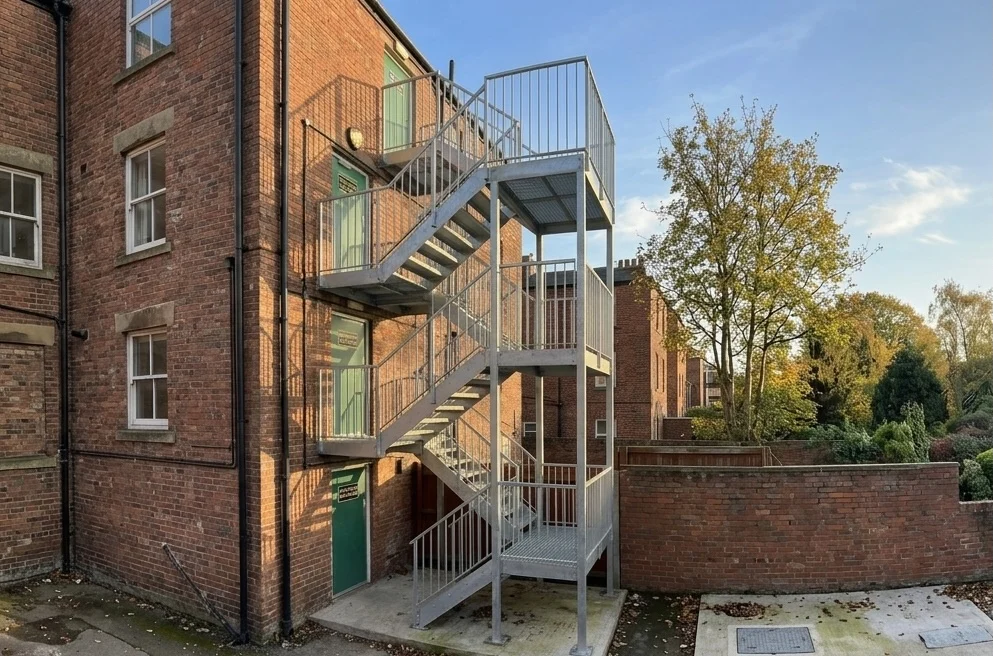
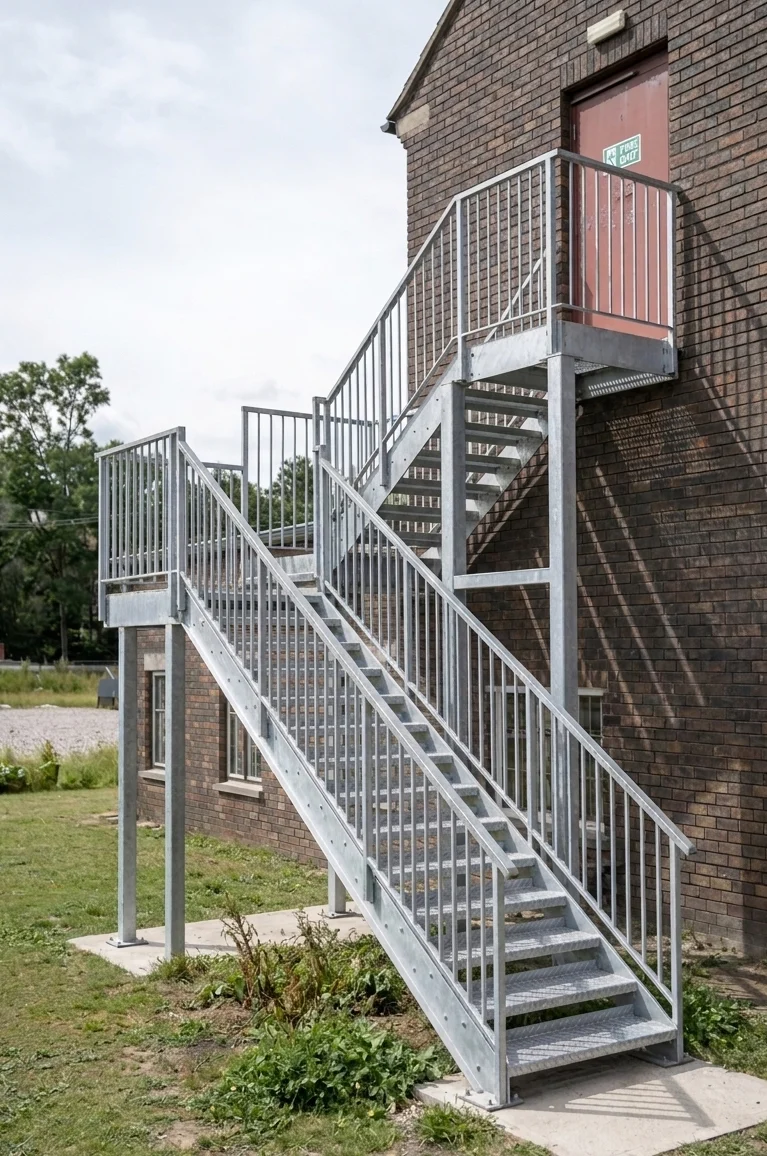
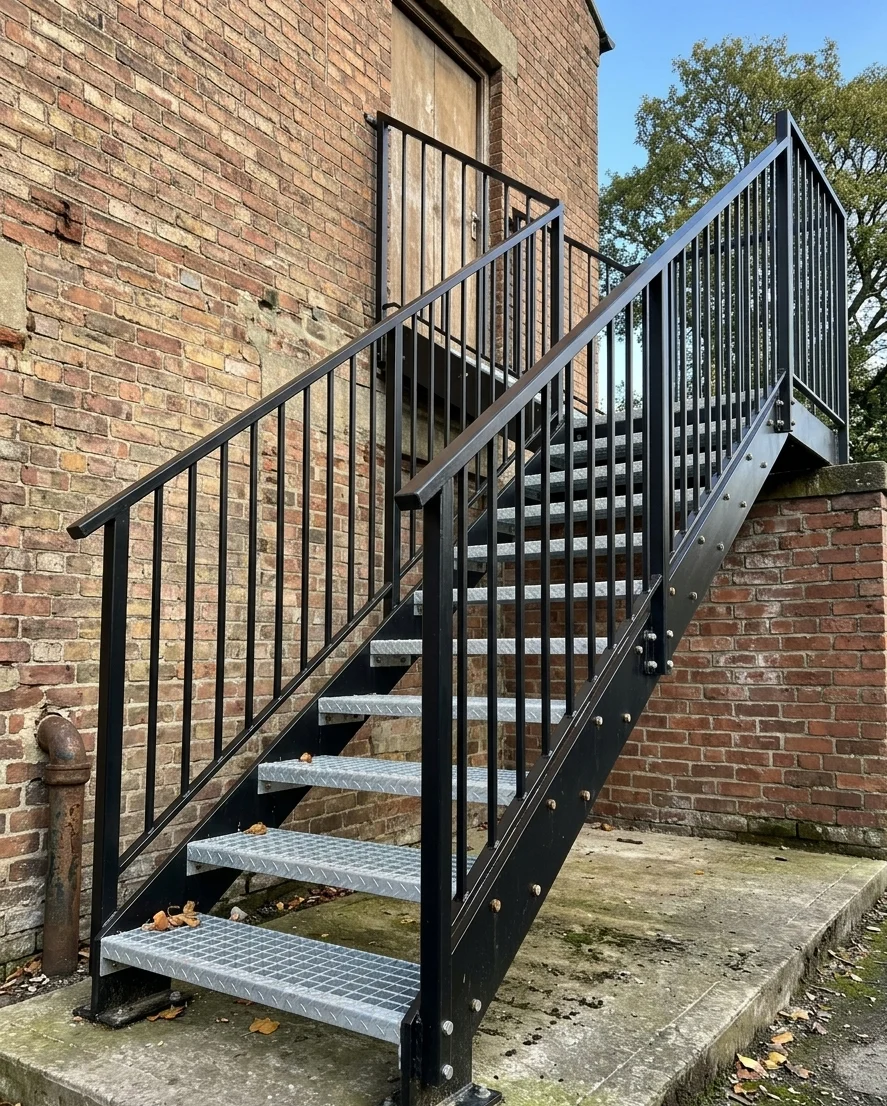
Multi-flight fire escape staircase — hot-dip galvanised steel, intermediate landings, anti-slip treads, BS 9991:2024 compliant
Continox installs bespoke fire escape stairs across all 32 London boroughs and the City of London. Pricing starts at £8,000 for apartment block fire escape replacement (3-storey, 4 flights), £12,000+ for multi-storey commercial premises (4+ storeys), and £18,000+ for HMO and high-occupancy installations requiring wider treads and dual-flight provision. All staircases manufactured in S275 hot-dip galvanised steel as standard, with anti-slip chequer plate or open mesh treads, dedicated balustrade, and intermediate landings at every storey. BS 9991:2024 / BS 9999 / Approved Document B compliance documentation, BS EN 1090-2 declaration of performance and UKCA marking included as standard — no separate fees for compliance paperwork. No London surcharge, fixed-price quote within 24 hours.
Why London Fire Escape Projects Demand Specialists
Fire escape stair commissioning in London operates under a fundamentally different regulatory environment from the rest of the UK. Post-Grenfell building safety reforms, the Building Safety Act 2022, BS 9991:2024 published in November 2024, and the September 2026 introduction of mandatory second staircases for buildings above 18 metres have created a tighter compliance landscape than any other UK region. Combined with London's particular building stock — 60,000+ HMOs, 19,000 listed buildings, and a high concentration of mansion blocks, retail-above-shops and warehouse conversions — fire escape work in the capital requires technical expertise that generic UK fabricators do not provide.
1. Post-Grenfell regulatory tightening. The Fire Safety (England) Regulations 2022, the Building Safety Act 2022 and BS 9991:2024 have substantially tightened compliance expectations for residential blocks above 11 metres. London Building Control inspectors apply these rules more rigorously than rural authorities, and the Building Safety Regulator (BSR) now has approval responsibility for buildings above 18 metres. Fire escape replacement projects on these buildings require BSR sign-off in addition to standard Building Regulations approval.
2. Restricted access between buildings. London's tightly-packed terraced and mid-rise stock means fire escape replacement frequently happens in tight spaces between adjacent buildings — often with structural ties to multiple buildings, restricted crane access, and no parking provision for fabrication delivery. Components have to be designed and pre-finished for installation in narrow alleys and rear courtyards.
3. Listed building considerations. Where the property is Grade I, II* or II listed (around 19,000 listed buildings in Greater London), fire escape replacement requires Listed Building Consent separate from Building Regulations approval. Even where the existing fire escape is itself a 20th-century addition rather than original fabric, the consent process examines proposed appearance, fixings into listed masonry, and visual impact on the listed structure.
4. HMO compliance scrutiny. London has the highest concentration of HMOs in the UK (around 60,000+ licensed properties across Greater London). HMO fire escape requirements are governed by the Housing Act 2004, LACORS Housing Fire Safety guidance, and individual borough licensing standards. Inspections by Tower Hamlets, Hackney, Newham and Westminster licensing officers are particularly rigorous, and non-compliance carries fines up to £30,000 per breach plus potential prosecution.
5. Mansion block leaseholder/RTM dynamics. A substantial proportion of London fire escape replacements happen on Right To Manage (RTM) or leaseholder-funded apartment blocks, where the procurement process involves multiple stakeholders, Section 20 consultation under the Landlord and Tenant Act 1985, fixed-price quotes for transparent comparison, and detailed structural documentation for shared funding decisions.
Building Types Continox Services
Fire escape stair replacement and new installation in London cluster around six building type briefs. Each has its own typical configuration, occupancy load, regulatory framework and pricing band. Survey stage establishes which approach matches the specific building condition and use class.
Converted Victorian and Edwardian buildings, 1930s mansion blocks, post-war residential conversions. Replacement of corroded mid-20th-century steel fire escapes, BS 9991:2024 compliance. Often RTM-funded or leaseholder-procured. Multi-flight with intermediate landings.
Licensed HMO properties under Housing Act 2004 and LACORS guidance. Higher occupancy ratings, stricter borough licensing scrutiny. Wider tread requirements, increased balustrade specification, fire-rated materials. Tower Hamlets, Hackney, Newham concentrations.
Mixed-use buildings, retail with residential above, office premises. BS 9999 commercial compliance, Approved Document B, Regulatory Reform (Fire Safety) Order 2005. Wider treads (1100–1200mm), heavier substrate, dual-flight at higher occupancy.
Care home and assisted living premises. CQC-regulated environments, Personal Emergency Evacuation Plan (PEEP) considerations, BS 9991:2024 vulnerable occupant provisions. Often requires evacuation lift integration, gentler stair pitch, refuge area consideration.
Wapping, Limehouse, Hackney Wick warehouse conversions. Mixed industrial-residential use, marine-grade specification for waterside, heavy-duty galvanised structures. Multi-flight with industrial chequer plate or open mesh treads.
Buildings above 18m require Building Safety Regulator (BSR) approval under Building Safety Act 2022. Mandatory second staircase from September 2026 per BS 9991:2024. Comprehensive compliance documentation, structural calculations, fire engineering input.
Why building type matters for compliance: The same flight length can vary by 2–3× in cost depending on building type, because the regulatory framework and required specification differs significantly. A residential apartment block fire escape under BS 9991:2024 has different width requirements, balustrade loading and material specifications from a commercial premises under BS 9999. Survey stage establishes building type, use class, occupancy load and regulatory framework before issuing fixed-price quote. View the complete fire escape range on the dedicated fire escape stairs page.
Three Pillars of London Fire Escape Compliance
Fire escape stair compliance in London 2026 rests on three regulatory pillars: British Standards covering design and materials, Building Regulations covering technical performance, and Fire Safety legislation covering ongoing duty of care. Each pillar has been substantially updated post-Grenfell. Continox provides full documentation across all three pillars as standard with every quotation.
Updated November 2024. Covers flats, HMOs, student accommodation, care homes. Includes 18m+ second staircase requirement (September 2026), evacuation lifts, smoke ventilation, single-stair limits.
Code of practice for fire safety in non-domestic buildings. Risk-based approach, occupancy-driven width, escape distances, refuge provision, structural fire resistance.
2026 amendments take effect 30 September 2026. Updated escape route requirements, evacuation lift provisions, second staircase 18m+ rule, structural fire performance.
Regulatory Reform (Fire Safety) Order. Names the Responsible Person (typically building owner or duty holder) for ongoing fire safety. Inspections, risk assessments, maintenance.
Loading 0.74 kN/m residential, 1.5 kN/m commercial, 3.0 kN/m crowd loading. Handrail height 900–1100mm. Balustrade gap maximum 100mm.
Mandatory declaration of performance for all structural steelwork. UKCA marking required under UK Construction Products Regulations. Legally required for permanent installation.
For deeper coverage of UK fire escape regulations see the designing effective fire escape staircases guide. For Approved Document B 2026 amendment detail see the AD B changes breakdown. For HMO-specific requirements see the HMO fire escape requirements article.
Fire Escape Coverage Across London Boroughs
Continox installs fire escape stairs across all 32 London boroughs and the City of London. The boroughs below represent active concentrations of recent commission work, although project lead time and pricing are identical regardless of postcode within the M25.
Mansion blocks, listed buildings, mixed-use commercial. RBKC + Westminster planning rigour.
Period conversions, Hampstead listed property, retail above shops Camden Town.
Highest HMO density. Wapping warehouse conversions. Strict licensing inspections.
Large HMO concentrations, Victorian terrace conversions, contemporary new builds.
High HMO licensing scrutiny. Stratford regeneration, mansion block stock.
Georgian and Victorian conversions. Caledonian Road / Holloway HMO market.
Brixton, Bermondsey, Elephant & Castle. High-rise + mansion block mix.
Battersea, Clapham, Putney mansion blocks. Riverside developments.
Period mansion block stock, Fulham Road retail-above-shops compliance.
Outer London boroughs — Bromley, Croydon, Ealing, Enfield, Harrow, Havering, Hillingdon, Hounslow, Redbridge, Richmond, Kingston, Sutton, Waltham Forest — equally covered. Greater London delivery and installation included in fixed-price quotation.
Three Typical London Fire Escape Projects
Project specifications below reflect typical fixed-price residential and commercial fire escape commissions across London. Headline figures do not include VAT — actual project quotation issued following the on-site survey.
Hackney — 4-Storey Mansion Block Replacement
Replacement of corroded mid-20th-century external fire escape on a 4-storey converted Victorian residential mansion block in Hackney E8. Multi-flight configuration with intermediate landings at each storey, BS 9991:2024 compliant, S275 hot-dip galvanised steel structure, 1100mm width, open mesh treads, dedicated handrail with intermediate rail. Right To Manage company commission, Section 20 consultation supported. Building Control sign-off documentation supplied. Project total: £18,500–£22,000. Lead time 7–8 weeks. Installation 4 days (off-hours work to minimise resident disruption).
Tower Hamlets — HMO Compliance Upgrade E1
Licensed HMO property in Tower Hamlets E1, 3-storey conversion. Existing wooden rear staircase failing borough licensing inspection — replacement required for licence renewal. New galvanised steel quarter-landing fire escape, 900mm width, anti-slip chequer plate treads, BS 9991:2024 compliant, supplementary fire-rated balustrade. Tower Hamlets licensing officer pre-consultation included. Project total: £10,500–£12,500. Lead time 6 weeks. Installation 3 days.
Westminster — Listed Commercial W1
Grade II listed mixed-use building W1, retail ground floor with offices above. Existing primary fire escape inadequate for current occupancy (BS 9999 review). New external fire escape stair to second escape route, listed building consent supported, sympathetic RAL 7016 anthracite grey powder coat over galvanising to integrate with retained period façade. Westminster City Council Listed Building Consent process: 12 weeks. Project total: £24,000–£28,000. Total lead time 16–18 weeks. Installation 4 days.

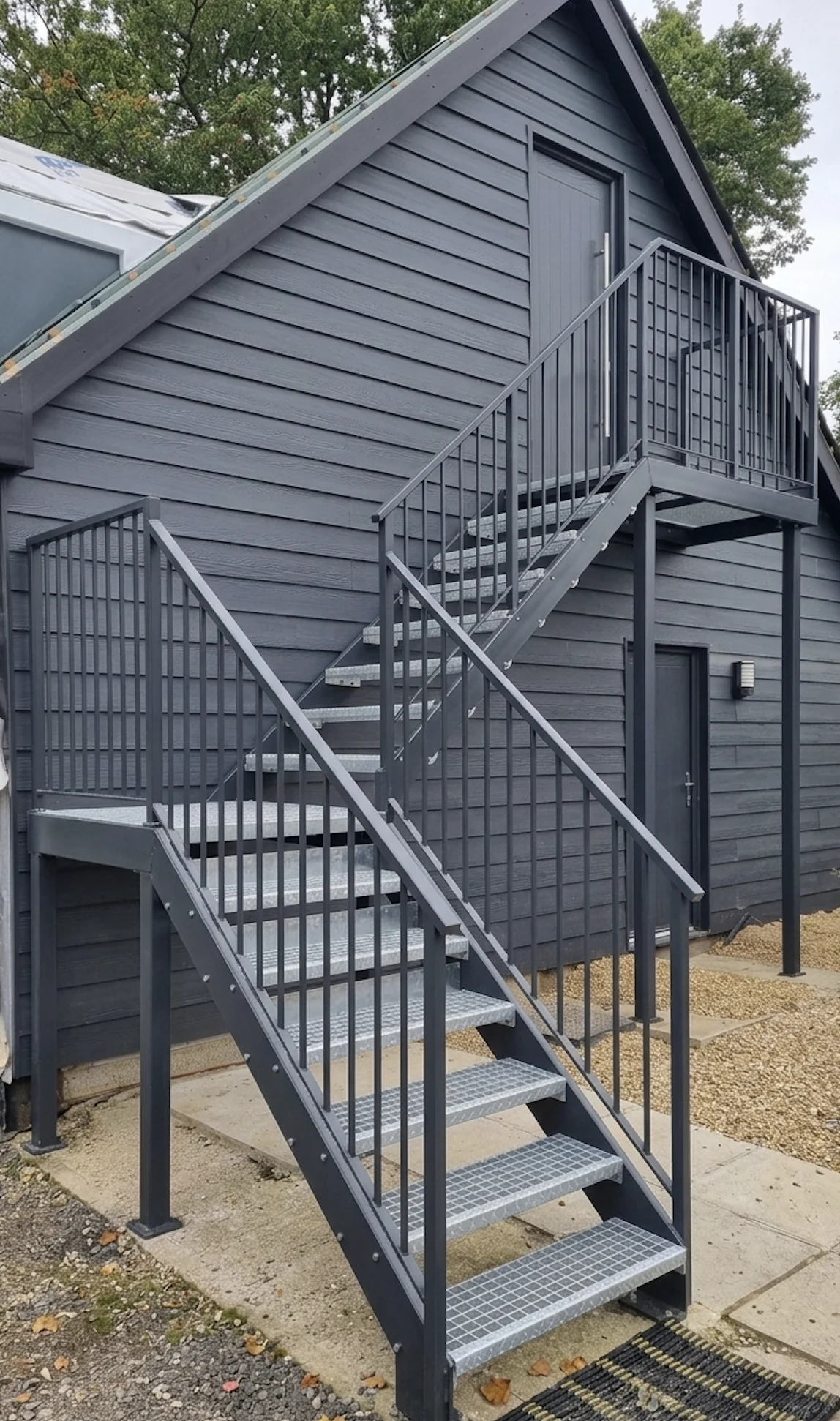
See Continox Fire Escape Project Work
The full Continox portfolio includes apartment block fire escape replacements, HMO compliance installations, commercial multi-storey fire escapes, listed building sympathetic insertions and warehouse conversion fire safety upgrades across Greater London. Browse structural drawings, material specifications, and on-site installation photography.
Browse Project Portfolio →Fire Escape Stairs Pricing Across London
Indicative starting prices for bespoke fire escape stair installations across London. All quotes are fixed-price following a free on-site survey, and include design, structural calculations, manufacture in hot-dip galvanised S275 steel, BS 9991:2024 / BS 9999 compliance documentation, BS EN 1090-2 declaration of performance, UKCA marking, professional installation by the in-house team, and removal of any existing fire escape.
| Project Type | Configuration | From |
|---|---|---|
| Single-storey residential fire escape | Straight or quarter-landing | £5,500 |
| Apartment block 3-storey replacement | Multi-flight + intermediate landings | £8,000 |
| Apartment block 4–5 storey | Multi-flight, BS 9991:2024 compliant | £14,000 |
| HMO 3-storey compliance upgrade | Quarter-landing, fire-rated balustrade | £8,500 |
| Commercial 3-storey office | 1100mm wide, BS 9999 compliant | £12,000 |
| Commercial 4+ storey | Multi-flight, dual escape provision | £18,000 |
| Care home / assisted living | Gentle pitch, refuge area, PEEP-ready | £14,000 |
| Industrial / warehouse conversion | Heavy-duty, marine-grade option | £10,000 |
| Listed building sympathetic replacement | Listed Building Consent supported | £14,000+ |
| RAL powder coat upgrade | Any RAL colour over galvanising | +£800–1,500 |
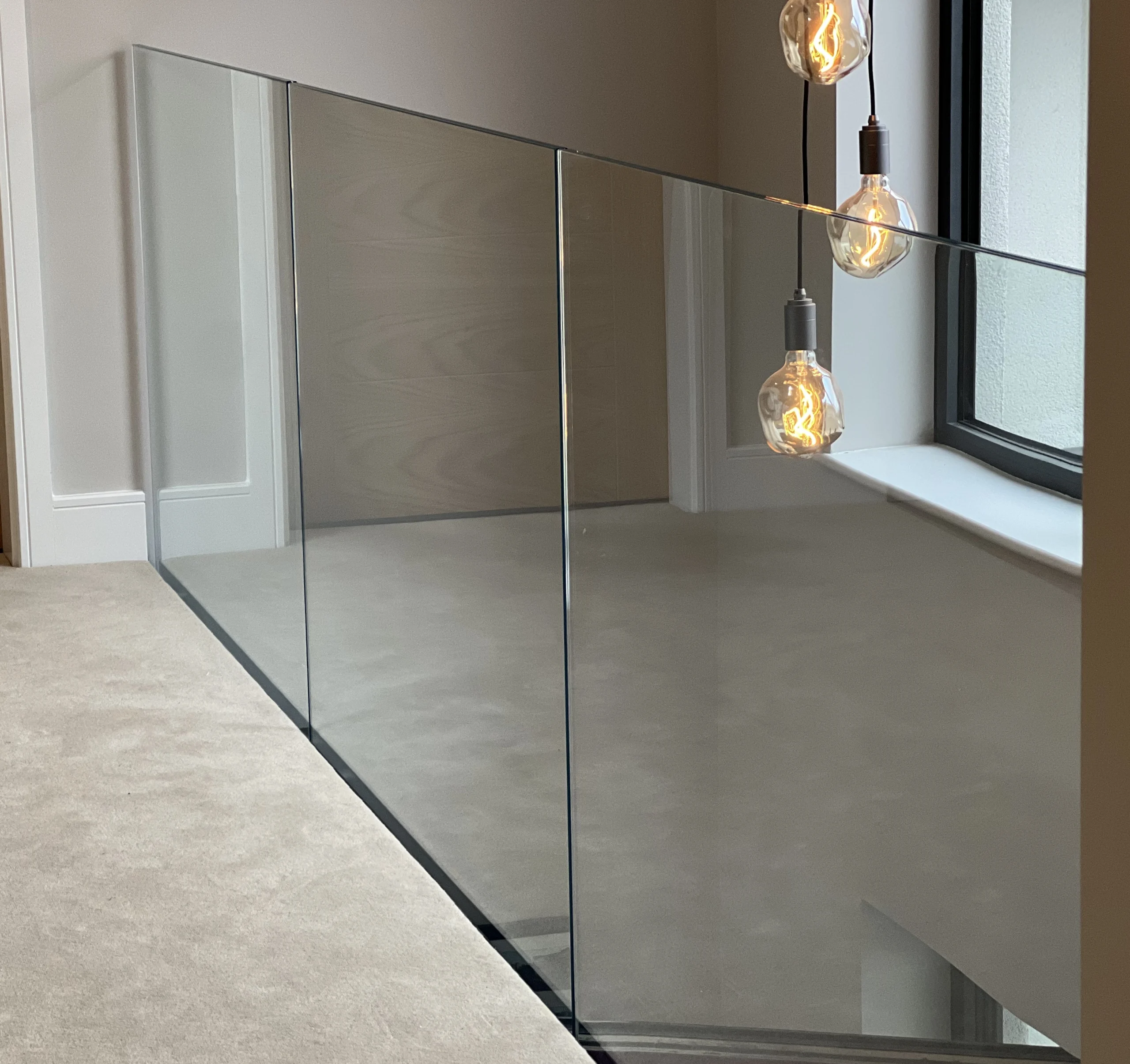
| Glass balustrade upgrade | 17.5mm laminated toughened panels | +£450/m |
Comprehensive cost breakdown by configuration, building type and compliance tier covered in the dedicated external staircase pricing page. For specific guidance on fire escape regulations see the legal requirements article.
September 2026 — Second Staircase RequirementFrom 30 September 2026, all new residential buildings with a storey above 18 metres must have at least two staircases under BS 9991:2024 and the Approved Document B 2026 amendments. This applies to new builds and major refurbishments where building consent is granted after that date. Continox supports developer and architect briefs for second staircase provision, including full BSR approval documentation, fire engineering input, and integration with existing building structures. Coverage of the full requirement on the second staircase requirements UK guide.
The London Fire Escape Replacement Process
A standard non-listed London fire escape replacement project runs from initial enquiry to completed installation in 6–8 weeks. The process is structured into seven defined stages so that landlord-led, RTM-led, architect-led and licensing-driven projects all follow the same audit trail.
Stage 1 — Initial enquiry & indicative pricing. Telephone or email enquiry, sharing initial drawings, photographs of the existing fire escape, current Building Control documentation. Indicative price range provided within 24 hours based on building type, storeys and configuration.
Stage 2 — Free on-site London survey. Continox surveyor visits the property to take precise measurements, assess existing structure for safe removal sequence, identify masonry connection points, photograph access constraints, and discuss requirements with building owner / RTM committee / architect. Free across all 32 London boroughs.
Stage 3 — Design development & CAD. Following the survey, design team produces CAD drawings with structural calculations, BS 9991:2024 / BS 9999 compliance schedule, and 3D visualisation showing proposed staircase in context with building façade. Architect-led briefs accommodated with multi-format design pack.
Stage 4 — Fixed-price quotation. Detailed itemised quote issued in writing, fixed-price following the on-site survey. Includes design, structural calculations, BS EN 1090-2 declaration of performance, BS 9991:2024 / BS 9999 compliance, UKCA marking, manufacture, hot-dip galvanising, optional powder coat, professional installation, removal of existing fire escape, Building Control sign-off documentation.
Stage 5 — Manufacture in workshop. 4–6 weeks. Steel CNC-cut and welded to BS EN 1090-2, hot-dip galvanised to BS EN ISO 1461, optional powder coat applied, sub-assembly trial-fit before dispatch.
Stage 6 — London delivery & installation. In-house Continox installation team transports pre-assembled components to the London site, manages access (parking permits, Congestion Charge zone, mews access, restricted alleys), and completes installation in 2–4 days depending on configuration. Off-hours installation available where minimising resident disruption is critical.
Stage 7 — Sign-off & handover. Following installation, all Building Regulations documentation supplied for Building Control sign-off — structural calculations, BS 6180 compliance evidence, BS EN 1090-2 declaration of performance, BS EN 14449 glass certification (where applicable), UKCA marking. Listed building documentation supplied separately where required.
What to Look For in a London Fire Escape Specialist
Selecting a fire escape specialist for a London project is a higher-stakes decision than typical UK external staircase work. The combination of BS 9991:2024 compliance, listed building constraints, HMO licensing requirements and access challenges means that low-cost online fabricators rarely deliver acceptable results. Six factors separate genuine London-capable specialists from suppliers who merely accept London commissions.
1. BS 9991:2024 / BS 9999 / AD B compliance documentation as standard. This is legally required, but rogue traders frequently omit it. Continox supplies all three as standard with every quotation — there is no separate fee for compliance paperwork. A supplier that charges extra for compliance is signalling that they do not provide it routinely.
2. BS EN 1090-2 declaration of performance. Legally required for structural steelwork in the UK. Frequently omitted by rogue traders. The declaration is essential evidence for Building Control sign-off and ongoing duty of care under the Fire Safety Order 2005.
3. UKCA marking on structural components. Required under UK Construction Products Regulations. A supplier who cannot supply UKCA-marked steelwork is not legally compliant for permanent installation.
4. Hot-dip galvanising as standard, not as upgrade. Primer-painted steelwork delivers 5–10 years service life in the London environment. Galvanised delivers 25–40+ years. Suppliers quoting primer-painted as standard are quoting for a decade-life staircase, not a multi-decade compliant installation.
5. Free on-site survey across all 32 boroughs. A quote without on-site survey is an estimate, not a quote. London building stock variability means remote pricing routinely under-quotes the actual project. Continox includes free London-wide survey as part of the standard process.
6. Section 20 / RTM project experience. RTM-led and Section 20 leaseholder consultation projects have specific procurement requirements: detailed itemised quotation, transparent line-item pricing, structural documentation supporting consultation. Continox supports RTM and Section 20 projects with formatted documentation. Browse the full project portfolio for relevant reference work.
Fire Escape Stairs London — FAQ
Common questions on fire escape stair commissioning across all 32 London boroughs
Free London Survey + Fixed-Price Quote
Free on-site survey across all 32 London boroughs. Bespoke fire escape design fully compliant with BS 9991:2024, BS 9999 and Approved Document B. Fixed-price quotation within 24 hours — no London surcharge, no hidden compliance fees. Hot-dip galvanised steel from £8,000 apartment block, £12,000+ commercial. UKCA marked, BS EN 1090-2 compliant.