

Floating Staircase vs Central Spine — Which One for Your Spanish Project?
A side-by-side comparison of the two most-specified modern staircase systems for Spanish villa projects — floating cantilever vs central spine. Cost, structural engineering, aesthetic, CTE DB-SUA compliance and where each system wins.
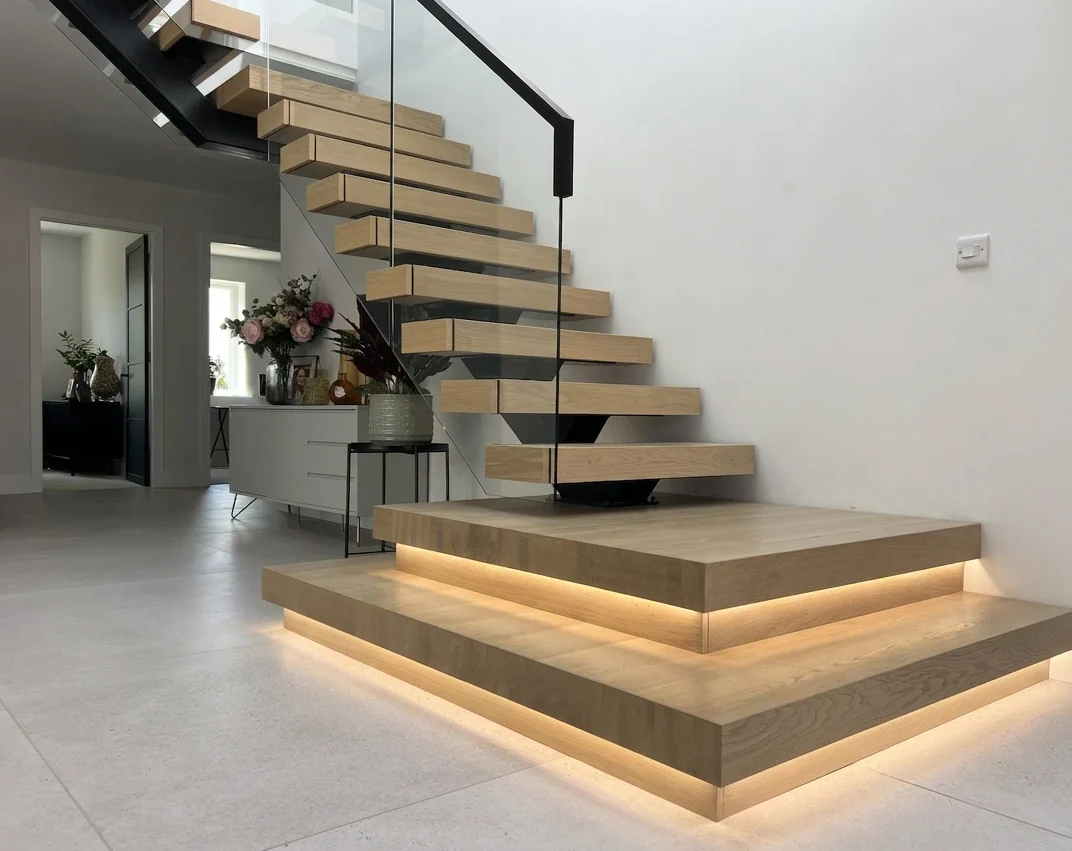
Two of the most-specified Continox modern staircase systems for Spanish villa projects — floating cantilever (left) and central spine (right) photographed in completed Marbella and Pedralbes installations
For Spanish architects specifying a modern staircase, the most common decision after configuration (straight, L-shape, U-shape) is which structural system to choose: floating cantilever — where each tread cantilevers from a hidden steel substructure embedded in the supporting wall — or central spine — where a single structural steel beam runs along the staircase axis with treads cantilevering from both sides. Both systems are CTE DB-SUA compliant, both pair beautifully with frameless glass balustrades, and both can be supplied as uso restringido villa specifications with 100mm solid hardwood treads. The difference lies in installation requirements, aesthetic, structural transparency and cost. This guide covers all six factors that drive the choice — for the wider Spanish market overview see our Modern Staircase Spain hub, for the regulatory framework see our CTE DB-SUA Guide, and for the full UK product range see /modern-staircase/, /external-staircase/ and /glass-balustrade/.
Choose floating cantilever when you have a structurally sound supporting wall, want a single visual mass that "disappears" into the wall, and the project budget starts at €7,999. Choose central spine when the staircase is positioned in open space (not against a wall), the architectural intent is sculptural visibility, both sides need to be visually equal, and the project budget starts at €8,999. Most-specified Spanish villa configuration is central spine — open-plan villa typology in Marbella, Pedralbes, La Moraleja, Bendinat and Jávea favours the spine system because villa stairwells are rarely positioned against a single load-bearing wall. Floating systems work better in apartment renovations and townhouse retrofits where one wall reliably exists.
Floating vs Central Spine — Side by Side
Floating Cantilever Staircase
From €7,999- Structure: Hidden steel substructure embedded in supporting wall
- Tread support: Each tread cantilevers from wall-side only
- Visual mass: Treads appear to float — wall absorbs the structural mass
- Wall requirement: Solid load-bearing wall, structural concrete or reinforced masonry
- Best for: Apartment renovations, townhouse retrofits, single-wall stairwells
- Aesthetic: Minimalist, treads-only — most "floating" look
- Compliance: CTE DB-SUA Article 4.1 uso restringido (open risers permitted in villa interior)
Central Spine Staircase
From €8,999- Structure: Single I-beam steel spine running along stair axis
- Tread support: Each tread cantilevers from spine — both sides equal
- Visual mass: Sculptural beam visible — structural intent read clearly
- Wall requirement: None — staircase stands free in open space
- Best for: Villa open-plan interiors, double-height entry halls, Marbella-Pedralbes-La Moraleja standard
- Aesthetic: Modernist statement piece — frameless glass both sides
- Compliance: CTE DB-SUA Article 4.1 uso restringido (open risers permitted in villa interior)
What Drives the Choice — 6 Factors That Matter
The decision between floating cantilever and central spine is rarely about cost alone. Six factors typically govern which system fits the project — and the right answer changes by region within Spain (apartment-heavy Eixample favours different systems than open-plan Marbella villas).
Project Typology & Location
The single most important factor. Spanish villa typology favours one system; apartment typology favours the other. The geography matters because villa-heavy markets (Marbella, La Moraleja, Bendinat, Jávea) trend one way; apartment-heavy markets (central Madrid, Valencia city, Eixample Barcelona, Palma Old Town) trend the other.
| Project Typology | Recommended System | Why |
|---|---|---|
| Villa, open-plan ground floor | Central spine | Stairwell rarely against single wall; both sides need to be visually equal |
| Villa, double-height entry hall | Central spine + LED | Sculptural beam reads as architectural feature |
| Apartment renovation, single-wall stairwell | Floating cantilever | Wall provides structural support; "floating" aesthetic emphasised |
| Townhouse retrofit, between two walls | Floating cantilever | Either wall can host substructure; visual lightness vs solid wall |
| Loft conversion, mid-floor stairwell | Central spine | No reliable load-bearing wall; spine self-supports |
| Period building, heritage interior | Central spine | Avoids structural intervention into heritage walls |
| Commercial, office, retail | Central spine | Open-plan interiors; uso general compliance possible with risers |
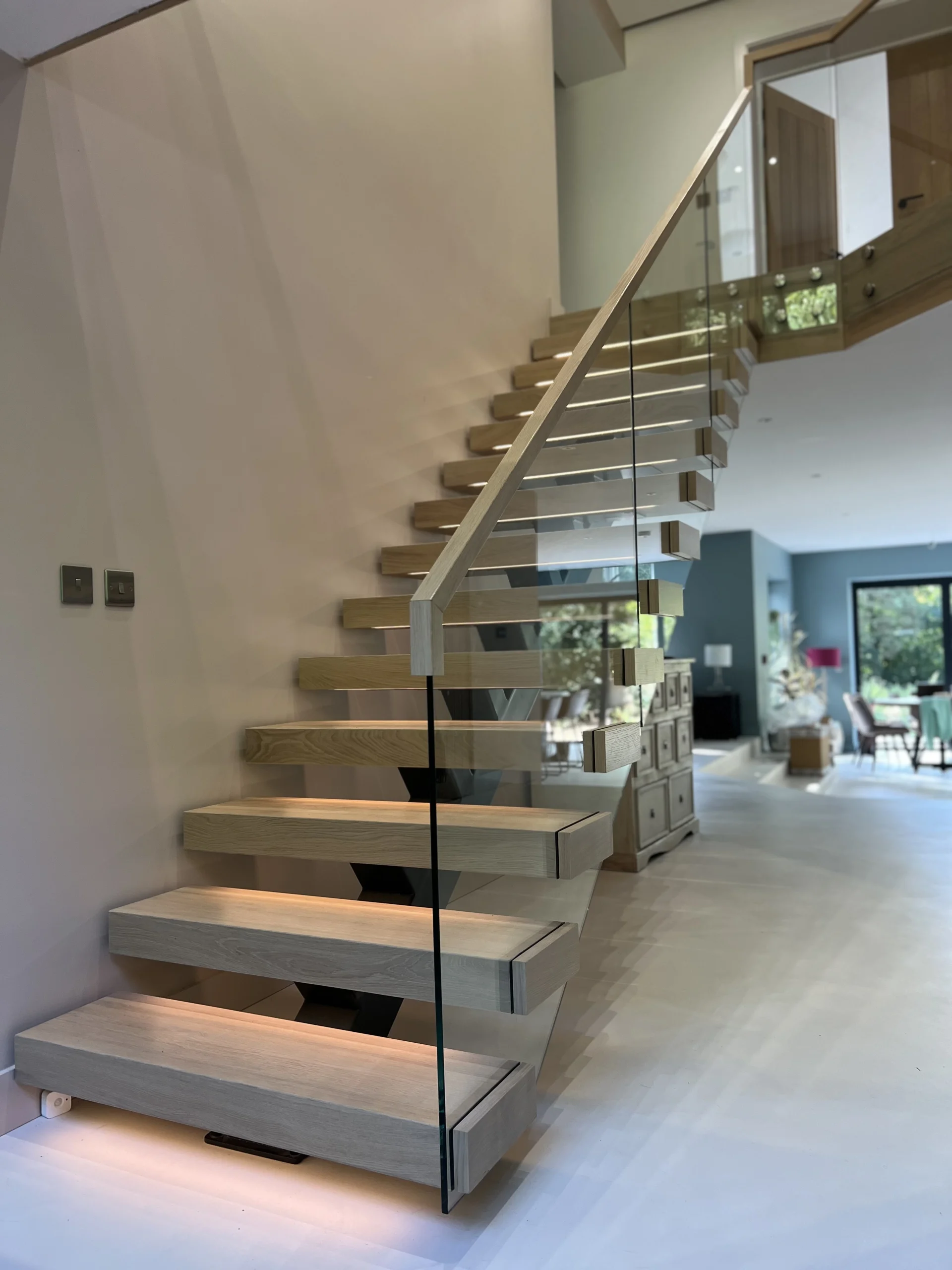
Central spine staircase configured for an open-plan villa interior — single I-beam visible, treads cantilevering both sides, frameless glass balustrades creating maximum visual lightness
Structural Wall Requirements
Floating cantilever requires a structurally competent supporting wall — typically reinforced concrete, structural masonry, or steel-framed walls with adequate fixing substrate. The hidden substructure embedded in the wall takes the full cantilever moment of every tread plus live load. This is non-negotiable: a floating staircase cannot be installed against a stud wall, hollow brick partition, or undamaged-but-shallow heritage wall. Many Marbella villas, La Moraleja contemporary new-builds, and even modern Bendinat villas do not have walls suitable for floating systems in the position where the staircase needs to be — which is why central spine dominates the Spanish villa market.
Central spine has no wall requirements at all. The single steel beam is supported only at top and bottom — typically by floor slab fixings or a concrete plinth — and self-supports its full structural load. This makes it suitable for staircases positioned in any location, including open-plan interiors with no walls within reach, mezzanine voids, and double-height stairwells.
Before specifying floating cantilever, the architect of record must confirm: (1) wall material (RC concrete ≥150mm thick, or structural masonry ≥240mm with adequate density); (2) wall continuity (no door openings within 300mm of fixing positions); (3) substrate condition (no rebar conflicts, no internal voids); and (4) load path (foundation can carry the additional dead + live load transferred through the wall). Continox engineers review this at design stage and either confirm floating feasibility or recommend central spine where the wall is unsuitable.
Cost Difference
The base price difference between floating and central spine is roughly €1,000 (12% premium for spine). Floating starts at €7,999 supply; central spine starts at €8,999 supply. The reason: central spine uses more steel (continuous I-beam plus support details at top/bottom), more powder-coating surface area, and slightly more complex fabrication. Floating's hidden substructure is often a smaller piece of steel — but the wall preparation work shifts cost to the main contractor's site programme rather than the staircase supply.
Hidden cost — wall preparation for floating: Floating cantilever requires precise wall preparation: structural opening, embedded steel substructure installation, precise alignment with each tread position, and final wall reinstatement (rendering, finishing). Spanish main contractors typically charge €800–€2,400 for wall preparation over and above the staircase supply price. Central spine has no equivalent cost — the spine simply lands on the floor slab. Net comparison: when wall preparation costs are factored in, central spine often comes out cheaper than floating despite the higher list price.
| Cost Element | Floating Cantilever | Central Spine |
|---|---|---|
| Continox supply price (from) | €7,999 | €8,999 |
| Typical villa configuration | €9,500 – €12,500 | €10,500 – €14,500 |
| Wall preparation (main contractor) | €800 – €2,400 | €0 (floor slab fixing only) |
| Total typical project cost | €10,300 – €14,900 | €10,500 – €14,500 |
| Lead time | 4–8 weeks | 4–8 weeks |
| Structural risk | Wall capacity verification required | Floor slab capacity standard |
Aesthetic & Architectural Intent
The two systems read very differently in completed projects. Floating cantilever emphasises material — treads appear to grow out of the wall, the wall itself becomes part of the composition, and the structural intent is hidden. The eye reads "treads only", giving maximum visual lightness against a solid wall plane. This works brilliantly when the supporting wall is a deliberate architectural element (a feature stone wall, a polished concrete surface, or a clad timber panel).
Central spine emphasises structure — the steel beam is visible, intentional, and part of the design language. The eye reads "beam plus treads", which can feel more architecturally honest, especially in modernist or industrial-influenced interiors. The visible beam also reads as a sculptural element in its own right — particularly with Y-shape geometry where the beam transitions through space.


Frameless glass treatment differs too. Floating systems typically use single-side balustrades (the wall side has no glass — it has the wall). Central spine universally specifies frameless glass on both sides, which doubles the glass area, doubles the visual transparency, and roughly doubles the balustrade cost. For projects where the staircase frames a view (sea, garden, double-height living space), central spine with bilateral glass is the natural choice.
CTE DB-SUA Compliance
Both systems satisfy CTE DB-SUA Sección 1 dimensional requirements identically — huella ≥22cm uso restringido / ≥28cm uso general, contrahuella ≤20cm restringido / 13–18.5cm general, anchura ≥80cm restringido / ≥100cm general, balustrade ≥90cm with Ø10cm sphere rule. The system choice does not affect dimensional compliance.
Where the systems differ on compliance is open-tread permission. Both can be specified with open risers (no contrahuella material, just the gap below each tread) but only in uso restringido villa interior applications under DB-SUA Article 4.1, with the 2.5cm tread overlap rule satisfied. For uso general (apartment commons, commercial, public concurrence), neither system permits open risers — both must use closed risers. In practice this means floating and central spine are equally available in:
- Villa interiors (Marbella, La Moraleja, Pedralbes, Bendinat, Jávea) — uso restringido, open risers allowed for both systems
- Single-dwelling apartment renovations — uso restringido for the dwelling's internal stair, open risers allowed
- Communal apartment staircases — uso general, both systems require closed risers and stricter dimensions
- Commercial, retail, hospitality — uso general, closed risers, full ergonomic formula 54 ≤ 2C+H ≤ 70cm
For deeper regulatory detail see our CTE DB-SUA Guide.
Installation & Spanish Site Programme
Installation logistics differ meaningfully between the two systems. Floating cantilever installation is a two-stage process integrated with the structural shell:
- Stage 1 (structural shell phase): Embedded substructure installed during wall construction — typically requires steel embeds set into RC formwork before pouring, or threaded sleeves cast into the wall
- Stage 2 (finishing phase / fase de acabados): Treads installed onto pre-positioned substructure, balustrade fitted, finishing applied to wall
This means floating cantilever must be planned at the structural design stage, not specified retroactively after the shell is complete. Many Spanish architects miss this and discover at finishing stage that they need central spine instead.
Central spine is a single-stage installation during finishing (fase de acabados): the prefabricated spine and treads arrive crated, the spine is fixed to the floor slab at top and bottom, treads bolted on, balustrade fitted. No shell-stage coordination required. This is one reason central spine is the most-specified system across the Spanish market — it integrates more easily with main contractor programmes and architect specification timelines.
For greenfield Spanish projects, the choice can be made freely at the proyecto básico stage. For renovation or retrofit projects, the choice is often constrained by what already exists: an existing wall structurally suitable for floating, or an open-plan interior that demands central spine. Continox engineers work with the architect of record at the enquiry stage to confirm feasibility before any 3D visuals or structural calculations are produced.
Which System Wins — Real Project Scenarios
Six common Spanish project scenarios with the recommended system and reasoning:
New-build Marbella villa, open-plan ground floor, double-height entry hall
Stairwell positioned in entry hall with no adjacent load-bearing wall. Both sides visually exposed. Architect wants sculptural feature.
→ Central Spine (Y-shape recommended)Eixample apartment renovation, between two original walls
Existing structural masonry walls both sides of stairwell. Heritage interior, minimal intervention preferred. Single visual mass desired.
→ Floating Cantilever (off one wall)La Moraleja contemporary new-build, glass-walled stairwell
Stairwell positioned in glass-walled volume connecting living area to first floor. No solid wall available. Architectural transparency essential.
→ Central Spine (with frameless glass both sides)Pedralbes townhouse loft conversion
Loft conversion accessed via mid-floor stairwell. Existing wall structurally questionable. Architect wants minimal mass.
→ Central Spine (avoids wall verification risk)Bendinat hillside villa, single feature stone wall in entry
Featured local stone wall is the architectural focal point. Treads should appear to grow from the stone. Wall is reinforced concrete behind stone cladding.
→ Floating Cantilever (emphasises stone wall)Madrid Salamanca period apartment, communal building staircase
Communal stair serving 6 dwellings. Uso general classification. Building Control requires closed risers and full ergonomic compliance.
→ Central Spine (closed risers, easier dimensional optimisation)Not Sure Which System Fits Your Spanish Project?
Continox engineers review your stairwell geometry, wall condition and architectural intent at enquiry stage — and recommend floating, central spine or one of our 9 alternative systems with a fixed-price quote within 48 hours. Free 3D visualisation, full CTE DB-SUA compliance pack, intra-EU supply.
Get Free QuoteBeyond the Two Headline Systems — 9 Configurations Available
While floating cantilever and central spine dominate Spanish villa specifications, Continox supplies 9 distinct staircase configurations across the modern range. Each has its niche; the right choice depends on stairwell geometry, architectural intent and project budget.
| System | From (EUR supply) | Typical Use Case |
|---|---|---|
| 1. Central Spine with Platform | €9,999 | Villa with quarter or half landing — Sotogrande, La Moraleja |
| 2. Central Spine Staircase ⭐ | €8,999 | Standard villa specification — most-specified system Spain-wide |
| 3. U-Shape Central Spine | €9,500 | Tight-footprint villa, Eixample apartment, narrow stairwell |
| 4. L-Shape Central Spine | €9,300 | Quarter-turn villa, Sitges coastal property, change of direction |
| 5. U-Shape Steel Plates | €9,800 | L-shape with quarter landing, oak treads on steel plate strings |
| 6. Y-Shape Central Spine | €10,500 | Sculptural statement, La Zagaleta-class villa, double-height feature |
| 7. Steel Bars Staircase | €8,500 | Vertical baluster alternative to glass — privacy + style |
| 8. Premium Central Spine | €11,500 | LED-integrated, walnut treads, Sierra Blanca / Cascada de Camoján level |
| 9. Fully Bespoke | €10,000 | Custom geometry, helical, mixed materials — concept-to-delivery |
Floating cantilever sits within the bespoke range (System 9) at €7,999+ when configured as a wall-mounted system rather than a standalone spine. The lower starting price reflects simpler fabrication; the higher complexity comes from wall preparation rather than the staircase itself.

L-shape central spine staircase — quarter-turn configuration suitable for villa stairwells with change of direction
Worked Examples — Same Brief, Two Systems
To make the cost difference concrete, here are two real Continox projects with similar briefs (Spanish villa, 14 risers, 2,800mm floor-to-floor) — one specified as floating cantilever, the other as central spine. See our project portfolio for additional examples and our regional guides for Marbella, Barcelona, Madrid, Mallorca and Valencia.
| Element | Floating (Eixample apartment) | Central Spine (Marbella villa) |
|---|---|---|
| Configuration | Straight flight, against RC wall | Straight flight, free-standing |
| Risers | 14 | 14 |
| Treads (100mm walnut) | €2,300 | €2,400 |
| Steel substructure | €2,400 (hidden, embedded) | €3,800 (visible I-beam) |
| Balustrade | €2,200 (one side glass + wall) | €4,200 (both sides frameless) |
| Handrail | €480 (wall-mounted) | €680 (glass-mounted) |
| Engineering & documentation | included | included |
| Subtotal supply | €7,380 | €11,080 |
| Wall preparation (contractor) | €1,400 (additional) | €0 |
| Total typical project | €8,780 | €11,080 |
The headline cost is lower for floating, but the side-by-side comparison shows the gap is smaller than it first appears once wall preparation is factored in. For visually equivalent specifications (frameless glass both sides on central spine — only one side on floating), the price difference reflects different visual outcomes rather than different value.
Floating vs Central Spine — FAQ
Which is more popular in Spain — floating or central spine?
Central spine is the most-specified modern staircase system in Spain, particularly in villa-heavy luxury markets like Marbella, Pedralbes, La Moraleja, Bendinat and Jávea. The reason: Spanish open-plan villa typology rarely positions stairwells against a single load-bearing wall. Floating cantilever is more common in apartment renovations and townhouse retrofits where a structurally suitable wall reliably exists. Across the broader Spanish market, central spine probably accounts for 65-70% of bespoke modern staircase orders.
Is floating cantilever cheaper than central spine?
The headline supply price is roughly 12% lower for floating (€7,999 vs €8,999 starting). However, floating requires wall preparation work by the project's main contractor — typically €800–€2,400 for embedded substructure installation, alignment and wall finishing. Central spine has no equivalent cost (the spine simply lands on the floor slab). When wall preparation is factored in, the total project cost is often comparable, with central spine sometimes coming out cheaper for villa applications.
Can I retrofit a floating staircase into an existing villa?
Possibly, but only if the existing wall is structurally suitable — typically reinforced concrete ≥150mm thick, or structural masonry ≥240mm with adequate density. The wall needs to be opened, the embedded substructure installed, and the wall reinstated. This is significantly more disruptive than installing a central spine, which only requires floor slab fixings. For most Spanish villa retrofits, central spine is the more practical choice — especially in projects where preserving the existing fabric matters.
Are open-tread floating staircases legal in Spain?
Yes — for villa interior staircases (uso restringido under CTE DB-SUA Article 4.1), open risers are explicitly permitted on both floating and central spine systems, provided the projection of the upper tread overlaps the lower tread by at least 2.5 cm. For uso general (apartment commons, commercial, public concurrence), open risers are not permitted on either system — both must use closed risers per DB-SUA Article 4.2.
Can I have frameless glass on both sides with floating cantilever?
Not in the same way as central spine. Floating cantilever has a wall on one side (which provides the structure), so glass on that side is unnecessary and would defeat the floating aesthetic. Glass goes on the open side only. If you want frameless glass both sides — which is the universal expectation in Spanish luxury villa specifications — central spine is the natural choice.
Which system handles double-height stairwells better?
Central spine. The single I-beam can span the full double-height as a continuous structural element, with intermediate landings supported by spine extensions or floor connections. Floating cantilever struggles in double-height because the supporting wall is often a non-load-bearing void edge (mezzanine railing) rather than a structural wall — the cantilever load cannot be safely transferred. For double-height entry halls in Marbella, La Moraleja, Bendinat or La Cumbre del Sol villas, central spine with Y-shape geometry is the most-specified configuration.
Does Continox supply both systems with the same warranty?
Yes. Both floating cantilever and central spine systems are supplied with 5 years warranty against manufacturing defect. Both are manufactured at the same EN 1090-1 EXC2 facility near Kraków, with marcado CE plate and Declaration of Performance per EU Construction Products Regulation 305/2011. Both ship with structural calculations signed by a UK Chartered Structural Engineer (IStructE) under Eurocode framework recognised throughout Spain. The CTE DB-SUA compliance schedule supplied with the technical pack is the same line-by-line evidence document for both systems.
Which system has the longer lead time?
Both systems have the same lead time: 4–8 weeks from order confirmation to delivery on site in Spain. Breakdown: 1 week for design sign-off (3D visuals + architect approval), 3–6 weeks fabrication at Kraków, 4–7 working days transit by dedicated freight as intra-EU supply. The difference is when each system can be installed on site: floating requires shell-stage coordination for the embedded substructure; central spine installs in a single stage during the fase de acabados programme.
Ready to Specify the Right System?
Continox engineers review your stairwell, wall condition, project programme and architectural intent at enquiry — recommending floating, central spine, or one of our 9 alternative systems. Free 3D visualisation, fixed-price quote within 48 hours, full CTE DB-SUA compliance pack, intra-EU supply across Spain.
Get Free Quote