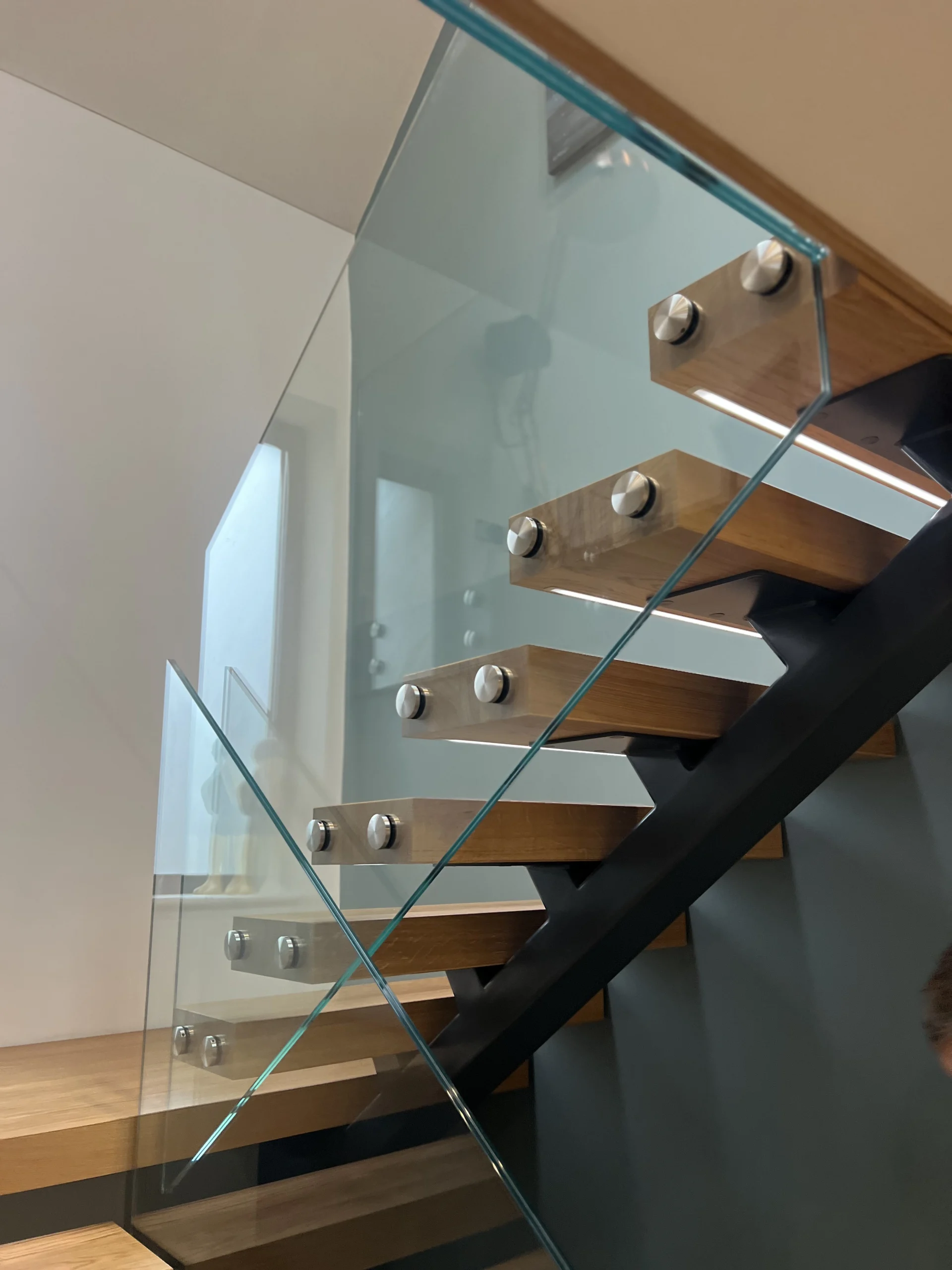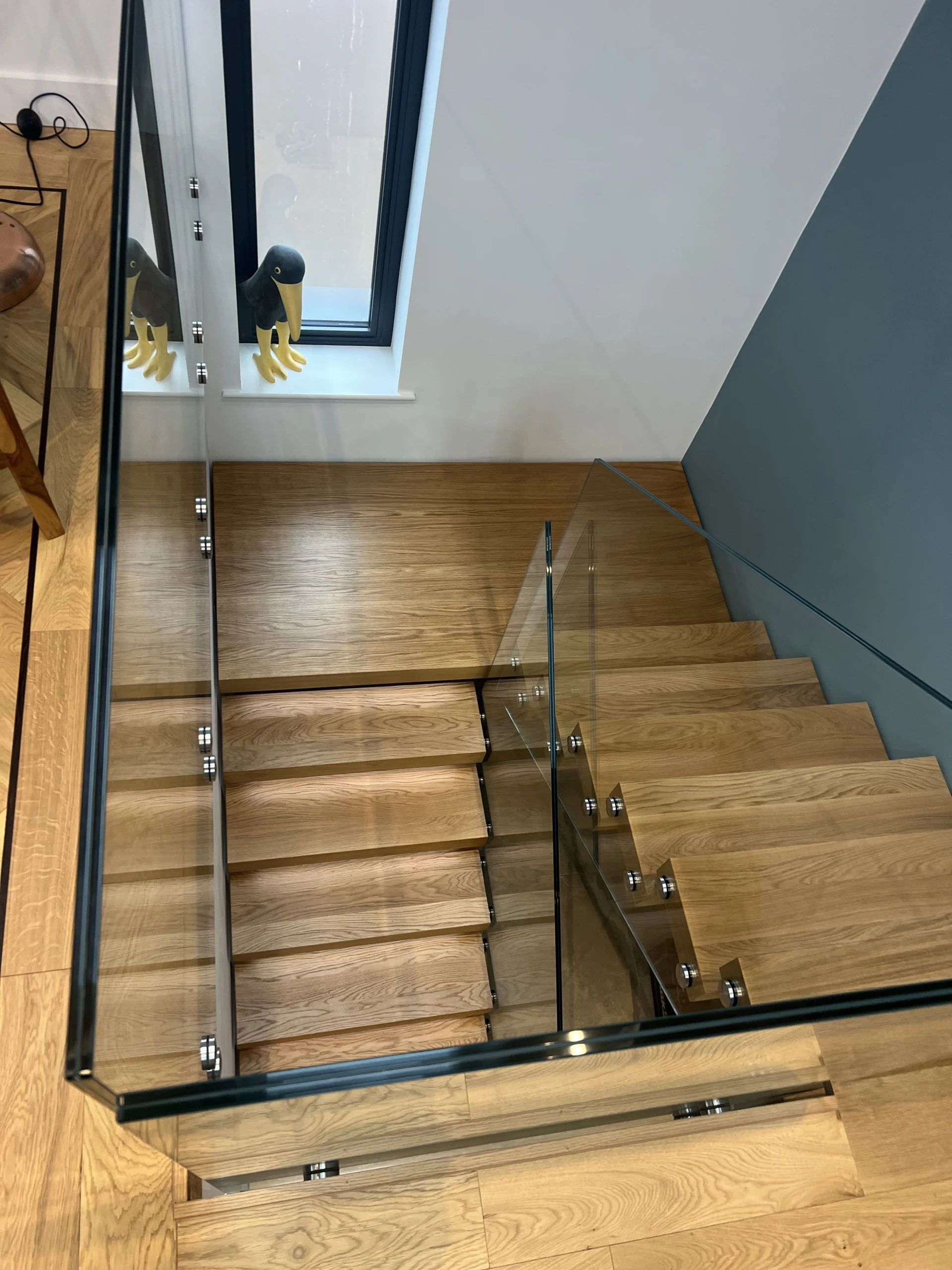

LED lighting transforms a floating staircase from a structural element into the defining feature of a home. A well-designed LED integration does three things simultaneously: it provides functional safety lighting for each tread (essential for nighttime navigation), it creates the dramatic floating effect that makes the staircase appear to hover without support, and it eliminates the need for overhead stairwell lighting — which often casts harsh shadows that flatten the staircase's visual impact. This guide covers the four LED integration methods available for floating staircases, with real specifications, costs, installation requirements, and the practical considerations that determine which approach works best for your project.

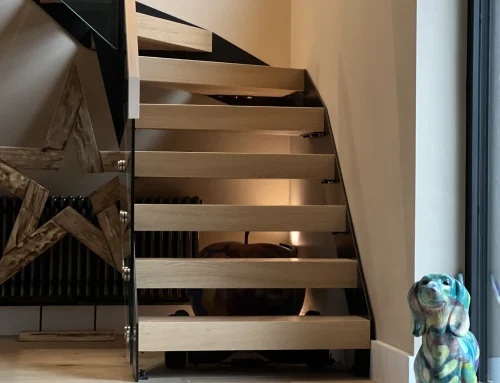
Under-tread LED strip lighting on a floating staircase — the signature Continox LED integration
There are four ways to integrate LED lighting into a floating staircase: under-tread strip lighting (the most popular — £600–£1,200 for a full flight, warm white 3000K, creates the floating glow effect), nosing-recessed strip (hidden in a channel routed into the front edge of each tread — more subtle), wall-recessed step lights (individual LED fixtures recessed into the stairwell wall at each tread — £40–£80 per light), and handrail-integrated strip (LED concealed within a hollow or slotted handrail — illuminates the staircase from above). All options require a 12V or 24V DC LED driver, dimmer-compatible wiring, and pre-planning during the staircase design phase — retrofitting LED into an existing staircase is significantly more expensive and less elegant. Budget £600–£1,200 for under-tread integration on a standard 13-tread floating staircase.
4 LED Integration Methods — Compared
| Method | Cost (Full Flight) | Effect | Best For |
|---|---|---|---|
| Under-tread LED strip | £600–£1,200 | Warm downward glow beneath each tread — floating effect | Floating, cantilever, central spine designs |
| Nosing-recessed strip | £800–£1,500 | Subtle line of light at the front edge of each tread | Minimalist, architectural, premium specification |
| Wall-recessed step lights | £500–£1,000 (13 × £40–£80) | Individual pools of light at each step from the wall | Enclosed stairwells, traditional stairs, retrofits |
| Handrail-integrated strip | £400–£800 | Downward wash from the handrail — illuminates treads from above | Glass balustrade stairs, wall-mounted handrails |
Under-Tread LED Strip — The Signature Floating Effect
1 How it works
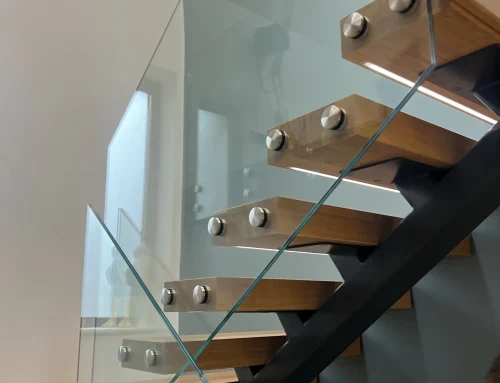
An LED strip (typically 8–12mm wide, self-adhesive backing) is fixed to the underside of each tread, set back 20–30mm from the front edge. The strip faces downward, casting a wash of light onto the riser or wall below the tread. On a floating staircase with open risers, this creates the signature hovering effect — each tread appears to float on a cushion of light, with no visible light source.
The LED strip is connected to a low-voltage driver (12V or 24V DC) concealed in a cupboard, ceiling void, or within the staircase structure itself. The wiring runs through the steel frame — in a Continox floating staircase, the cable channels are integrated into the steel structure during fabrication, so no wiring is visible after installation.
Specification
| Component | Recommended Spec |
|---|---|
| LED strip type | COB (chip-on-board) or SMD 2835 — dotless preferred |
| Colour temperature | 2700K (extra warm) or 3000K (warm white) — avoid 4000K+ (too clinical) |
| CRI (Colour Rendering Index) | 90+ for natural colour reproduction on oak/walnut treads |
| Brightness | 300–600 lumens per metre — enough for ambient, not task lighting |
| IP rating | IP20 (internal stairs) or IP65 (if near external doors or damp areas) |
| Driver | 24V DC constant voltage, dimmable (trailing-edge or 0-10V) |
| Dimmer | Trailing-edge dimmer or smart home integration (Lutron, Philips Hue compatible) |
| Lifespan | 50,000 hours (~17 years at 8 hours/day) |
COB vs SMD: COB (chip-on-board) LED strips produce a continuous, dot-free line of light — no visible individual LEDs. SMD strips (the older technology) show individual dots at close range, which can look cheap on a premium staircase. For under-tread applications where the strip is not directly visible, SMD 2835 is acceptable. For nosing-recessed or handrail applications where the light source may be partly visible, COB is strongly recommended.
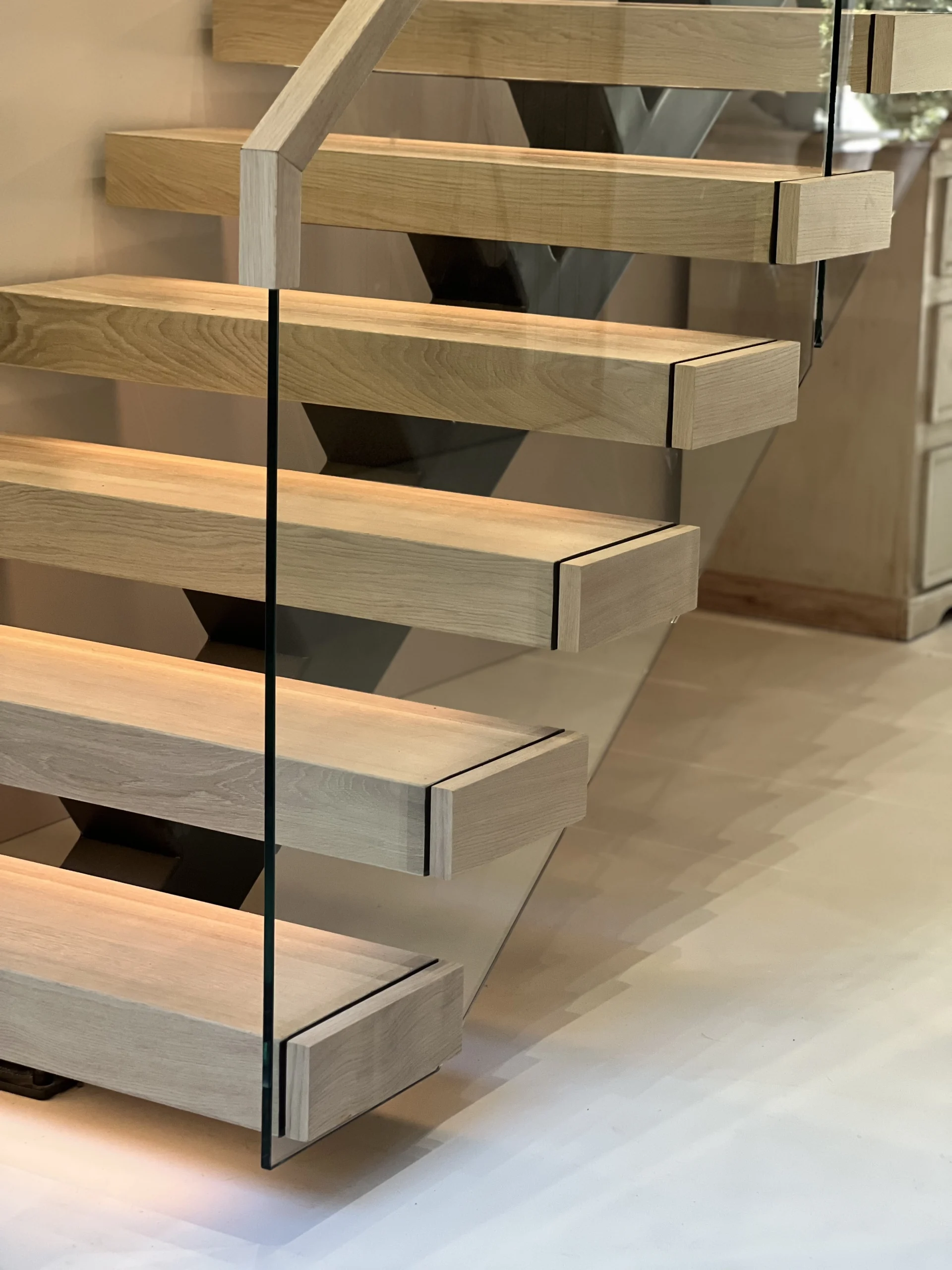 Under-tread LED — warm 3000K wash creates the floating effect
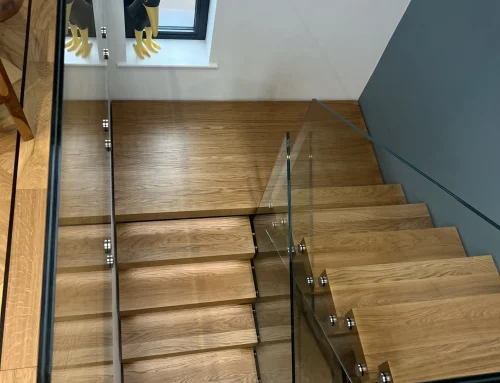
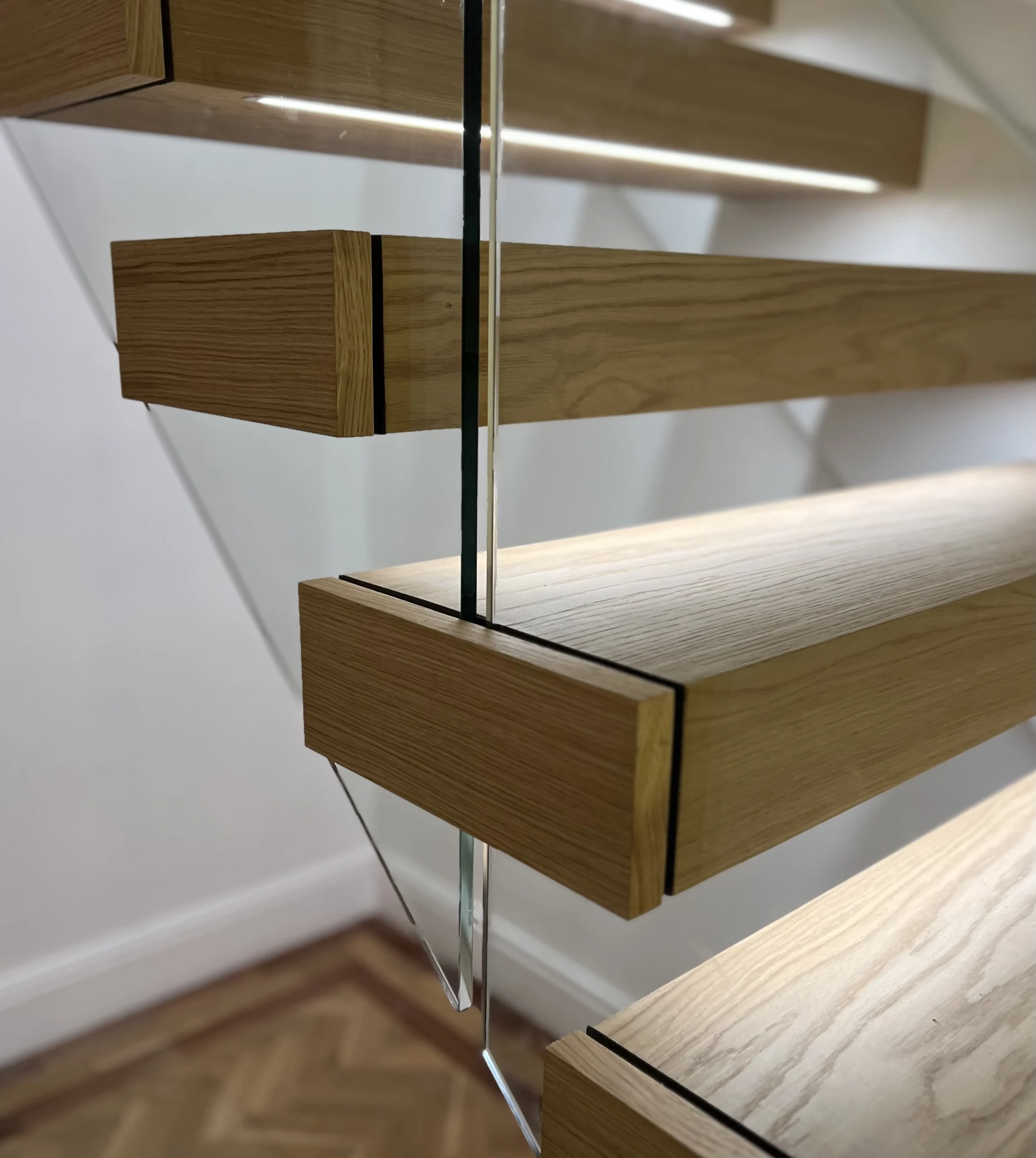 Open risers + LED — each tread hovers on a cushion of light
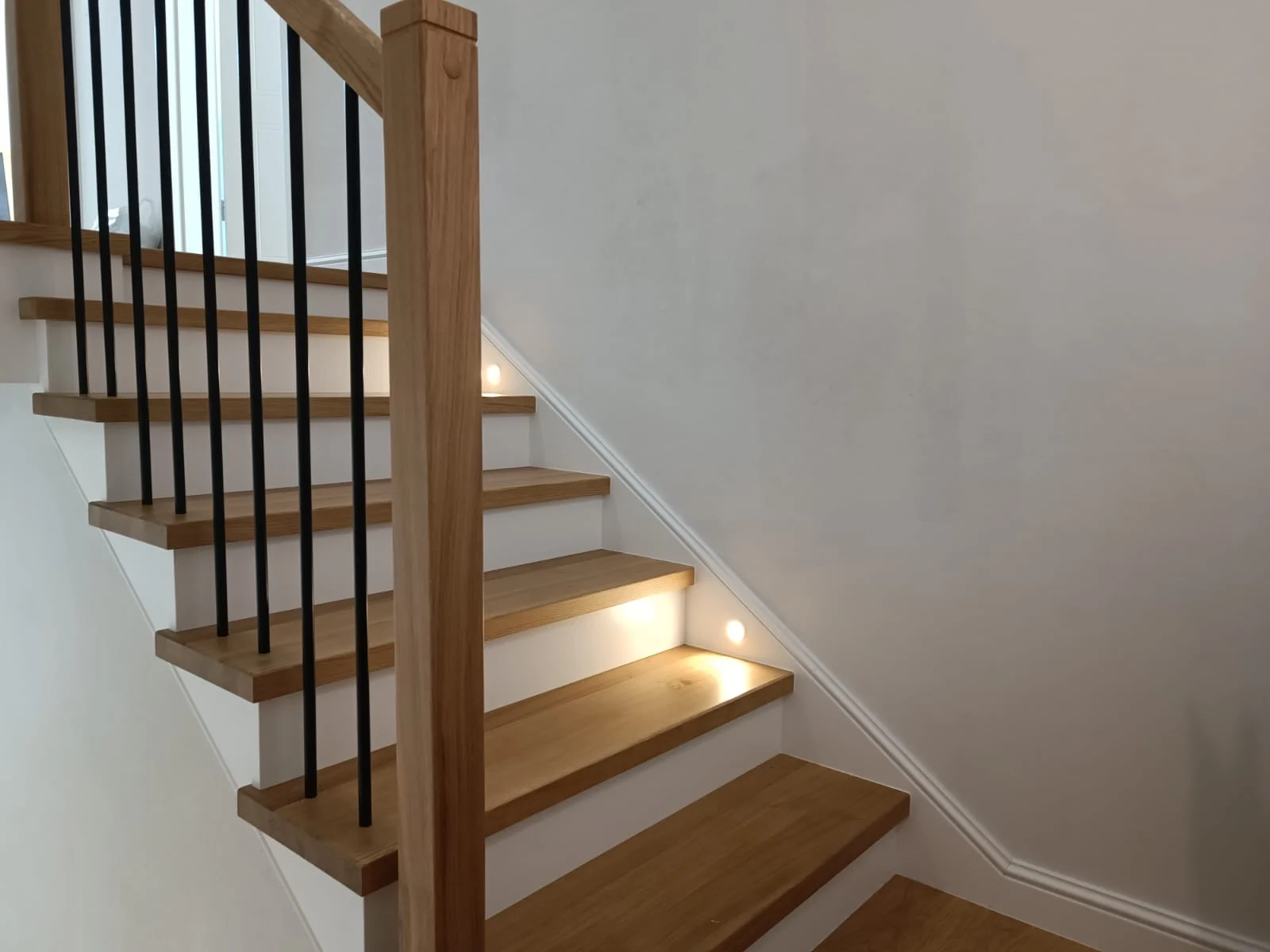 Wall-recessed step lights — alternative for closed-riser designs
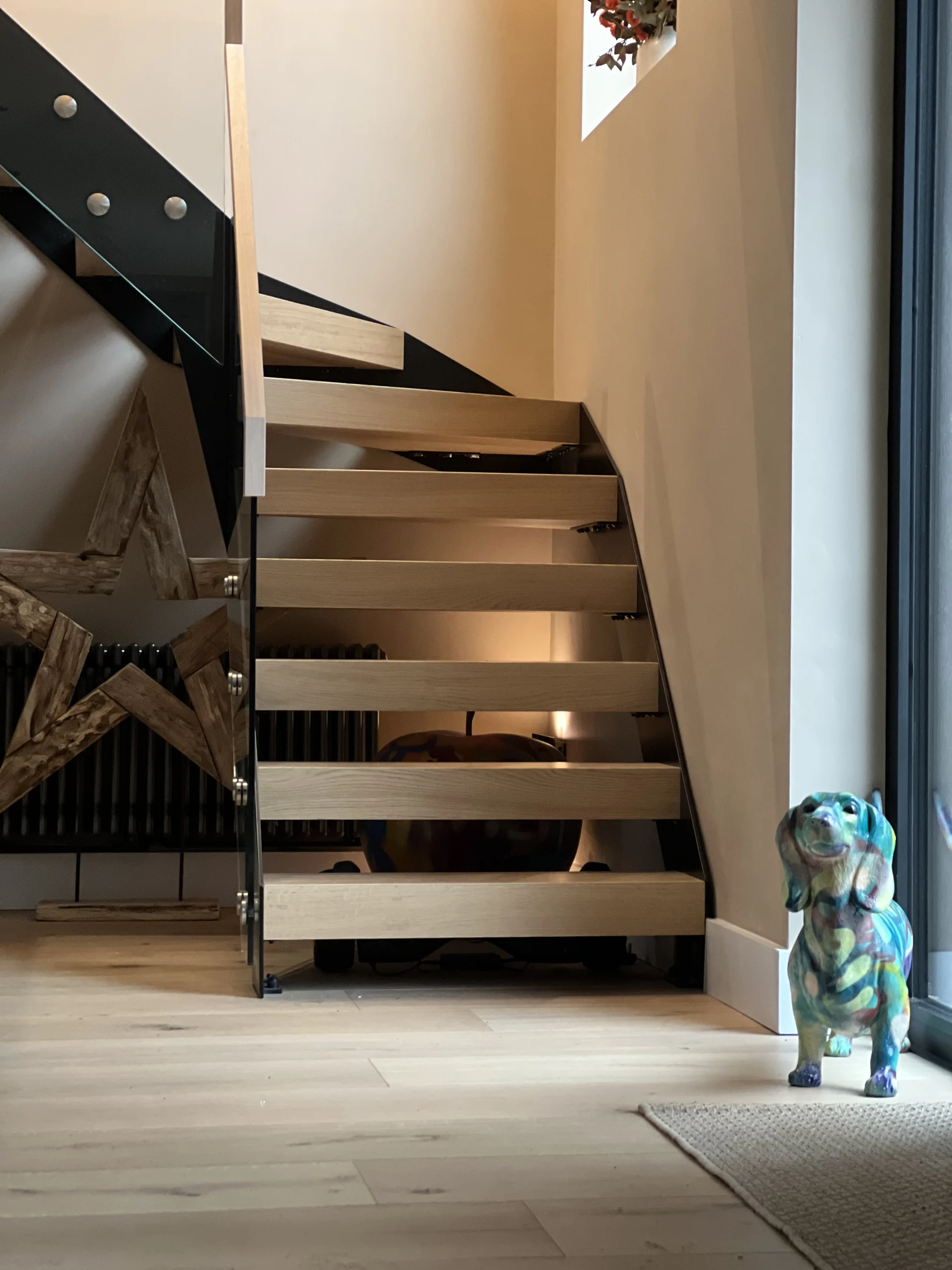
Full flight LED integration — the complete Continox specification
Wall-recessed step lights — alternative for closed-riser designs
Full flight LED integration — the complete Continox specification
Nosing-Recessed LED Strip — The Architectural Detail
2 How it works
A slim aluminium channel (typically 10mm × 8mm with a frosted diffuser) is routed into the front edge (nosing) of each tread. The LED strip sits inside the channel, facing forward and downward. The diffuser spreads the light into a continuous, dot-free line along the leading edge of each step. The effect is subtle and architectural — a thin line of light defines each step without flooding the stairwell with ambient wash.
This method is more expensive than under-tread strip because it requires precision routing of each tread (typically done during manufacture, not on site) and the aluminium channels add material cost. It is the preferred specification for premium residential projects and commercial staircases where a restrained, architectural aesthetic is desired.
Cost: £800–£1,500 for a full 13-tread flight, including channels, strip, driver, and wiring.
Wall-Recessed Step Lights — The Retrofit-Friendly Option
3 How it works
Individual LED fixtures (typically 70mm × 70mm or circular Ø60mm) are recessed into the stairwell wall at each tread level. Each light casts a small pool of downward light onto the tread below. This method does not require any modification to the staircase itself — the lights are in the wall, not the staircase — which makes it the best option for adding LED lighting to an existing staircase without replacing it.
Wall-recessed step lights are available in warm white (3000K), tuneable white (2700K–6500K), and RGB options. They require a mains-powered LED driver (some models accept 240V directly). The wall must be chased out to accommodate the fixture and wiring — this is a building work task, not a staircase manufacturer task. A qualified electrician must install the wiring to comply with Part P of the Building Regulations (electrical safety in dwellings).
Cost: £40–£80 per fixture installed. A full flight of 13 lights: £500–£1,000 plus electrician labour and making good.
Handrail-Integrated LED — The Dual-Purpose Solution
4 How it works
An LED strip is concealed within a hollow or slotted handrail, facing downward. The light washes down from the handrail onto the treads below, providing functional illumination of each step from above. This method works with both wall-mounted handrails (the strip is hidden in a channel on the underside of the handrail) and balustrade-mounted handrails (the strip sits in a slotted tube — typically a 42mm or 48mm diameter round handrail with a 24mm slot).
Handrail-integrated LED is the least visually dramatic of the four methods — it does not create the floating effect of under-tread lighting — but it is the most functionally effective for illuminating the treads in a way that makes each step clearly visible. It is particularly effective on staircases with glass balustrade, where the light passes through the glass and creates a subtle diffused glow on the stairwell walls.
Cost: £400–£800 for a full flight, including slotted handrail, strip, driver, and wiring.
Colour Temperature — The Most Important Decision
Colour temperature — measured in Kelvin (K) — determines whether the light appears warm and inviting or cool and clinical. This single specification has more impact on how the staircase feels than any other lighting parameter.
| Colour Temperature | Appearance | Recommendation |
|---|---|---|
| 2700K (extra warm white) | Amber, candle-like, intimate | Best for oak treads — enhances warm tones |
| 3000K (warm white) | Warm, inviting, natural | The standard recommendation — works with all timbers |
| 4000K (cool white) | Neutral, clean, slightly blue | Avoid for residential — too clinical for home interiors |
| 6500K (daylight) | Blue-white, harsh | Never use on a residential staircase |
| RGB (colour-changing) | Any colour — programmable | Entertainment option — use with a warm white baseline |
The golden rule: Match the LED colour temperature to the timber. Oak and walnut look their best under 2700K–3000K warm light, which enhances the amber and brown tones of the grain. Cool white (4000K+) makes oak look grey and washed out. If you are investing £7,900+ in a bespoke floating staircase with solid oak treads, do not undermine it with the wrong colour temperature.
Electrical Requirements — What Your Electrician Needs to Know
LED staircase lighting is low-voltage (12V or 24V DC) and draws minimal power — a full flight of 13 treads with LED strip typically consumes 30–50 watts. However, the installation still involves mains-powered components (the LED driver, dimmer switch, and supply wiring) which must comply with Part P of the Building Regulations (Electrical Safety in Dwellings).
Key electrical considerations
The LED driver (transformer) converts 240V mains to 12V or 24V DC. It should be located in an accessible position (cupboard, ceiling void, or under-stair enclosure) for future replacement — LED drivers have a shorter lifespan than the LED strips themselves (typically 5–10 years versus 15–20 years for the strips). Use a 24V system rather than 12V for runs longer than 5 metres — 12V systems suffer voltage drop over distance, causing the LEDs to dim towards the end of the strip. The dimmer must be compatible with the LED driver type — trailing-edge dimmers for mains-dimming drivers, or 0-10V / DALI dimmers for constant-voltage drivers. Motion sensors can activate the LED lighting when someone approaches the staircase — a useful energy-saving and convenience feature, particularly for nighttime use.
Plan early: LED integration must be specified during the staircase design phase — not as an afterthought. The cable channels need to be fabricated into the steel structure, the tread profiles may need routing for nosing channels, and the driver and dimmer positions must be coordinated with the electrician. At Continox, LED cable channels are integrated into our steel frames during fabrication at no additional structural cost — the wiring simply threads through the existing steel sections. Retrofitting LED into a completed staircase is possible (with wall-recessed step lights or surface-mounted strip), but never as elegant or well-integrated as a factory-designed solution.
Cost Breakdown — 2026 UK LED Staircase Pricing
| Item | Cost | Notes |
|---|---|---|
| LED strip (COB, 3000K, 13 treads) | £100–£200 | Quality COB strip: ~£8–£15 per tread length |
| Aluminium channels + diffusers (if nosing-recessed) | £80–£150 | ~£6–£12 per channel |
| LED driver (24V, dimmable, 60W) | £40–£80 | Mean Well or equivalent |
| Dimmer switch (trailing-edge or smart) | £30–£80 | Lutron, Varilight, or smart home compatible |
| Wiring and connectors | £30–£60 | Low-voltage cable, solderless connectors |
| Motion sensor (optional) | £20–£50 | PIR or microwave, top and bottom of flight |
| Electrician labour (Part P compliant) | £200–£400 | Half-day installation, testing, certification |
| Total: under-tread strip | £600–£1,200 | Full flight, dimmer-controlled, Part P compliant |
These costs are for the LED lighting integration only — they do not include the staircase itself. A Continox floating staircase with LED starts from £8,500 (staircase + LED integration). A central spine staircase with LED and glass balustrade starts from £10,500. For full staircase pricing, see our bespoke staircase cost guide.
Design Considerations — Getting the Light Right
Brightness control
Staircase LED lighting should be dimmable — always. At full brightness during the day, the LED provides functional step illumination. Dimmed to 10–20% in the evening, it creates ambient mood lighting. At night with a motion sensor, a gentle fade-on provides safe navigation without jolting awake anyone sleeping nearby. A staircase LED that is either on or off (no dimming) is a missed opportunity and a common client complaint.
Light direction
Under-tread strip casts light downward onto the tread below — creating shadows beneath each step that define the floating effect. Nosing-recessed strip casts light forward and slightly downward — defining the step edge for safety. Wall-recessed lights cast light outward from the wall onto the tread surface. Handrail strip casts light downward from above. Each direction produces a different mood — under-tread is the most dramatic, wall-recessed is the most subtle.
Every tread or alternate treads?
Lighting every tread produces the most consistent, premium effect and is the standard recommendation for bespoke floating staircases. Lighting alternate treads (every second step) reduces cost by roughly 40% but creates an uneven rhythm that can feel incomplete on a premium staircase. For budget-conscious projects, alternate treads are acceptable — but if the staircase is a design feature worth £7,900+, light every tread.
For more on how LED integrates with different staircase materials, see our wood vs steel staircase comparison. For loft conversion staircase lighting, see our loft conversion ideas guide.
Frequently Asked Questions — LED Floating Staircase Lighting
Under-tread LED strip lighting for a standard 13-tread floating staircase costs £600–£1,200 fully installed, including LED strip, driver, dimmer, wiring, and electrician labour. Nosing-recessed strip costs £800–£1,500. Wall-recessed step lights cost £500–£1,000 (13 fixtures). Handrail-integrated strip costs £400–£800. All prices are for the LED lighting only — the staircase itself is additional.
Yes — but the options are more limited. Wall-recessed step lights are the best retrofit option because they do not require modification to the staircase itself (the lights go in the wall). Surface-mounted LED strip can be added under existing treads, but the wiring must be routed externally or through channels cut into the wall. The result is never as elegant as factory-integrated LED on a new staircase. If you are planning a staircase replacement anyway, specify the LED integration during design.
Warm white at 3000K is the standard recommendation for residential staircases — it enhances the natural tones of oak and walnut treads and creates an inviting atmosphere. Extra warm (2700K) is ideal for intimate, cosy settings. Avoid cool white (4000K+) on residential staircases — it makes timber look grey and creates a clinical feel. RGB (colour-changing) is available but should always include a warm white baseline for everyday use.
The LED strips themselves are low-voltage (12V or 24V DC) and safe to handle. However, the driver (transformer) connects to the 240V mains supply, which must be installed by a qualified electrician to comply with Part P of the Building Regulations. The electrician should also test and certify the installation. Budget £200–£400 for electrician labour (half-day).
Quality LED strips are rated for 50,000 hours — approximately 17 years at 8 hours of daily use. The LED driver (transformer) has a shorter lifespan of 5–10 years and should be positioned in an accessible location for eventual replacement. When the driver fails, the LED strips themselves are usually still functional — you replace the driver only, not the entire system.
Yes — LED staircase lighting can integrate with most smart home systems (Lutron, Philips Hue, Google Home, Amazon Alexa, Apple HomeKit) via a compatible driver and dimmer. This allows voice control, scheduling, scene integration, and remote dimming. Motion-sensor activation (PIR or microwave sensors at the top and bottom of the flight) is also available, enabling automatic fade-on when someone approaches the staircase.
LED staircase lighting improves safety for all users — including children — by making each tread clearly visible in low-light conditions. The LED strips operate at 12V or 24V DC (low voltage), which is safe to touch. The strips produce negligible heat. LED staircase lighting is a safety improvement, not a risk — it is one of the most effective ways to prevent falls on stairs at night.
COB (chip-on-board) LED strip produces a continuous, dot-free line of light — no visible individual LEDs. SMD (surface-mount device) strip shows individual light points at close range. For staircase applications, COB is recommended wherever the strip may be partly visible (nosing channels, handrail slots). SMD 2835 is acceptable for under-tread applications where the strip is hidden from direct view.
Want a Floating Staircase with Integrated LED?
Continox designs and manufactures bespoke floating staircases with factory-integrated LED lighting. Cable channels built into the steel frame during fabrication — no visible wiring, no retrofit compromises. From £8,500 with LED. Based in Gosport, Hampshire.