
As a building owner, landlord or managing agent, the safety of your fire escape staircases is your legal responsibility — not your contractor's, not your tenant's. This guide sets out exactly what UK law requires, how to assess whether your existing fire escapes are compliant, and what the consequences of non-compliance look like in practice.
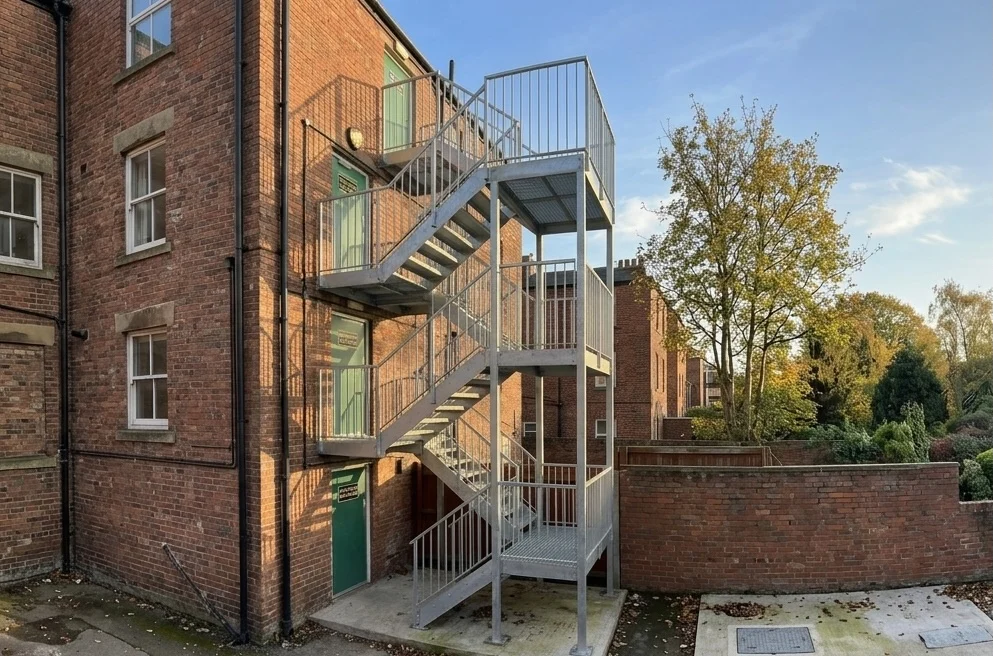
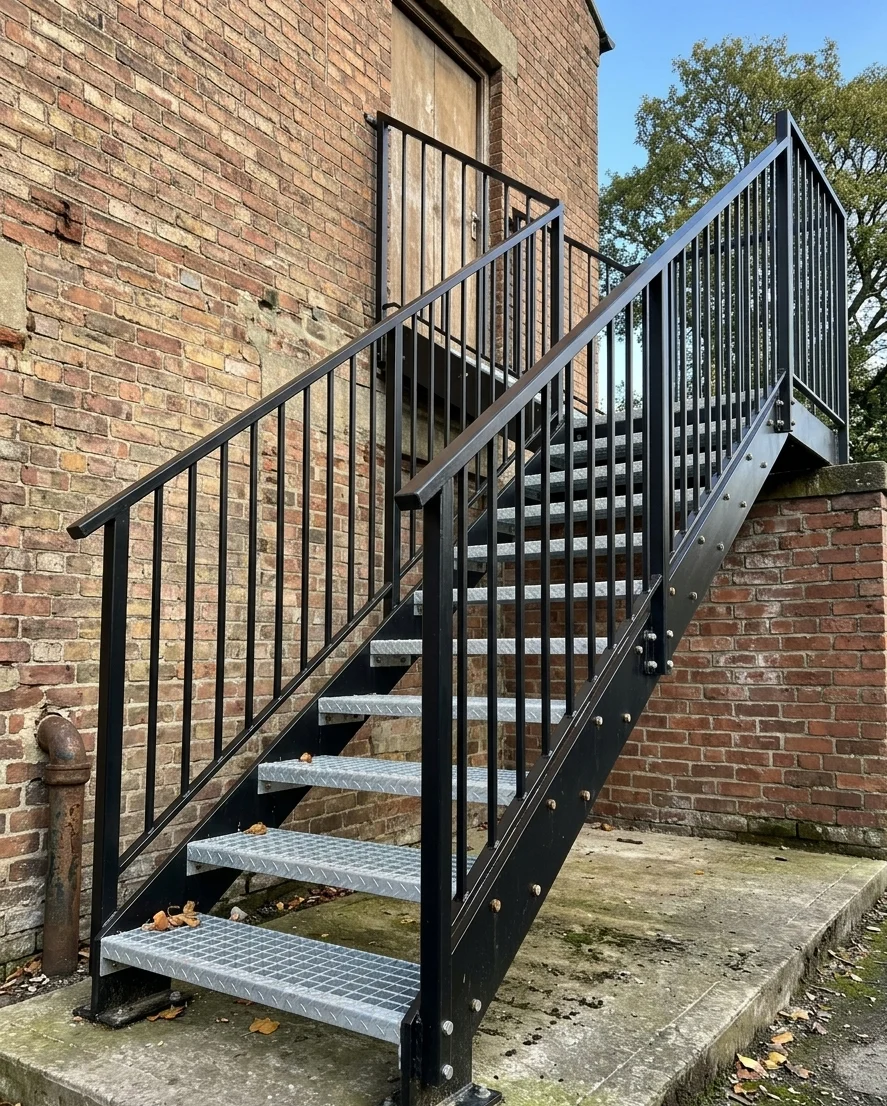
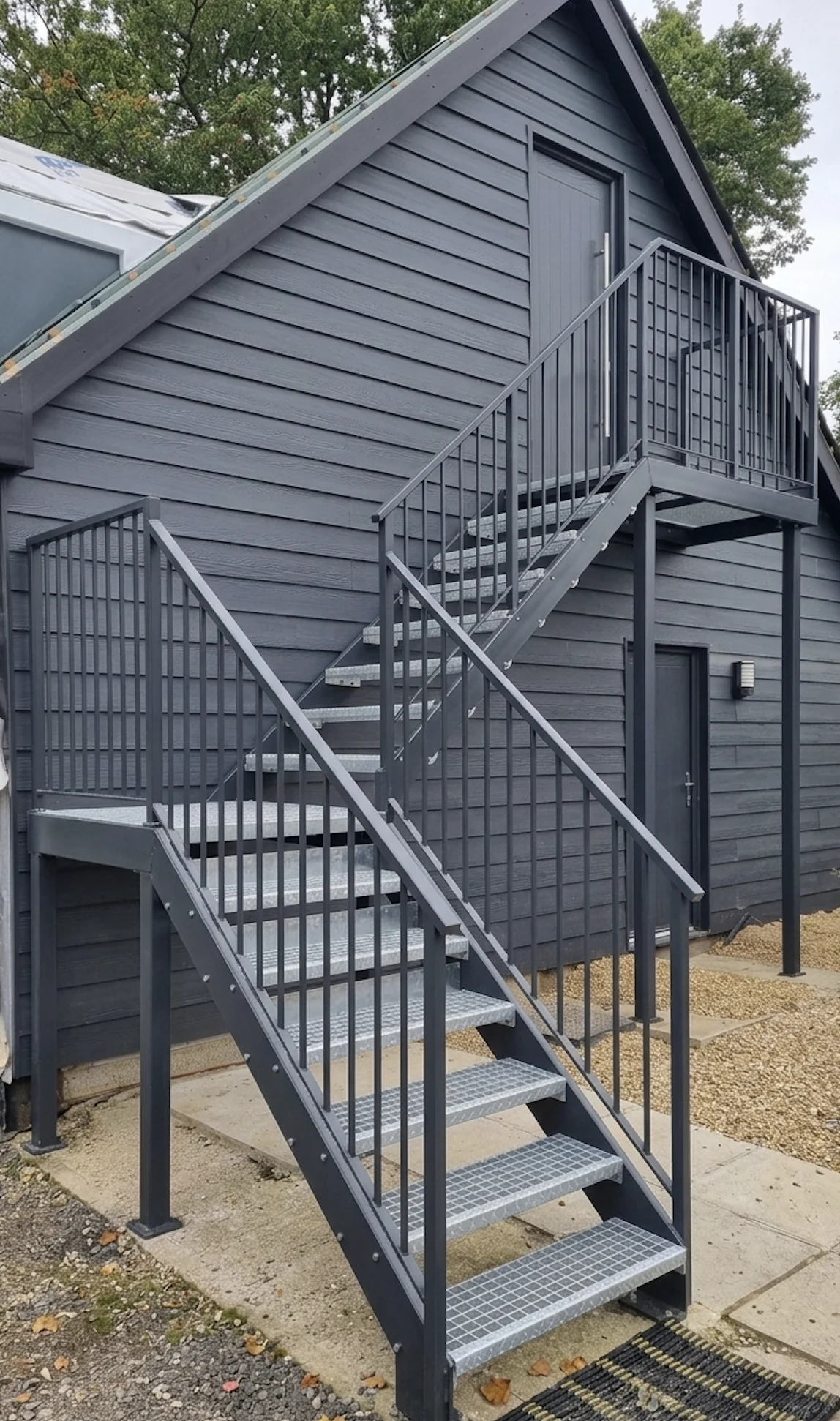
Compliant external fire escape staircase installed by Continox — BS 9991 engineered, UKCA marked.
Who Is Legally Responsible for Fire Escape Safety?
Under the Regulatory Reform (Fire Safety) Order 2005, every non-domestic premises and every building with common areas — including HMOs, apartment blocks and converted houses — must have a designated "responsible person." This is typically the building owner, landlord or managing agent, and the duty is non-delegable: you cannot transfer your legal responsibility to a tenant or a contractor.
The responsible person's core duties include carrying out a fire risk assessment, implementing adequate means of escape, and ensuring that fire escape routes — including any external staircases — are maintained in good working order at all times. This is not a one-off obligation: it is an ongoing duty that requires periodic reassessment as building use, occupancy or layout changes.
Legal Duty — Not Optional The Fire Safety Order applies to any premises where people work or reside in buildings with common areas. For HMOs, compliance with fire escape requirements is also a condition of your HMO licence under the Housing Act 2004. Failure to comply can result in licence revocation, enforcement notices, unlimited fines and — in cases of serious risk — prosecution. See our fire escape staircase page for compliant solutions.
Fire Escape Safety Checklist
Use the following checklist to assess whether your existing fire escape staircases meet UK requirements. Each item references the relevant standard or regulation. If your installation fails any of these checks, a professional assessment and likely upgrade are required.
Fire Escape Staircase — Safety Compliance Checklist
8 CheckpointsClear Width ≥ 1000mm
Measure the unobstructed width between the inner faces of handrails or balustrades — not the overall structural width. Any obstruction reducing this below 1000mm is non-compliant.
BS 9991 / Approved Document BRise 150–190mm, Going ≥ 220mm
Check each step for uniform rise and going. Inconsistent dimensions are a trip hazard and a compliance failure. Maximum pitch must not exceed 42°.
Approved Document KHandrails at 900–1000mm
Handrails must be present and fixed at 900–1000mm above the pitch line. Both sides required where the staircase width exceeds 1000mm. Check fixings for security and corrosion.
Approved Document K / BS 9991Balustrade Height ≥ 1100mm at Landings
Platform and landing balustrades must be minimum 1100mm high. The 100mm sphere rule applies — no opening may permit passage of a 100mm sphere.
Approved Document K / BS 6180Non-Slip Tread Surface
All tread surfaces must be non-slip — particularly critical for external staircases exposed to rain, moss growth or frost. Open mesh or perforated steel treads are the standard compliant specification.
BS 9991 / Approved Document BStructural Integrity — No Corrosion or Movement
The staircase must not flex, move or vibrate excessively under load. Check all fixing points, welds, bolts and base plates for corrosion, loosening or structural deterioration. Any significant rust penetration to the main structure requires urgent assessment.
BS EN 1090 / BS 9991Unobstructed Access at All Times
Fire escape routes must be kept clear at all times. Check that doors opening onto the staircase do not obstruct the clear width, and that no items are stored on landings or treads.
Fire Safety Order 2005UKCA Marking & Documentation
For newer installations (post-2021), the staircase should carry UKCA marking and a Declaration of Performance for the structural steel components. If you cannot locate this documentation, it may not have been provided.
UK Construction Products RegulationsTechnical Requirements: Key Dimensions
The following table sets out the minimum dimensional requirements for fire escape staircases in the UK. These apply to external fire escapes serving residential buildings, HMOs and apartment blocks. For the full regulatory context, see our UK Staircase Building Regulations guide.
| Requirement | Standard | Specification |
|---|---|---|
| Min clear width | BS 9991 / Doc B | 1000mm |
| Min rise | Approved Document K | 150mm |
| Max rise | Approved Document K | 190mm |
| Min going | Approved Document K | 220mm |
| Max pitch | Approved Document K | 42° |
| Min headroom | Approved Document K | 2000mm |
| Handrail height | Approved Document K | 900–1000mm |
| Landing balustrade height | Part K / BS 6180 | 1100mm |
| Max balustrade opening | Approved Document K | 100mm sphere |
| Tread surface | BS 9991 | Non-slip required |
6 Signs Your Fire Escape Needs Replacing
Not all fire escape deficiencies are obvious. The following warning signs — identified during Continox site surveys — indicate that an existing fire escape staircase may require urgent attention or full replacement.
01 Structural Movement or Flex
If the staircase moves, bounces or vibrates noticeably under normal load, the fixing points or structural members are likely compromised. This is an immediate safety concern requiring professional assessment.
02 Significant Rust Penetration
Surface rust on galvanised steel is normal after many years of exposure and can be treated. However, deep rust penetrating the base metal — particularly at welds, fixing points and base plates — indicates structural degradation that cannot be remedied by surface treatment alone.
03 Loose or Missing Fixings
Wall fixings, base plate bolts and tread fixings must all be secure and fully torqued. Loose fixings allow structural movement that accelerates corrosion and increases the risk of progressive failure under emergency loading.
04 Inadequate Width
Many older fire escapes were installed before BS 9991 required a 1000mm minimum clear width. If your staircase measures less than 1000mm between handrails, it does not meet current standards and would fail a Building Control inspection.
05 Slippery or Deteriorated Treads
Solid plate treads without anti-slip treatment, moss-covered surfaces, or treads that have deformed or corroded through present a significant slip and fall risk — particularly in wet conditions or emergency evacuation scenarios.
06 No Documentation or UKCA Marking
If you cannot produce structural calculations, CAD drawings or a Declaration of Performance for your existing fire escape, you have no evidence of compliance. This is increasingly being required by Building Control and insurance assessors.
Inspection & Maintenance
Even a compliant fire escape staircase requires periodic inspection and maintenance to remain safe and legally defensible. The following schedule is recommended for external steel fire escapes in the UK.
Annual Inspection
A thorough annual inspection should cover: structural integrity (movement, weld condition, fixing security), corrosion assessment (surface vs penetrating rust), tread condition (slip resistance, deformation, debris accumulation), handrail and balustrade security (height verification, sphere rule compliance), and access clearance (unobstructed route confirmed). Keep a written record of each inspection — this forms part of your fire risk assessment documentation.
Post-Winter Check
The UK winter is the most damaging period for external steel structures. Freeze-thaw cycles accelerate corrosion at fixings and welds, and galvanising can be compromised by repeated salt or grit exposure on staircases near roads or car parks. A post-winter check in March or April is good practice.
Professional Assessment
If your annual inspection identifies structural movement, significant corrosion or dimensional non-compliance, a professional structural assessment is required — not a like-for-like maintenance repair. Continox provides free on-site surveys across the UK, with a written assessment and guide price provided within 24 hours. See our fire escape staircase range for details.
Maintenance vs Replacement: Surface rust treatment, tread cleaning and fixing re-torquing are legitimate maintenance activities that extend the life of a compliant staircase. However, they cannot remediate structural deficiencies — incorrect dimensions, inadequate width, or penetrating corrosion in structural members. If in doubt, seek a professional structural assessment rather than attempting a surface fix that leaves underlying non-compliance unresolved.
Enforcement & Consequences of Non-Compliance
The consequences of non-compliant fire escapes in the UK are serious and have become more rigorously enforced since the Fire Safety Act 2021 extended the scope of the Fire Safety Order to explicitly include external structures, including staircases, balconies and cladding.
Enforcement Notice
Local fire and rescue authorities can issue enforcement notices requiring specific remedial works within a defined timeframe. Failure to comply with an enforcement notice is a criminal offence.
Prohibition Notice
In cases of serious and immediate risk, a prohibition notice can prevent occupation of all or part of the building until the deficiency is remedied. For HMOs, this means loss of rental income immediately.
Unlimited Fines
Prosecution under the Fire Safety Order can result in unlimited fines and — in cases involving loss of life — custodial sentences. The HSE and local fire authorities have increased enforcement activity significantly since 2021.
HMO Licence Implications For HMO landlords, a non-compliant fire escape is not just a safety issue — it is grounds for licence refusal or revocation under the Housing Act 2004. Local authority licensing officers are increasingly requiring photographic evidence of compliance as part of licence renewal. A new compliant fire escape from Continox, with full structural documentation and UKCA marking, provides exactly the evidence required.
How Continox Can Help
Continox designs, manufactures and installs bespoke fire escape staircases for residential landlords, HMO operators, commercial building owners and managing agents across the UK. Every installation includes:
Free on-site survey — we visit your property, assess the existing structure if applicable, and provide a written assessment and guide price within 24 hours, with no call-out charge. Structural engineering — full calculations to BS EN 1090 and BS 9991, plus detailed CAD drawings for your Building Control submission. UKCA marking — all Continox structural steel components carry UKCA marking and a Declaration of Performance as standard — something many suppliers cannot provide. Professional installation — installed by our in-house team, no subcontractors, 4–6 week lead time.
Residential HMO fire escape staircases from £3,500 excl. VAT. Commercial multi-landing systems from £5,500 excl. VAT. For a detailed cost breakdown, see our staircase cost guide.

Fire Escape Safety — FAQ
Common questions from building owners, landlords and managing agents about fire escape safety requirements in the UK.
Get a Free Safety Assessment
Within 24 Hours
Free on-site survey, written assessment and guide price within 24 hours. BS 9991 compliant replacement staircases from £3,500 — installed by our in-house team across the UK.