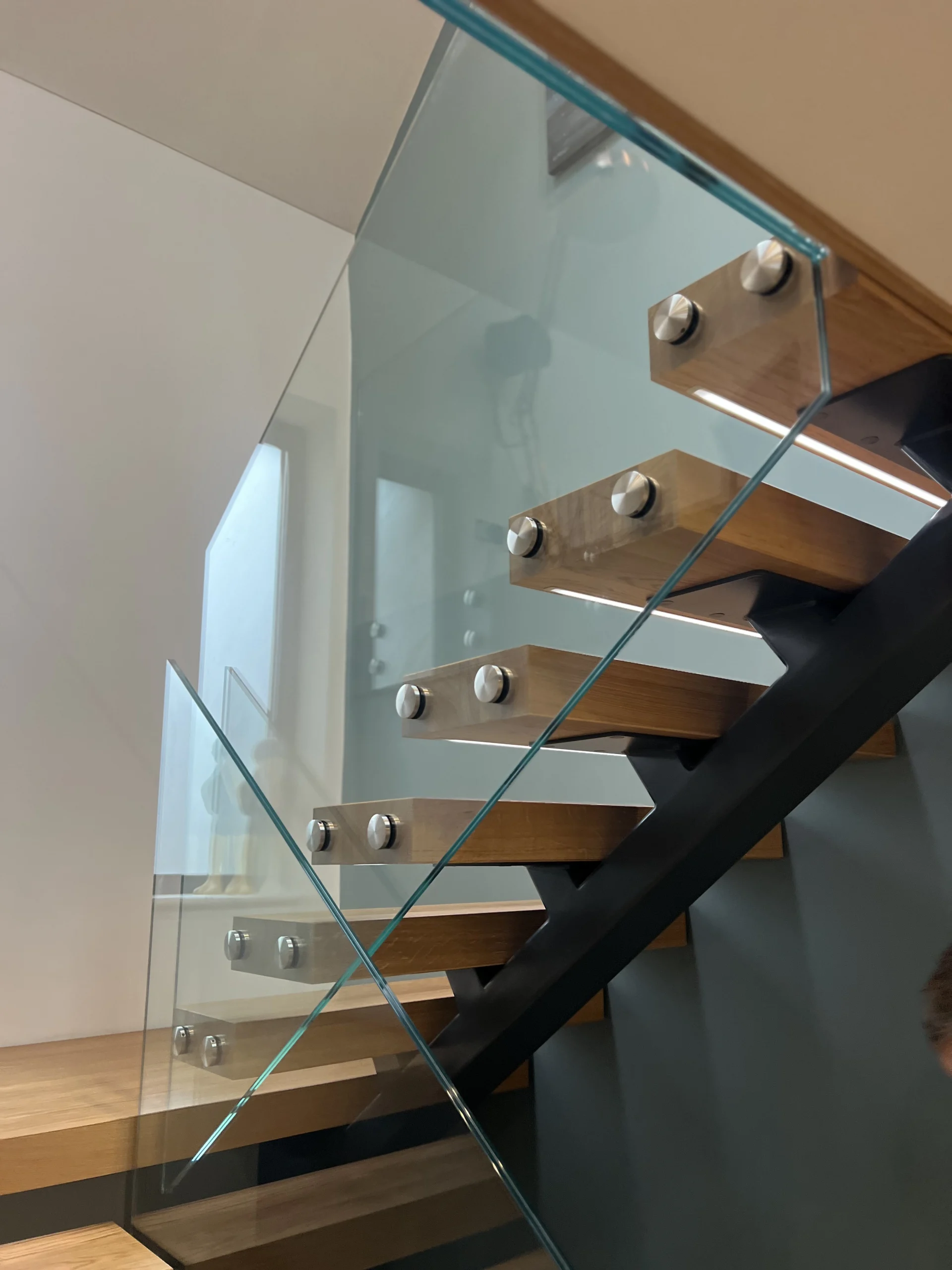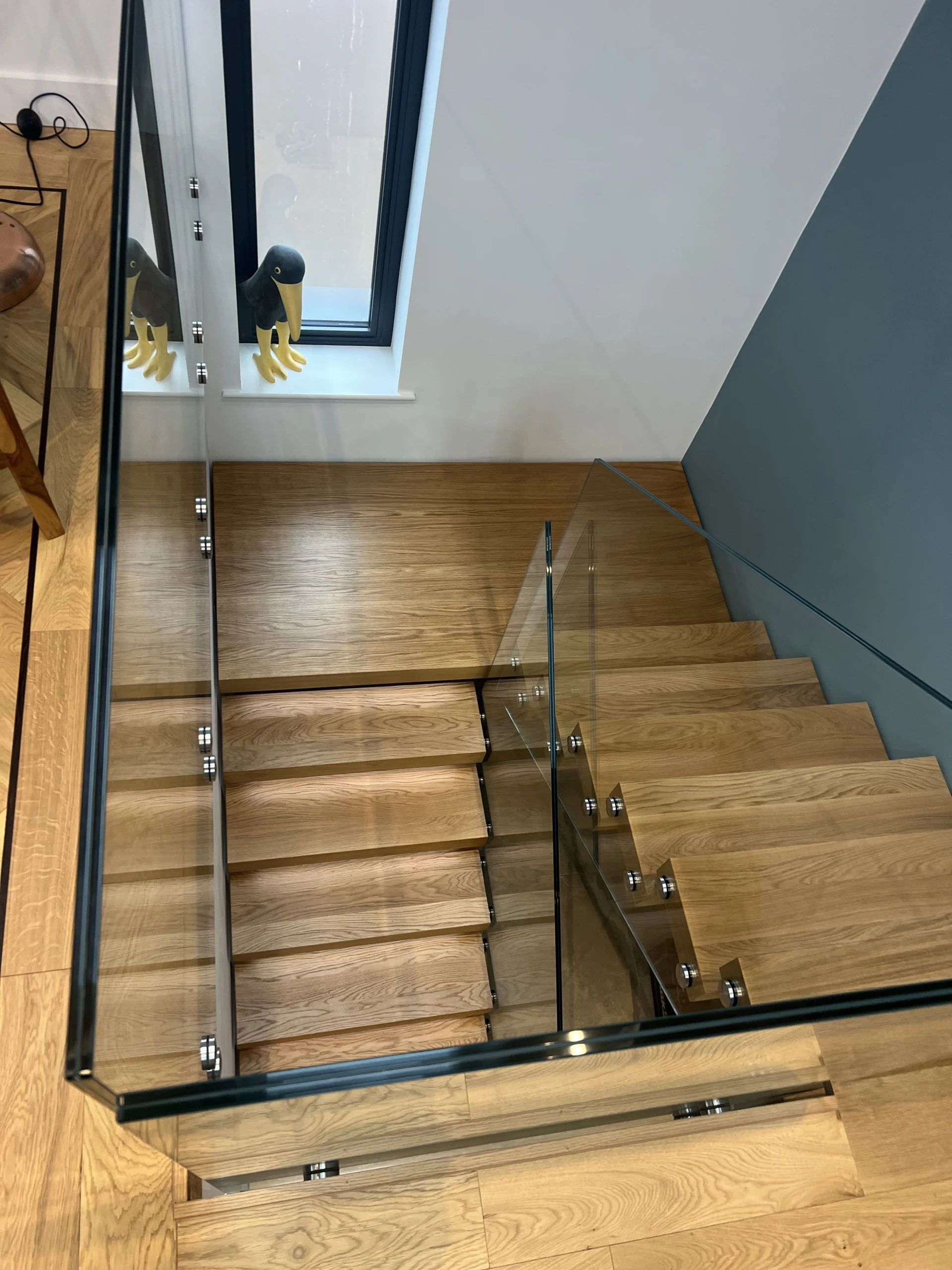

For most homeowners installing a new staircase in the UK, the answer is straightforward: planning permission is not required, but Building Regulations approval always is. The two are frequently confused — and confusing them is what causes projects to stall. This guide explains exactly when each applies, what the key dimensional requirements are under Part K, and what documentation a professional staircase installer should provide to make Building Control sign-off straightforward.
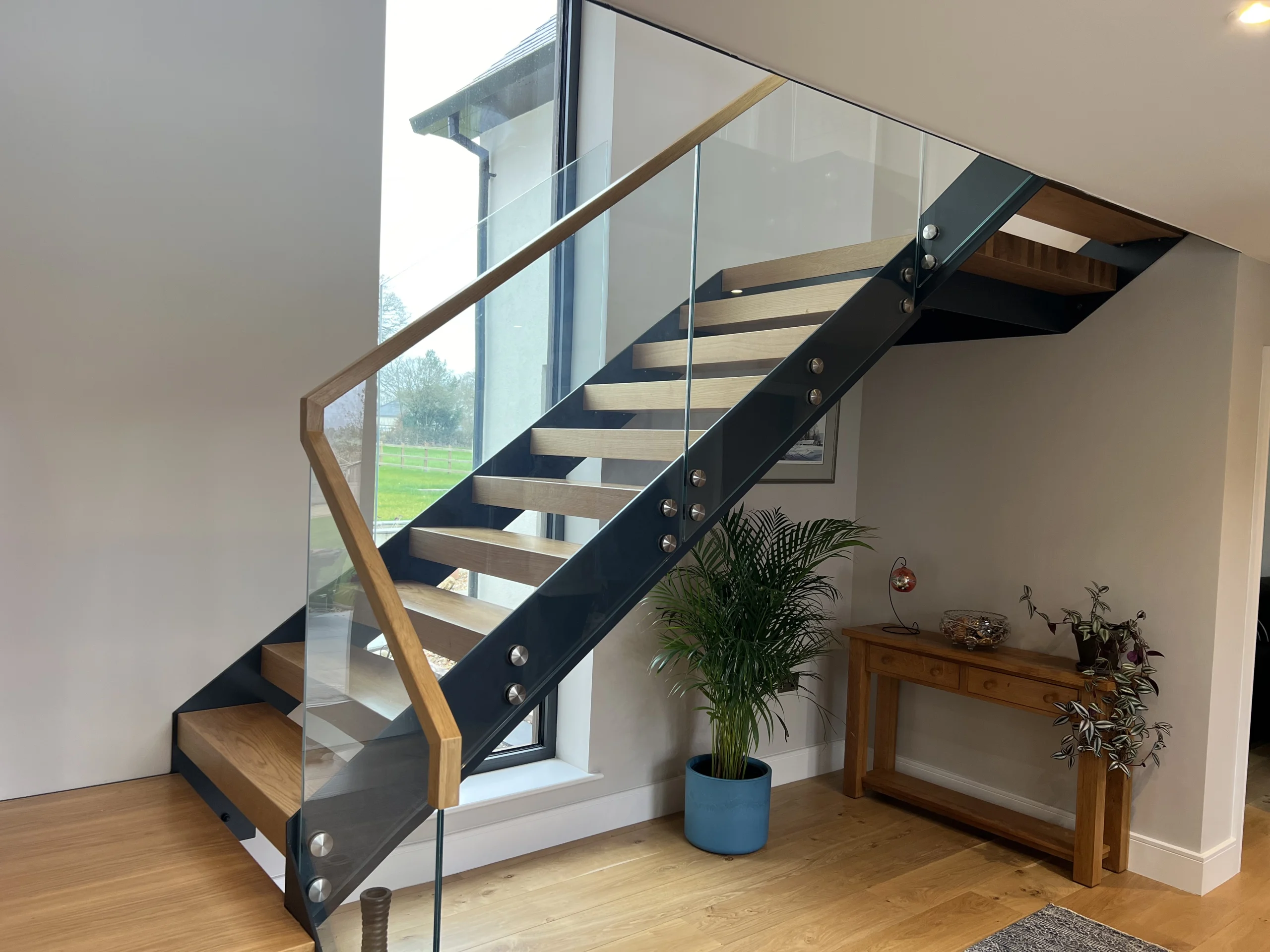
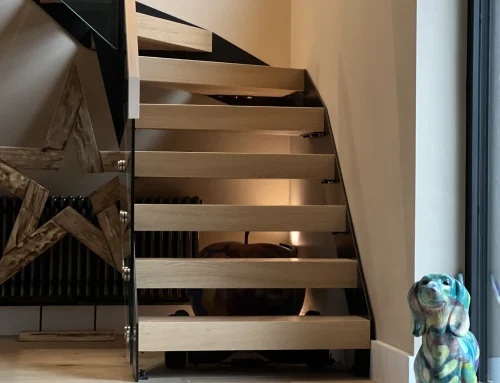
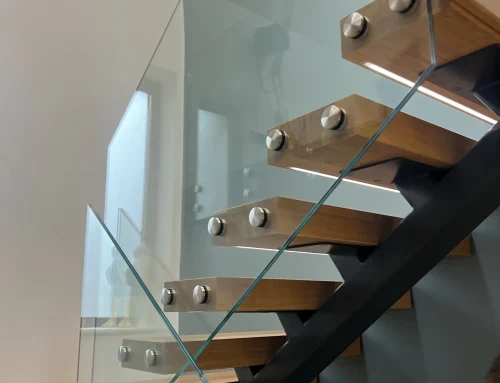
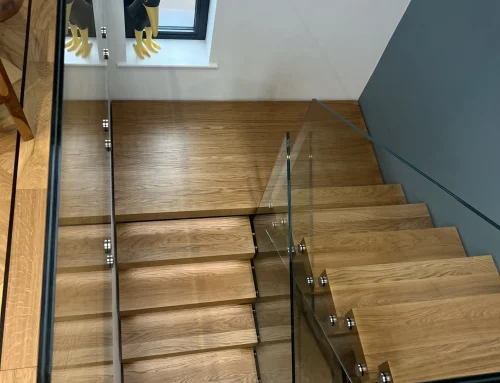
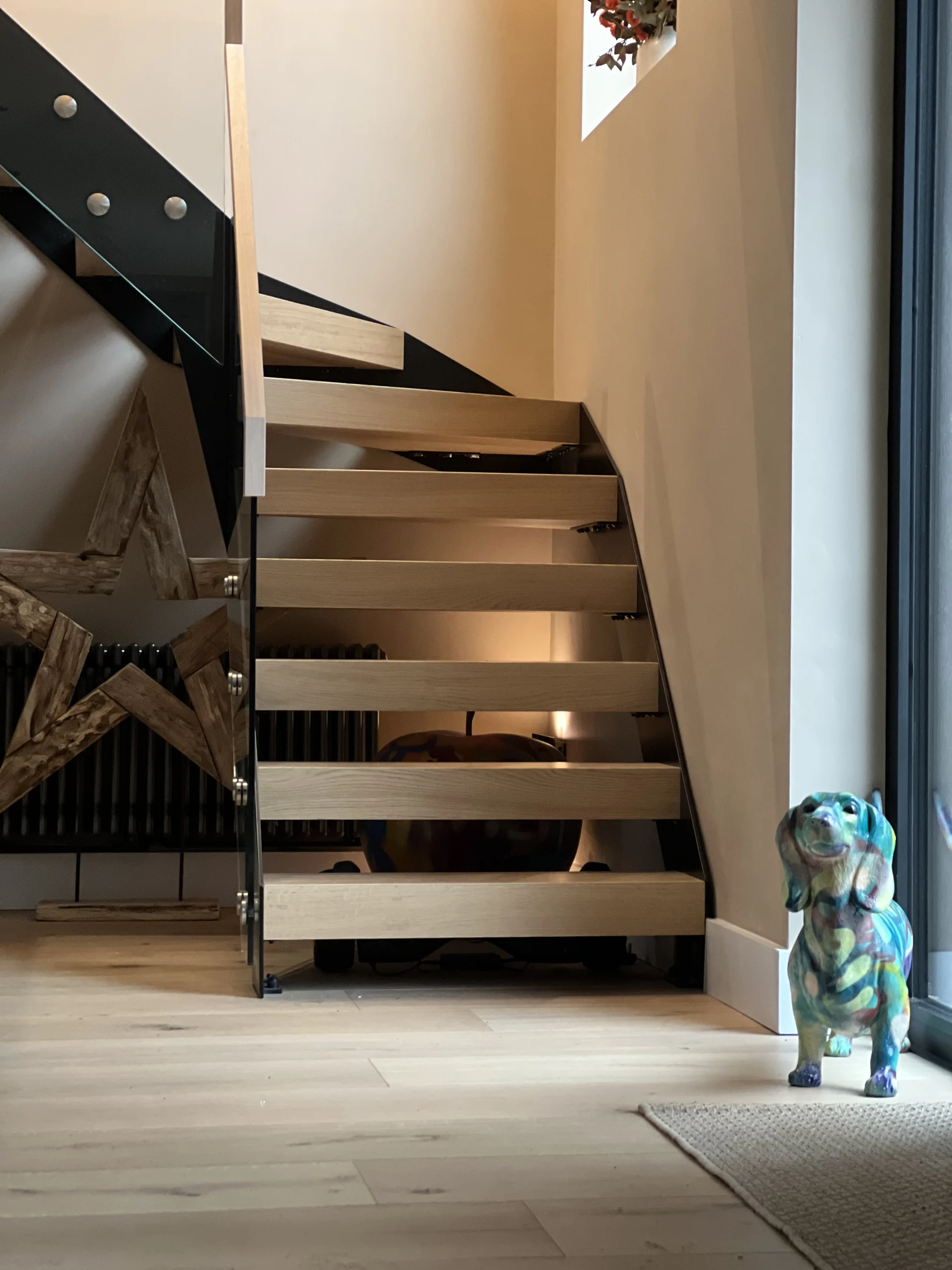
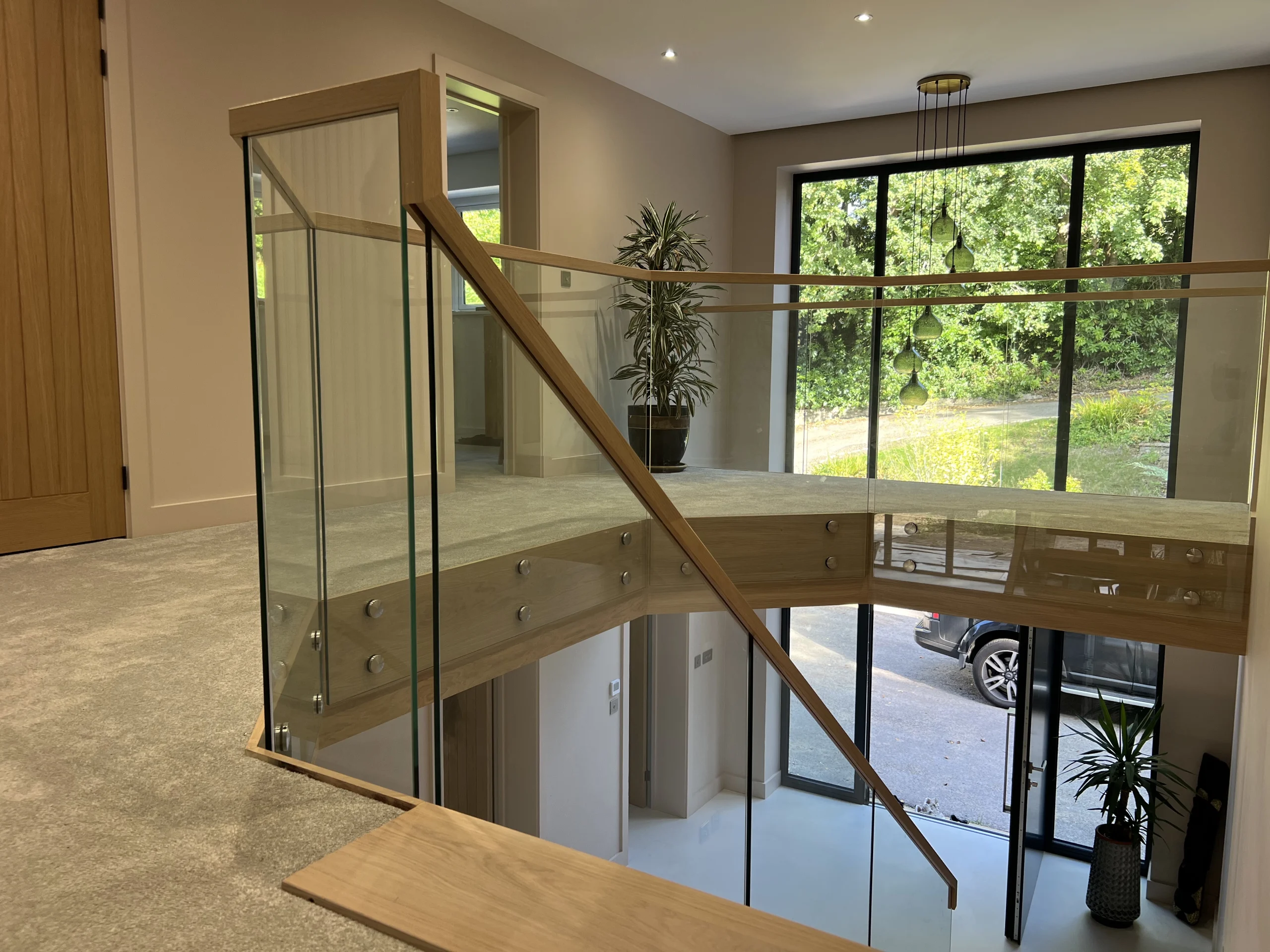
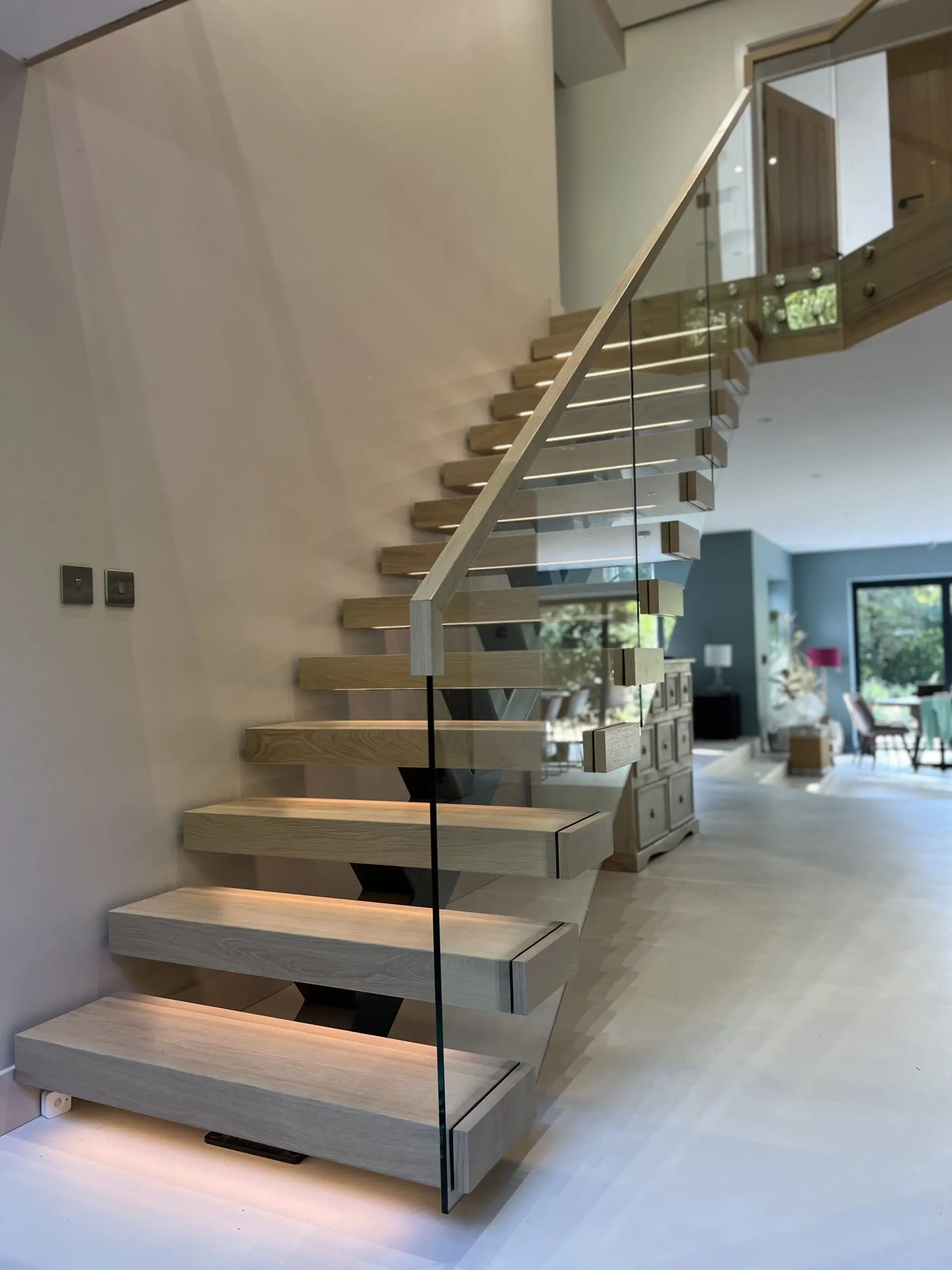
Bespoke contemporary staircase by Continox — designed and installed to full Approved Document K compliance, with structural calculations and CAD drawings provided as standard.
Planning Permission vs Building Regulations: The Key Distinction
These are two entirely separate requirements governed by different legislation, and understanding the difference saves a significant amount of confusion at the start of any staircase project.
Replacing or installing a new internal staircase is classified as an interior renovation and falls under permitted development rights for most domestic properties. You do not need to apply to your local planning authority unless specific exceptions apply (listed buildings, conservation areas, extensions).
Every new staircase installation — regardless of whether planning permission is needed — must comply with Building Regulations under Approved Document K (protection from falling, collision and impact). Building Control notification and inspection is required. This is a legal obligation, not optional.
Why the confusion? Many homeowners assume that because planning permission is not required, no official approval is needed at all. This is incorrect. Building Regulations apply to the safety of the structure — dimensions, headroom, balustrade height, handrail specification — and compliance must be demonstrated to Building Control before and after installation. Failing to notify Building Control can create complications when selling the property.
When Planning Permission Is Required
While most staircase installations do not require planning permission, there are specific circumstances where it does apply. Check each of the following before assuming permitted development rights cover your project.
Listed Buildings
Any change to a listed building — internal or external — requires listed building consent from your local planning authority. This applies to the staircase itself, any structural alterations required to accommodate it, and any changes to existing historic fabric. Consent must be obtained before work begins. Contravening listed building legislation is a criminal offence.
Conservation Areas
Properties in conservation areas may have Article 4 Directions removing permitted development rights for certain works. Internal changes like staircases are generally not affected, but if your staircase project involves any external alterations — new openings, structural changes visible from outside — conservation area consent may be required. Always check with your local planning authority before proceeding.
New Extensions
If your staircase is being installed as part of a new extension — for example, a staircase to access a new storey added to the property — the staircase is included within the planning permission application for the extension itself. The extension requires planning permission; the staircase specification is assessed as part of the Building Regulations application within that project.
Basement Conversions
Creating a new habitable basement typically requires planning permission because it constitutes a material change in the use of the space. The staircase providing access to that basement is assessed as part of the basement conversion application. Some basement projects fall under permitted development — confirm with your local planning authority before committing to design costs.
Loft Conversions
Many loft conversions fall within permitted development rights and do not require planning permission — but the staircase providing access to the loft always requires Building Regulations approval. If the loft conversion itself requires planning permission, the staircase specification will be reviewed as part of that application. Loft staircases have specific reduced headroom provisions under Approved Document K.
Standard Replacement or Refurbishment
Replacing an existing staircase with a new design — even one that is significantly different in appearance, material or structure — does not require planning permission as long as the work is internal and does not affect the external appearance of the building. Building Regulations approval is still required. This covers the vast majority of contemporary staircase projects.
Building Regulations: Approved Document K Requirements
Whether or not planning permission applies, every new staircase in the UK must comply with Approved Document K — Protection from Falling, Collision and Impact. The following table sets out the key dimensional requirements. Note the distinction between private stairs (within a single dwelling) and common stairs (shared access in flats, HMOs and commercial buildings) — the requirements differ.
| Requirement | Private Stair | Common / Utility Stair | Standard |
|---|---|---|---|
| Max Rise (per step) | 220mm | 190mm | Approved Document K |
| Min Going (tread depth) | 220mm | 250mm | Approved Document K |
| Max Pitch | 42° | 38° | Approved Document K |
| 2R + G Formula | 550–700mm | 550–700mm | Approved Document K |
| Min Headroom | 2000mm | 2000mm | Approved Document K |
| Loft Stair Headroom | 1800mm (centre) / 1900mm (sides) | N/A | Approved Document K |
| Handrail Height | 900–1000mm above pitch line | 900–1000mm above pitch line | Approved Document K |
| Handrail Both Sides | If width > 1000mm | If width > 1000mm | Approved Document K |
| Landing Balustrade Height | 900mm (ground floor) / 1100mm (above ground) | 1100mm | Part K / BS 6180 |
| Max Balustrade Opening | 100mm sphere rule | 100mm sphere rule | Approved Document K |
| Open Risers | Permitted if 100mm sphere cannot pass | Not permitted | Approved Document K |
For the complete UK staircase dimension requirements with worked examples and explanatory notes, see our dedicated UK Staircase Building Regulations guide. For glass balustrade specifications and compliance requirements, see our Glass Balustrade Regulations UK guide.
Common error: confusing private and common stair requirements. The rise and going limits for a private staircase within a single dwelling (max rise 220mm, min going 220mm) are less restrictive than those for a common staircase in a flat, HMO or commercial building (max rise 190mm, min going 250mm). Applying private stair dimensions to a shared-access staircase is a non-compliance error that Building Control will flag. All Continox staircases are designed to the correct standard for the building type.
Listed Buildings & Conservation Areas
If your property is listed or located in a conservation area, the regulatory framework is more complex than for a standard domestic property. The following guidance covers the key obligations — but always verify the specific requirements with your local planning authority before committing to a design.
Listed Building Consent
Any alteration to a listed building that affects its character as a building of special architectural or historic interest requires listed building consent — regardless of whether it is internal or external. A new staircase that involves removing, cutting into or altering any historic fabric will require consent. The application is assessed by your local planning authority's conservation officer. Carrying out works without consent is a criminal offence with no time limit on prosecution.
Conservation Areas
Conservation area designation protects the character of an area rather than individual buildings. Internal changes such as replacing a staircase do not typically require conservation area consent. However, if the staircase project involves any external works — new openings, structural changes, alterations affecting the building's external appearance — these require prior approval. Some conservation areas have Article 4 Directions that further restrict permitted development; check with your local authority before proceeding.
Design Requirements for Listed Properties
Even where listed building consent is granted, the conservation officer may place conditions on the design — specifying materials, fixing methods, reversibility, and the degree to which historic fabric may be disturbed. Contemporary steel and glass staircase designs have been approved in listed buildings, but the case must be made carefully. Using a specialist conservation architect alongside your staircase installer is strongly advisable.
Building Regulations Still Apply
Listed building consent and Building Regulations are separate processes. Even where listed building consent is obtained, the staircase must still comply with Approved Document K — or, where strict compliance would harm historic character, a relaxation must be formally agreed with Building Control. Relaxations are possible but must be applied for and documented. Continox provides all structural calculations and CAD drawings required to support either a standard Building Control submission or a relaxation application.
The Building Control Process
Understanding how Building Control works removes uncertainty from the project timeline. For a new staircase installation, the process follows four stages — from notification through to final sign-off.
Building Notice or Full Plans Application
Your architect or building surveyor submits either a Building Notice (simpler, for straightforward works) or a Full Plans application (with drawings and calculations) to your local Building Control authority or an Approved Inspector.
Plans Approval (Full Plans Only)
Where a Full Plans application is submitted, Building Control reviews the drawings and structural calculations and issues formal approval before work begins. This provides certainty that the design complies before any fabrication starts.
Site Inspection
Building Control inspects the installation at key stages — typically at commencement and on completion. The inspector checks that the installed staircase matches the approved drawings and that dimensional compliance has been achieved on site.
Completion Certificate
On satisfactory inspection, Building Control issues a Completion Certificate confirming the work complies with Building Regulations. This document is required when selling the property and should be retained permanently.
Full Plans vs Building Notice: A Full Plans application provides more certainty — the design is approved before fabrication begins, eliminating the risk of a compliance issue being identified after installation. For a bespoke staircase project at the price levels involved, Full Plans is the recommended route. Continox provides the structural calculations and CAD drawings required for a Full Plans submission as part of every project — there is no additional charge for this documentation.
What Continox Provides for Building Control
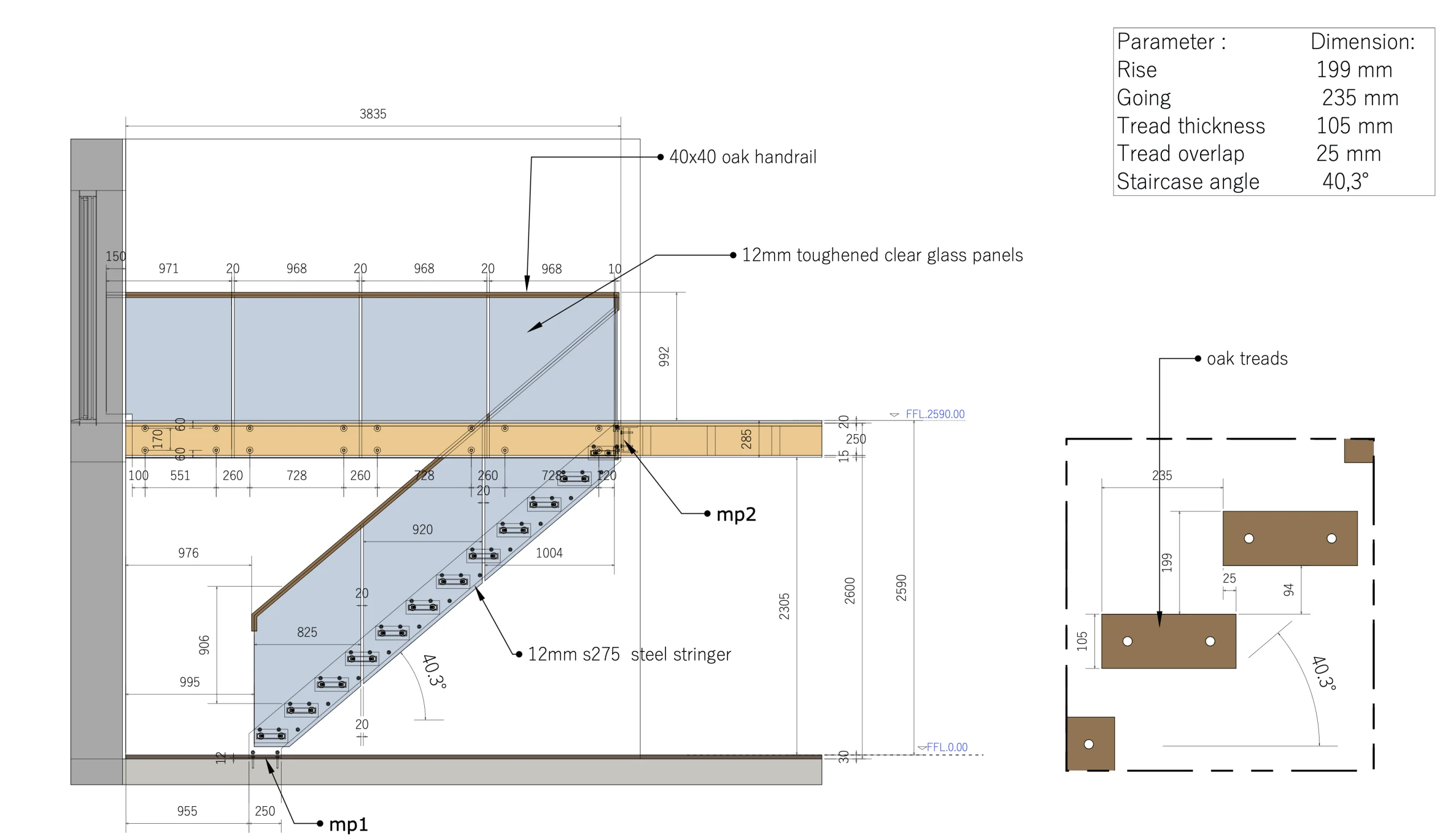
Every Continox bespoke staircase includes the full technical documentation package required to support a Building Control application. This is included in the project price — not charged as an extra — because it is a fundamental part of responsible professional installation.
Structural Calculations
Full structural engineering to BS EN 1090 — demonstrating load compliance, material specification and connection design. Signed by a qualified structural engineer. Required for Full Plans Building Control submissions.
CAD Drawings — PDF & DWG
Detailed as-built CAD drawings showing all dimensions, fixing positions, material specifications and compliance notes. Provided in both PDF and DWG format. Suitable for direct submission to Building Control by your architect or surveyor.
UKCA Marking & Declaration of Performance
All structural steel components carry UKCA marking and a Declaration of Performance under UK Construction Products Regulations. A legal requirement — and increasingly required as evidence of compliance by Building Control surveyors and commercial insurers.
3D Design Visuals
Photorealistic 3D renders of the staircase in your actual space, produced before fabrication begins. Useful for supporting a listed building consent application where the visual impact of the new staircase on the historic interior needs to be demonstrated.
Dimensional Compliance Schedule
A written schedule confirming every Approved Document K dimension — rise, going, pitch, headroom, handrail height, balustrade height, sphere rule — for the specific design. Provides Building Control with a clear compliance reference without requiring line-by-line measurement on site.
Material Specifications
Written specifications for all structural materials — steel grade (S275 or S355 to BS EN 10025), glass specification (BS EN 12150 or BS EN 14449), tread material and finish. Required for Building Control review and retained on file for the life of the building.
Planning Permission & Building Regs — FAQ
Common questions from homeowners and developers about planning permission and Building Regulations for staircases in the UK.
Free Survey, Full Documentation & Fixed-Price Quote
Every Continox staircase includes structural calculations, CAD drawings and UKCA documentation as standard — everything your architect or surveyor needs for Building Control. Free on-site survey, 3D visuals included, fixed price within 24 hours.