

Glass Balustrade Regulations Netherlands: Bbl, NEN 2608, NEN 6707 & EN 12600 Compliance Guide
The complete glass-balustrade specification framework for Dutch projects — Bbl 4.20 (vloerafscheiding), NEN 2608 (constructive safety + doorvalwering), NEN 6707 (fixing and design), NEN 3569 (letselbeperking), EN 14449 laminated, EN 12150 tempered, EN 12600 1B1 impact classification, EN 14179 heat-soak — plus the Continox VSG supply matrix and Noord-Holland coastal-corrosion specification.
Glass balustrades for Dutch staircases must satisfy two parallel safety frameworks: NEN 2608 (constructive safety — the glass must not fail under design load and must prevent fall-through) and NEN 3569 (letselbeperking — if the glass does break, the breakage pattern must not cause serious injury). NEN 2608 is referenced directly by the Bbl; NEN 3569 is convention rather than mandatory but specified in nearly every Dutch bestek. Operationally: Continox supplies tempered laminated VSG (gehard gelaagd glas) per EN 14449 + EN 12150, classified 1B1 per EN 12600 (the highest impact class — large-soft-body 50 kg pendulum at 1200 mm drop without dangerous breakage), with heat-soak treatment per EN 14179 for external installations and elevated balustrades to mitigate nickel sulphide spontaneous breakage. Glass thickness selection runs from VSG 13.52 (residential interior) through VSG 17.52 (most-specified) to VSG 25.52 (heavy-duty publieke functie).
Two Parallel Frameworks: Constructive Safety vs Letselbeperking
The Dutch regulatory approach to glass in balustrades is structured around two parallel frameworks that designers regularly conflate but should treat separately.
Framework 1 · Constructive safety (NEN 2608). This is the question: will the glass safely carry the design loads applied to it without failing? For balustrades the loads are line load (0.8 kN/m woonfunctie, 1.0 kN/m woongebouw, 3.0 kN/m publieke bijeenkomst) plus the 0.5 kN top-rail point load and the doorvalwering scenario where the glass must arrest a falling person. NEN 2608 is the constructive safety standard for flat glass in buildings and is referenced directly by the Bbl as a means of satisfying the regulatory threshold. For balustrades that prevent fall-through (doorvalveilig), NEN 2608 paragraaf 5.1.3(5) governs.
Framework 2 · Letselbeperking (NEN 3569). This is a different question: if the glass does break (impact, accident, fatigue), does the breakage pattern cause serious injury? NEN 3569 classifies vertically placed, line-supported flat glass that is reachable by people (within 0.85 m horizontal distance) and prescribes the impact-resistance class required per EN 12600. NEN 3569 is not directly named by the Bbl as a relevant standard — but it is universally specified in Dutch bestekken because it is the practical methodology for demonstrating compliance with the broad NEN 2608 paragraaf 5.1.3(5) requirement that glass failure must not lead to disproportionate injury.
The practical implication: a Continox glass balustrade specification cites both frameworks. NEN 2608 confirms structural adequacy under design load (the glass thickness, lamination structure and fixing arrangement). NEN 3569 + EN 12600 confirm injury limitation if the glass fails (the impact-resistance class — typically 1B1 for the toughest situations including residential balustrades and publieke functie applications).
Referenced by Bbl. Governs structural adequacy under load (line, point, doorvalwering). Includes paragraaf 5.1.3(5) requirement for proportionate failure.
NEN 3569 — Letselbeperking
Not named by Bbl but universal in bestekken. Governs injury limitation if glass fails. Classifies via NEN-EN 12600 impact test (1B1 / 2B2 / 3B3).
NEN 6707 — Fixing & detailing
Governs fixing methodology: line-supported, point-fixed, clamped, channel-mounted. Covers structural sealant joints and silicone systems for glass balustrades.
How the Bbl Links to Glass Balustrade Specification
The Besluit bouwwerken leefomgeving (Bbl) does not prescribe materials directly — it sets performance requirements that buildings or building components must meet. For glass balustrades the relevant Bbl articles are:
- Bbl 4.20 (vloerafscheiding) — the geometric requirement: balustrade is mandatory where fall > 1.0 m, height ≥ 1000 mm above 1 m fall and ≥ 1200 mm above 13 m drop, climbable-zone rule 200–700 mm no foothold, spijlenafstand ≤ 100 mm.
- Bbl 4.4 + Eurocode — the structural-loading requirement: line loads, point loads, doorvalwering scenarios per EN 1991-1-1 and the Dutch national annex.
- Bbl direct citation — the operational specification standards: NEN 2608 (flat glass in buildings) is named as the route to demonstrating compliance with the structural-glass requirements.
NEN 3569 is not directly cited by the Bbl, which is sometimes raised as a question by Dutch architects new to glass-balustrade specification. The answer is that NEN 2608 paragraaf 5.1.3(5) requires that glass failure must not lead to disproportionate injury — and NEN 3569 is the practical methodology that demonstrates compliance with that requirement. Specifying NEN 3569 in the bestek therefore satisfies a Bbl-derived requirement indirectly. Continox supplies cross-referenced documentation showing both NEN 2608 structural calculation and NEN 3569 risk-class compliance for every project.

NEN 3569 Risk Classes & EN 12600 Impact Classification
NEN 3569 categorises gebruiksfuncties into four risk groups and prescribes a minimum EN 12600 impact-classification for vertical glass that is reachable by people (within 0.85 m). For glass balustrade applications the three most-relevant tiers are summarised in the cards below.
Cat a · Woonfunctie & logies
Single-family residences, apartments, hotel rooms, and ancillary spaces (storage, garages). The most relaxed impact-class minimum, but balustrades that prevent fall-through (doorvalveilig) are uplifted to 1B1 because of the doorvalwering scenario.
- Single-family villa staircases
- Apartment internal balustrades
- Grachtenpand renovations
Cat b · Kantoor / onderwijs / zorg
Offices, schools, hospitals, healthcare facilities, plus the common circulation of woongebouwen and hotels. The 1B1 class is the highest EN 12600 tier and corresponds to laminated tempered safety glass that withstands the 50 kg pendulum at 1200 mm drop without dangerous breakage pattern.
- Apartment building common stairs
- Office building internal balustrades
- Hospital + school stairwells
Cat d · Bijeenkomst / sport
Assembly, sport and visitor-accessible structures. The highest line-load category (3.0 kN/m) drives glass thickness up significantly, and the 1B1 impact class remains mandatory. Heat-soaking per EN 14179 is conventional to mitigate spontaneous breakage in high-throughput environments.
- Theatre & concert hall balustrades
- Sports facility tiered seating
- Convention centre stairwells
The EN 12600 classification system uses a three-character code (e.g. 1B1) that combines impact-resistance class (1, 2, 3 from highest to lowest), breakage type (B = laminated safety, A = tempered toughened) and post-breakage class (1, 2, 3 from least dangerous fragmentation to most). Class 1B1 is the toughest and is the standard Continox specification for Dutch projects regardless of risk tier — supplying to the highest classification eliminates uncertainty across project review.
Drop height 1 (190 mm): Class 3 — minimum impact resistance
Drop height 2 (450 mm): Class 2 — moderate impact resistance
Drop height 3 (1200 mm): Class 1 — highest impact resistance (1B1)
After impact the glass is graded for breakage type:
A: Tempered, fragments into small particles
B: Laminated, glass held by interlayer (no opening > 76 mm)
C: Wired or annealed glass (no longer compliant for new-build NL)
1B1 = highest drop test passed + laminated breakage pattern + lowest danger class.
The Continox VSG Supply Matrix — Thicknesses by Application
VSG (Verbund-Sicherheits-Glas, German nomenclature for laminated safety glass; "gelaagd veiligheidsglas" in Dutch) is supplied with two specification numbers — for example VSG 17.52. The first number is the total glass thickness in millimetres (here, two 8 mm tempered panes); the second is the interlayer thickness in tenths of a millimetre (52 = 1.52 mm PVB or SentryGlas interlayer).
The Continox supply matrix below cross-references VSG specification with application and Bbl gebruiksfunctie. All Continox glass is tempered (gehard) per EN 12150 + laminated per EN 14449, classified 1B1 per EN 12600, with heat-soak treatment per EN 14179 for external and elevated installations.
| VSG Spec | Construction | Application | Typical Use | Heat-soak |
|---|---|---|---|---|
| VSG 13.52 | 2 × 6 mm + 1.52 mm PVB | Interior, residential | Apartment balustrade, woonfunctie line-supported | Optional |
| VSG 15.52 | 2 × 7 mm + 1.52 mm PVB | Interior, residential premium | Villa balustrade, larger spans, woonfunctie | Optional |
| VSG 17.52 | 2 × 8 mm + 1.52 mm PVB | Interior most-specified | Most Continox Dutch projects · woongebouw | Recommended |
| VSG 19.52 | 2 × 9 mm + 1.52 mm PVB | Tall spans, premium villas | Double-height stairwells, atrium balustrades | Recommended |
| VSG 21.52 | 2 × 10 mm + 1.52 mm PVB | External + coastal | External terraces, Bloemendaal & Wassenaar | Mandatory |
| VSG 23.52 | 2 × 11 mm + 1.52 mm PVB | Heavy-duty publieke functie | Office circulation, school, healthcare | Mandatory |
| VSG 25.52 | 2 × 12 mm + 1.52 mm PVB | Assembly, structural glass | Bijeenkomstfunctie, large spans, retail | Mandatory |
Table 1 · Continox VSG supply matrix for Dutch projects. All specifications tempered (EN 12150) + laminated (EN 14449), classified 1B1 (EN 12600). Final thickness selection confirmed by structural calculation per NEN 2608 + NEN 6707 for the specific span, fixing geometry and load case.
Three points worth flagging. First, the SentryGlas interlayer (a stiffer ionoplast alternative to standard PVB) is offered as an upgrade for tall-span balustrades or glass that retains structural integrity post-breakage — relevant for top-end villa atria and certain publieke functie applications. Second, the 1.52 mm interlayer is the Continox standard; 0.76 mm and 1.14 mm are technically available but not specified for balustrades because they reduce post-breakage residual strength. Third, the matrix above shows two tempered panes (gehard) on each side — tempering improves both static strength (by ~4×) and breakage pattern (small dice rather than large shards), and is standard for all Continox balustrade glass.
NEN 6707: Fixing Methods & Structural Detailing
NEN 6707 is the Dutch standard for fixing flat glass — the methodology by which glass attaches to its supporting structure. For balustrades, four fixing types dominate Continox supply across the Dutch market:
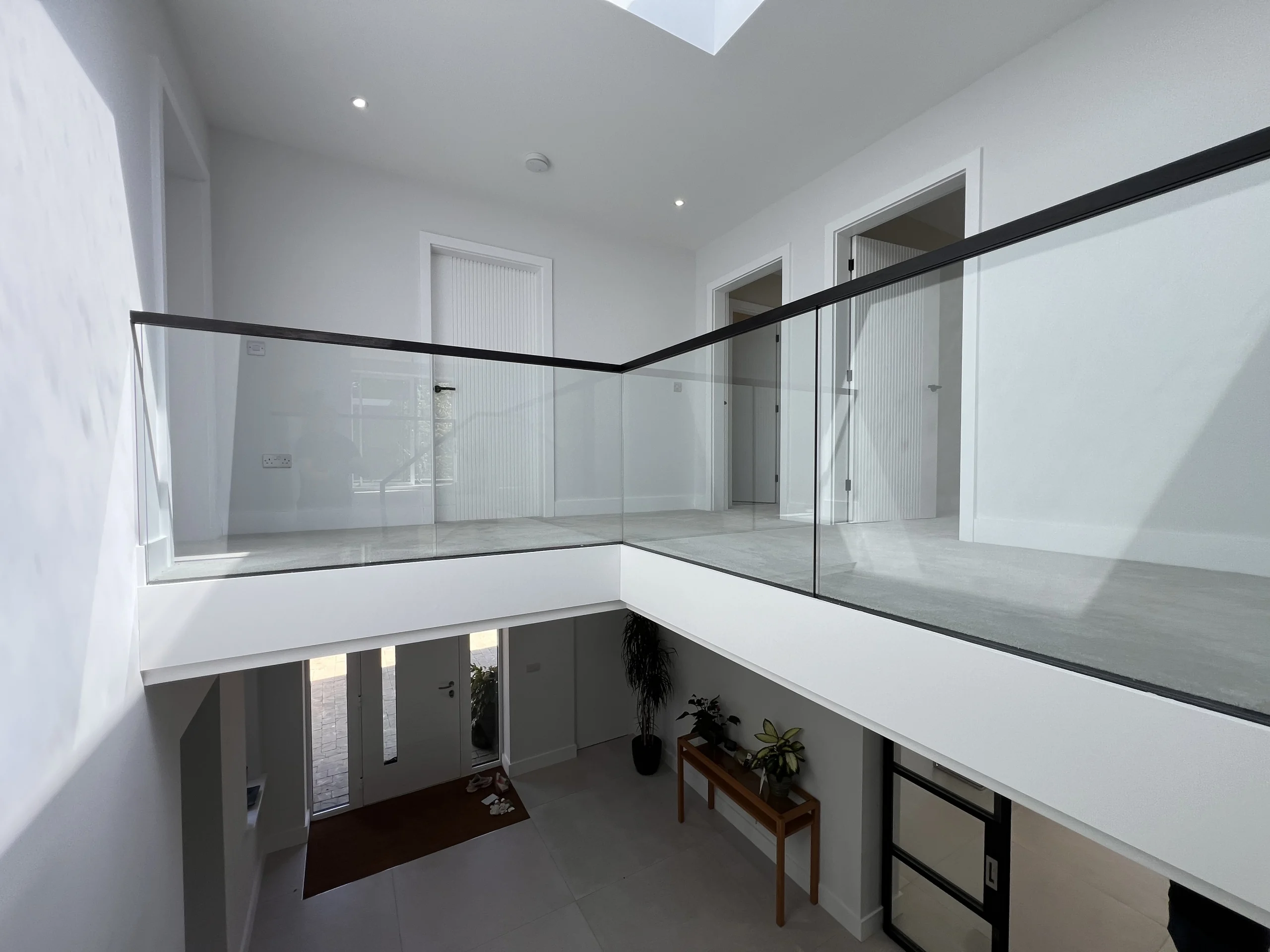
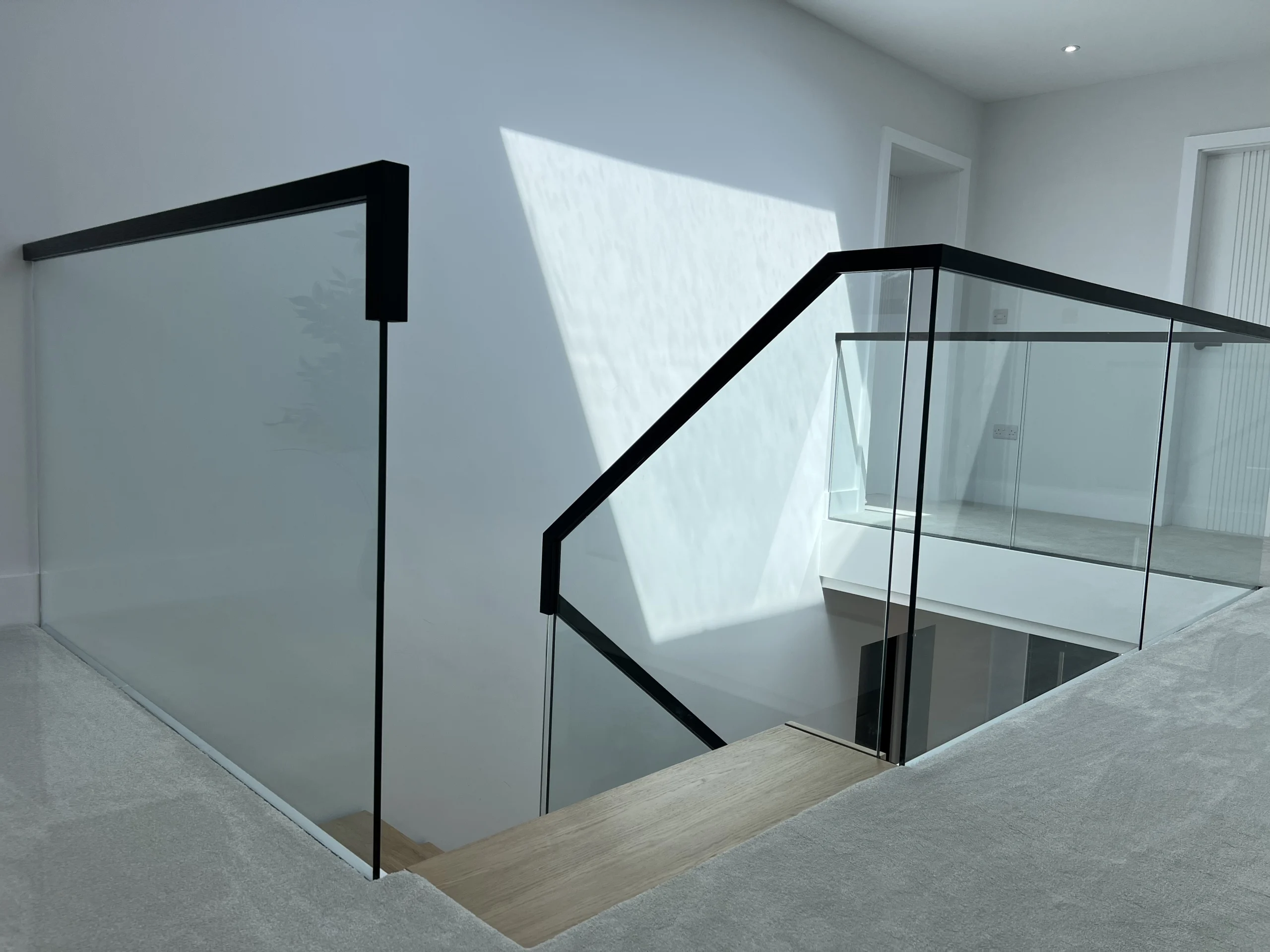
- Channel-mounted (U-profile) — the glass slots into a continuous bottom U-channel mounted to the floor structure or stair stringer. The most-specified Continox configuration; fully concealed at the glass base, integrated handrail at the top.
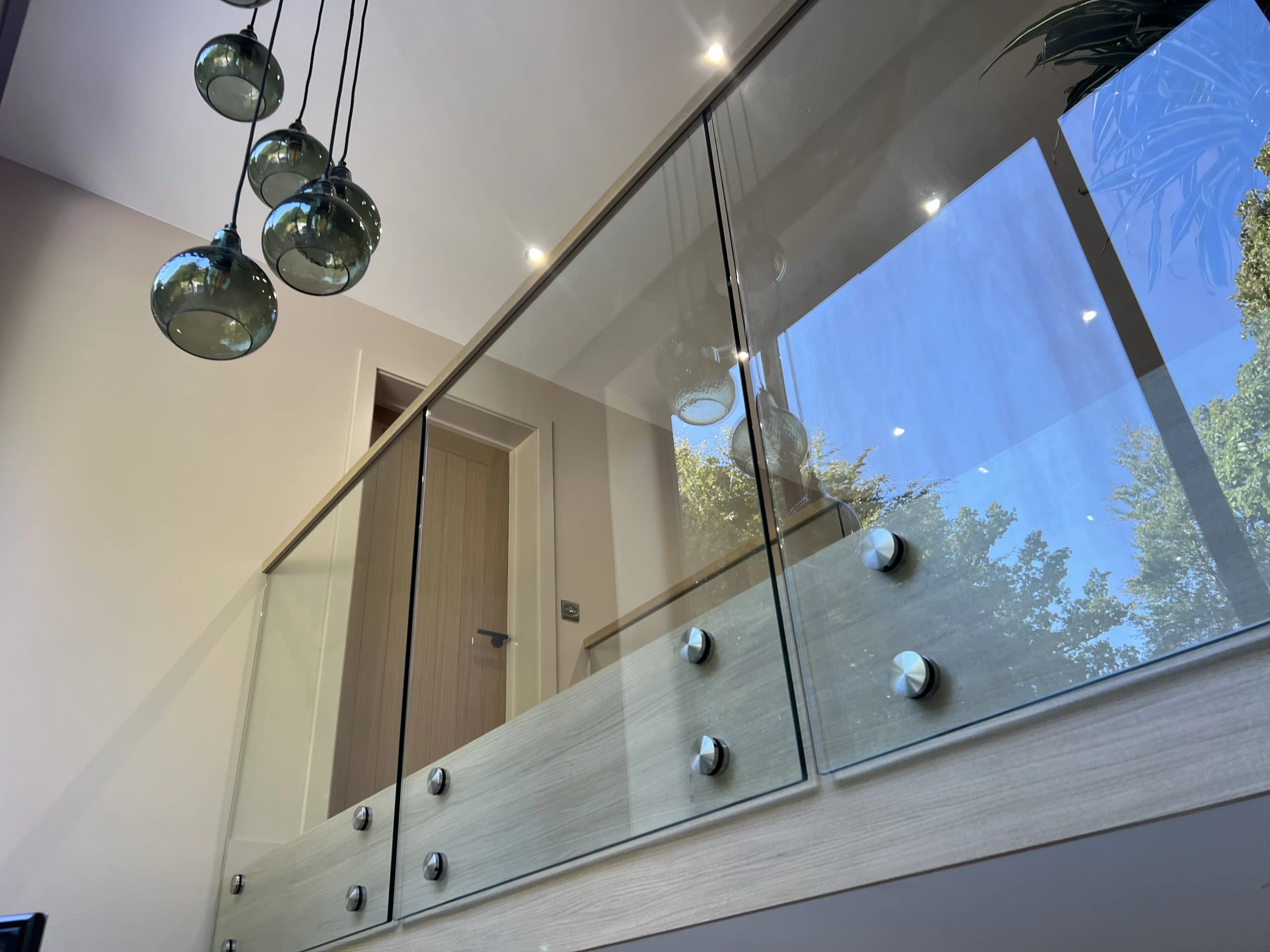
- Point-fixed (round pin) — discrete stainless-steel pins drilled through the glass at corners or along the edge, transferring load into the substrate. Used for taller spans and where the floor edge cannot accommodate a continuous channel.
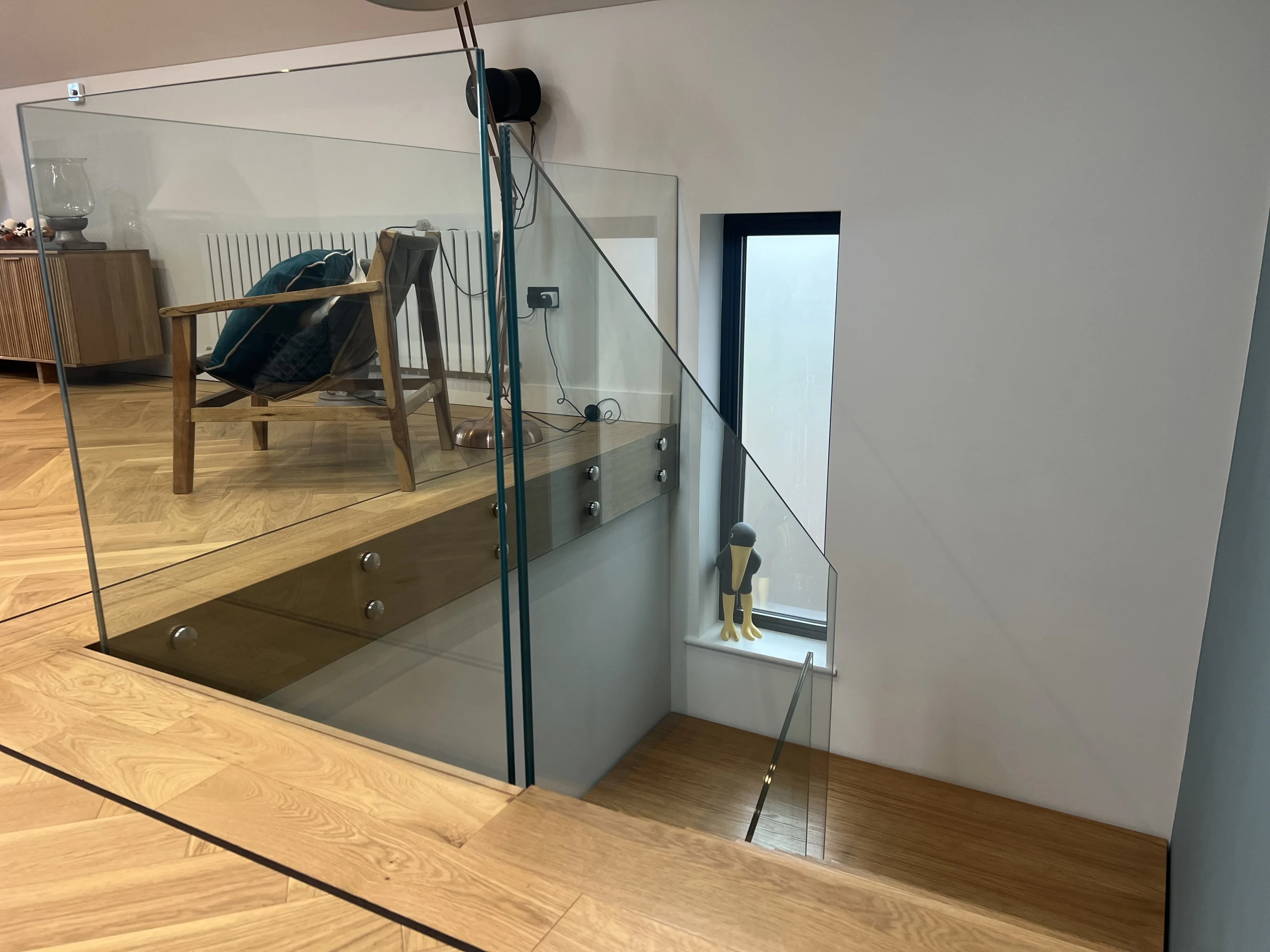
- Clamp-fixed (face-fixed) — clamps fitted to the face of a steel post or stringer, gripping the glass without through-drilling. Common in retrofit scenarios and where the glass edge geometry must be preserved.
- Structural sealant (rare for balustrades) — silicone-bonded glass without mechanical fixing. Specified only where the structural calculation supports it; not Continox standard for balustrade applications because of the post-breakage residual-strength concern.
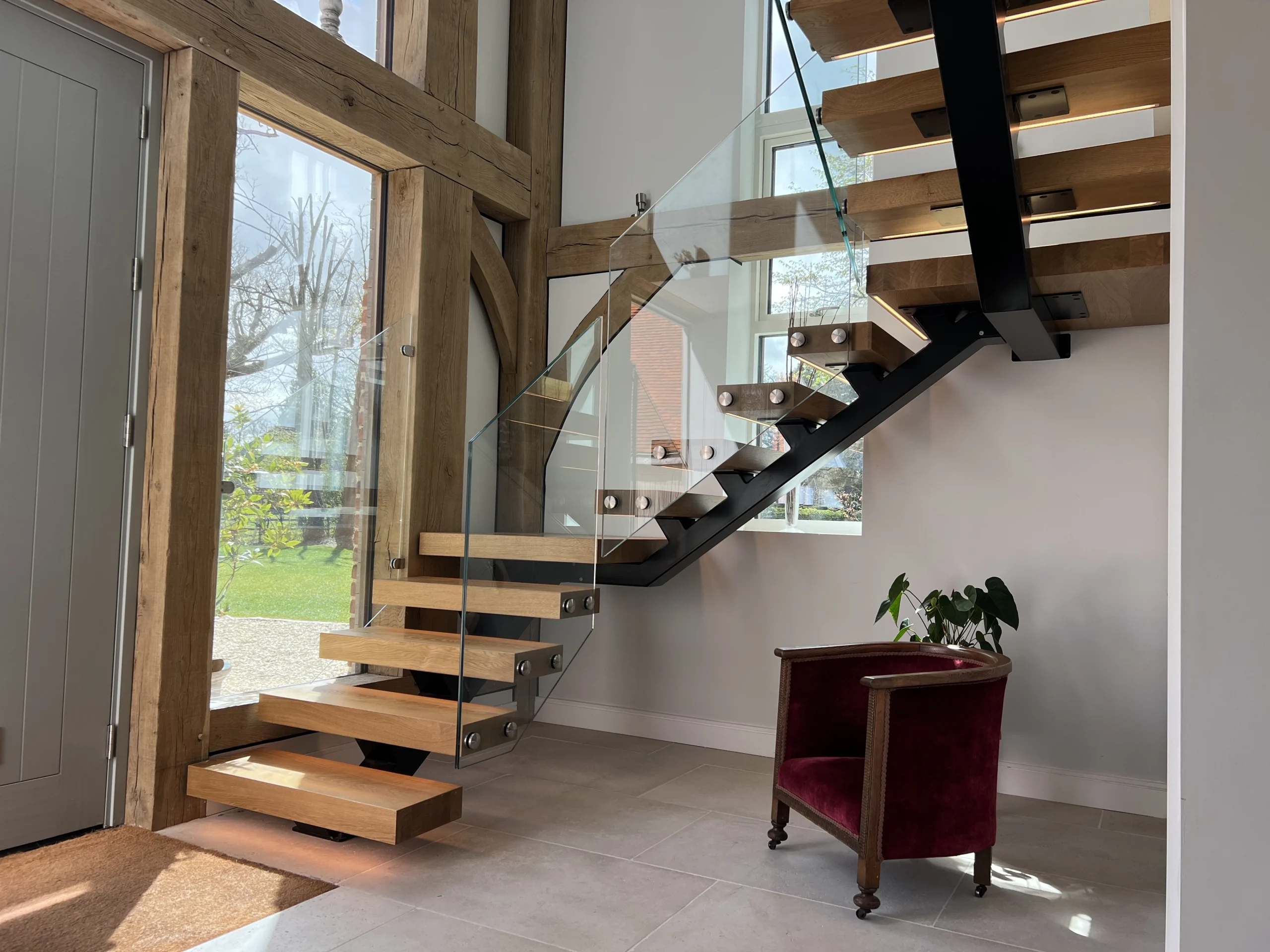
The Continox default for Dutch balustrade projects is the channel-mounted U-profile with integrated oak or steel handrail above. This configuration satisfies Bbl 4.20 (1000 mm height), NEN 2608 (line load 0.8 kN/m through the channel into the floor deck), NEN 6707 (continuous line support), NEN 3569 (1B1 impact class via the laminated tempered glass), and Bbl 4.28 (handrail integrated above with 300 mm horizontal terminus extension).
Coastal-Corrosion Specification: Noord-Holland & Zeeland
The North Sea coastal belt — Bloemendaal, Aerdenhout, Wassenaar, Zandvoort, the Zeeland archipelago — is one of the most aggressive built-environment exposure zones in Europe. Salt aerosol, persistent humidity, prevailing westerly winds and intermittent cold-fog cycles drive accelerated corrosion of steel components and stress nickel-sulphide inclusions in tempered glass. Glass balustrade specification within 10 km of the coast requires three protocol adjustments above the standard inland configuration.
The coastal specification is included in Continox supply automatically for projects within 10 km of the coast — there is no premium upcharge. The same protocol applies to internal balustrades in coastal villas where windows are frequently open and the indoor atmosphere takes on coastal humidity over the summer months — Bloemendaal, Aerdenhout and 't Gooi villa-belt clients overwhelmingly request this specification by default.
Continox Glass Thickness Selector — 5-Step Decision Flow
Selecting the correct VSG thickness for a specific project follows a structured decision flow. The five steps below take a project from gebruiksfunctie classification through to confirmed VSG supply specification.
Identify gebruiksfunctie & line-load category
Woonfunctie residential = 0.8 kN/m, woongebouw common circulation = 1.0 kN/m, publieke / bijeenkomst = 3.0 kN/m. The line load drives glass thickness more than any other parameter.
Determine span and fixing type
Channel-mounted line support spans 1.0–2.0 m in standard configurations. Point-fixed extends to 2.5 m+ with appropriate bracket geometry. Larger spans drive proportionally thicker glass per NEN 2608 calculation.
Apply doorvalwering (fall-through) requirement
For balustrades preventing fall-through, NEN 2608 paragraaf 5.1.3(5) plus NEN 3569 risk-class lift the glass to 1B1 minimum. Continox standard specification is 1B1 for all balustrade applications regardless of fall height.
Check coastal exposure (within 10 km of coast)
Coastal projects step up to VSG 21.52 minimum + heat-soak per EN 14179 + A4 marine stainless fixings + ISO 9227 salt-spray verification. Applies to Bloemendaal, Aerdenhout, Wassenaar, Zandvoort, Zeeland.
Confirm with structural calculation per NEN 2608
Continox supplies the NEN 2608 + NEN 6707 cross-referenced calculation for the specific span, fixing geometry and load case. Thickness sometimes uplifted from the matrix baseline if local geometry imposes higher bending moments. Final spec confirmed before fabrication.
Common Specification Errors at Wkb Review
The Wet Kwaliteitsborging voor het bouwen (Wkb) review process — the post-2024 successor to the gemeentelijk bouwtoezicht for many project categories — checks glass-balustrade specification against Bbl, NEN 2608 and the cited NEN 3569 class. Five errors are flagged with disproportionate frequency at review, each easy to avoid if the bestek is structured correctly from the outset.
Error 2: Tempered monolithic glass without lamination. Tempered glass alone passes the impact test (small fragments) but does not satisfy doorvalwering — once broken, the entire pane drops out, defeating the fall-through prevention. NEN 2608 for balustrades requires laminated.
Error 3: Heat-soak omitted for elevated or external installations. Spontaneous breakage from nickel sulphide inclusions occurs in service, often years post-installation. EN 14179 heat-soak is the standard mitigation; coastal projects mandatory, elevated balustrades strongly recommended.
Error 4: Fixing detail not cross-referenced to NEN 6707. Listing "frameless glass balustrade" without specifying channel / point-fix / clamp methodology and the NEN 6707 alignment. Wkb review will request the structural detail; better to include from the bestek.
Error 5: Top rail / handrail integration not specified. The 0.5 kN top-rail point load (Bbl 4.20) and the 1.0 kN leuning point load (Bbl 4.28) are different load cases. Specify both; ensure the top-rail or integrated handrail can transfer both into the glass and through the channel/fixing into structure.
For the underlying Bbl framework (articles 4.20 + 4.28 + classification + structural loading), see Dutch Staircase Regulations: Bbl + NEN 3509 (NL01).
Frequently Asked Questions
What thickness of glass is required for a Dutch balustrade?
For a typical Dutch interior residential balustrade with channel-mounted fixing and 1.0–1.5 m span, the Continox standard specification is VSG 17.52 (2 × 8 mm tempered laminated + 1.52 mm PVB interlayer), classified 1B1 per EN 12600. Larger spans, taller spans, woongebouw common circulation or publieke functie applications step up through VSG 19.52, VSG 21.52 and VSG 23.52. Coastal projects within 10 km of the North Sea step up to VSG 21.52 minimum with mandatory heat-soak per EN 14179 and A4 marine stainless fixings.
Final thickness is confirmed by structural calculation per NEN 2608 + NEN 6707 for the specific span, fixing geometry and load case — Continox supplies this calculation as standard with every Dutch project quotation.
Is NEN 3569 mandatory under the Bbl?
Strictly, no — NEN 3569 is not directly named by the Bbl as a relevant standard. However, NEN 2608 (which IS directly named by the Bbl) includes paragraaf 5.1.3(5), which requires that flat glass failure must not lead to disproportionate injury. NEN 3569 is the practical methodology that demonstrates compliance with that requirement, and is therefore universally specified in Dutch bestekken.
The practical answer: specify NEN 3569 in your bestek, even though the Bbl does not literally cite it. Continox supplies cross-referenced documentation showing both NEN 2608 structural calculation and NEN 3569 risk-class compliance for every project — eliminating the question at Wkb review.
What does EN 12600 class 1B1 mean?
EN 12600 is the European pendulum-impact test for glass. The 1B1 classification has three components: 1 = highest drop-height class (50 kg twin-tyre pendulum from 1200 mm without dangerous breakage); B = laminated glass breakage pattern (glass held by interlayer, no opening greater than 76 mm); 1 = lowest danger class for post-breakage fragmentation. It is the highest specification in the standard and is the Continox default for Dutch balustrade applications.
Why is heat-soak treatment recommended for coastal projects?
Tempered glass contains microscopic nickel sulphide inclusions that under thermal cycling can transform from one crystalline phase to another, expanding by approximately 4% and causing spontaneous breakage in service — often years after installation. The heat-soak test per EN 14179 holds the glass at 290°C for 2 hours under controlled conditions, accelerating the phase transformation and identifying compromised panes before installation. Heat-soaking dramatically reduces (though does not eliminate) the spontaneous-breakage risk.
For coastal projects within 10 km of the North Sea — Bloemendaal, Aerdenhout, Wassenaar, Zeeland — Continox makes heat-soak mandatory. The combination of persistent thermal cycling, salt aerosol and onshore wind makes the spontaneous-breakage risk unacceptable. Inland projects with elevated balustrades or large glass areas have heat-soak strongly recommended; smaller residential interior balustrades may proceed without it.
What is the difference between doorvalwering and letselbeperking?
These are the two parallel safety frameworks for glass in Dutch construction. Doorvalwering (fall-through prevention) is governed by NEN 2608 paragraaf 5.1.3(5) and is referenced directly by the Bbl — it asks: will the glass arrest a falling person without breaking through? Letselbeperking (injury limitation) is governed by NEN 3569 and is convention rather than mandatory citation in the Bbl — it asks: if the glass breaks for any reason, does the breakage pattern cause serious injury?
For balustrade specification both frameworks apply simultaneously. Continox supplies tempered laminated VSG that satisfies both — the glass is structurally adequate to prevent fall-through (NEN 2608) AND the breakage pattern (1B1 per EN 12600) prevents injury if the glass does fail (NEN 3569).
Do I need a structural calculation for every glass balustrade?
Yes — every glass balustrade installation in a Dutch new-build or significant verbouw project requires a structural calculation per NEN 2608 demonstrating that the specified glass thickness, lamination, fixing methodology and span will safely carry the design loads (line load 0.8 kN/m woonfunctie, 1.0 kN/m woongebouw, or 3.0 kN/m publieke; plus the 0.5 kN top-rail point load and the doorvalwering scenario).
Continox supplies the NEN 2608 + NEN 6707 cross-referenced calculation as standard with every Dutch project quotation. The calculation forms part of the Omgevingsvergunning dossier where applicable, and is the technical evidence the Wkb-erkend kwaliteitsborger relies on at review.