

Dutch Staircase Regulations: Bbl + NEN 3509 Compliance Guide for Architects, Constructeurs & Developers
The complete framework for designing modern staircases in the Netherlands — Bbl articles 4.20 (vloerafscheiding) and 4.24–4.28 (trap), NEN 3509 residential dimensions, classification across woonfunctie / woongebouw / publieke functie, plus the rechtens-verkregen-niveau principle that governs every grachtenpand renovation. Note: the former Bouwbesluit was replaced by the Besluit bouwwerken leefomgeving (Bbl) on 1 January 2024.
Dutch staircase design for nieuwbouw follows the Besluit bouwwerken leefomgeving (Bbl) hoofdstuk 4 — minimum aantrede 220 mm, maximum optrede 188 mm, klimlijn ratio not steeper than 2:3, helling 37°–45°, doorloophoogte minimum 2300 mm, balustrade 1000 mm above 1 m fall (1200 mm above 13 m drop), leuning 800–1000 mm above tread on both sides for residential new-build, spijlenafstand maximum 100 mm. Verbouw projects (including grachtenpand renovations) are governed by the rechtens-verkregen-niveau principle — typically the existing or the bestaande-bouw threshold, whichever is higher. NEN 3509 is the operational dimension standard for residential staircases; NEN 6707/3569 govern glass balustrades.
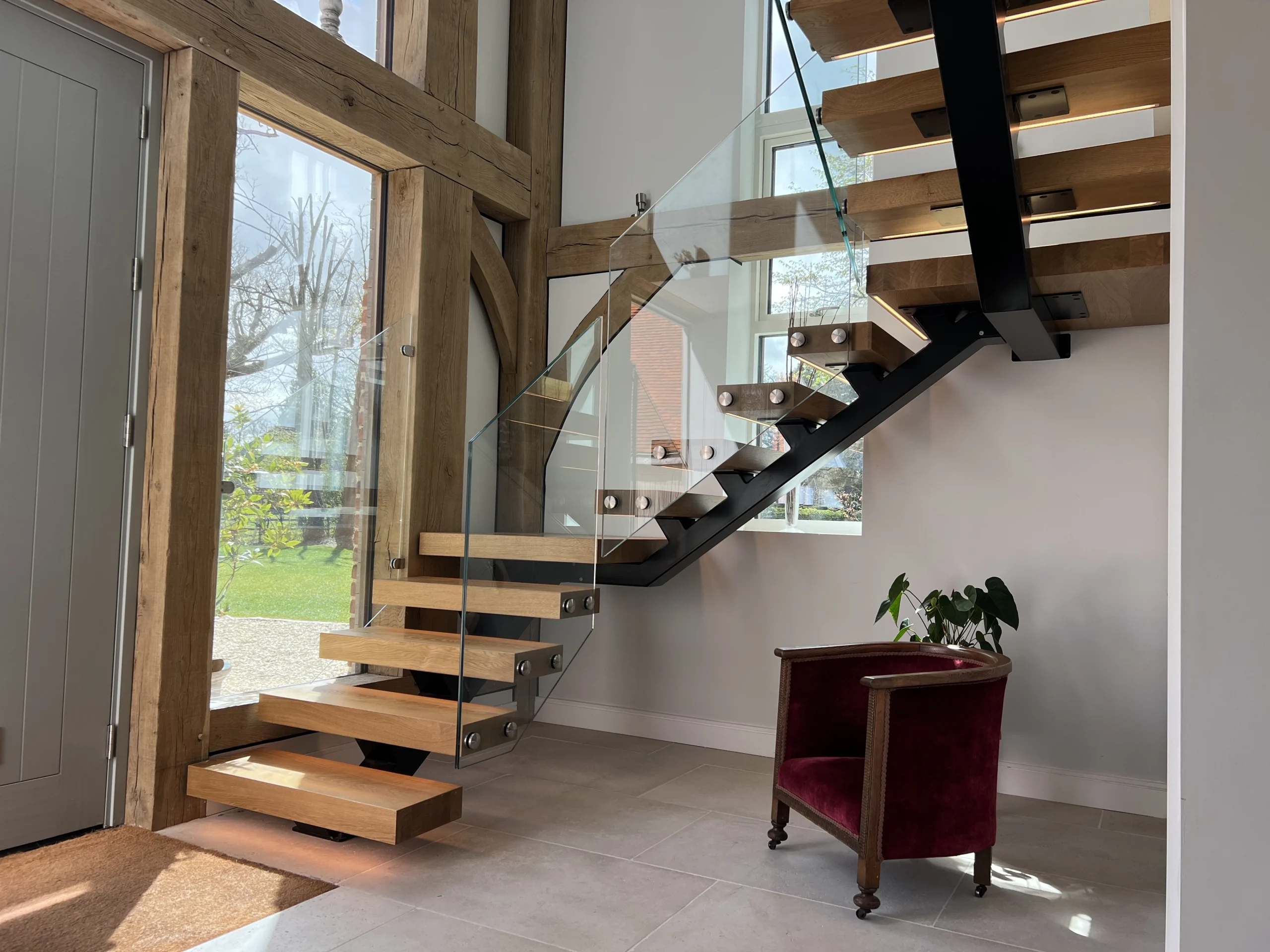
The Bbl Framework — From Bouwbesluit to Besluit bouwwerken leefomgeving
On 1 January 2024 the Dutch building regulation landscape changed materially. The Bouwbesluit 2012 — the regulation that had governed staircase design, balustrades, fire safety and building physics for over a decade — was replaced as part of the broader Omgevingswet reform by the Besluit bouwwerken leefomgeving (Bbl). For staircase specification this is more than a name change: the chapter structure was reorganised, article numbers renumbered, and the relationship between national rules and municipal omgevingsplan was redrawn.
The Bbl is structured around four operative chapters that determine which rules apply to a given project:
- Hoofdstuk 3 · Bestaande bouw — minimum standards that any existing building must continue to meet
- Hoofdstuk 4 · Nieuwbouw — full new-build standards including the staircase, balustrade and leuning rules in afdelingen 4.2.3 (afscheiding aan een rand van een vloer, trap of hellingbaan) and 4.2.4 (veilig overbruggen van hoogteverschillen)
- Hoofdstuk 5 · Verbouw, verplaatsing en gebruiksfunctiewijziging — the rules for renovations and conversions, governed by the rechtens-verkregen-niveau principle
- Hoofdstuk 6 · Gebruik van bouwwerken — operational rules applying after completion
For staircase specification, the practical workflow runs as follows. Identify whether the project is nieuwbouw (full new construction or rebuild from foundation), verbouw (renovation, extension, conversion) or applies only to a bestaande bouwwerk. Then identify the gebruiksfunctie (use class — see Section 02). The two together determine which articles apply and at what threshold values.
Two further frameworks intersect with the Bbl in everyday practice. The NEN-EN harmonised standards — particularly NEN 3509 for residential staircase dimensions, NEN 6707 for glass balustrade fixing and NEN 3569 for glass safety classification — are the operational specification standards that designers reference once Bbl thresholds are met. And the municipal omgevingsplan (the post-2024 successor to the bestemmingsplan) can introduce maatwerkvoorschriften that vary or supplement Bbl rules in specific neighbourhoods or for protected monuments. For grachtenpand renovations along the Amsterdam canal ring this matters significantly — a topic we return to in Section 07.
Legal basis: Omgevingswet + Besluit bouwwerken leefomgeving
Nieuwbouw chapter: Hoofdstuk 4 (afdelingen 4.2.3 + 4.2.4)
Bestaande bouw chapter: Hoofdstuk 3
Verbouw chapter: Hoofdstuk 5 (rechtens verkregen niveau)
Operational standards: NEN 3509 (stairs), NEN 6707 (glass fixing), NEN 3569 (glass safety)
Three-Tier Classification: Woonfunctie, Woongebouw, Publieke Functie
The Bbl uses gebruiksfuncties (use classes) to determine which threshold values apply. For staircase design the three classifications that matter most are:
- Woonfunctie — a residence (single-family home, apartment, villa). The most relaxed dimensional thresholds and the most common scenario for bespoke staircase projects. NEN 3509 references this class directly.
- Woongebouw — multi-family or apartment building common circulation (the staircase serving multiple woonfuncties). Slightly stricter width and balustrade rules because the staircase is shared.
- Publieke functie — bijeenkomstfunctie (assembly), winkelfunctie (retail), kantoorfunctie (office), gezondheidszorgfunctie (healthcare), onderwijsfunctie (education) and similar. The strictest dimensional, balustrade and structural-loading rules.
The classification table below summarises the principal staircase-relevant thresholds across the three tiers for nieuwbouw projects under hoofdstuk 4. Values below should be cross-checked against the current Bbl text for any specific project; this table reflects the standard residential and common-circulation positions.
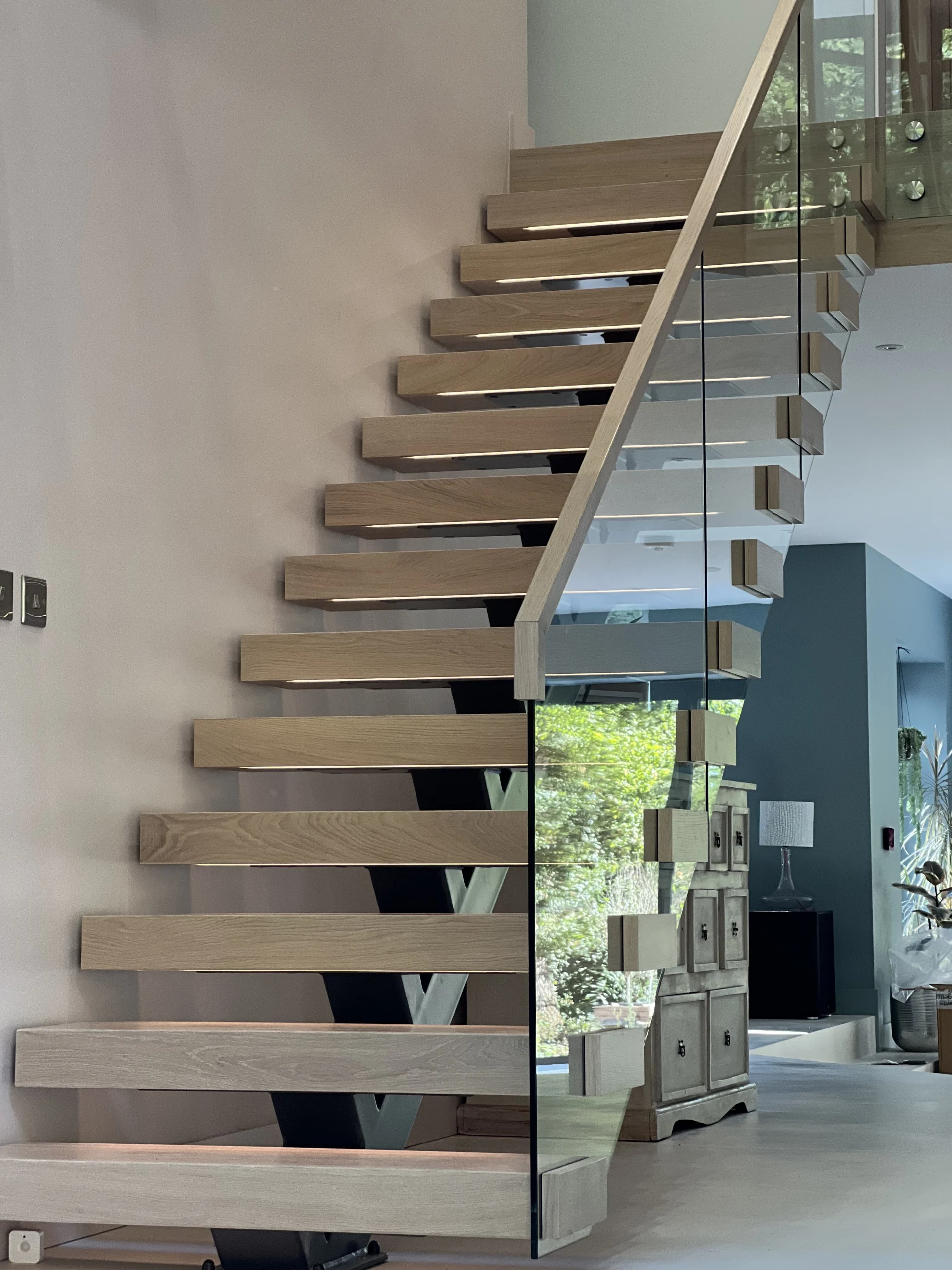
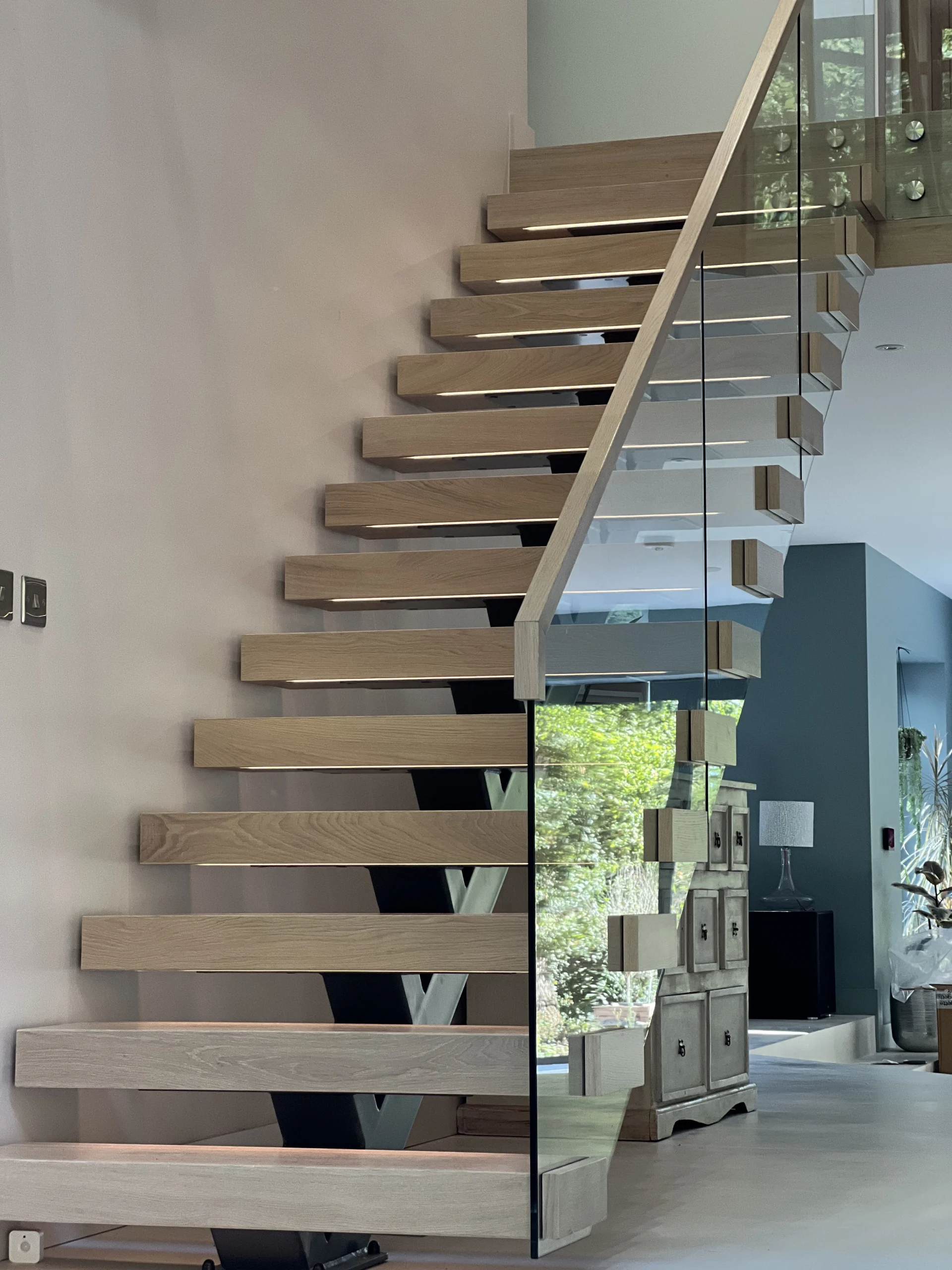
| Parameter | Woonfunctie (residential) | Woongebouw (common circ.) | Publieke functie |
|---|---|---|---|
| Aantrede minimum | 220 mm | 220 mm | 240 mm |
| Optrede maximum | 188 mm | 188 mm | 185 mm |
| Klimlijn ratio max | 2:3 (≈ 33.7°) | 2:3 | 2:3 stricter applied |
| Helling typical | 37°–45° advisory | 37°–42° | 30°–37° preferred |
| Trap breedte minimum | 800 mm | 1000–1100 mm | 1100–1200 mm+ |
| Doorloophoogte (headroom) | 2300 mm | 2300 mm | 2300 mm |
| Balustrade above 1 m fall | 1000 mm | 1000 mm | 1000 mm |
| Balustrade above 13 m drop | 1200 mm | 1200 mm | 1200 mm |
| Balustrade variable load | 0.8 kN/m | 1.0 kN/m | 3.0 kN/m (assembly) |
| Spijlenafstand maximum | 100 mm | 100 mm | 100 mm |
| Leuning required | One side (both for new-build) | Both sides | Both sides |
Table 1 · Bbl hoofdstuk 4 staircase thresholds by gebruiksfunctie. Dimensions reference the standard residential and common-circulation interpretation; verify specific values against the live Bbl text for any project.
Three points stand out for designers transitioning from Bouwbesluit familiarity. First, the Bbl preserves most of the dimensional thresholds the Bouwbesluit established — minimum aantrede 220 mm, maximum optrede 188 mm and the 2:3 klimlijn ratio remain the residential anchor values. Second, the article numbering changed: where the Bouwbesluit cited specific articles for dimensions and balustrades, the Bbl reorganises these into afdelingen 4.2.3 and 4.2.4 with new article numbers (4.20 onward for vloerafscheiding, 4.24–4.28 for trap requirements). Third, the rechtens-verkregen-niveau principle that applies to verbouw projects has been clarified — see Section 07.
Staircase Dimensions: Aantrede, Optrede, Klimlijn, Helling
The four parameters that govern the geometric design of a Dutch residential staircase are aantrede (going / tread depth), optrede (rise), the klimlijn (climb-line ratio between rise and going), and the resulting helling (overall pitch angle). The table below sets out the operational values for woonfunctie nieuwbouw projects under Bbl hoofdstuk 4.
| Geometric parameter | Bbl woonfunctie value | Practical implication |
|---|---|---|
| Aantrede (tread depth at klimlijn) | ≥ 220 mm | The tread depth measured at the klimlijn — typically 30 cm from the inner stringer for straight flights, or along the walking arc for winders. |
| Optrede (riser height) | ≤ 188 mm | Maximum vertical rise per step. For a typical 2700 mm floor-to-floor height this gives 15 risers minimum at maximum optrede. |
| Klimlijn ratio (optrede : aantrede) | ≤ 2:3 | The ratio cannot be steeper than 2 vertical to 3 horizontal — for example 188:282 satisfies, but 188:265 violates. Test: 2 × optrede + aantrede should sit within the comfort band. |
| Helling (pitch angle) | 37°–45° advisory | Below 37° the staircase consumes excessive floor area; above 45° comfort drops sharply. The 2:3 klimlijn ratio gives ≈ 33.7° as the maximum allowed pitch. |
| Doorloophoogte (headroom) | ≥ 2300 mm | Vertical clearance measured from the leading edge of any tread to the underside of any obstruction above. Critical in grachtenpand renovations where existing floor structures often constrain headroom severely. |
| Trap breedte (clear width) | ≥ 800 mm woonfunctie | The clear walking width — measured between the inside face of the leuning on each side, or between leuning and wall. Trap breedte excludes the leuning itself. |
| Trapneus (tread nose) | Visible / non-tripping | Bbl requires the leading edge of each tread to be clearly identifiable. Open-tread configurations need explicit visual differentiation; carpeted treads need contrast at the nose. |
Table 2 · Geometric design parameters for residential nieuwbouw staircases under Bbl hoofdstuk 4 + NEN 3509.
For a worked example: a typical Dutch new-build apartment with floor-to-floor height of 2700 mm and 16 risers achieves an optrede of 168.75 mm. Pairing with an aantrede of 230 mm gives a klimlijn ratio of 168.75:230 ≈ 0.73, comfortably below the 2:3 (≈ 0.67) maximum. The resulting helling is approximately 36.3°, sitting at the low end of the advisory comfort band.
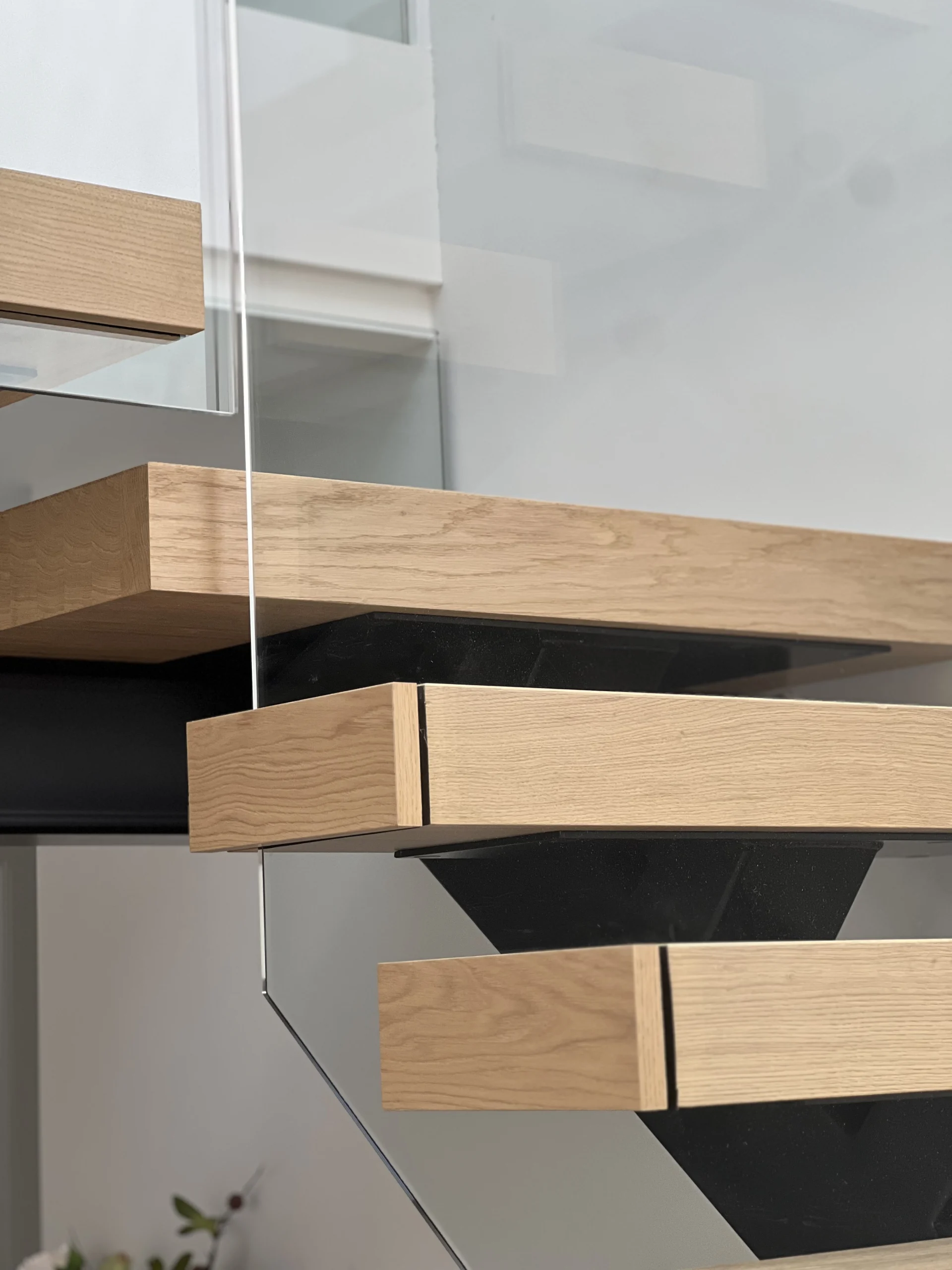
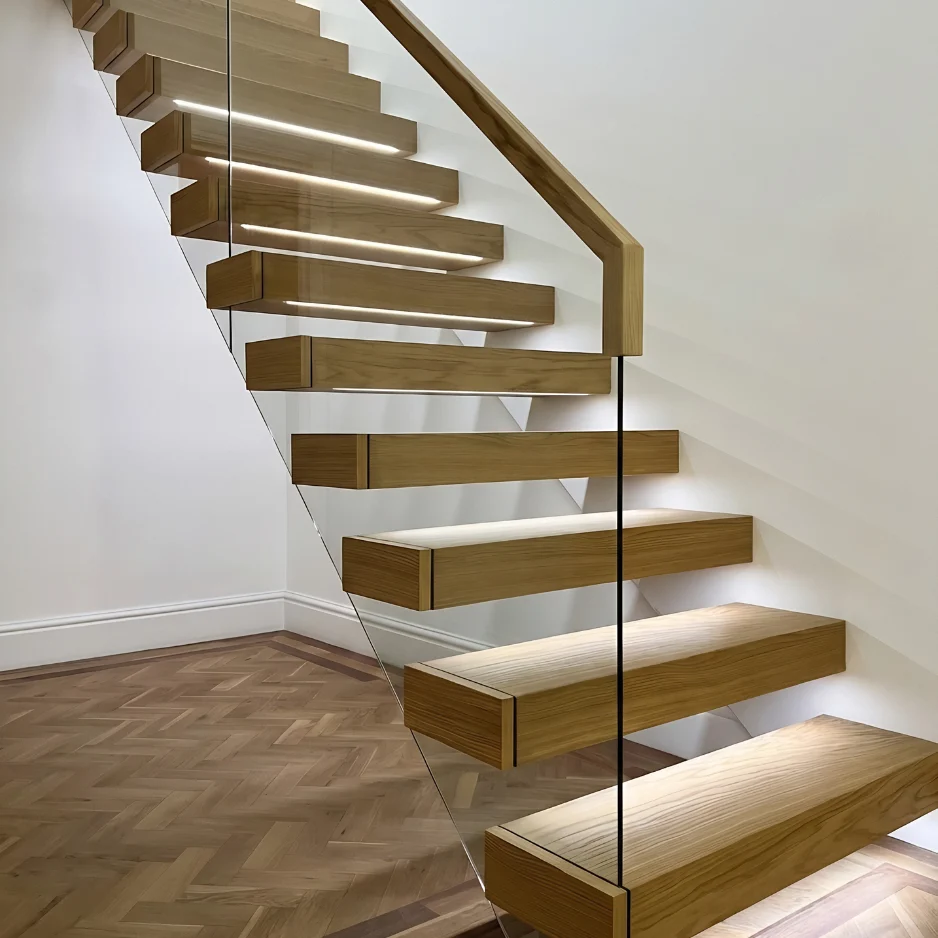
Where Continox configurations interact with these dimensions: the Central Spine tier (from €9,999) accommodates aantrede 230–280 mm, optrede 165–185 mm and trap breedte 900–1100 mm — sitting well within Bbl woonfunctie limits and NEN 3509 advisory zones. The compact L-Shape Steel Plates tier (from €8,999) is engineered for stairwells where the footprint constrains the geometry; we typically design at 220 mm aantrede / 185 mm optrede to maximise the effective walking surface within tight grachtenpand floor plans.
For glass balustrade specification — laminated thicknesses, NEN 3569 risk classification, Continox VSG supply matrix — see Glass Balustrade Regulations Netherlands (NL02).
Vloerafscheiding (Balustrade) — Article 4.20 Heights & Geometry
Article 4.20 of the Bbl establishes the vloerafscheiding (floor edge protection / balustrade) requirement for any nieuwbouw structure where a floor or staircase side sits more than 1 m above adjacent floor, terrain or water. The article defines minimum heights, geometric constraints to prevent climbability, and opening dimensions to prevent fall-through.
| Balustrade parameter | Nieuwbouw (Bbl 4.20) | Bestaande bouw (Bbl 3.x) |
|---|---|---|
| Threshold for balustrade | Fall > 1.0 m | Fall > 1.5 m |
| Floor balustrade — standard height | 1000 mm | 900 mm |
| Floor balustrade — above 13 m drop | 1200 mm | 900 mm (no exception) |
| Trap balustrade — above tread | 850 mm | 600 mm |
| Climbable zone (no foothold) | 200 mm to 700 mm above floor | Not applied for existing |
| Spijlenafstand (vertical gap) | ≤ 100 mm | ≤ 100 mm if < 12 yr children |
| Lower zone gap (0–700 mm) | ≤ 100 mm | Same |
| Maximum offset from floor edge | 50 mm | 100 mm |
| Top rail interruptions | ≤ 100 mm continuous | Not specified |
Table 3 · Balustrade heights and geometric constraints under Bbl hoofdstuk 4 (nieuwbouw) versus hoofdstuk 3 (bestaande bouw).
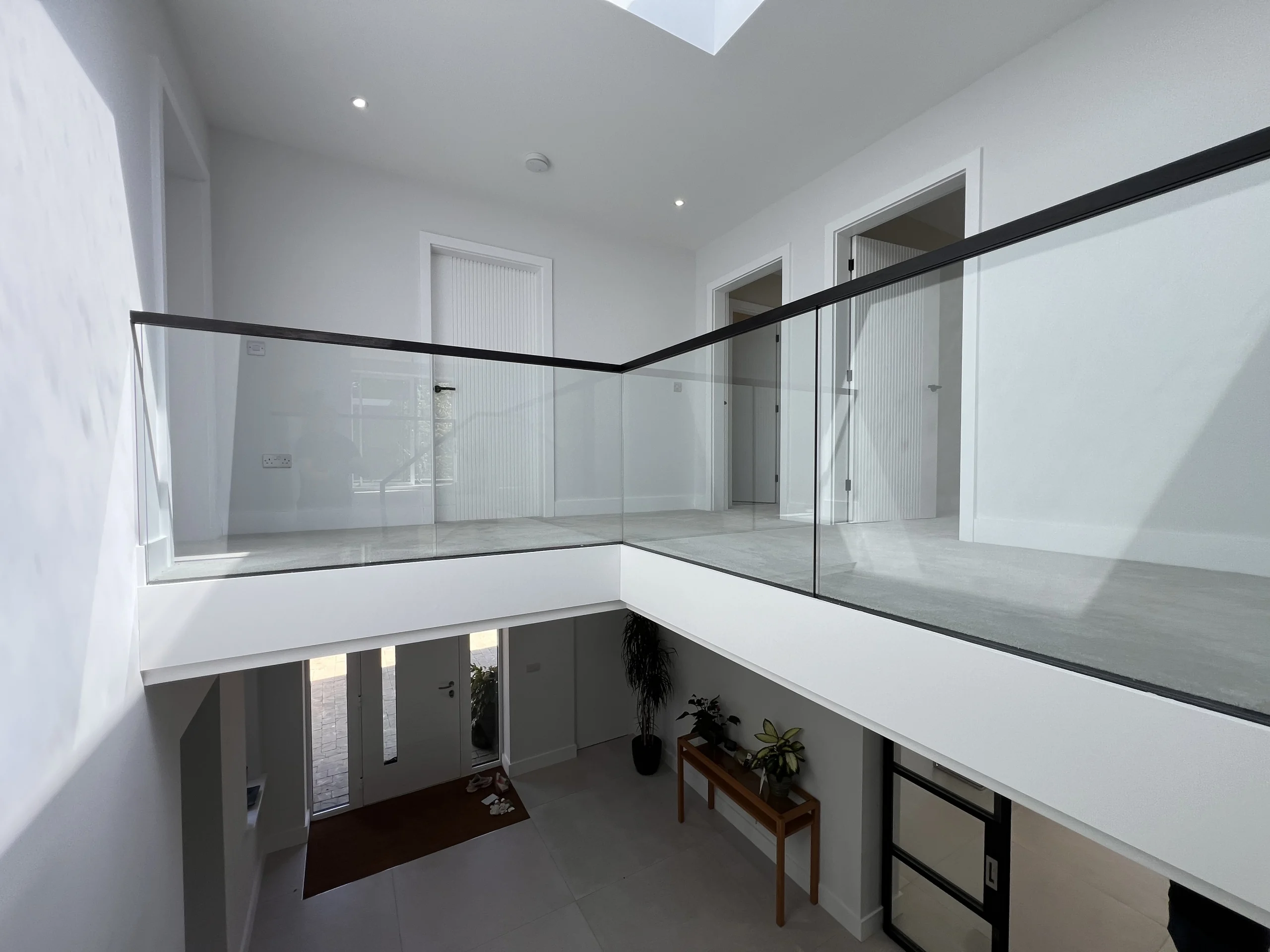
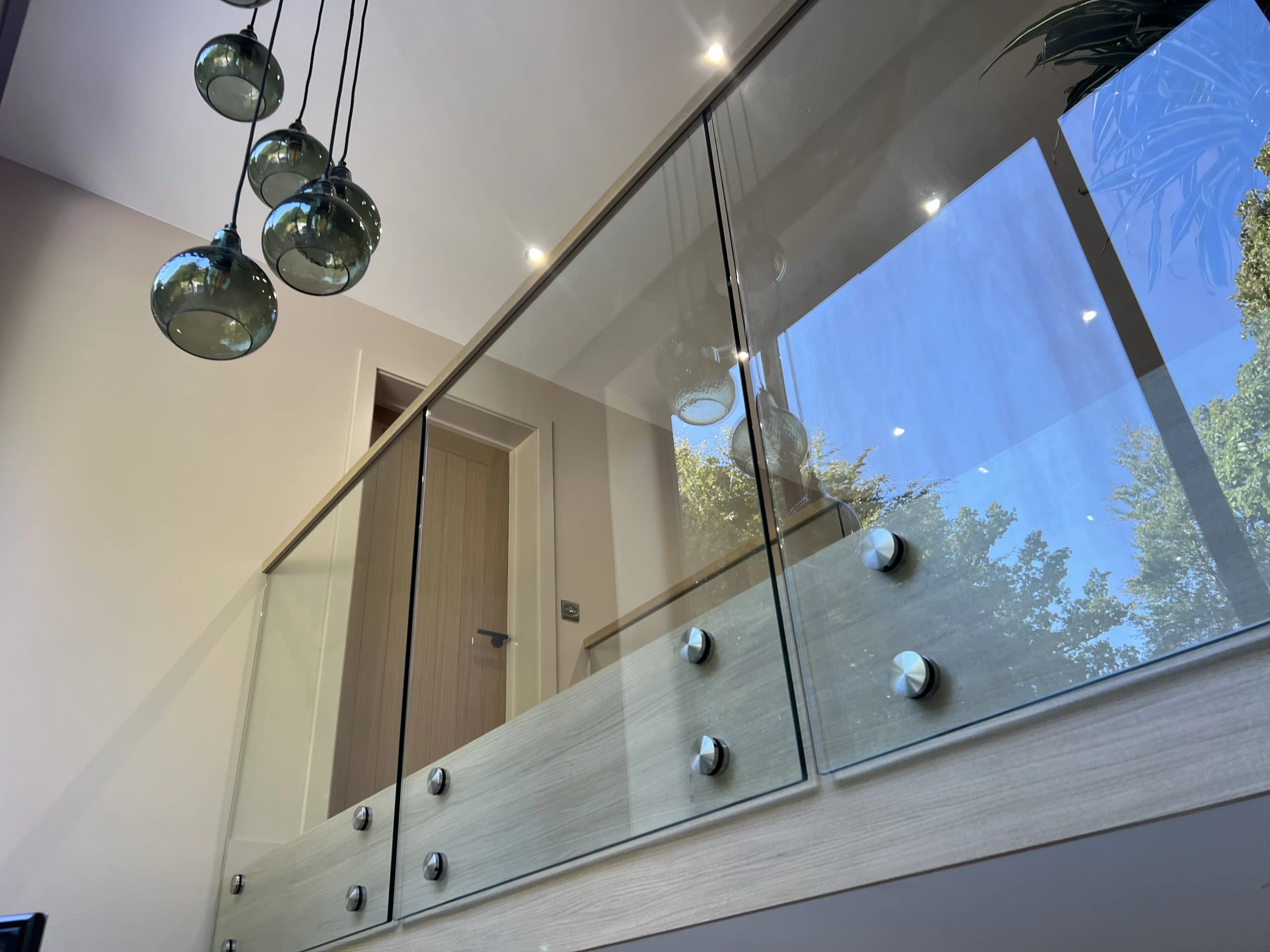
Three Bbl 4.20 provisions deserve particular attention because they affect material specification rather than just height. First, the climbable-zone rule: between 200 mm and 700 mm above the floor a balustrade must offer no climbing foothold — a horizontal rail or shelf in this range is non-compliant for woonfunctie. This is why frameless glass balustrades (where the only surface in the lower zone is the glass plane itself) are increasingly specified — they automatically satisfy the rule. Second, the spijlenafstand 100 mm rule applies vertically and horizontally — gaps in any orientation through which a 100 mm sphere can pass are non-compliant. Third, the top rail continuity rule limits interruptions to 100 mm — a design with separated newel posts or interrupted handrails can fail review even if individual heights are correct.
For external balustrades — Bloemendaal coastal villa terraces, Wassenaar dune-front projects, Zeeland waterfront — the height and geometric rules are identical, but the material specification adds corrosion considerations. Glass balustrades within 10 km of the North Sea coast typically specify tempered laminated VSG 13.52 or VSG 17.52 with heat-soaking per EN 14179 to mitigate nickel sulphide spontaneous breakage; steel components transition to A4 marine stainless or duplex grades.
Error 2: Spijlenafstand > 100 mm — vertical bars at 110 mm or 120 mm centres still appear in heritage-inspired designs but fail Bbl review.
Error 3: Trap balustrade at 1000 mm — applying floor balustrade height to the trap is overspec but visually wrong; the trap rule is 850 mm above the leading tread edge.
Error 4: Edge offset > 50 mm — fixing the balustrade more than 50 mm back from the floor edge creates a fall-through gap; common when retrofitting glass into existing newel hardware.
Leuning (Handrail) — Article 4.28 Heights, Sides & Continuity
Article 4.28 of the Bbl establishes the leuning (handrail) requirement for any staircase that overcomes a height difference greater than 1 m and has a klimlijn helling steeper than 2:3. For nieuwbouw woonfunctie projects, leuning is mandatory on both sides of the staircase, with strict rules on height, continuity, terminus geometry and grip cross-section.

| Leuning parameter | Nieuwbouw (Bbl 4.28) | Bestaande bouw / verbouw |
|---|---|---|
| Mandatory side(s) | Both sides | One side minimum |
| Height above leading tread edge | 800–1000 mm | 800–1000 mm |
| Continuity along flight | Continuous, no gaps | Practical gaps allowed |
| Terminus extension | ≥ 300 mm horizontal at top + bottom | Not always required |
| Grip cross-section diameter | 32–50 mm (round) or equiv. | Same advisory |
| Wall clearance | ≥ 45 mm | ≥ 35 mm |
| Mounting strength | 1.0 kN at any point | Same |
| Trap classification trigger | Hoogteverschil > 1.0 m + helling steeper 2:3 | Same |
Table 4 · Bbl 4.28 leuning requirements. The 300 mm horizontal terminus extension at top and bottom is the most-cited Bbl requirement that catches retrofit projects.
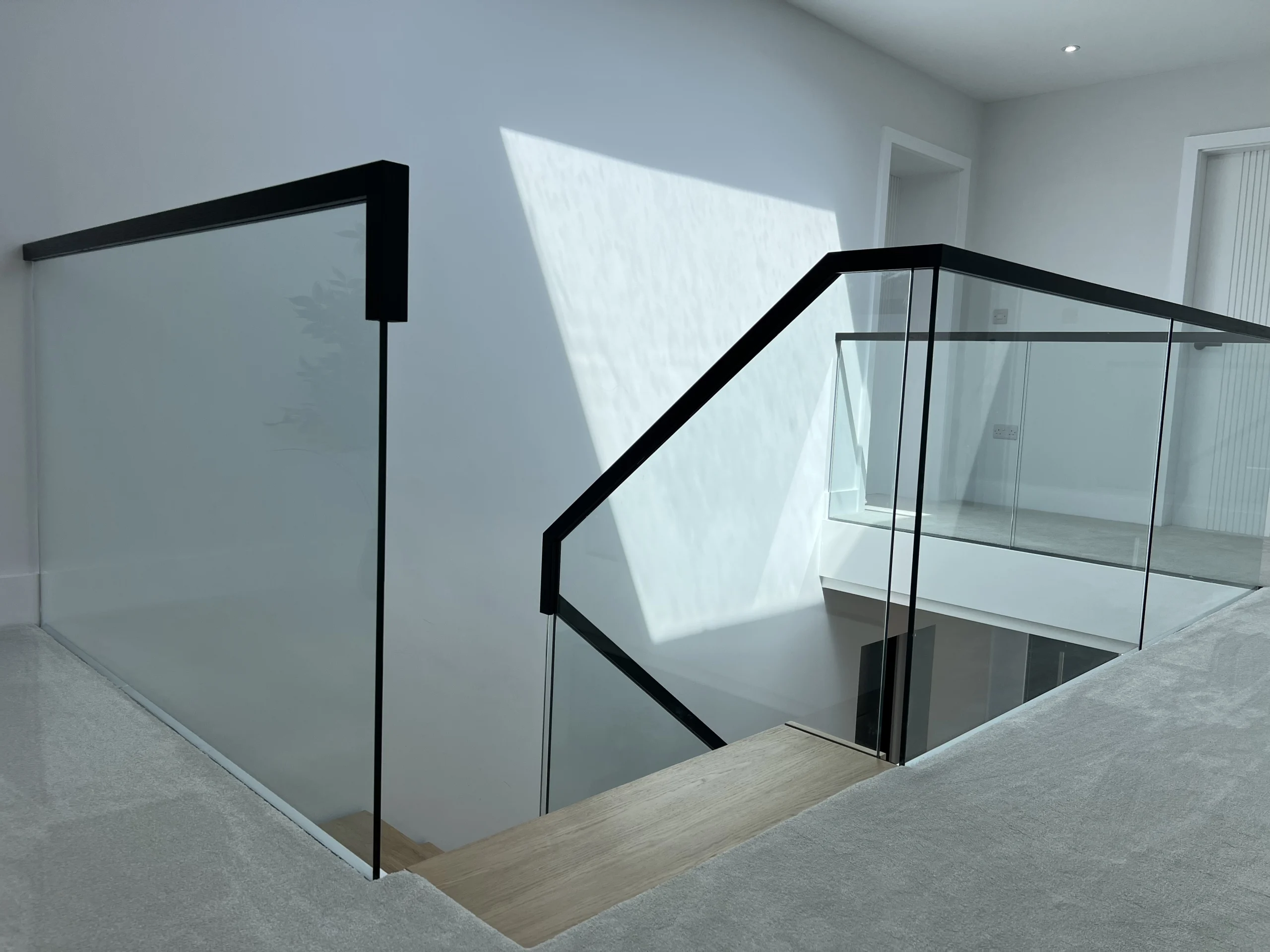
The 300 mm terminus extension is the rule most frequently flagged at Wkb (Wet Kwaliteitsborging) review. The leuning must extend horizontally at least 300 mm beyond both the top and bottom tread, allowing users to maintain grip during the transition off the staircase. In compact grachtenpand stairwells where a wall meets the staircase orthogonally, this extension can require a knee-joint or curved return — a detail Continox provides as standard on every leuning specification we supply for Dutch projects.
Two further leuning details warrant attention. The grip cross-section rule means a leuning that is too thick (architectural-style 60 mm flat bar) or too thin (decorative 20 mm cable) will fail Bbl 4.28 — the rule references comfortable hand grip, conventionally interpreted as an outer profile equivalent to a 32–50 mm round bar. The 1.0 kN point loading rule means the leuning must withstand a horizontal point force of 1 kN at any location — relevant for the leuning's own cross-section, but more critically for the wall fixings or balustrade-integrated mounting. For frameless glass balustrade applications, the leuning typically integrates into the glass top via a U-channel or clamp profile sized to transmit the 1.0 kN load through the glass into the structural fixing below.
Structural Loading & Eurocode Cross-Reference
Bbl loading requirements for staircase and balustrade design are aligned with Eurocode 1 (NEN-EN 1991-1-1 + Dutch national annex) — the same European framework that governs structural design across the EU. For staircase specification, three loading cases dominate the analysis:
- Trap variable load — the live load applied to the tread surface, conventionally 2.0 kN/m² for woonfunctie + woongebouw and 4.0 kN/m² for publieke functie assembly
- Balustrade variable load — the horizontal load applied to the top rail, classified by gebruiksfunctie
- Leuning point load — the 1.0 kN concentrated load applied at any point along the handrail per Bbl 4.28
| Loading case | Woonfunctie | Woongebouw | Publieke functie |
|---|---|---|---|
| Trap variable load (kN/m² distributed) | 2.0 kN/m² | 3.0 kN/m² | 4.0 kN/m² assembly |
| Trap point load (kN concentrated) | 2.0 kN | 3.0 kN | 4.0 kN |
| Balustrade horizontal line load | 0.8 kN/m | 1.0 kN/m | 3.0 kN/m assembly |
| Balustrade point load (top rail) | 0.5 kN | 0.5 kN | 1.5 kN |
| Leuning concentrated point load | 1.0 kN | 1.0 kN | 1.5 kN |
| Eurocode reference | EN 1991-1-1 Cat A | EN 1991-1-1 Cat A | EN 1991-1-1 Cat C |
Table 5 · Structural loading values aligned to Eurocode 1 (EN 1991-1-1) categories and the Dutch national annex. Final values to be confirmed by the project's appointed constructeur.
The link between Bbl, NEN 3509 and Eurocode is straightforward in practice. Bbl establishes the regulatory threshold (the staircase must safely carry the design load). NEN 3509 prescribes operational dimensions and detailing. Eurocode (EN 1991-1-1 + EN 1990 + EN 1993 for steel members) provides the structural calculation methodology. Continox supplies a complete structural calculation pack with every staircase delivery to the Netherlands, cross-referencing the Bbl gebruiksfunctie classification with Eurocode load category and material partial factors per the Dutch national annex.
For Continox systems specifically: the Central Spine tier uses S355J0 steel for the main spine, designed to carry the full 2.0 kN/m² woonfunctie variable load with a partial factor γF = 1.5 and member resistance factor γM0 = 1.0 per the Dutch annex. The Floating tier uses cantilevered tread brackets fixed to a concealed wall structure — here the structural-substrate decision (reinforced concrete, structural-steel frame, or load-bearing masonry) becomes the governing constraint, and the calculation methodology bridges EN 1993 (steel cantilever) and EN 1992 (concrete substrate) or EN 1996 (masonry substrate) accordingly.
Verbouw, Bestaande Bouw & the Rechtens-Verkregen-Niveau Principle
For the bulk of premium staircase work in the Netherlands — Amsterdam grachtenpand renovations, Den Haag townhouse upgrades, Utrecht binnenstad apartment conversions — the project is not nieuwbouw. It is verbouw, and the rules change materially. Bbl hoofdstuk 5 governs verbouw, and at its centre sits the rechtens-verkregen-niveau principle.
Rechtens-verkregen-niveau translates loosely as "the legally acquired level" — the minimum quality threshold to which a verbouw project must build. The principle says: the post-renovation result must achieve at least the higher of (a) the existing situation immediately before the verbouw, and (b) the bestaande-bouw threshold under hoofdstuk 3. It does not require the project to meet nieuwbouw thresholds — that would be impractical for most heritage renovations.
For staircase specification this means a grachtenpand renovation where the existing trap has 195 mm optrede and 220 mm aantrede (steeper than the 2:3 klimlijn ratio) does not need to be rebuilt to nieuwbouw geometry. The rechtens-verkregen-niveau is the existing geometry, and the verbouw must preserve that or improve toward bestaande-bouw threshold without making the situation worse. In practice: replacing the trap structure within the existing stairwell footprint typically keeps the existing geometry, while integrating a new leuning to bestaande-bouw spec (≥ 800 mm height, single-side mandatory) and a balustrade to ≥ 900 mm where the fall > 1.5 m.
YES → rechtens-verkregen-niveau = existing situation; preserve or improve
NO → must improve at minimum to hoofdstuk 3 threshold
Q2: Does the verbouw substantially alter the staircase footprint or geometry?
NO → rechtens-verkregen-niveau applies; existing geometry preserved
YES, partial → altered components meet hoofdstuk 5 transitional threshold
YES, complete rebuild → falls into nieuwbouw; hoofdstuk 4 applies
Q3: Is the building a rijksmonument or gemeentelijk monument?
YES → omgevingsvergunning required; RCE or municipal Bureau Monumentenzorg involvement
NO → standard Wkb (Wet Kwaliteitsborging) review path
The grachtenpand reality merits its own treatment because Amsterdam's canal-house housing stock interacts with three regulatory frameworks simultaneously. The Bbl establishes the technical rules. The Rijksdienst voor het Cultureel Erfgoed (RCE) protects rijksmonumenten — buildings of national heritage significance, which includes most of the central Amsterdam canal ring. The municipal Bureau Monumentenzorg (in Amsterdam's case) administers the local omgevingsvergunning permit process for monumentenwerk. For a typical Prinsengracht renovation, this means the staircase replacement requires both a Wkb-compliant technical solution AND a monumentenvergunning that respects the heritage character of the building — frequently driving designers toward compact spine systems that integrate with existing 17e-century stairwell footprints rather than imposing modern dimensional ideals.
Continox supplies for both scenarios. The L-Shape Steel Plates and U-Shape Steel Plates tiers are engineered with footprint flexibility specifically for grachtenpand renovations — we work to the existing stairwell envelope and design within it, rather than requiring a stairwell rebuild. The structural calculations and detail drawings released with every Continox supply form part of the monumentenvergunning dossier; your appointed Dutch architect leads the permit application.

For the grachtenpand reality in detail — neighbourhood profiles, monumentenvergunning workflow, Randstad regional context, Noord-Holland coastal-corrosion specification — see Modern Staircase Amsterdam Grachtenpand & Randstad Premium (NL03).
Cross-Border Comparison: Netherlands / Belgium / Germany
Dutch architects working on cross-border projects — German clients buying along the eastern provinces, Belgian developers active in Limburg, or Dutch firms commissioned for Antwerp or Düsseldorf work — need to know where Dutch rules diverge from neighbouring frameworks. The comparison below sets the three principal staircase parameters across the three jurisdictions for residential nieuwbouw.
Three structural divergences are worth flagging. First, Germany's Schrittmaßregel (2 × Steigung + Auftritt = 590–650 mm) is a comfort formula not present in the Bbl or in Belgian federal code — it constrains German staircase design more tightly than Dutch klimlijn-only rules. Second, the balustrade height diverges: the Netherlands sets 1000 mm at the residential standard, Belgium sets 900 mm, and Germany sets 900 mm with a step to 1100 mm at 12 m drop (versus 13 m in NL). Third, spijlenafstand rules: the Netherlands holds the strictest 100 mm vertical-and-horizontal rule, Belgium typically permits 110 mm, and Germany conventionally allows up to 120 mm.
The implication for cross-border specification is that a staircase designed for the Dutch Bbl will exceed German DIN 18065 and Belgian NBN B 03-004 minimums in nearly every dimension. The reverse is not true — German projects shipping to Netherlands need to verify the 100 mm spijlenafstand and the 1000 mm Bbl balustrade height before approval. Continox supplies to the strictest applicable threshold automatically; for our Belgium cluster the same staircase ships at NL spec, ensuring zero rework if the project specification changes.
Frequently Asked Questions
What is the minimum aantrede and maximum optrede for a Dutch residential staircase?
Under Bbl hoofdstuk 4 (nieuwbouw woonfunctie) the minimum aantrede is 220 mm measured at the klimlijn, and the maximum optrede is 188 mm. Together these establish a klimlijn ratio of 188:220 ≈ 0.85, which sits within the Bbl 2:3 maximum (0.67) when measured as a ratio of optrede to aantrede.
For verbouw projects in existing buildings (most grachtenpand renovations fall here), the rechtens-verkregen-niveau principle applies — typically the existing geometry can be preserved provided the post-renovation result meets the bestaande-bouw threshold under hoofdstuk 3.
What is the difference between Bouwbesluit 2012 and the Bbl?
The Besluit bouwwerken leefomgeving (Bbl) replaced the Bouwbesluit 2012 on 1 January 2024 as part of the Omgevingswet reform. For staircase specification the dimensional thresholds are largely preserved — minimum aantrede 220 mm, maximum optrede 188 mm, balustrade 1000 mm and the 2:3 klimlijn ratio remain the residential anchors. The article numbering changed: where the Bouwbesluit cited specific articles, the Bbl reorganises these into afdelingen 4.2.3 (vloerafscheiding) and 4.2.4 (trap) under hoofdstuk 4 nieuwbouw.
The bigger change is structural: the Bbl integrates with the Omgevingsplan (post-2024 successor to bestemmingsplan) and the Wkb (Wet Kwaliteitsborging) review process. Most architects find day-to-day specification work very similar in substance, with terminology and article references requiring updating.
How tall must a staircase balustrade be in the Netherlands?
For nieuwbouw under Bbl 4.20: 1000 mm minimum height for floor balustrades where the fall exceeds 1 m, increasing to 1200 mm where the drop exceeds 13 m. On the trap itself, the balustrade height measured above the leading edge of the tread is 850 mm minimum.
For bestaande bouw under hoofdstuk 3, the threshold lowers to 900 mm floor balustrade and 600 mm trap balustrade. Spijlenafstand (vertical gap between bars) is capped at 100 mm in both nieuwbouw and bestaande bouw, and the climbable-zone rule (no foothold between 200 mm and 700 mm) applies to nieuwbouw but not retroactively to existing buildings.
Is a leuning required on both sides of a Dutch staircase?
For nieuwbouw woonfunctie under Bbl 4.28, leuning is required on both sides of any staircase that overcomes a height difference greater than 1 m and has a klimlijn helling steeper than 2:3. The leuning sits at 800–1000 mm above the leading edge of each tread and must extend horizontally at least 300 mm beyond the top and bottom riser to allow grip during transition off the staircase.
For verbouw and bestaande bouw, the threshold relaxes to one-side mandatory, with both-sides advisory. The 300 mm terminus extension at top and bottom is one of the most-cited Bbl 4.28 requirements at Wkb review and is worth checking on every retrofit drawing.
What is the rechtens-verkregen-niveau principle and how does it affect grachtenpand renovations?
The rechtens-verkregen-niveau ("legally acquired level") principle in Bbl hoofdstuk 5 governs verbouw projects. It says: the post-renovation result must achieve at least the higher of (a) the existing situation immediately before the verbouw, and (b) the bestaande-bouw threshold under hoofdstuk 3. It does not require the verbouw to meet nieuwbouw thresholds.
For a typical Amsterdam grachtenpand renovation this is the principle that allows the existing 17e-century steep-staircase geometry to be preserved. A new staircase fitted into the existing stairwell footprint typically inherits the rechtens-verkregen-niveau, which means designers do not need to widen the stairwell or relax the helling to match nieuwbouw rules. Continox supplies compact-footprint spine systems specifically engineered for this scenario.
Does the Bbl reference NEN 3509 directly, and what does NEN 3509 add?
The Bbl establishes the regulatory thresholds — what minimum aantrede, what maximum optrede, what balustrade height. NEN 3509 is the operational specification standard for residential staircase dimensions, providing the practical detail (klimlijn measurement methodology, advisory zones for comfortable use, terminology for tread-and-riser geometry) that designers use during day-to-day specification.
The Bbl does reference NEN-standards by name where applicable, and NEN 3509 is the common reference for residential staircase work. For glass balustrades, the Bbl + NEN 6707 (fixing and design) + NEN 3569 (safety classification) form the parallel framework — covered in detail in NL02 Glass Balustrade Regulations Netherlands.