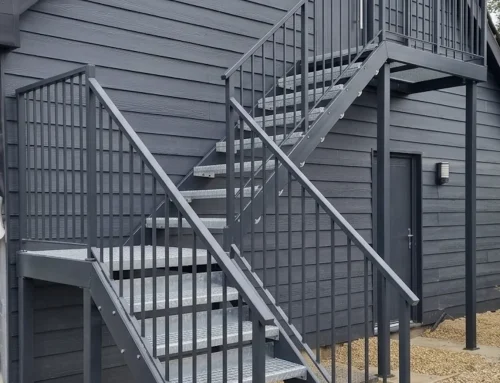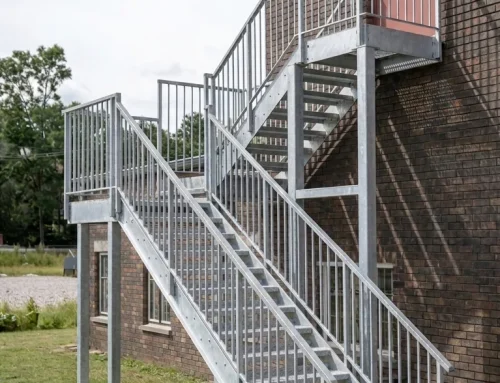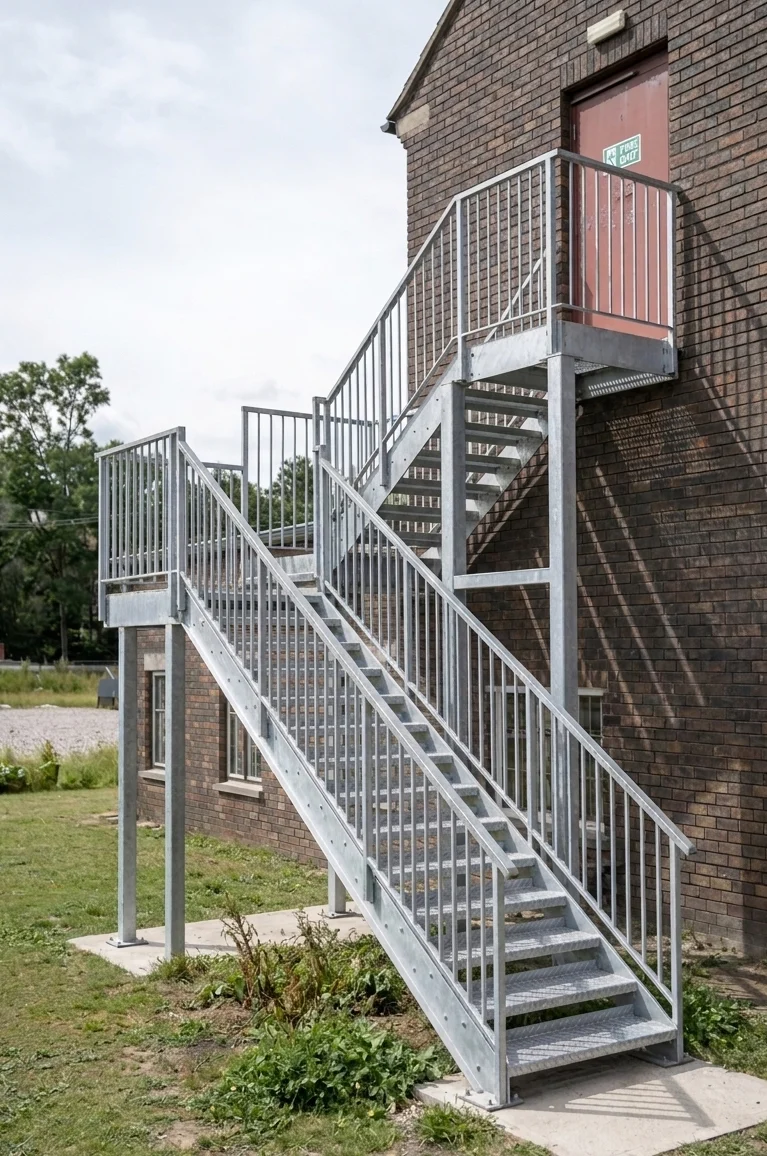

Designing an effective fire escape staircase requires a precise understanding of UK Building Regulations, British Standards and structural engineering principles. Whether you're an architect, developer, building owner or facilities manager, this guide sets out the key design requirements — from dimensions and materials to configuration options and common mistakes to avoid.
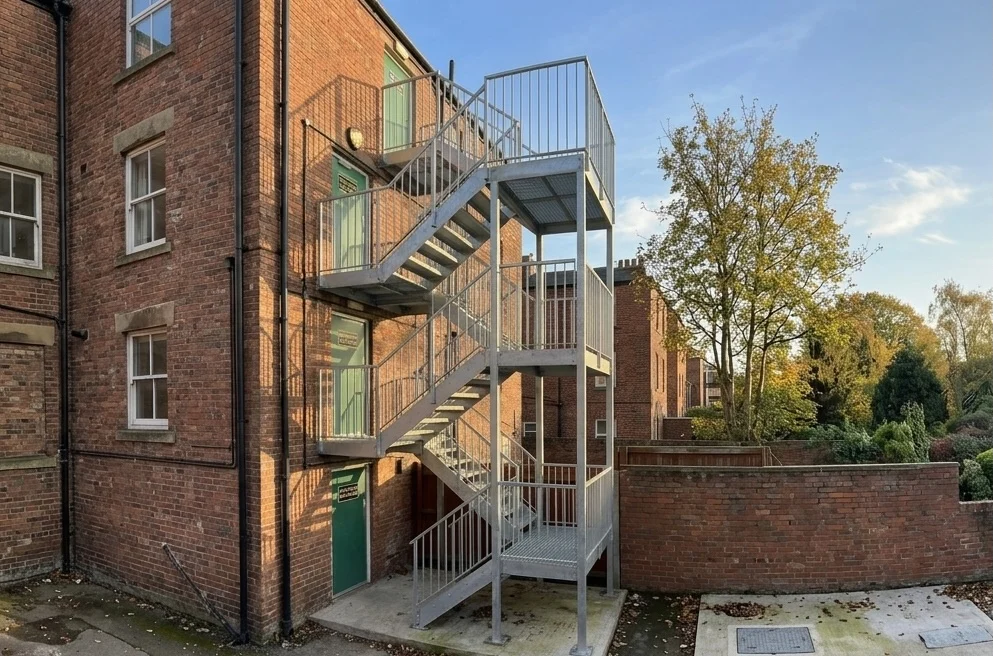
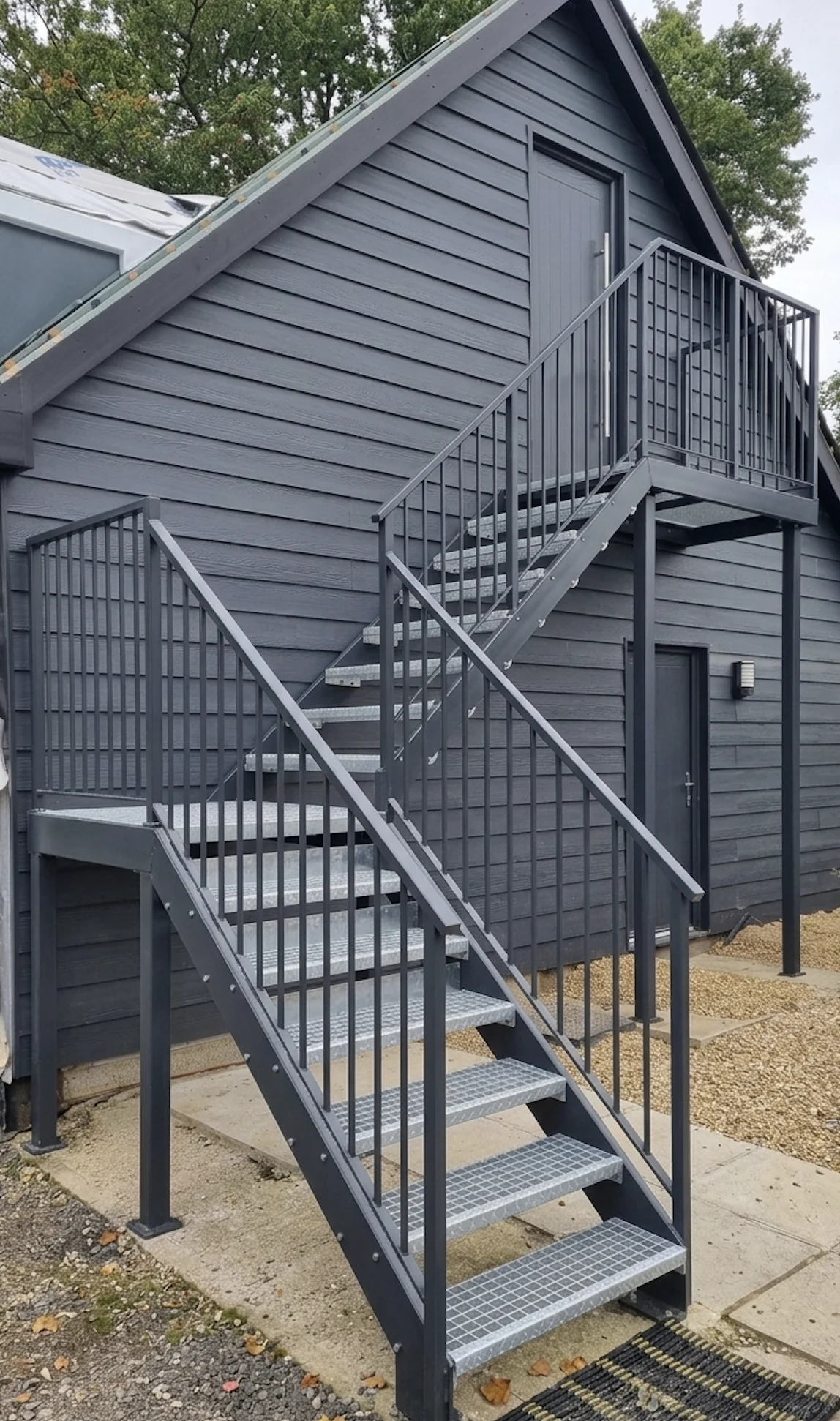
Bespoke fire escape staircase designed and installed by Continox — BS 9991 compliant, UKCA marked.
Design Principles & Legal Framework
Effective fire escape staircase design begins with the legal framework. In the UK, four key instruments govern what a fire escape must achieve — and getting any of them wrong creates both safety risk and regulatory exposure.
Regulatory Reform (Fire Safety) Order 2005
The Regulatory Reform (Fire Safety) Order 2005 places a legal duty on the "responsible person" — building owner, landlord or managing agent — to ensure adequate means of escape are provided, maintained and clearly signposted. This is the foundational duty: the subsequent regulations define what "adequate" means in technical terms.
Approved Document B (Fire Safety)
Approved Document B sets out the technical guidance for meeting Building Regulations in relation to fire safety. It covers means of escape requirements for different building types — including minimum staircase widths, enclosure requirements, protected routes and travel distances. Any new fire escape staircase installation requires Building Regulations compliance under Approved Document B.
BS 9991: Fire Safety in Residential Buildings
BS 9991 is the British Standard for fire safety in the design, management and use of residential buildings. It provides detailed technical requirements for external fire escape staircases — including clear width minimums, structural performance and accessibility. For commercial buildings, BS 9999 provides the equivalent standard.
Approved Document K: Protection from Falling
Approved Document K governs the dimensional requirements for all staircases — including fire escapes. It sets maximum rise, minimum going, maximum pitch, headroom clearances and handrail specifications. Compliance with Part K is required in addition to Approved Document B for all new fire escape installations. For a full overview see our UK Staircase Building Regulations guide.
Key principle: A fire escape staircase must provide a clear, unobstructed means of escape from every floor it serves to a place of safety at ground level. The design must prioritise speed of evacuation, structural integrity under emergency loading conditions and resistance to the effects of fire and smoke.
Technical Design Requirements: Dimensions & Specifications
The following dimensional requirements apply to external fire escape staircases in the UK under Approved Document B, BS 9991 and Approved Document K. These are minimum requirements — Building Control may specify more stringent dimensions depending on building type, occupancy and risk assessment.
| Design Requirement | Standard / Reference | Specification |
|---|---|---|
| Min clear width | BS 9991 / Approved Doc B | 1000mm |
| Min rise (per step) | Approved Document K | 150mm |
| Max rise (per step) | Approved Document K | 190mm (common/public) |
| Min going (tread depth) | Approved Document K | 220mm (straight flight) |
| Going (tapered steps) | Approved Document K | 280–300mm at walking line |
| Max pitch | Approved Document K | 42° |
| Min headroom | Approved Document K | 2000mm (vertically above pitch line) |
| Handrail height | Approved Document K | 900–1000mm above pitch line |
| Handrails required | BS 9991 | Both sides if width exceeds 1000mm |
| Balustrade height (landing) | Approved Document K / BS 6180 | 1100mm at landings & platforms |
| Max balustrade opening | Approved Document K | 100mm sphere rule |
| Tread surface | BS 9991 / Approved Doc B | Non-slip finish required |
Source: Approved Document K (2013) · Approved Document B · BS 9991. See also our Glass Balustrade Regulations guide for balustrade specifications.
Configuration Options
The configuration of a fire escape staircase is determined by the building layout, available footprint, number of floors to be served and access requirements at each level. Each configuration has distinct structural and spatial implications.
Straight Flight
The simplest and most common configuration — a single continuous run of stairs descending from landing to ground. Requires the greatest linear footprint but is the easiest to evacuate quickly. Preferred for single-storey height changes or where space along the building elevation is not constrained.
L-Shape (Quarter Turn)
Changes direction through 90° at an intermediate platform landing. Useful where the building has a return corner, or where the straight flight footprint would project excessively from the building face. The intermediate landing must meet the minimum clear width requirement of 1000mm.
U-Shape (Half Turn / Switchback)
Returns through 180° at a mid-level landing — allowing maximum height gain in a compact footprint close to the building face. Common for multi-storey HMOs and apartment buildings where the plan footprint of a straight flight would be impractical. The well between flights must allow unobstructed emergency access.
Spiral
The most space-efficient configuration — but subject to significant restrictions under BS 9991 and Approved Document B for means of escape applications. Spiral staircases are generally only acceptable as a secondary fire escape where a primary compliant staircase already exists. Always confirm acceptability with Building Control before specifying.
Material Selection for Fire Escape Staircases
Structural Steel — The Correct Choice
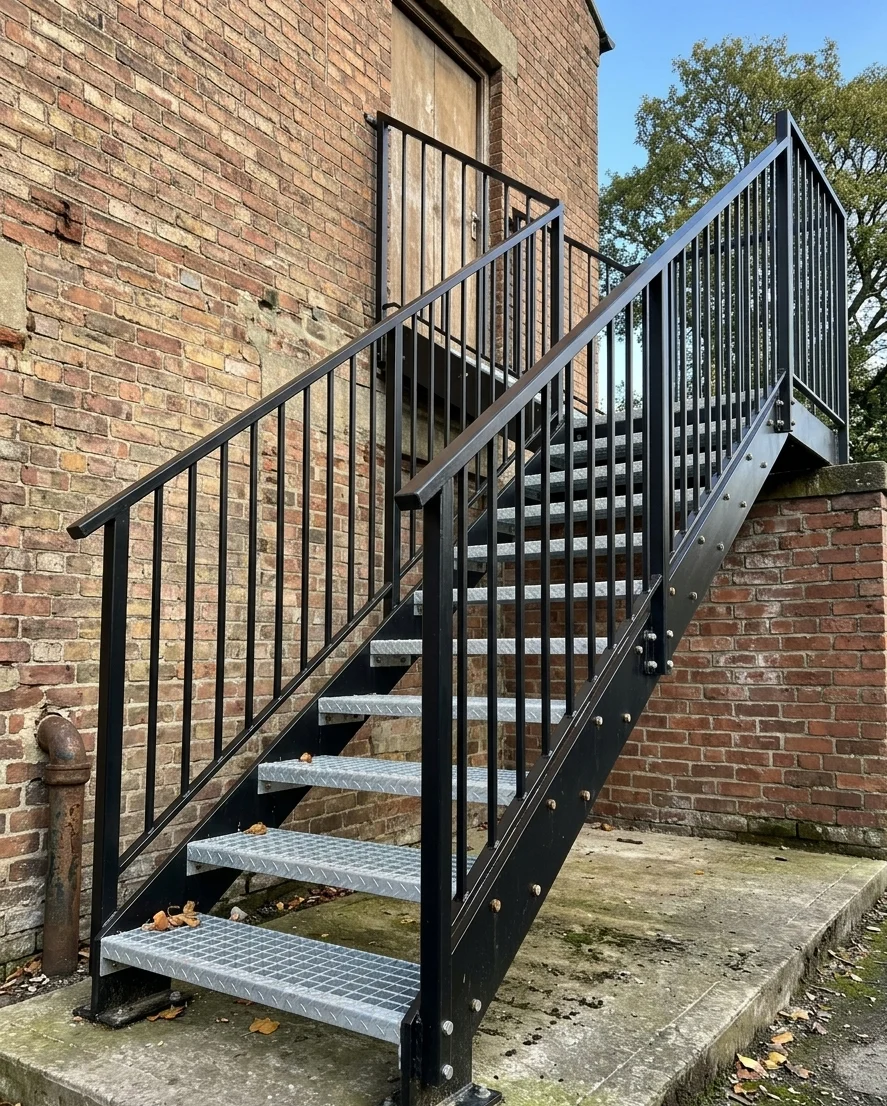
Structural steel is the only appropriate material for external fire escape staircases in the UK. Steel maintains its structural integrity at temperatures where timber fails, making it the preferred specification under Approved Document B for means of escape. Continox fabricates all fire escape staircases from structural grade S275 or S355 steel to BS EN 10025, with full UKCA marking and Declaration of Performance as required by UK Construction Products Regulations.
Do not use timber for external fire escape staircases. Timber is combustible and loses structural integrity rapidly when exposed to fire. It is not an appropriate material for external fire escape staircases under any circumstances. Similarly, aluminium — while corrosion-resistant — loses structural strength rapidly at elevated temperatures and is generally not acceptable for fire escape applications without specific engineering justification.
Galvanised vs Powder-Coated Finish
Hot-dip galvanising to BS EN ISO 1461 provides the most durable long-term protection for external fire escapes — a metallurgically bonded zinc coating that is self-repairing at cut edges and provides 30–50 years of corrosion protection in most UK environments. It is the standard specification for fire escapes in exposed locations, coastal environments and high-rainfall areas.
Powder coating is applied over a galvanised or shot-blasted primer and provides a smooth, aesthetically superior finish in any RAL colour. It is the preferred specification where visual integration with the building exterior is important — contemporary apartment blocks, residential conversions and listed building settings. Powder coating over hot-dip galvanising (duplex system) provides the longest combined service life.
Tread Specification
UK Building Regulations require non-slip tread surfaces for all fire escape stairs. For external applications, open mesh or perforated steel treads are the preferred specification — both provide excellent slip resistance in wet conditions, allow water and debris to fall through, and require minimal maintenance. Solid plate treads with mechanically fixed anti-slip nosings are available where open treads are not appropriate, such as where the staircase passes over occupied areas.
Balustrade & Handrail Design
The balustrade and handrail system is a critical safety component of any fire escape staircase — and one that is frequently under-specified. The requirements are set out in Approved Document K and BS 6180 (Barriers in and about Buildings).
Key requirements: balustrades at landings and platforms must be a minimum of 1100mm high. Handrails must be positioned between 900mm and 1000mm above the pitch line of the stair. All balustrade and handrail systems must comply with the 100mm sphere rule — no opening in the infill may permit passage of a 100mm diameter sphere.
For load requirements, BS 6180 requires balustrades to resist a horizontal load of 0.74 kN/m for residential applications and 3.0 kN/m for commercial applications. All Continox fire escape balustrade systems are structurally engineered to these load requirements and tested accordingly.
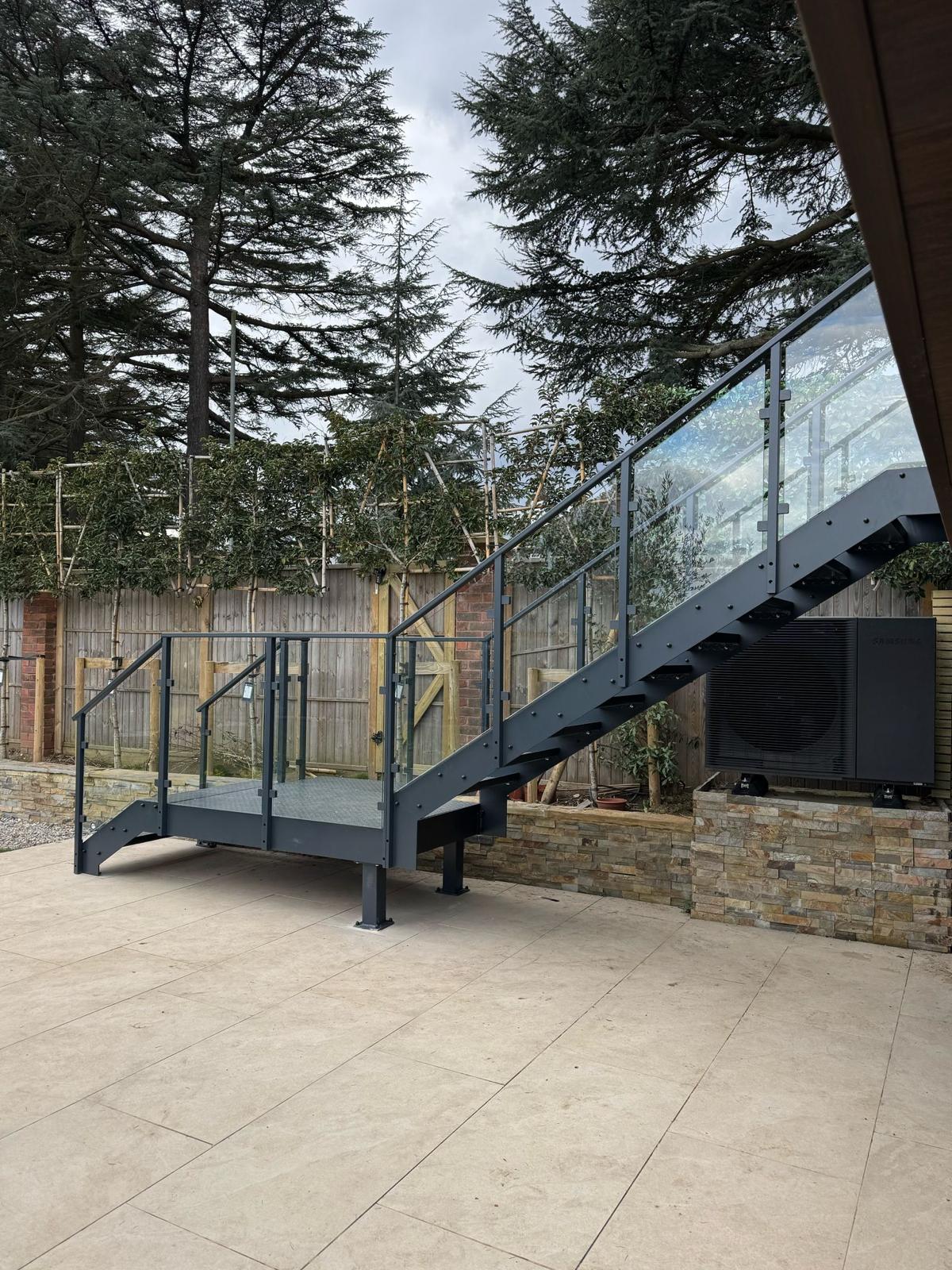

For glass infill panels in fire escape balustrades, all glass must be toughened to BS EN 12150 or toughened & laminated to BS EN 14449. See our Glass Balustrade Regulations guide for full glass specification requirements.
Common Design Mistakes to Avoid
The following design errors are regularly identified by Building Control surveyors and fire safety inspectors. Avoiding them at the design stage saves significant cost and delay.
Insufficient Clear Width
Specifying a staircase that meets the nominal structural width but fails the 1000mm minimum clear width — measured between the inner faces of handrails or balustrades, not the outer structural dimension. Always verify clear width at handrail level.
Incorrect Pitch or Rise/Going Combination
Exceeding the 42° maximum pitch or specifying rise/going combinations that fall outside the Approved Document K envelope. All three parameters — rise, going and pitch — must be checked simultaneously, not individually.
Inadequate Landing Platforms
Failing to provide clear, level landing platforms at each floor level served by the staircase — or providing platforms that are insufficient in depth for occupants to open doors and pass safely. Landing platforms must be at least as wide as the staircase and a minimum of 1200mm deep.
Specifying Spiral Staircases Without Building Control Approval
Spiral staircases are generally only acceptable as a secondary means of escape under BS 9991 where a primary compliant staircase already exists. Specifying a spiral as the sole means of escape from upper floors will not achieve Building Regulations approval.
Wrong Balustrade Height at Landings
Applying the handrail height (900–1000mm) to landing balustrades, which require a minimum of 1100mm. The distinction between handrail height on the stair pitch and balustrade height at landings and platforms is a common source of non-compliance.
Absent or Inadequate UKCA Documentation
Failing to obtain a Declaration of Performance and UKCA marking for structural steel components as required by UK Construction Products Regulations. Building Control sign-off on new builds and major refurbishments requires this documentation — and many steel suppliers cannot provide it. All Continox fire escape staircases carry UKCA marking as standard.
The Continox Design Process
Continox manages fire escape staircase design from initial site survey through to final installation — with structural engineering, CAD drawings and UKCA documentation included as standard. Here is what the process involves:
Free On-Site Survey
We visit your site, assess the structural fixing substrate, measure the elevation and confirm the configuration requirements. A guide price is provided within 24 hours — no call-out charge, no obligation.
Structural Engineering & CAD Drawings
Our engineering team produces full structural calculations to BS EN 1090 and BS 9991, plus detailed CAD drawings showing plan, elevation and fixing details. Provided in PDF and DWG format for your Building Control submission.
Precision Fabrication
Your fire escape is fabricated to exact specification in our own workshop — structural grade steel, galvanised or powder-coated, UKCA marked with Declaration of Performance. Quality-checked before leaving the facility.
Professional Installation
Installed by our experienced in-house team — no subcontractors, no on-site welding. Fully compliant with BS 9991 and Approved Document B. Total lead time from enquiry to installation: 4–6 weeks. View our fire escape staircase range.

Completed fire escape staircase installation by Continox — designed, manufactured and installed by our in-house team across the UK.
Fire Escape Staircase Design — FAQ
Common questions about designing compliant fire escape staircases in the UK.
Expert Design & Installation Across the UK
Free on-site survey, structural drawings included, fixed-price quotation within 24 hours. BS 9991 compliant, UKCA marked, installed by our in-house team.