
Fire escape requirements for commercial and public buildings in the UK are governed by three overlapping legal instruments: the Regulatory Reform (Fire Safety) Order 2005, Approved Document B of the Building Regulations, and BS 9999 (fire safety in non-domestic buildings). Understanding how these interact — and what they specifically require for external fire escape staircases — is essential for building owners, facilities managers, architects and anyone responsible for fire safety compliance in a non-domestic premises.
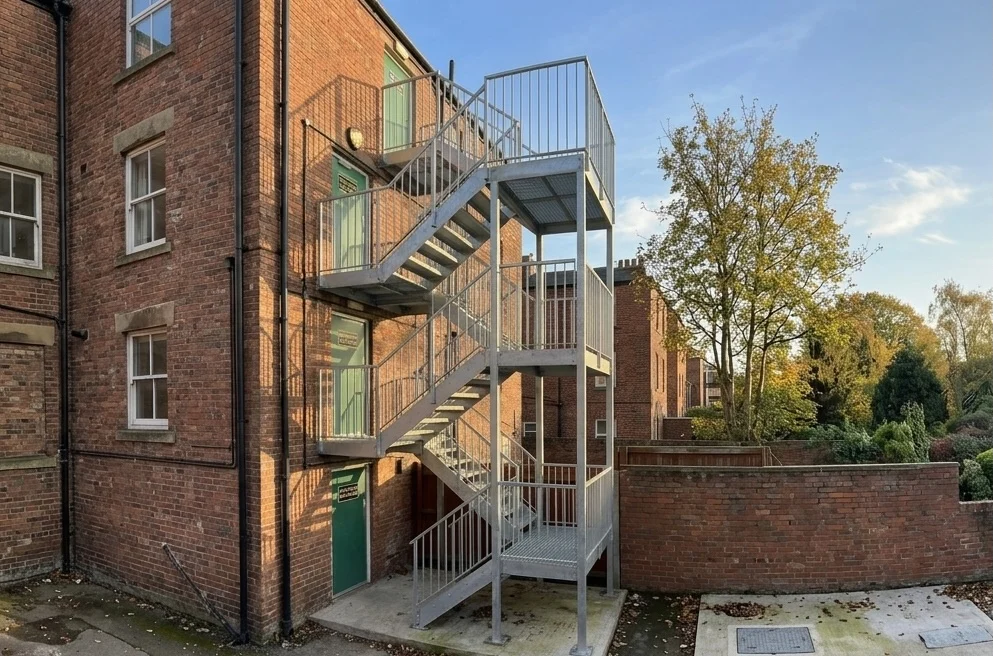
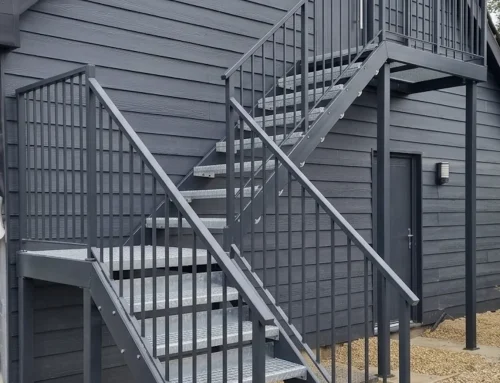
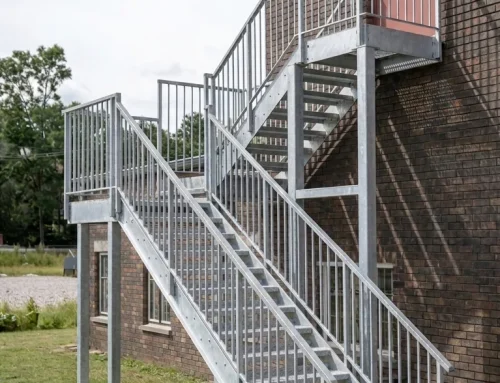
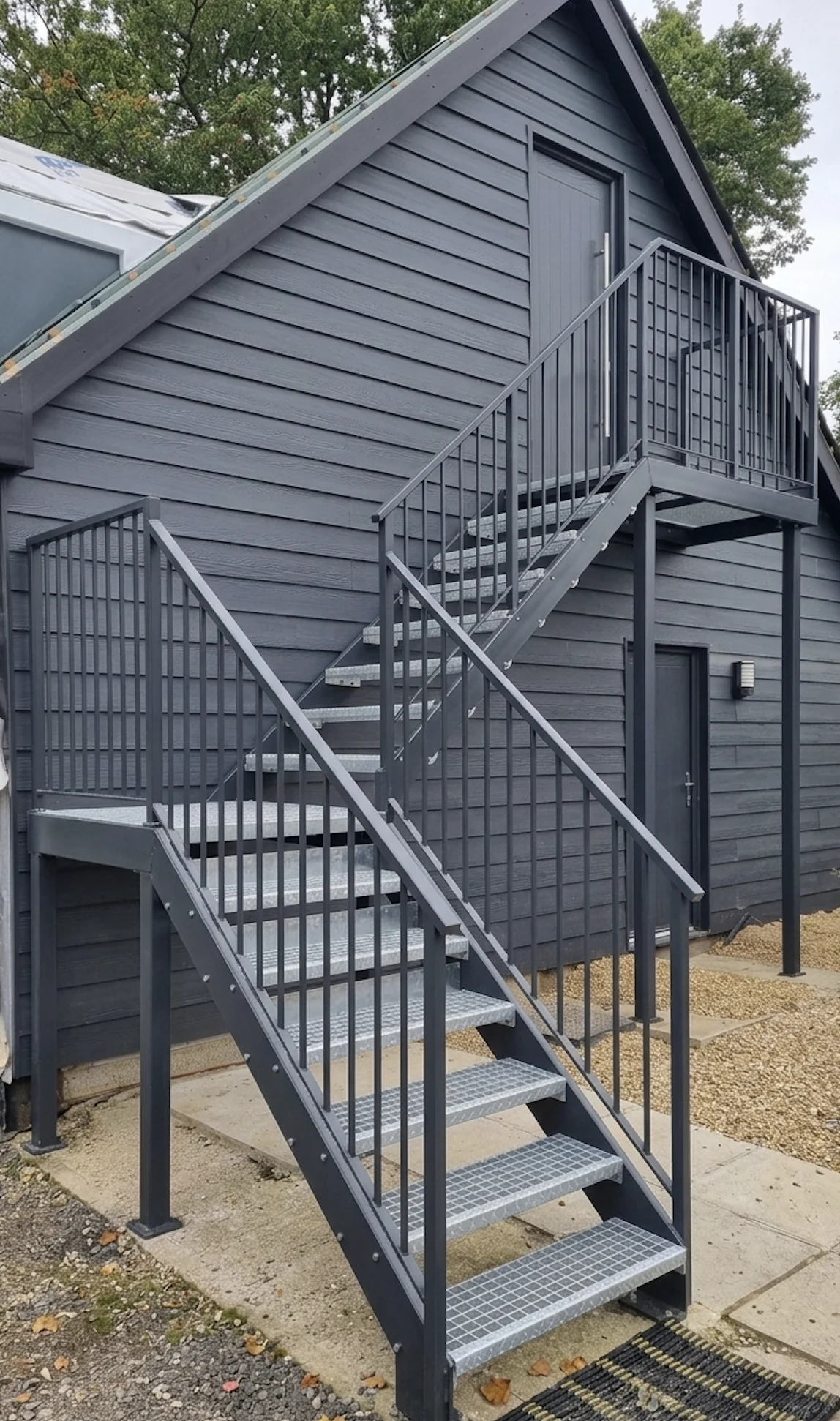
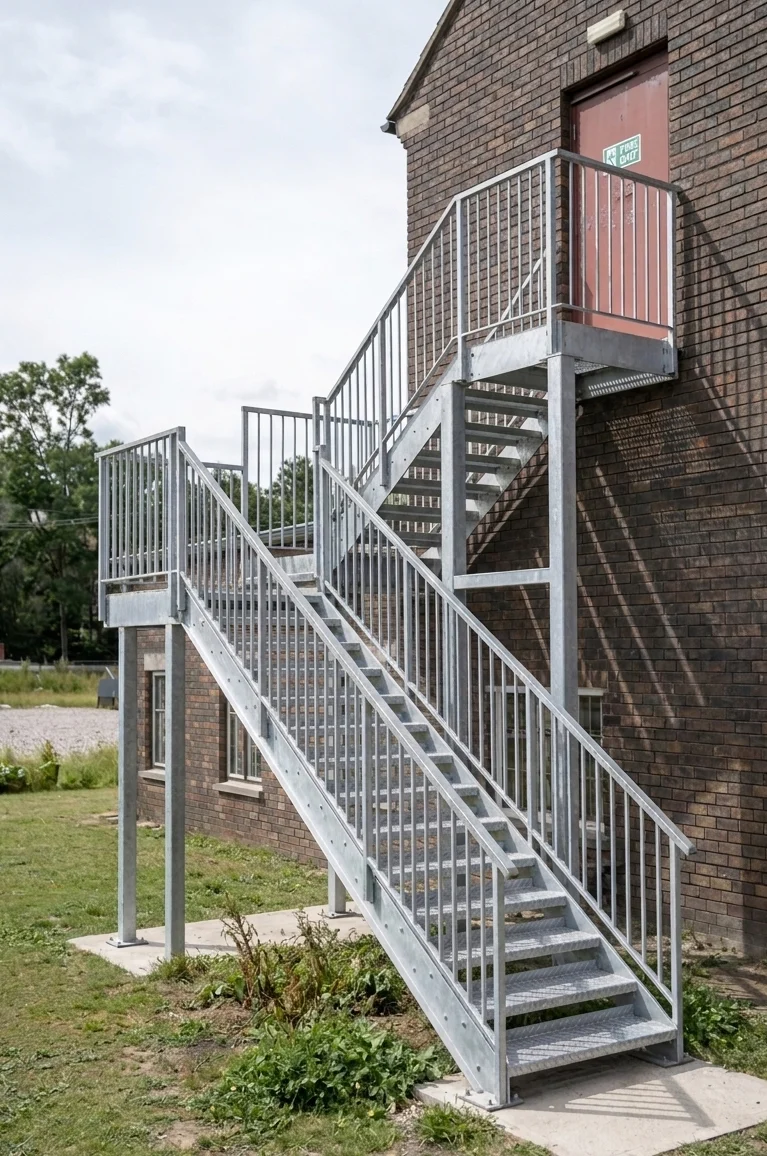
BS 9999 compliant external fire escape staircase installed by Continox — UKCA marked, structural calculations provided, commercial load specification as standard.
The Legal Framework: Three Instruments That Apply Simultaneously
Unlike residential properties, commercial and public buildings in the UK are subject to a layered compliance framework where three separate legal instruments apply simultaneously. Each operates independently — satisfying one does not automatically satisfy the others — and the requirements interact in ways that are not always obvious without specialist knowledge.
Regulatory Reform (Fire Safety) Order 2005
The Fire Safety Order applies to all non-domestic premises in England and Wales — offices, retail units, warehouses, schools, hotels, hospitals and any building to which members of the public have access. It places an ongoing legal duty on the responsible person (the employer, building owner or occupier) to carry out a fire risk assessment, implement adequate means of escape, and maintain those means in efficient working order at all times. Article 17 specifically requires that fire precautions — including external fire escape staircases — are maintained. Non-compliance is a criminal offence under Article 32, carrying unlimited fines and potential imprisonment.
Approved Document B — Fire Safety
Approved Document B provides the technical guidance for complying with Building Regulations Part B (fire safety). For non-domestic buildings, it sets out means of escape requirements including: minimum staircase widths scaled to occupant load, travel distances to the nearest protected staircase, enclosure requirements for protected routes, structural performance under fire conditions, and signage and emergency lighting requirements. Buildings above 18m are subject to additional requirements under the Building Safety Act 2022, introduced following the Grenfell Tower inquiry.
BS 9999: Fire Safety in Non-Domestic Buildings
BS 9999 is the British Standard specifically covering fire safety in the design, management and use of non-domestic buildings. It provides detailed technical requirements for fire escape staircases — dimensional specifications, structural load requirements (3.0 kN/m commercial vs 0.74 kN/m residential), tread surface standards and balustrade specifications. All structural steel components used in commercial fire escape installations must carry UKCA marking and a Declaration of Performance. BS 9999 is the commercial equivalent of BS 9991 which covers residential buildings.
Health and Safety at Work Act 1974
The Health and Safety at Work Act 1974 and the Management of Health and Safety at Work Regulations 1999 require employers to ensure, so far as reasonably practicable, the health and safety of all persons at work — including provision of adequate means of escape. For commercial premises, this extends the fire safety obligation beyond the building fabric to the employer's duty of care to employees. The Act operates in parallel with the Fire Safety Order and is enforced separately by the Health and Safety Executive. Non-compliance can result in enforcement notices, improvement notices and prosecution.
The Fire Safety Act 2021 and Building Safety Act 2022. Recent legislation has significantly strengthened the fire safety framework for multi-occupancy and higher-risk buildings. The Fire Safety Act 2021 clarified that the Fire Safety Order applies to the structure, external walls and flat entrance doors of multi-occupancy residential buildings. The Building Safety Act 2022 introduced the Building Safety Regulator and more stringent requirements for buildings over 18m. Both Acts are being brought into force in phases — building owners of higher-risk buildings should ensure they have taken appropriate professional advice on compliance.
Technical Requirements: Dimensions & Specifications
The following dimensional requirements apply to external fire escape staircases in commercial and public buildings under Approved Document B, BS 9999 and Approved Document K. These are minimum requirements — fire risk assessors and Building Control officers may specify more demanding dimensions based on occupant load, building configuration and use type.
| Requirement | Commercial / Public Specification | Standard |
|---|---|---|
| Min Clear Width | 1000mm minimum — may be wider based on occupant load | BS 9999 / Approved Document B |
| Max Rise (per step) | 190mm | Approved Document K |
| Min Going (tread depth) | 250mm | Approved Document K |
| Max Pitch | 38° | Approved Document K |
| Min Headroom | 2000mm throughout | Approved Document K |
| Handrail Height | 900–1000mm above pitch line | Approved Document K |
| Handrails Both Sides | Required if width exceeds 1000mm | BS 9999 |
| Landing Balustrade Height | 1100mm minimum — all landings | Part K / BS 6180 |
| Max Balustrade Opening | 100mm sphere rule | Approved Document K |
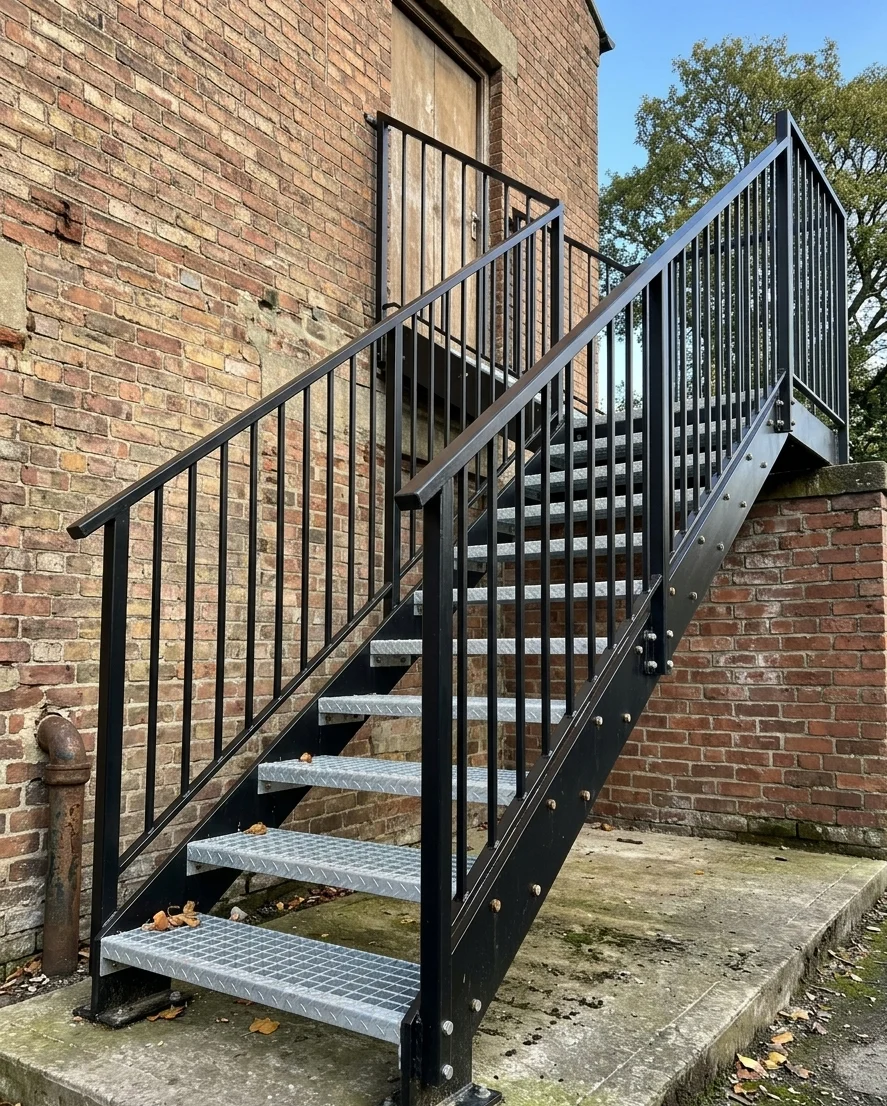
| Tread Surface | Non-slip — open mesh, perforated steel or anti-slip coated | BS 9999 / Approved Document B |
| Horizontal Load | 3.0 kN/m — four times the residential requirement | BS 6180 |
| Open Risers | Not permitted on common/public escape staircases | Approved Document K |
| Structural Standard | BS EN 1090 — structural steel fabrication & erection | BS EN 1090 |
| UKCA Marking | Required — Declaration of Performance mandatory | UK CPR |
Occupant load determines minimum staircase width. Approved Document B scales minimum staircase width to the number of persons simultaneously using the escape route. A 1000mm clear width serves up to approximately 220 persons. Buildings with higher floor-level occupancy require wider staircases — 1200mm or 1400mm clear widths are common on retail and entertainment premises. Your fire risk assessor calculates the required width for each escape route based on the specific floor-by-floor occupancy. Continox designs to the specified width — confirmed following the free on-site survey.
Requirements by Building Type
While the legislative framework is consistent across all non-domestic premises, the practical application of fire escape requirements differs by building type. The following covers the key differences for the four most common commercial building categories.
Offices & Commercial Buildings
Purpose Group 5Offices are classified as Purpose Group 5 under Approved Document B. The responsible person is typically the employer or building owner. Fire escape requirements are based on the number of occupants per floor and the travel distance to the nearest protected staircase — Approved Document B sets maximum travel distances of 25m (one direction) or 45m (two directions) for office use.
- Fire Safety Order applies — employer is responsible person
- Health & Safety at Work Act applies simultaneously
- Travel distance to escape: max 25m (one direction)
- Multi-storey offices require protected staircase enclosure
- External fire escape must serve every occupied floor
- Regular fire drills and maintenance records required
Retail & Leisure Premises
Purpose Group 4/6Retail and entertainment premises (Purpose Groups 4 and 6) typically have the highest occupant densities and the most demanding escape width requirements. Large retail units with public assembly areas may require multiple external fire escapes. Travel distance limits are shorter than for offices due to higher occupancy risk.
- Higher occupant density — wider staircases often required
- Travel distance: max 18m (one direction) for assembly use
- Members of public — unfamiliar with building layout
- Licensing conditions may add further requirements
- BS 9999 applies — commercial 3.0 kN/m load requirement
- Signage and emergency lighting mandatory on all routes
Educational Buildings
Purpose Group 5 / SpecialSchools, colleges and universities have specific requirements reflecting both the high occupancy density during class changes and the presence of children or young people who may require more guidance during evacuation. The Department for Education's Building Bulletin 100 (BB100) supplements Approved Document B for school buildings.
- BB100 (school buildings) supplements Approved Doc B
- Higher frequency of evacuation drills required
- Children present — balustrade openings critically important
- 100mm sphere rule applies to all openings
- Multi-storey schools need floor-level access at every storey
- Ofsted and local authority inspection may review fire provisions
Warehouses & Industrial
Purpose Group 7Industrial and storage buildings (Purpose Group 7) typically have lower occupant density but higher fire load from stored goods or industrial processes. The Fire Safety Order applies. Where mezzanine levels or elevated working platforms exist, fire escape staircases must be provided to each occupied level.
- Fire load from goods/processes — specialist risk assessment
- Mezzanine levels require dedicated fire escape per level
- HSE (Health & Safety Executive) involvement for industrial
- External staircases often in galvanised finish for durability
- Wider temperature and exposure range than office environments
- UKCA marking mandatory on all structural steel components
The Responsible Person: Ongoing Duties
The Fire Safety Order does not impose a one-off compliance obligation — it creates a continuous duty. The responsible person must ensure fire precautions remain adequate and maintained throughout the life of the building. The following are the core ongoing obligations that directly relate to external fire escape staircases.
Fire Risk Assessment
A written fire risk assessment must be carried out and kept up to date. For buildings with five or more employees, the assessment must be recorded in writing. The assessment must be reviewed whenever there is a significant change to the building, its use or its occupancy. The fire escape staircase is a critical element of the assessment — its condition, compliance and accessibility must be specifically addressed.
Annual Structural Inspection
External fire escape staircases must be structurally inspected at least annually — checking for corrosion, fixing security, tread condition, handrail integrity and dimensional compliance. A post-winter inspection (March–April) is also recommended to identify freeze-thaw damage. All inspections must be documented in writing and records retained for a minimum of three years.
Route Clearance
Escape routes — including the approach to the fire escape staircase, all landings and the ground-level exit — must be kept clear of obstructions at all times. Propping open fire doors, storing goods on landings or allowing vegetation to obstruct the base of the staircase are all compliance failures under the Fire Safety Order.
Access Door Maintenance
Access doors to the fire escape at every floor level must be self-closing (or held open by electromagnetic hold-open devices linked to the fire alarm), openable from the inside without a key at all times, and maintained in good working order. Door closers, locks and seals must be checked as part of the regular maintenance programme.
Signage & Emergency Lighting
All escape routes including external fire escape staircases must be identified with compliant escape route signs (ISO 7010 / BS ISO 7010 standard symbols). Emergency lighting must illuminate the route during a power failure. Both signage and emergency lighting must be tested and documented at the required intervals — typically monthly function test and annual full discharge test.
Documentation Retention
The responsible person must retain: the current fire risk assessment, structural calculations and UKCA documentation for the fire escape staircase (for the life of the structure), inspection records for a minimum of three years, and records of any maintenance or remedial works carried out. These documents must be available for inspection by the fire and rescue authority on request.
When a New Fire Escape Staircase Is Required
Building owners sometimes need to install a new external fire escape staircase not just for new builds but in response to changes in use, enforcement action or deterioration of an existing structure. The following are the most common triggers.
Change of Use or Occupancy
Converting an office to residential, a warehouse to a school, or any change that increases occupancy density or changes the risk profile of a building may require a new or upgraded fire escape staircase to comply with the requirements for the new use. Approved Document B applies to the new use classification, which may be more demanding than the original specification.
Enforcement Notice from Fire Authority
The fire and rescue authority has powers under the Fire Safety Order to issue enforcement notices requiring specific fire safety measures to be implemented within a specified timeframe. An enforcement notice requiring a new or upgraded fire escape staircase must be complied with — failure to do so can result in a prohibition notice closing the building or criminal prosecution.
Structural Deterioration — Replacement Required
An existing fire escape staircase with structural corrosion causing section loss, dimensional non-compliance, or lack of documentation cannot be maintained back to compliance — it must be replaced. Surface treatment cannot remediate structural deficiencies. Where a staircase pre-dates BS 9999 and has non-compliant dimensions (clear width below 1000mm, rise above 190mm), replacement is the only compliant solution.
New Build or Refurbishment
Any new commercial building or material change to an existing building triggering a Building Regulations full plans application will require fire escape provision to be designed and installed to current Approved Document B and BS 9999 standards. Building Control will not sign off the development without a compliant external fire escape staircase where the building layout and occupancy require one.
For full information on our commercial fire escape range including multi-landing systems, pricing and lead times, see our fire escape staircase page and our external staircase range.
What Continox Provides for Commercial Projects
Every Continox commercial fire escape installation includes the complete documentation package required for Building Control submission, fire risk assessment and licensing authority review — included in the project price as standard.
Structural Calculations
Full structural engineering to BS EN 1090 and BS 9999 — covering 3.0 kN/m commercial load, fixing design and material specification. Signed by a qualified structural engineer.
CAD Drawings
Detailed drawings in PDF and DWG format showing all dimensions, fixing positions and compliance notes. Suitable for Building Control Full Plans submission and fire risk assessment documentation.
UKCA Marking & DoP
All structural steel components carry UKCA marking and a Declaration of Performance — a legal requirement under UK Construction Products Regulations and increasingly required by commercial insurers.
Compliance Schedule
Written schedule confirming every BS 9999 and Approved Document K dimension — rise, going, pitch, headroom, handrail height, balustrade height, load specification. Simplifies Building Control and fire authority inspection.
Free On-Site Survey
Site visit to assess substrate, measure the opening and confirm access door positions. Fixed-price quotation within 24 hours. No call-out charge, no obligation.
Professional Installation
Installed by Continox's in-house team — no subcontractors. Lead time 4–6 weeks. Commercial fire escapes from £5,500 excl. VAT for a multi-landing system.
Fire Escape Legal Requirements — FAQ
Common questions from building owners, facilities managers and architects about fire escape requirements for commercial and public buildings in the UK.
Free Survey, Full Documentation & Fixed-Price Quote
Free on-site survey, structural calculations to BS EN 1090, CAD drawings, UKCA marking and fixed-price quotation within 24 hours. Commercial fire escape staircases from £5,500 — designed, engineered and installed across the UK.