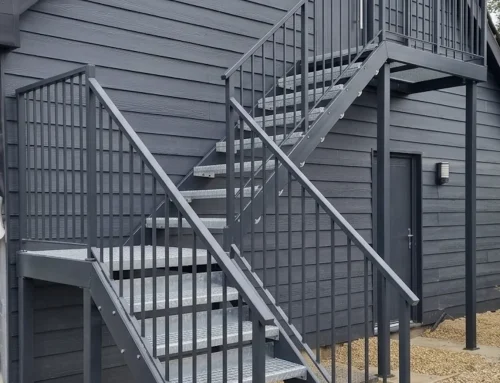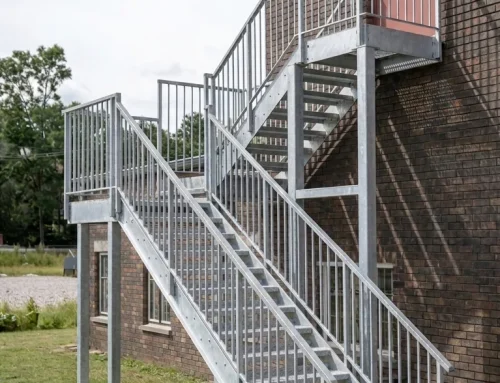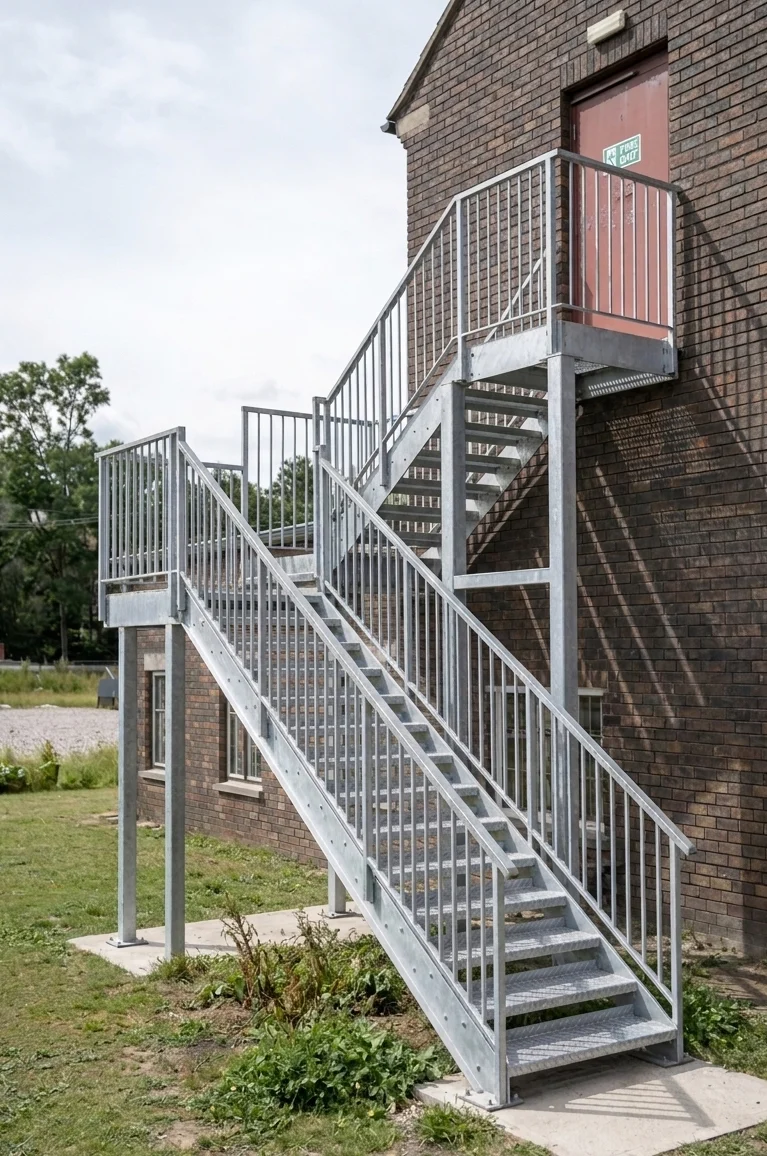

Fire escape staircase maintenance is not discretionary housekeeping — it is a legal obligation under the Regulatory Reform (Fire Safety) Order 2005. Neglecting it creates structural risk, regulatory exposure and, in the worst case, catastrophic failure during an emergency evacuation. This guide sets out a practical, legally grounded maintenance framework for building owners, landlords and facilities managers.
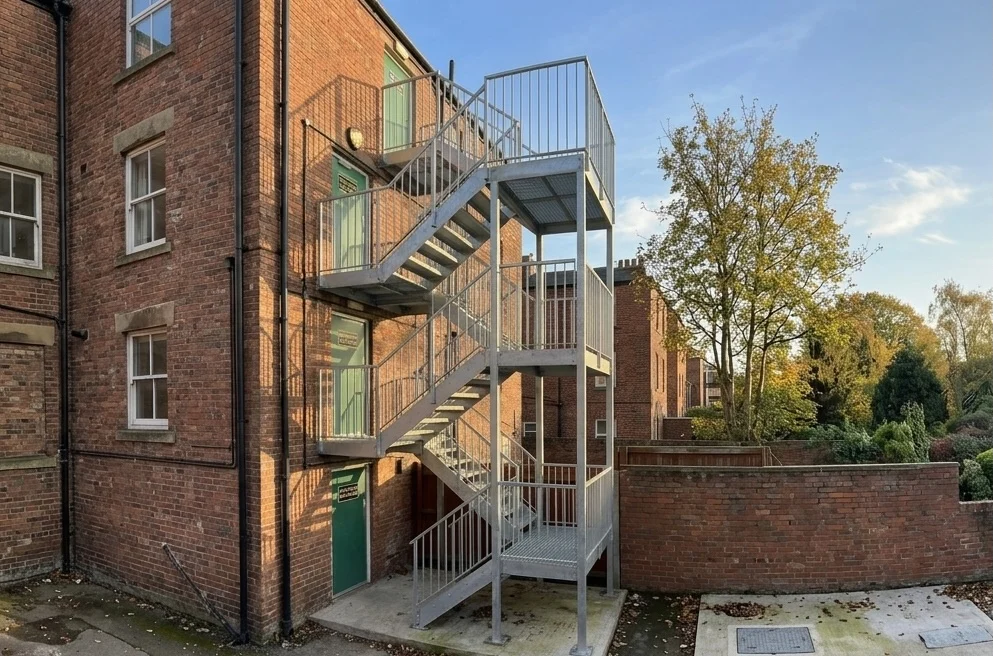
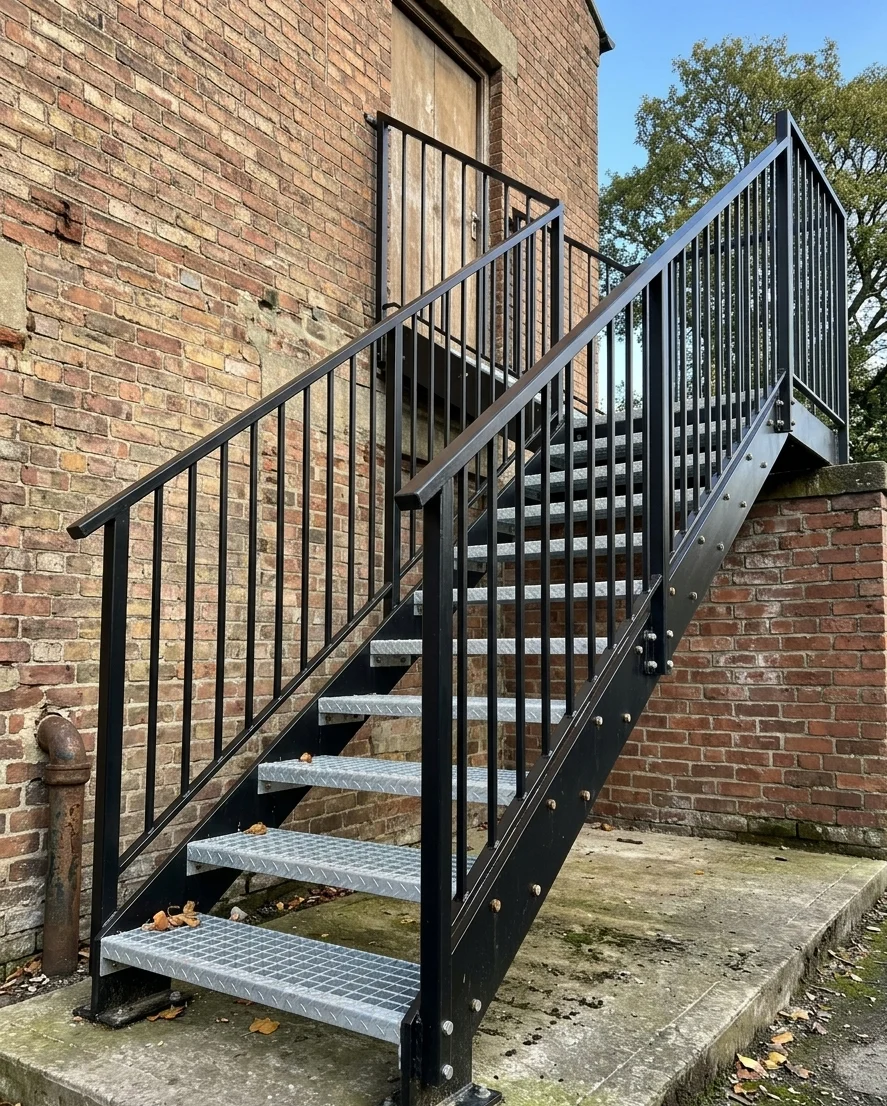
External fire escape staircase maintained to BS 9991 standards — installed and serviced by Continox across the UK.
The Legal Duty to Maintain Fire Escapes
Article 17 of the Regulatory Reform (Fire Safety) Order 2005 places an explicit legal duty on the responsible person to ensure that all fire precautions — including means of escape — are maintained in an efficient state, in efficient working order and in good repair. This is not a passive obligation: it requires proactive, documented maintenance activity, not simply reactive repairs when problems are reported.
For HMO landlords, the maintenance duty is reinforced by the Housing Act 2004, which requires adequate means of escape to be maintained as a condition of the HMO licence. Local authority licensing officers are increasingly requiring written maintenance records as evidence of compliance at licence renewal. For commercial buildings, the duty also applies under the Health and Safety at Work Act 1974, which requires employers to maintain safe workplace conditions including escape routes.
Article 17 — Maintenance of Fire Precautions The Fire Safety Order requires the responsible person to ensure fire precautions are maintained. Failure to comply is a criminal offence under Article 32 of the Order — carrying unlimited fines and, where failure leads to loss of life, potential imprisonment. The fire and rescue authority has powers to issue enforcement notices, prohibition notices and prosecute without warning where serious risk is identified.
Recommended Maintenance Schedule
The following schedule sets out a practical maintenance framework for external steel fire escape staircases in the UK. Adapt the frequency based on the building's exposure, usage intensity and environmental conditions.
Full Structural Inspection
- Structural integrity assessment
- Corrosion depth measurement
- All fixings checked & torqued
- Dimensional compliance check
- Tread surface condition
- Handrail & balustrade security
- Access clearance confirmed
- Written record produced
Corrosion & Fixing Check
- Freeze-thaw damage at welds
- Salt/grit exposure assessment
- Base plate & anchor condition
- Galvanising integrity check
- Tread surface — moss/ice damage
- Powder coat chipping or peeling
Post-Event Assessment
- Post high-wind — fixing movement
- Post flood — corrosion acceleration
- Post snow/ice — tread condition
- Post impact — structural damage
- Visual inspection minimum
- Professional check if in doubt
Documentation is essential. Every inspection — whether by the responsible person or a professional — must be recorded in writing and retained. Records should include: date of inspection, inspector name, findings, any defects identified, remedial actions taken and the date of next scheduled inspection. These records form part of your fire risk assessment documentation and must be available for inspection by the fire authority on request.
Annual Inspection Checklist
Use this checklist to carry out a systematic annual inspection of your external fire escape staircase. Any item that cannot be confirmed as satisfactory should be noted, remedied and re-checked. If in doubt about any structural finding, commission a professional assessment.
Fire Escape Staircase — Annual Inspection Checklist
8 CheckpointsStructural Integrity — No Flex or Movement
Apply moderate manual load to the structure at multiple points. Any perceptible flex, movement or vibration beyond minimal elastic deflection indicates a structural concern. Check for movement at wall fixings, base plates and inter-flight connections.
BS EN 1090 / BS 9991Corrosion Assessment — Surface vs Penetrating
Surface rust on galvanised steel (red-brown staining over an intact zinc layer) is treatable. Penetrating rust that has consumed the zinc layer and is attacking the base metal — identifiable by pitting, flaking scale or section loss — requires immediate assessment. Pay particular attention to welds, fixing holes, cut edges and base plates.
BS EN ISO 1461 / BS 9991All Fixings Secure — Bolts, Anchors, Brackets
Check every accessible fixing point for looseness, corrosion or pull-out. Wall anchor bolts are the most critical — use a calibrated torque wrench to verify torque values match the structural specification. Replace any corroded, missing or damaged fasteners immediately.
BS EN 1090Tread Condition — Non-Slip Surface Intact
Check each tread for: deformation or cracking, moss or algae growth, blocked drainage apertures (on open mesh treads), anti-slip nosing integrity, and any sharp edges or protrusions. Non-slip performance must be maintained at all times — particularly for external staircases exposed to rain and frost.
BS 9991 / Approved Document BHandrail Security & Height Compliance
Check all handrail fixings for security — handrails must not rotate, flex laterally or exhibit any play at fixing points. Verify height at pitch line is within 900–1000mm. Check that handrails are continuous across flights and landings, with no gaps at flight transitions.
Approved Document K / BS 9991Balustrade Height & 100mm Sphere Rule
Measure balustrade height at all landing platforms — minimum 1100mm required. Check that no opening in the infill permits passage of a 100mm sphere. For glass infill panels, check for chips, cracks or delamination at edges and patch fitting locations.
Approved Document K / BS 6180Access Route — Unobstructed at All Times
Confirm the entire escape route — from every access door, across all landings, down all flights and to the final exit at ground level — is clear of any obstruction. Check that access doors open without resistance and do not reduce the staircase clear width below 1000mm when open.
Fire Safety Order 2005 / BS 9991Documentation Review — Records Up to Date
Confirm that structural calculations, CAD drawings and Declaration of Performance (UKCA) documents are on file. Check that the previous inspection record is available and that any previously identified defects have been resolved with evidence. Update the inspection log with today's findings.
Fire Safety Order 2005 / UK CPR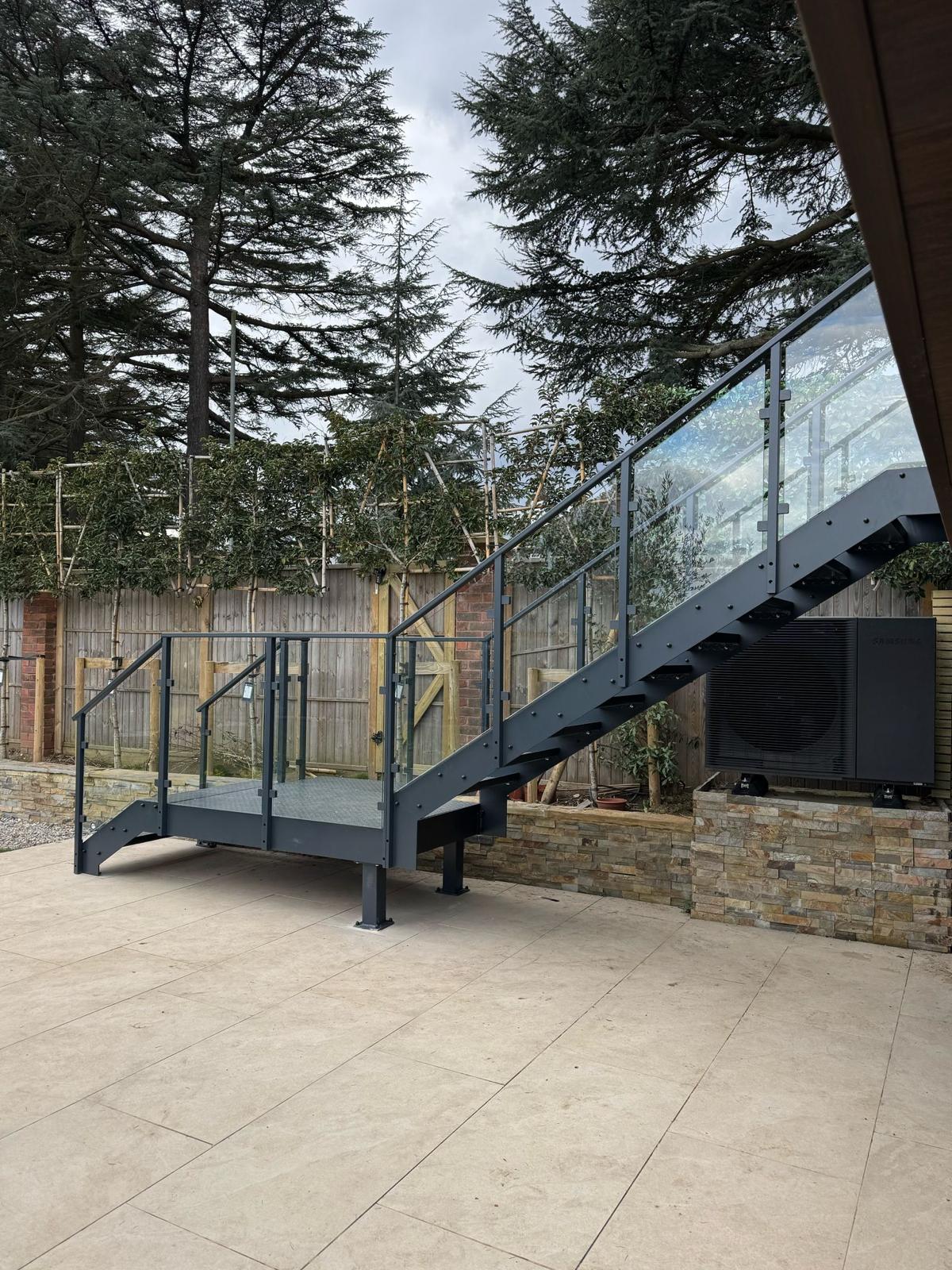
Maintenance vs Replacement: Making the Right Decision
Not every deficiency requires full replacement — but understanding the boundary between what maintenance can and cannot achieve is critical for managing both safety risk and cost effectively.
✓ Maintenance Is Appropriate When:
- Surface rust over intact zinc layer — treat and re-coat
- Loose bolts or fixings — re-torque or replace fasteners
- Chipped or worn powder coating — spot repair with matching paint
- Blocked mesh treads — clean and clear drainage apertures
- Moss or algae on treads — biocide treatment and pressure wash
- Minor weld porosity visible — monitor, document, reassess next inspection
✕ Replacement Required When:
- Penetrating corrosion in structural members — section loss visible
- Structural movement or flex under normal load
- Clear width below 1000mm — dimensional non-compliance
- Base plates or wall fixings corroded beyond re-torque
- Staircase pre-dates BS 9991 — likely non-compliant dimensions
- No structural documentation available — cannot demonstrate compliance
Important distinction: Surface treatment cannot remediate structural section loss. If corrosion has consumed the base metal — even partially — the affected component must be replaced, not painted over. Applying a coating over compromised steel gives the appearance of maintenance while masking an ongoing structural deterioration. When in doubt, commission a professional structural assessment. Continox provides free on-site assessments with a written report and guide price within 24 hours.
Maintaining Your Fire Escape Finish
The maintenance requirements differ depending on whether your fire escape is hot-dip galvanised or powder coated. Understanding the difference helps you target maintenance effort effectively.
Hot-Dip Galvanised Steel
Galvanising provides self-repairing protection — the zinc layer sacrificially protects exposed steel at cut edges and minor damage sites. Annual maintenance consists of: washing down with clean water (removing road salt and grit deposits), visual inspection of zinc layer integrity, and cold galvanising compound application to any areas of red rust. Avoid pressure washing at high pressure directly at welds. Expect 30–50 years of effective protection in most UK environments without major intervention.
Powder Coated Steel
Powder coating requires more proactive maintenance than galvanising. Annual maintenance consists of: wash down with mild soapy water and soft brush (no abrasive cleaners), inspection for chipping, cracking or blistering (particularly at edges and fixing holes), and spot repair of any damage with matching RAL paint to prevent moisture ingress. Blistering of the coating — especially at welds — may indicate corrosion beneath the surface and requires investigation, not simply re-painting.
Documentation & Record Keeping
Written maintenance records are not just good practice — they are a legal requirement under the Fire Safety Order and increasingly required by HMO licensing authorities, commercial insurers and Building Control surveyors. The following table sets out what documentation you should hold and for how long.
| Document | Purpose | Retention Period |
|---|---|---|
| Structural calculations | Demonstrates design compliance to BS EN 1090 / BS 9991 | Life of structure |
| CAD as-built drawings | Reference for dimensions, fixing positions, load paths | Life of structure |
| UKCA Declaration of Performance | Legal requirement for structural steel components | Life of structure |
| Annual inspection records | Evidence of Fire Safety Order Article 17 compliance | Minimum 3 years |
| Remedial works records | Evidence that identified defects were addressed | Minimum 3 years |
| Fire risk assessment | Required for all non-domestic and HMO premises | Current + 1 previous |

When to Call Continox
If your annual inspection identifies structural concerns, dimensional non-compliance or a lack of documentation, the next step is a professional assessment — not further maintenance. Continox provides free on-site surveys across the UK, with a written structural assessment and guide price within 24 hours.
Where replacement is required, our typical lead time from initial enquiry to completed installation is 4–6 weeks — including structural engineering, CAD drawings, fabrication, UKCA marking and professional installation by our in-house team. Residential replacement fire escapes from £3,500 excl. VAT. Commercial multi-landing systems from £5,500 excl. VAT. For details see our fire escape staircase page or our staircase cost guide.
Fire Escape Maintenance — FAQ
Common questions from building owners, landlords and facilities managers about fire escape staircase maintenance in the UK.
Get a Free Professional Assessment
Free on-site survey, written structural assessment and guide price within 24 hours. Replacement fire escapes from £3,500 — installed by our in-house team across the UK.