
Hotels in the UK are subject to more demanding fire escape requirements than most other building types — operating under the Fire Safety Order 2005, Approved Document B, BS 9999 and the Regulatory Reform (Fire Safety) Order simultaneously, with the added complexity of sleeping guests who cannot self-evacuate without assistance. This guide covers the specific legal framework, technical requirements and design considerations that apply to fire escape staircases in UK hotels — and what to expect from a professional installation.
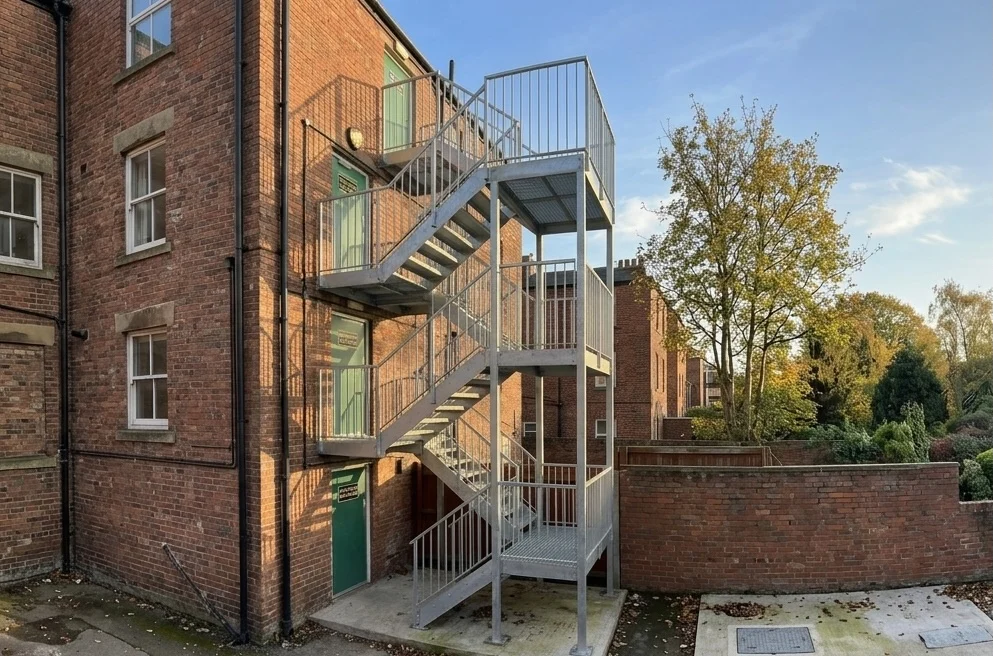
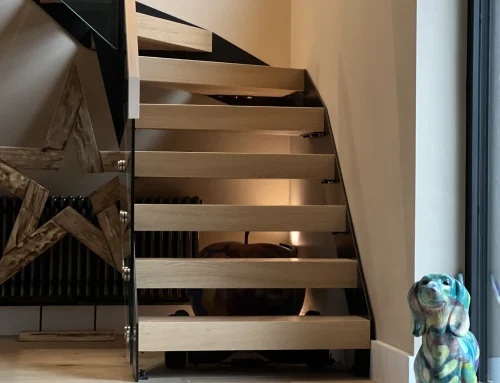
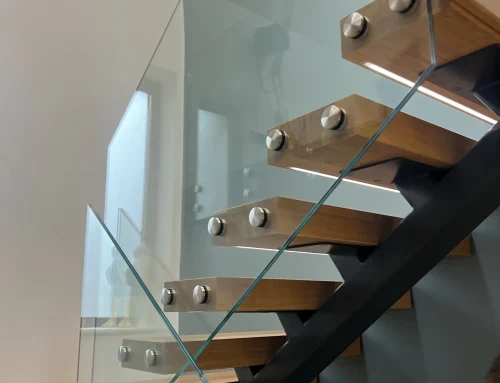
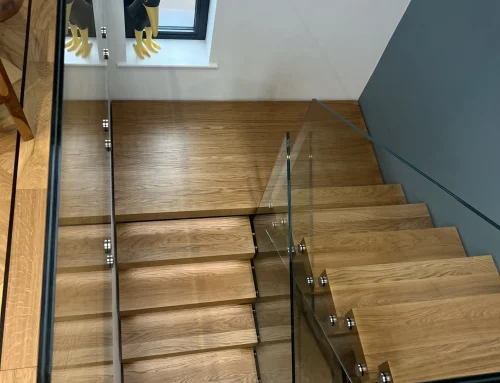
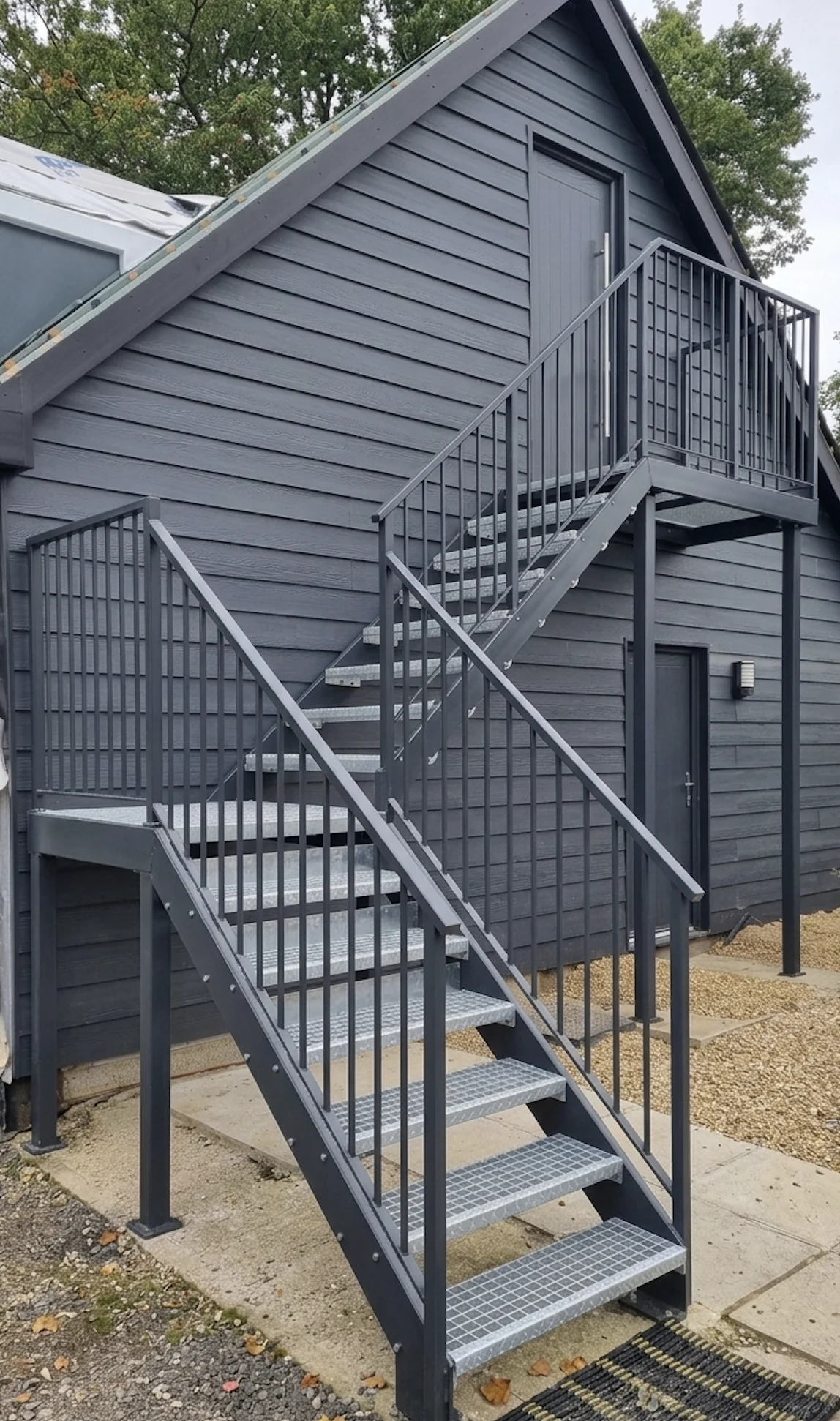
Commercial fire escape staircase installed by Continox — BS 9999 compliant, UKCA marked, powder-coated finish. Suitable for hotels, guesthouses and multi-storey hospitality buildings.
The Legal Framework for Hotel Fire Escapes
Hotels operate under a layered legal framework that is more complex than standard commercial premises. Understanding which legislation applies — and how the obligations interact — is the starting point for any fire escape compliance project.
Regulatory Reform (Fire Safety) Order 2005
The Fire Safety Order applies to all non-domestic premises including hotels, guesthouses and B&Bs. It places a legal duty on the responsible person — the hotel owner or operator — to carry out a fire risk assessment, implement adequate means of escape, and maintain those means of escape in good working order. All escape routes, including external fire escape staircases, must be kept clear, structurally sound and compliant at all times. Non-compliance is a criminal offence under Article 32, carrying unlimited fines and potential imprisonment.
Approved Document B (Fire Safety)
Approved Document B provides the technical guidance for Building Regulations compliance in relation to fire safety. For hotels, it sets out means of escape requirements by occupancy type and storey count — including minimum staircase widths scaled to occupant numbers, travel distances to the nearest protected staircase, enclosure requirements for protected routes, and structural performance under fire conditions. Hotels above 18m are subject to additional requirements under the Building Safety Act 2022 following the Grenfell inquiry.
BS 9999: Fire Safety in Non-Domestic Buildings
BS 9999 is the British Standard specifically covering fire safety in the design, management and use of non-domestic buildings — including hotels. It provides detailed technical requirements for fire escape staircases including dimensional specifications, structural load requirements, tread surface standards and balustrade specifications. All Continox commercial fire escape installations are engineered to BS 9999. This standard is the commercial equivalent of BS 9991 which covers residential buildings.
Licensing Act 2003 & Local Authority Conditions
Hotels with licensed premises — bars, restaurants, function rooms — are also subject to licensing conditions set by the local authority, which typically include specific fire safety requirements. Licensing officers can impose conditions requiring fire escape routes to meet specific standards as a condition of the licence. These conditions are in addition to the Fire Safety Order obligations and are enforced separately. A fire escape staircase that satisfies Building Regulations may still need to meet additional conditions set at licence level.
Sleeping risk — the most critical factor for hotels. The Fire Safety Order categorises hotels as sleeping risk premises — a category that attracts the highest level of regulatory scrutiny. Guests who are asleep cannot self-evacuate without being alerted and assisted. This means the means of escape — including external fire escape staircases — must be capable of handling the full occupant load at any hour, in any condition, without prior warning. The fire and rescue authority gives sleeping risk premises priority for inspection and enforcement.
Technical Requirements: Hotel Fire Escape Dimensions
The following dimensional requirements apply to external fire escape staircases in hotel and hospitality buildings under Approved Document B, BS 9999 and Approved Document K. Note that these are the minimum requirements — local fire risk assessors and Building Control officers may specify more demanding dimensions based on occupant load and building configuration.
| Requirement | Hotel / Commercial Specification | Standard |
|---|---|---|
| Min Clear Width | 1000mm minimum — may be wider based on occupant load | BS 9999 / Approved Document B |
| Max Rise (per step) | 190mm | Approved Document K |
| Min Going (tread depth) | 250mm | Approved Document K |
| Max Pitch | 38° | Approved Document K |
| Min Headroom | 2000mm throughout | Approved Document K |
| Handrail Height | 900–1000mm above pitch line | Approved Document K |
| Handrails Both Sides | Required if width exceeds 1000mm | BS 9999 |
| Landing Balustrade | 1100mm minimum | Part K / BS 6180 |
| Max Balustrade Opening | 100mm sphere rule | Approved Document K |
| Horizontal Load | 3.0 kN/m — commercial specification | BS 6180 |
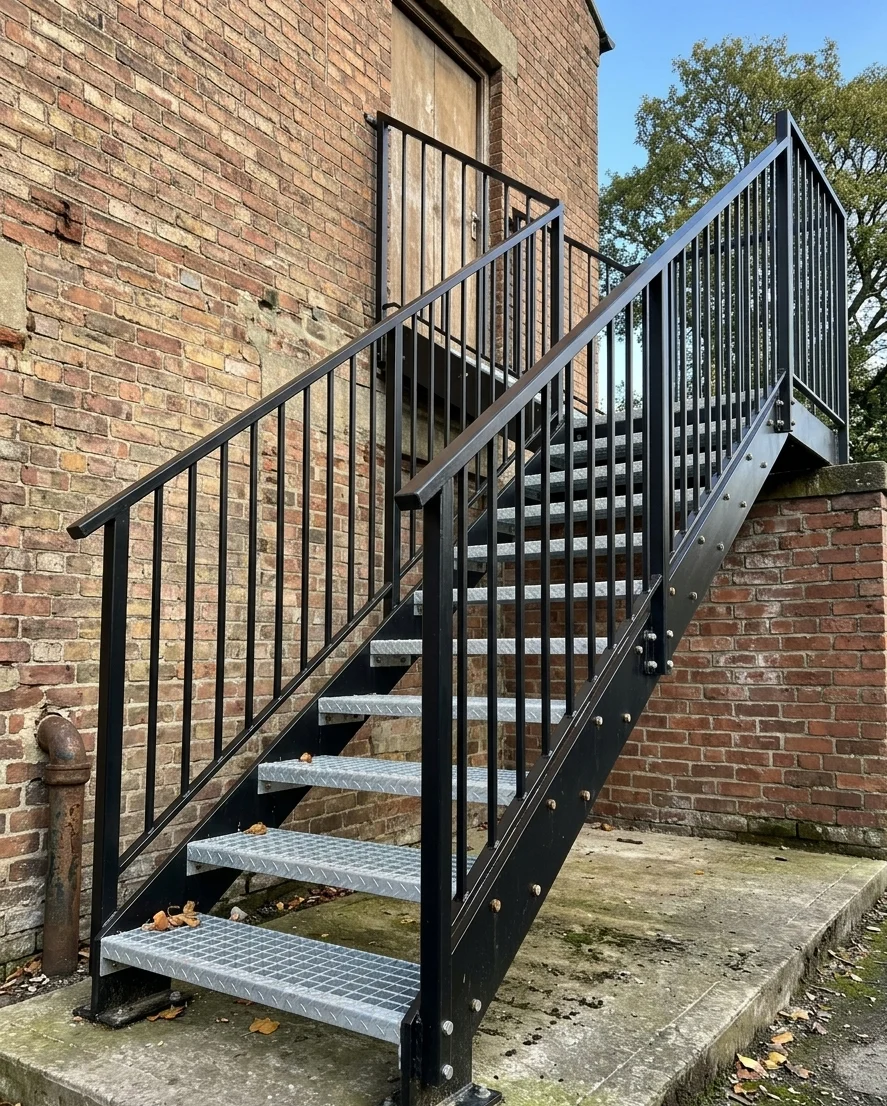
| Tread Surface | Non-slip — open mesh, perforated steel or anti-slip coating | BS 9999 / Approved Document B |
| Structural Standard | BS EN 1090 — structural steel fabrication | BS EN 1090 |
| UKCA Marking | Required — Declaration of Performance | UK CPR |
Occupant load determines minimum width. Approved Document B scales the minimum staircase width to the number of occupants using the escape route. For a 1000mm clear width, the maximum simultaneous occupant load is typically 220 persons. Larger hotels with higher floor-level occupancy may require 1200mm or 1400mm clear widths. Your fire risk assessor calculates the required width for each escape route based on the specific floor-by-floor occupancy. Continox designs to the specified width — confirmed at the free on-site survey.
Hotel vs Residential: Key Differences
The requirements for a fire escape staircase in a hotel are significantly more demanding than those for a residential property. Understanding the specific differences avoids the common error of specifying a residential-grade installation in a commercial-use building.
- Horizontal load 3.0 kN/m (BS 6180 commercial)
- Max rise 190mm — common stair requirement
- Min going 250mm — common stair requirement
- Max pitch 38° vs 42° residential
- Landing balustrade 1100mm minimum always
- Open risers not permitted on common stairs
- Fire Safety Order applies in full — at all times
- Sleeping risk — highest enforcement priority
- May require wider staircase based on occupant load
- Licensing conditions may add further requirements
- Horizontal load 0.74 kN/m (BS 6180 residential)
- Max rise 220mm — private stair allowance
- Min going 220mm — private stair allowance
- Max pitch 42°
- Landing balustrade 900mm at ground floor
- Open risers permitted (100mm sphere rule)
- Fire Safety Order applies to common areas only
- Lower enforcement priority than sleeping risk
- 1000mm clear width standard minimum
- No licensing conditions
A residential-spec fire escape in a hotel is non-compliant. A balustrade certified to 0.74 kN/m residential load cannot be used in a hotel application requiring 3.0 kN/m commercial load. The difference is a factor of four. Similarly, private stair tread dimensions (max rise 220mm, min going 220mm) do not satisfy the common stair requirements that apply to hotel escape routes (max rise 190mm, min going 250mm). All Continox commercial fire escape installations are engineered and certified to the commercial specification as standard.
Multi-Storey Hotels: Multi-Landing Systems
Hotels of two or more storeys require fire escape systems that provide an independent means of escape from every floor level — with intermediate platforms at each storey. These multi-landing systems are structurally more complex than single-flight residential fire escapes and require careful engineering to manage cumulative structural loads, differential movement between landings, and the higher horizontal load requirements of commercial use.
Two-Storey Hotel
Single flight with intermediate landing at first floor. Typical for converted guesthouses and smaller boutique hotels. Access from both ground and first floor levels via individual access doors at each landing platform.
Three to Four Storeys
Two or three flights with landings at each storey. The most common configuration for mid-size UK hotels. Structural loading increases significantly with each additional flight — cumulative load management is critical at the base structure and wall fixings.
Five Storeys and Above
Complex multi-landing systems requiring detailed structural engineering. Buildings above 18m are subject to additional Building Safety Act 2022 requirements. Separate structural engineer involvement is advisable alongside the staircase installer for buildings of this height.
Continox designs and installs multi-landing commercial fire escape systems across the UK — from two-storey guesthouse conversions to multi-storey commercial hotel developments. All systems include full structural engineering to BS EN 1090 and BS 9999, CAD drawings for Building Control, UKCA marking and Declaration of Performance. See our full external staircase range and fire escape staircase page for system details and guide prices.
Design Considerations for Hotel Fire Escapes
Hotel operators increasingly require fire escape staircases that satisfy compliance requirements without detracting from the building's external appearance. A poorly finished fire escape on the rear elevation of a boutique hotel is as much a commercial problem as a safety concern. The following design decisions allow compliance and aesthetics to be achieved simultaneously.
Powder Coating — Any RAL Colour
All Continox commercial fire escape staircases are available in any RAL powder-coat colour — allowing the staircase to match the building's exterior cladding, render colour or window frame finish. Applied over a hot-dip galvanised primer (duplex system), powder coating provides both long-term corrosion protection and the visual finish quality required for a contemporary hotel exterior. The most common specifications for hotel projects are RAL 9005 (jet black), RAL 7016 (anthracite grey) and RAL 7035 (light grey).
Hot-Dip Galvanising
For hotels in coastal, high-exposure or industrial environments, hot-dip galvanising to BS EN ISO 1461 provides the most durable long-term corrosion protection — with a service life of 30–50 years in most UK environments. The silver-grey finish of galvanised steel suits exposed industrial or heritage settings and requires minimal ongoing maintenance. For maximum durability in marine environments, galvanising as the sole finish — rather than as a primer for powder coating — is the preferred specification.
Glass Infill Panels
For boutique and design-led hotels, glass infill panels in the balustrade — rather than steel bar or mesh infill — add visual lightness and a contemporary finish that complements high-specification hotel exteriors. External glass balustrade panels require toughened & laminated glass (BS EN 14449), marine-grade stainless steel fixings and weather-sealed base channels. This specification integrates with our broader glass balustrade range and can be applied to fire escape landing platforms and intermediate balustrade sections.
Integrated Access Control
Hotel fire escapes require access doors at each floor level that are openable from the inside at all times without a key — under the Fire Safety Order, escape routes must be immediately usable in an emergency. Access doors can be integrated with electronic access control (card or code entry from outside) while maintaining free egress from the inside. Continox coordinates the structural opening dimensions and fixings for access door installation — door supply and fitting by the client's preferred supplier.
What Continox Provides for Hotel Projects
Every Continox hotel fire escape installation includes the full technical documentation package required for Building Control, fire risk assessment and licensing authority review — all included in the project price.
Free On-Site Survey
Site visit to assess structural substrate, measure the opening and confirm access door positions. Written guide price within 24 hours. No charge, no obligation.
Structural Calculations
Full structural engineering to BS EN 1090 and BS 9999 — covering commercial load requirements (3.0 kN/m), fixing design and material specification. Signed by a qualified structural engineer.
CAD Drawings — PDF & DWG
Detailed as-built drawings showing all dimensions, fixing positions and compliance notes. Suitable for Building Control submission and fire risk assessment documentation.
UKCA Marking & Declaration of Performance
All structural steel components carry UKCA marking and a Declaration of Performance under UK Construction Products Regulations — a legal requirement and increasingly required by licensing authorities and commercial insurers.
Compliance Schedule
Written schedule confirming every BS 9999 and Approved Document K dimension — rise, going, pitch, headroom, handrail height, balustrade height, load specification — for the specific design. Simplifies Building Control and fire authority inspection.
Professional Installation
Installed by Continox's in-house team — no subcontractors. Typically 2–4 days on site for a multi-landing hotel installation. Site left clean on completion with all compliance documentation handed over.
Hotel Fire Escape Staircase Guide Prices
The following guide prices cover the most common hotel fire escape configurations. All prices are for supply and installation, excluding VAT, and include the full documentation package described above. A fixed price is provided following the free on-site survey.
For full pricing information across all external staircase types including fire escapes, see our external staircase page and our dedicated fire escape stairs page. For staircase dimension requirements see our UK Staircase Building Regulations guide.
Hotel Fire Escape Stairs — FAQ
Common questions from hotel owners, operators and facilities managers about fire escape staircase requirements in UK hospitality buildings.
Free Survey, Full Documentation & Fixed-Price Quote
Free on-site survey, structural calculations, CAD drawings, UKCA marking and fixed-price quotation within 24 hours. Commercial fire escape staircases from £5,500 — designed, engineered and installed across the UK.