
If you own or manage a House in Multiple Occupation, the fire escape staircase is the single most critical safety element in the building — and the one most likely to trigger enforcement action if it fails to meet standards. HMO fire escape requirements go significantly beyond standard residential building regulations, with additional obligations under the Housing Act 2004, the Regulatory Reform (Fire Safety) Order 2005, and your local council's licensing conditions. This guide covers every staircase and escape route requirement for HMO properties in England, with specific guidance by storey count, and the real costs of compliance in 2026.
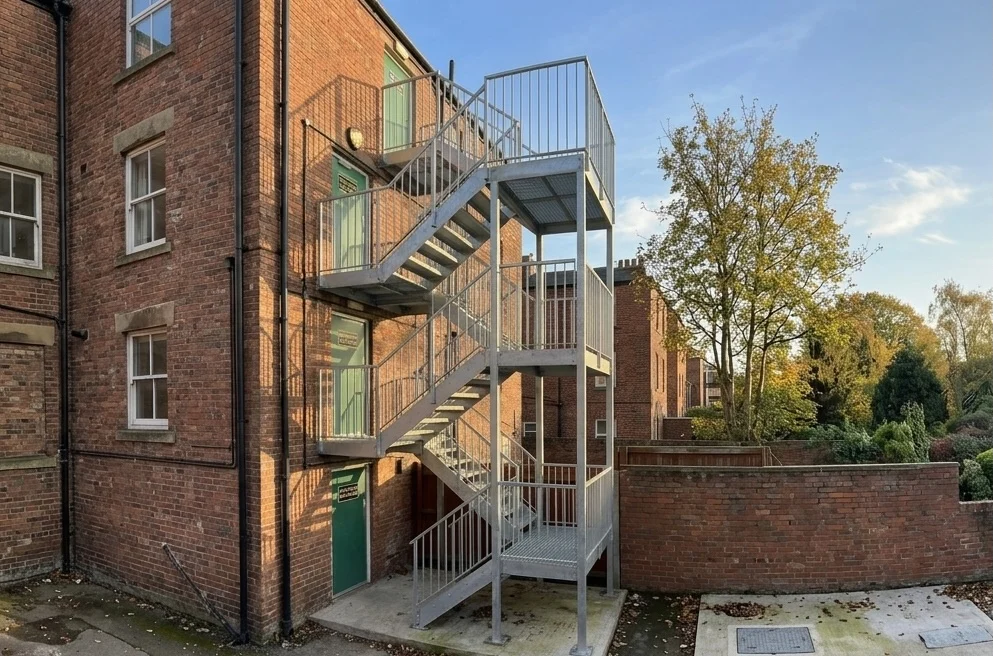
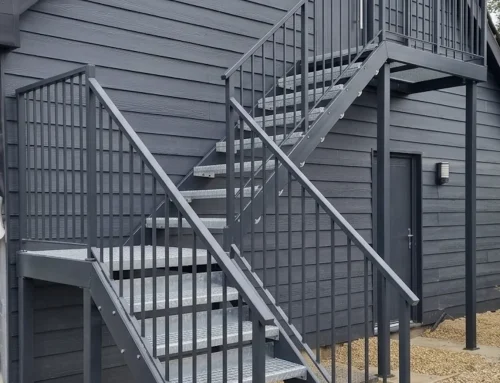
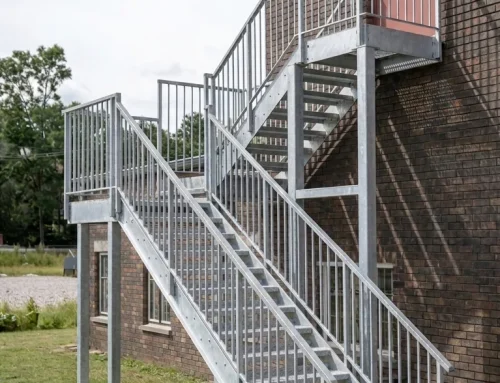
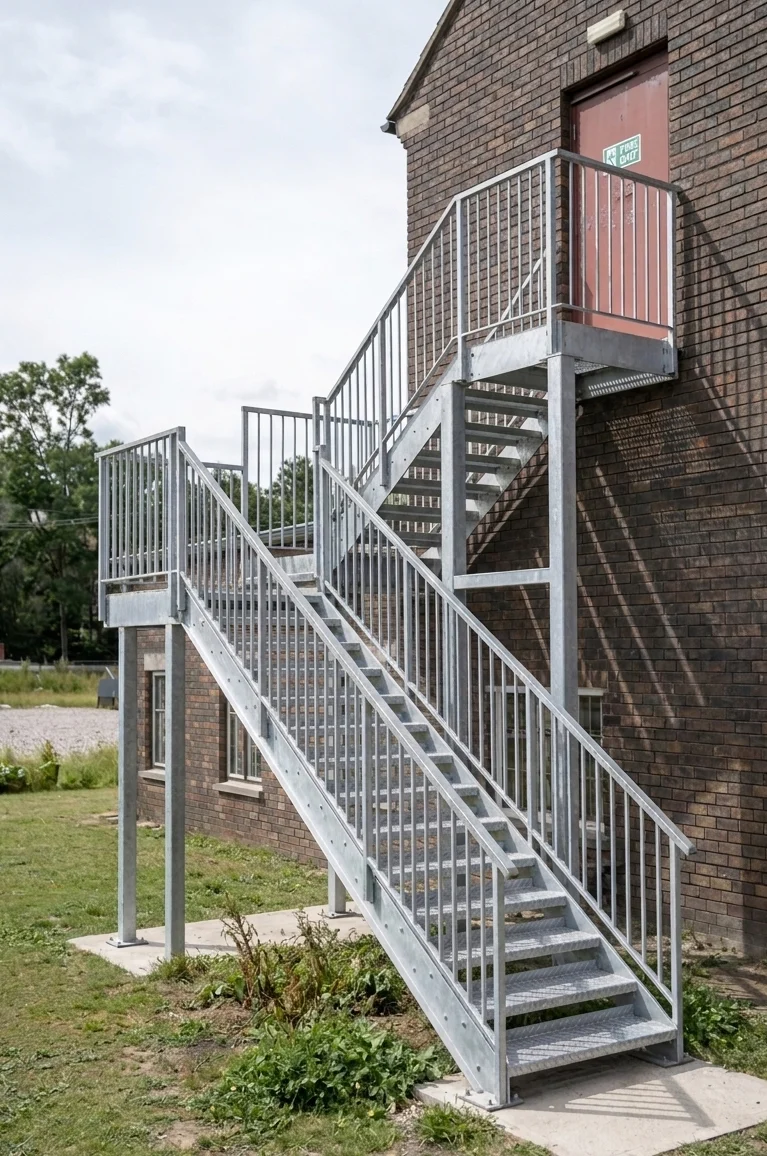
A galvanised steel external fire escape staircase on a multi-storey HMO — designed, manufactured, and installed by Continox
HMO fire escape requirements mandate a protected escape route — typically the main internal staircase enclosed by 30-minute fire-resistant construction, with FD30 self-closing fire doors on all rooms opening onto it, thumb-turn locks on final exit doors, and a clear unobstructed path to the outside. Three-storey HMOs require Grade A fire alarm systems (BS 5839 Part 6, Category LD2), emergency lighting in escape routes, and — where the internal route is compromised — an external fire escape staircase as an alternative means of escape. External fire escape stairs must meet BS 9991 / BS 5395 with minimum 1,000mm clear width, 150–190mm rise, ≥250mm going, galvanised steel construction, and 1,100mm balustrade height at landing level. Non-compliance penalties include fines up to £30,000 per offence, prosecution, licence revocation, and rent repayment orders.
Who This Guide Is For — And Why It Matters
This guide is written for HMO landlords, property managers, and letting agents responsible for ensuring fire safety compliance. If you own a property occupied by three or more tenants from two or more households who share facilities, you are operating an HMO — and the fire safety requirements are substantially more demanding than for a standard rental property.
The consequences of non-compliance are severe. Councils can issue financial penalties of up to £30,000 per offence, prosecute landlords with unlimited fines and up to two years imprisonment, revoke HMO licences (stopping rental income immediately), and issue rent repayment orders requiring you to return up to 12 months of rent. Following the Grenfell tragedy, the Fire Safety Act 2021 and Building Safety Act 2022 have given fire and rescue authorities stronger enforcement powers — and they are using them.
Insurance warning: In the event of a fire, your insurer will check whether the property met fire safety standards at the time of the incident. Non-compliant fire escape routes, missing fire doors, or inadequate alarm systems can void your building insurance policy entirely — leaving you personally liable for all losses, including injury or death claims.
The Legislation — Three Laws That Apply Simultaneously
1 Housing Act 2004
The Housing Act 2004 requires HMOs to meet minimum fire safety standards as a condition of licensing. Your local council sets specific licensing conditions — which may exceed the national minimum standards — and can enforce them through improvement notices, prohibition orders, and financial penalties. The Act defines what constitutes an HMO and establishes mandatory licensing for properties with five or more occupants from two or more households.
2 Regulatory Reform (Fire Safety) Order 2005 (RRO)
The RRO requires the "responsible person" (usually the landlord or managing agent) to carry out a fire risk assessment of all common parts of the HMO and to implement the findings. The fire risk assessment must identify hazards, evaluate risks, and specify the fire safety measures required — including escape routes, fire detection, emergency lighting, and structural fire protection. The RRO is enforced by the local fire and rescue authority, separately from council housing enforcement.
3 Building Regulations (Approved Document B)
If you are converting a property to HMO use, or making structural alterations to an existing HMO, Approved Document B governs the fire safety design of the building — including the staircase, escape routes, and structural fire resistance. Building Control approval is required for any material changes to the fire escape route or staircase structure.
Internal Escape Routes — Requirements by Storey Count
The fire escape requirements for an HMO depend primarily on how many storeys the property has. More storeys means longer escape routes, higher risk, and more demanding fire protection requirements.
Two-storey HMO
The main staircase must be a 30-minute protected escape route — enclosed by walls, floors, and ceilings with 30-minute fire resistance, with FD30 self-closing fire doors on all rooms opening onto the stairwell. The staircase must lead directly to a final exit door that opens onto a place of safety outside the building. The final exit door must be openable from inside without a key — typically a thumb-turn mortice lock.
Fire alarm: Grade D1, Category LD2 minimum — mains-powered interlinked smoke detectors in all escape routes and high-risk rooms (kitchen, living room), plus heat detectors in kitchens. Emergency lighting is usually not required unless the escape route has no natural light.
Three-storey HMO
Three storeys is the threshold where requirements step up significantly. The protected stairwell must run the full height of the building with 30-minute fire resistance on all enclosing surfaces. FD30S self-closing fire doors are required on every room opening onto the stairwell — with intumescent strips and cold smoke seals.
Fire alarm: Grade A, Category LD2 — a panel-controlled system with smoke detectors in all escape routes and high-risk rooms, heat detectors in kitchens, manual call points at every final exit and entrance to the stairwell, and separate sounders. This is a commercial-grade system, not domestic smoke alarms.
Emergency lighting: required in all escape routes — stairwells, corridors, and landings. Must provide 3 hours of illumination on battery backup, tested monthly and annually.
The three-storey trigger: A basement counts as a storey. A property with a basement, ground floor, and first floor is a three-storey building for fire safety purposes — even if the basement is only used for storage. Many landlords are caught out by this classification. If you have a basement, confirm the storey count with your council before assuming two-storey requirements apply.
Four-storey HMO and above
At four storeys, a protected lobby or corridor approach between the stairway and all floors (except the top floor) is required. If protected lobbies cannot be provided due to the building layout, an alternative means of escape — typically an external fire escape staircase — becomes necessary. The fire alarm system upgrades to Grade A, Category LD1 (detectors in every room except bathrooms and toilets).
| HMO Storeys | Fire Alarm Grade | Emergency Lighting | External Escape Likely? |
|---|---|---|---|
| 2 storeys | Grade D1, LD2 | Usually not required | Rarely |
| 3 storeys | Grade A, LD2 | Required in escape routes | Sometimes (if internal route compromised) |
| 4+ storeys | Grade A, LD1 | Required throughout | Often required |
When You Need an External Fire Escape Staircase
An external fire escape staircase is required when the fire risk assessment identifies that the internal escape route is not adequate — typically in the following situations.
The internal staircase does not discharge directly to a final exit (for example, the staircase opens into a kitchen or living room before reaching the front door). The building has four or more storeys and protected lobbies cannot be provided. The layout creates an "inner room" situation where a tenant must pass through another tenant's room to reach the escape route. The council's licensing conditions specifically require an alternative means of escape. The fire risk assessment identifies an unacceptable risk on the internal route that cannot be mitigated by fire doors and detection alone.
Continox HMO projects: We regularly design and install external fire escape staircases for HMO properties across Southern England. The most common scenario is a three-storey Victorian terrace converted to bedsit accommodation, where the internal staircase passes directly through the ground-floor kitchen — creating an unacceptable fire risk on the primary escape route. An external steel staircase from the first and second floors to ground level provides a compliant alternative escape route.
External Fire Escape Staircase — Technical Specifications
An external fire escape staircase on an HMO must comply with BS 9991 (fire safety in residential buildings), BS 5395 (stairs), and Approved Document B. The requirements are more demanding than for a residential loft conversion staircase.
| Requirement | Value | Standard |
|---|---|---|
| Minimum clear width | 1,000mm | BS 9991 |
| Rise per step | 150–190mm | BS 9991 (common stair) |
| Going (tread depth) | ≥250mm | BS 9991 (common stair) |
| Maximum pitch | 38° | Common / fire escape stair |
| Headroom | ≥2,000mm | Approved Document K |
| Handrail height (stairs) | 900–1,000mm | BS 9991 |
| Balustrade height (landing) | 1,100mm | BS 6180 (elevated / commercial) |
| Material | S275 or S355 structural steel | BS EN 1090 |
| Protection | Hot-dip galvanised (ISO 1461) | 85–200μm zinc coating |
| Treads | Open-mesh or chequer plate (anti-slip) | Non-slip surface mandatory |
| Landing at each floor | ≥ width of stair × 900mm depth | Clear, unobstructed |
| 100mm sphere rule | No sphere may pass through balustrade | Part K / BS 6180 |
For the full specifications of external fire escape staircases, including galvanising vs powder coating, duplex systems, and maintenance requirements, see our dedicated fire escape stairs page and our guide on external staircases.
 Galvanised fire escape — multi-landing design for 3-storey HMO
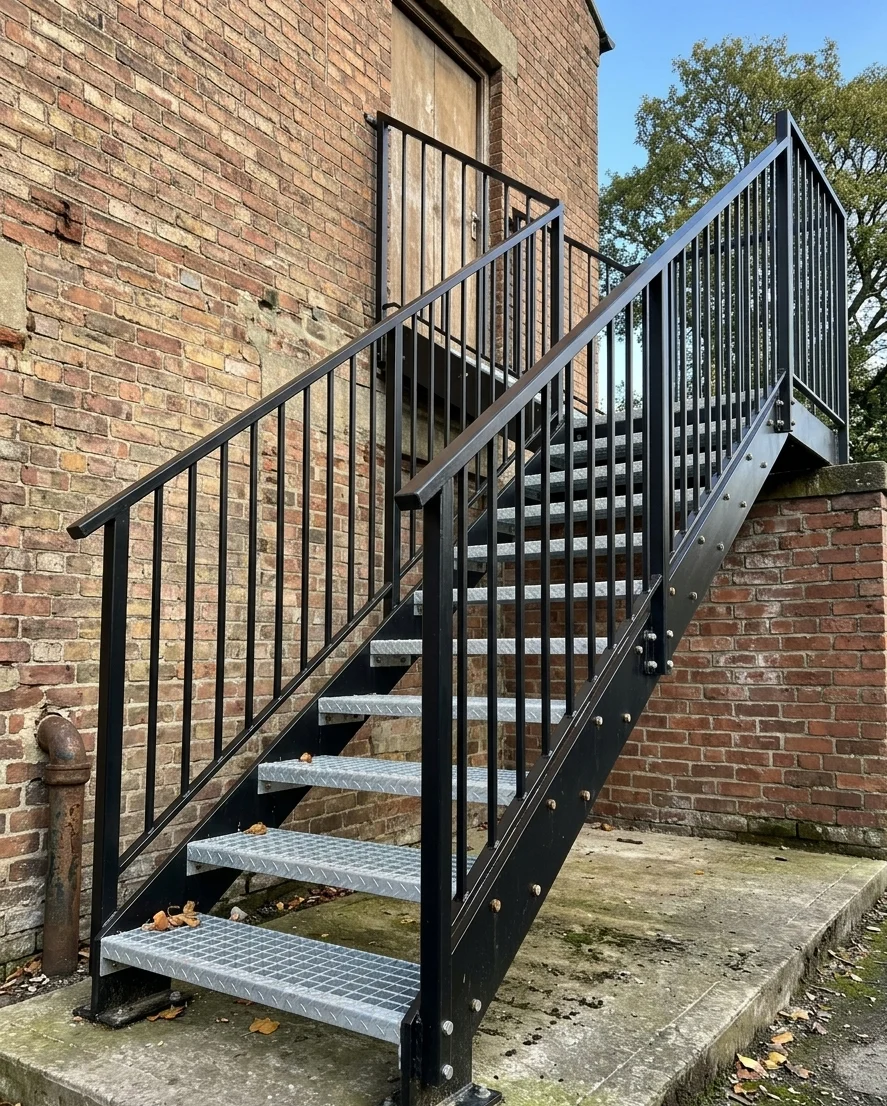 Powder coated external staircase — duplex finish for coastal environments
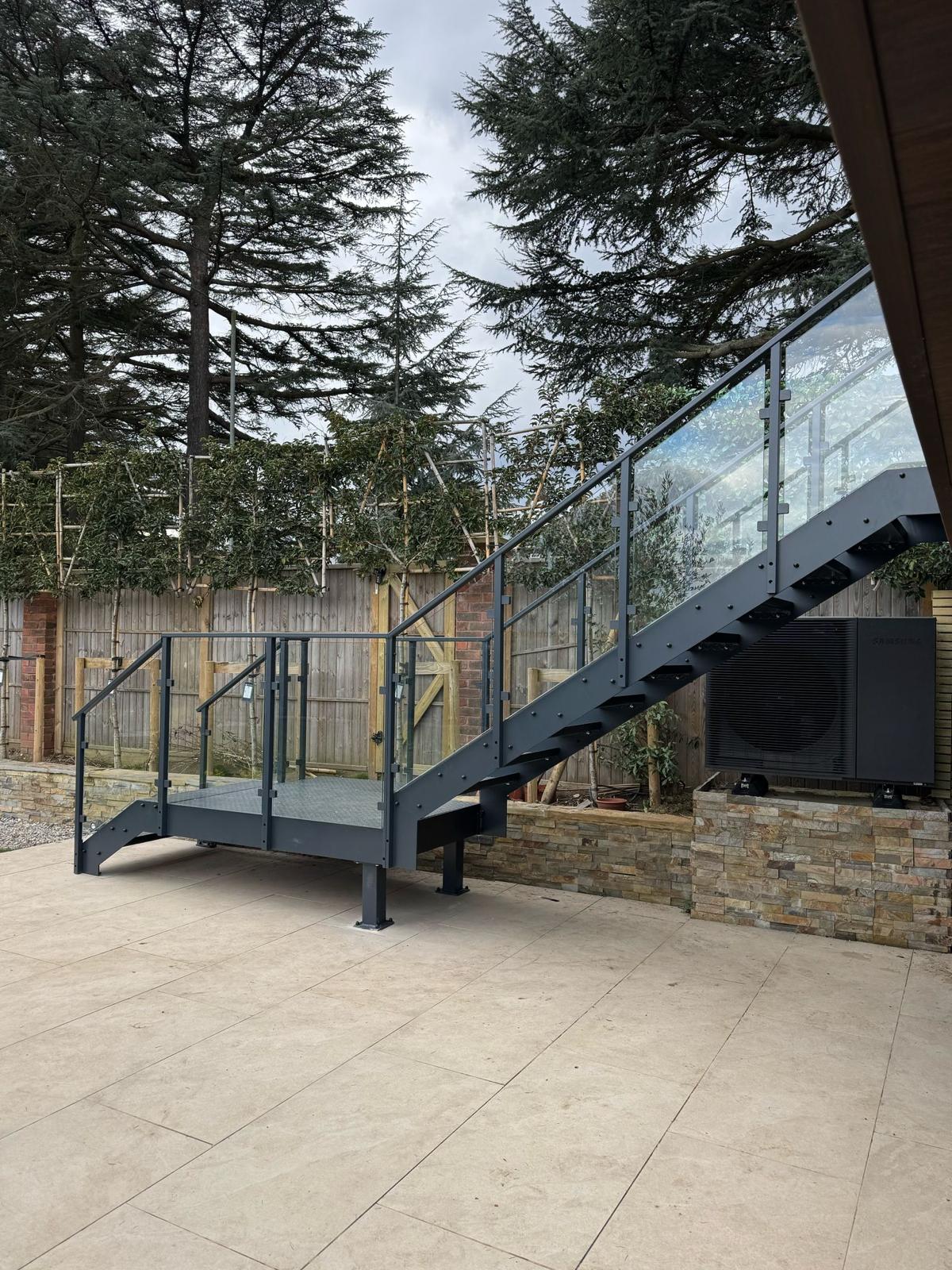
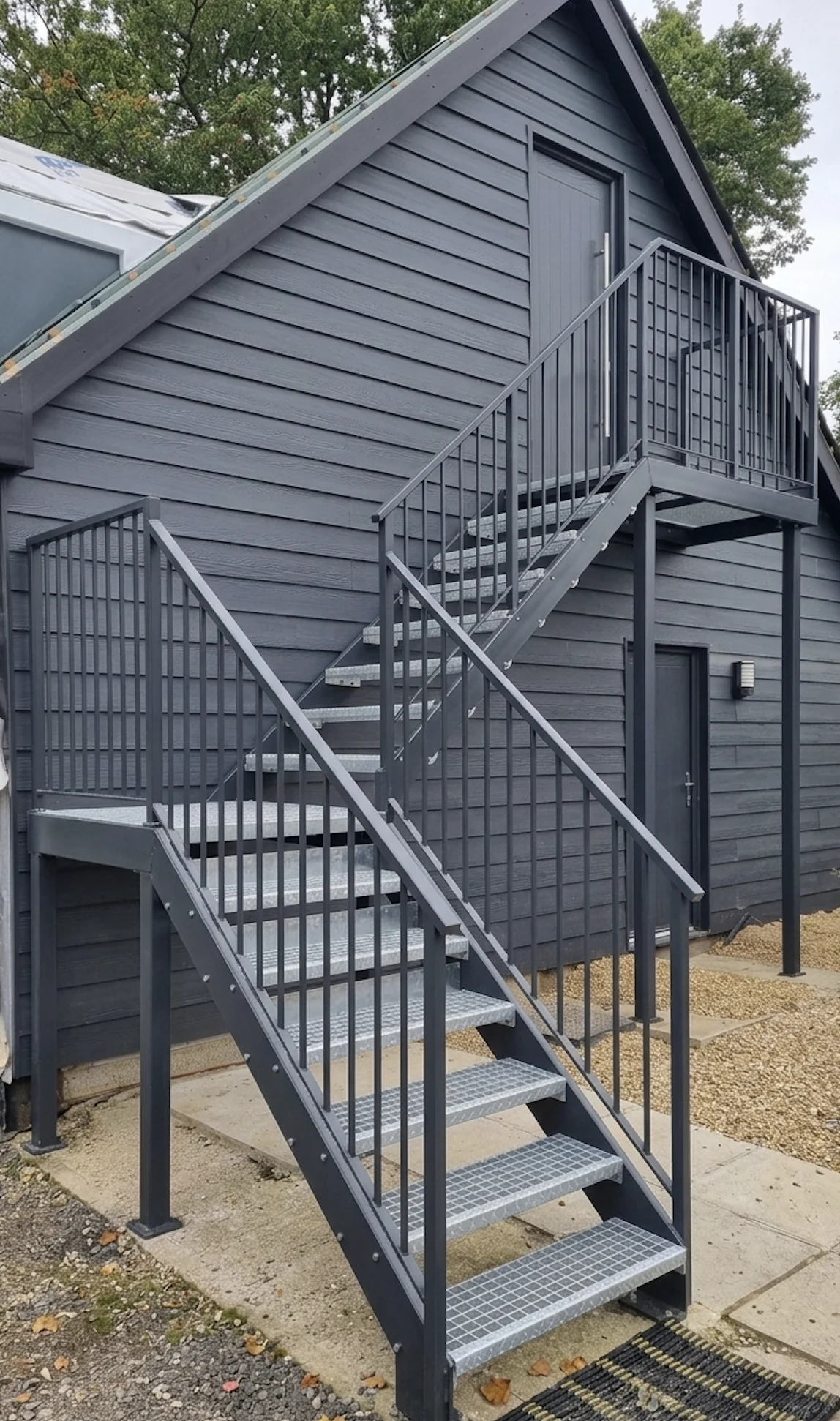 Right-turn configuration — landing at each floor level for compliant access
 External spiral fire escape — compact footprint for constrained sites
Fire Doors — The Requirement Most Landlords Get Wrong
Every door opening onto the protected escape route in an HMO must be a self-closing fire door. This is the single requirement that generates the most enforcement notices, because many landlords install fire doors but neglect critical details.
Compliant HMO fire doors must be FD30 rated (30-minute fire resistance), fitted with intumescent strips (which expand in heat to seal the gap between door and frame), cold smoke seals (brush strips that prevent smoke passing around the door edges), self-closing devices complying with BS EN 1154 (hydraulic overhead closers — not rising butt hinges, which rarely produce a reliable close), three steel hinges, and a latch that holds the door firmly in the closed position.
Room locks must be escape-type — openable from inside without a key. Thumb-turn mortice locks are the standard solution. Never use double-locked deadbolts on escape route doors — this is a serious fire safety offence.
The final exit door (front door) must also be openable from inside without a key. A thumb-turn Yale or mortice escape lock is the standard. Key-operated locks on final exit doors are one of the most common — and most dangerous — fire safety failures in HMOs.
Fire Detection and Alarm Systems — What Your HMO Needs
The type of fire alarm system required depends on the property's storey count, layout, and occupation type. The grading and categorisation follows BS 5839 Part 6.
| System | What It Means | Typical HMO Use |
|---|---|---|
| Grade D1 | Mains-powered alarms with tamper-proof 10-year lithium battery backup | Small 2-storey shared houses |
| Grade A | Commercial panel-controlled system with control panel, manual call points, detectors, and sounders | 3+ storey HMOs, bedsit HMOs |
| Category LD2 | Detectors in all escape routes + high-risk rooms (kitchens, living rooms) | Standard HMO requirement |
| Category LD1 | Detectors in all rooms (except bathrooms/toilets) | 4+ storey HMOs, high-risk layouts |
Grade D2 systems (with user-replaceable batteries) are no longer compliant for HMOs — tenants frequently remove batteries, making the system useless. If your property still has Grade D2 alarms, upgrade immediately.
Cost: Grade D1 interlinked system for a 6-bed HMO: £300–£600 installed. Grade A panel-controlled system: £2,500–£6,000 depending on property size and complexity.
HMO Fire Escape Staircase Costs — 2026 Pricing
| Item | Cost Range | Notes |
|---|---|---|
| External fire escape (residential HMO, 2 landing) | From £3,500 | Galvanised steel, BS 9991 compliant |
| External fire escape (3+ landing, commercial) | From £5,500 | Multi-storey, heavier structural loads |
| Duplex finish (galvanised + powder coat) | +£800–£1,500 | 40–60 year service life |
| Fire doors (FD30, per door fitted) | £120–£300 | Including intumescent strips, closers, seals |
| Grade D1 alarm system (6-bed) | £300–£600 | Mains-powered, interlinked, LD2 |
| Grade A alarm system (6-bed) | £2,500–£5,000 | Panel-controlled, LD2, BS 5839 cert |
| Emergency lighting (per floor) | £200–£400 | BS 5266, 3-hour battery backup |
| Fire risk assessment (professional) | £150–£350 | IFE/BAFE registered assessor |
| Building Control approval | £200–£500 | For structural alterations |
Total compliance cost example: A three-storey Victorian terrace being converted to a 6-bed HMO typically requires: external fire escape (£5,500), 6× FD30 fire doors (£1,500), Grade A alarm system (£3,500), emergency lighting (£800), fire risk assessment (£250), and Building Control (£350). Total: approximately £11,900. This is a one-off capital investment that protects your licence, your insurance, your tenants, and your business.
The Fire Risk Assessment — Your Legal Foundation
The fire risk assessment (FRA) is the document that determines exactly what fire safety measures your HMO requires. Under the RRO, the responsible person must carry out a "suitable and sufficient" assessment of fire risks in all common parts and ensure the findings are implemented.
A professional FRA for a standard HMO costs £150–£350 and covers escape routes, fire detection, structural fire separation, fire doors, emergency lighting, signage, fire-fighting equipment, and management procedures. The assessor produces a written report with a risk rating and prioritised action plan.
While you can technically carry out an FRA yourself, using a qualified assessor (IFE, BAFE, or TFRAR registered) provides credibility and legal protection if challenged. Most councils expect a professional FRA as part of the HMO licence application. Review the assessment annually and after any material change — new tenants, building works, or layout alterations.
Common Enforcement Triggers — What Gets Landlords Fined
1 Obstructed escape routes
Bicycles, pushchairs, furniture, and stored items in hallways and on staircases. This is the fastest way to receive an improvement notice — councils check during routine inspections and often issue penalties on the spot.
2 Missing or non-compliant fire doors
Doors without self-closing devices, missing intumescent strips, or using standard internal doors instead of rated FD30 fire doors. This is the most common enforcement notice in HMO inspections.
3 Key-operated final exit locks
Final exit doors that require a key to open from inside. This traps occupants during a fire and is a prosecutable offence. Replace immediately with thumb-turn escape locks.
4 Inadequate or absent fire alarm system
Battery-operated smoke alarms (Grade D2), non-interlinked alarms, or missing detectors in required locations. Three-storey HMOs without a Grade A system are increasingly subject to immediate improvement notices.
5 No fire risk assessment
Operating an HMO without a documented fire risk assessment is a criminal offence under the RRO. Penalties can include unlimited fines and imprisonment.
For detailed guidance on glass balustrade specifications for commercial balustrade applications, or for more on external staircase design and compliance, see our dedicated product pages.
Frequently Asked Questions — HMO Fire Escape Requirements
All HMOs need a compliant means of escape — but not all need an external fire escape staircase. Most two and three-storey HMOs rely on the internal staircase as the primary escape route, protected by 30-minute fire-resistant construction and fire doors. An external fire escape staircase is required when the fire risk assessment identifies that the internal route is inadequate — typically in four-storey properties, buildings with complex layouts, or properties where the internal staircase passes through a high-risk area like a kitchen.
Two-storey shared houses typically need a Grade D1, Category LD2 system — mains-powered interlinked alarms in escape routes and high-risk rooms. Three-storey HMOs and bedsit-type properties generally require a Grade A, Category LD2 panel-controlled system. Four-storey and above properties require Grade A, Category LD1 (detectors in all rooms). Your council's specific licensing conditions may exceed these minimums — always check.
An external galvanised steel fire escape staircase for a residential HMO starts from £3,500 for a two-landing design. Multi-storey commercial HMOs with three or more landings start from £5,500. A duplex finish (galvanised + powder coat) adds £800–£1,500 but provides 40–60 years of service life. Prices include design, manufacture, and installation by Continox.
Councils can issue financial penalties of up to £30,000 per offence, prosecute with unlimited fines and up to two years imprisonment, revoke HMO licences, and issue rent repayment orders requiring return of up to 12 months of rent. Fire and rescue authorities can issue enforcement notices directly. Insurance policies may be voided if fire safety standards are not met at the time of a fire.
Yes — a fire risk assessment is a legal requirement under the Regulatory Reform (Fire Safety) Order 2005 for all HMOs. Operating without a documented FRA is a criminal offence. A professional assessment costs £150–£350 and should be reviewed annually. Most councils require an up-to-date FRA as part of the HMO licence application.
Yes — a basement counts as a storey for fire safety purposes. A property with a basement, ground floor, and first floor is classified as three storeys, which triggers the requirement for a Grade A fire alarm system, emergency lighting, and potentially an external fire escape. Additionally, 60-minute fire resistance (rather than 30-minute) is required between the basement and ground floor, and a separate exit from the basement is strongly recommended.
Under BS 9991, fire escape staircases serving as common stairs must be at least 1,000mm clear width. This is wider than the minimum for a private domestic staircase. The width is measured as the clear distance between walls or balustrades — handrails may intrude by up to 100mm on each side. For HMOs above 18m in height, the minimum width increases to 1,100mm.
Fire alarm systems require weekly testing (a brief function test by a competent person, logged in a book) and six-monthly servicing by a specialist engineer. Emergency lighting requires monthly function tests and annual full-discharge tests. Fire doors should be checked regularly for damage, proper closure, and functioning self-closers. The fire risk assessment should be reviewed annually and after any material change. External fire escape staircases should be visually inspected annually for corrosion, structural damage, and obstruction.
Need a Fire Escape Staircase for Your HMO?
Continox designs and manufactures BS 9991 compliant external fire escape staircases for HMO properties across Southern England. Galvanised steel, precision-engineered, installed by our own team — with full certification for your HMO licence application. From £3,500 residential / £5,500 commercial.