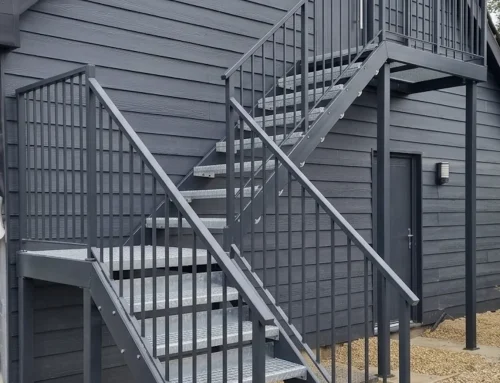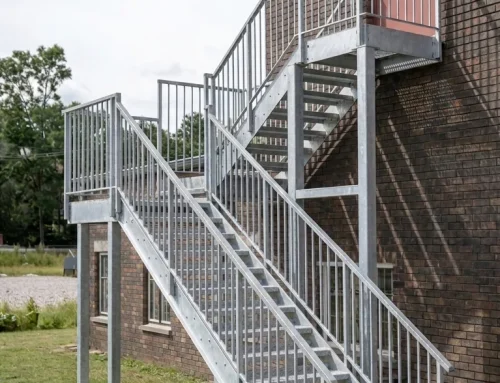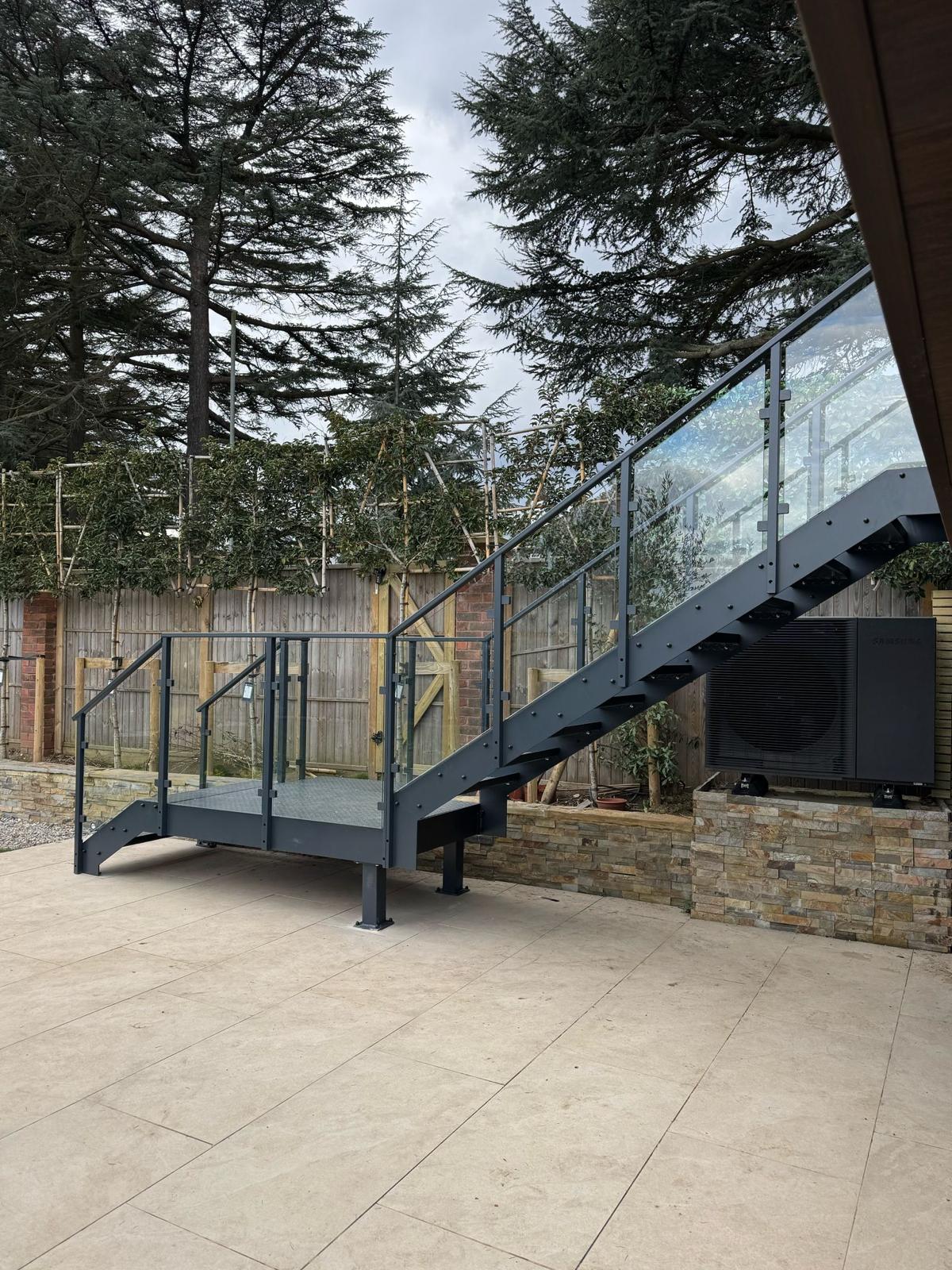

External Staircases London — Steel Fabrication & Installation
Bespoke external staircases installed across all 32 London boroughs — garden access, basement entry, roof terrace, fire escape replacement, period rear access — from £3,500 residential and £5,500 commercial. Continox manufactures hot-dip galvanised steel structures compliant with BS EN 1090-2 and Approved Document K, with optional powder coat in any RAL colour. No London surcharge, free on-site survey, fixed-price quote within 24 hours. This guide covers use cases, configurations, materials, pricing and planning considerations.
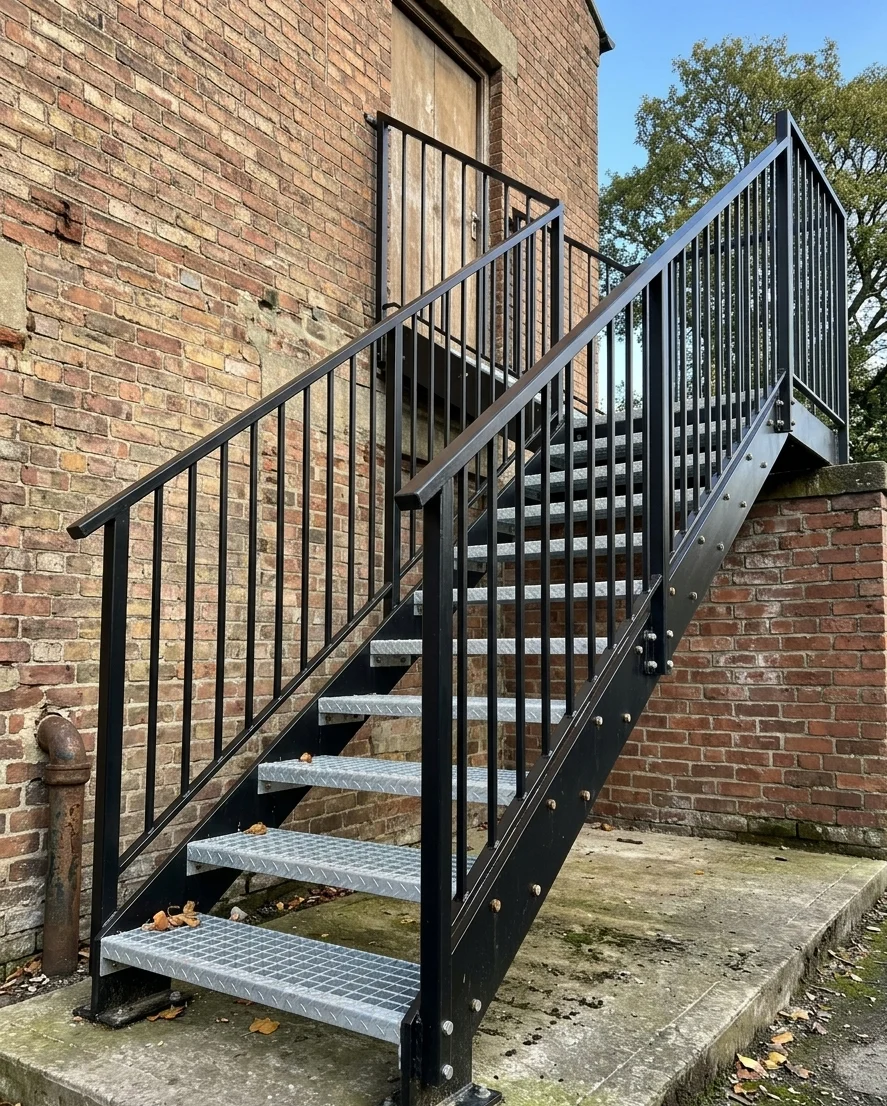
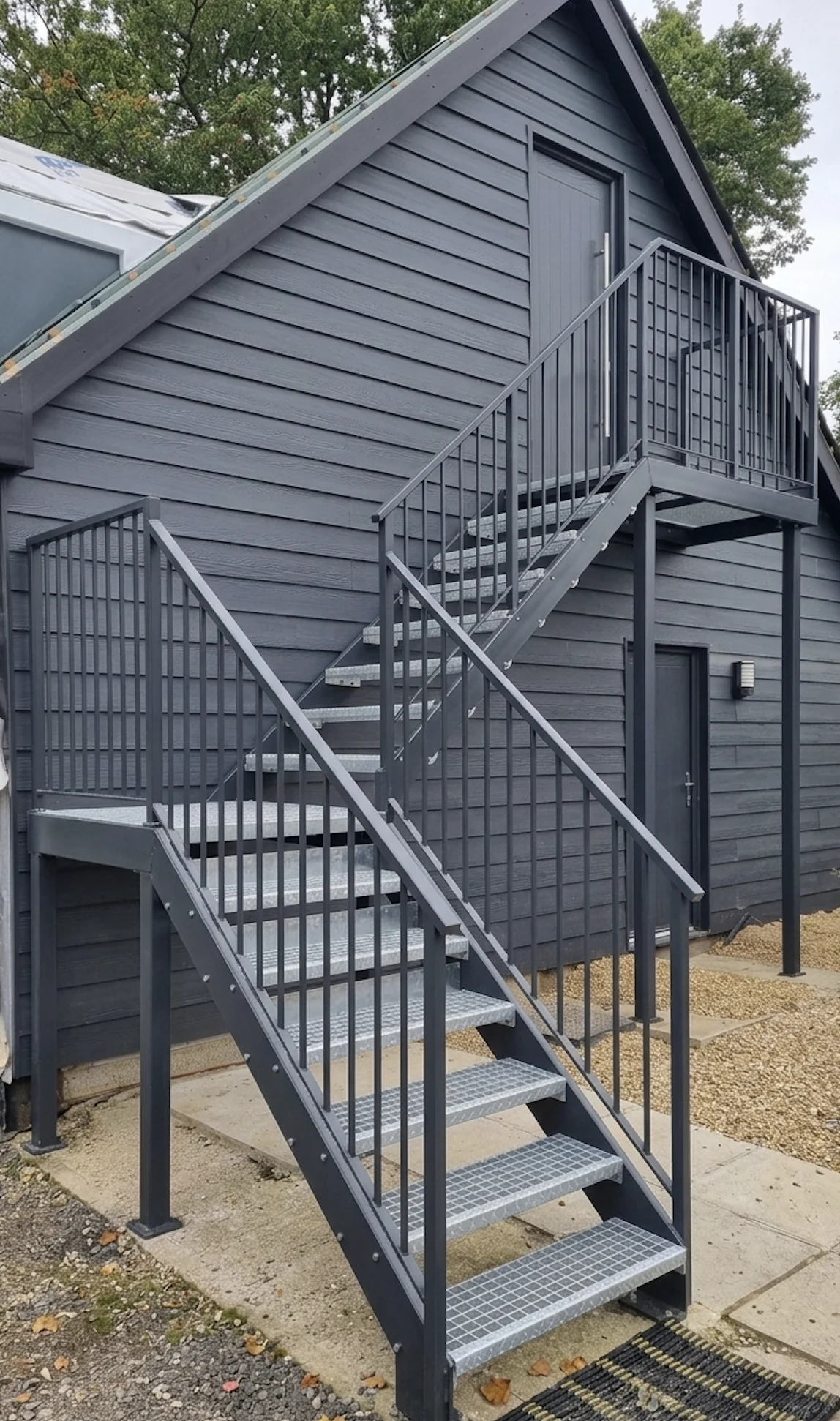
Bespoke external staircase — RAL 9005 matte black powder coated steel, hot-dip galvanised substrate, anti-slip treads
Continox installs bespoke external staircases across all 32 London boroughs and the City of London. Pricing starts at £3,500 for a straight residential garden flight, £5,500 for a commercial access staircase, and £8,000+ for fire escape replacement projects on residential apartment blocks. All staircases manufactured in S275 hot-dip galvanised steel as standard, with optional RAL powder coat finish in any colour, anti-slip treads, integrated handrails, and stainless steel or glass balustrade upgrades. No London surcharge — Greater London projects pay the same fixed price as projects anywhere in the UK. Free on-site survey, fixed-price quote within 24 hours, BS EN 1090-2 declaration of performance supplied with every staircase. Typical lead time: 4–6 weeks from order to installation. UKCA marked and Building Regulations compliant.
Why London External Staircase Projects Need Specialists
External staircase commissioning in London is rarely a clean, simple specification. The combination of period property stock, restricted access, planning sensitivity in Conservation Areas, mixed-use buildings, and rear-of-property substrate variability means that what works on a typical suburban detached house will not necessarily work on a Victorian terrace in Hackney or a converted warehouse in Wapping. Five London-specific factors define what a serious external staircase project has to address.
1. Period property substrate variability. London Victorian and Edwardian terraces typically present a mix of substrate conditions where the staircase needs to land or fix — original Yorkstone paving, brick on flat, modern poured concrete patio, or composite decking. Each substrate requires different fixing detail, different load distribution and different waterproofing strategy at the staircase base. Survey-stage substrate identification is essential.
2. Rear access constraints. The majority of London residential external staircase projects sit at the rear of terraced properties — often accessed through the property itself or via narrow side returns. Components have to be sized for delivery through standard 760mm doorways and narrow side passages, and pre-finished sub-assembly approach is essential to avoid extended on-site fabrication that the property cannot support.
3. Conservation Area planning. Substantial portions of central London — Hampstead, Notting Hill, Belgravia, Marylebone, Greenwich — sit within designated Conservation Areas where any external alteration visible from the public realm requires planning consideration. External staircases visible from the street, from neighbouring properties, or from public footpaths typically need at minimum a courtesy consultation with the borough's Conservation Officer; in many cases a formal planning application.
4. Listed building consent for period rear access. Where the property itself is listed (around 19,000 listed buildings across Greater London), external staircase replacement requires Listed Building Consent separate from Building Regulations approval. Even rear staircases not visible from the public realm fall under listed building controls because the works affect the listed structure itself.
5. Mixed weather exposure & galvanic corrosion. London's combination of urban pollution, rain exposure, periodic salt-laden coastal weather, and proximity to building masonry creates a more aggressive environment for external steelwork than typical rural sites. Hot-dip galvanising to BS EN ISO 1461 is the baseline finish standard — primer-painted steelwork has a service life of around 5–10 years before corrosion failure, while galvanised steelwork delivers 25–40+ years before maintenance is required.

External Staircase Use Cases Across London
Six use cases account for the majority of Continox external staircase commissions across Greater London. Each has its own typical configuration, material specification and pricing band — the survey stage establishes which approach matches the specific property condition.
Victorian and Edwardian terraces with raised ground floor, accessing rear garden over light well or below-grade patio. Straight or quarter-landing flight, hot-dip galvanised steel, optional powder coat, infill bar or stainless steel handrail.
Internal flight to flat roof, or external flight from existing roof terrace. Compact spiral or straight configuration. Glass balustrade upgrade common in penthouse projects. Wind-loading calculations essential at terrace level.
External access to basement flat, kitchen extension or utility room. Often replacing rotting timber or rusting Victorian wrought iron. Galvanised steel with anti-slip treads, side-fix into masonry above light well.
Office mezzanine external access, retail rear delivery flight, light industrial. Wider treads (typically 1000–1200mm), heavier substrate (S275 minimum), Approved Document K compliance for commercial occupancy.
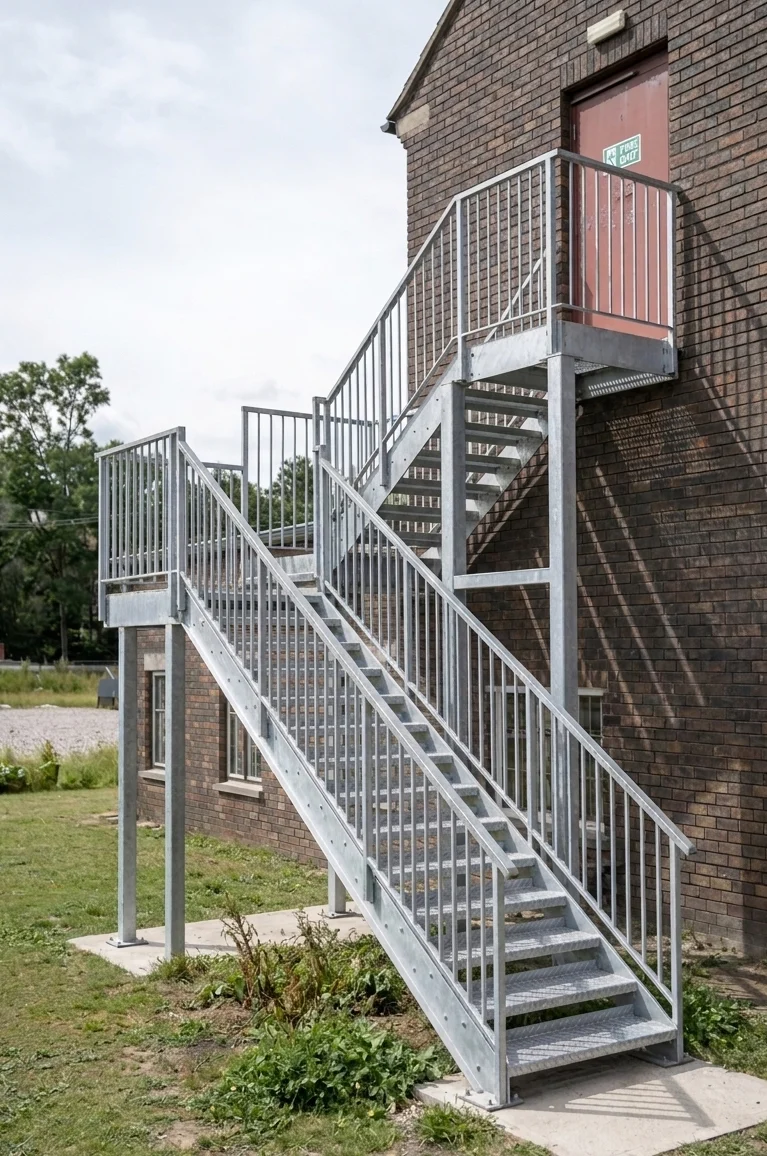
Replacement of corroded existing fire escape on apartment blocks, HMOs, retail above shops. BS 9991:2024 / BS 9999 compliance, Approved Document B. Galvanised mild steel with chequer plate or open mesh treads.
Architect-led contemporary external feature in London new-build or refurbishment. RAL 9005 matte black powder coat, premium handrail detail, integrated LED, glass balustrade upgrade. Higher specification than standard galvanised approach.
Why use case matters for pricing: The same flight length can vary by 2–3× in cost depending on whether it is a basic galvanised garden access flight or a contemporary architect-led feature with stainless handrail and integrated LED. Survey stage establishes use case, substrate, occupancy and aesthetic requirement before issuing a fixed-price quote. View the complete external staircase range and configurations on the dedicated external staircase page.
External Staircase Coverage Across London
Continox installs across all 32 London boroughs and the City of London, with delivery vehicles routed centrally from the manufacturing facility on the south coast and installation managed by the in-house team. The boroughs below represent the most active concentrations of external staircase commissions across recent project work.
Mansion blocks, period townhouses, mixed-use rear access. Conservation Area planning routine.
Victorian terrace garden access, period basement entry, listed building consent common.
Warehouse conversions, mezzanine access, contemporary insertions in Victorian terraces.
Wapping, Limehouse, dock conversions. Marine-grade specification for waterside properties.
Georgian and Victorian terraces, basement flat access, period rear staircase replacement.
Battersea, Clapham, Brixton. Family terraces with rear garden access, mansion block external.
Period terrace refurbishments, rear access replacement, garden flight installations.
Bermondsey, Greenwich edge, mixed-use commercial-residential, retail rear access.
Maritime conservation areas, period terrace, river-facing properties with marine-grade specification.
Outer London boroughs — Bromley, Croydon, Ealing, Enfield, Harrow, Havering, Hillingdon, Hounslow, Newham, Redbridge, Richmond, Kingston, Sutton, Waltham Forest — are equally covered. Project lead time is identical regardless of postcode within the M25.
External Staircase Configurations Specified in London
Different London property types call for different external staircase configurations. The decision depends on the rise (floor-to-floor distance), the available footprint at the base of the staircase, sight lines from the property and from neighbours, and whether the staircase is straight-run or needs to land between two reference points. The configurations below cover around 95% of recent Continox external commissions across Greater London.
Single uninterrupted run, simplest and most cost-effective. Suits most residential garden access and commercial side-of-building applications. Standard width 800–1000mm, treads at 250–280mm going.
Two flights connected by a 90° landing. Suits constrained footprint where straight run won't fit, or where the staircase needs to follow the property line. Most commonly specified for rear access.
Two flights with a half-landing creating a U-shape. Suits multi-storey commercial applications and tall residential properties where total rise exceeds 3m. Smaller footprint than quarter-landing equivalent.
Compact circular configuration, smallest footprint of any external staircase type. Suits roof terrace access, balcony to garden, mews properties with limited rear yard. Diameter typically 1500–2000mm.
Multi-storey configuration for apartment blocks, HMOs, retail above shops, commercial premises. BS 9991:2024 / BS 9999 compliant, with intermediate landings every storey, dedicated balustrade.
Treads cantilevered from wall mountings, no visible stringer, contemporary appearance. Suits architect-led modern projects and feature stairs. Heavier structural fixings into masonry required.
Three Real London External Staircase Projects
Project briefs commissioned across recent Continox London external work cluster around three configurations. The specifications below reflect typical fixed-price residential and commercial projects.
Hampstead — Victorian Terrace Garden Access
Replacement of a rotting timber rear staircase on a Victorian terraced property in Hampstead, providing access from a raised ground-floor kitchen extension to the rear garden. Quarter-landing right-turn configuration, 900mm width, S275 hot-dip galvanised steel substructure with RAL 7016 anthracite grey powder coat, anti-slip checker plate treads, stainless steel handrail. Conservation Area courtesy consultation completed during design phase. Project total: £4,800–£5,800. Lead time 5 weeks. Installation 1.5 days.
Wapping — Warehouse Conversion Roof Terrace
New external spiral staircase providing access from a Wapping warehouse conversion penthouse to a flat roof terrace with River Thames views. 1800mm diameter spiral, S275 hot-dip galvanised + RAL 9005 matte black powder coat, stainless steel handrail, marine-grade specification due to coastal proximity, anti-slip treads with composite decking infill. Wind loading calculations supplied with quote. Project total: £6,500–£7,500. Lead time 6 weeks. Installation 2 days.
Hackney — Apartment Block Fire Escape Replacement
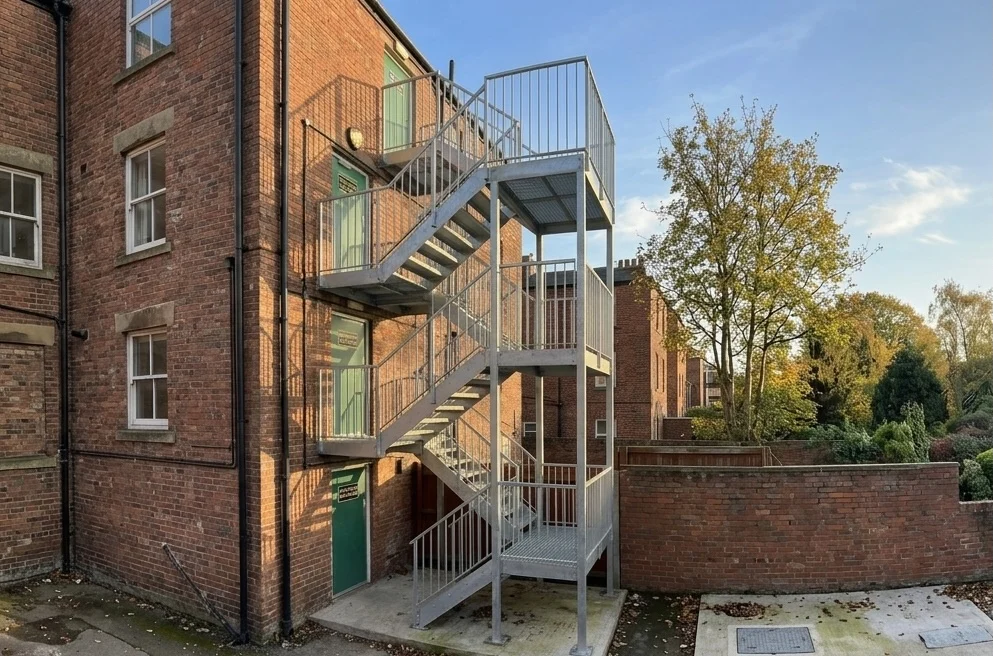
Replacement of corroded mid-20th-century external fire escape on a 4-storey converted Victorian residential block in Hackney. Multi-flight configuration with intermediate landings at each storey, BS 9991:2024 compliant, S275 hot-dip galvanised steel structure, open mesh treads, dedicated balustrade with intermediate handrail. Building Control sign-off documentation supplied. Right To Manage company commission. Project total: £18,500–£22,000. Lead time 7–8 weeks. Installation 4 days (off-hours work to minimise resident disruption).
See Continox External Project Work
The full Continox project portfolio includes residential garden access flights, apartment block fire escape replacements, commercial mezzanine access, period rear staircase replacements and warehouse conversion roof terrace stairs across Greater London. Browse structural drawings, material specifications, and on-site installation photography. Real projects, real specifications.
Browse Project Portfolio →Materials & Finishes for London External Staircases
External steelwork in the London environment has different material requirements from internal staircases. The combination of urban pollution, rain exposure, periodic salt-laden weather, and proximity to building masonry creates a more aggressive corrosion environment than rural sites. The material specification below represents the Continox standard for external London projects.
| Material / Finish | Specification | Service Life |
|---|---|---|
| S275 structural steel | Mild steel substructure, all stringer and tread support | 50+ years if maintained |
| Hot-dip galvanised (BS EN ISO 1461) | Standard finish, full immersion zinc coating | 25–40+ years |
| Powder coat (RAL any) | Applied over galvanising, aesthetic finish | 10–15 years before retouch |
| Stainless steel grade 316 | Marine-grade, riverside / coastal properties | 50+ years |
| Stainless steel grade 304 | Standard handrail, urban exposure | 30+ years |
| Chequer plate treads | 5mm thickness, anti-slip pattern | 30+ years |
| Open mesh / cheesegrater treads | Galvanised steel, drainage, lighter visual | 30+ years |
| Composite decking infill | Pan-style treads with composite, residential aesthetic | 15–25 years |
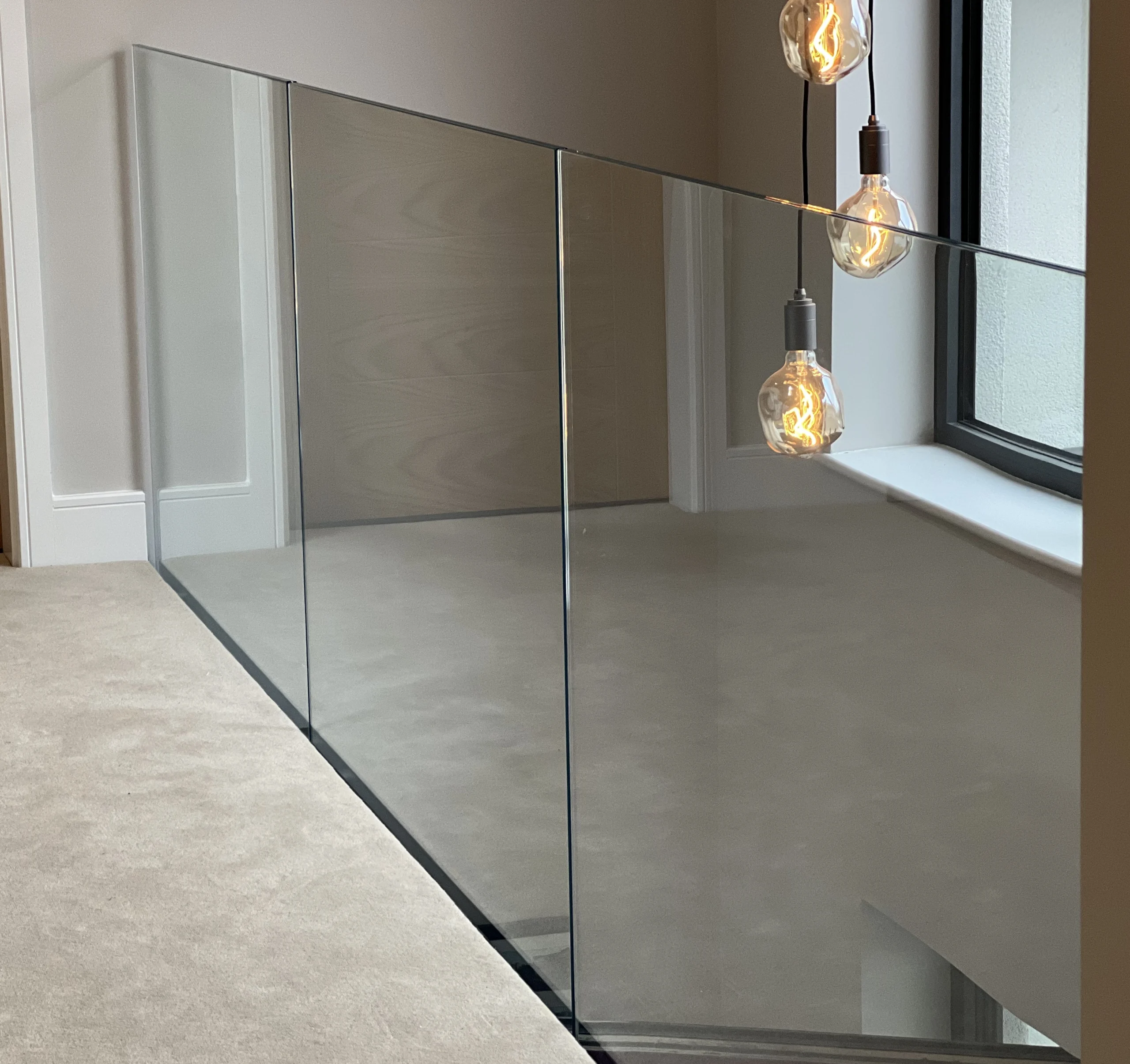
| Toughened glass balustrade (BS EN 14449) | 17.5mm laminated, point-fixed spigots | 50+ years |
Why galvanising matters for London projectsPrimer-painted external steelwork has a service life of around 5–10 years in the London environment before corrosion failure. Hot-dip galvanised steelwork delivers 25–40+ years before maintenance is required. The cost difference at fabrication stage is around 15–20% but the lifecycle saving is substantial. Continox specifies hot-dip galvanising as standard on every external staircase — primer-painted steelwork is not offered. UKCA marking and BS EN 1090-2 declaration of performance supplied with every staircase.
Planning Permission & Listed Building Consent
External staircase installations in London often require planning consideration even where Permitted Development Rights would normally apply. The specific triggers depend on whether the property is listed, sits within a Conservation Area, or whether the staircase is visible from the public realm.
Permitted Development. For non-listed properties not in a Conservation Area, external staircases typically fall under Permitted Development Rights provided they do not exceed certain dimensional thresholds and do not affect external appearance from the public realm. Garden access flights, basement entry stairs and rear roof terrace access frequently qualify under PD without formal planning application.
Conservation Areas. Substantial portions of central London — Hampstead, Notting Hill, Belgravia, Marylebone, Greenwich, Cheyne Walk, Holland Park — sit within designated Conservation Areas where external alterations visible from the public realm typically require courtesy consultation with the borough's Conservation Officer. In many cases a formal planning application is required even where the staircase is not directly street-facing. London boroughs vary in interpretation — Westminster, Camden and RBKC are typically more rigorous than outer boroughs.
Listed buildings. Where the property is Grade I, II* or II listed (around 19,000 listed buildings across Greater London), external staircase installation or replacement requires Listed Building Consent from the local planning authority, separate from Building Regulations approval. Consent process typically adds 8–14 weeks to project timeline. Continox supports listed building projects with a heritage statement, structural calculations, design justification and contextual visualisation as part of the standard documentation pack.
Building Regulations. Approved Document K (Protection from Falling) and Approved Document B (Fire Safety) apply to virtually every external staircase project in London. BS 6180 governs balustrade loading. BS EN 1090-2 governs structural steelwork — declaration of performance is legally required and supplied with every Continox staircase. UKCA marking is required for all structural steel components.
BS Standards & UKCA Compliance
External staircases in London must comply with a stack of British Standards and Building Regulations. The Continox standard specification meets every applicable requirement as baseline — there are no chargeable extras for compliance documentation.
| Standard | What it covers |
|---|---|
| Approved Document K | Stair dimensions, rise/going, headroom, handrail height, protection from falling |
| Approved Document B | Fire safety, escape route requirements where staircase is part of means of escape |
| BS 6180:2011 | Barriers in/about buildings — guardrail loading, 0.74 kN/m residential, 1.5 kN/m commercial |
| BS EN 1090-2 | Structural steel execution — declaration of performance required |
| BS EN ISO 1461 | Hot-dip galvanising — coating thickness and quality |
| BS 5395-1 / BS 5395-3 | Stairs ladders walkways — utility and industrial stair design |
| BS 9991:2024 | Residential fire safety where staircase serves means of escape |
| UKCA marking | UK Construction Products Regulations — required on structural steel |
For dedicated guidance on UK staircase regulations and compliance, see the staircase building regulations guide. For glass balustrade specific compliance see the glass balustrade regulations breakdown. Fire escape specific requirements covered separately on the fire escape stairs page.
What to Look For in a London External Staircase Specialist
Selecting an external staircase specialist for a London project is a higher-stakes decision than for a typical UK project. The combination of access challenges, planning sensitivity, listed building constraints and substrate variability means that low-cost online manufacturers and general welders rarely deliver acceptable results. Six factors separate genuine London-capable specialists from suppliers who merely accept London commissions.
1. Hot-dip galvanising as standard, not as upgrade. Primer-painted steelwork delivers 5–10 years service life in the London environment. Galvanised delivers 25–40+. Suppliers quoting primer-painted as standard are quoting for a 10-year staircase, not a 30-year staircase.
2. BS EN 1090-2 declaration of performance supplied with every staircase. This is legally required in the UK for structural steelwork, but rogue traders frequently omit it. The declaration confirms manufacturing standards and is essential evidence for Building Control sign-off.
3. UKCA marking on structural components. Required under UK Construction Products Regulations. A supplier who cannot supply UKCA-marked steelwork is not legally compliant for permanent installation.
4. London-specific access experience. Components designed and pre-finished for delivery through standard 760mm doorways, narrow side returns, lift access in apartments. Pre-assembly approach in the workshop, not on-site fabrication.
5. Free on-site survey across all 32 boroughs. A quote without an on-site survey is an estimate, not a quote. London substrate variability means remote pricing routinely under-quotes the actual project. Continox includes free survey across Greater London as part of the standard process.
6. Fixed-price quotation, not estimates. "From £X" is the start of a negotiation that ends higher than the headline. Continox quotations are fixed-price following the on-site survey, with all line items itemised in writing before fabrication begins. View the full Continox project portfolio at continox.uk/work.
External Staircases London — FAQ
Common questions on bespoke external staircase commissioning across all 32 London boroughs
Free London Survey + Fixed-Price Quote
Free on-site survey across all 32 London boroughs. Bespoke external staircase design tuned to your property, substrate and access. Fixed-price quotation within 24 hours — no London surcharge, no hidden extras. Hot-dip galvanised steel from £3,500 residential, £5,500 commercial. UKCA marked, BS EN 1090-2 compliant, designed and installed by the in-house Continox team.