
Fire Escape Cost London 2026 — Real Prices for Replacement & New Installs
Fire escape stair cost in London 2026: £5,500 single-storey residential, £8,000–£14,000 apartment block, £12,000–£24,000 commercial multi-storey, £20,000+ for 18m+ buildings requiring BSR approval. Continox manufactures bespoke fire escape stairs across all 32 London boroughs in hot-dip galvanised steel, fully compliant with BS 9991:2024 and BS 9999. No London surcharge, no hidden compliance fees, fixed-price quote within 24 hours. This guide breaks down real prices, hidden costs, and three worked London project examples.
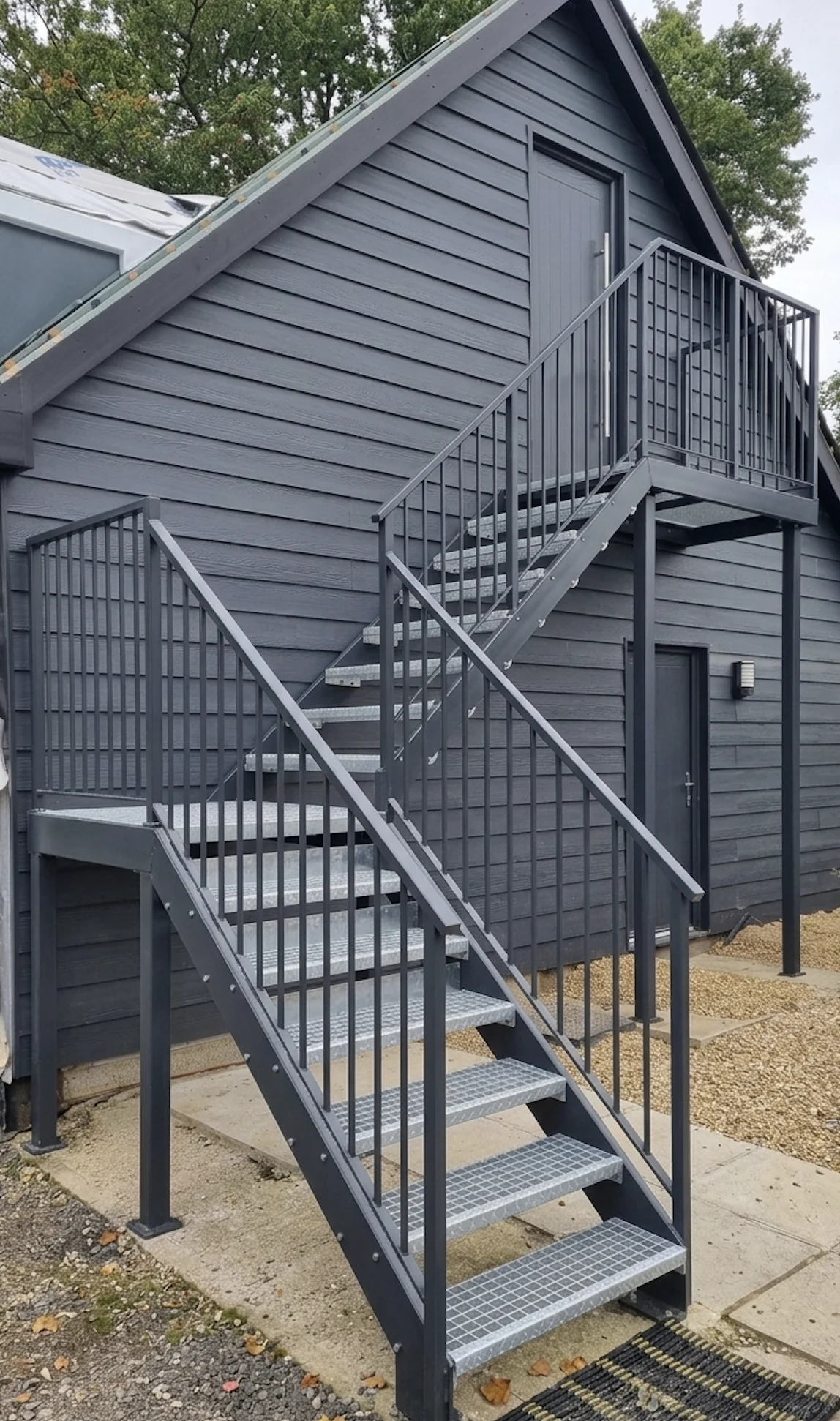
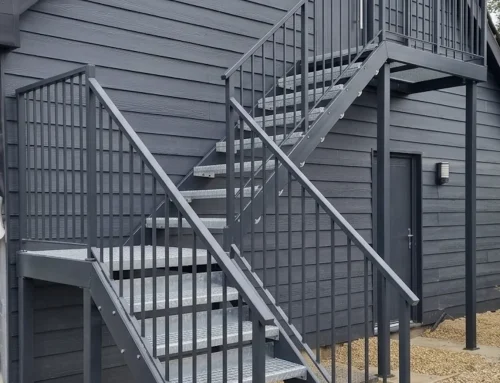
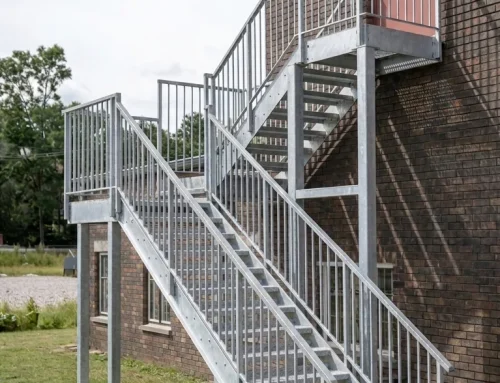
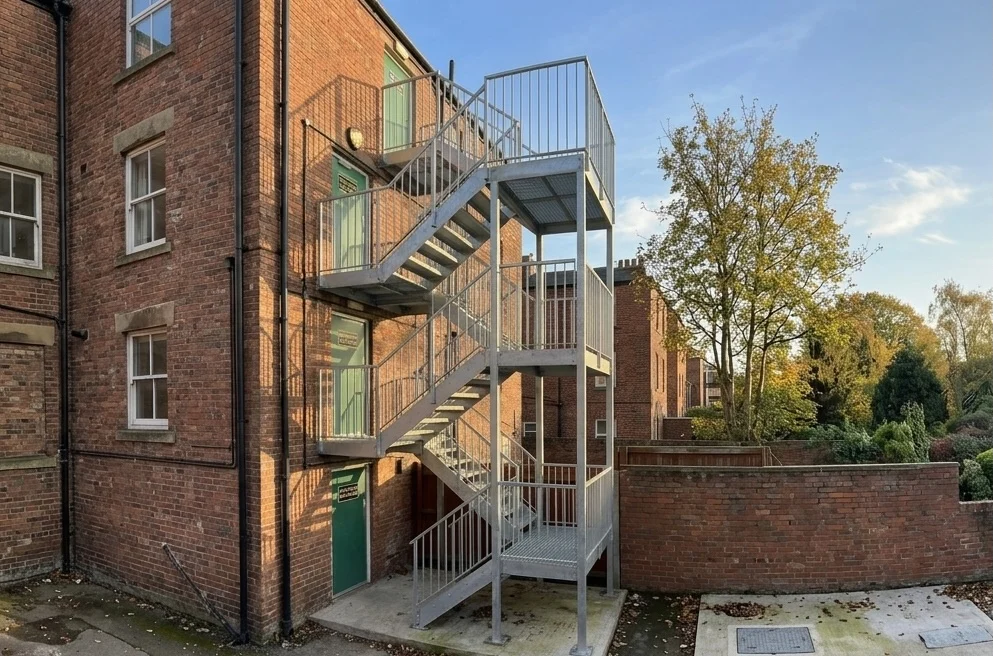
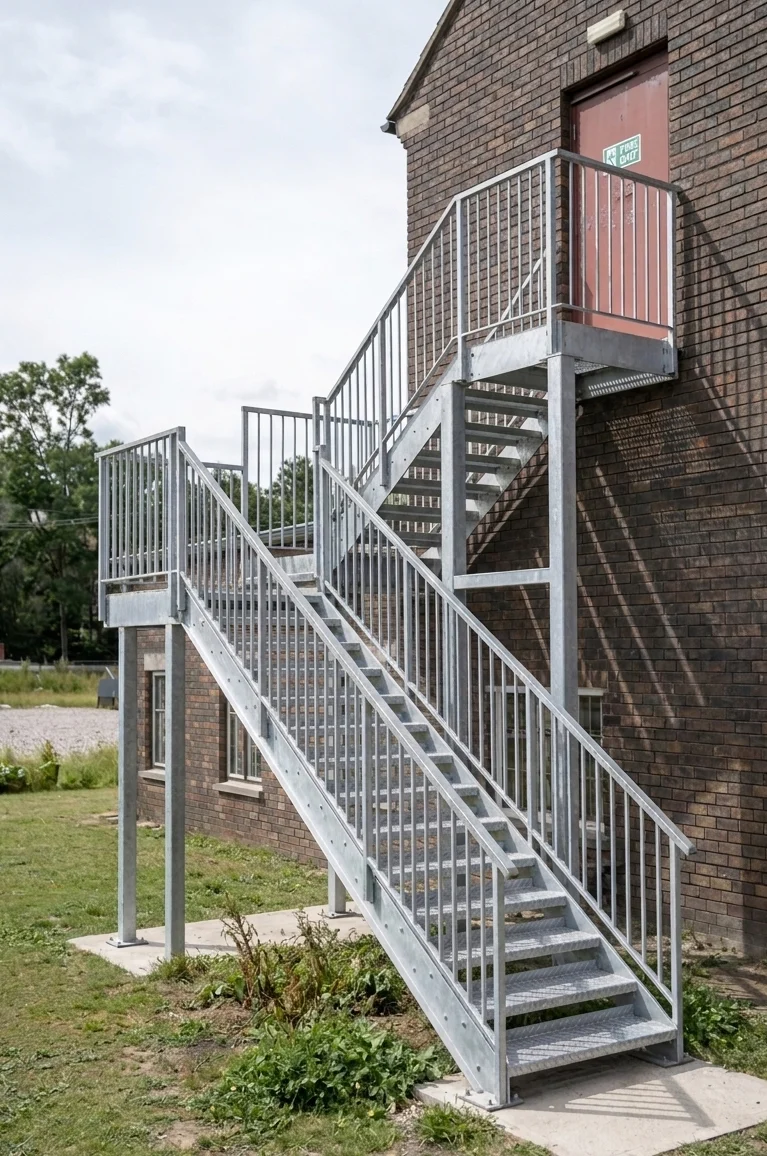
Quarter-landing fire escape — galvanised S275 steel, anti-slip treads, fixed-price installation across all 32 London boroughs
Bespoke fire escape stair installation in London 2026 ranges from £5,500 for a simple single-storey residential flight to £28,000+ for a 4+ storey listed commercial premises with full BS 9991:2024 / BS 9999 compliance documentation. Typical project bands: £5,500–£8,000 residential single-storey, £8,000–£14,000 apartment block 3–5 storey replacement, £8,500–£12,500 HMO compliance upgrade, £12,000–£18,000 commercial 3–4 storey, £18,000–£24,000 commercial 4+ storey, £14,000+ listed building with consent process, £20,000+ buildings above 18m requiring Building Safety Regulator approval. Continox prices flat across the UK — no London surcharge. All compliance documentation, BS EN 1090-2 declaration of performance, UKCA marking and removal of existing fire escape included as standard.
What Drives Fire Escape Cost in London?
Fire escape stair pricing in London 2026 is driven by six primary factors. Generic quotes that ignore these variables routinely under-quote at enquiry stage and revise upward once the on-site survey reveals the real specification. A transparent quotation breaks down each factor explicitly so the building owner, RTM committee or Section 20 leaseholder consultation can see exactly what is being paid for.
1. Number of storeys. Each additional storey adds approximately one full flight of stairs plus one intermediate landing. A 3-storey replacement is around 50% more expensive than a 2-storey, a 4-storey adds another 30–40%, and a 5+ storey installation requires additional structural calculations and dual-flight provision. Storey count is the single largest cost driver.
2. Building use class & occupancy. Residential under BS 9991:2024 has different width, balustrade and fire-rating requirements from commercial under BS 9999. HMO licensed properties carry stricter compliance scrutiny than purpose-built flats. Care homes require gentler stair pitch and refuge area provision. Industrial conversions need heavier substrate and marine-grade specification where waterside.
3. Width & flight configuration. Residential minimum 800–900mm width, commercial 1100–1200mm, dual-flight at higher occupancy. Quarter-landing (right turn) is around 30% more than straight flight. Half-landing (180° switchback) is around 60% more. Spiral fire escape is compact but more expensive per linear metre due to fabrication complexity.
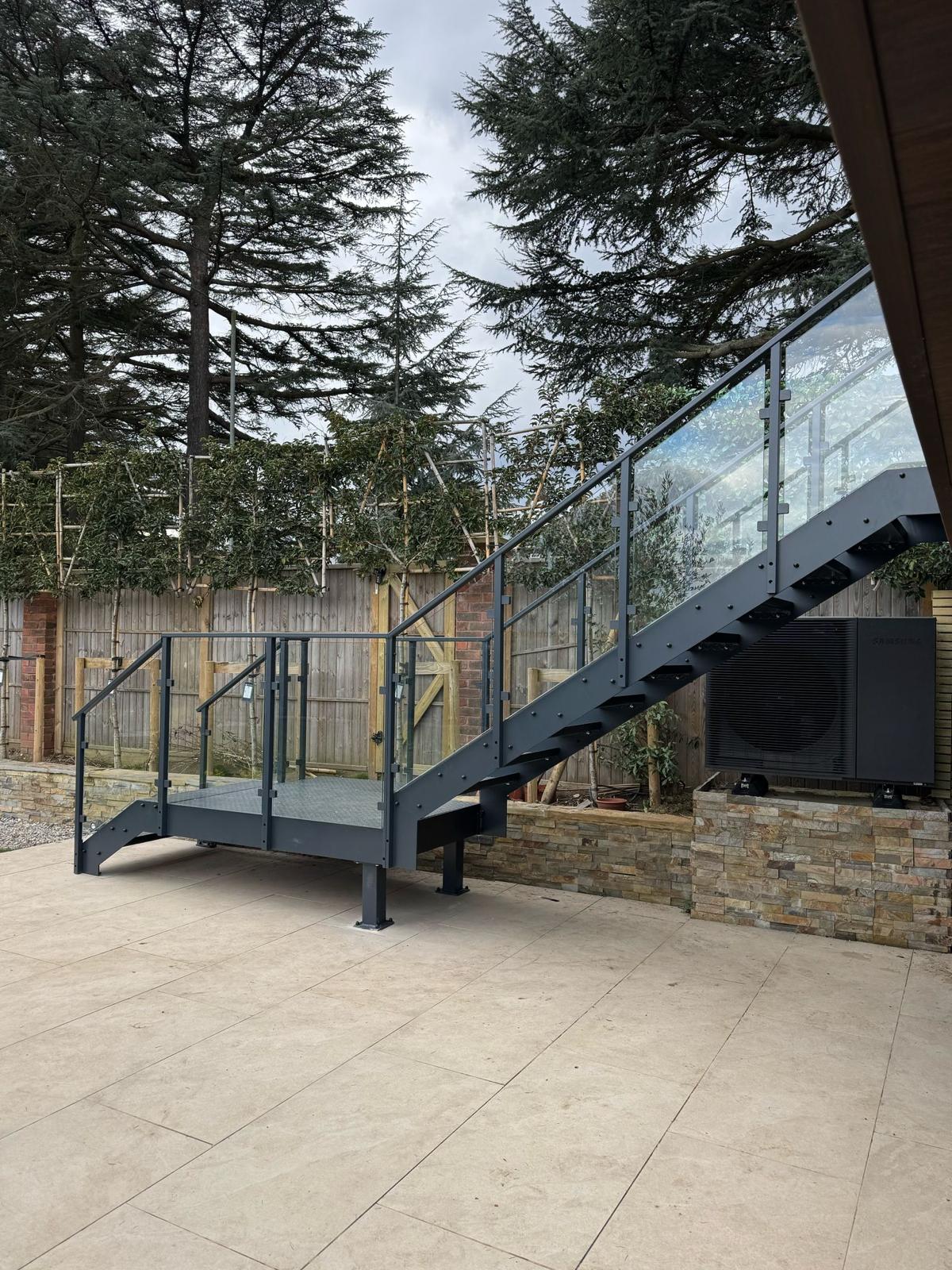
4. Material & finish specification. Hot-dip galvanised S275 steel is the baseline standard — primer-painted is not recommended for London environment. Optional RAL powder coat in any colour adds £800–1,500. Stainless steel grade 316 handrail (riverside / marine-exposed) adds £600–1,200. Glass balustrade upgrade adds £450/m. Composite decking infill on pan-style treads adds 12–18%.
5. Listed building & Conservation Area consent process. Listed Building Consent adds 8–12 weeks to the project timeline and £1,500–£3,500 in additional documentation and design time (heritage statement, structural justification, visual impact assessment). Conservation Area courtesy consultation typically free; formal planning application £1,000–£2,500.
6. Building Safety Regulator (BSR) approval (18m+). Buildings above 18 metres require BSR approval under the Building Safety Act 2022, separate from standard Building Regulations. BSR approval adds 12–18 weeks to the project timeline and £3,000–£8,000 in additional fire engineering input, structural calculations, and second staircase design (mandatory from 30 September 2026 per BS 9991:2024).
Three London Fire Escape Cost Tiers
Fire escape projects across London cluster into three pricing tiers based on building type, occupancy and compliance complexity. Each tier represents a distinct technical brief, regulatory framework and market — survey stage establishes which tier matches the specific building.
- Single private dwelling
- 900mm width straight flight
- Galvanised S275 steel
- BS 9991:2024 compliant
- Anti-slip chequer plate treads
- Infill bar handrail
- Fixed-price 4–5 weeks
- 3–5 storey multi-flight
- 900–1100mm width
- Intermediate landings each storey
- BS 9991:2024 + HMO licensing
- RTM / Section 20 documentation
- Open mesh or chequer plate treads
- Off-hours installation option
- 3–6+ storey commercial
- 1100–1200mm width
- BS 9999 commercial compliance
- Dual-flight at higher occupancy
- Heavy-duty galvanised structure
- Listed building option
- BSR approval (18m+)
Why fixed-price matters for fire escape projects: Headline "from £X" pricing is the start of a negotiation that usually ends 30–50% higher. Continox quotations are fixed-price following the on-site survey, with all line items itemised in writing before fabrication begins. For RTM-led and Section 20 leaseholder consultation projects, transparent line-item pricing is essential for shared funding decisions. View the full fire escape range and configurations on the dedicated fire escape stairs page.
Complete London Fire Escape Pricing Table 2026
Indicative starting prices for bespoke fire escape stair installations across London 2026. All quotes are fixed-price following a free on-site survey. All prices below include design, structural calculations, BS 9991:2024 / BS 9999 compliance documentation, BS EN 1090-2 declaration of performance, UKCA marking, S275 hot-dip galvanised manufacture, professional installation by the in-house team, and removal of any existing fire escape. Prices exclude VAT.
| Project Type | Storeys | Configuration | From |
|---|---|---|---|
| Single-storey residential | 1 | Straight flight, 900mm wide | £5,500 |
| 2-storey residential | 2 | Straight or quarter-landing | £6,800 |
| Apartment block replacement | 3 | Multi-flight + landings, 1000mm | £8,000 |
| Apartment block replacement | 4 | Multi-flight + landings, 1100mm | £11,500 |
| Apartment block replacement | 5 | Multi-flight + landings, 1100mm | £14,500 |
| HMO compliance upgrade | 3 | Quarter-landing + fire-rated | £8,500 |
| HMO compliance upgrade | 4 | Multi-flight + LACORS spec | £12,000 |
| Commercial office | 3 | 1100mm BS 9999 compliant | £12,000 |
| Commercial office | 4 | 1200mm + dual-flight option | £18,000 |
| Care home / assisted living | 3 | Gentle pitch + refuge area | £14,000 |
| Industrial / warehouse | 3 | Heavy-duty galvanised + open mesh | £10,000 |
| Listed building sympathetic | 3 | RAL 7016 + Listed Building Consent | £14,000+ |
| Buildings above 18m (BSR) | 6+ | BSR approval + second staircase | £20,000+ |
| Spiral external fire escape | 2–3 | Compact, 1800–2000mm diameter | £6,500 |
Hidden Costs to Watch For — Common Pitfalls
Headline quotations from low-cost fabricators frequently exclude items that are then charged separately at fabrication stage. The Continox approach is to include all of these as standard in the fixed-price quotation — there are no separate fees for compliance documentation, removal, delivery, parking permits or finish upgrades unless explicitly priced as line items.
Frequently charged separately. Continox includes removal in fixed-price quotation as standard regardless of existing structure size.
"London surcharge" applied by suppliers based outside the M25. Continox prices flat — no London surcharge regardless of borough.
Daily Congestion Charge, Ultra Low Emission Zone, parking permits in restricted streets. Frequently passed on to client. Continox includes as standard.
Some suppliers charge separately for compliance paperwork. Continox supplies all documentation as standard — no fee for compliance.
Structural calculations, BS EN 1090-2 declaration, UKCA marking. Required for sign-off. Continox includes as standard with every project.
Optional aesthetic upgrade over galvanising. Any RAL colour. Most commonly RAL 9005 matte black or RAL 7016 anthracite grey for London.
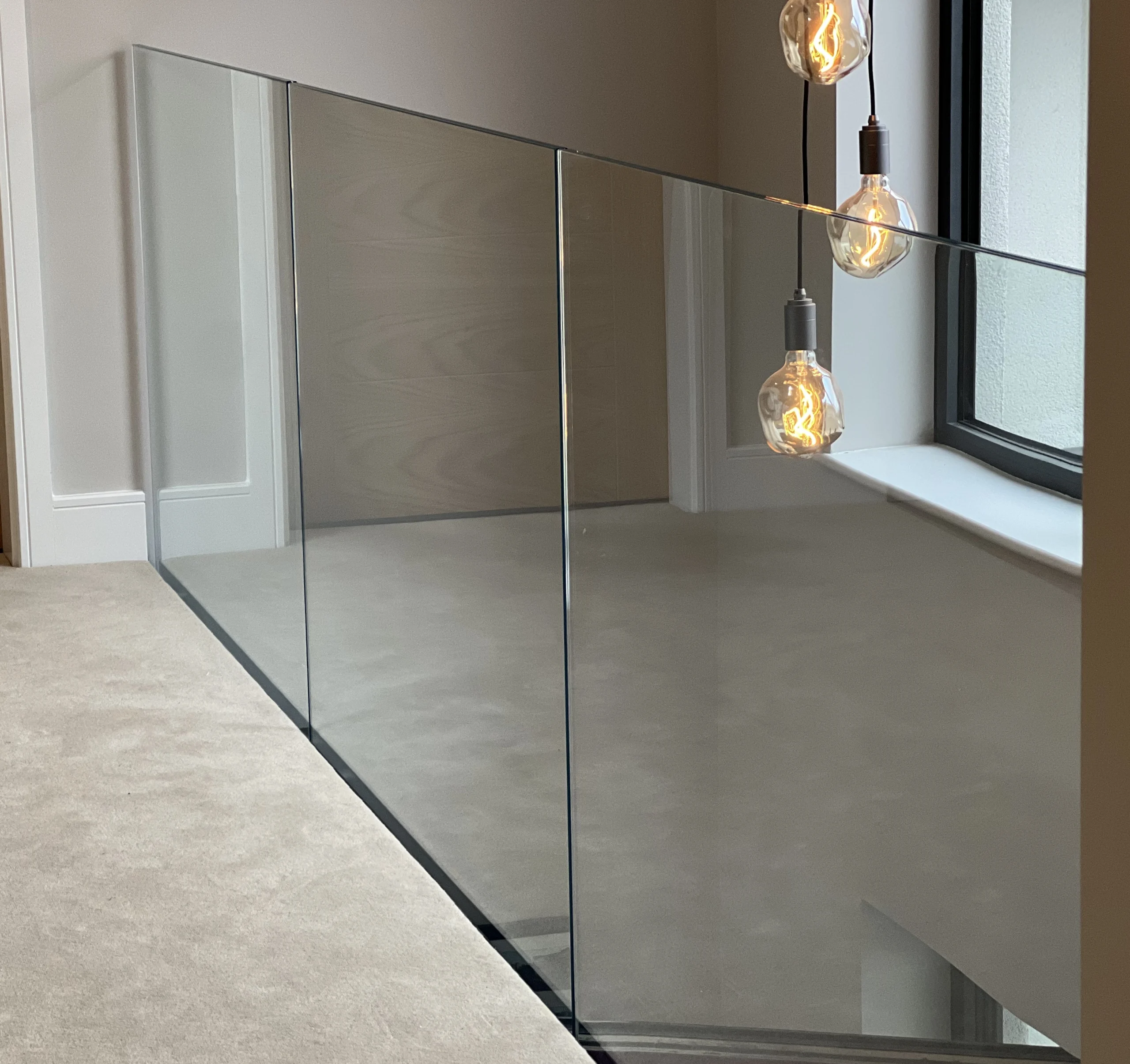
17.5mm laminated toughened glass panels in place of infill bar handrail. Premium aesthetic upgrade for contemporary specifications.
Heritage statement, structural justification, visual impact assessment. Required for listed buildings only. Continox supports with documentation pack.
Compliance Documentation Should Never Be a Hidden CostBS 9991:2024 / BS 9999 / Approved Document B compliance documentation, BS EN 1090-2 declaration of performance, and UKCA marking are legally required for permanent fire escape installation in the UK. Suppliers charging extra for these are signalling that they do not provide them routinely. A supplier who cannot supply UKCA-marked steelwork or who omits BS EN 1090-2 declaration is not legally compliant for permanent installation. Continox includes every required compliance document as standard with every quotation — there are no separate fees for legal compliance.
Three Worked London Fire Escape Project Examples
Project examples below reflect typical fixed-price commissions across recent Continox London work. Headline figures exclude VAT — actual project quotations issued following on-site survey of the specific building.
Hackney — 4-Storey Mansion Block Replacement
Building: 4-storey converted Victorian mansion block, Hackney E8. 12 flats, RTM-led project, Section 20 leaseholder consultation completed.
Existing: Corroded mid-20th-century steel fire escape, structural inadequacy identified in fire risk assessment. Removal required.
New installation: Multi-flight configuration with intermediate landings at each storey. S275 hot-dip galvanised steel, 1100mm width, open mesh treads (drainage), dedicated handrail with intermediate rail, BS 9991:2024 compliant. Removal of existing structure included. Off-hours installation to minimise resident disruption.
Documentation: Section 20 itemised quotation, BS 9991:2024 compliance schedule, BS EN 1090-2 declaration of performance, UKCA marking, structural calculations.
Project total: £18,500–£22,000Tower Hamlets — HMO Compliance Upgrade E1
Building: Licensed 7-bedroom HMO in Tower Hamlets E1. 3-storey period conversion. Tower Hamlets borough licensing renewal.
Existing: Wooden rear staircase failing borough licensing inspection. Replacement required for licence renewal — non-replacement risks £30,000 fine under Housing Act 2004.
New installation: Quarter-landing fire escape configuration, 900mm width, S275 hot-dip galvanised steel, anti-slip chequer plate treads, supplementary fire-rated balustrade. BS 9991:2024 compliant, LACORS Housing Fire Safety guidance applied.
Documentation: Tower Hamlets licensing officer pre-consultation, HMO compliance evidence pack, BS 9991:2024 schedule, structural calculations.
Project total: £10,500–£12,500Westminster — Listed Commercial W1
Building: Grade II listed mixed-use building W1, retail ground floor with offices above. 3 commercial storeys plus basement.
Existing: Primary fire escape inadequate for current occupancy — BS 9999 commercial review identified second escape route requirement.
New installation: External fire escape stair providing second escape route. RAL 7016 anthracite grey powder coat over galvanising for sympathetic integration with retained period façade. 1200mm width, BS 9999 commercial compliance, Listed Building Consent supported.
Documentation: Westminster City Council Listed Building Consent application (12 weeks), heritage statement, structural justification, visual impact assessment, BS 9999 schedule, BS EN 1090-2 declaration.
Project total: £24,000–£28,000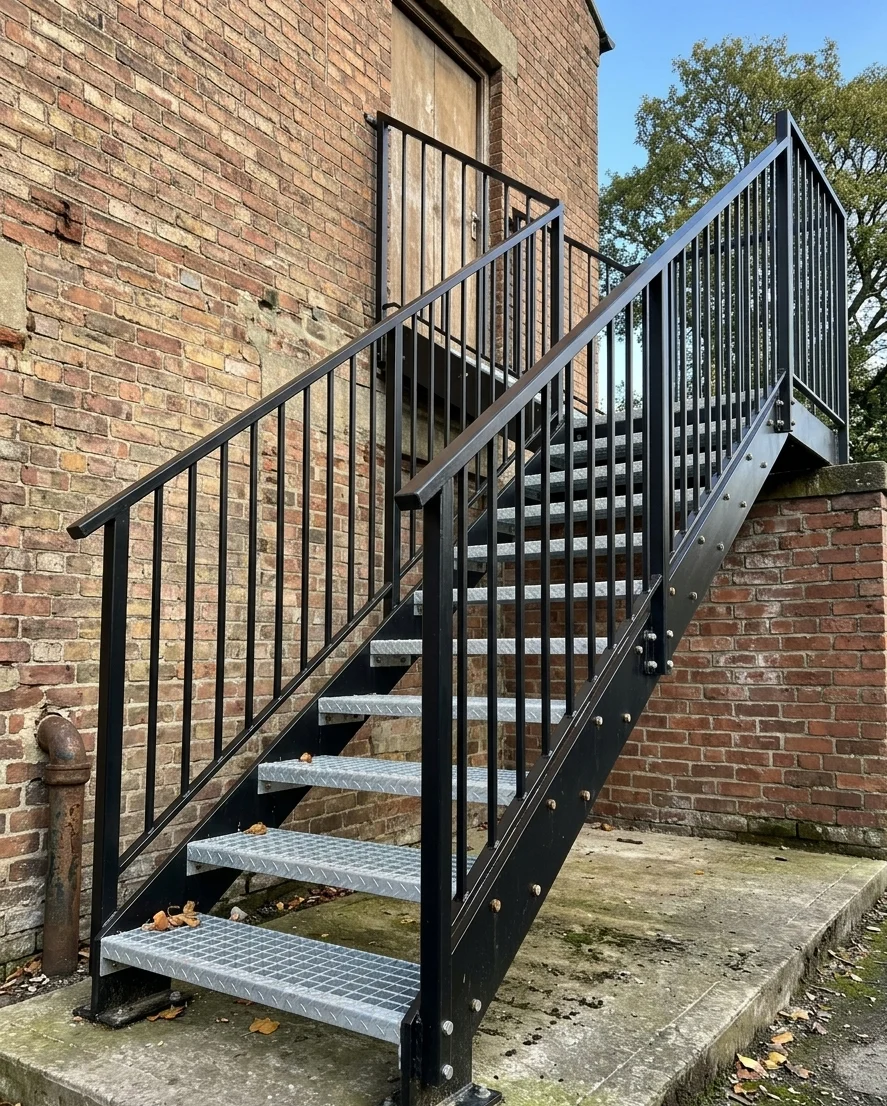

See Real London Fire Escape Project Costs
The full Continox project portfolio includes apartment block replacements, HMO compliance upgrades, commercial multi-storey installations, listed building sympathetic projects and care home compliance work across Greater London. Each project documented with structural drawings, material specifications, compliance documentation and on-site installation photography. Real projects, real fixed prices.
Browse Project Portfolio →How to Reduce Fire Escape Cost Without Compromising Compliance
Building owners and RTM committees can legitimately reduce fire escape stair costs without compromising BS 9991:2024 / BS 9999 compliance through five practical approaches. The savings below typically range from 8% to 25% of the headline project total.
1. Specify open mesh treads instead of chequer plate. Open mesh ("cheesegrater") treads provide drainage, reduce material weight and cost, and are equally compliant with Approved Document K slip-resistance requirements. Saving: £400–£900 on a typical 3-storey project. Aesthetic preference factor — chequer plate is more solid in appearance.
2. Defer optional RAL powder coat at fabrication. Hot-dip galvanising provides full corrosion protection — the powder coat is purely aesthetic. Galvanised-only finish is fully compliant. Saving: £800–£1,500. Powder coat can be applied as planned maintenance 3–5 years later if aesthetic upgrade becomes priority.
3. Specify standard infill bar handrail instead of glass balustrade. Standard infill bar provides BS 6180 compliant guardrail at substantially lower cost than glass balustrade upgrade. Saving: £450/linear metre. Glass balustrade is a premium specification — fully optional under compliance regulations.
4. Schedule installation outside peak summer. Workshop fabrication lead times are shortest in winter (October–February) and longest in summer (May–August). Off-peak project scheduling can reduce lead time from 7–8 weeks to 5–6 weeks, reducing project carrying costs.
5. Bundle multiple buildings in single procurement. Property management companies, housing associations and large RTM portfolios can negotiate volume pricing where multiple fire escape projects are procured together. Continox supports portfolio briefs with consolidated quotation and shared installation logistics. Typical saving: 8–12% across the portfolio.
What You Should Never Compromise on Cost
Five elements are not negotiable on fire escape stair projects regardless of budget pressure. Building owners attempting to economise on these elements expose themselves to legal liability under the Regulatory Reform (Fire Safety) Order 2005, void building insurance, and risk failed Building Control sign-off. The cost reduction approaches above respect compliance — the elements below should never be downgraded.
1. BS EN 1090-2 declaration of performance. Legally required for structural steelwork. A supplier who omits this is not legally compliant for permanent installation — non-negotiable.
2. UKCA marking on all structural components. Required under UK Construction Products Regulations. Steelwork without UKCA marking cannot be legally used in permanent installation.
3. Hot-dip galvanising to BS EN ISO 1461. Primer-painted steelwork delivers 5–10 years service life vs 25–40+ years for galvanised. The 15–20% cost saving at fabrication is recovered with substantial loss in lifecycle replacement cost. Galvanising is non-negotiable for permanent London exterior installation.
4. BS 9991:2024 / BS 9999 compliance documentation. Required for Building Control sign-off and ongoing duty of care under Fire Safety Order 2005. A non-documented installation is non-compliant regardless of physical specification.
5. Professional installation by qualified team. DIY-kit fire escape installations are not legally compliant for commercial premises, HMOs, or apartment blocks. Continox installation is undertaken exclusively by the in-house qualified team — no subcontractors, no DIY assembly. View completed work on the project portfolio.
Fire Escape Cost London 2026 — FAQ
Real prices for fire escape stair installation across all 32 London boroughs in 2026
Free London Quote — Fixed-Price 2026 Pricing
Free on-site survey across all 32 London boroughs. Fixed-price 2026 fire escape quotation within 24 hours — no London surcharge, no hidden compliance fees, no separate removal or delivery charges. From £5,500 single-storey residential, £8,000 apartment block, £12,000 commercial. UKCA marked, BS 9991:2024 / BS 9999 / BS EN 1090-2 compliant.