
How Long Does It Take to Replace a Staircase? — UK 2026 Timeline Guide
The full timeline for replacing a staircase in the UK is 4–8 weeks from first enquiry to handover, with on-site disruption typically limited to 2–5 days. The exact duration depends on staircase type (bespoke takes longer than off-the-shelf), site complexity (single flight vs L-shape), Building Control sign-off, and material lead times. This guide breaks down the seven phases of a UK staircase replacement project, what happens at each stage, how long you'll be without stair access, and the most common causes of delay — based on 15 years of Continox installations across the UK. For pricing alongside timelines, use our UK staircase cost calculator.
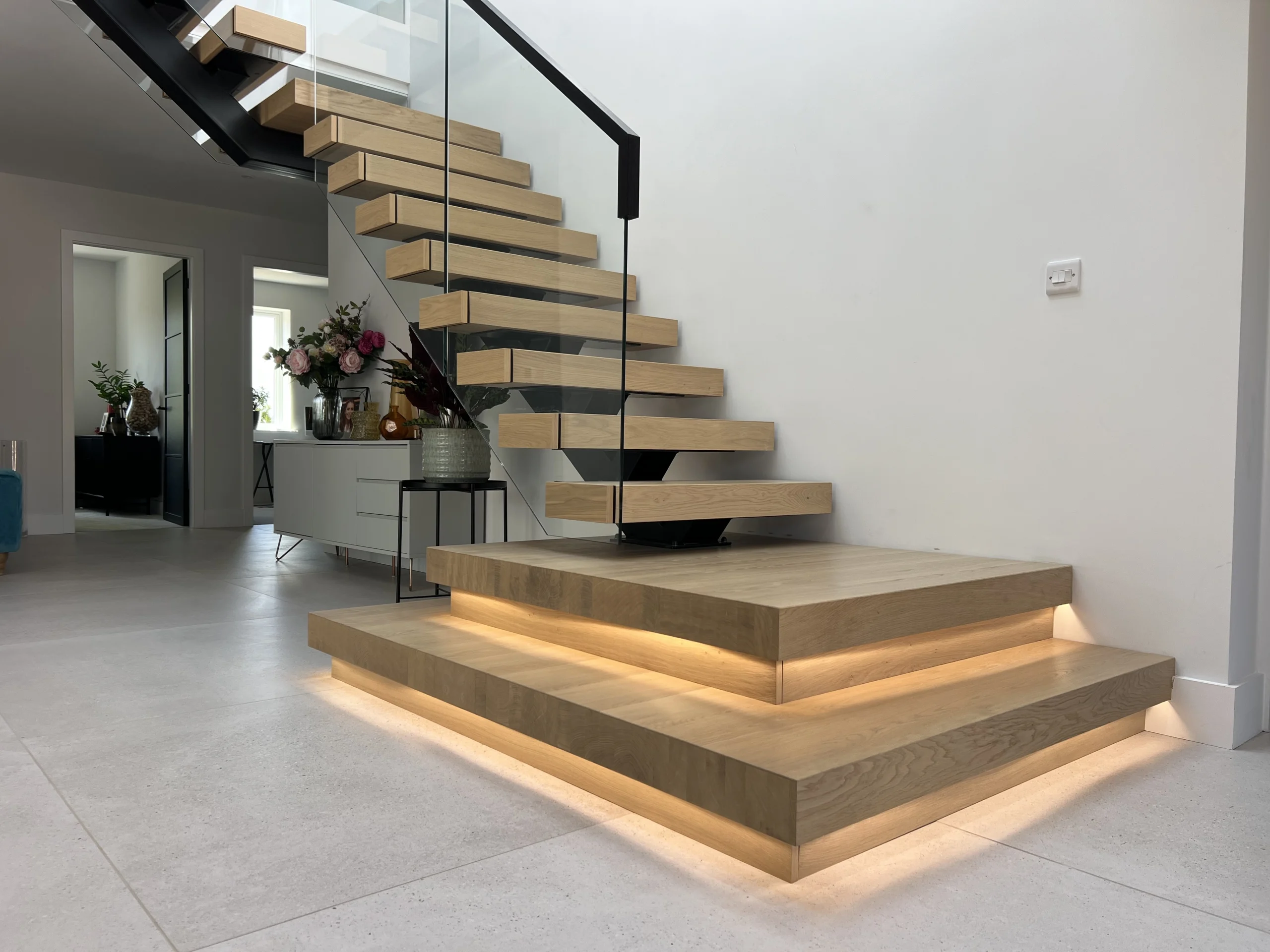
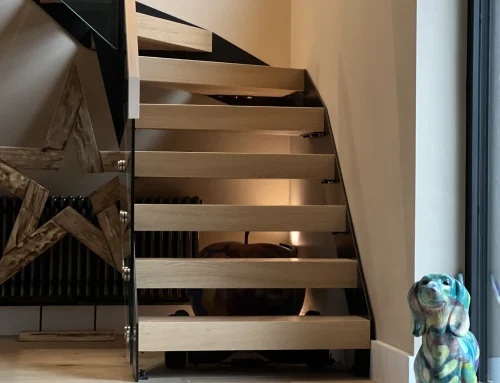
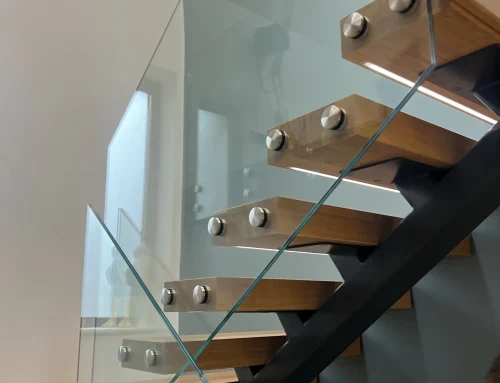
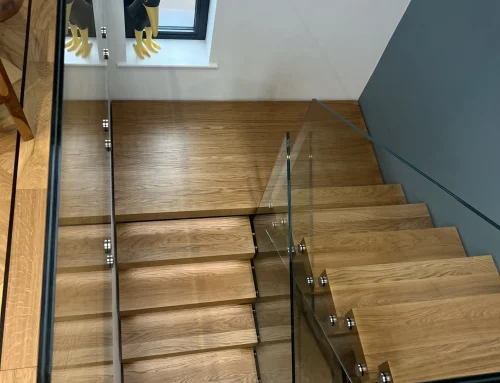
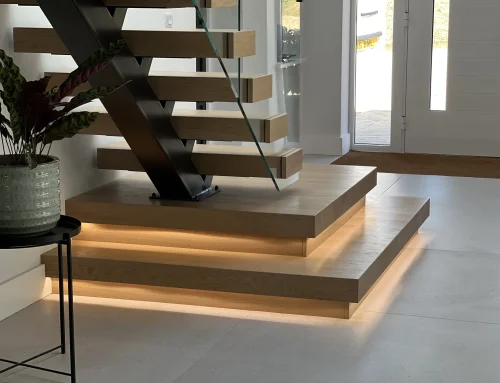
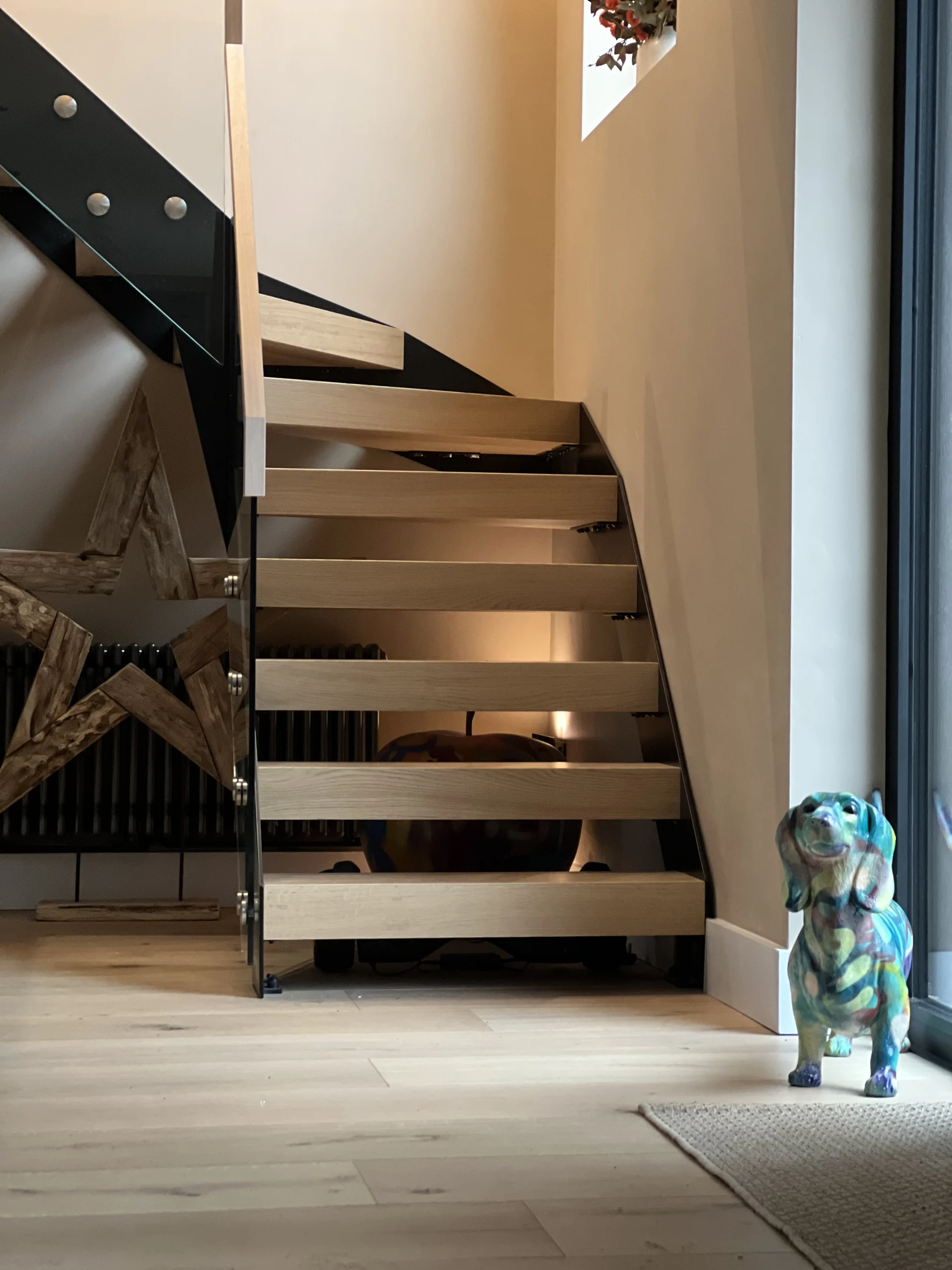
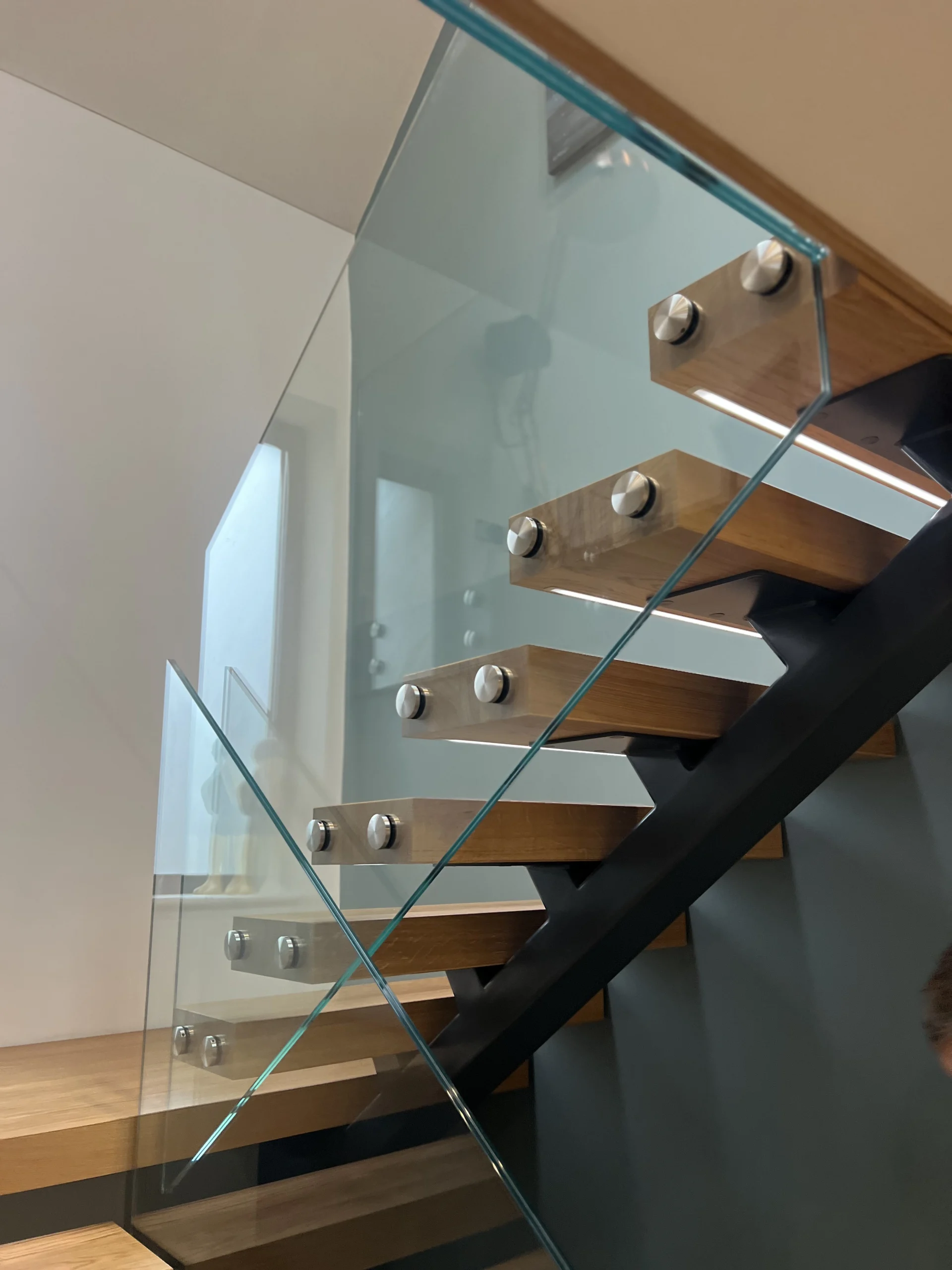
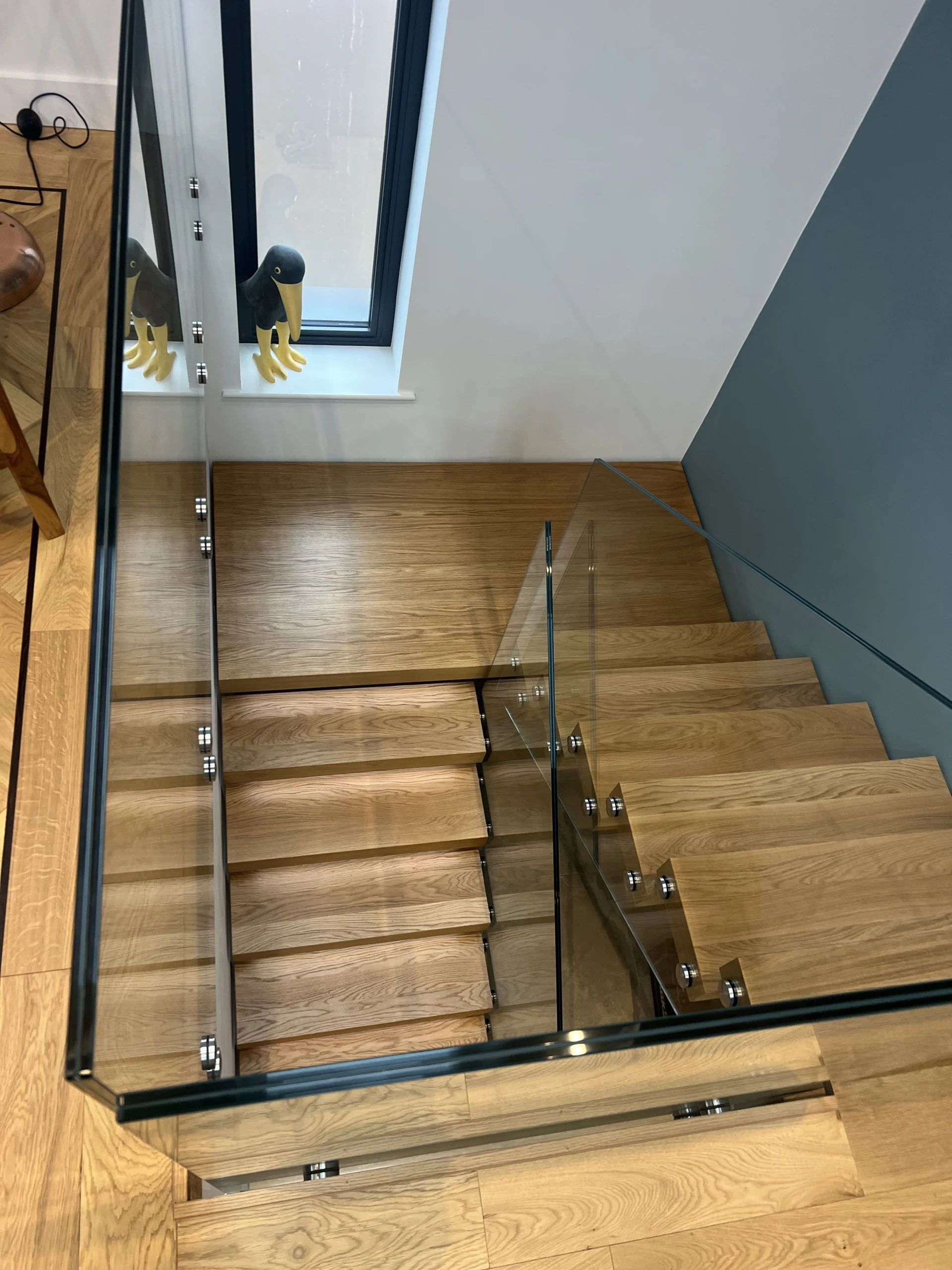
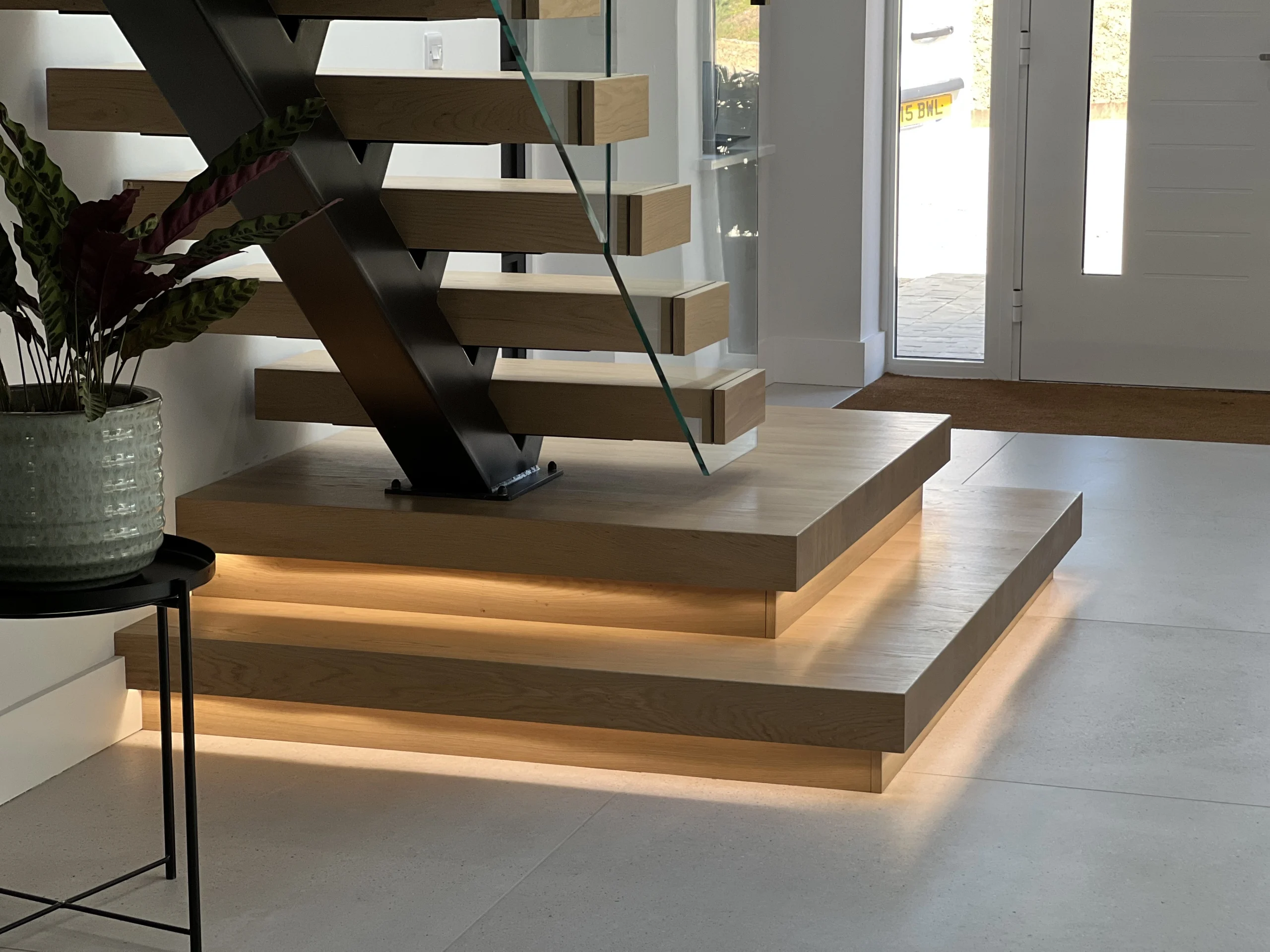
Completed bespoke L-shape floating staircase — typical project timeline 5–6 weeks from initial survey to handover.
Replacing a staircase in the UK takes 4–8 weeks total, with 2–5 days of on-site disruption. Breakdown: site survey (3–7 days), design and 3D visuals (1–2 weeks), drawing approval and deposit (3–5 days), fabrication (3–5 weeks), site preparation and removal of existing staircase (1 day), installation (2–4 days), and final snagging (1 day). DIY kit replacements can be installed in 1–2 days after a 1–2 week lead time. Bespoke designs with curved geometry, glass balustrade or LED integration extend fabrication to 6–8 weeks. Most homes can occupy normally throughout the project; stair access is interrupted for 24–48 hours during the swap itself.
The 7-Phase Timeline — Visualised
Every UK staircase replacement project follows the same seven phases. The diagram below shows the typical duration of each phase and where they overlap.
Typical 7-phase UK staircase replacement timeline — bespoke project at 6–7 weeks total
Phase-by-Phase — What Happens When
The phases below are sequential — each one depends on the previous one being completed. The first three phases run on email/phone/digital; phases 4–7 are physical work. Most of the elapsed time in a UK staircase project is in the fabrication phase (off-site), with the actual on-site disruption being a small fraction of total project duration.
Once you make initial contact, the staircase manufacturer will arrange a site survey within 3–5 working days. The survey typically takes 60–90 minutes on site. The surveyor measures floor-to-floor height (multiple points to identify variations), staircase footprint, ceiling thickness at landings, headroom on the pitch line, available width, structural attachment points (joist direction, wall construction), and existing finish levels (carpet, hard floor, plaster).
For bespoke designs, the surveyor will also discuss aesthetic preferences, structural constraints, and budget. This is the stage where Part K compliance issues are identified — if the existing staircase is non-compliant on rise, going, headroom or pitch, the surveyor flags how the new design will resolve these. Read more in our UK staircase headroom requirements guide.
What you need to have ready: Existing floor plans (if available), photos of the staircase from multiple angles, ideas/inspiration images, an indicative budget bracket. If you don't have these, the surveyor will work without them — it just adds 1–2 days to the design phase.
The design phase converts the site survey into a fully specified, structurally engineered staircase. For a bespoke project, you should expect 2D plans, sections and elevations, plus full 3D photorealistic visualisations of the staircase in your space. Standard kit staircases skip this step — the design is fixed, only dimensions are checked against site measurements.
Most design phases include 1–2 revision rounds. You review the initial proposal, request changes (different tread thickness, alternative balustrade, different colour scheme), and a revised design is produced within 2–3 working days. Major design pivots — changing from L-shape to U-shape, changing from steel to timber substructure — typically restart the clock and add 5–7 days.
Compliance work happens during this phase. The designer verifies the proposed design against Approved Document Part K (geometry), Part B (fire safety where relevant), and BS standards for materials. Read more about the 2R+G comfort formula that determines whether your staircase will be comfortable to use.
Once the design is finalised, you sign off the production drawings and pay a deposit (typically 30–50% of the project value). At Continox, this is also the point at which we confirm the manufacturing slot — your project enters the production schedule and a fabrication start date is locked in.
For projects requiring Building Control submission (most replacements do — see our UK staircase regulations guide), the production drawings and structural calculations are submitted to your local authority Building Control or an approved inspector during this phase. Approval typically comes back within 5–10 working days; this runs in parallel with fabrication, so it rarely delays the overall timeline.
See What Your Specification Costs
The design phase gets faster when you arrive with a budget bracket. Our calculator gives you instant pricing by type, material, balustrade and region.
Fabrication is the longest phase of the project — and it's also the phase you don't see. Your existing staircase is still in place and fully usable throughout this period. Off-site, the manufacturer is cutting steel sections, welding substructures, machining oak treads, sourcing glass panels, finishing components and quality-checking before delivery.
Typical fabrication durations: a standard joiner-built timber staircase needs 2–3 weeks. A bespoke steel-and-oak floating staircase needs 3–4 weeks. A bespoke design with frameless glass balustrade and LED integration needs 4–5 weeks. Curved or helical staircases — which require CNC-formed strings — can take 6–8 weeks.


Lead time pressure pointsMaterial supply chains drive most fabrication delays. Glass panels (toughening + lamination) typically run 2–3 week lead times from glass suppliers. Custom RAL powder coat colours add 5–7 days vs standard black/grey. Engineered oak from European mills runs 7–14 day lead times. Reputable manufacturers maintain stock of common materials specifically to avoid these bottlenecks — but bespoke specifications inevitably require ordering in.
The day the new staircase arrives on site, the existing staircase comes out. The team starts at 8am, protects the surrounding floors and walls with dust sheets and hardboard, dismantles the existing staircase from top to bottom, removes spindles and handrails, lifts treads, removes strings and any newel posts, makes good around the floor opening, and skips the waste material. This typically completes by mid-afternoon.
This is the only phase of the project where you have no stair access. For single-flight homes, the fix is straightforward — everyone is downstairs (or upstairs) for the duration. For L-shape and U-shape staircases, partial access via the lower flight is sometimes possible during removal of the upper flight only.
Planning around no-stair-access: If anyone in the household has mobility issues, schedule the removal day for a date when alternative arrangements are easy — staying with family, hotel for one night, or working from a downstairs reception room. Most homeowners find 24 hours is comfortable; 48 hours is the upper limit before frustration sets in.
Installation of the new staircase follows a fixed sequence. Day 1: the structural substructure is installed — steel spine, wall brackets, mounting plates — and levelled precisely to the floor markings. Day 2: oak treads or timber strings are fitted, end caps are added, fascia boards are installed below platforms. Day 3: glass balustrade panels are point-fixed, handrails are mounted, LED systems are wired and tested. Day 4: snagging — final adjustments, cover caps, plaster making-good around install points.
For straight-flight installations with timber spindle balustrade, the entire install can compress to 1–2 days. For complex L-shape floating designs with frameless glass and integrated LED, 3–4 days is typical. Our Romsey case study documents a 3-day installation of a 15-riser L-shape floating staircase with 12mm toughened glass — useful as a real-world reference.


The final on-site phase is snagging — walking the staircase with the homeowner, identifying any minor cosmetic issues (paint touch-ups, cap alignments, finish polish), and scheduling a return visit if anything substantive needs addressing. For most projects, snagging is a 30-minute walkthrough on the last day of installation with no return visit needed.
Building Control sign-off runs in parallel — the inspector visits within 5–10 working days of installation completion to inspect the finished staircase against the approved drawings. They check geometry (rise, going, pitch, headroom), guarding (height, 100mm sphere rule), structural fixings, and fire compliance where relevant. Once signed off, you receive a Completion Certificate which is essential when selling or remortgaging.
Timeline by Staircase Type
Different staircase types have meaningfully different timelines. The table below shows realistic UK 2026 durations for each main type, broken down by phase.
| Staircase Type | Total Timeline | Fabrication | On-Site Install |
|---|---|---|---|
| DIY kit (off-the-shelf) | 1–2 weeks | Stock | 1–2 days |
| Standard joiner straight | 3–4 weeks | 2 weeks | 1–2 days |
| Joiner L-shape with winder | 4–5 weeks | 3 weeks | 2–3 days |
| Bespoke floating (steel + oak) | 5–6 weeks | 3–4 weeks | 2–3 days |
| Bespoke central spine + glass | 6–7 weeks | 4–5 weeks | 3–4 days |
| Bespoke helical / curved | 8–12 weeks | 6–8 weeks | 3–5 days |
| Spiral (standard) | 3–4 weeks | 2 weeks | 2–3 days |
Can You Live in the House? — Yes, Mostly
This is the question every homeowner asks first, and the answer is reassuring: yes, in 95% of UK staircase replacement projects you can occupy the house normally. The fabrication phase (3–5 weeks of the total timeline) happens entirely off-site — you have full stair access throughout. The only disruption is during phases 5 and 6, when stair access is interrupted for 24 hours to 4 days depending on the staircase type and household setup.
For single-flight homes with a usable downstairs (kitchen, living room, downstairs WC) and bedroom-equivalent space on one floor, the swap is straightforward — the household lives on the side of the house with full facilities until the new staircase is functional. For multi-storey homes (3+ floors), the install team can typically maintain access to the lower floors via the downstairs flight while working on the upper.
Where it gets harder: properties with elderly residents who can't easily move bedrooms downstairs for 1–2 nights, properties where the only bathroom is upstairs, and pet households where animals can't safely navigate construction debris. In these cases, we'd recommend booking a hotel or family stay for the 24–48 hour install window — small inconvenience for a 30-year asset.
Common Delays — And How to Avoid Them
1. Site survey errors discovered during fabrication
If the original site measurements were wrong (typically due to plaster thickness assumptions, or hidden joists discovered during opening prep), fabrication has to pause while components are remade. Avoidance: insist on a full physical site survey, not "off plans" — this is non-negotiable on bespoke projects.
2. Building Control approval delays
Approved drawings can sit in your local authority Building Control queue for 2–4 weeks during peak season (April–September). Avoidance: submit the application as early as possible — at end of Phase 3 — so approval runs in parallel with fabrication, not after. For time-critical projects, use an approved inspector instead of local authority Building Control (5-day turnaround typical vs 2–4 weeks).
3. Material supply chain bottlenecks
Glass panels, custom RAL colours, specific oak grades all have supply chain risk. Avoidance: order materials at start of fabrication phase, not at the point they're needed for assembly. Manufacturers who hold stock of common materials (Continox keeps oak, standard powder-coat colours, common glass thicknesses on hand) absorb most of this risk.
4. Site access issues
A new staircase has to physically arrive at the site. For long single-piece elements (steel spine for floating staircase, full-length stringers for straight flights), narrow access in terraced or period properties can require dismantling sub-assemblies, getting them through the door, and re-welding/bolting on site. Avoidance: discuss access during site survey — confirm the largest single piece can fit through the entry route.
5. Existing structure surprises
Cutting into the floor opening sometimes reveals damaged joists, unexpected services routing, or non-standard construction details. Avoidance: a thorough site survey including (where possible) lifting a floorboard or two near the opening to check what's underneath. Bespoke manufacturers expect to handle some surprises — DIY-kit suppliers don't, and you'll be left to source and fund any structural work yourself.
Best Time of Year — Seasonal Timing
Staircase manufacturers in the UK have predictable seasonal demand patterns. Understanding these can save you 1–2 weeks of lead time and sometimes a few percent on price.
Quietest period (longer lead time available, sometimes better pricing): Late November to mid-January — homeowners delay starting projects until after the new year. Workshops have spare capacity. Busiest period (longer lead times, premium booking): April to September — peak renovation season aligned with school summer holidays. Sweet spot: Mid-January to mid-March — workshops have capacity, you avoid summer disruption to family life, and the staircase is finished before the spring/summer entertaining season.
Get an Instant Cost Estimate
Now you know how long it takes — find out what it costs. Adjust type, material, balustrade and region for live UK 2026 pricing.
Staircase Replacement Timeline — FAQ
Common questions UK homeowners ask about how long staircase replacement takes.
Free Survey + Fixed-Price Quote
Continox provides full project timelines from day one — every quote includes survey date, fabrication slot, install dates, and Building Control sign-off schedule. No surprises, no rolling delays. Free on-site survey across Southern England, photorealistic 3D visuals, fixed-price quotation within 24 hours.