

Bespoke Modern Staircases for Austrian Architects & Developers
Nine modern staircase systems engineered for Austrian projects — from Wien Gründerzeit altbau insertion and Salzburg heritage premium, to Kitzbühel ultra-luxury chalet and Vorarlberg Baukultur contemporary. EN 1090-1 EXC2 manufacturing, OIB Richtlinie 4 aligned, cold-climate-grade steel for alpine altitudes.
Continox is the bespoke modern staircase specialist serving Austria's premium residential and architectural market. We manufacture each Stiege in our EN 1090-1 EXC2 facility near Kraków, Poland — meaning intra-EU B2B supply with reverse-charge USt., zero customs friction, and 2–3 day transit to all 9 Bundesländer via the Bayern–Salzburg or Bayern–Tirol motorway corridors.
Our Austrian project portfolio spans the country's three premium markets: Wien Gründerzeit altbau and Wienerwald villa belt, Tirol & Vorarlberg ultra-luxury alpine (Kitzbühel, Lech, Zürs, Sölden, Bregenzerwald), and Salzburg & Salzkammergut heritage premium (Aigen estates, Wolfgangsee, Mondsee, Attersee waterfront). Each project receives full OIB Richtlinie 4-aligned documentation, Eurocode structural calculations with Austrian national annex, and material specifications cold-climate-graded for the project's altitude.
Nine Staircase Systems for Austrian Projects
Every Continox staircase is bespoke — built to the exact dimensions, finishes and Austrian regulatory requirements of your project. The nine system archetypes below define the structural and visual logic; within each, every component is custom-fabricated. EUR pricing is from-budget for typical residential floor heights (~3.0 m) and represents fully fitted (delivered & installed) project value.

L-Shape Steel Plates
90° turn configuration in steel plate stringer architecture. The entry-level Continox archetype — minimalist, structurally honest, ideal for compact Wien Altbau insertions where space is the primary constraint.
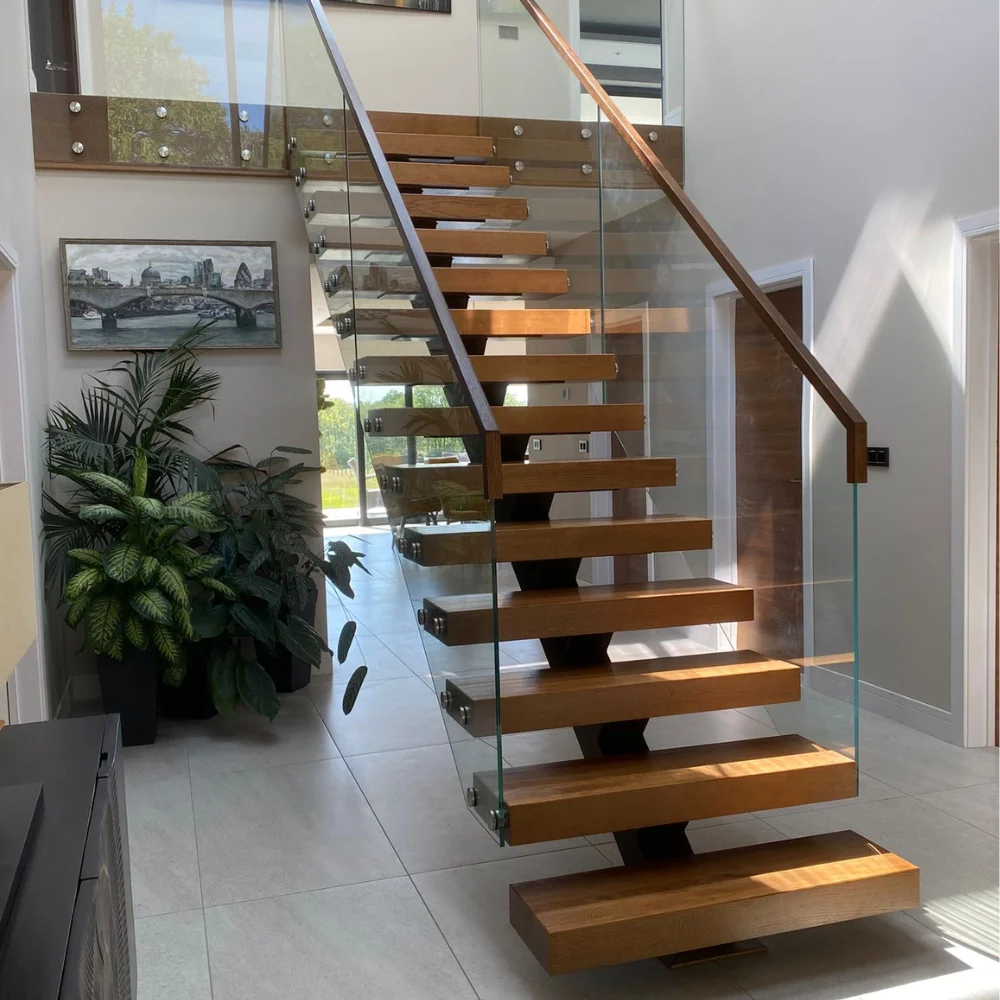
Central Spine Staircase
Single steel spine running below floating treads — the most-specified Continox configuration for Austrian premium residential. Sculptural, contemporary, oak treads optional.

U-Shape Steel Plates
180° configuration with mid-flight Podest landing — ideal for taller floor heights typical in Gründerzeit altbau (3.5–4.2 m floor-to-floor) where straight runs become uncomfortable.
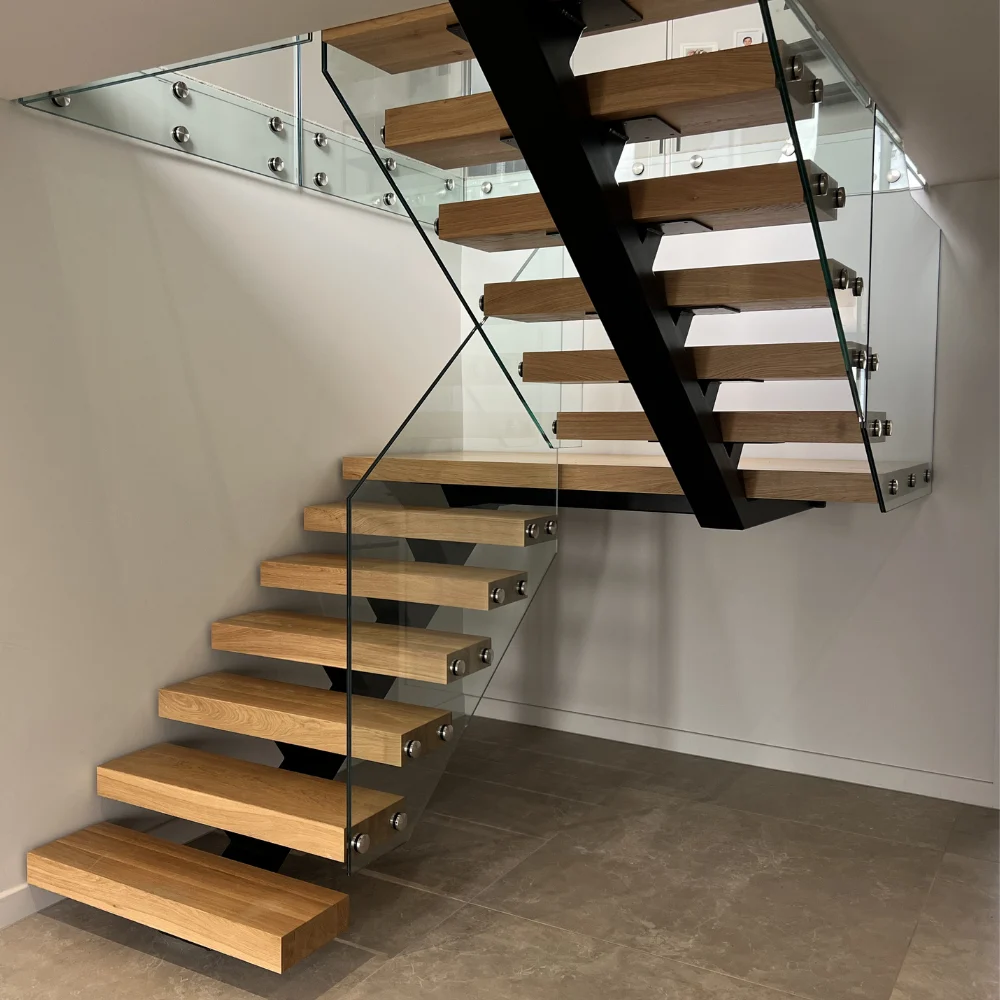
U-Shape Central Spine
Spine architecture in U-configuration — combines the structural drama of central spine with the spatial efficiency of U-turn. Premium Wien duplex specification.
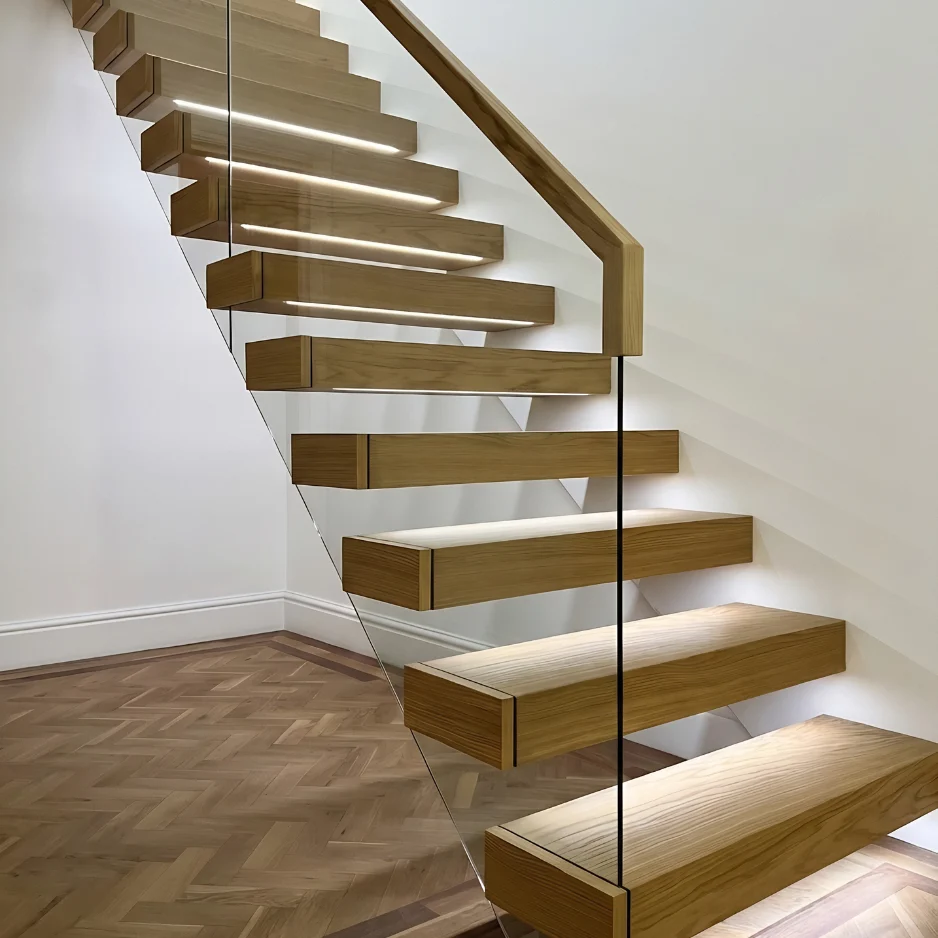
Floating Staircase
Cantilever treads anchored into structural wall — visually unsupported. Requires Stahlbeton or verified Mauerwerk substrate; not all Wien Altbau walls qualify (substrate Befund mandatory).
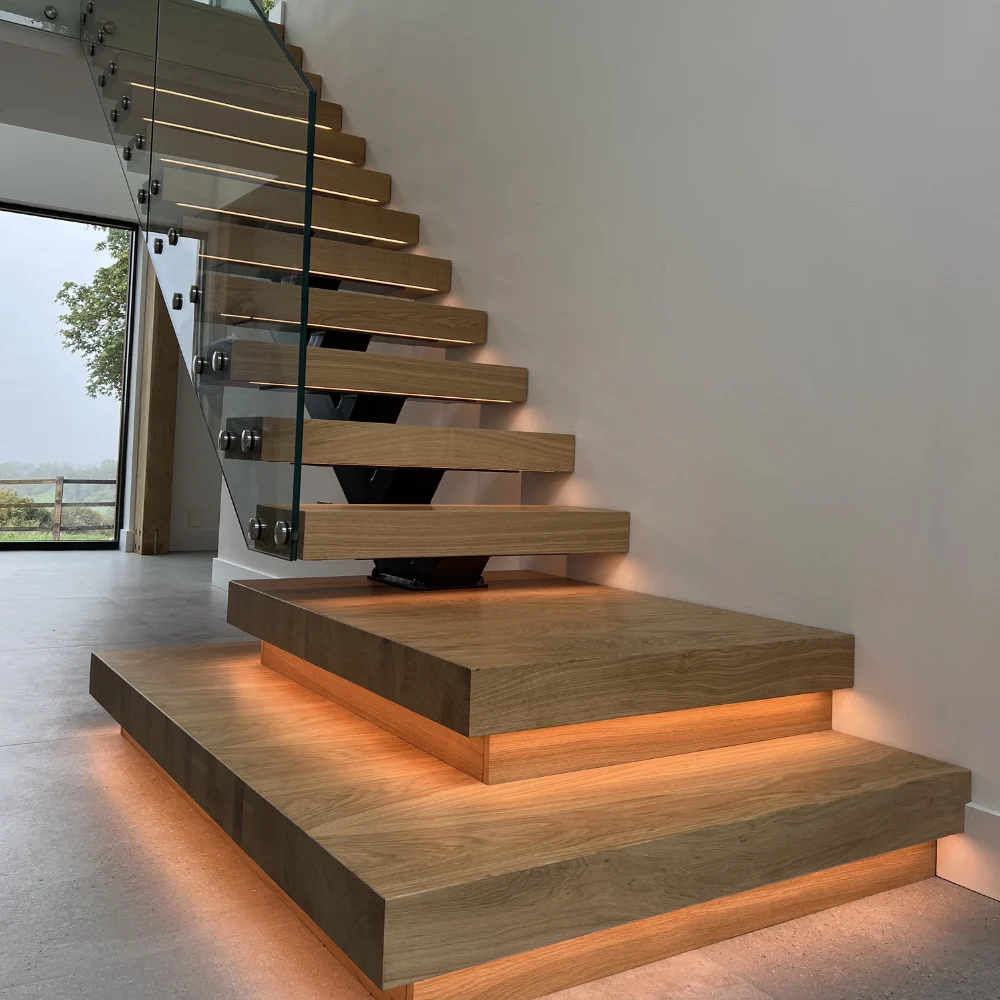
Central Spine with Platform
Spine architecture with intermediate platform integrated into the structural narrative — large floor-plate residential, Salzkammergut villa, Kitzbühel chalet entry hall configurations.
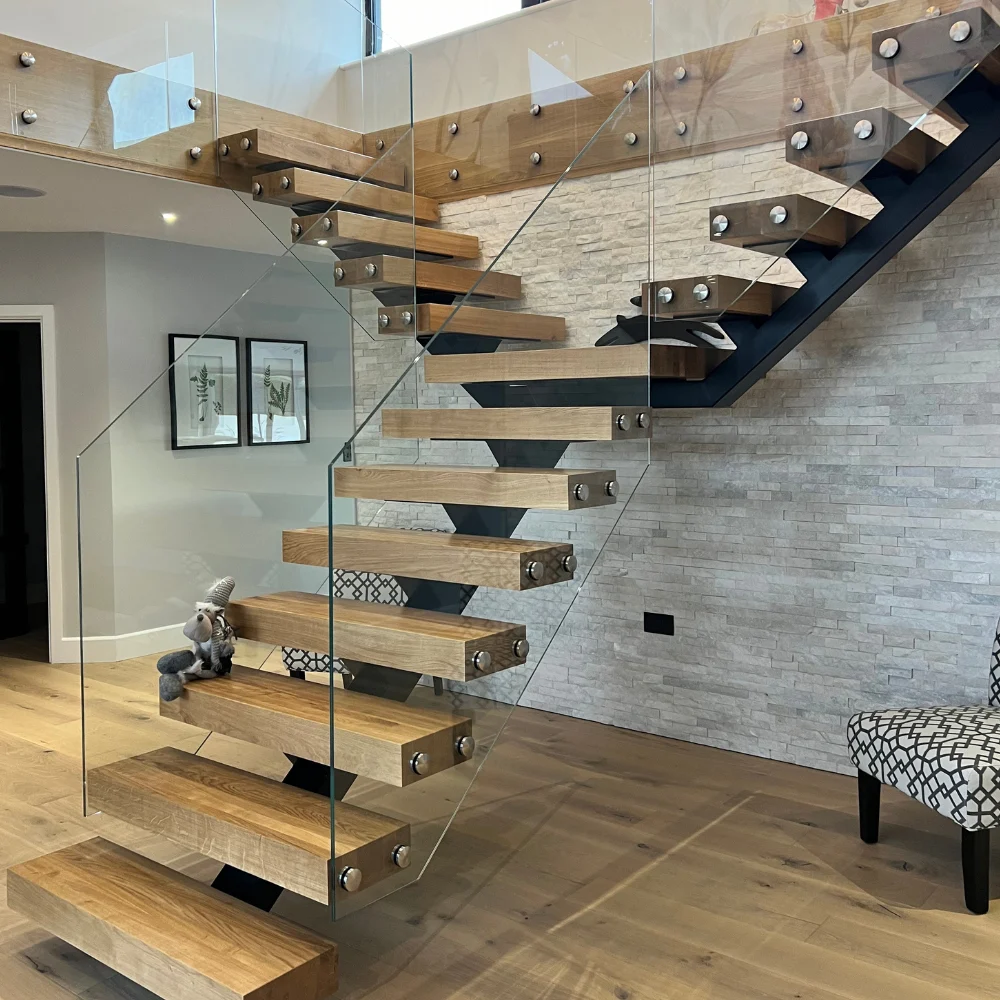
Y-Shape Central Spine
Dual-direction split from central platform — the sculptural showpiece configuration. Specified for ultra-luxury alpine chalets and grand entry halls in heritage villa renovations.
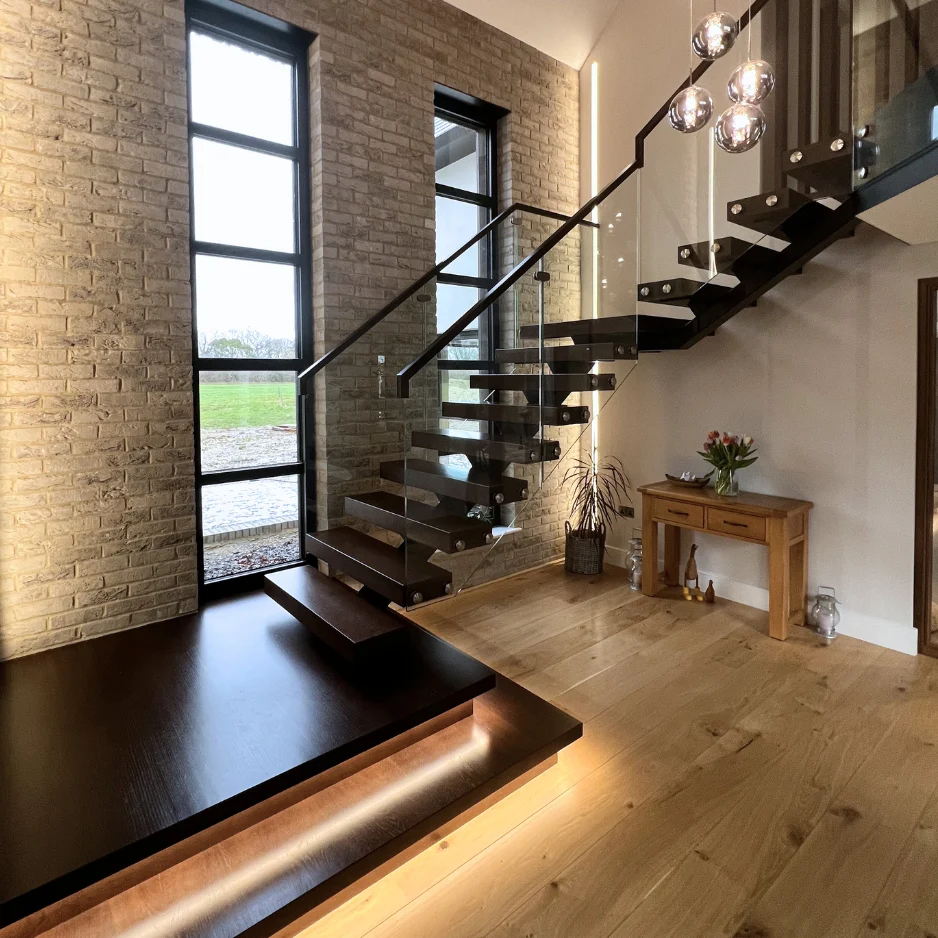
Premium Central Spine
Central spine with European Oak A-grade premium tread & riser specification — Bichlalm chalet, Aigen villa, Salzburg Altstadt heritage projects. Hand-selected oak from Austrian/Bavarian forestry.
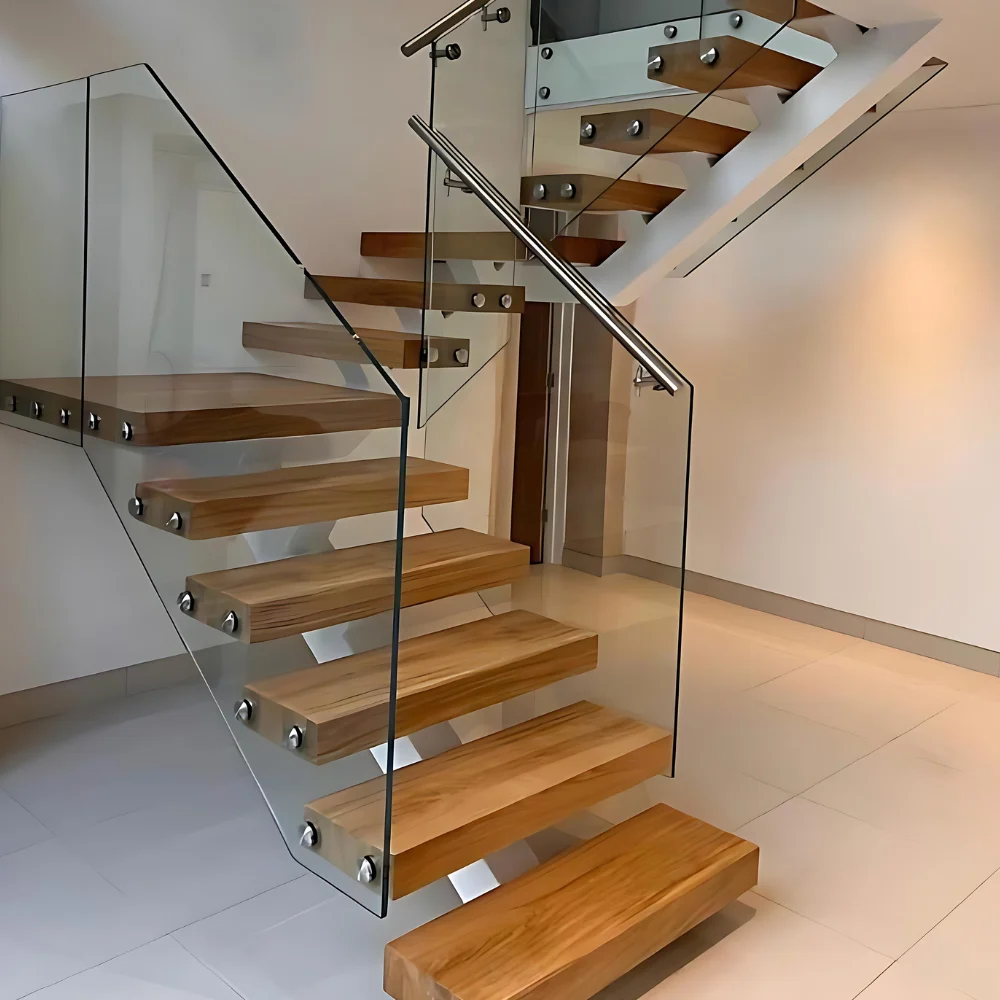
Fully Bespoke
Architecturally unique fabrication — when no system archetype matches the brief. Direct collaboration with the project's Architekt & Tragwerksplaner from concept through Befund and Schlussüberprüfung.
Three Premium Markets Across Austria
Continox supplies all 9 Bundesländer, but Austria's premium staircase demand concentrates in three distinct markets — each with its own project archetype, regulatory overlay, and specification logic. Click through to the regional supply guide for project profiles, neighborhood breakdowns, and system-selection recommendations specific to each market.
Wien · Niederösterreich
Wien & Niederösterreich — Gründerzeit Altbau & Villa Belt
Capital region premium. Innere Stadt Gründerzeit duplex insertion, Döbling Cottageviertel villa renovation, Hietzing Schönbrunn-side, plus the Wienerwald villa belt — Klosterneuburg, Mödling, Baden bei Wien, and contemporary new-build in Wien Hauptbahnhof Sonnwendviertel.
Tirol · Vorarlberg
Tirol & Vorarlberg — Alpine Chalet & Baukultur Premium
Top-end alpine. Kitzbühel Bichlalm and Aurach private chalets, Lech am Arlberg, Zürs and Sölden Skigebiet ski resort property, Innsbruck-Igls premium residential, plus the Vorarlberg Baukultur architectural movement — Bregenzerwald, Schruns Montafon, Hohenems contemporary residential.
Salzburg · Salzkammergut
Salzburg & Salzkammergut — Heritage Premium & Lakeside Villas
Heritage premium and waterfront. Salzburg Altstadt UNESCO insertion, Aigen and Anif estate properties, plus the Salzkammergut lake belt — Wolfgangsee, Mondsee, Attersee waterfront villas — and historic Bad Ischl Kaiserstadt and Hallstatt UNESCO premium residential renovation.
Specification & Project Process
From first quotation to commissioned installation, a typical Austrian project runs ~12 weeks. We document each stage with the deliverables Austrian Architekten and Tragwerksplaner expect — ÖBauerung-aligned drawings, Eurocode structural calculations, and full ÖNORM-harmonised material certification.
Quotation & Concept
Submit project drawings (or Bauanzeige documents) and we return a fixed-price EUR quotation in 48 working hours, with system recommendation and altitude-graded material spec.
Technical & Structural
3D visualisation, technical drawings, Eurocode structural calculations with Austrian national annex — typically 2 weeks after order. Coordination with project Tragwerksplaner.
Manufacture
EN 1090-1 EXC2 fabrication near Kraków — typically 6–8 weeks. Each component receives mill certificate traceability to heat number, full DoP and CE documentation pack.
Delivery & Install
2–3 day intra-EU transit via Bayern–Salzburg / Bayern–Tirol corridor, 2–3 day installation by Continox-trained team, project commissioning with Schlussüberprüfung support.
Architect & Specifier Questions
The questions Austrian Architekten, Tragwerksplaner and developers ask us most often. For technical depth, follow the linked guides in the resource library above.
What's the lead time for a Continox staircase to an Austrian project?
Standard timeline ~12 weeks from signed order: 2 weeks for technical drawings, 6–8 weeks manufacture, 2–3 days delivery, 2–3 days installation. Quotation in 48 working hours from receipt of project documents.
Are Continox staircases compliant with OIB Richtlinie 4?
Yes. Every Continox staircase for Austrian projects is engineered to OIB Richtlinie 4 dimensional rules (Stiegenlaufbreite, Steigungsverhältnis, Geländer height) and Eurocode structural framework with Austrian national annex. Final regulatory acceptance and Schlussüberprüfung remain with the project's Austria-registered Architekt or Ziviltechniker.
How does pricing in EUR compare to Austrian-domestic Stiegenbau?
Continox EUR pricing is typically 30–45% below Austrian-domestic Stiegenbau premium fabricators for equivalent EN 1090-1 EXC2 specification — driven by Polish manufacturing economics, not lower spec. Mill certificates, EN 1090, Eurocode and ÖNORM compliance are identical.
Do you supply ski resort properties above 1,500 m?
Yes — alpine projects are a Continox specialisation. We supply S355J0 (verified to −20 °C) as default above 800 m and S355J2 (verified to −30 °C) above 1,500 m, with full EN 10025 mill certification. Kitzbühel, Lech, Zürs, Sölden, Hochfügen, Ischgl all receive cold-climate-graded material as standard.
Is Brexit relevant when ordering for Austrian projects?
No. Continox manufactures in Poland (EU), so deliveries to Austria are intra-EU B2B with reverse-charge USt., zero customs declarations, no Brexit paperwork. Transit takes 2–3 days via direct EU motorway through Bayern.
Can a Continox spine be anchored into Wien Gründerzeit Mauerwerk?
Often yes, with substrate verification. Late-19th-century Wienerberger brick typically tests at sufficient compressive strength for chemical anchoring of cantilever spine reactions, but a Befund by a Tragwerksplaner is required project-by-project. Our flagship technical guide covers the anchor capacity logic.