

OIB Richtlinie 4 & Austrian Staircase Regulations — Complete Architect Guide
Stiegenlaufbreite, Steigungsverhältnis, Wohnbau Klasse classification, Geländer requirements, fire-resistance overlay and the federal-vs-Bundesländer regulatory architecture — the foundation reference for Austrian bespoke staircase specification.
How OIB Richtlinien Govern Austrian Staircases
Austria's building code is structured as a federal-cantonal hybrid. The Österreichisches Institut für Bautechnik (OIB) publishes six harmonised Richtlinien — guidelines that define unified technical requirements across all 9 Bundesländer. OIB Richtlinie 4 (Nutzungssicherheit und Barrierefreiheit) is the staircase-relevant document, covering dimensional rules, fall protection, accessibility and Geländer specification. OIB Richtlinie 2 (Brandschutz) provides the parallel fire-resistance framework that overlays staircase specification in Notwendige Stiegen.
Each of the 9 Bundesländer adopts OIB Richtlinien through its own Landesbauordnung (LBO) — Wien through Wiener Bauordnung (BauO Wien), Tirol through Tiroler Bauordnung (TBO), Salzburg through Salzburger Bauordnung (Sbg BO), and so on. The Richtlinien content is identical across Bundesländer, but the Bauanzeige submission process, the form sets, and the Schlussüberprüfung (final inspection) procedure differ. An Architekt working in both Wien and Innsbruck files different paperwork, but specifies the same Stiegenlaufbreite.
OIB Richtlinie 4 = "what you build." Landesbauordnung = "how you submit and get it approved." The technical specification is federal; the procedure is Bundesländer.
For Austrian Continox projects, this means a single technical specification serves the project regardless of Bundesland, but the project's Architekt or Ziviltechniker für Bauwesen handles Bundesland-specific submissions. Our documentation pack is OIB Richtlinie 4-aligned with Eurocode structural calculations using the Austrian national annex — accepted for Bauanzeige in all 9 Bundesländer.
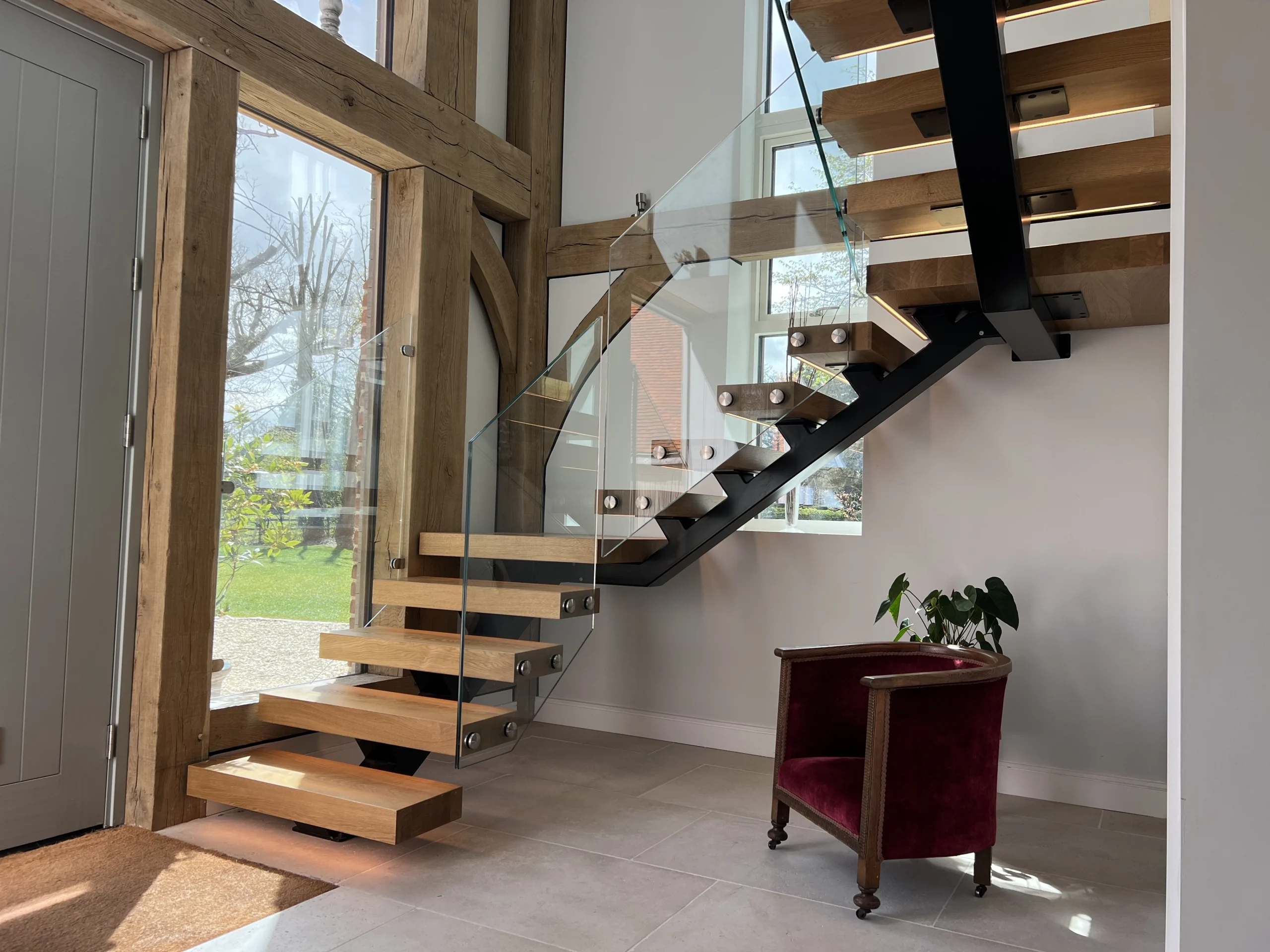
Continox central spine staircase — engineered to OIB Richtlinie 4 with Austrian national annex Eurocode calculations
Stiegenlaufbreite — Minimum Widths by Use
OIB Richtlinie 4 defines minimum useable staircase width — nutzbare Stiegenlaufbreite — measured between Geländer or between wall and Geländer (not between stringers, which is wider). The minimums scale with building use and Wohnbau Klasse classification.
| Use / Wohnbau Klasse | Min. Stiegenlaufbreite | Typical Specified | Notes |
|---|---|---|---|
| Single-family (WK 1) | 90 cm | 100–110 cm | Useable width between Geländer |
| Two-family (WK 1, separate entries) | 90 cm | 100–110 cm | Per Stiege within unit |
| Multi-residential ≤ 4 storeys (WK 2–3) | 100 cm | 110–120 cm | Notwendige Stiege, fire-rated |
| Multi-residential ≥ 4 storeys (WK 4) | 120 cm | 120–135 cm | Sicherheitsstiege requirements |
| Hochhäuser (WK 5, ≥ 22 m) | 120 cm | 135 cm minimum | Plus fire-resistant Vorraum |
| Internal nicht-notwendige (within unit) | 80 cm (relaxed) | 90–100 cm | Architectural Stiegen, not escape |
Source: OIB Richtlinie 4, applicable Landesbauordnung implementation. Typical Continox specifications shown.
The nutzbare Stiegenlaufbreite measurement is critical for Continox spine and floating system specifications. A Wien Innere Stadt Gründerzeit duplex with 105 cm useable width specified between Geländer translates to a structural envelope of typically 115–125 cm — depending on Geländer thickness and fixing detail. We always quote the useable Stiegenlaufbreite explicitly to avoid ambiguity between architectural drawings and shop fabrication.
Steigungsverhältnis & The Schrittmaßregel
OIB Richtlinie 4 governs step geometry through two parallel rules. The first is dimensional limits on Steigung (riser height) and Auftritt (going / tread depth) by use class. The second is the comfort rule — the Schrittmaßregel — derived from human stride physiology: 2 × Steigung + Auftritt = 59–65 cm. Both must be satisfied.
Maximum Steigung & Minimum Auftritt by Use
| Building Use | Max Steigung | Min Auftritt | Typical Spec |
|---|---|---|---|
| Wohnbau Klasse 1 (single-family) | 20 cm | 23 cm | 17–18 cm / 27–29 cm |
| Wohnbau Klasse 2–3 (multi-residential) | 18 cm | 27 cm | 17 cm / 28 cm |
| Wohnbau Klasse 4–5 (high-density / Hochhaus) | 17 cm | 28 cm | 16.5 cm / 29 cm |
| Sicherheitsstiege (escape) | 18 cm | 26 cm | 17 cm / 28 cm |
| Nicht-notwendig within unit | 22 cm | 21 cm | 18–20 cm / 24–26 cm |
For Austrian Continox specifications, our default Steigungsverhältnis is 17/29 cm for Wohnbau Klasse 1 — comfortable, generous Auftritt, full Schrittmaßregel compliance. Where floor-to-floor heights are non-standard (Wien Gründerzeit altbau commonly 3.5–4.2 m floor-to-floor vs new-build 2.7–3.0 m), we recalibrate to maintain the Schrittmaßregel rather than the typical 17/29 — sometimes the result is 18/27 or 17.5/28.
Wohnbau Klasse 1–5 — The Defining Classification
The Wohnbau Klasse (WK) classification is the master variable that drives almost every other Austrian staircase requirement — width, fire-resistance, accessibility (Barrierefreiheit), and structural loading. It's defined by building height, occupancy and use mix.
| Klasse | Definition | Typical Project | Stiege Treatment |
|---|---|---|---|
| WK 1 | Single-family, ≤ 1 unit, ≤ 7 m floor | Wien Cottageviertel villa, Kitzbühel chalet | Relaxed — typically nicht-notwendig within |
| WK 2 | 2 units, ≤ 7 m floor, ≤ 400 m² Nutzfläche | Two-family Mödling, Anif duplex | Notwendige Stiege if shared between units |
| WK 3 | ≤ 7 m floor, no Nutzfläche limit | Mehrfamilienhaus 2–3 storey | Notwendige + REI 30 fire-resistance |
| WK 4 | 7 m to 22 m floor | Wien Hauptbahnhof Sonnwendviertel | Notwendige + REI 60 + Geländer 1.1 m |
| WK 5 | > 22 m floor (Hochhaus) | Vienna twin towers, urban Hochhaus | Sicherheitsstiege + REI 90 + Vorraum |
Most Continox Austrian projects fall under Wohnbau Klasse 1 — single-family premium residential where the staircase is typically nicht-notwendig (architectural, within a single unit). This unlocks design flexibility: relaxed dimensional rules, no fire-resistance requirement, no mandatory Vorraum. Floating staircases, sculptural Y-Shapes, dramatic central spine with platform configurations are all reachable in WK 1 — and rarely reachable in WK 3+ where the Stiege becomes a Notwendige Stiege subject to fire-resistance and geometric constraints.
If your client wants a Continox floating staircase in a Wien Innere Stadt duplex, the project must be Wohnbau Klasse 1 and the Stiege must be classified as nicht-notwendig (i.e., serving only one unit, with a separate Notwendige Stiege as the legal escape route). This is almost always achievable in altbau renovation — the existing Hauptstiege provides the legal route, and the new Continox Stiege is internal to the unit.
Geländer & Handrail Requirements
OIB Richtlinie 4 sets minimum Geländer (guard) heights at fall risks — measured from finished floor or tread surface to top of handrail. Heights scale with fall depth and Wohnbau Klasse.
| Fall Height | Use Class | Min Geländer Height | Typical Spec |
|---|---|---|---|
| ≥ 1.0 m (residential within unit) | WK 1, nicht-notwendig | 1.00 m | 1.00–1.10 m |
| ≥ 1.0 m (notwendig + WK 2–3) | Notwendige Stiege | 1.00 m | 1.10 m |
| ≥ 12 m fall | Any class | 1.10 m | 1.10 m |
| WK 4 (≥ 7 m floor) | High-density | 1.10 m | 1.10 m |
| Hochhaus / WK 5 | ≥ 22 m | 1.10 m | 1.10 m + special detailing |
Geländer Opening Limits — Child Safety
Where a residential building admits children (almost all Wohnbau), Geländer must restrict child climbing and prevent passage of a 12 cm sphere. This limits horizontal openings, gap dimensions and decorative detail. Continox glass balustrades comply through laminated VSG infill; metal-bar Geländer must use spacing ≤ 12 cm (vertical bars) or solid panel construction.
Handrail (Handlauf) Continuity
Where the Stiege has more than 3 risers, a continuous handrail (Handlauf) is required on at least one side. For Wohnbau Klasse 4–5 and any commercial Stiege, handrail is required on both sides. Handrail diameter is typically 30–50 mm, gripping clearance from wall ≥ 5 cm, and the handrail must extend ~30 cm beyond the top and bottom landing for descent stability — particularly relevant in Sicherheitsstiegen for emergency egress.
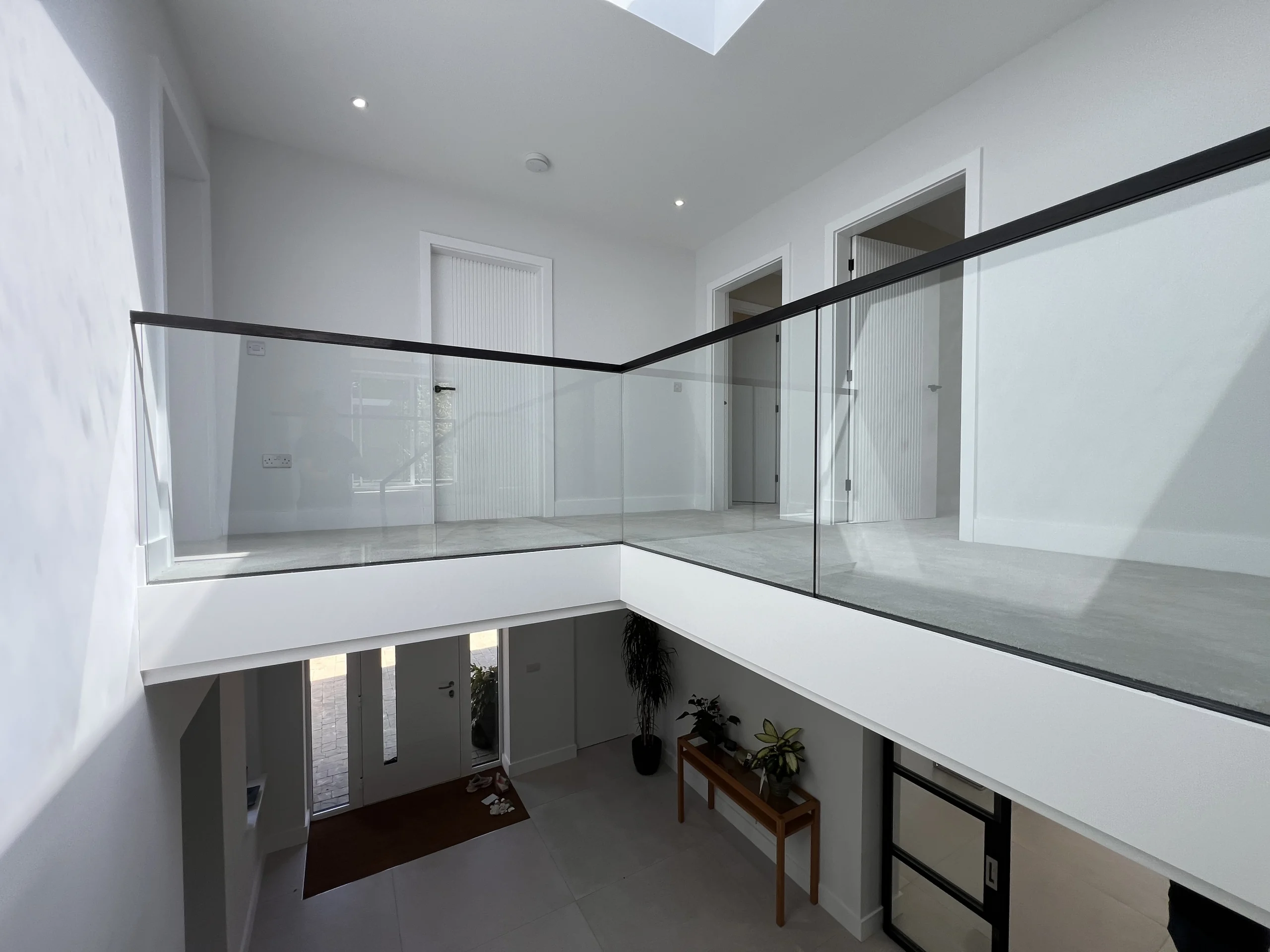
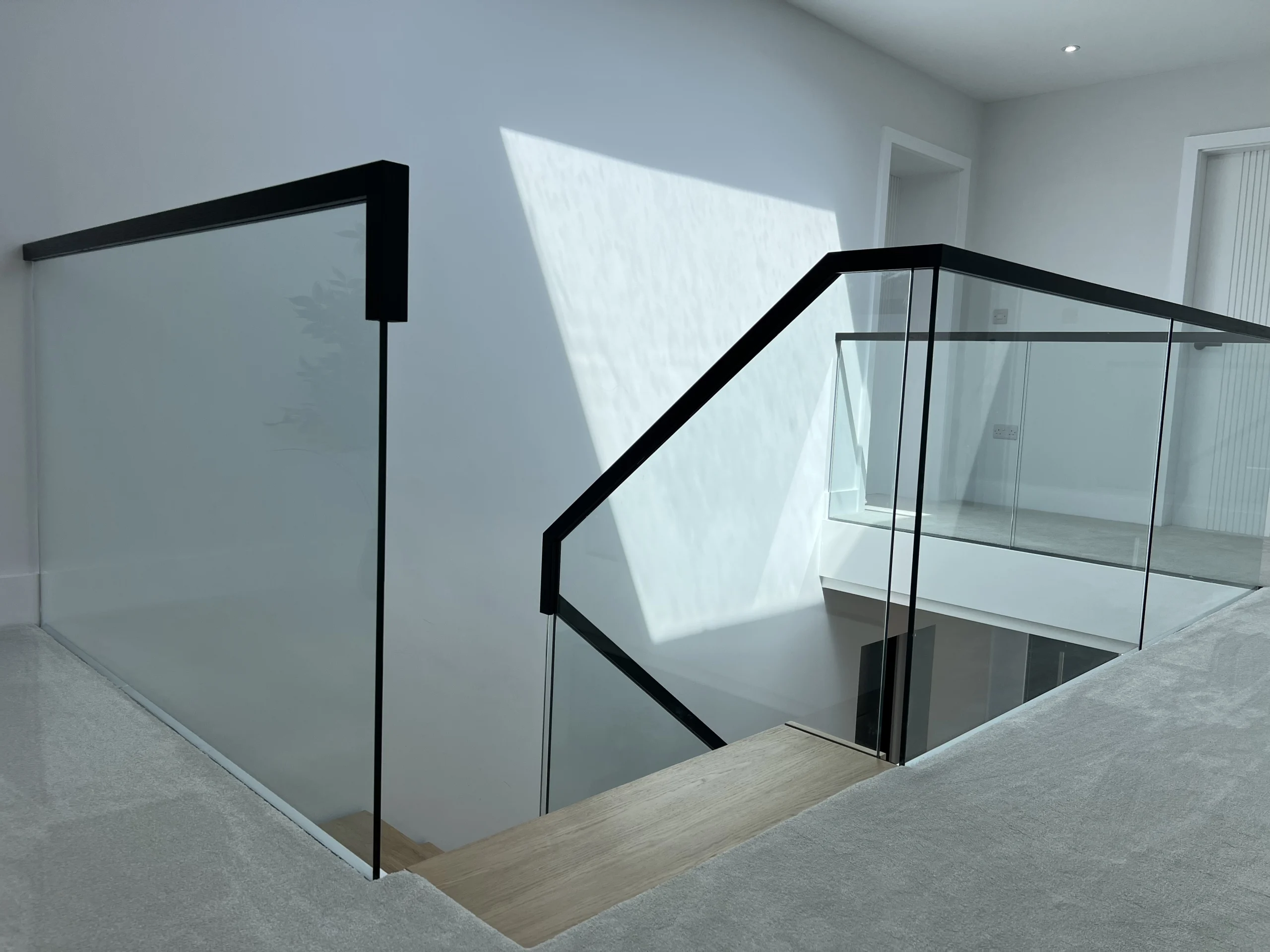
Continox glass Geländer with handrail at OIB Richtlinie 4 height — laminated VSG infill, frameless fixing, brushed stainless or painted black handrail per project finish
OIB Richtlinie 2 — Brandschutz for Notwendige Stiegen
Where a staircase is a Notwendige Stiege (legal escape route serving multiple units, multiple storeys, or in any building beyond Wohnbau Klasse 1), it falls under OIB Richtlinie 2 fire-resistance requirements — separate from but parallel to OIB Richtlinie 4. Fire-rating scales with Wohnbau Klasse.
| Wohnbau Klasse | Stiege Fire-Resistance | Stiegenhaus Wand | Notes |
|---|---|---|---|
| WK 1 (single-family) | None (if nicht-notwendig) | None (within unit) | Stiegen design unrestricted |
| WK 2–3 | REI 30 | REI 60 | Standard fire compartmentation |
| WK 4 | REI 60 | REI 90 | Stiegenhaus + Vorraum |
| WK 5 (Hochhaus) | REI 90 | REI 90 + non-combustible | Sicherheitsstiege + smoke-evacuation |
Continox bespoke staircases are most commonly specified in Wohnbau Klasse 1 projects where fire-resistance does not apply to the architectural Stiege itself. The legal escape route (Hauptstiege) is the existing concrete-and-tile Stiegenhaus typical to Wien Gründerzeit altbau, and the Continox internal Stiege adds architectural quality without inheriting fire-rating obligations.
For Wohnbau Klasse 2–3 projects (Mödling Mehrfamilienhaus, Klosterneuburg Doppelhaushälfte), Continox supplies steel structures with intumescent paint coating to achieve REI 30 — verified through DOP testing under EN 13381-8. Tread material (oak, glass, steel plate) influences the rating: oak treads in REI 30 require 28 mm minimum thickness with verified ignition behaviour.
Bauanzeige & Schlussüberprüfung Process
Austrian building control divides into two procedural stages: Bauanzeige (notification / building permit application — pre-construction) and Schlussüberprüfung (final inspection — post-construction). Both are administered by the Bundesland (Magistrat in Wien, Bezirkshauptmannschaft elsewhere) under the local Landesbauordnung.
Bauanzeige — Pre-Construction Documentation
For a Continox staircase replacement or insertion in an existing dwelling, the typical Bauanzeige documentation includes architectural plans (Grundrisse, Schnitte, Ansichten in 1:50 or 1:100), the Stiege's structural calculations (Statik) prepared by a Tragwerksplaner or Ziviltechniker, a description of materials and fire-resistance (where applicable), and confirmation of compliance with OIB Richtlinie 4. The package goes to the Bauamt for review — typical processing time 4–8 weeks for residential.
Continox supplies the technical documentation pack supporting the Architekt's Bauanzeige submission: Eurocode structural calculations (Austrian national annex), EN 1090-1 EXC2 manufacturing certificate, mill certificates traceable to heat number, declaration of performance (DoP) per CPR 305/2011, and where applicable intumescent coating certification for REI 30 ratings. The Architekt or Ziviltechniker compiles this with the project architecture for the Bauamt submission.
Schlussüberprüfung — Final Inspection
Upon completion, the Bauamt conducts a Schlussüberprüfung (sometimes Endabnahme or Kollaudierung in older terminology). The inspector verifies built dimensions match approved Bauanzeige documents, fire-resistance ratings are achieved (where applicable), and Geländer heights and child-safety detailing are correct. For Continox installations, the Architekt or Tragwerksplaner attends with our as-built documentation and the on-site verification typically takes 30–60 minutes.
Austria vs Germany vs Switzerland — Specifier's Comparison
Architects working across the DACH region — Austrian practice with German clients, German practice with Swiss alpine projects, Swiss practice with Vorarlberg adjacent — frequently navigate three parallel regulatory frameworks. They share Eurocode foundations but diverge in dimensional rules, classification taxonomy and submission process.
Austria
Germany
Switzerland
The Austrian and Swiss frameworks align more closely than either does to Germany — both share 1.00 m Geländer height as default, a similar Stiegenlaufbreite minimum, and a comparable Schrittmaßregel. German DIN 18065 is more permissive on Geländer (0.90 m default, 1.10 m only above 12 m fall) and on Stiegenlaufbreite within a unit (80 cm), but stricter on notwendig classification. Continox supplies all three jurisdictions from a single manufacturing facility with framework-specific documentation per project.
OIB Richtlinie 4 — Architect & Specifier Questions
The questions Austrian Architekten, Tragwerksplaner and developers most commonly ask about OIB Richtlinie 4 application to bespoke modern staircases.
Does OIB Richtlinie 4 apply equally in all 9 Bundesländer?
Federally yes — OIB Richtlinie 4 is the unified Austrian technical framework. The dimensional rules, Geländer heights and classification taxonomy are identical across Wien, Niederösterreich, Oberösterreich, Salzburg, Tirol, Vorarlberg, Steiermark, Kärnten and Burgenland. What differs is procedural: each Bundesland's Landesbauordnung defines its own Bauanzeige form set, submission deadlines and Schlussüberprüfung procedure.
What is the absolute minimum Stiegenlaufbreite for an Austrian residence?
For a single-family residence (Wohnbau Klasse 1) where the Stiege is nicht-notwendig (within a single unit, not a legal escape route), the absolute minimum useable width is typically 80 cm. For practical comfort and Continox specification, we recommend 90 cm minimum, with 100–110 cm being the typical specified range for premium residential.
Can a Continox floating staircase be specified as a Notwendige Stiege?
Generally no. Floating staircases (cantilever treads) cannot easily achieve REI 30+ fire-resistance and are not appropriate as legal escape routes. The standard solution is to specify the existing concrete-and-tile Hauptstiege as the legal Notwendige Stiege, and use the Continox floating Stiege as nicht-notwendig within a Wohnbau Klasse 1 unit. This works for almost all Wien altbau renovations and is the most common Continox configuration for Austrian premium projects.
What's the Schrittmaßregel and is it mandatory?
The Schrittmaßregel is the comfort formula 2 × Steigung + Auftritt = 59 to 65 cm, derived from human stride physiology. It's not strictly mandated by OIB Richtlinie 4 but is universally applied in Austrian Tragwerksplaner practice and is referenced in all major Austrian building physics textbooks. Stairs that deviate significantly from this range cause discomfort and trip hazards. Continox always verifies the Schrittmaßregel before finalising step geometry.
Are the OIB rules for Geländer height stricter than DIN 18065?
Yes, slightly. OIB Richtlinie 4 requires 1.00 m Geländer height at any fall ≥ 1 m, while German DIN 18065 sets the default at 0.90 m and only escalates to 1.10 m above 12 m fall height. For cross-border projects (Bayern–Salzburg or Tirol–Allgäu adjacent), Continox specifies to the higher of the two requirements, ensuring compliance whichever framework controls.
Does OIB Richtlinie 4 apply to internal architectural Stiegen within a single unit?
Mostly no — internal nicht-notwendige Stiegen are subject to relaxed rules. Width may drop to 80 cm, Steigung up to 22 cm, and Auftritt as low as 21 cm are permissible. This is what makes Continox sculptural Stiegen (floating, Y-Shape, dramatic spine) achievable in WK 1 single-family — the regulation is permissive when no escape route is involved.
Continue Through the Austria Resource Library
This OIB Richtlinie 4 guide is the regulatory foundation. The full Continox Austria Resource Center extends with seven more guides covering glass standards, regional context, technical engineering and implementation:
- AT02 — Glass Balustrade Regulations Austria (ÖNORM B 3716) — companion regulatory pillar covering laminated VSG, ÖNORM EN 14449/12150/12600, heat-soak and Continox glass supply matrix
- AT03 — Modern Staircases for Wien & Niederösterreich — capital region projects, Gründerzeit altbau insertion logic, Cottageviertel villa supply
- AT04 — Modern Staircases for Tirol & Vorarlberg Alpine — Kitzbühel, Lech, Zürs ultra-luxury chalet specification
- AT05 — Modern Staircases for Salzburg & Salzkammergut — heritage premium plus lakeside villa supply
- AT06 — Cold Climate Steel & Substrate Engineering — flagship technical pillar covering S355J0/J2 grade selection, Altbau Mauerwerk anchor capacity, thermal bridge and duplex coating
- AT07 — UK Supplier Austria — Shipping & System Selection — combined intra-EU logistics and floating-vs-spine decision framework
- /at/ — Austria Resource Center — the full library hub with architect specification journey
Need OIB Richtlinie 4 Documentation for Your Project?
Continox supplies full OIB Richtlinie 4-aligned documentation pack with every Austrian project — Eurocode structural calculations (Austrian national annex), EN 1090-1 EXC2 mill certificates, DoP per CPR 305/2011, ready for your Architekt or Ziviltechniker's Bauanzeige submission. Free 3D visualisation, fixed EUR quote in 48 working hours.
Get Free Quote Resource Center