

Glass Balustrade Regulations Austria — ÖNORM B 3716 Complete Guide
Kategorie A/B/C classification, VSG laminated build-up, ESG-H heat-soaked tempered, ÖNORM EN harmonised standards and Continox supply matrix — the foundation reference for absturzsichernde Verglasung in Austrian bespoke staircase and balustrade projects.
ÖNORM B 3716 — The Austrian Glass Standard
Austria's framework for safety glazing in fall-protective applications is ÖNORM B 3716, published by Austrian Standards International. The standard is the Austrian implementation of the broader European harmonised glass framework (EN 14449, EN 12150, EN 12600), but adds Austria-specific application categories, design loadings and verification protocols. ÖNORM B 3716 is referenced in OIB Richtlinie 4 §2.4 and is the technical document that Bauanzeige reviewers expect to see cited in glass balustrade specifications.
The standard covers any glazed element where breakage could lead to a fall — staircase Geländer, balcony parapets, French-window infills, glazed Stiegenhaus screens, and walk-on roof glazing. For Continox bespoke modern staircases, the relevant subset is internal Geländer and externally-mounted balcony or terrace balustrades, both of which are explicitly addressed in ÖNORM B 3716's scope.
ÖNORM B 3716 ≠ ÖNORM EN 12600. EN 12600 is the European pendulum-impact test standard (which produces classifications like 1B1, 2B2 etc.). B 3716 is the Austrian application standard that tells you which EN 12600 class is required for which use. Both must be satisfied — B 3716 dictates the rule, EN 12600 verifies the glass.
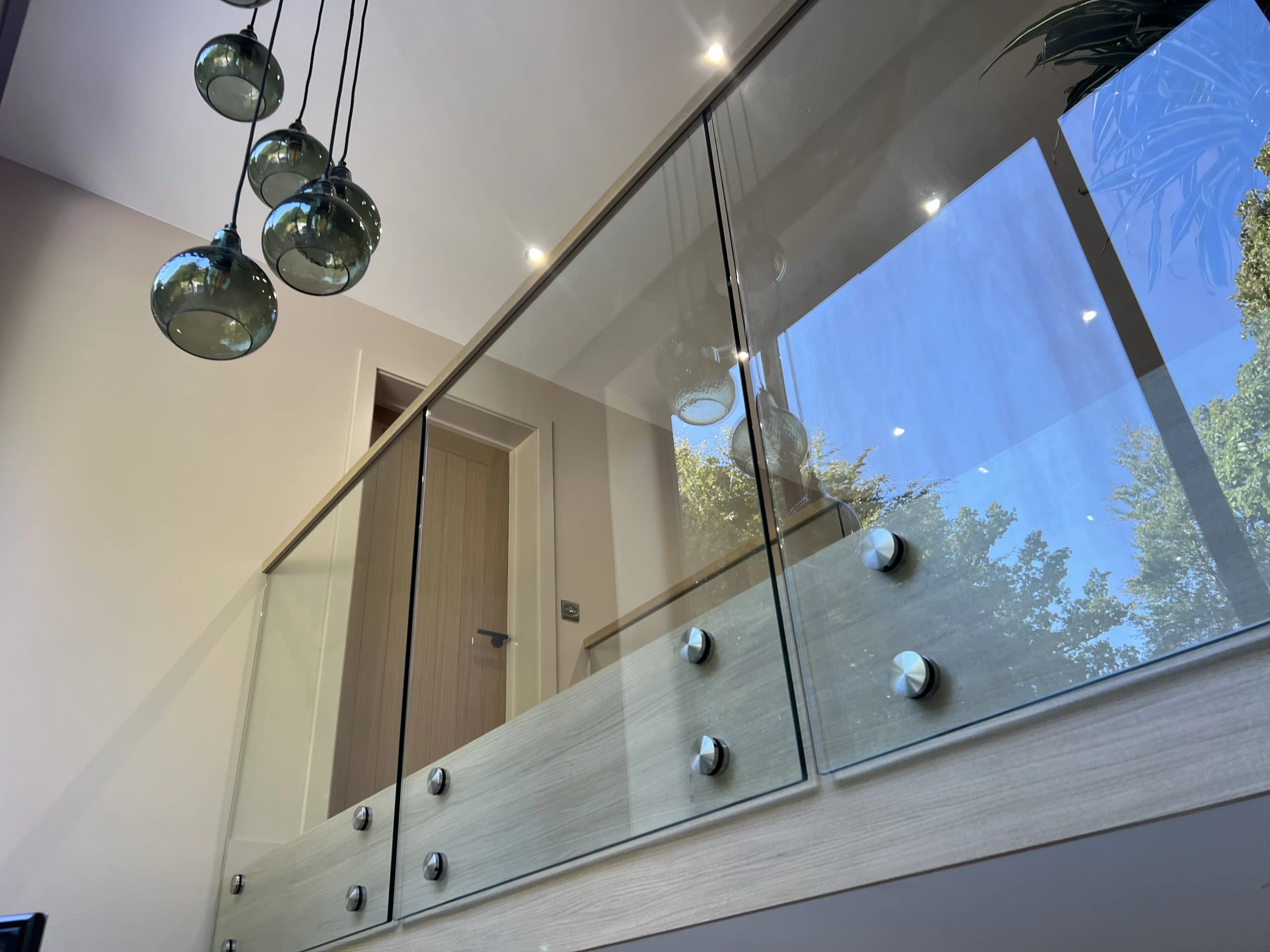
Continox glass balustrade with stainless point-fixings — ÖNORM B 3716 Kategorie B compliant, laminated VSG infill, heat-soak treated for external installation
Kategorie A, B, C — Classification by Fall Consequence
ÖNORM B 3716 classifies fall-protective glazing into three categories, defined by the consequence of glass failure rather than the geometry of the installation. The category drives glass build-up, thickness, and supplementary handrail requirements.
Kategorie A
Glazing whose breakage cannot lead to a fall. Internal partition glass, low-level glazing without significant fall risk. Covered for completeness — rarely the relevant category for staircase or balcony applications.
Kategorie B
Glazing where breakage could lead to a fall, but a structural handrail (Handlauf) takes the fall load if glass fails. The most common Continox configuration — frameless glass with continuous metal Handlauf above.
Kategorie C
Glazing where breakage directly leads to a fall — no continuous Handlauf, glass alone is the fall protection. Stricter requirements: heavier VSG, more fixing redundancy, mandatory heat-soak. Specified for fully frameless premium applications.
For Continox Austrian projects, Kategorie B is the default specification — the frameless glass infill is supplemented by a continuous brushed-stainless or painted-steel Handlauf running above, capable of carrying horizontal Geländer load (typically 1.0–1.5 kN/m line load per ÖNORM B 1991-1-1) even if the glass were to fail. Kategorie C applies where the architectural intent is purely glass — no Handlauf — typically Salzburg Altstadt heritage where contemporary intervention demands minimal visual footprint.
VSG, ESG-H & Annealed — Glass Build-Up by Application
Three glass families appear in Austrian Geländer specification, distinguished by failure behaviour and impact resistance. Choosing the right one is application-driven, not preference-driven.
VSG — Verbundsicherheitsglas (Laminated Safety Glass)
Two or more glass panes bonded with a polymer interlayer (typically PVB — polyvinyl butyral, sometimes SentryGlas Plus / SGP for higher post-breakage performance). On impact, the glass shatters but stays bonded to the interlayer — the failure is graceful, no fragments fall, and the broken pane retains residual load capacity. VSG is mandatory for ÖNORM B 3716 Kategorie B and C.
Continox VSG specification typically uses 2× 4 mm PVB-laminated (overall 8.76 mm including interlayer) for Kategorie B internal applications, scaling to 2× 6 mm (12.76 mm) or 2× 8 mm (16.76 mm) for Kategorie C and external applications.
ESG / ESG-H — Einscheibensicherheitsglas (Tempered Safety Glass)
Single tempered glass pane with high mechanical strength (~5× annealed) and a specific failure pattern: small, blunt fragments. ESG alone is generally insufficient for fall-protective Geländer in Austria — when it breaks, all fragments fall away simultaneously and offer no residual fall protection. ESG appears in Austrian Geländer only when laminated (becoming ESG-VSG) or in specific Kategorie A applications where fall isn't a consequence.
ESG-H (heat-soaked) is mandatory for any external tempered application — see Section 05 below for the NiS-inclusion mechanism.
Annealed Glass
Standard float glass without tempering or lamination. Not permitted in any ÖNORM B 3716 category — annealed glass on impact produces large, sharp fragments that pose laceration risk and offer zero post-breakage capacity. Continox does not supply annealed glass in any Geländer or staircase application.
ÖNORM EN — Harmonised European Glass Standards
ÖNORM B 3716 doesn't exist in isolation. It references and depends on the harmonised European glass standard family, which Austria adopts through ÖNORM EN-prefixed identicals. Each governs a specific aspect of glass production, classification or testing.
| Standard | Title | What It Covers |
|---|---|---|
| ÖNORM EN 14449 | VSG laminated safety glass | Production, testing & CE marking of laminated safety glass with PVB or SGP interlayer |
| ÖNORM EN 12150 | ESG tempered safety glass | Thermal toughening process, mechanical properties, fragment pattern after breakage |
| ÖNORM EN 14179 | ESG-H heat-soaked tempered | Heat-soak testing protocol — NiS inclusion induction at 290°C / 8 hours minimum |
| ÖNORM EN 12600 | Pendulum impact test | Classification by impact behaviour — 1B1 (best), 2B2, 3B3 — required for Kategorie B/C |
| ÖNORM EN 1991-1-1 | Eurocode 1 Verkehrslasten | Geländer line loads — 1.0 kN/m residential, 3.0 kN/m public/commercial |
| ÖNORM B 3716 | Austrian application standard | Categories A/B/C, application rules, supplementary requirements |
For a Continox glass Geländer in a Wien Innere Stadt duplex, the documentation pack references all six standards: EN 14449 (the laminated glass certification), EN 12150 (if tempered components used), EN 12600 (impact class verification — typically 1B1), EN 1991-1-1 (line load assumptions for structural calculation), and ÖNORM B 3716 (the Kategorie B/C application classification). The Bauanzeige documentation explicitly cites this hierarchy.
EN 12600 Impact Classification — Reading the Code
The 1B1, 2B2, 3B3 codes from EN 12600 follow a specific pattern: the first number is the drop height in metres (1 = 0.19 m, 2 = 0.45 m, 3 = 1.20 m), the letter is the failure mode (B = laminated stays bonded — desirable), and the second number is the highest drop height passed. Kategorie B and C glass under ÖNORM B 3716 require 1B1 minimum — meaning the glass passed the 1.20 m pendulum drop test with bonded failure mode. Continox VSG specifications meet 1B1 as standard.
Heat-Soak Treatment — NiS Inclusion & ESG-H
Tempered glass (ESG) has one statistically rare but consequential failure mode: spontaneous breakage from nickel sulfide (NiS) inclusions. NiS is a contaminant in float-glass production that exists in two crystalline phases — α and β. The β-phase is ~4% larger in volume. After tempering, NiS particles trapped in the glass can slowly transform from α to β over months or years, the volume expansion causes internal stress, and at some point the pane fractures spontaneously — without external impact, often years after installation.
The risk is small (estimated 1 in 10,000 tempered panes contain NiS large enough to cause failure) but the consequence is serious for fall-protective Geländer. The mitigation is heat-soak treatment per ÖNORM EN 14179: the tempered pane is held at ~290 °C for ≥ 8 hours, which forces the α→β transformation in the factory, breaking any pane with critical NiS before it leaves the supplier. Surviving panes (called ESG-H, heat-soaked tempered) are statistically far less likely to fail in service.
ÖNORM B 3716 makes heat-soak (ESG-H) mandatory for: (1) all external tempered glazing; (2) any tempered glazing in fall-protective applications above 4 m installation height; (3) any tempered glazing in publicly accessible areas. For Continox Austrian projects, this means every external balcony, terrace and alpine installation receives heat-soaked glass as standard.
VSG Already Mitigates NiS — But Heat-Soak Still Adds Value
One nuance: when tempered glass is laminated (ESG-VSG), NiS-induced breakage of one pane doesn't cause the full Geländer to fall — the laminated assembly retains residual capacity. So NiS mitigation is technically less critical for laminated externally-mounted glass than for monolithic ESG. However, ÖNORM B 3716 still specifies heat-soaked ESG components in laminated external assemblies, particularly in Kategorie C applications, and Continox follows this requirement as standard.
The Continox Glass Supply Matrix
Below is the Continox standard glass specification matrix for Austrian projects, organised by application. These are project-default specifications — most jobs accept these directly, complex projects may upgrade or be reduced after structural calculation.
| Application | Kategorie | Glass Spec | Continox Default |
|---|---|---|---|
| Internal Stiegen Geländer (residential) | B | VSG 8.76–10.76 mm | VSG 10.76 mm + Handlauf |
| Internal Galerie / mezzanine | B | VSG 10.76–12.76 mm | VSG 12.76 mm + Handlauf |
| Internal frameless premium | C | VSG 16.76 mm | VSG 16.76 mm point-fixed |
| External balcony / terrace | B | VSG-ESG-H 12.76 mm | VSG-ESG-H 12.76 mm heat-soak |
| External frameless premium | C | VSG-ESG-H 16.76–21.52 mm | VSG-ESG-H 17.52 mm |
| Alpine ≥ 1,500 m | B/C | VSG-ESG-H + thermal allowance | VSG-ESG-H 16.76 mm heat-soak |
| Public / commercial | B/C | 3 kN/m line-load build-up | VSG 13.52 mm minimum + Handlauf |
Source: Continox internal supply standards aligned to ÖNORM B 3716. Project-specific verification by Tragwerksplaner remains mandatory.

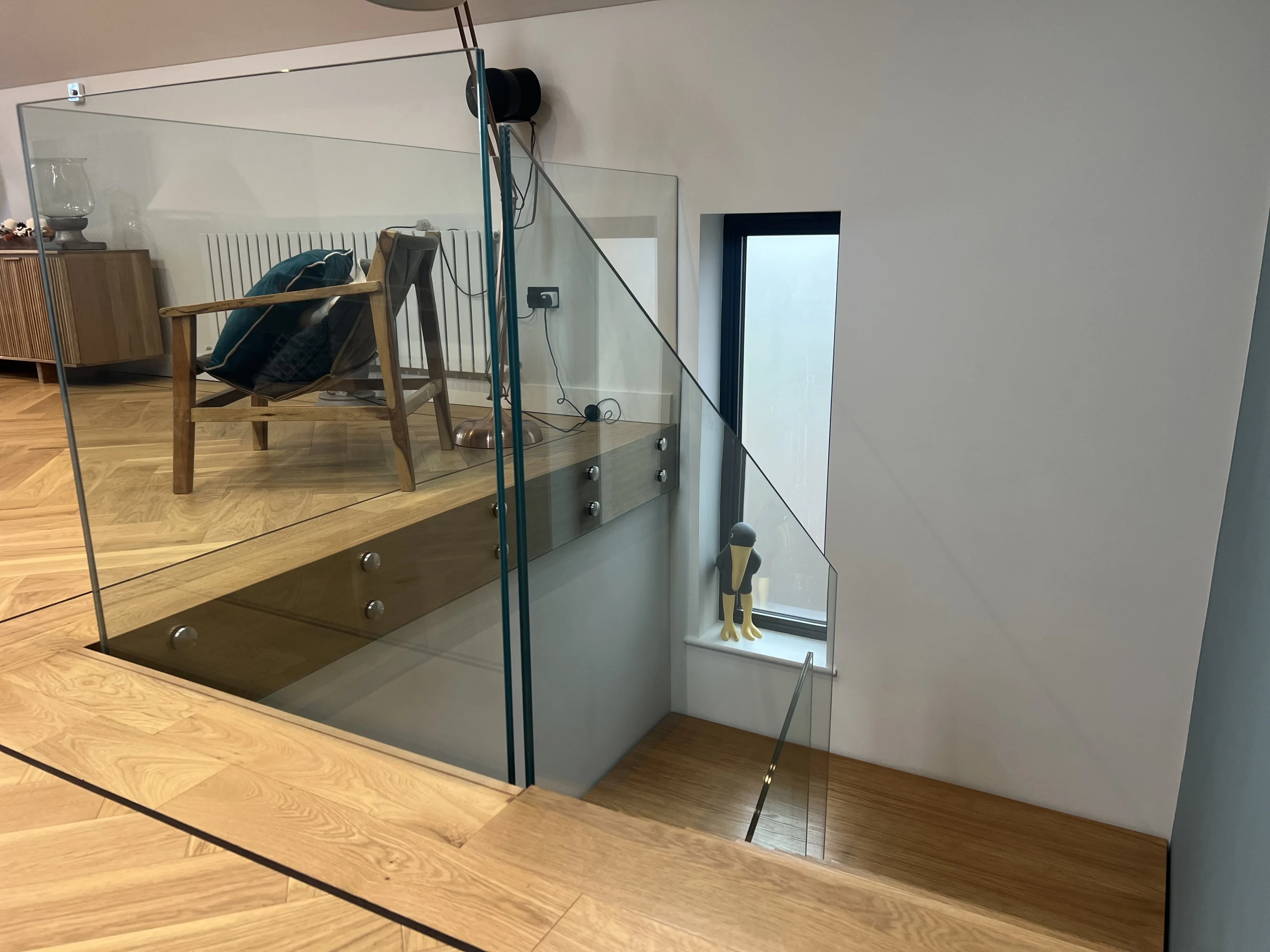
Left: Kategorie B with oak Handlauf — typical Wien Cottageviertel villa. Right: Kategorie C frameless premium — Salzburg Altstadt heritage insertion, no Handlauf, VSG 16.76 mm point-fixed.
External & Alpine Installations — Beyond the Standard
External and alpine glass Geländer present three engineering realities that ÖNORM B 3716 partially addresses but Continox project experience extends.
Thermal Cycling — UV and Temperature Range
An external glass Geländer in Tirol Kitzbühel (~800 m, range −20 °C to +35 °C) cycles across 55 °C annually. At 1,500 m (Lech, Sölden), the range extends from −30 °C to +30 °C. PVB interlayers tolerate this range when correctly specified, but standard PVB can cloud or develop edge separation if water ingress occurs at glass edges in unprotected fixings. Continox external Geländer specify SGP (SentryGlas Plus) interlayer above 1,200 m altitude — the SGP polymer is dimensionally more stable, retains transparency at low temperatures, and bonds more strongly to glass than PVB.
Wind Loading — Elevated Locations
Eurocode wind load calculations (ÖNORM EN 1991-1-4 with Austrian national annex) produce significantly higher line loads at exposed alpine locations. A Kitzbühel Bichlalm villa terrace facing prevailing wind can experience 1.5–2.0 kN/m² peak wind load on a Geländer — vs ~0.6 kN/m² for a sheltered Wien Innere Stadt courtyard. The glass build-up must accommodate this; Continox alpine projects routinely specify VSG 16.76 mm (or higher) where Wien projects accept VSG 10.76 mm.
Humidity Cycling — Mountain Microclimate
Alpine air alternates between very dry winter (≤ 30% RH) and humid spring/summer (90%+ RH on lake-adjacent installations like Wolfgangsee). This stresses fixings, gaskets and silicone joints more than urban climates. Continox specifies 316 stainless for all external and alpine fixings (vs 304 for internal Wien Innenstadt projects), and uses structural silicone conformant to EN ISO 11600 Type S for any frameless point-fixed assembly.
Austria vs Germany vs Switzerland — Glass Standards Comparison
The DACH glass framework is more harmonised than the staircase dimensional rules — all three countries reference EN 14449, EN 12150, EN 12600 and EN 14179 — but each adds a national application standard with its own classification taxonomy. Architects working cross-border navigate three parallel categorisations that don't perfectly translate.
Austria
Germany
Switzerland
Practical implication: a Continox glass balustrade designed to ÖNORM B 3716 Kategorie B with VSG 12.76 mm + Handlauf will satisfy German DIN 18008 Kategorie B and Swiss SIA 358/1 Kategorie II without modification. The build-up is harmonised; only documentation language and citation hierarchy differ. For DACH cross-border architects, this means Continox can supply a single technical specification serving all three jurisdictions with minor documentation adaptation.
ÖNORM B 3716 — Architect & Specifier Questions
The questions Austrian Architekten, Tragwerksplaner and developers most commonly ask about glass balustrade specification under ÖNORM B 3716.
Is ÖNORM B 3716 mandatory or just guidance?
ÖNORM B 3716 is referenced by OIB Richtlinie 4 §2.4 and is the technical document Bauanzeige reviewers expect to see cited in glass balustrade specifications. While not directly legally binding (only OIB Richtlinien have that status through Landesbauordnung implementation), in practice it defines the recognised standard of care — non-compliance is grounds for Bauanzeige rejection or insurance disputes.
Can I use plain ESG (tempered) glass for an Austrian Geländer?
Generally no. ÖNORM B 3716 Kategorie B and C — which cover virtually all fall-protective Geländer — require laminated VSG. Monolithic ESG offers no post-breakage residual capacity (when it shatters, all fragments fall away), making it inappropriate for fall protection. ESG appears in Austrian Geländer only as a component of laminated VSG-ESG-H build-ups.
What does the EN 12600 "1B1" classification actually mean?
1B1 is the highest classification under the EN 12600 pendulum impact test. The first "1" means the glass passed the 1.20 m drop height test; "B" means failure mode was bonded — i.e. laminated layers stayed together (the desired behaviour); the second "1" means it passed at the highest tested level. ÖNORM B 3716 requires 1B1 minimum for Kategorie B and C, which Continox VSG specifications achieve as standard.
When is heat-soak (ESG-H) mandatory in Austrian projects?
ÖNORM B 3716 makes heat-soak mandatory for all external tempered glazing, any tempered glazing in fall-protective applications above 4 m installation height, and any tempered glazing in publicly accessible areas. For Continox external balustrade and alpine projects, every tempered component receives heat-soak treatment per ÖNORM EN 14179 (290 °C / 8 hours minimum) as standard.
Why specify SGP interlayer instead of PVB for alpine projects?
SGP (SentryGlas Plus) is dimensionally more stable than PVB across thermal cycles, retains transparency at low temperatures, and bonds more strongly to glass. For projects above 1,200 m altitude (Lech, Sölden, Hohenems alpine), Continox specifies SGP interlayer as standard — eliminates the cloud-edge risk that PVB exhibits in extreme thermal cycling environments.
Does an Austrian glass Geländer always need a continuous Handlauf?
No — but the absence of a Handlauf escalates the glass classification from Kategorie B to Kategorie C, which mandates heavier VSG build-ups (typically 16.76 mm minimum), more fixing redundancy and stricter installation tolerances. Frameless Kategorie C costs ~30–45% more than Kategorie B with Handlauf for the same span. Architectural decision driven by aesthetic priority vs cost.
Continue Through the Austria Resource Library
This ÖNORM B 3716 guide pairs with the OIB Richtlinie 4 staircase regulations guide to form the Austria foundation. The full Resource Center extends with five more guides covering regional context, technical engineering and implementation:
- AT01 — OIB Richtlinie 4 & Austrian Staircase Regulations — companion regulatory pillar covering Stiegenlaufbreite, Steigungsverhältnis, Wohnbau Klasse classification and Geländer height requirements
- AT03 — Modern Staircases for Wien & Niederösterreich — capital region projects, Gründerzeit altbau insertion, Cottageviertel villa supply
- AT04 — Modern Staircases for Tirol & Vorarlberg Alpine — Kitzbühel, Lech, Zürs ultra-luxury chalet specification with alpine glass requirements
- AT05 — Modern Staircases for Salzburg & Salzkammergut — heritage premium and Salzkammergut lakeside villa supply
- AT06 — Cold Climate Steel & Substrate Engineering — flagship technical pillar — companion to glass thermal cycling addressing steel cold-climate reality
- AT07 — UK Supplier Austria — Shipping & System Selection — combined intra-EU logistics and floating-vs-spine decision framework
- /at/ — Austria Resource Center — full library hub with architect specification journey
- Continox Glass Balustrades — main product page for matching Geländer beyond Stiegen applications
Need ÖNORM B 3716 Documentation for Your Austrian Project?
Continox supplies full ÖNORM B 3716-aligned glass specification with every Austrian project — Kategorie B/C verification, ÖNORM EN 14449 mill certificates for VSG, EN 14179 heat-soak certification for external/alpine, EN 12600 1B1 impact classification, ready for your Architekt or Ziviltechniker's Bauanzeige submission. Free 3D visualisation, fixed EUR quote in 48 working hours.
Get Free Quote Resource Center