

Modern Staircases for Salzburg & Salzkammergut — Heritage Premium & Lakeside Villas
Salzburg Altstadt UNESCO heritage insertion, Aigen and Anif estate properties, plus the Salzkammergut lake belt — Wolfgangsee, Mondsee, Attersee, Bad Ischl, Hallstatt — the Continox regional reference for Austria's distinctive heritage-and-water staircase market.
Heritage + Lakeside — A Two-Stream Market
Unlike Wien (urban heritage only) or Tirol/Vorarlberg (alpine only), the Salzburg–Salzkammergut region runs two parallel premium markets. Salzburg city is fundamentally a heritage market: the Altstadt is UNESCO World Heritage, Aigen and Anif are turn-of-the-century villa districts, and project briefs emphasise insertion into protected fabric. Salzkammergut — the lake district straddling Salzburg and Oberösterreich Bundesländer — is a lakeside villa market: Wolfgangsee, Mondsee, Attersee, plus heritage Bad Ischl Kaiserstadt and UNESCO Hallstatt. Project specifications differ significantly between the two streams.
The unifying factor is altitude. Salzburg city sits at ~425 m, the major lake basins between 470 m (Mondsee) and 600 m (Wolfgangsee), with surrounding villas extending to ~950 m on adjacent hillsides. This places nearly all projects in our S355J0 default grade band (above 800 m where heated interior installations still benefit from the J0 precaution, exterior installations require J0 mandatorily). Lake-effect microclimate adds humidity-cycling complications absent in Wien or Innsbruck.
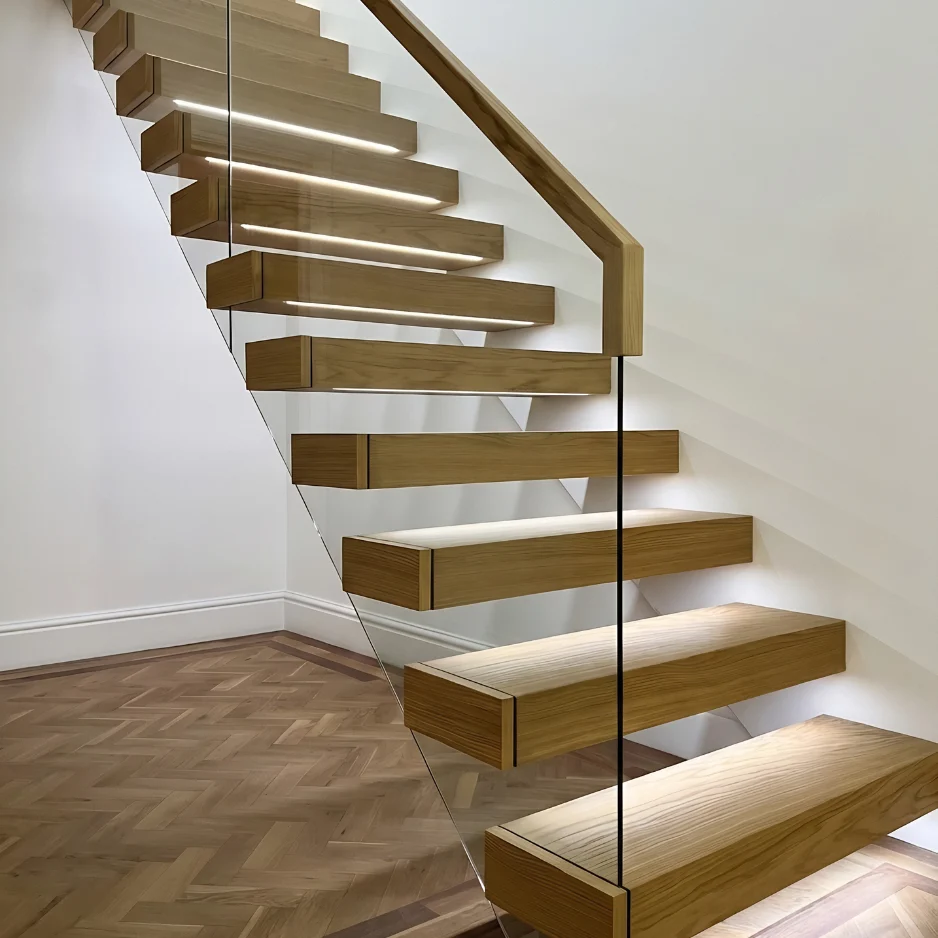
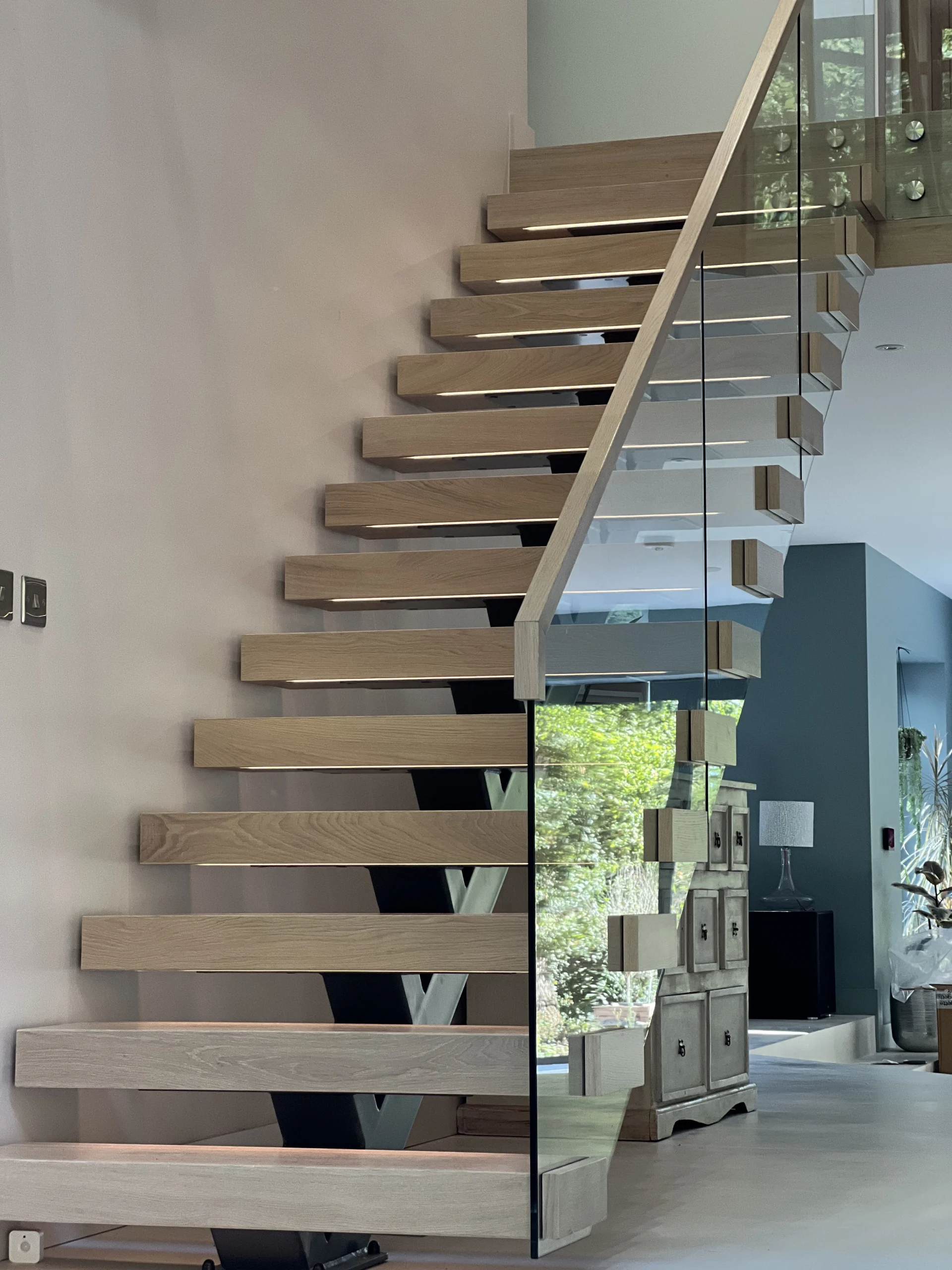
Floating staircase configuration — typical Salzkammergut lakeside villa specification. Oak treads, frameless glass with continuous Handlauf, structural Stahlbeton substrate. SGP interlayer mandatory for waterfront glass within 50 m of shoreline.
Salzburg — Altstadt Heritage & Aigen Estates
Salzburg city's premium staircase demand splits cleanly. The Altstadt — UNESCO World Heritage core enclosed within the medieval city walls between Mönchsberg and Kapuzinerberg — is exclusively heritage-grade renovation, with Salzburger Stadtbildkommission oversight on every visible alteration. The Aigen and Anif estate districts (south of Altstadt, leading toward Anif Schloss and Hellbrunn) are the city's villa belt — late-19th-century to interwar Bürgerhaus architecture with much greater design freedom. Beyond city boundary, Maria Plain, Bergheim and Anif contemporary new-build adds Stahlbeton-substrate projects to the regional portfolio.
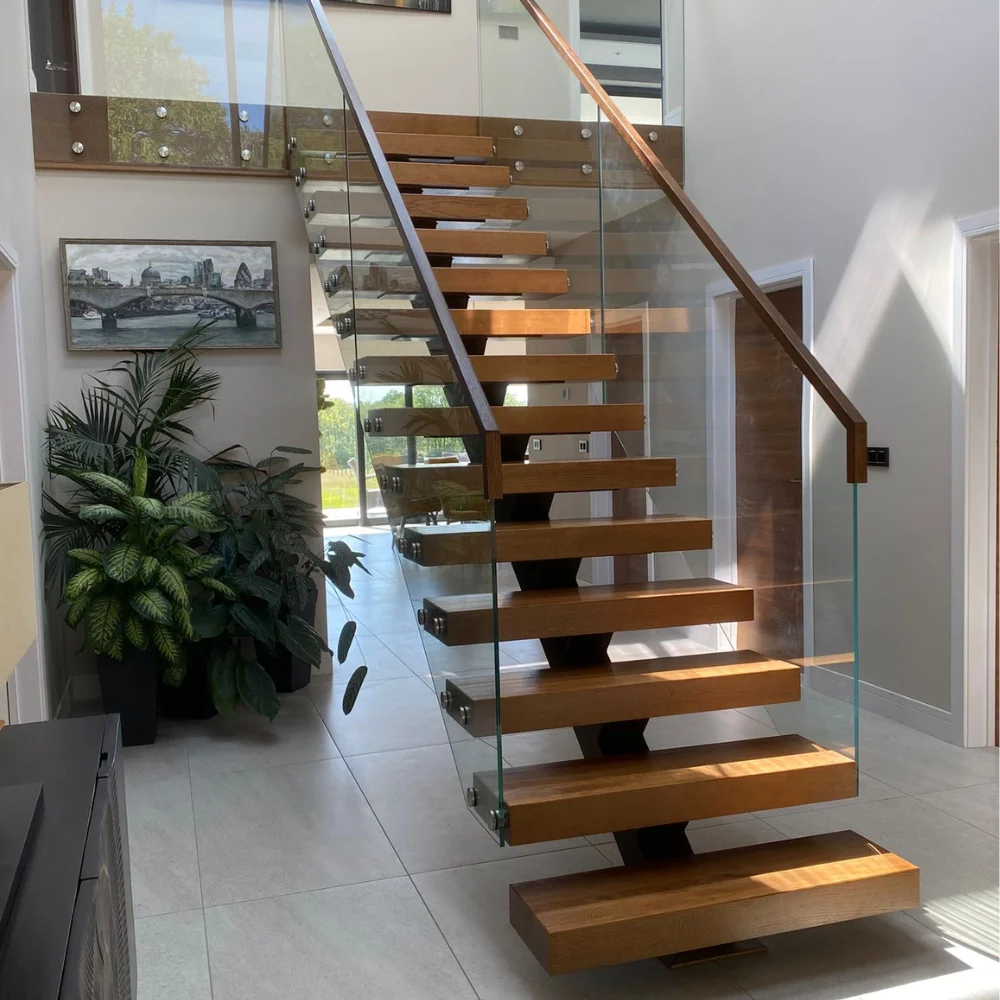
Altstadt UNESCO Heritage Core
Medieval-Baroque city core within historic walls. Getreidegasse, Mozartplatz, Residenz vicinity — almost entirely denkmalgeschützt. Internal Continox insertions feasible but require Stadtbildkommission coordination.
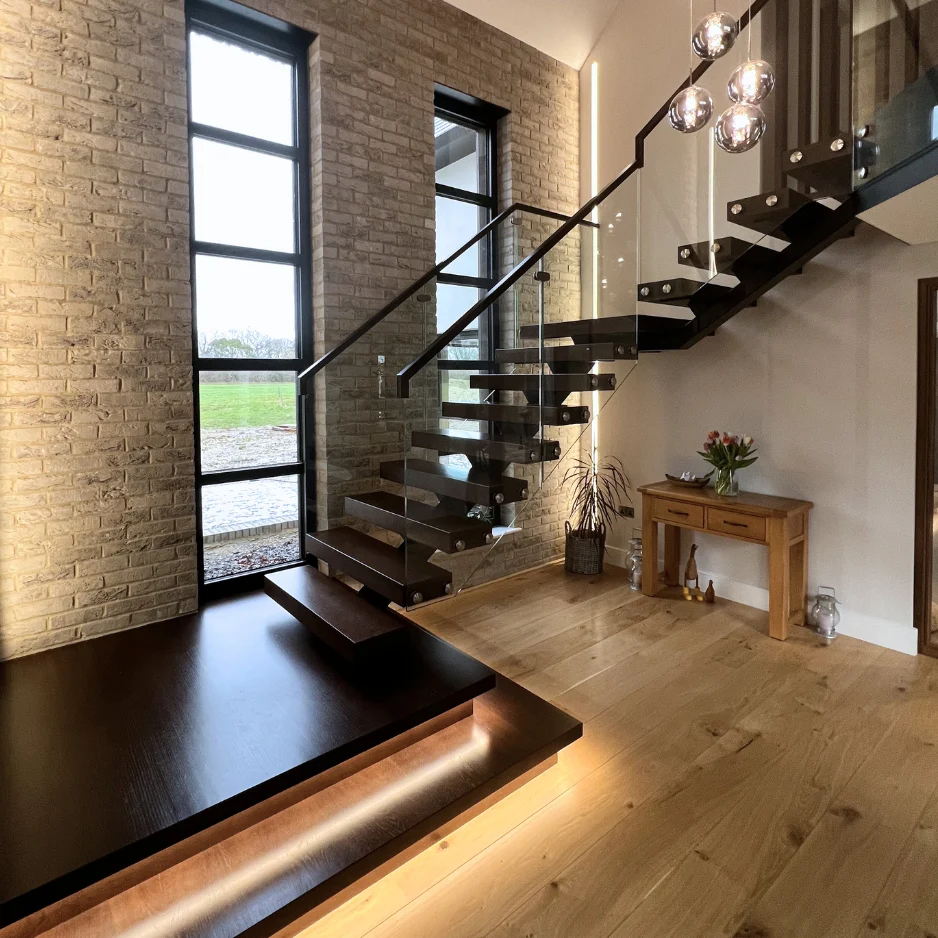
Aigen, Anif & Hellbrunn-side
Salzburg's villa belt south of Altstadt. Aigen Bürgerhaus renovation, Anif estate properties (close to Schloss Anif), Hellbrunn-vicinity, Glasenbach contemporary new-build — Premium Oak central spine territory.
Salzkammergut — Lake Belt & Heritage Resort
Salzkammergut spans Salzburg and Oberösterreich Bundesländer — a single architectural-cultural region with split regulatory administration. The lake belt itself is the premium driver: Wolfgangsee (St Wolfgang, Strobl, St Gilgen), Mondsee, Attersee (Schörfling, Weyregg, Unterach) and Traunsee (Gmunden, Altmünster) attract waterfront villa renovation and contemporary new-build alike. Heritage residential extends through Bad Ischl (Kaiservilla and surrounding Kaiserzeit summer-villa stock) and Hallstatt (UNESCO World Heritage). The architectural register varies: lake villas often modern-contemporary with structural-honesty intent (similar to Vorarlberger Baukultur in spirit), Bad Ischl heritage Kaiserzeit Bürgerhäuser, Hallstatt vernacular fishing-village restoration.
Wolfgangsee — St Wolfgang & Strobl
Premier Salzkammergut lake. St Wolfgang waterfront villa renovation, Strobl premium residential, St Gilgen heritage, Fuschl ultra-luxury hotel district. Lakeside microclimate dictates 316 stainless and SGP interlayer specifications.
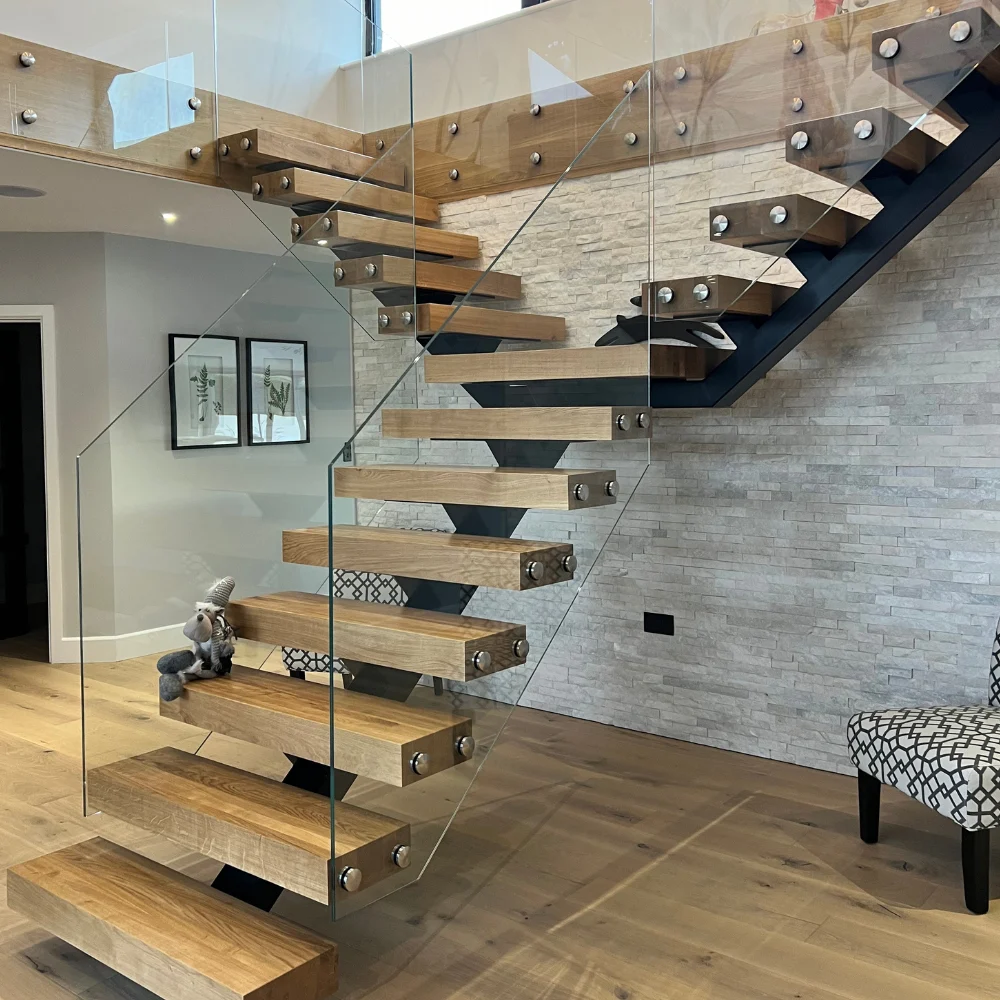
Mondsee & Attersee Waterfront
Mondsee village heritage, Attersee shoreline villa belt — Schörfling, Weyregg am Attersee, Unterach, Steinbach. Contemporary villa new-build dominant, Y-Shape and Premium Central Spine specifications.
Bad Ischl & Kaiservilla Surroundings
Imperial-era heritage resort. Bad Ischl Kaiserzeit Bürgerhäuser (1860–1914 era summer villas), Kaiservilla vicinity premium residential, Trauntal villa renovations. Often denkmalgeschützt, mid-difficulty insertion.
Hallstatt UNESCO Heritage
UNESCO World Heritage fishing village, salt-mining cultural landscape. Vernacular Salzkammergut wooden architecture, narrow building plots, complex listed-building constraints. Continox single-spine Stiegen with vieux-bois oak treads typical.
Lakeside Microclimate Matrix — Three Engineering Realities
Salzkammergut waterfront installations face a microclimate envelope distinct from Wien urban or alpine Tirol. Three specific engineering realities require accommodation in Continox lakeside specifications — and they're not optional refinements, but baseline material choices for any project within ~50 m of shoreline.
Three Engineering Considerations Beyond Standard Alpine
Wolfgangsee, Mondsee and Attersee waterfront installations cycle between very different microclimates than dry alpine: high-humidity onshore winds, lake-fog inversions, and shore-zone salt-mineral aerosols. Specifications scale accordingly.
Humidity Cycling
Lake-shore air alternates 95% RH summer/spring vs 30% RH winter dry. 316 stainless mandatory for all external fixings (vs 304 inland), SGP interlayer mandatory for glass within 50 m of waterfront — PVB clouds at edge in this cycle.
Lake-Effect Snow & Föhn
Wolfgangsee and Attersee experience lake-effect winter snow plus periodic Föhn-wind warm spells with rapid temperature swings. Steel grade S355J0 default, but anchor specifications must accommodate diurnal thermal cycling.
Shoreline Aerosol
Within 50 m of shoreline, water aerosol plus mineral content (calcium, organic acids from forested catchment) attacks unprotected metal. Duplex coating C5-M minimum for any external structural element, regardless of altitude.
Salzburg UNESCO & Stadtbildkommission Process
Salzburg Altstadt is UNESCO World Heritage (inscribed 1996, "Historic Centre of the City of Salzburg"). Visible alterations are supervised by the Salzburger Stadtbildkommission — a body comparable to but distinct from Wien's Bundesdenkmalamt (BDA). The Stadtbildkommission has authority over the Altstadt protected zone (Schutzzone) and reviews all Bauanzeige submissions visible from public spaces.
What the Commission Reviews — and What It Doesn't
Like the Wien BDA, the Stadtbildkommission is heritage-protective but pragmatic. Internal apartment interventions in Altstadt buildings — including modern Continox Stiegen — are typically approved without commission modification, provided the intervention isn't visible from Stadtbildkommission-protected public viewpoints.
- Always reviewed: external façade modifications, visible Stiegenhaus from public spaces, roof pitches, window replacements, signage
- Sometimes reviewed: hidden structural modifications affecting building height, attic conversions visible from Mönchsberg or Festungsberg
- Rarely reviewed: internal apartment Stiege insertion, hidden floor reconfiguration, kitchen/bathroom upgrades, internal partition changes
- Never reviewed: finishes, lighting, furniture, internal Continox Stiegen serving a single residential unit
The practical implication for Continox Altstadt projects: an internal Stiege insertion in a Getreidegasse or Mozartplatz residence is rarely a Stadtbildkommission concern. The architectural challenge is preserving Altstadt interior detail (cornicing, parquet, stuccowork) while routing the Continox Stiege — which is an architectural design problem, not a regulatory one.
Festspiele Season — Salzburg's Unique Logistical Constraint
Salzburg has a logistical specificity not encountered in any other Austrian region: the Salzburger Festspiele. Running mid-July through end of August, the festival closes much of the Altstadt to vehicle traffic, restricts delivery windows to early-morning hours (typically 06:00–10:00), and adds layers of access permitting through the Festspielleitung. For Continox Altstadt projects, this means installation scheduling that avoids July–August entirely is strongly preferred — September through June offers free delivery scheduling.
The constraint is less acute outside the Altstadt itself: Aigen, Anif, and broader Salzburg city remain accessible during Festspiele. Salzkammergut is unaffected — Wolfgangsee, Mondsee, Attersee installations proceed normally year-round. The constraint specifically applies to Altstadt heritage Bauanzeige projects.
For Altstadt UNESCO projects, Continox quotation includes a Festspiele-aware delivery schedule. A signed order placed in March allows manufacture through May–June, delivery and installation September (post-Festspiele opening) — clean schedule, no logistical premium. A signed order placed in May targeting summer installation requires either accelerated manufacture for June pre-Festspiele installation, or deferral to post-Festspiele September. We make this trade-off clear at quotation stage.
Salzburger & Oberösterreichische Bauordnung
Salzkammergut's regional split between Salzburg and Oberösterreich Bundesländer creates parallel regulatory administration with similar — but not identical — submission processes.
Salzburger Bautechnikgesetz
Salzburg's framework is the Salzburger Bautechnikgesetz with the Salzburger Bauordnung implementing OIB Richtlinien. Bauanzeige submission is through the local Bezirkshauptmannschaft (Magistrat Salzburg for the city, BH Salzburg-Umgebung for surrounding district including Anif and Wolfgangsee West). For Altstadt projects, the parallel Stadtbildkommission review adds 4–8 weeks. Bad Ischl falls under Oberösterreich (BH Gmunden), creating cross-Bundesland coordination for Salzkammergut projects spanning both administrative regions.
Oberösterreichische Bauordnung
Oberösterreich's framework is the OÖ Bauordnung 1994 with implementing technical regulations. Salzkammergut Oberösterreich submissions go through the local Bezirkshauptmannschaft (BH Gmunden for Bad Ischl, Hallstatt, Traunsee; BH Vöcklabruck for Mondsee, Attersee). For Hallstatt UNESCO projects, parallel oversight by Bundesdenkmalamt applies (similar to Wien BDA process), since Hallstatt's UNESCO designation engages national heritage authorities differently than Salzburg's local Stadtbildkommission.
Salzburg & Salzkammergut — Architect Questions
The questions Salzburg and Salzkammergut Architekten and project developers ask Continox most frequently when starting a new heritage or lakeside project.
What's the typical lead time for a Salzburg Altstadt UNESCO project?
Standard Continox manufacture and delivery is 12 weeks from signed order. Salzburg Altstadt UNESCO projects typically add 4–8 weeks for Stadtbildkommission review (when the Bauanzeige involves any visible alteration), plus potential Festspiele-season scheduling that may defer installation 6–10 weeks if mid-summer delivery is required. Total realistic project timeline 16–28 weeks. We recommend signed orders in November–February for September–June installation windows, avoiding Festspiele entirely.
Why is 316 stainless mandatory for Wolfgangsee installations vs 304 elsewhere?
Lakeside microclimate cycles between very high humidity (95% RH onshore summer, 100% RH lake-fog inversions) and dry winter. Combined with mineral aerosol from forested catchment areas, this produces enough corrosive stress that 304 stainless develops surface staining within 5–8 years. 316 contains higher chromium and added molybdenum, providing meaningful resistance margin. The cost premium is small (~10–15% on stainless component cost), but the long-term aesthetic difference is significant.
Can a Continox floating staircase be specified for a Salzkammergut waterfront villa?
Often yes, with substrate verification. Most Salzkammergut waterfront villas built post-1990 have Stahlbeton primary structure (well-suited to floating cantilever reactions of 30+ kN per anchor). For older lakeside Bürgerhaus renovation (Bad Ischl Kaiserzeit, Wolfgangsee historic shore), substrate Befund typically shows Mauerwerk insufficient for floating — central spine or U-Shape configurations preferred for these heritage waterfront projects. The choice is substrate-driven, not aesthetic.
Does denkmalgeschützt status in Salzburg work the same as in Wien?
Process similar but jurisdiction different. Wien's BDA (federal) reviews building-listing-protected interventions; Salzburg city has additional Stadtbildkommission review for Altstadt protected zone. Hallstatt UNESCO projects engage federal BDA directly (different from city Stadtbildkommission). Bad Ischl Kaiserzeit denkmalgeschützt buildings under federal BDA. Internal apartment Stiege insertions remain typically straightforward across all three regimes — visible-from-public-space alterations are where complications arise.
What's the typical project budget for a Wolfgangsee waterfront villa staircase?
Wolfgangsee waterfront premium projects typically span €18,000–28,000 fully fitted with standard configurations (central spine, oak treads, Kategorie B glass). Floating staircase configurations in new-build Stahlbeton substrate reach €22,000–32,000. Premium Y-Shape sculptural Stiegen for ultra-luxury Wolfgangsee villas €28,000–40,000. Bad Ischl Kaiserzeit heritage projects sit at €15,000–22,000 for typical specifications. Hallstatt vernacular vieux-bois single-spine projects €15,000–20,000.
Why does Salzburger Stadtbildkommission have authority separate from BDA?
Austrian heritage protection runs through two parallel layers. Bundesdenkmalamt (BDA) is federal — it lists individual buildings under the Denkmalschutzgesetz, focusing on architectural/historical significance of specific structures. Salzburger Stadtbildkommission is local — it reviews all building activity within the Altstadt protected zone (Schutzzone) for compatibility with the UNESCO World Heritage urban character, regardless of whether individual buildings are BDA-listed. They overlap but address different concerns: BDA = "is this specific building historically significant?" Stadtbildkommission = "does this alteration respect the protected urban context?"
Continue Through the Austria Resource Library
This Salzburg & Salzkammergut regional guide completes the three-regional set in the Continox Austria cluster. The full Resource Center includes foundation, technical and implementation guides:
- AT01 — OIB Richtlinie 4 & Austrian Staircase Regulations — regulatory foundation covering Stiegenlaufbreite, Steigungsverhältnis, Wohnbau Klasse classification
- AT02 — Glass Balustrade Regulations Austria (ÖNORM B 3716) — companion glass standard pillar covering VSG, ESG-H heat-soak, SGP interlayer for lakeside glass
- AT03 — Modern Staircases for Wien & Niederösterreich — capital region urban heritage projects, Gründerzeit altbau Wienerberger reality
- AT04 — Modern Staircases for Tirol & Vorarlberg Alpine — alpine ultra-luxury market, Kitzbühel/Lech ultra-luxury chalets
- AT06 — Cold Climate Steel & Substrate Engineering — flagship technical pillar — base specifications extended by lakeside microclimate considerations
- AT07 — UK Supplier Austria — Shipping & System Selection — combined intra-EU logistics and floating-vs-spine decision framework
- /at/ — Austria Resource Center — full library hub with architect specification journey
Specifying a Salzburg or Salzkammergut Project?
Continox supplies Salzburg and Salzkammergut projects with full OIB Richtlinie 4-aligned + EN 1090-1 EXC2 documentation, lakeside-specification material upgrades (316 stainless, SGP interlayer for waterfront), Festspiele-season-aware project scheduling for Altstadt UNESCO projects, and 2–3 day intra-EU delivery via Bayern–Salzburg corridor. Free 3D visualisation, fixed EUR quote in 48 working hours.
Get Free Quote Resource Center