
Powder coating and galvanising are the two dominant steel finishing processes used in UK architectural metalwork — and although they're often discussed interchangeably, they do fundamentally different jobs. Galvanising protects steel from corrosion at a metallurgical level. Powder coating delivers an aesthetic finish and adds surface-level protection. The premium specification for any exterior steel element — fire escape staircases, balcony railings, external balustrades — combines both in a system called the "duplex coating," which delivers 40–60 year service life in typical UK exposure. This guide explains what each process actually does, when to specify one or the other, and why for external staircase work the correct answer is almost always both.
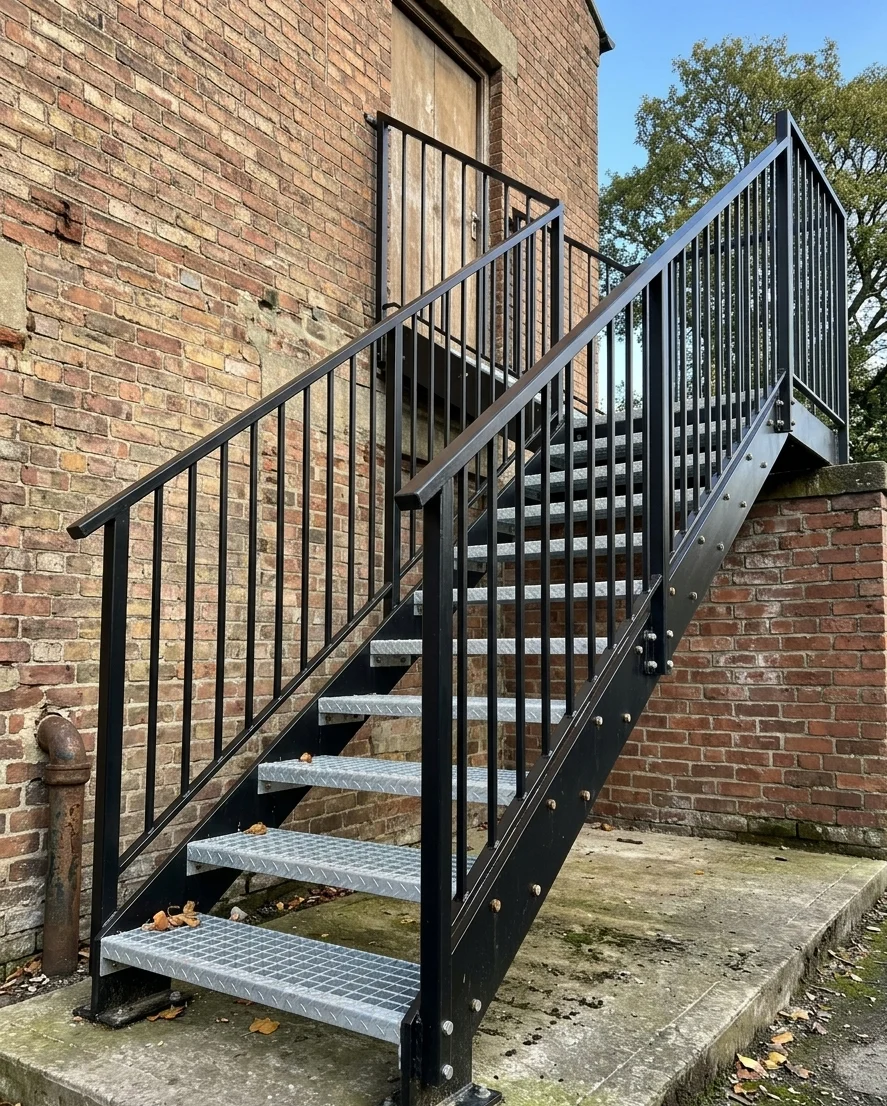
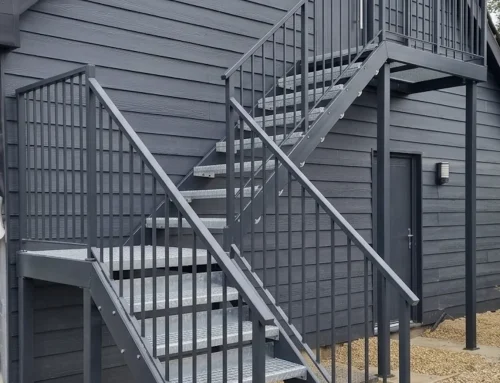
External staircase by Continox — duplex finish: hot-dip galvanised substrate + RAL 9005 matt black powder coat topcoat for 40–60 year service life.
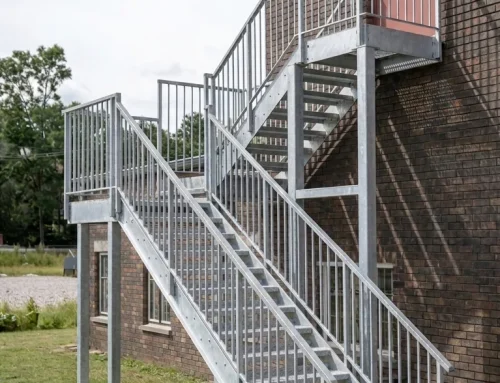
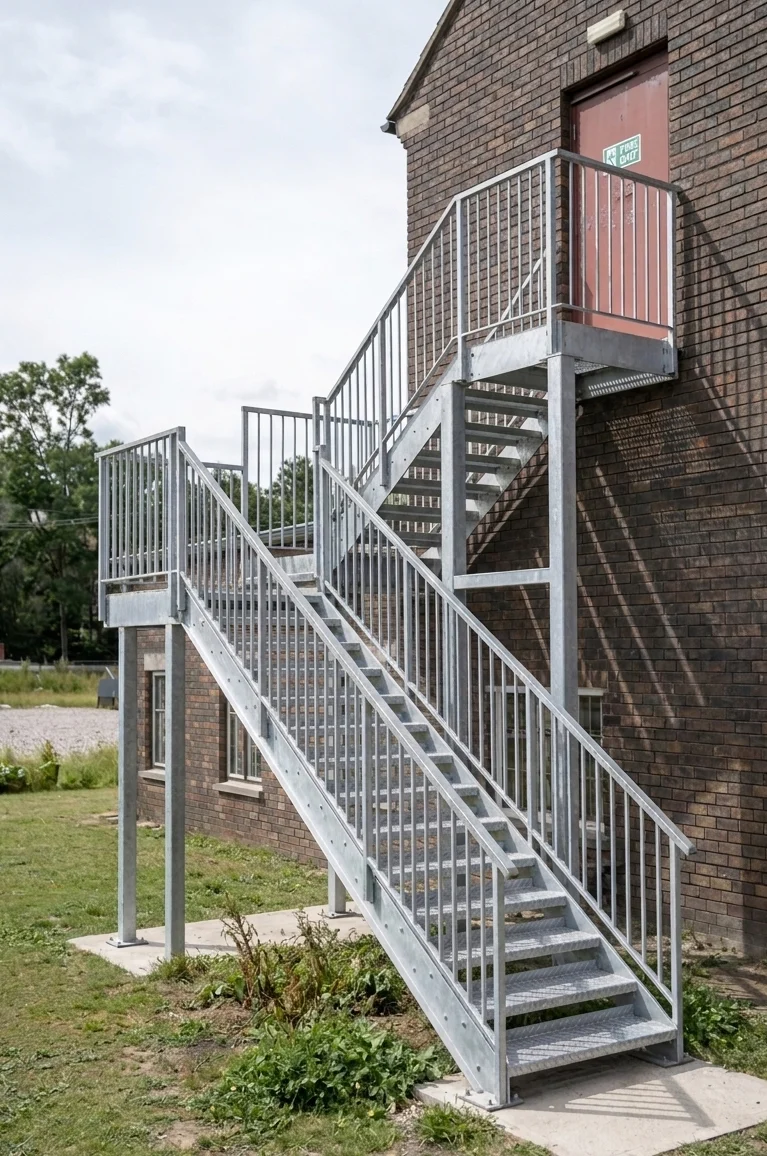
Galvanising is a metallurgical corrosion protection process — molten zinc chemically bonds to the steel surface, preventing rust even if the coating gets scratched. It's functional, not decorative: raw galvanised steel has a grey-silver matte or spangled appearance. Powder coating is an electrostatically applied paint process — coloured powder is baked onto the surface at 200°C to form a hard, uniform, coloured finish. It's primarily aesthetic and adds scratch resistance. For interior steel, powder coat alone is sufficient. For any exterior UK application — fire escape stairs, balcony railings, external balustrades — the correct specification is duplex: galvanise first, then powder coat on top.
What is Galvanised Steel?
Galvanising is the process of coating steel or iron with a layer of zinc to prevent corrosion. The dominant UK method for structural and architectural steelwork is hot-dip galvanising to BS EN ISO 1461 — the steel is immersed in a bath of molten zinc at approximately 450°C, forming a metallurgical bond between the zinc and the underlying steel. This bond is not a surface layer in the paint sense; it's an alloy that becomes part of the steel itself.
How Galvanising Protects Steel
Hot-dip galvanising protects steel by two distinct mechanisms. Barrier protection — the zinc layer physically separates the steel from moisture and oxygen, which are the two chemical agents of rust. Cathodic (sacrificial) protection — even if the zinc is scratched or damaged down to bare steel, the zinc continues to protect. Zinc is electrochemically more reactive than iron, so in the presence of moisture it corrodes preferentially, leaving the exposed steel beneath unrusted. This is why galvanising works even on cut edges and drill holes, unlike paint.
Appearance & Finish
Newly galvanised steel has a distinctive bright silver, often spangled (crystallised) surface. Within weeks of exposure to the atmosphere it weathers to a matte mid-grey as a passive zinc carbonate layer forms on the surface. This zinc carbonate patina is actually part of the protection mechanism — it slows further zinc consumption. Galvanised finish is not aesthetically elegant by most architectural standards; it's practical, industrial, and purposeful.
Galvanising standard — BS EN ISO 1461: Specifies minimum zinc coating thicknesses based on steel section thickness. For typical architectural sections (6mm+ steel), the minimum coating is 85μm. Mean coating thickness is typically 100–150μm on real-world fabrications, with heavy sections reaching 200μm. Thicker zinc coating = longer service life before first maintenance.
What is Powder Coated Steel?
Powder coating is a dry paint application process governed by BS EN 13438 for architectural applications. Finely ground polyester or epoxy-polyester powder is electrostatically charged and sprayed onto the steel surface, where it adheres due to electrostatic attraction. The coated part is then passed through an oven at approximately 180–200°C for 15–20 minutes, during which the powder melts, flows out to a uniform film, and chemically cross-links to form a hard, durable coating.
How Powder Coating Protects Steel
Powder coating provides barrier protection only — the cured film separates the steel from moisture and oxygen. Unlike galvanising, there is no sacrificial protection: if the coating is chipped or scratched down to bare steel, corrosion will start at the damage point and can spread laterally beneath the coating (a mechanism called "under-film corrosion" or "filiform corrosion"). This is the critical limitation of powder coating alone in exterior applications.
Appearance & Finish
Powder coat is available in the full RAL colour range, with finish options from dead matt through satin, semi-gloss to high gloss. Surface quality is excellent — uniform, smooth, hard, and resistant to UV fading, chipping and abrasion. Typical architectural thickness is 60–100μm, though heavy-duty exterior powder coats can be specified up to 120μm.
Powder coat alone ≠ exterior protectionA common architectural specification error is to powder coat raw steel for an exterior application. The finish looks correct on day one, but any mechanical damage — a scratch from a keychain, impact from a ladder, even handling damage during installation — becomes a corrosion initiation point. Within 2–3 UK winters, visible rust bleeding will appear at every damage point. For external steelwork, powder coat must always be applied over a galvanised substrate — this is the duplex system.
Powder Coated vs Galvanised — Side by Side
- Primary function: corrosion protection
- Coating thickness: 85–200μm zinc
- Bond type: metallurgical alloy
- Scratch resistance: self-healing (cathodic)
- Colour options: silver/grey only
- Service life: 40–70 years (rural)
- Standard: BS EN ISO 1461
- Temperature stable: to ~200°C
- Primary function: colour & aesthetics
- Coating thickness: 60–100μm polymer
- Bond type: mechanical + chemical
- Scratch resistance: surface hardness only
- Colour options: full RAL range
- Service life: 15–25 years topcoat
- Standard: BS EN 13438
- UV stability: excellent (super-durable grades)
Full Technical Comparison
| Parameter | Galvanised | Powder Coated |
|---|---|---|
| Primary purpose | Corrosion protection | Aesthetic finish + scratch protection |
| Applied by | Hot-dip bath (450°C) | Electrostatic spray + oven cure (200°C) |
| Coating thickness | 85–200μm (zinc) | 60–100μm (polymer) |
| Colour options | Silver-grey only | Full RAL — matt to gloss |
| Damage behaviour | Self-healing (cathodic) | Under-film corrosion at damage points |
| Recoatability | Single-application process | Yes — can be stripped & recoated |
| Typical service life (UK) | 40–70 years | 15–25 years (over galv substrate) |
| Interior suitability | Suitable but rarely used (aesthetic) | Excellent |
| Exterior suitability | Excellent | Only over galv substrate (duplex) |
| Relative cost (per m²) | £12–£25 | £15–£35 |
The Duplex System — Galvanising + Powder Coat
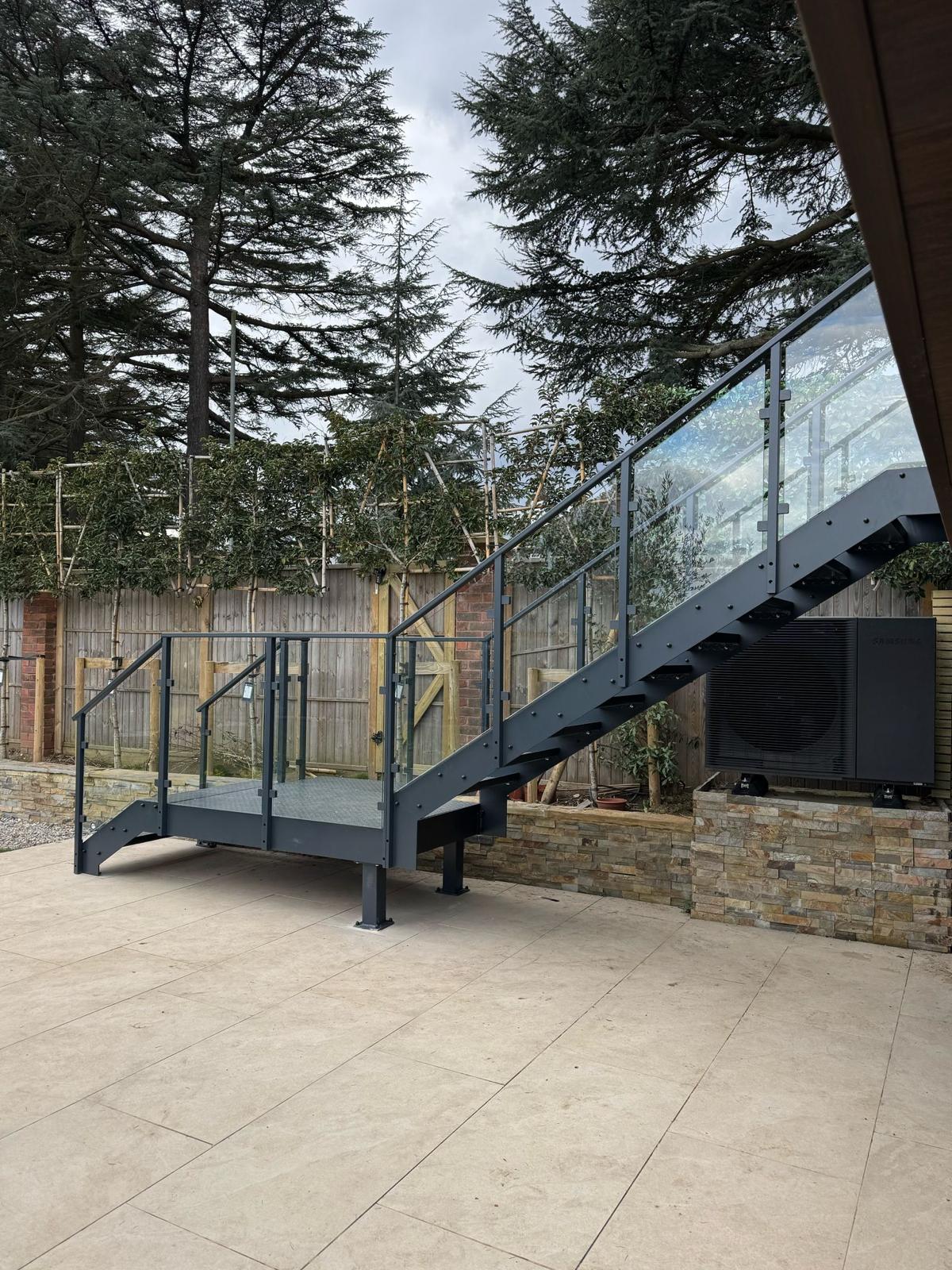
For almost every exterior architectural steel application in the UK — fire escape staircases, balcony railings, external balustrades, canopies, gates — the correct specification combines hot-dip galvanising as the substrate protection with powder coat as the aesthetic topcoat. This is the duplex system, and it delivers performance that neither process achieves alone.
The duplex system works synergistically. If the powder coat is damaged, the galvanising beneath prevents rust. If the zinc is exposed to air (through a damage point), the powder coat on the surrounding area slows zinc consumption. Combined service life typically exceeds the sum of each coating used alone — an effect called the "synergy bonus."
UK Environmental Categories — ISO 12944
ISO 12944 classifies atmospheric corrosion environments into six categories — C1 (interior dry) through CX (marine offshore). Which coating system is adequate for your project depends entirely on which category applies. Specifying below the required category causes premature failure; specifying above adds cost with no benefit.
For most UK residential and commercial projects: Category C3 applies (urban/suburban) — duplex galvanise + powder coat delivers 30–40 years to first maintenance. For coastal Hampshire, Dorset and Sussex properties near the sea (C4): duplex is still correct, but expect the topcoat to need refreshing at 15–20 years. Continox specifies duplex as standard on all exterior steelwork regardless of location.
Cost Impact — What Does Each Add?
On a typical 3-storey external fire escape staircase (approximately 45m² of coated surface area), duplex specification adds £800–£1,400 to the steel treatment cost versus galvanising alone — a premium of typically 6–10% on the total installed price. Against the 40-year service life benefit, this is the single best value-for-money upgrade in external staircase specification. For external staircase pricing see our external staircase range from £3,500 residential / £5,500 commercial.
Which Finish Should You Specify?
Specification Decision Guide


Maintenance & Long-Term Care
Both coating systems need different maintenance approaches. Galvanised-only steel needs effectively no maintenance for the first 20–30 years in a C3 environment — the zinc carbonate patina does its job. At 30–40 years, when zinc thickness drops below a protective threshold, the decision is either re-galvanising (requires dismantling and transport to galvaniser) or overcoating with a zinc-rich primer + topcoat to extend service life another 15–20 years.
Duplex systems typically need no attention for 20–25 years in C3. When maintenance is needed, it's usually topcoat refresh only — scuff-sand, clean, reapply powder-compatible liquid topcoat. Because the galvanised layer underneath is still protecting the steel, this is aesthetic maintenance, not structural. Re-galvanising is rarely needed within normal building lifespans on duplex systems.
Powder Coat vs Galvanised — FAQ
Common questions from UK architects, specifiers and homeowners on steel finish specification.
Free Survey + Duplex Quote
Free on-site survey across the UK, fixed-price quotation within 24 hours. All external Continox steelwork specified duplex as standard — galvanising to ISO 1461 plus powder coat topcoat. External staircases from £3,500 residential / £5,500 commercial.