
Care homes face fire safety challenges that no other building type shares. The residents who need to escape are the people least able to do so — elderly, frail, cognitively impaired, mobility-limited, or entirely dependent on staff for evacuation. This is why care home fire escape requirements go far beyond standard commercial building regulations, incorporating progressive horizontal evacuation strategies, enhanced compartmentation, specialist detection systems, and — where vertical escape is necessary — staircases designed for assisted evacuation with wheelchairs, evacuation chairs, and ski sheets. This guide covers every fire escape requirement for care homes in England, from the regulatory framework through to the staircase specifications, costs, and CQC inspection expectations.
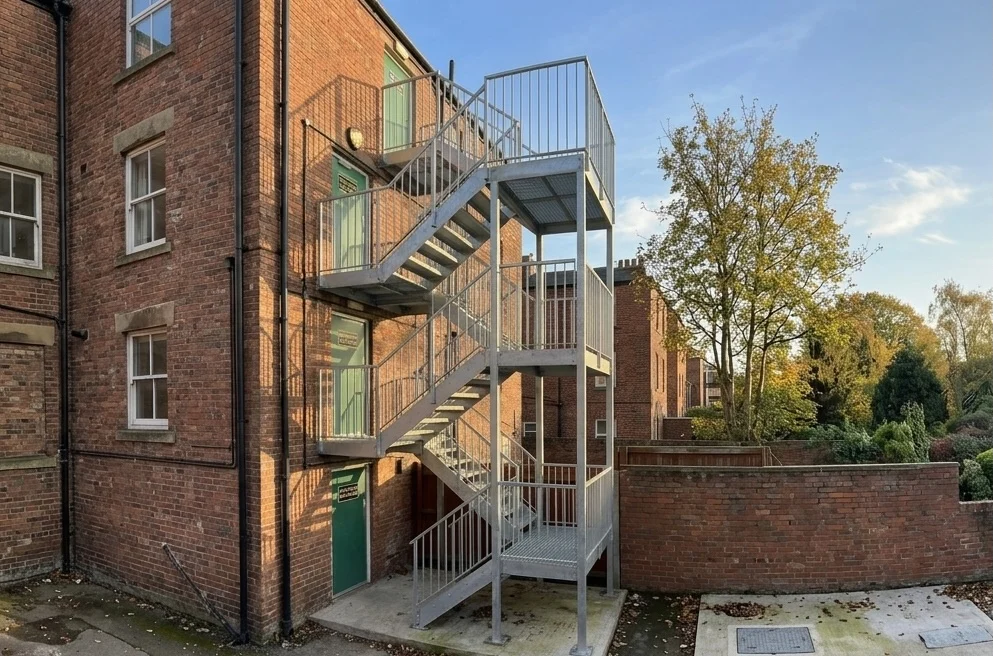
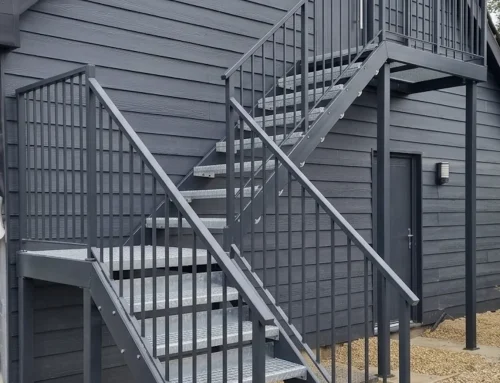
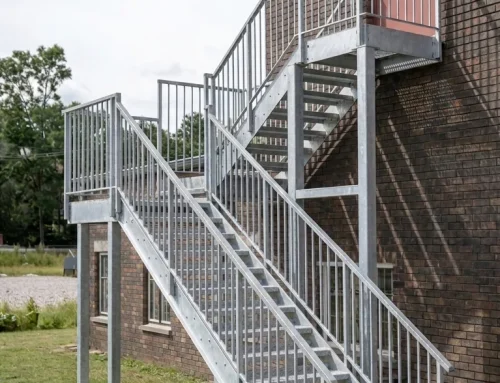
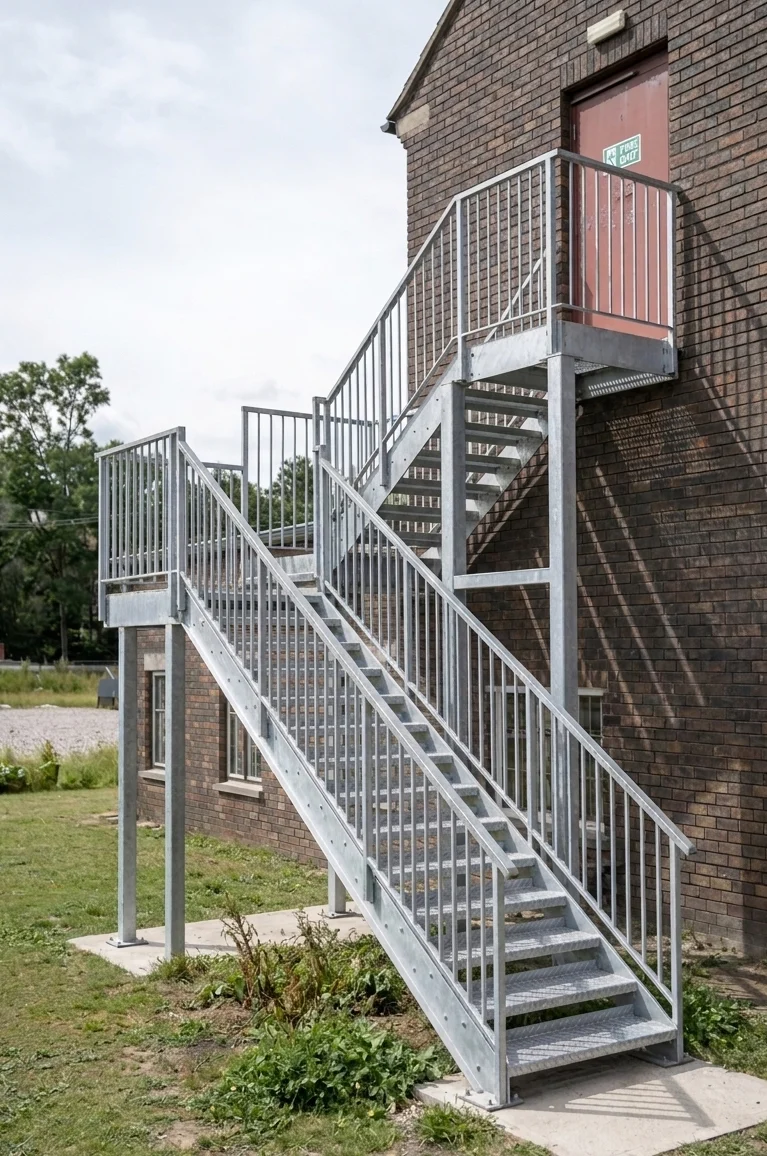
A galvanised steel external fire escape staircase on a multi-storey care home — designed and installed by Continox
Care home fire escape requirements are governed by the Regulatory Reform (Fire Safety) Order 2005, Approved Document B (Volume 2), BS 9991:2024 (which now specifically includes residential care homes), HTM 05-02 (for NHS-linked facilities), and CQC inspection standards. The default evacuation strategy is progressive horizontal evacuation (PHE) — moving residents horizontally to an adjacent fire compartment, not down stairs. This requires at least two fire compartments per floor with 30-minute (minimum) or 60-minute (ideal) fire-resistant construction, FD30S fire doors, L1 detection coverage (every room except bathrooms), and Personal Emergency Evacuation Plans (PEEPs) for all residents. External fire escape staircases are required where the building layout does not support adequate horizontal evacuation or where the fire risk assessment identifies vertical escape as necessary. External stairs must meet BS 9991 / BS 5395 with 1,200mm+ clear width (to accommodate evacuation chairs), 150–170mm rise, ≥250mm going, and 1,100mm balustrade height.
Why Care Homes Are Different from Every Other Building
The fundamental challenge of care home fire safety is that the standard assumption underlying all fire escape design — that building occupants will self-evacuate when the alarm sounds — does not apply. In a typical care home, a significant proportion of residents cannot walk unaided, cannot understand instructions due to dementia, cannot hear alarms, or are asleep and cannot be woken quickly. Some are bedbound. Some are connected to supplemental oxygen, which dramatically increases fire intensity.
This means the evacuation strategy cannot rely on staircases as the primary means of escape. Instead, care homes use progressive horizontal evacuation: when a fire is detected, residents are moved horizontally — along the same floor — through fire doors into an adjacent fire compartment that provides a temporary refuge. Vertical evacuation down staircases is the last resort, used only when horizontal evacuation has failed or the fire has spread beyond a single compartment.
The implication for staircase design is significant. Internal and external staircases in care homes must be wide enough to accommodate evacuation chairs and ski sheets operated by staff, have shallower gradients than domestic stairs, provide refuge areas at each landing, and be designed for use by people who are being carried or assisted rather than walking independently.
The stakes: In 2019, New Grange Care Home was fined £175,000 after two residents died in a fire — caused by inadequate staff training and an insufficient evacuation plan. The CQC has cancelled registrations and closed care homes for fire safety failures. Non-compliance is not a risk that can be managed — it is a risk that ends care businesses and costs lives.
The Regulatory Framework — 5 Laws That Apply Simultaneously
1 Regulatory Reform (Fire Safety) Order 2005 (RRO)
The primary fire safety legislation. The "responsible person" (usually the registered manager or provider) must carry out a suitable and sufficient fire risk assessment of all common parts and implement its findings. The RRO is enforced by the local fire and rescue authority, and non-compliance can result in unlimited fines and up to two years imprisonment.
2 Approved Document B (Volume 2)
Part B governs fire safety design for all non-domestic buildings, including care homes (classified as purpose group 2a — "residential institutional"). It specifies compartmentation standards, fire resistance periods, means of escape, staircase provision, and fire door requirements. Care homes require higher fire resistance standards than standard commercial buildings.
3 BS 9991:2024
The 2024 revision of BS 9991 explicitly extends its scope to include residential care homes — a significant change from earlier editions. It provides specific guidance on fire safety design for care environments, including compartmentation for progressive horizontal evacuation, staircase widths for assisted evacuation, and refuge area specifications. This is now the primary technical standard for care home fire safety design.
4 HTM 05-02 (Healthcare premises)
Health Technical Memorandum 05-02 provides fire safety design guidance for healthcare premises. While primarily aimed at NHS facilities, it applies to care homes that are linked to healthcare services, particularly nursing homes providing clinical care. HTM 05-02 provides detailed guidance on progressive horizontal evacuation design.
5 CQC Registration and Inspection
The Care Quality Commission inspects fire safety as part of its "Safe" domain. CQC inspectors check fire risk assessments, evacuation plans, PEEPs, staff training records, fire door condition, alarm testing logs, and the physical condition of escape routes. Fire safety failures directly affect CQC ratings and can result in enforcement action, conditions on registration, or cancellation of registration.
Progressive Horizontal Evacuation — How It Works
Progressive horizontal evacuation (PHE) is the standard evacuation strategy for care homes. Rather than evacuating the entire building, PHE moves residents from the affected compartment to an adjacent fire compartment on the same floor. This avoids the need for vulnerable residents to navigate staircases — the most dangerous and time-consuming element of any evacuation.
Stage 1: Immediate zone
Staff move residents from the room or area where the fire has been detected to the nearest fire compartment boundary. Fire doors close (automatically or manually) to seal the affected compartment. This must be achievable within 2½ minutes of the alarm activating — a benchmark that requires adequate staffing, particularly at night.
Stage 2: Adjacent compartment
Residents shelter in the adjacent compartment while the fire service responds. The compartment's 30-minute (minimum) or 60-minute (ideal) fire resistance provides a temporary refuge. If the fire is contained within the original compartment, no further evacuation may be necessary.
Stage 3: Vertical evacuation (last resort)
If the fire spreads beyond the original compartment or the adjacent compartment is compromised, vertical evacuation via internal or external staircases becomes necessary. This is where staircase design becomes critical — the stairs must accommodate staff carrying or assisting residents who cannot walk, using evacuation chairs, ski sheets, or other aids.
Compartmentation is everything: Progressive horizontal evacuation only works if the fire compartments are intact. Propped-open fire doors, breached compartment walls (holes around service pipes, missing fire stops), and damaged fire door seals all compromise the strategy. The most common finding in fire and rescue authority inspections of care homes is compromised compartmentation — and it is the single most dangerous fire safety failure.
Compartmentation Requirements — The Structural Foundation
| Element | Requirement | Notes |
|---|---|---|
| Floor fire resistance | 60 min (ideal) / 30 min (minimum) | Higher standard than standard commercial |
| Compartment wall fire resistance | 30 min minimum | Must extend to full height of building |
| Fire doors (compartment boundaries) | FD30S self-closing | Intumescent strips + cold smoke seals |
| Fire doors (bedroom doors) | FD30S self-closing | Hold-open devices linked to alarm acceptable |
| Compartments per floor | Minimum 2 | Each must have independent escape route |
| Compartment capacity | Must accommodate adjacent compartment residents | Design for double occupancy during PHE |
| Service penetrations | Fire-stopped to same rating as wall/floor | Most common failure point in inspections |
| Stairwell enclosure | 30 min (≤18m) / 60 min (>18m) | Protected stairway — fire sterile zone |
Fire Detection — L1 Category Coverage
Care homes require Category L1 fire detection — the most comprehensive coverage level under BS 5839 Part 6. L1 means detectors in every room (except bathrooms and toilets), every corridor, every landing, every stairwell, every cupboard housing electrical intake, and every roof void. This exceeds the L2 requirement for HMOs and reflects the critical importance of early detection when residents cannot self-evacuate.
The alarm system must be Grade A (panel-controlled) for most care homes. Domestic Grade D alarms are not acceptable. The system must include smoke detectors in bedrooms and corridors, heat detectors in kitchens and laundries, manual call points at every final exit and stairwell entrance, and sounders throughout — supplemented by visual beacons for residents with hearing impairments.
Cost: Grade A, Category L1 fire alarm system for a typical 30-bed care home: £5,000–£10,000 installed, depending on building complexity and existing wiring.
External Fire Escape Staircases — When and Why
An external fire escape staircase is required when the building layout does not support adequate progressive horizontal evacuation — typically in the following situations. The building has only one fire compartment per floor (and adding compartment walls is not structurally feasible). The internal escape routes are compromised by the building layout — for example, where the staircase passes through a kitchen or utility area. The fire risk assessment identifies a need for an alternative vertical escape route. The building is being extended or converted, and the existing staircase provision does not meet current standards.
Care home staircase specifications
External fire escape staircases on care homes must be wider than standard commercial fire escapes to accommodate evacuation chairs and staff-assisted evacuation.
| Requirement | Care Home Value | Standard |
|---|---|---|
| Minimum clear width | 1,200mm (recommended for evacuation chair use) | BS 9991 / Part K |
| Rise per step | 150–170mm | General access stair |
| Going (tread depth) | ≥250mm (preferred 280mm) | General access stair |
| Maximum pitch | 33° | Same as schools / institutional |
| Risers | Solid only — open risers not permitted | Non-domestic requirement |
| Handrail height | 900–1,000mm both sides | BS 9991 |
| Balustrade height (landing) | 1,100mm | BS 6180 / Part K non-domestic |
| Landing at each floor | ≥1,200mm × 1,500mm (refuge area) | Must accommodate wheelchair + attendant |
| Material | S275/S355 structural steel, galvanised | BS EN 1090 / ISO 1461 |
| Treads | Chequer plate or open mesh — anti-slip | Non-slip mandatory |
| Contrasting nosings | Required — Part M | 55mm on tread + 55mm on riser |
For detailed specifications and pricing on fire escape stairs and external staircases, see our dedicated product pages.
 Galvanised fire escape — 1,200mm wide with refuge landings for care home use
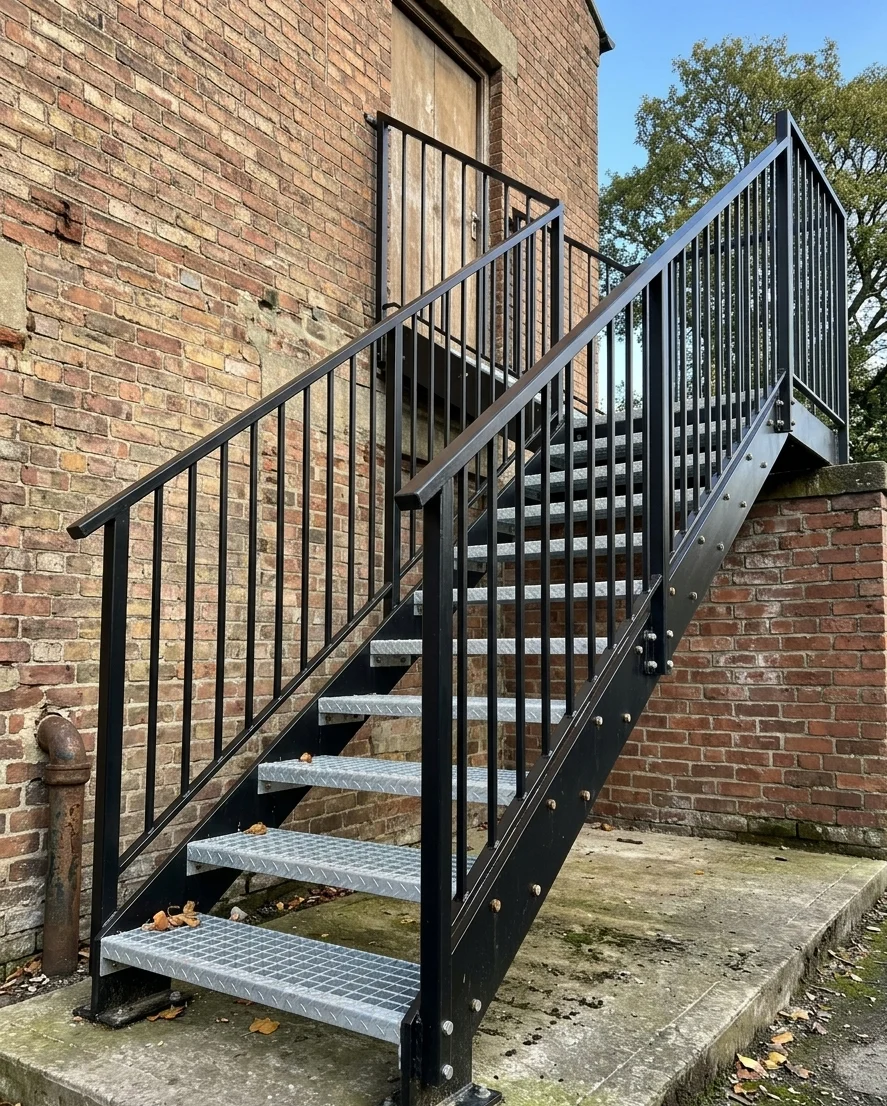 Duplex finish — galvanised + powder coat for 40–60 year service life
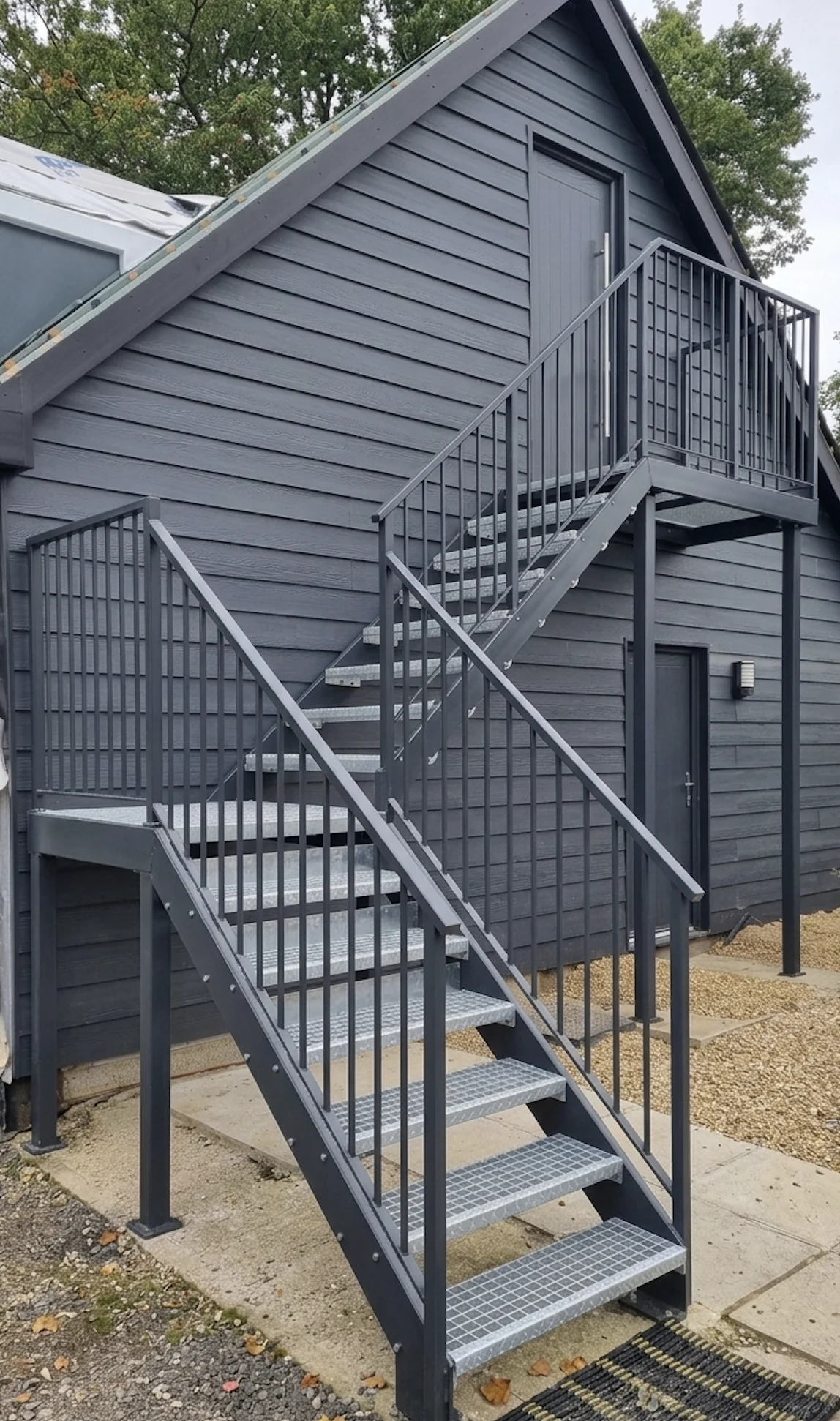 Multi-landing design — refuge area at each floor for staged evacuation
 1,100mm guarding — non-domestic standard for institutional buildings
PEEPs — Personal Emergency Evacuation Plans
Every resident in a care home who cannot self-evacuate must have a documented Personal Emergency Evacuation Plan. This is not optional — it is a regulatory requirement under the RRO and a CQC inspection standard. The PEEP must specify the resident's mobility level and cognitive awareness, the evacuation method appropriate for them (walking with assistance, evacuation chair, ski sheet, carry), the number of staff required to evacuate them, the route to be used, and any specific equipment needed.
PEEPs must be reviewed whenever a resident's condition changes, when the building layout is altered, or when staffing levels change — particularly night staffing, which is the critical period for care home fires. CQC inspectors routinely check whether PEEPs are in place, up to date, and understood by the staff on duty.
Fire Doors — The Care Home Challenge
Fire doors in care homes face a specific tension: they must be self-closing for fire safety, but residents with dementia, mobility impairments, or wheelchair dependence find self-closing doors difficult or impossible to operate. The solution is electromagnetic hold-open devices linked to the fire alarm system — the doors remain open during normal use but release automatically when the alarm activates.
Hold-open devices must comply with BS 7273 Part 4, be connected to the fire alarm panel, and release on activation of any detector in the relevant zone. They are required on all corridor fire doors and compartment doors where resident access is expected. Bedroom doors may use standard self-closing devices, but hold-open devices on bedroom doors are increasingly accepted where the fire risk assessment supports this approach.
All care home fire doors must be FD30S rated (30-minute fire resistance, smoke-sealed), fitted with intumescent strips and cold smoke seals, hung on three steel hinges, and openable from both sides. Locks on bedroom doors must be override-capable by staff using a master key system.
Costs — Care Home Fire Escape Compliance 2026
| Item | Cost Range | Notes |
|---|---|---|
| External fire escape (1,200mm wide, 2 landing) | From £5,500 | Galvanised steel, refuge landings, BS 9991 |
| External fire escape (1,200mm wide, 3+ landing) | From £9,000 | Multi-storey care home |
| Duplex finish (galvanised + powder coat) | +£800–£1,500 | 40–60 year service life |
| Grade A, L1 fire alarm (30-bed home) | £5,000–£10,000 | Panel, detectors in every room, manual call points |
| FD30S fire doors with hold-open (per door) | £250–£450 | Including electromagnetic hold-open device |
| Emergency lighting (per floor) | £300–£600 | BS 5266, 3-hour backup |
| Fire risk assessment (specialist care home) | £250–£600 | Must cover PHE strategy and PEEPs |
| Evacuation chair (per unit) | £400–£1,200 | Stored at top of each staircase |
| Compartmentation remedial works | £2,000–£8,000 | Fire stopping, wall repairs, ceiling repairs |
Total compliance cost example: A two-storey, 40-bed care home requiring an external fire escape, compartmentation remedial works, alarm upgrade, and fire door replacement typically costs £25,000–£40,000 for full compliance. This is a capital investment that protects residents, secures your CQC registration, and prevents fines that can reach six figures.
CQC Inspection — What Inspectors Check
CQC inspectors assess fire safety under the "Safe" domain. A fire safety failure can result in the home being rated "Requires Improvement" or "Inadequate" — and in serious cases, enforcement action including conditions on registration or cancellation. Here is what they check.
1 Fire risk assessment
Is the FRA up to date (reviewed within 6 months)? Was it carried out by a competent person? Have the action plan recommendations been implemented? Does the FRA specifically address the needs of residents who cannot self-evacuate?
2 PEEPs
Does every resident have a PEEP? Are PEEPs reviewed when residents' conditions change? Do night staff know and understand the PEEPs for residents on their floor?
3 Fire doors
Are all fire doors in good condition? Do self-closing devices work? Are intumescent strips and smoke seals intact? Are hold-open devices linked to the alarm? Are any fire doors propped open without a hold-open device?
4 Alarm and detection
Is the alarm system tested weekly with results logged? Is there a six-monthly service certificate from a competent engineer? Are all detectors functioning and correctly positioned?
5 Escape routes and staircases
Are escape routes clear and unobstructed? Are external fire escape staircases in good structural condition? Is emergency lighting functioning? Are evacuation chairs in place and staff trained to use them?
6 Staff training
Have all staff received fire safety training within the last 12 months? Have fire drills been conducted — including simulated night evacuations? Do staff understand progressive horizontal evacuation procedure?
For the full specifications on glass balustrade for commercial and institutional applications, or balcony railings for care home outdoor spaces, see our product pages.
Frequently Asked Questions — Care Home Fire Escape
Not all care homes need external fire escape stairs — the default strategy is progressive horizontal evacuation within the building. External fire escape stairs are required when the fire risk assessment identifies that the internal routes are inadequate: for example, where there is only one compartment per floor, where the internal staircase is compromised by the layout, or where Building Control or the fire authority requires an alternative vertical escape route.
Progressive horizontal evacuation (PHE) is the standard strategy for care homes. Residents are moved horizontally to an adjacent fire compartment on the same floor — not down stairs. This requires at least two fire compartments per floor with 30–60 minute fire resistance. Vertical evacuation down staircases is the last resort, used only when horizontal evacuation has failed. "Delayed evacuation" (staying in a fire-resistant room) is an exceptional strategy requiring considerable planning and is not suitable for most care homes.
Care homes require a Grade A (panel-controlled), Category L1 fire alarm system — the most comprehensive coverage level. L1 means detectors in every room except bathrooms and toilets, including bedrooms, corridors, cupboards, roof voids, and kitchens (heat detectors). This exceeds the L2 requirement for HMOs. Domestic Grade D alarms are not acceptable. Cost: £5,000–£10,000 for a typical 30-bed home.
A minimum of 1,200mm clear width is recommended for care home fire escape staircases to accommodate evacuation chairs operated by staff. This is wider than the 1,000mm minimum for standard commercial fire escapes. Landings must be at least 1,200mm × 1,500mm to serve as refuge areas that can accommodate a wheelchair plus an attendant.
Most enforcing authorities and the CQC expect care home fire risk assessments to be reviewed every 6 months — not the 12 months typical for other commercial premises. The higher risk profile, changing resident acuity, and fluctuating staffing levels justify the shorter interval. Additionally, the FRA should be reviewed after any material change: new residents, building alterations, layout changes, or significant staffing changes.
CQC inspectors check fire safety under the "Safe" domain. They examine the fire risk assessment (is it current and competent?), PEEPs for all residents, fire door condition and self-closing devices, alarm testing logs and service certificates, escape route condition, staff training records, fire drill records (including simulated night evacuations), and the overall evacuation strategy. Fire safety failures can result in a "Requires Improvement" or "Inadequate" rating, and in serious cases, conditions on registration or cancellation.
Total compliance for a 40-bed care home typically costs £25,000–£40,000, including: external fire escape staircase (from £5,500), Grade A L1 alarm system (£5,000–£10,000), fire doors with hold-open devices (£250–£450 each), emergency lighting (£300–£600 per floor), compartmentation remedial works (£2,000–£8,000), fire risk assessment (£250–£600), and evacuation chairs (£400–£1,200 each). This is a one-off capital investment that protects your CQC registration and prevents fines.
The RRO allows unlimited fines and up to two years imprisonment for fire safety failures. The Fire Safety Act 2021 has strengthened enforcement powers. The CQC can impose conditions on registration, suspend registration, or cancel registration (closing the home). Additionally, the responsible person can face personal criminal liability. The largest UK care home fire safety fine to date was £175,000 following the death of two residents.
Need a Fire Escape Staircase for Your Care Home?
Continox designs and manufactures BS 9991 compliant fire escape staircases for care homes across Southern England. 1,200mm+ width for evacuation chair access, refuge landings at each floor, galvanised steel construction — with full certification for CQC and fire authority inspections. From £5,500.