

DIN 18065 Staircase Regulations Germany — Complete Architect's Guide
Complete technical reference for German architects designing staircases under DIN 18065:2020-08 — Auftritt, Steigung, Laufbreite, Schrittmaßregel, Wohngebäude vs Gebäude im Allgemeinen classification, notwendige vs nicht notwendige Treppen, and 16 Landesbauordnungen interaction.
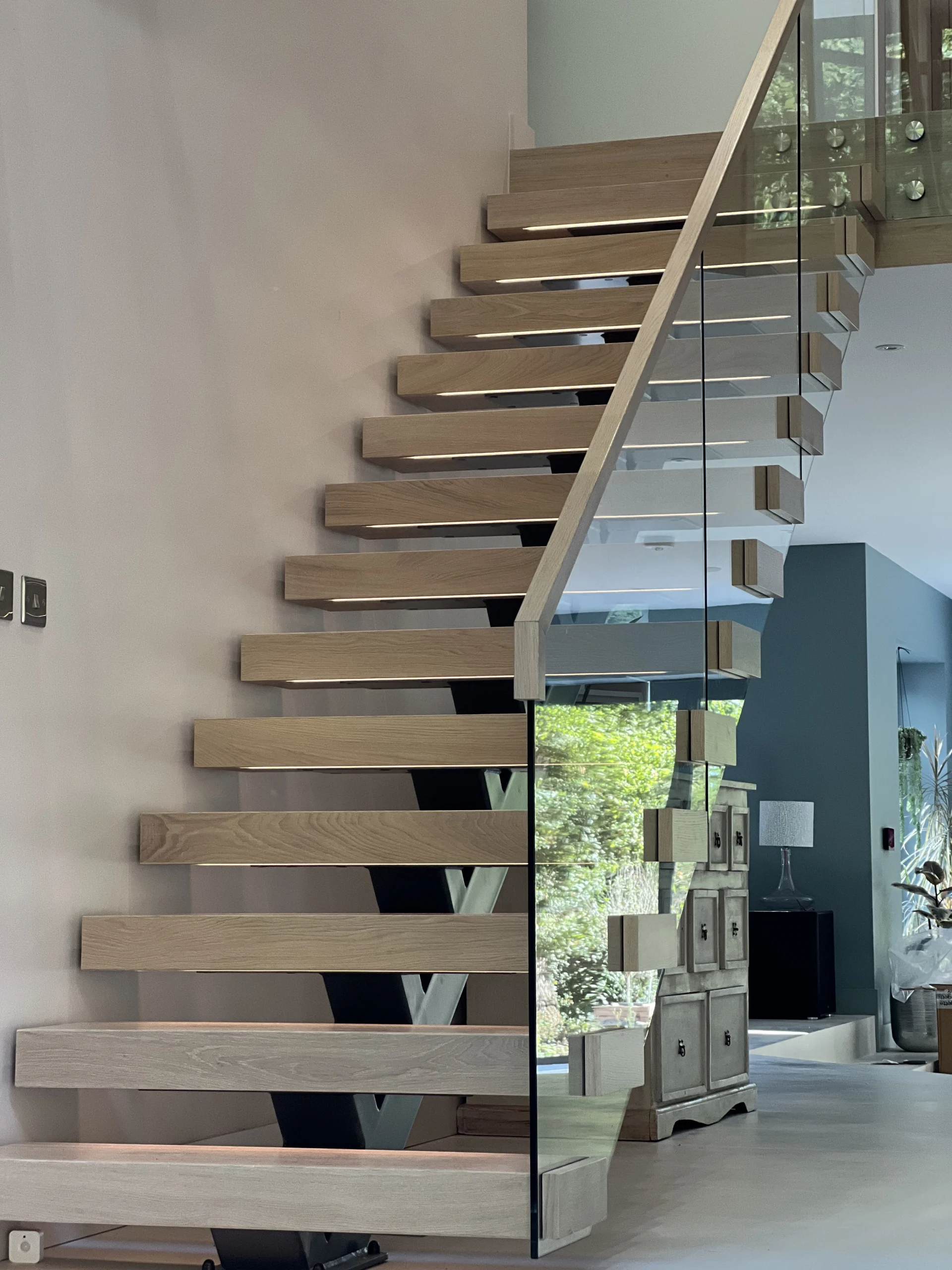
Straight-run modern staircase engineered to DIN 18065:2020-08 — Auftritt within 230–370 mm range, Steigung within 140–200 mm, Laufbreite ≥800 mm, Schrittmaßregel 2s+a = 590–650 mm satisfied throughout
For German architects, structural engineers and Bauleiter specifying staircases, DIN 18065:2020-08 "Gebäudetreppen — Begriffe, Messregeln, Hauptmaße" is the central technical regulation governing every dimensional and safety parameter. The norm replaces the 2015-03 version with revised terminology, clarified tolerances, and extended provisions for Krankentransport per DIN EN 1865-1. Combined with the relevant Landesbauordnung of each of Germany's 16 Bundesländer — and the underlying Musterbauordnung (MBO) federal model code — the German staircase regulatory landscape is one of the most rigorous in Europe. This guide covers all eight factors that govern compliance, the binary classification (Wohngebäude vs Gebäude im Allgemeinen), the Schrittmaßregel ergonomic formula, the notwendige vs nicht notwendige Treppen distinction, and how Continox supplies full DIN 18065 + Landesbauordnung documentation as part of every German project. For the wider German market overview see our Modern Staircase Germany hub; for the full UK product range see /modern-staircase/, /external-staircase/, /glass-balustrade/ and /work/.
DIN 18065:2020-08 sets two binary classifications: Wohngebäude mit bis zu zwei Wohnungen + innerhalb von Wohnungen (single-family villa, two-flat building, internal apartment stair) requires Auftritt 230–370 mm, Steigung 140–200 mm, Laufbreite ≥800 mm. Gebäude im Allgemeinen (Mehrfamilienhäuser with 3+ dwellings, public concurrence, commercial) requires Auftritt ≥260 mm, Steigung ≤190 mm, Laufbreite ≥1000 mm. The Schrittmaßregel ergonomic formula (2 × Steigung + Auftritt = 590–650 mm) is recommended for the smaller class and strictly enforced for the larger. The norm becomes legally binding via inclusion in each Bundesland's VVTB (Verwaltungsvorschrift Technische Baubestimmungen) or LTB (Liste Technischer Baubestimmungen). Where the Landesbauordnung and DIN 18065 conflict, the Landesbauordnung takes precedence. Geländer minimum 90 cm (Δh ≤12 m) or 110 cm (Δh >12 m), Lichter Abstand ≤12 cm, Horizontalkraft minimum 500 N/m.
- Regulatory Framework — DIN 18065 within German Building Law
- Factor 01 — Binary Classification (Wohngebäude vs Gebäude im Allgemeinen)
- Factor 02 — Auftritt (Going) Dimensions
- Factor 03 — Steigung (Riser) Dimensions
- Factor 04 — Laufbreite (Width) Requirements
- Factor 05 — Schrittmaßregel (Ergonomic Formula)
- Factor 06 — Notwendige vs Nicht Notwendige Treppen
- Factor 07 — Wendelung & Curved Stair Geometry
- Factor 08 — Landesbauordnung Interaction (16 Bundesländer)
- DIN 18065 vs CTE DB-SUA (Spain) vs Approved Document K (UK)
- How Continox Documents DIN 18065 Compliance
- FAQ — German Architects Ask
Regulatory Framework — DIN 18065 within German Building Law
German staircase compliance pulls from five regulatory layers, each addressing a different aspect. Understanding the hierarchy is essential — many compliance disputes between architects and Bauamt arise from confusion between DIN 18065's technical recommendations and the legally-binding Landesbauordnung provisions.
| Document | Legal Status | What It Governs |
|---|---|---|
| Musterbauordnung (MBO) | Federal model code (non-binding) | Reference framework for §50 (Treppen) and §51 (Treppenräume) |
| 16 Landesbauordnungen | State law (binding) | BayBO, LBO BW, BauO NRW, HBauO, BauO Bln, BremLBO etc — each state's binding code |
| DIN 18065:2020-08 | Technical norm via VVTB/LTB | Begriffe, Messregeln, Hauptmaße — dimensional & safety provisions |
| Eurocode + DIN EN /NA | Structural law (binding) | EN 1990/NA, EN 1991-1-1/NA — line loads, structural calculations |
| DIN 18040-1, -2, -3 | Accessibility norm (state-dependent) | Barrierefrei — staircases in public buildings, dwellings, public realm |
| Arbeitsstättenverordnung (ArbStättV) | Workplace law (binding) | Workplace staircase rules — applies in addition to building code |
| Sondervorschriften (industry-specific) | Sector regulations | Berufsgenossenschaften rules, hospital codes, school codes etc |
The Hierarchy in Practice
The Landesbauordnung sets the legal floor: every staircase in a given Bundesland must satisfy it. DIN 18065 then provides the technical detail — what dimensions and tolerances satisfy the Landesbauordnung's general "safe staircase" requirement. Where the two documents agree (most cases), DIN 18065's specific numbers govern. Where they conflict — and this happens in several Bundesländer for Brüstungshöhe and Geländer details — the Landesbauordnung takes precedence.
DIN 18065:2020-08 example for Erschwernis gegen das Überklettern (climbability prevention) cites 70 cm as the protected height in Gebäude im Allgemeinen. Bremen's BremLBO sets the binding figure at 50 cm for projects in the Bremen city-state. Baden-Württemberg's LBOAVO sets 60 cm. A Continox staircase supplied to a Bremen Mehrfamilienhaus is engineered to the 50 cm BremLBO figure regardless of the DIN's 70 cm example — the Landesbauordnung wins.
How DIN 18065 Becomes Legally Binding
DIN 18065 itself is published by the Deutsches Institut für Normung (DIN), a private standards organisation. The norm becomes legally binding through inclusion in each Bundesland's:
- VVTB (Verwaltungsvorschrift Technische Baubestimmungen) — administrative regulation of technical building provisions, used in some Bundesländer
- LTB (Liste Technischer Baubestimmungen) — list of technical building provisions, used in other Bundesländer
- MVV TB (Muster-Verwaltungsvorschrift Technische Baubestimmungen) — federal model administrative regulation, adopted by most Bundesländer with state-specific modifications
Most Bundesländer exempt Wohngebäude der Gebäudeklassen 1 und 2 (single-family and two-family houses, building classes 1 and 2) from strict DIN 18065 application — but practitioner consensus is that DIN 18065 minimum dimensions should be satisfied even where not strictly mandatory, both for safety and for resale value.
Binary Classification — Wohngebäude vs Gebäude im Allgemeinen
DIN 18065's central organising principle is the binary classification distinguishing residential dwellings up to two units from all other building types. This distinction cascades through every dimensional parameter — the smaller class permits looser dimensions reflecting the lower user count and familiar-occupant assumption; the larger class enforces stricter dimensions reflecting the higher user count and unfamiliar-visitor assumption.
Wohngebäude mit bis zu zwei Wohnungen + innerhalb von Wohnungen
The smaller classification covers:
- Single-family detached villa (Einfamilienhaus) — full villa typology dominant in Munich Bogenhausen, Hamburg Blankenese, Berlin Grunewald, Frankfurt Westend, Stuttgart Halbhöhenlage
- Two-family semi-detached (Doppelhaushälfte, Zweifamilienhaus) — common typology in suburban Munich, Düsseldorf, Cologne
- Internal staircase within a single dwelling (Treppe innerhalb einer Wohnung) — duplex apartments, mezzanine apartments, loft conversions in Berlin Altbau and Hamburg Gründerzeit
- Family townhouse (Reihenhaus) — typically classified as a single dwelling per unit
Gebäude im Allgemeinen
The larger classification covers everything else:
- Mehrfamilienhäuser (multi-family buildings, 3+ dwellings) — includes the communal staircase serving the dwellings
- Hospitality — hotels, restaurants, cafés, bars (Public concurrence)
- Commercial — offices (Bürogebäude), retail (Einzelhandel), shopping centres
- Education — Kindergärten, schools, universities, training facilities
- Healthcare — hospitals, clinics, doctors' practices, care homes
- Transport — train stations, bus stations, airports, U-Bahn stations
- Public buildings — government, libraries, museums, sports facilities
- Industrial — workshops, warehouses, factory production areas
The boundary is the third dwelling. A semi-detached with two flats is Wohngebäude (smaller class). The same building structure with a third flat — even a granny annexe with separate kitchen and bathroom — becomes Mehrfamilienhaus (larger class). The dimensional uplift is significant: Laufbreite jumps from ≥800 mm to ≥1000 mm, Auftritt minimum from 230 mm to 260 mm, Schrittmaßregel becomes mandatory rather than recommended.
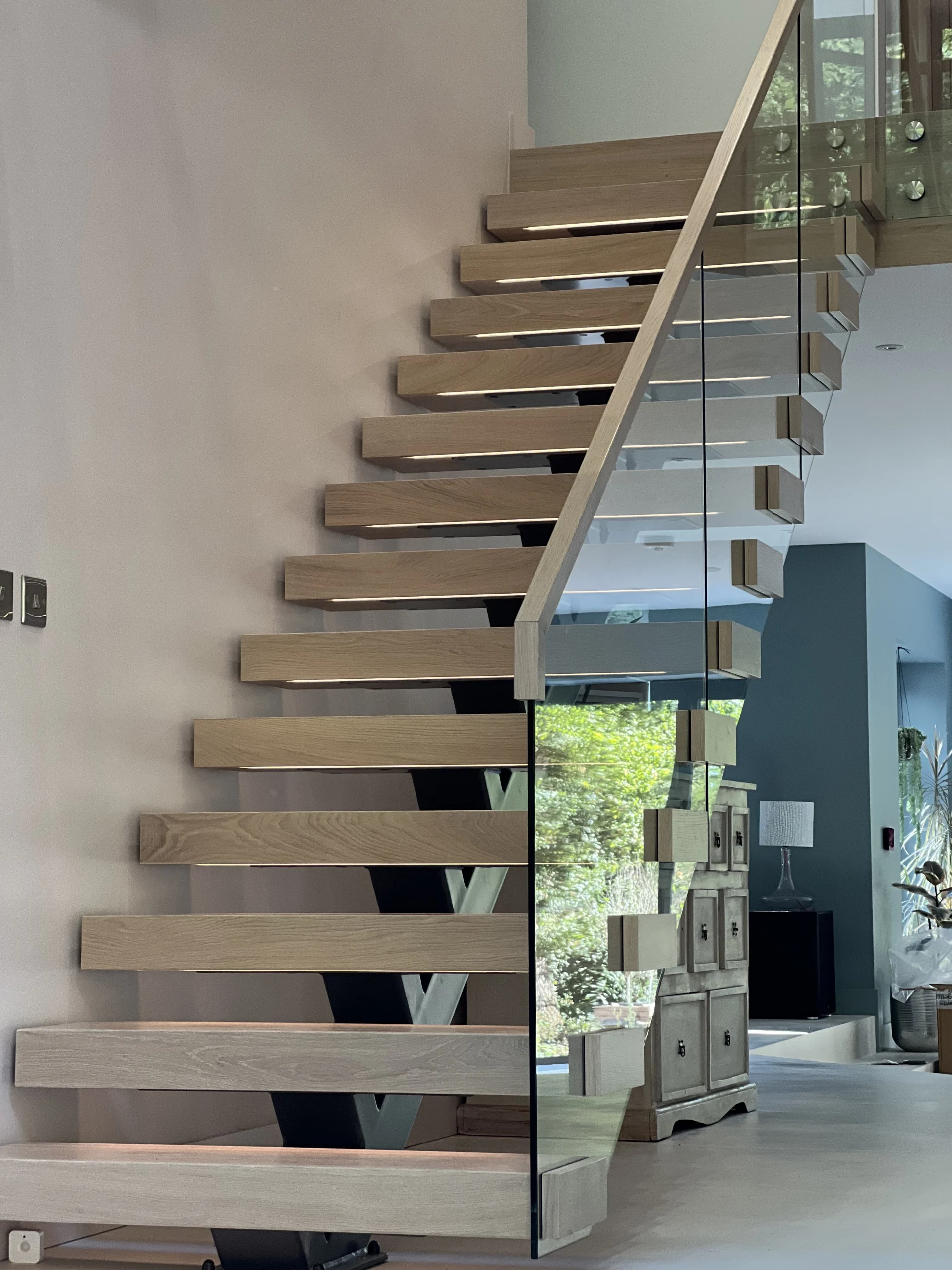
Wohngebäude mit bis zu zwei Wohnungen — single-family villa central spine staircase satisfying DIN 18065 Auftritt 230–370 mm, Steigung 140–200 mm, Laufbreite ≥800 mm, with open risers permitted under the smaller classification
Auftritt (Going) Dimensions
The Auftritt is the horizontal tread depth — the surface a foot lands on during a step. DIN 18065 specifies the Auftritt as measured on the Lauflinie (walking line) — typically about one-third of the Laufbreite from the inner edge for curved staircases.
| Classification | Min Auftritt | Max Auftritt | Typical Spec |
|---|---|---|---|
| Wohngebäude mit bis zu zwei Wohnungen | 230 mm | 370 mm | 270–290 mm (most common) |
| Innerhalb einer Wohnung | 230 mm | 370 mm | 250–280 mm |
| Gebäude im Allgemeinen | 260 mm | 370 mm (recommended) | 280–310 mm (most common) |
Tolerance & Measurement Convention
DIN 18065:2020-08 specifies that all dimensions are measured at the Fertigmaß (gebrauchsfertiger Zustand) — the finished, ready-to-use state, not the structural shell (Rohbau). The architect must account for finished flooring (parquet, tile, screed) when verifying compliance against the design.
For variable Auftritt staircases (Wendelstufen, gewendelte Treppen), DIN 18065 specifies separate minimums:
- At Lauflinie: Full Auftritt minimum (230 mm Wohngebäude / 260 mm Allgemein)
- At inner boundary: ≥50 mm (Wohngebäude) / ≥100 mm (Allgemein)
This is why Spindeltreppen (spiral staircases) face stricter limitations under Allgemein classification — the inner-boundary minimum of 100 mm is hard to satisfy on tight spiral geometries. Most Mehrfamilienhaus communal staircases are therefore straight or U-shape rather than spiral.
Steigung (Riser) Dimensions
The Steigung is the vertical riser height — the difference in elevation between two consecutive treads. Steigung is the dimension that, combined with Auftritt, determines whether the staircase satisfies the Schrittmaßregel ergonomic formula.
| Classification | Min Steigung | Max Steigung | Typical Spec |
|---|---|---|---|
| Wohngebäude mit bis zu zwei Wohnungen | 140 mm | 200 mm | 170–185 mm (most common) |
| Innerhalb einer Wohnung | 140 mm | 210 mm (in some interpretations) | 175–195 mm |
| Gebäude im Allgemeinen | 140 mm | 190 mm | 165–180 mm |
Antrittsstufe — Tolerance for First Riser
DIN 18065:2020-08 Article 6.1 includes a specific provision for the Antrittsstufe (first riser, lowest tread): in Wohngebäude mit bis zu zwei Wohnungen and innerhalb von Wohnungen, the first riser may deviate from the nominal Steigung by up to 15 mm. The standard 5 mm maximum tolerance between the first and subsequent risers does not apply in these residential cases.
For Gebäude im Allgemeinen the tolerance is strictly limited to 5 mm across all risers — including the Antrittsstufe. This reflects the higher safety requirement when unfamiliar visitors use the staircase.
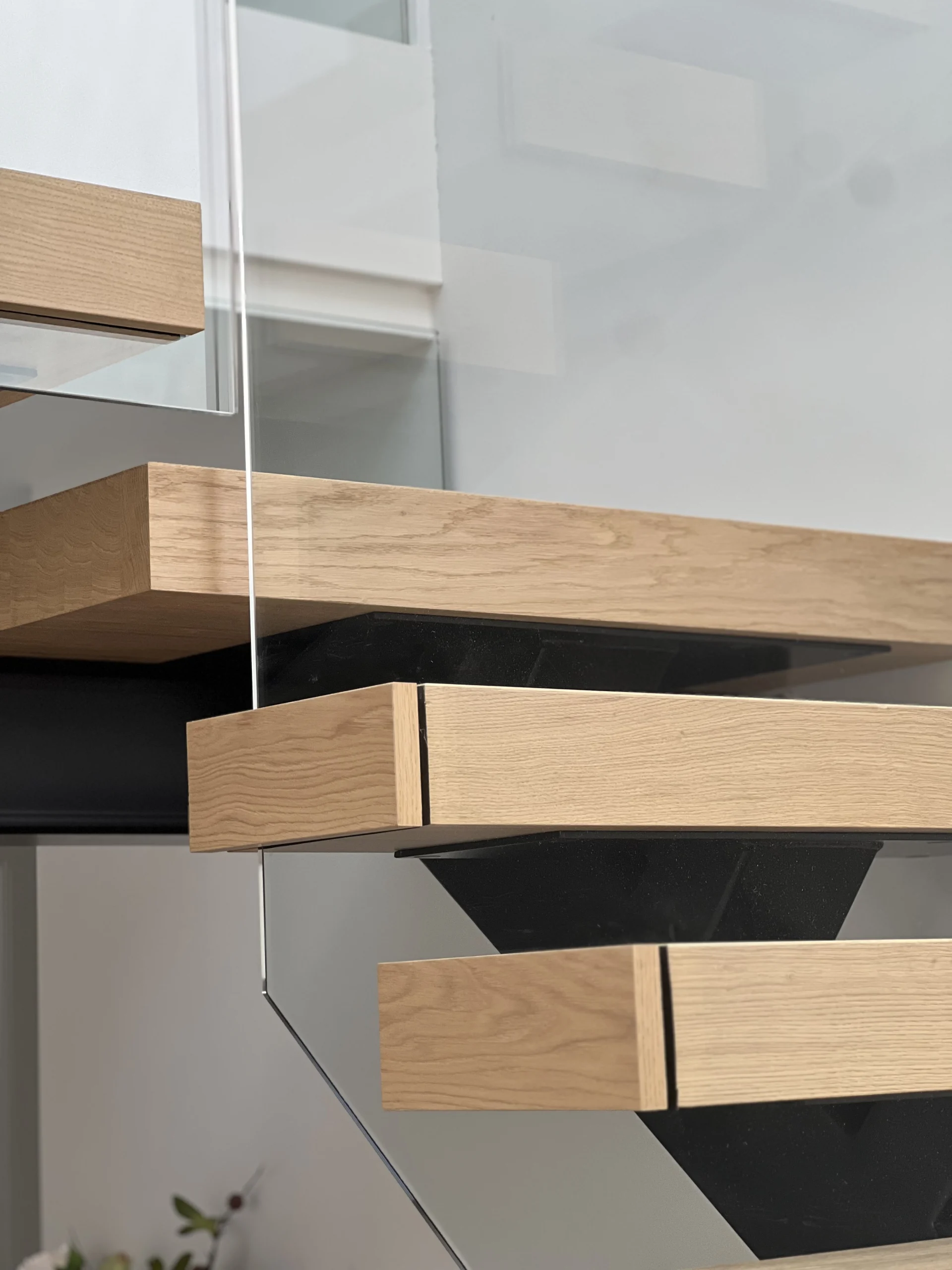
Auftritt and Steigung close-up — 100 mm solid hardwood treads with Auftritt within DIN 18065 Wohngebäude range (typical 270–290 mm) and Steigung 170–185 mm
Laufbreite (Width) Requirements
The Laufbreite (running width) is the most binding dimensional constraint for German staircase planning — the difference between the two classifications is 200 mm (800 mm vs 1000 mm), often the difference between fitting a staircase into a stairwell and not. DIN 18065 distinguishes between nutzbare Laufbreite (usable running width) and the structural construction width.
| Classification | Min Laufbreite | Notes |
|---|---|---|
| Wohngebäude mit bis zu zwei Wohnungen | ≥800 mm | Measured at Fertigmaß between handrail and wall |
| Innerhalb einer Wohnung | ≥800 mm | Same as above |
| Gebäude im Allgemeinen — Mehrfamilienhaus <3 Wohnungen | ≥1000 mm | Communal stair serving 3+ dwellings |
| Gebäude im Allgemeinen — public concurrence | ≥1000 mm + Krankentrage capacity | DIN EN 1865-1 stretcher transport must be possible |
| Workplace per ArbStättV | Variable, often ≥1000 mm | Minimum based on number of users in evacuation |
Nutzbare Laufbreite vs Konstruktionsbreite
DIN 18065 distinguishes precisely between two width measurements:
- Konstruktionsbreite (construction width) — the structural width as designed in the proyecto/Ausführungsplanung, measured between Rohbau wall surfaces or limiting structural elements
- Nutzbare Laufbreite (usable running width) — the actual usable width at Fertigmaß, measured horizontally between limiting finished surfaces: handrail-to-wall, handrail-to-handrail, or wall-to-wall after wall finishing
The DIN minimum applies to the nutzbare Laufbreite. A staircase designed at 1050 mm Konstruktionsbreite that loses 60 mm to wall plaster + handrail offset can drop below 1000 mm at Fertigmaß and breach the Allgemein minimum.
Krankentransport DIN EN 1865-1 — Mehrfamilienhaus Provision
DIN 18065:2020-08 introduced a new provision (extending the 2015-03 version) for Mehrfamilienhäuser: notwendige Treppen must accommodate Krankentragen-Transport per DIN EN 1865-1:2015-08 by Rettungsdienst (emergency medical services). The 2020 update specifies that larger Laufbreiten and Podestbreiten than the general minimums may be required if the standard 1000 mm width does not allow stretcher manoeuvring at landings — particularly relevant on quarter-turn and U-turn configurations.
Practical impact: For Mehrfamilienhaus communal staircases with quarter-landings (Viertelpodest), the Podestbreite often needs to be 1100–1200 mm (rather than 1000 mm) to clear the DIN EN 1865-1 stretcher dimensional requirement. Continox engineers verify this geometry at design stage when supplying to Mehrfamilienhaus projects.
Schrittmaßregel — Ergonomic Formula
The Schrittmaßregel is Germany's ergonomic comfort formula, mathematically equivalent to the British 2R+G formula and the Spanish 54 ≤ 2C+H ≤ 70 cm rule, but with German-specific bounds and metric units:
Schrittmaßregel — DIN 18065:2020-08
- Formula: 2 × Steigung + Auftritt = 590–650 mm
- Where Steigung is in mm and Auftritt is in mm
- Target: Average human stride length while ascending or descending
- Optimum: 630 mm (centre of range, most comfortable)
- Wohngebäude: Recommended best practice, not strictly enforced
- Gebäude im Allgemeinen: Strictly enforced — failure = non-compliance
Worked Example — Munich Villa Staircase
Typical Munich Bogenhausen villa specification, 2,700 mm Geschosshöhe (floor-to-floor):
- 15 risers required for 2,700 mm rise → Steigung = 180 mm
- Auftritt selection: Schrittmaßregel: 2 × 180 + Auftritt = 590–650 → Auftritt = 230–290 mm
- Practical choice: Auftritt = 280 mm (within Wohngebäude 230–370 range, within Schrittmaßregel)
- Verification: 2 × 180 + 280 = 640 mm ✓ (within 590–650 range, near optimum)
- Total run: 14 Auftritte × 280 mm = 3,920 mm
Why It Matters
A staircase that satisfies all three dimensional minimums (Auftritt ≥230 mm, Steigung ≤200 mm, Laufbreite ≥800 mm) but breaches the Schrittmaßregel produces uncomfortable, fatiguing climbing. For Mehrfamilienhaus communal stairs and public concurrence applications, breach of the Schrittmaßregel is grounds for the Bauamt to refuse Bauabnahme (building handover).
The "alte" Sicherheitsregel (Steigung + Auftritt = 460 mm) and Bequemlichkeitsregel (Auftritt − Steigung = 120 mm) were removed from DIN 18065 in earlier revisions. Only the Schrittmaßregel remains in DIN 18065:2020-08. Some older textbooks and Bauamt traditions still reference the older formulas, but they have no current legal force.

Notwendige vs Nicht Notwendige Treppen
Beyond the Wohngebäude/Allgemein binary, DIN 18065 (and the Landesbauordnungen) distinguish staircases by building-code necessity:
Notwendige Treppen (Necessary Staircases)
A staircase qualifies as notwendige Treppe if it forms a mandatory part of the building's circulation — required for accessing a Wohngeschoss (residential floor), serving as a Rettungsweg (escape route) under fire safety law, or providing the primary access to occupiable floors. Notwendige Treppen must satisfy DIN 18065 in full and the relevant Landesbauordnung's Treppenraum (staircase room) requirements.
Nicht Notwendige Treppen (Supplementary Staircases)
A staircase qualifies as nicht notwendige Treppe if the floor it accesses is already served by a notwendige Treppe — typically secondary access to lofts used only for storage (nur zu Lagerzwecken), basement service stairs, secondary garden access. Per DIN 18065 commentary, a fold-down loft ladder (Bodentreppe per DIN EN 14975) may sometimes substitute for a nicht notwendige Treppe.
Nicht notwendige Treppen may deviate from DIN 18065 dimensional requirements — but Standsicherheit (structural safety) and Nutzungssicherheit (usage safety) must still be guaranteed, often requiring a separate Standsicherheitsbescheinigung (structural safety certificate) from the engineer.
| Staircase Use | Classification | DIN 18065 Compliance |
|---|---|---|
| Villa internal — main circulation | Notwendige Treppe | Full DIN 18065 Wohngebäude class |
| Villa loft (occupiable) | Notwendige Treppe | Full DIN 18065 |
| Villa loft (storage only) | Nicht notwendige Treppe | Standsicherheitsbescheinigung; loft ladder OK |
| Villa basement (occupiable) | Notwendige Treppe | Full DIN 18065 |
| Villa basement (utility/storage) | Nicht notwendige Treppe | Less strict; safety certificate |
| Mehrfamilienhaus communal stair | Notwendige Treppe + Rettungsweg | Full DIN 18065 Allgemein + Landesbauordnung Treppenraum |
| Mehrfamilienhaus secondary stair | Nicht notwendige Treppe | Less strict; safety certificate |
| Office secondary mezzanine stair | Notwendige Treppe | Full DIN 18065 Allgemein |
| Workshop industrial stair | Notwendige Treppe + ArbStättV | DIN 18065 + workplace law |
This is the topic of our deeper-dive guide on Notwendige vs Nicht Notwendige Treppen — covering boundary cases (granny annexe access, holiday-let conversion, mixed-use building) where the classification can be ambiguous.
Wendelung & Curved Stair Geometry
DIN 18065 includes specific provisions for staircases with curved or winder treads (Wendelung, gewendelte Treppen, Spindeltreppen). The dimensional rules differ from straight-flight requirements because the Auftritt varies along the tread depth.
Lauflinie — The Walking Line
For curved or winder treads, the Lauflinie is the assumed line of normal walking trajectory — typically positioned at about one-third of the Laufbreite from the inner edge. The Schrittmaßregel and Auftritt minimum are checked at the Lauflinie, not at the inner or outer boundary.
Wendelstufen Geometry Rules
Wendelstufen — DIN 18065 Requirements
- Auftritt at Lauflinie: Full minimum (230 mm Wohngebäude / 260 mm Allgemein)
- Auftritt at inner boundary: ≥50 mm (Wohngebäude) / ≥100 mm (Gebäude im Allgemeinen)
- Auftritt at outer boundary: No specified maximum
- Lauflinie position: Approximately 1/3 of Laufbreite from inner edge
- Schrittmaßregel: Verified at Lauflinie
Spindeltreppen (Spiral Staircases)
Spindeltreppen — staircases winding around a central post — are only conditionally permitted as notwendige Treppen. The 100 mm minimum at inner boundary (Allgemein class) effectively prohibits tight-radius spirals from serving as primary Mehrfamilienhaus circulation. For villa interior applications (Wohngebäude class), spirals with 50 mm minimum at inner boundary are achievable but require careful design — particularly the central post diameter must allow the 50 mm minimum on the practical Auftritt.

Quarter-turn central spine staircase with Wendelstufen — Auftritt verified at Lauflinie (1/3 Laufbreite from inner edge), inner-boundary minimum 50 mm satisfied throughout the turn (Wohngebäude class)
Bodentreppen — DIN EN 14975
Loft access ladders (Bodentreppen, fold-down or pull-out) are governed by DIN EN 14975 rather than DIN 18065. They typically qualify only as nicht notwendige Treppen and serve loft spaces used only for storage. For occupiable loft conversions, a notwendige Treppe per DIN 18065 is required.
Landesbauordnung Interaction — 16 Bundesländer
Germany's federal structure means each of the 16 Bundesländer maintains its own Landesbauordnung. The Musterbauordnung (MBO) serves as a federal model code under §§50–51 (Treppen, Treppenräume), but each state is free to adopt, modify or substitute provisions.
| Bundesland | State Code | Notable Variation |
|---|---|---|
| Bayern | BayBO + AVBayBO | Beidseitige Handläufe required for staircases serving >2 Wohnungen (Art. 32 Abs. 6 BayBO) |
| Baden-Württemberg | LBO + LBOAVO | Brüstungshöhe 60 cm specified in LBOAVO |
| Berlin | BauO Bln | References DIN 18065 directly via VVTB |
| Brandenburg | BbgBO | Standard MBO adaptation |
| Bremen | BremLBO | Brüstungshöhe 50 cm specified — strictest in Germany |
| Hamburg | HBauO | City-state with specific Treppenraum rules for Hanseatic Altbau heritage |
| Hessen | HBO | Standard MBO adaptation; Frankfurt high-rise specifics |
| Mecklenburg-Vorpommern | LBauO M-V | Standard adaptation |
| Niedersachsen | NBauO | Hannover, Braunschweig — standard adaptation |
| Nordrhein-Westfalen | BauO NRW | Largest state — Düsseldorf, Cologne, Essen, Dortmund |
| Rheinland-Pfalz | LBauO RhPf | Standard adaptation |
| Saarland | LBO Saar | Standard adaptation |
| Sachsen | SächsBO | Dresden Altbau / Plattenbau specifics |
| Sachsen-Anhalt | BauO LSA | Standard adaptation |
| Schleswig-Holstein | LBO SH | Sylt holiday villa specifics — DIN EN 1865-1 stretcher rule strict |
| Thüringen | ThürBO | Standard adaptation |
Gebäudeklassen — Building Classes 1–5
Most Landesbauordnungen organise buildings into Gebäudeklassen 1–5 based on height, size, and use. The classes determine which fire safety, escape route and Treppen requirements apply:
- Gebäudeklasse 1 — Single-family detached/semi-detached up to 2 Nutzungseinheiten, total ≤400 m²
- Gebäudeklasse 2 — Buildings up to 7 m height, up to 2 Nutzungseinheiten, total ≤400 m²
- Gebäudeklasse 3 — Other buildings up to 7 m
- Gebäudeklasse 4 — Buildings up to 13 m height, ≤400 m² per Nutzungseinheit
- Gebäudeklasse 5 — Buildings over 13 m, including Sonderbauten (special buildings)
DIN 18065 application is exempt for some classes in some Bundesländer — typically Gebäudeklassen 1 und 2 (Wohngebäude) are exempt from strict DIN 18065 enforcement, though best practice is to satisfy the norm regardless. Gebäudeklassen 3, 4, 5 generally require full DIN 18065 + Landesbauordnung compliance.
DIN 18065 vs CTE DB-SUA vs Approved Document K
German architects working on Spanish or UK projects (or vice versa) often need to compare DIN 18065 against CTE DB-SUA (Spain) and Approved Document K (UK) frameworks. The three regulations cover the same protective intent but differ in dimensional thresholds and classification structure.
| Parameter | Germany — DIN 18065:2020-08 | Spain — CTE DB-SUA | UK — Approved Doc K |
|---|---|---|---|
| Smaller class name | Wohngebäude mit bis zu zwei Wohnungen | Uso restringido | Private dwelling |
| Smaller class — Min Auftritt/Going | 230 mm | 220 mm (huella) | 220 mm |
| Smaller class — Max Steigung/Riser | 200 mm | 200 mm (contrahuella) | 220 mm |
| Smaller class — Min Width | 800 mm (Laufbreite) | 800 mm (anchura) | 800 mm (suggested) |
| Larger class name | Gebäude im Allgemeinen | Uso general | Common stair / public |
| Larger class — Min Going | 260 mm | 280 mm | 250 mm |
| Larger class — Max Riser | 190 mm | 185 mm (with lift) | 180 mm |
| Larger class — Min Width | 1000 mm | 1000 mm | 1000 mm (typical) |
| Ergonomic formula | Schrittmaßregel: 2s+a = 590-650 mm | 54 ≤ 2C+H ≤ 70 cm | 2R+G = 550-700 mm |
| Geländerhöhe normal | 900 mm (Δh ≤12 m) | 900 mm (Δh ≤6 m) | 900 mm internal |
| Geländerhöhe high | 1100 mm (Δh >12 m) | 1100 mm (Δh >6 m) | 1100 mm at landings |
| Sphere/gap rule | Lichter Abstand ≤120 mm | Ø100 mm | Ø100 mm |
| Open risers permitted | Wohngebäude: yes (with overlap) | Uso restringido: yes (≥25 mm overlap) | Private: yes (sphere rule) |
| Federal/state structure | 16 Landesbauordnungen | 17 Comunidades + national CTE | 4 home nations + Eng+Wales |
The dimensional rules are broadly similar across the three frameworks — all derived from human ergonomic considerations and converge on similar numbers. For deeper cross-border reference, see our CTE DB-SUA Staircase Regulations Spain Guide and Uso Restringido vs Uso General Guide — the Spanish equivalents to this DIN reference. The most consequential differences:
- Germany has a 12 m fall threshold for the 1100 mm Geländer requirement, Spain has 6 m — German residential buildings less commonly trigger the 1100 mm height
- Germany allows 12 cm Lichter Abstand, Spain requires Ø10 cm sphere rule — Germany slightly more permissive on baluster spacing
- Germany requires beidseitige Handläufe (Bayern) for >2 Wohnungen — Spain requires both sides only above 1.20 m width
- Germany's Krankentransport DIN EN 1865-1 rule for Mehrfamilienhäuser has no Spanish or UK direct equivalent
A staircase designed to satisfy DIN 18065 + Landesbauordnung will satisfy CTE DB-SUA in nearly all cases (the German numbers are slightly stricter on Auftritt minimum), and will satisfy Approved Document K in nearly all cases. Continox's Eurocode-framework structural calculations are recognised across all three jurisdictions via DIN EN/UNE EN/BS EN harmonisation.
For German architects working on Spanish villa projects — or Spanish architects working on German projects — the safer engineering approach is to specify to the stricter of the two frameworks: DIN 18065 Auftritt 260 mm (Allgemein) vs CTE huella 280 mm → use 280 mm. The dimensional uplift is modest and produces a staircase that satisfies both regulatory regimes simultaneously, useful for cross-listed properties or Continental developer projects.
How Continox Documents DIN 18065 Compliance
Every Continox staircase supplied to Germany ships with a complete DIN 18065 + Landesbauordnung compliance pack as part of the standard Bauantrag documentation:
Continox DIN 18065 Compliance Pack
- Classification declaration — explicit statement of Wohngebäude or Gebäude im Allgemeinen, plus notwendige/nicht notwendige and Gebäudeklasse 1–5 at the head of the technical pack
- Dimensional schedule — line-by-line evidence of Auftritt, Steigung, Laufbreite, headroom, Antrittsstufe tolerance
- Schrittmaßregel calculation — 2 × Steigung + Auftritt result, verified within 590–650 mm range, target 630 mm optimum
- Wendelung evidence (where applicable) — Lauflinie position, inner-boundary minimum (50 mm Wohngebäude / 100 mm Allgemein)
- Geländer specification — Geländerhöhe 90 cm or 110 cm depending on Δh, Lichter Abstand ≤12 cm, Horizontalkraft ≥500 N/m
- Handlauf specification — width 3.5–4.5 cm, height 80–115 cm above Stufenvorderkante, plus extension beyond first/last riser
- Krankentransport DIN EN 1865-1 — verification for Mehrfamilienhaus projects that stretcher transport is possible
- Eurocode structural calculations — signed by UK Chartered Structural Engineer (IStructE) under EN 1990, EN 1991-1-1, EN 1993, EN 1995 + German national annexes
- EN 1090-1 EXC2 Declaration of Performance — for steel components, with marcado CE plate fitted
- Landesbauordnung-specific cover sheet — referencing the relevant state code (BayBO, LBO, BauO NRW, HBauO, BauO Bln, BremLBO etc)
The Bauantrag pack supports the German-registered architect's submission to the relevant Bauamt (building authority) and integrates into the Ausführungsplanung phase. Final compliance verification, Bauabnahme by the Bauamt, and any required Standsicherheitsbescheinigung remain the legal responsibility of the project's German-registered architect or Bauleiter.
Specifying for a German Project?
From €7,999 supply-only, delivered across all 16 Bundesländer as intra-EU supply (1–3 working days). Free 3D visualisation, fixed-price quote within 48 hours, full DIN 18065:2020-08 + Landesbauordnung-specific compliance pack in English and German.
Get Free QuoteFAQ — German Architects Ask
What is DIN 18065:2020-08 and what does it cover?
DIN 18065:2020-08 "Gebäudetreppen — Begriffe, Messregeln, Hauptmaße" is Germany's primary technical norm for permanent staircases in buildings. It covers terminology (Begriffe), measurement rules (Messregeln), and main dimensions and tolerances (Hauptmaße). The norm applies to staircases in and on buildings, with binary classification: Wohngebäude mit bis zu zwei Wohnungen + innerhalb von Wohnungen (Auftritt 230–370 mm, Steigung 140–200 mm, Laufbreite ≥800 mm) and Gebäude im Allgemeinen (Auftritt ≥260 mm, Steigung ≤190 mm, Laufbreite ≥1000 mm). Excluded: einschiebbare Treppen (fold-down), Rolltreppen (escalators), Freitreppen im Gelände (open-ground exterior stairs).
What is the Schrittmaßregel and where does it apply?
The Schrittmaßregel is Germany's ergonomic comfort formula: 2 × Steigung + Auftritt = 590–650 mm (with Steigung and Auftritt in millimetres). The formula targets the average human stride length and produces comfortable rise/going proportions. For Wohngebäude mit bis zu zwei Wohnungen the formula is recommended best practice. For Gebäude im Allgemeinen (Mehrfamilienhäuser, public concurrence, commercial) the formula is strictly enforced as a compliance criterion — failure to satisfy it can render the staircase non-compliant for Bauabnahme regardless of meeting individual Auftritt and Steigung minimums.
What's the difference between Wohngebäude and Gebäude im Allgemeinen?
DIN 18065's binary classification: Wohngebäude mit bis zu zwei Wohnungen + innerhalb von Wohnungen covers single-family villas (Einfamilienhaus), two-flat buildings (Zweifamilienhaus, Doppelhaushälfte), internal staircases within a single dwelling (duplex apartments, mezzanines), and family townhouses (Reihenhaus). Min Laufbreite 800 mm, Auftritt 230–370 mm, Steigung 140–200 mm. Gebäude im Allgemeinen covers Mehrfamilienhäuser (3+ dwellings — including the communal stair), public concurrence (hotels, restaurants), commercial (offices, retail), education (schools), healthcare (hospitals), industrial, and transport buildings. Stricter requirements: Min Laufbreite 1000 mm, Auftritt ≥260 mm, Steigung ≤190 mm, Schrittmaßregel mandatory, Krankentransport DIN EN 1865-1.
How do the 16 Landesbauordnungen interact with DIN 18065?
Each German Bundesland maintains its own Landesbauordnung — BayBO Bayern, LBO Baden-Württemberg, BauO NRW, HBauO Hamburg, BauO Bln Berlin, BremLBO Bremen and 10 others. The Musterbauordnung (MBO) is a federal model code. DIN 18065 is incorporated into each state's binding regulations via the VVTB (Verwaltungsvorschrift Technische Baubestimmungen) or LTB (Liste Technischer Baubestimmungen). Where the Landesbauordnung and DIN 18065 conflict, the Landesbauordnung takes precedence. Notable variations: Bremen sets Brüstungshöhe 50 cm, Baden-Württemberg 60 cm; Bayern's BayBO requires beidseitige Handläufe for staircases serving more than 2 dwellings.
What's the difference between notwendige and nicht notwendige Treppen?
A notwendige Treppe is a building-code-required staircase forming a mandatory part of building circulation — accessing a Wohngeschoss, serving as a Rettungsweg (escape route), or providing primary access to occupiable floors. Notwendige Treppen must satisfy DIN 18065 in full plus the Landesbauordnung Treppenraum requirements. A nicht notwendige Treppe is a supplementary staircase — typically secondary access to a loft used only for storage (Lagerzwecke), basement service stairs, or where the floor is already served by a notwendige Treppe. Nicht notwendige Treppen may deviate from DIN 18065 dimensions but must still guarantee Standsicherheit and Nutzungssicherheit, often requiring a separate Standsicherheitsbescheinigung. See our Notwendige vs Nicht Notwendige Treppen Guide for boundary cases.
Can I have open-tread floating staircases in German projects?
Yes — for Wohngebäude mit bis zu zwei Wohnungen and innerhalb von Wohnungen (single-family villa, two-flat, internal apartment stair), DIN 18065 permits open risers provided the Auftritt minimum (230 mm) and Schrittmaßregel are satisfied. The Antrittsstufe tolerance (15 mm deviation from nominal Steigung) also applies in this class. For Gebäude im Allgemeinen (Mehrfamilienhäuser with 3+ dwellings, public concurrence, commercial), open risers are typically not permitted under the relevant Landesbauordnung — closed risers required. Continox supplies floating cantilever and central spine staircases with open risers to villa projects in Munich Bogenhausen, Berlin Grunewald, Hamburg Blankenese, and similar luxury single-family typologies.
What's the Geländer rule under DIN 18065?
DIN 18065 specifies Geländer (balustrade) requirements: Geländerhöhe minimum 90 cm where fall height (Δh) is between 1 m and 12 m, increasing to 110 cm where Δh exceeds 12 m. The Lichter Abstand (clear gap) between Geländerstäbe must not exceed 12 cm in any direction wherever unsupervised young children may be present (essentially all Wohnungsbau). The Horizontalkraft (horizontal force capacity) must be minimum 500 N/m at the top edge for residential applications — for Mehrfamilienhäuser and public concurrence, Eurocode EN 1991-1-1 + national annex specifies higher line loads (1.0–3.0 kN/m). The Erschwernis gegen das Überklettern (climbability prevention) must avoid horizontal climbable elements between 30–70 cm above floor level.
What's the Krankentransport DIN EN 1865-1 rule?
DIN 18065:2020-08 introduced an extended provision for Mehrfamilienhäuser: notwendige Treppen must accommodate Krankentragen-Transport per DIN EN 1865-1:2015-08 by Rettungsdienst (emergency medical services). This means the staircase geometry — particularly at quarter-landings and U-turns — must allow a standard ambulance stretcher to be carried up or down. Practically: Podestbreite often needs 1100–1200 mm rather than the standard 1000 mm minimum, particularly on tight U-shape configurations. Wohngebäude mit bis zu zwei Wohnungen and innerhalb von Wohnungen are exempt from this requirement.
How does DIN 18065 compare to Spanish CTE and UK Approved Document K?
All three frameworks address the same protective intent with similar dimensional outcomes. Key DIN-specific points: Auftritt minimum 230 mm (Wohngebäude) is slightly higher than Spain's huella 220 mm. Geländer 1100 mm threshold is at 12 m fall height in Germany vs 6 m in Spain. Lichter Abstand 12 cm in Germany is slightly more permissive than Spain's Ø10 cm sphere rule. Germany has the unique Krankentransport DIN EN 1865-1 rule for Mehrfamilienhäuser. Bayern's beidseitige Handläufe requirement for >2 Wohnungen has no direct Spanish or UK equivalent. A staircase designed to DIN 18065 + Landesbauordnung will generally satisfy CTE DB-SUA and Approved Document K simultaneously.
How does Continox handle DIN 18065 compliance documentation?
Continox supplies a full DIN 18065 + Landesbauordnung compliance pack with every German project: classification declaration (Wohngebäude or Allgemein, plus notwendige/nicht notwendige and Gebäudeklasse), dimensional schedule (line-by-line evidence of Auftritt, Steigung, Laufbreite), Schrittmaßregel calculation (2s+a result with target 630 mm), Wendelung evidence where applicable (Lauflinie, inner-boundary minimum), Geländer specification (90 cm/110 cm height, Lichter Abstand ≤12 cm, Horizontalkraft ≥500 N/m), Handlauf specification, Krankentransport verification for Mehrfamilienhäuser, Eurocode structural calculations signed by UK Chartered Structural Engineer (IStructE), EN 1090-1 EXC2 Declaration of Performance, and Landesbauordnung-specific cover sheet (BayBO, LBO, BauO NRW, HBauO etc). Final Bauabnahme remains the legal responsibility of the project's German-registered architect.
Ready to Specify a DIN 18065 Compliant Staircase?
From villa interior Wohngebäude to Mehrfamilienhaus communal supply — Continox supplies bespoke modern staircases with the full DIN 18065:2020-08 + Landesbauordnung-specific compliance pack. Free 3D visualisation, fixed-price quote within 48 hours, intra-EU supply (1–3 working days), structural calculations signed by UK Chartered Structural Engineer (IStructE).
Get Free Quote