

Uso Restringido vs Uso General — Spain Staircase Use Classification Guide
A complete decision guide for Spanish architects determining use classification under CTE DB-SUA Article 4 — what triggers uso restringido vs uso general, how it affects every dimensional parameter, the boundary cases that confuse projects, and how Continox documents both classifications.
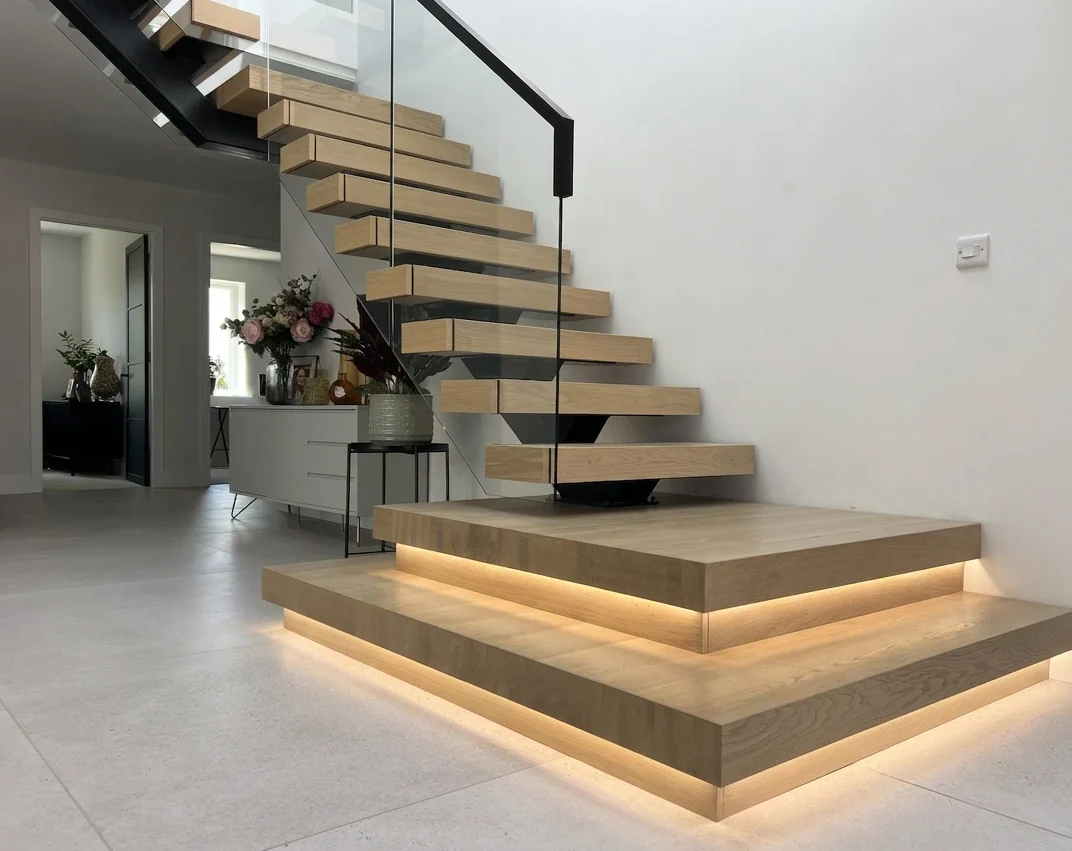
Villa interior staircase — uso restringido under CTE DB-SUA Article 4.1, with open risers permitted, 22 cm minimum huella, 80 cm minimum anchura — the most common Spanish villa specification
The single most important regulatory decision Spanish architects make when designing a staircase is the use classification under CTE DB-SUA Article 4 — choosing between uso restringido (restricted use, typically villa interior single-dwelling) or uso general (general use, communal residential, public concurrence, commercial). This decision cascades through every other parameter: minimum huella (going), maximum contrahuella (riser), minimum anchura (width), permission for open risers, ergonomic formula application, balustrade dimensions, handrail requirements, and even the overall staircase typology that's permissible. Get the classification wrong and the project's licencia de obras can be refused or the certificat final d'obra withheld at handover. This guide covers the boundary cases that confuse Spanish projects, what each classification actually requires, and how Continox documents both — for the full dimensional reference see our CTE DB-SUA Staircase Guide; for the Spanish market overview see our Modern Staircase Spain hub; and for the full UK product range see /modern-staircase/, /external-staircase/, /glass-balustrade/ and /work/.
Uso restringido applies to staircases serving a single dwelling exclusively — villa interior, dwelling-internal apartment stair, family townhouse stairs. Permits 22 cm minimum huella, 20 cm maximum contrahuella, 80 cm minimum anchura, and open risers (with 2.5 cm tread overlap). Uso general applies to communal residential staircases (apartment building stairs serving multiple dwellings), public concurrence (hotels, restaurants, retail, gyms, offices), and commercial applications. Requires 28 cm minimum huella, 13–18.5 cm contrahuella range, 100 cm minimum anchura, ergonomic formula 54 ≤ 2C+H ≤ 70 cm, closed risers only. The arquitecto director de obra determines classification at proyecto básico stage based on the dwelling/use category — and this decision must be carried through to the certificado final de obra for the licencia de obras to be issued.
- What CTE DB-SUA Article 4 Actually Says
- Uso Restringido — When It Applies & What It Permits
- Uso General — When It Applies & What It Requires
- Dimensional Parameters — How Classification Changes Every Number
- Boundary Cases — Where Architects Get Confused
- Real Spanish Project Scenarios & Classification
- Consequences of Misclassification — Licencia & Certificate Risk
- Regional Decree Interaction (Catalonia, Balears, Comunitat Valenciana)
- How Continox Documents Both Classifications
- FAQ — Spanish Architects Ask
What CTE DB-SUA Article 4 Actually Says
The legal text governing use classification sits in CTE DB-SUA Sección 4 (Seguridad de Utilización y Accesibilidad — Section 4 Stairs & Ramps). The classification framework is essentially binary, with one well-defined edge case (uso restringido extended) and several application-specific clarifications.
The Two Classifications
Uso Restringido
- Definition: Staircase used exclusively within a single dwelling (vivienda) or a single occupancy unit
- Typical applications: Villa interior stair, single-dwelling internal stair (apartment with internal mezzanine or duplex layout), family townhouse staircase
- Use intensity: Low frequency, single household, occupants familiar with the space
- Risk profile: Lower — users know the staircase intimately
- Min huella (going): 22 cm
- Max contrahuella (riser): 20 cm
- Min anchura (width): 80 cm
- Open risers: Permitted (with 2.5 cm tread overlap)
- Ergonomic formula: Recommended but not strictly enforced
- Handrail: Required if flight rise > 55 cm
Uso General
- Definition: All staircases not falling under uso restringido — communal residential, public concurrence, commercial, hospitality, retail, education, healthcare, transport
- Typical applications: Apartment building communal stair, hotel/retail/office stair, school, hospital, train station, shopping centre
- Use intensity: High frequency, multiple users, including unfamiliar visitors
- Risk profile: Higher — users may include children, elderly, mobility-impaired, unfamiliar with the space
- Min huella (going): 28 cm
- Max contrahuella (riser): 13–18.5 cm with lift, 17.5 cm without lift
- Min anchura (width): 100 cm (residential), 120 cm (most public uses), 140 cm (large public)
- Open risers: NOT permitted — closed risers mandatory
- Ergonomic formula: 54 cm ≤ 2C+H ≤ 70 cm — strictly enforced
- Handrail: Required both sides if width > 1.20 m, plus intermediate handrail if width > 4.0 m
The Boundary — Single Dwelling Test
The boundary between the two classifications is the "single dwelling" test. A staircase qualifies as uso restringido only if it serves one dwelling exclusively. As soon as the staircase serves two or more dwellings — even if those dwellings belong to the same family — the classification becomes uso general. This test applies regardless of whether the dwellings are physically separate or combined under one ownership.
A 4-bedroom villa with a single internal staircase serving the family living quarters is uso restringido — single dwelling, single occupant household. The same villa with a granny annexe at first-floor level (separate kitchen, bathroom, entrance) accessed by the same staircase becomes uso general — two dwellings sharing one stair. The dimensional requirements jump significantly: anchura from ≥80 cm to ≥100 cm, huella from ≥22 cm to ≥28 cm, ergonomic formula becomes mandatory.
Uso Restringido — When It Applies
Uso restringido is the most-specified classification across Spanish villa and luxury market projects. It applies to:
Single-Family Villa Interior
The clearest case. A detached or semi-detached villa with a single internal staircase serving the family's living quarters falls cleanly into uso restringido. This includes villa typologies dominant across the Spanish luxury market: Marbella Costa del Sol villas, La Moraleja and Pozuelo Madrid villas, Pedralbes and Sant Cugat Catalonia villas, Bendinat and Son Vida Balearic villas, Jávea and Moraira Costa Blanca villas. All of these are single-dwelling villa typologies — uso restringido straightforwardly applies.
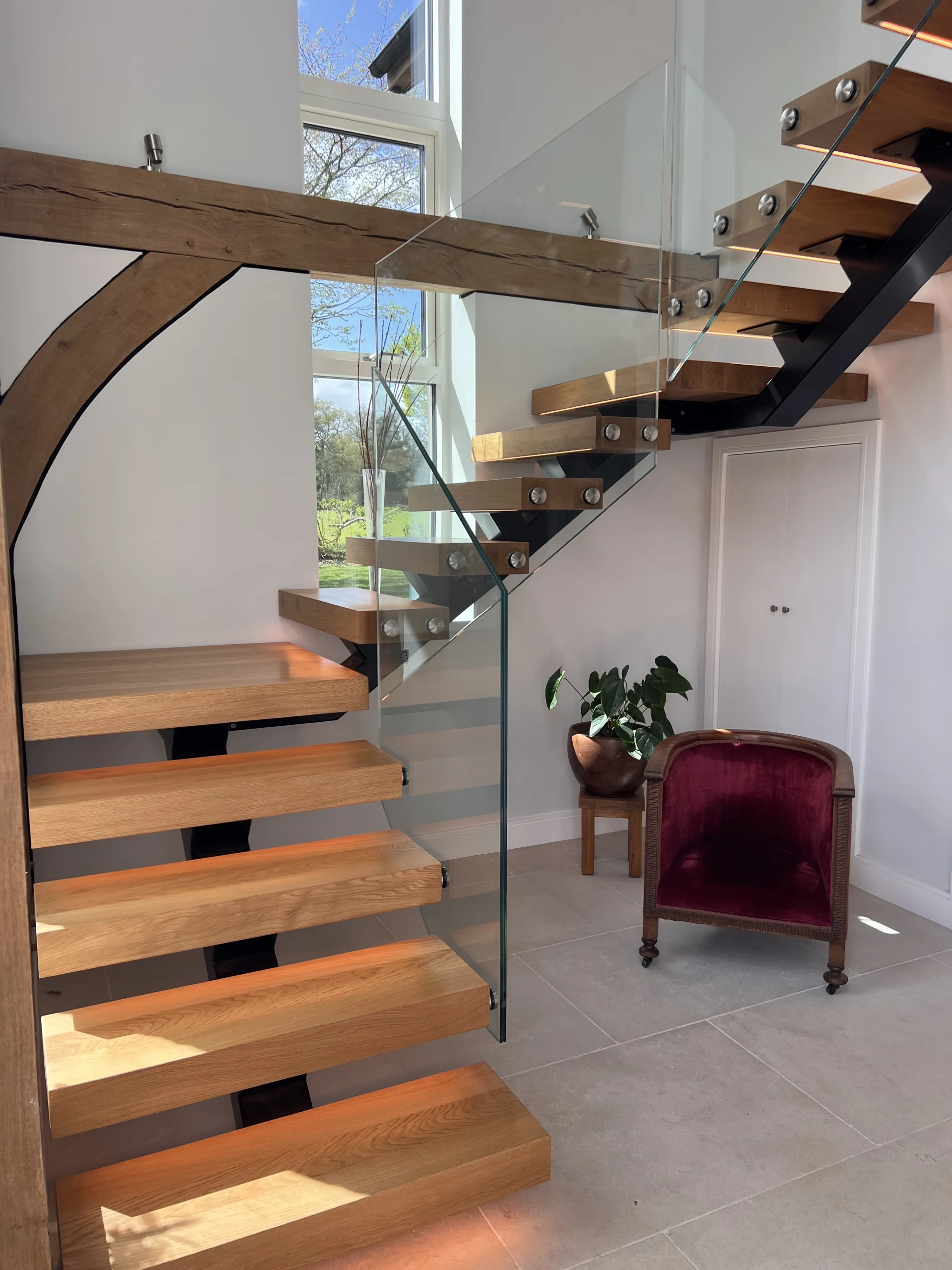
Villa central spine staircase — uso restringido configuration with 22 cm huella, open risers, 100 mm solid hardwood treads, frameless glass balustrade — typical Marbella, La Moraleja, Bendinat or Pedralbes villa specification
Internal Dwelling Stair (Apartment Duplex / Mezzanine)
An apartment with an internal staircase connecting two floors of the same dwelling — typical duplex apartment, loft conversion, or mezzanine layout — is uso restringido. The staircase serves only the residents of that one apartment, not the building's communal traffic. Common in:
- Penthouse duplexes in Eixample Barcelona and Salamanca Madrid period buildings
- Loft conversions in Palma Old Town townhouses and Valencia Ruzafa apartments
- Mezzanine apartments in modern Pozuelo de Alarcón and Sant Cugat developments
- Two-floor town apartments in coastal locations like Sitges, Altea and Cadaqués
Family Townhouse
A townhouse occupied by a single family — even with multiple floors — qualifies as uso restringido. The Spanish urban townhouse market (casa entre medianeras) commonly takes this form: 2-3 floors plus basement, single staircase, single family.
Uso Restringido — Full Parameter Set
- Min huella (going): 22 cm at the stair axis (line of normal walking trajectory)
- Max contrahuella (riser): 20 cm
- Min anchura (effective width): 80 cm clear between handrails / wall surfaces
- Max consecutive flight: No specified maximum (unlike uso general's 18-step rule)
- Min headroom: 220 cm vertical clearance above the stair pitch line
- Open risers: Permitted, provided upper tread overlaps lower tread by ≥2.5 cm
- Pitch: Up to ~42° practical limit; CTE doesn't impose absolute maximum for restringido
- Ergonomic formula: Recommended (54 ≤ 2C+H ≤ 70 cm) but not enforced as compliance criterion
- Handrail: One side, on the wall side, where flight rise > 55 cm
- Curved/winder treads: Permitted with min huella 22 cm at 50 cm from inner edge of stair axis
- Balustrade: Min 90 cm height (residential), Ø10 cm sphere rule, climbability rule per CTE DB-SUA Article 3.2
Uso General — When It Applies
Uso general applies to all staircases serving more than one dwelling, public concurrence buildings, and commercial uses. The classification is broader and the dimensional requirements significantly tighter.
Apartment Building Communal Stair
The most common uso general application across Spain. Any staircase in a multi-dwelling building (edificio plurifamiliar) that serves the communal access between dwellings is uso general — regardless of how many dwellings are served. Two-dwelling small apartment buildings, six-dwelling Eixample blocks, twenty-dwelling residential developments — all uso general for the communal stair.
Public Concurrence — Hotel, Retail, Restaurant
Buildings open to the public — hotels, restaurants, cafés, retail shops, shopping centres, gyms, hospitality venues — are uso general regardless of size or capacity. CTE Categories C1–C5 (see DB-SE-AE line load classification) all fall under uso general for the staircase classification, with progressively higher line loads applied to balustrades.
Office, Education, Healthcare, Transport
Workplace and institutional buildings — offices (CTE Category B), schools and universities, hospitals and clinics, train and bus stations, airports — are all uso general. The classification reflects the higher number of users and the broader range of user profiles (children in schools, elderly in healthcare, mobility-impaired across all institutional settings).

Public concurrence staircase — uso general configuration with 28 cm minimum huella, 100 cm minimum anchura, closed risers, ergonomic formula 54 ≤ 2C+H ≤ 70 cm strictly applied
Uso General — Full Parameter Set
- Min huella (going): 28 cm at the stair axis
- Max contrahuella (riser): 18.5 cm with lift alternative; 17.5 cm without lift
- Min anchura (effective width): 100 cm residential common; 120 cm most public uses; 140 cm large public
- Max consecutive flight: 18 risers between landings (residential common)
- Min headroom: 220 cm vertical clearance
- Open risers: NOT permitted — closed risers mandatory
- Pitch: Determined by huella + contrahuella combination; ergonomic formula governs
- Ergonomic formula: 54 cm ≤ 2C+H ≤ 70 cm — strictly enforced as compliance criterion
- Handrail: Both sides if width > 120 cm; intermediate handrail if width > 4.0 m
- Handrail height: 90–110 cm above pitch line, continuous along flight, ergonomically graspable
- Curved/winder treads: Permitted with stricter tread geometry rules
- Balustrade: 90 cm or 110 cm depending on Δh; line load 0.8–3.0 kN/m depending on category (see Glass Balustrade Regulations)
- Accessibility: May require accessibility provisions per DB-SUA Section 9 — ramped or lift-served alternative
Dimensional Parameters — How Classification Changes Every Number
The downstream effect of choosing uso restringido vs uso general cascades through every dimensional parameter. The table below shows the differences side-by-side — the same staircase volume can fit very differently depending on classification.
| Parameter | Uso Restringido | Uso General (residential) | Uso General (public) |
|---|---|---|---|
| Min huella (going) | 22 cm | 28 cm | 28 cm |
| Max contrahuella with lift | 20 cm | 18.5 cm | 18.5 cm |
| Max contrahuella without lift | 20 cm | 17.5 cm | 17.5 cm |
| Min anchura (width) | 80 cm | 100 cm | 120–140 cm |
| Open risers | Permitted (2.5 cm overlap) | NOT permitted | NOT permitted |
| Ergonomic formula 54 ≤ 2C+H ≤ 70 cm | Recommended only | Strictly enforced | Strictly enforced |
| Max consecutive risers between landings | None specified | 18 risers | 18 risers (often 14) |
| Min headroom | 220 cm | 220 cm | 220 cm |
| Handrail single side | Required if rise > 55 cm | Required always | Required always |
| Handrail both sides | Optional | Required if width > 120 cm | Required if width > 120 cm |
| Intermediate handrail | Not required | Required if width > 400 cm | Required if width > 400 cm |
| Balustrade min height | 90 cm | 90 cm (110 cm if Δh > 6 m) | 90 cm (110 cm if Δh > 6 m) |
| Balustrade line load | 0.8 kN/m | 0.8–1.0 kN/m | 1.6–3.0 kN/m |
| Glass spec (Continox standard) | 17.52 mm tempered laminated | 17.52 mm tempered laminated | 21.52 mm tempered laminated |
| Curved tread huella at 50 cm from inner edge | 22 cm | 28 cm | 28 cm |
The Open Riser Question — Most Common Confusion
The single most-discussed difference between the two classifications is the open riser permission. Spanish architects working on villa projects routinely specify open-riser floating cantilever or central spine staircases — the contemporary luxury aesthetic. This is fully permissible under uso restringido, with the requirement that upper tread overlaps lower tread by at least 2.5 cm. Under uso general, open risers are categorically not permitted — the staircase must have closed risers (vertical contrahuella material between treads).
An open-riser floating staircase is fine in a Marbella villa (single dwelling, uso restringido) — but the same staircase moved to a luxury Eixample apartment building serving multiple penthouse units would breach uso general's closed-riser requirement. Architects must verify the dwelling count first, then determine whether open risers are available for the brief.
Width — Often the Critical Constraint
The 80 cm vs 100 cm minimum anchura difference is often the most space-impactful aspect of the classification choice. A villa stairwell designed at 90 cm clear width works for uso restringido but fails uso general. The 20 cm uplift seems modest but matters in space-constrained Eixample apartment retrofits, Palma Old Town heritage conversions, and tight-footprint Sitges townhouse stairs — locations where the architect must verify whether the staircase serves a single dwelling (allowing the 80 cm minimum) or multiple units (forcing 100 cm).
Boundary Cases — Where Architects Get Confused
The cleanest cases — single villa interior (restringido), apartment building communal stair (general) — are unambiguous. The boundary cases below routinely cause classification disputes between architects and Building Control:
Granny Annexe / Secondary Dwelling Within Villa
A villa with a self-contained granny annexe (separate kitchen, bathroom, entrance) accessed via the main villa staircase becomes two dwellings sharing one stair — uso general applies. Even if the annexe is family use only, the legal classification depends on whether it qualifies as a separate dwelling under Spanish housing law (own kitchen, own sanitary facilities, own access). Many Spanish architects miss this and specify uso restringido for villa-with-annexe configurations, only to face Building Control issues at the certificat final d'obra stage.


Holiday Let / Vacation Rental
A villa used commercially as a holiday let (vivienda de uso turístico, VUT) operates with rotating unfamiliar guests rather than single-family residents. Building Control treats this similarly to a hotel apartment — uso general applies if the property is licensed for tourist let. The classification matters at the moment of licensing, not at original construction — which means villas sold for VUT operation may need staircase modifications to satisfy uso general before the tourist license is granted. Particularly relevant in Mallorca and Ibiza where VUT licensing is heavily regulated, and in Marbella tourist-rental villa market.
Home Office / Professional Work-From-Home
A villa or apartment used as a home office by a self-employed professional (lawyer, architect, consultant) where clients visit occasionally remains uso restringido — the dwelling classification doesn't change with limited professional activity, and Spanish urbanism law generally permits compatible professional uses within residential dwellings. The classification only changes if the staircase becomes the primary access for unrelated client traffic — at which point a separate professional license and uso general classification apply.
Mixed-Use Building — Shop Below, Apartment Above
A common Spanish urban building typology: ground-floor commercial (shop, café), first-floor apartment, accessed by a single staircase. The communal staircase is uso general — it serves both the commercial unit and the residential dwelling. The internal staircase within the apartment (if duplex layout) remains uso restringido. Architects must distinguish between the two and apply the relevant rules.
Multi-Generational Family Home
A villa designed for multi-generational living (parents + grandparents + children) but operating as a single household remains uso restringido — Spanish law tests "dwelling" as a self-sufficient living unit, not the number of people living in it. A 12-bedroom villa with multiple wings is still a single dwelling if it's organised as one household with shared kitchen, shared dining, shared family entrance.
Internal Stair vs Communal Stair in Same Building
An apartment building with both communal staircases (uso general) and individual apartment internal stairs (uso restringido for duplex apartments) requires the architect to apply different rules to different staircases in the same building. This is correct — each staircase is classified independently. The communal stair satisfies uso general; each duplex's internal stair satisfies uso restringido. Both must be documented separately in the technical pack.
Real Spanish Project Scenarios & Classification
Eight common Spanish project scenarios with the correct classification and reasoning:
Marbella villa, single family, double-height entry, 1 internal staircase
Single dwelling, single household. Owner family lives full-time. No granny annexe.
→ Uso RestringidoEixample 6-storey apartment building, communal stair
Six dwellings (one per floor), shared communal staircase from ground floor to top floor.
→ Uso General (residential common)Pedralbes villa with separate granny annexe upstairs
Two dwellings (main villa + self-contained annexe with kitchen and bathroom). Single staircase serves both.
→ Uso General (multi-dwelling)La Moraleja villa, family home, internal architect's home office
Single dwelling, single family. Architect works from home, occasional client visits but no separate access or unit.
→ Uso RestringidoSalamanca penthouse duplex, internal mezzanine stair
Single apartment unit with internal staircase to mezzanine. Building has separate communal stair for inter-apartment access.
→ Uso Restringido (internal stair)Same Salamanca building's communal staircase
Building serves 8 apartments. Communal staircase serves the inter-apartment access.
→ Uso General (communal residential)Bendinat villa licensed as Vivienda de Uso Turístico (VUT)
Property operates as holiday let with rotating guests via Mallorca tourist license.
→ Uso General (commercial / tourist)Jávea villa, family home, no commercial activity
Single family residence on Costa Blanca. No granny annexe, no holiday let, no commercial use.
→ Uso Restringido
Y-shape central spine staircase with open risers — fully compliant under uso restringido (CTE Article 4.1) for single-dwelling villa applications, would require closed risers and tighter dimensions if reclassified as uso general
Consequences of Misclassification
Getting the use classification wrong has cascading consequences across the project programme:
At Licencia de Obras Submission
If the Spanish municipal Building Control (Concejalía de Urbanismo) reviews the proyecto de ejecución and identifies a misclassification — typically uso restringido specified where uso general should apply — they can refuse the licencia de obras. Common triggers: open risers specified on what should be a communal apartment stair; 80 cm width specified on a multi-dwelling staircase; absent ergonomic formula compliance on a public concurrence stair.
During Construction — Inspection & Modification
Misclassification discovered during construction (after structural shell work has begun) requires either modification of the staircase to comply with the correct classification — significantly more expensive at this stage than at design — or re-classification of the dwelling itself (e.g. removing the granny annexe to keep uso restringido). Both options have cost and delay implications.
At Certificado Final de Obra
The arquitecto director de obra signs the certificado final de obra confirming the work matches the proyecto de ejecución and complies with applicable regulations. If the staircase doesn't satisfy the correct use classification, the certificate cannot be issued — which means the dwelling cannot legally be occupied. This is the most expensive failure mode: completed work that fails final certification triggers retrofit at the most expensive stage.
Cèdula d'Habitabilitat Refusal (Catalonia)
In Catalonia, the cèdula d'habitabilitat under Decret 141/2012 requires both CTE compliance and additional regional conditions. A staircase failing the correct CTE use classification cannot receive cèdula d'habitabilitat — and without cèdula, the dwelling cannot be sold, rented, or registered for utility connections.
For boundary cases where the architect is genuinely uncertain (mixed-use building with unclear residential vs commercial breakdown, villa with potential VUT future, family with possibility of granny annexe later), specifying to uso general is the safer engineering choice. The dimensional uplift is modest (28 cm vs 22 cm huella, 100 cm vs 80 cm anchura) and doesn't materially affect the staircase aesthetic. Specifying to uso restringido and being forced to reclassify later is significantly more expensive than over-specifying at design stage.
Regional Decree Interaction
Spanish regional habitability decrees layer additional requirements on top of CTE — but they do not modify the CTE use classification framework. The classification rules apply uniformly across mainland Spain and the Balearic Islands.
| Region | Regional Decree | How It Interacts with Use Classification |
|---|---|---|
| Catalonia | Decret 141/2012 (cèdula d'habitabilitat) | Requires CTE compliance for cèdula approval; classification rules from CTE apply unchanged |
| Balearic Islands | Decret 20/2007 + Decret 145/1997 (cèdula) | References CTE for staircase rules; tourist-let classification (VUT) governed by separate Balearic decree |
| Comunitat Valenciana | Decreto 65/2019 (DC-09) | Adds minimum width and ceiling clearance for residential dwellings; doesn't modify use classification |
| Comunidad de Madrid | Decreto 50/1999 (CAM) | References CTE; municipal licencia de obras administered through Concejalía de Urbanismo |
| Andalusia | Decreto 91/2020 (Reglamento Urbanismo) | References CTE; coastal Marbella additional environmental review for licensing |
| Basque Country | Decreto 117/2018 (cédula habitabilidad) | References CTE; Basque-language documentation may be required |
| Canary Islands | Decreto 117/2006 | References CTE; outside EU VAT zone affecting customs but not staircase rules |
How Continox Documents Both Classifications
Every Continox Spanish project ships with a use-classification-specific compliance pack. The documentation differs based on the classification specified at order:
Continox Documentation by Use Classification
- Use classification declaration — explicit statement of uso restringido or uso general at the head of the technical pack, citing CTE DB-SUA Article 4.1 or 4.2
- Dimensional schedule — line-by-line evidence the supplied staircase satisfies the relevant article's parameters (huella, contrahuella, anchura, ergonomic formula where applicable)
- Open riser justification (uso restringido only) — evidence that upper tread overlaps lower tread by ≥2.5 cm, satisfying CTE Article 4.1's open-riser permission
- Ergonomic formula calculation (uso general only) — calculation showing 54 ≤ 2C+H ≤ 70 cm satisfied at the specified huella and contrahuella
- Handrail specification — single-side or both-sides, intermediate handrail if width > 4.0 m, height 90–110 cm above pitch line
- Balustrade specification — height 90 or 110 cm, line load 0.8/1.6/3.0 kN/m per category
- Glass certification — 17.52 mm or 21.52 mm tempered laminated, EN 14449 + EN 12150
- Structural calculations — signed by UK Chartered Structural Engineer (IStructE) under Eurocode framework, line load matching the use classification
- EN 1090-1 EXC2 Declaration of Performance — for steel components, with marcado CE plate fitted
- Regional decree cross-reference — where Catalonia Decret 141/2012, Balears Decret 20/2007, or Comunitat Valenciana DC-09 apply
The arquitecto director de obra declares the use classification at proyecto básico stage. Continox engineers design, calculate and document accordingly. Final classification responsibility remains with the Spanish-registered architect of record — Continox supplies the engineering and documentation matching the classification declared, but does not independently certify whether the architect's classification choice is correct.
Specifying for Uso Restringido or Uso General?
Continox supplies bespoke modern staircases for both classifications, with the full CTE DB-SUA Article 4 compliance pack matching your declared use category. Free 3D visualisation, fixed-price quote within 48 hours, intra-EU supply with no Brexit customs.
Get Free QuoteFAQ — Spanish Architects Ask
What's the difference between uso restringido and uso general?
Uso restringido (CTE DB-SUA Article 4.1) applies to staircases serving a single dwelling exclusively — villa interior, single-dwelling apartment internal stair, family townhouse. It permits 22 cm minimum huella, 20 cm maximum contrahuella, 80 cm minimum anchura, and open risers (with 2.5 cm tread overlap). Uso general (Article 4.2) applies to all other staircases — communal residential, public concurrence, commercial — requiring 28 cm minimum huella, 13–18.5 cm contrahuella range, 100 cm minimum anchura, ergonomic formula 54 ≤ 2C+H ≤ 70 cm, and closed risers only.
Can I have open risers on a Spanish villa staircase?
Yes — open risers are permitted on uso restringido staircases under CTE DB-SUA Article 4.1, provided the projection of the upper tread overlaps the lower tread by at least 2.5 cm. This is why most Spanish villa floating cantilever and central spine staircases (Marbella, Pedralbes, La Moraleja, Bendinat, Jávea) can be specified with open risers — single-dwelling villa interiors qualify as uso restringido. For uso general (apartment communal stairs, commercial) open risers are not permitted.
What if my villa has a granny annexe — does that change the classification?
Yes, potentially. If the annexe qualifies as a separate dwelling under Spanish housing law (self-contained kitchen, bathroom, separate or shared access via the staircase), the villa becomes a two-dwelling property — and the shared staircase becomes uso general rather than uso restringido. The dimensional requirements jump: anchura from 80 cm to 100 cm, huella from 22 cm to 28 cm, ergonomic formula becomes mandatory, open risers no longer permitted. Classify carefully at proyecto básico stage.
How does VUT (vivienda de uso turístico) affect classification?
A villa or apartment licensed as Vivienda de Uso Turístico operates with rotating unfamiliar guests rather than single-family residents — Building Control typically treats this as uso general for staircase purposes, similar to a small hotel apartment. The classification matters at the moment of VUT licensing, not at original construction — which means villas being licensed for tourist let may need staircase modifications to satisfy uso general first. Particularly relevant in Mallorca, Ibiza and Costa del Sol tourist-rental markets.
Does the ergonomic formula apply to villa staircases?
For uso restringido villa staircases the ergonomic formula 54 ≤ 2C+H ≤ 70 cm is recommended best practice but not strictly enforced as compliance criterion. Spanish architects typically design villa staircases within the formula range anyway because it produces comfortable rise/going proportions. For uso general the formula is strictly enforced — failure to satisfy it can render the staircase non-compliant regardless of meeting individual huella and contrahuella minimums.
What width is required for a 4-dwelling apartment building stair?
100 cm minimum anchura — the staircase serves multiple dwellings and is therefore uso general, residential common subcategory. Add huella ≥28 cm, contrahuella 13–18.5 cm with lift (or 17.5 cm without lift), closed risers, ergonomic formula 54 ≤ 2C+H ≤ 70 cm. Handrail required at minimum on one side; both sides if width > 120 cm. The 18-step rule limits consecutive flight length between landings.
Can I specify uso restringido for a duplex apartment internal staircase?
Yes — a duplex apartment is a single dwelling spanning two floors, with the internal staircase serving only the residents of that dwelling. Classification is uso restringido (CTE Article 4.1), permitting 22 cm huella, 20 cm contrahuella, 80 cm anchura, open risers with 2.5 cm overlap. Note: this is the internal stair within the duplex; the building's communal stair (serving multiple apartments) is separate and falls under uso general.
What happens if Building Control disagrees with my classification?
Building Control review at the licencia de obras stage can challenge the use classification — typically when uso restringido is specified for what they consider a multi-dwelling or public-access situation. The architect of record can either accept the reclassification (modifying the staircase to satisfy uso general) or appeal with documentation supporting the single-dwelling test. Settling the classification at proyecto básico stage with explicit documentation is significantly more efficient than disputing at licencia stage. Continox supports both classifications with documentation matching whichever the architect declares.
Do regional habitability decrees change the classification rules?
No — regional decrees (Catalonia Decret 141/2012, Balears Decret 20/2007, Comunitat Valenciana DC-09, Madrid Decreto 50/1999) reference CTE for use classification and don't impose regional overrides on the restringido vs general distinction. Where the regional decrees do add requirements (cèdula d'habitabilitat documentation, lift provision, common-area circulation, dwelling layout), these layer on top of CTE classification rules rather than modifying them. The CTE Article 4 classification framework applies uniformly across mainland Spain and the Balearic Islands.
How does Continox handle both classifications?
Continox supplies bespoke modern staircases for both uso restringido and uso general projects with classification-specific documentation. The technical pack includes explicit classification declaration, line-by-line dimensional evidence, ergonomic formula calculation (uso general), open riser justification (uso restringido), structural calculations matching the line load category, and EN 1090-1 EXC2 Declaration of Performance. The arquitecto director de obra declares the classification at proyecto básico stage; Continox engineers design and document accordingly. Final classification responsibility remains with the Spanish-registered architect of record.
Ready to Specify Your Spanish Project?
From villa interior uso restringido to commercial uso general — Continox supplies the bespoke staircase, full CTE DB-SUA Article 4 compliance pack, and intra-EU delivery as a single coordinated supply. Free 3D visualisation, fixed-price quote within 48 hours, structural calculations signed by UK Chartered Structural Engineer (IStructE).
Get Free Quote