

Notwendige vs Nicht Notwendige Treppen Germany — Architect's Decision Framework
Complete reference for the German staircase use classification — when a Treppe is legally "necessary" as part of the Rettungsweg system, when it qualifies as supplementary, and how Maisonette-Wohnungen, Gebäudeklassen 1–5, Treppenraum requirements and Sicherheitstreppenräume cascade through the decision.
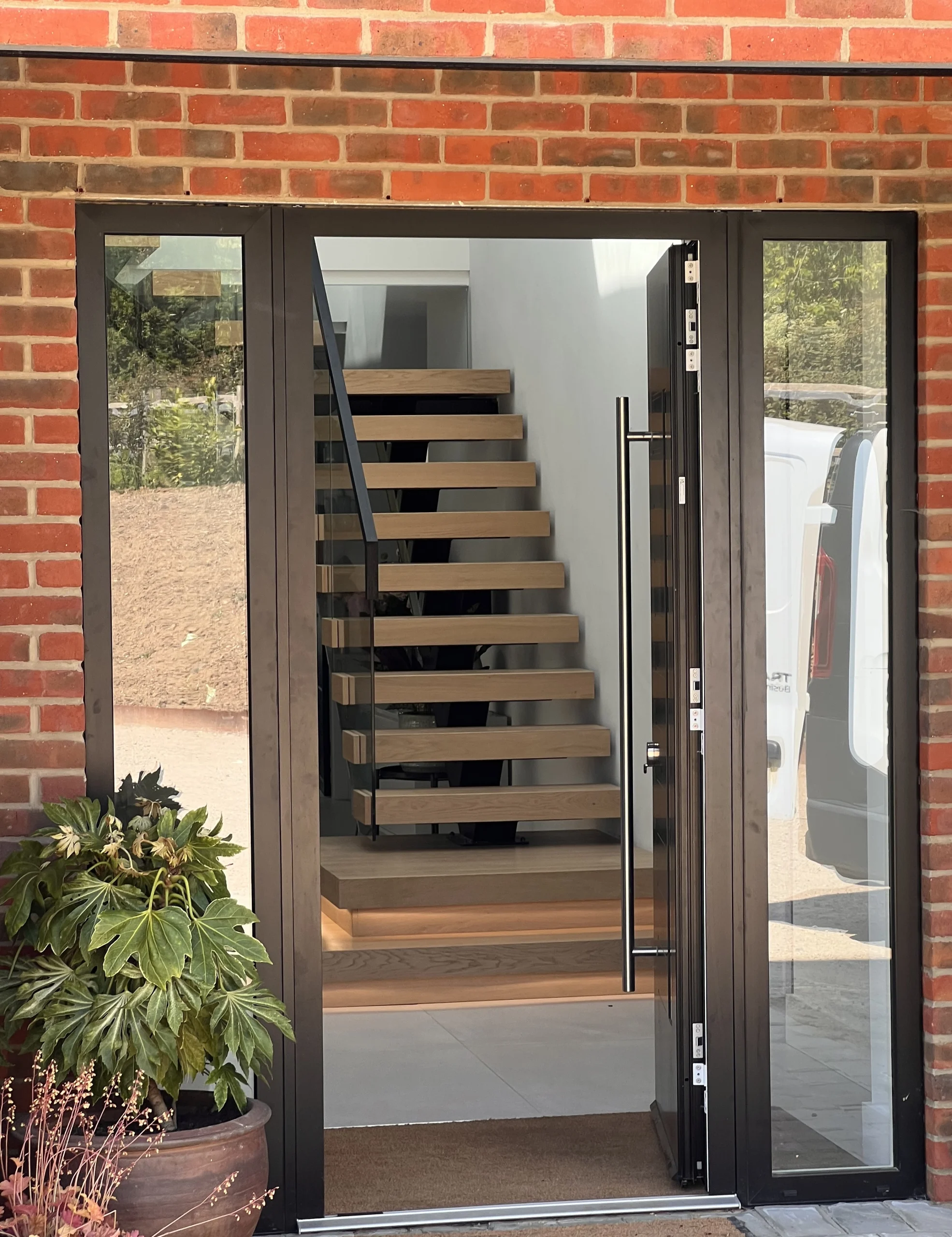
Notwendige Treppe in a notwendiger Treppenraum — vertical Rettungsweg system with fire-rated dicht- und selbstschließend door, the standard configuration for Mehrfamilienhaus communal access in Gebäudeklasse 3, 4 and 5
For German architects, structural engineers, Bauleiter and Brandschutzplaner specifying staircases, the legal classification of every Treppe falls into two binary categories with profound consequences for design, fire safety, and Bauabnahme: notwendige Treppe (legally necessary, part of the building's Rettungsweg system) and nicht notwendige Treppe (supplementary, not part of evacuation circulation). The distinction governs whether DIN 18065:2020-08 dimensional requirements apply in full, whether a notwendiger Treppenraum is required, whether F 90 fire-rated structural elements are mandatory, and whether the architect needs a separate Standsicherheitsbescheinigung for non-compliant geometry. This guide covers the seven decision factors, the Maisonette-Wohnung ausnahmen, the five Gebäudeklassen and their cascading requirements, the Sicherheitstreppenraum special case for high-risk Hochhäuser, and how Continox supplies notwendige Treppen with the full Brandschutz documentation pack. For the underlying dimensional rules see our DIN 18065 Staircase Regulations Germany Guide; for the wider German market overview see /de/modern-staircase-germany/; for the full UK product range see /modern-staircase/, /external-staircase/ and /glass-balustrade/.
A notwendige Treppe is legally required by §34 MBO and the relevant Landesbauordnung as the primary access to every floor (Geschoss) not at ground level (zu ebener Erde) and to occupiable lofts (benutzbarer Dachraum). It must satisfy DIN 18065:2020-08 in full, sit within a notwendiger Treppenraum (§35 MBO) for Gebäudeklassen 3–5, have tragende Teile in Feuerwiderstandsklasse F 90, and be reachable from any point in the building within maximum 35 m evacuation distance. Ausnahmen: single-Wohnung Maisonette-Geschossverbindung up to 200 m² + 2 Geschosse + alternativer Rettungsweg per Geschoss; Gebäudeklassen 1–2; Außentreppen safe in fire. A nicht notwendige Treppe is a supplementary staircase — typically loft access (Lagerzwecke only), basement service stairs, gallery access — that may deviate from DIN 18065 dimensional rules but must still guarantee Standsicherheit and Nutzungssicherheit. Bodentreppen per DIN EN 14975 may substitute for nicht notwendige Treppen in some cases.
- MBO §34 Framework — Why "Notwendige" Means Legally Necessary
- Factor 01 — When a Treppe is Notwendig (the Default Test)
- Factor 02 — When a Treppe is Nicht Notwendig (the Exception Test)
- Factor 03 — Treppenraum Requirement (§35 MBO)
- Factor 04 — Maisonette & Galerie Ausnahmen
- Factor 05 — Gebäudeklassen 1–5 Cascade
- Factor 06 — Brandschutz & Feuerwiderstandsklasse F 90
- Factor 07 — Sicherheitstreppenraum (Hochhaus Special Case)
- Architect's Decision Tree — Worked Examples
- Notwendige vs Nicht Notwendige vs Spanish Uso Restringido/General
- How Continox Documents the Classification
- FAQ — German Architects Ask
MBO §34 Framework — Why "Notwendige" Means Legally Necessary
The German term notwendige Treppe is often loosely translated as "necessary staircase" — but the legal meaning is far more specific than the everyday English word suggests. Notwendige Treppe is a defined legal category under §34 of the Musterbauordnung (MBO) — the federal model code adopted (with state-specific modifications) by all 16 Bundesländer. The MBO §34 (1) reads:
"Jedes nicht zu ebener Erde liegende Geschoss und der benutzbare Dachraum eines Gebäudes müssen über mindestens eine Treppe zugänglich sein (notwendige Treppe). Statt notwendiger Treppen sind Rampen mit flacher Neigung zulässig."
Translation: "Every floor (Geschoss) not at ground level, and every occupiable loft (benutzbarer Dachraum) of a building, must be accessible via at least one staircase (notwendige Treppe). Ramps of gentle slope are permitted instead of notwendige Treppen."
This single sentence cascades through the entire German staircase regulatory regime. Every staircase in Germany is automatically a notwendige Treppe by default — unless it qualifies for one of the specific exceptions (covered below), or it is an additional staircase serving a floor already accessed by a notwendige Treppe.
Why the Distinction Matters
The classification has profound consequences for what dimensional, structural, fire-safety, and Treppenraum rules apply:
| Requirement | Notwendige Treppe | Nicht Notwendige Treppe |
|---|---|---|
| DIN 18065 dimensional rules | Mandatory — full compliance | May deviate; safety still required |
| Notwendiger Treppenraum (§35 MBO) | Generally required (Gebäudeklassen 3–5) | Not required |
| F 90 Feuerwiderstandsklasse | Tragende Teile must be F 90 nichtbrennbar | Not required |
| Maximum 35 m to Treppenraum | Legal requirement (§35 (2) MBO) | No 35 m rule applies |
| Einschiebbare Treppen / Bodentreppen | Not permitted (DIN EN 14975 ladder excluded) | Permitted as loft access |
| Rolltreppen (escalators) | Not permitted as primary access | Not relevant for primary access |
| Steiltreppen (45°–75°) | Generally not permitted | Permitted (with safety certificate) |
| Open risers | Restricted to Wohngebäude class | Generally permitted |
| Bauabnahme verification | Bauamt verifies all rules satisfied | Standsicherheitsbescheinigung sufficient |
When a Treppe is Notwendig — The Default Test
Under MBO §34 (1), a staircase is automatically notwendig when it provides access to a floor (Geschoss) not at ground level OR to an occupiable loft (benutzbarer Dachraum). This is the German legal default — every staircase is presumed notwendig unless an exception applies.
The Three Triggering Cases
A staircase is notwendig if any of these applies:
- Access to non-ground-level Geschoss (any floor above or below the Erdgeschoss, including Kellergeschosse and Obergeschosse)
- Access to benutzbarer Dachraum (occupiable loft — used as Aufenthaltsraum, e.g. converted bedroom or office)
- Forms part of the bauaufsichtlicher Rettungsweg (escape route) under §33 MBO
The first case is the broadest — virtually every villa, apartment building, office building, school, hospital and commercial property has at least one notwendige Treppe.
Multiple Notwendige Treppen — When Required
Per MBO §33, the second Rettungsweg can be a second notwendige Treppe, an external rescue point reachable by Feuerwehr Hubrettungsfahrzeug or ladder, or a Sicherheitstreppenraum. For Sonderbauten (special buildings — hotels, hospitals, schools, sports halls, theatres etc), two separate notwendige Treppen are typically mandatory, ideally located at opposite sides of the building (möglichst entgegengesetzt per §35 (2) MBO) so that smoke or fire on one side does not block both routes.
For Hochhäuser (high-rise buildings, >22 m height to the upper Aufenthaltsraum floor), the Landesbauordnungen typically require minimum two separate Treppenräume with minimum Laufbreite 1.25 m. This is significantly stricter than the 1.0 m Allgemein minimum applying to standard Mehrfamilienhäuser.
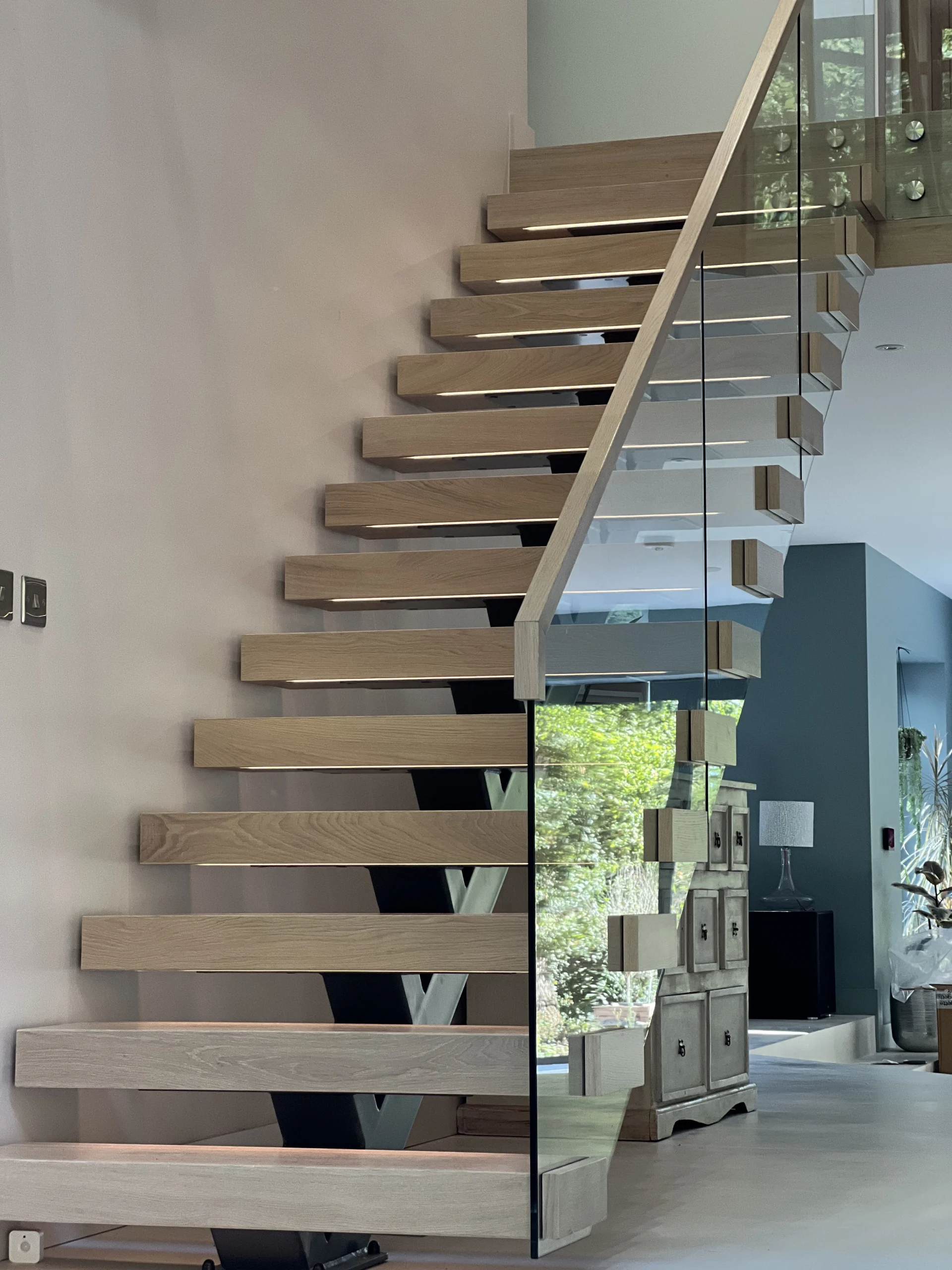
Notwendige Treppe — straight-run configuration in a Mehrfamilienhaus communal Treppenraum, satisfying DIN 18065 Gebäude im Allgemeinen requirements: Laufbreite ≥1000 mm, Auftritt ≥260 mm, Steigung ≤190 mm, Schrittmaßregel mandatory, Krankentransport DIN EN 1865-1 capable
When a Treppe is Nicht Notwendig — The Exception Test
A staircase is nicht notwendig when:
- The floor it accesses is already served by a notwendige Treppe, AND
- The Rettungsweg from every Aufenthaltsraum runs primarily over the notwendige Treppe (not the supplementary one), even if the supplementary staircase route would be physically shorter
Common nicht notwendige Treppen scenarios:
Loft Access for Storage Only (Lagerzwecke)
A staircase to a loft used only for storage (no Aufenthaltsraum) qualifies as nicht notwendig. The loft must not contain a converted bedroom, study, hobby room or any space where occupants stay for prolonged periods. Bodentreppen per DIN EN 14975 (fold-down or pull-out ladders) are permitted alternatives. Once the loft is converted to a bedroom (Aufenthaltsraum), the access immediately becomes notwendig and must satisfy DIN 18065.
Basement Service Stairs (Lagerkeller, Heizungsraum)
Basement access to utility/storage areas (Heizungsraum, Lagerkeller, Hauswirtschaftsraum) where no Aufenthaltsraum exists may qualify as nicht notwendig — provided the basement is not also served by an Aufenthaltsraum (rec room, home gym, hobby studio). The "two-stair" test: if there's already a notwendige Treppe to the basement Aufenthaltsraum, a separate utility access staircase from the garage or garden can be nicht notwendig.
Galerie / Gallery Access
Internal access to a Galerie (mezzanine gallery) within a single Wohnung that is itself served by a notwendige Treppe to the apartment entrance — the gallery access is nicht notwendig. The architect must demonstrate that the gallery does not constitute a separate Geschoss requiring its own Rettungsweg.
Garden / Terrace Outdoor Stairs (Freitreppen)
External garden steps connecting different terrace levels, or steps from a balcony to the garden, are typically nicht notwendige Treppen — the building is already accessed via the main notwendige Treppe (front door), and these supplementary outdoor stairs serve only landscape purposes.
Steiltreppen (Steep / Ladder-Style Stairs)
Staircases with slope between 45° and 75° (Steiltreppen, Treppenleitern) are generally not permitted as notwendige Treppen because their geometry breaches DIN 18065 dimensional minimums. They may qualify as nicht notwendige Treppen for specific limited uses (loft hobby room access, plant room access) — typically with a Standsicherheitsbescheinigung from the engineer and explicit Bauamt approval.
Relaxed Dimensional Rules for Nicht Notwendige Treppen
- Nutzbare Laufbreite: minimum 50 cm permitted (vs 80 cm Wohngebäude / 100 cm Allgemein)
- Steigung: up to 21 cm permitted (vs 20 cm Wohngebäude max)
- Auftritt: down to 24 cm permitted, or 21 cm with ≥3 cm Unterschneidung (overlap)
- Geländer: still required where Δh >1 m above lower surface
- Standsicherheit: Standsicherheitsbescheinigung from engineer typically required
- Nutzungssicherheit: overall safety must still be guaranteed
Treppenraum Requirement — §35 MBO
Once a staircase is classified as notwendige Treppe, MBO §35 (1) generally requires it to sit within a notwendiger Treppenraum — a dedicated, vertically continuous staircase room that protects the staircase as a Rettungsweg.
"Jede notwendige Treppe muss zur Sicherstellung der Rettungswege aus den Geschossen ins Freie in einem eigenen, durchgehenden Treppenraum liegen (notwendiger Treppenraum). Notwendige Treppenräume müssen so angeordnet und ausgebildet sein, dass die Nutzung der notwendigen Treppen im Brandfall ausreichend lang möglich ist."
Translation: "Every notwendige Treppe must lie within its own continuous staircase room (notwendiger Treppenraum) to ensure escape routes from the floors to the outside. Notwendige Treppenräume must be arranged and constructed so that the notwendige Treppen remain usable for sufficient time in case of fire."
Treppenraum Performance Requirements
The Treppenraum must:
- Run continuously (durchgehend) from the highest served Geschoss down to the Ausgang ins Freie (exit to open air)
- Have a direct exit to outside (unmittelbarer Ausgang ins Freie) at ground level
- Provide fire and smoke separation from adjoining Wohnungen, Flure, Lager-, Keller- and Dachräume
- Have dicht- und selbstschließende Türen (sealed and self-closing doors) at all openings into the Treppenraum from these adjoining spaces
- Maintain 35 m maximum evacuation distance from any point in any Aufenthaltsraum to the Treppenraum entrance
- For innenliegende (internal) Treppenräume — be equipped with a Rauchabzugsvorrichtung (smoke extraction)
Number of Treppenräume
Per §35 (2) MBO, where multiple notwendige Treppenräume are required (typical for Sonderbauten and Hochhäuser), they must be located möglichst entgegengesetzt (as far apart as possible, ideally on opposite sides of the building) so that the Rettungswege are as short as possible from any point.
F 30 / F 90 Türen and Bekleidungen
Per the Brandschutz section, doors into the Treppenraum from Wohnungen are typically F 30 dicht- und selbstschließend; from Lagerräume and Kellerräume potentially F 90 depending on Gebäudeklasse. Bekleidungen (linings) within Treppenräume must be nichtbrennbare Bauteile for Gebäudeklassen 3, 4 and 5 (this rule also applies to Maisonette internal staircases without their own Treppenraum in these higher classes).

Maisonette & Galerie Ausnahmen
MBO §35 (1) lists three explicit exceptions where a notwendige Treppe is permitted without its own Treppenraum. Architects designing Maisonette-Wohnungen, modern duplex apartments and loft conversions need to know these exceptions in detail.
Exception 1 — Gebäudeklassen 1 und 2
For buildings in Gebäudeklassen 1 (single-family detached up to 7 m, ≤2 Nutzungseinheiten, ≤400 m²) and 2 (other buildings up to 7 m, ≤2 Nutzungseinheiten, ≤400 m²), notwendige Treppen do not require a dedicated Treppenraum. This is why a typical single-family Munich Bogenhausen villa or Berlin Grunewald Einfamilienhaus has its open central spine staircase in the main living space — perfectly compliant.
Exception 2 — Maisonette-Wohnung (Geschossverbindung)
For internal staircases connecting maximum two Geschosse within the same Nutzungseinheit of total ≤200 m², where each Geschoss can reach an alternative Rettungsweg, no Treppenraum is required. This covers:
- Maisonette-Wohnungen in Mehrfamilienhäusern — duplex apartments where the upper level can reach the main building Treppenraum or a window-accessible Rettungsweg via Feuerwehr ladder
- Modern loft conversions — Gründerzeit Berlin Altbau where the converted Dachgeschoss is part of the apartment below
- Penthouse + main level configurations — Munich/Frankfurt high-end duplex with internal connecting staircase
The 200 m² is the total Nutzungseinheit (combined floor area of both Geschosse). A duplex with 120 m² lower + 100 m² upper = 220 m² exceeds the limit and cannot use this exception. Each Geschoss must also have an alternative Rettungsweg — typically a window the Feuerwehr can reach with a Hubrettungsfahrzeug or 10/15 m ladder. The architect must verify the Feuerwehraufstellfläche is accessible.
Exception 3 — Außentreppe
External staircases (Außentreppen) may serve as notwendige Treppen without a Treppenraum if their use remains adequately safe and is not endangered in case of fire. This typically requires:
- Construction in nichtbrennbare Baustoffe
- Sufficient distance from window openings (typically >5 m, but Landesbauordnung-specific)
- Direct exit to ground level Freie
- Protection from window fire emerging from adjacent floors
This is the technical basis for fire escape stairs (Fluchttreppen) on the exterior of commercial buildings, hotels and Mehrfamilienhäuser. Continox supplies these as galvanised steel + powder-coated configurations engineered to withstand German winter conditions and Brandschutz requirements. See our external staircase range for specifications.
Galerie within a Wohnung
A Galerie (mezzanine gallery) within a single Wohnung — typically a study, hobby room, sleeping area opening to the main double-height living space — is generally treated as part of the same Geschoss as the lower level if it does not constitute a fully separated room. The connecting staircase is then not a Geschossverbindung and qualifies as nicht notwendig. Boundary cases (where the gallery has its own bathroom, kitchenette, or fully enclosed bedroom) can move toward Geschossverbindung classification — architect judgment + early Bauamt consultation recommended.
Gebäudeklassen 1–5 Cascade
Most German Landesbauordnungen organise buildings into five Gebäudeklassen based on height (measured to the upper Aufenthaltsraum floor), area per Nutzungseinheit, and total Nutzungseinheiten count. The class determines which Brandschutz, Treppenraum and Treppen requirements apply.
| Class | Definition | Treppe / Treppenraum Requirement |
|---|---|---|
| Gebäudeklasse 1 | Single-family detached/semi-detached, ≤7 m height, ≤2 Nutzungseinheiten, ≤400 m² total | Notwendige Treppe ohne separate Treppenraum permitted; relaxed F 90 rules |
| Gebäudeklasse 2 | Other buildings ≤7 m height, ≤2 Nutzungseinheiten, ≤400 m² total | Notwendige Treppe ohne separate Treppenraum permitted; relaxed F 90 rules |
| Gebäudeklasse 3 | Other buildings ≤7 m height (typically >2 Nutzungseinheiten or >400 m²) | Notwendiger Treppenraum required; F 90 tragende Teile; nichtbrennbare Bekleidung |
| Gebäudeklasse 4 | Buildings ≤13 m height, ≤400 m² per Nutzungseinheit | Notwendiger Treppenraum required; F 90 throughout; stricter Brandschutz |
| Gebäudeklasse 5 | Buildings >13 m height including Sonderbauten | Notwendiger Treppenraum required; F 90 throughout; stricter Brandschutz; potentially Sicherheitstreppenraum |
| Hochhaus | >22 m height to upper Aufenthaltsraum floor | Min 2 separate Treppenräume; Min 1.25 m Laufbreite; Sicherheitstreppenraum often required |
Sonderbauten — Special Buildings
Beyond the standard Gebäudeklassen, certain building types are classified as Sonderbauten regardless of height:
- Versammlungsstätten (assembly buildings — theatres, sports halls, churches, concert venues)
- Hotels & Beherbergungsstätten (with >12 Betten)
- Krankenhäuser & Pflegeheime (hospitals and care homes)
- Schulen & Kindergärten (schools and Kindergärten)
- Gaststätten with >40 Gastplätzen
- Verkaufsstätten (retail) with >2,000 m²
- Hochhäuser (high-rise >22 m)
Sonderbauten require two notwendige Treppen (typically) and are subject to building-type-specific Sondervorschriften (Versammlungsstättenverordnung, Beherbergungsstättenverordnung etc) that supplement the general Landesbauordnung.
Brandschutz & Feuerwiderstandsklasse F 90
Notwendige Treppen are part of the building's vertical escape system and must remain functional in fire for sufficient time to allow self-rescue (Selbstrettung) and Feuerwehr intervention (Fremdrettung). The Feuerwiderstandsklasse F 90 is the standard fire resistance requirement for tragende Teile (load-bearing elements) of notwendige Treppen.
F 90 Specification
F 90 Requirements per MBO §34 (3)
- F 90: 90 minutes fire resistance under standard fire test (DIN 4102, EN 13501-2)
- Tragende Teile: Steel structural elements, concrete components, load-bearing tread support
- Nichtbrennbare Baustoffe: Materials classified A1 or A2 per DIN 4102 / EN 13501-1
- Required for: Gebäudeklassen 3, 4, 5 (and Sonderbauten regardless of class)
- Exemption: Wohngebäude geringer Höhe with ≤2 Wohnungen — relaxed (F 30 typical)
Steel Staircases & F 90
Steel structural elements typically fail F 90 in their bare form — unprotected steel loses load-bearing capacity at ~550°C, far below the temperatures reached in 90 minutes of standard fire test. To achieve F 90, steel must be:
- Encased in concrete (typically R 90 / F 90 verification under EN 1992-1-2 + EN 1994-1-2)
- Protected by intumescent paint (applied to manufacturer DFT specification, EN 13381-8 testing)
- Protected by board cladding (gypsum or calcium silicate boards, EN 13381-4 testing)
- Specified in solid timber for non-tragende Treppen (timber's char-rate-based behaviour can give F 30 / F 60 with engineered cross-sections)
Bodenbeläge — Stair Tread Surface
MBO requires nichtbrennbare Bodenbeläge (non-combustible floor coverings) on notwendige Treppen in Gebäudeklassen 3–5. This restricts the use of solid hardwood treads in some Mehrfamilienhaus and commercial applications — although schwerentflammbar (Bfl-s1) classified hardwood is generally accepted with the right finish/treatment specification.
Continox Approach to F 90 Compliance
For Continox staircases supplied to German Mehrfamilienhaus and commercial projects requiring F 90 compliance, three standard configurations:
- Steel + concrete encasement: Structural steel spine with reinforced concrete encasement designed to EN 1994-1-2 R 90, certified by UK Chartered Structural Engineer
- Steel + intumescent paint: EN 13381-8-tested intumescent system applied to manufacturer DFT, with European Technical Approval (ETA) covering F 90 90 min fire test
- Bfl-s1 hardwood treads: Solid oak or walnut treads with Bfl-s1 fire treatment, EN 13501-1 certified as schwerentflammbar Bodenbelag

Sicherheitstreppenraum — Hochhaus Special Case
For high-rise buildings (Hochhäuser, >22 m height) and certain Sonderbauten, the standard notwendiger Treppenraum is upgraded to a Sicherheitstreppenraum — a staircase room with even higher Brandschutz performance designed to remain absolutely smoke-free and accessible.
Sicherheitstreppenraum Requirements
A Sicherheitstreppenraum must satisfy enhanced criteria beyond a notwendiger Treppenraum:
- Smoke-free (rauchfrei) — guaranteed by overpressure ventilation (Druckbelüftung) or Schleusen (airlocks)
- Schleusen — separating airlocks between Wohnungen/Flure and the Treppenraum, with self-closing doors on both sides
- Dual exit routes from the Treppenraum at ground level
- Mechanical smoke extraction with fire-rated power supply
- Direct access to Feuerwehr lift (Feuerwehraufzug) in many configurations
When a Sicherheitstreppenraum is Required
The Hochhaus rule (typically Gebäudeklasse 5 + Hochhaus, >22 m height to upper Aufenthaltsraum floor) generally requires either:
- Two separate notwendige Treppenräume with min 1.25 m Laufbreite each (the more common solution), OR
- One Sicherheitstreppenraum + alternative Rettungsweg (the alternative for tight footprint Hochhäuser, e.g. Frankfurt Bankenviertel office towers)
Specifying the Sicherheitstreppenraum solution requires close coordination with the Brandschutzplaner from project inception — the Druckbelüftung systems, Schleusen configurations and Feuerwehraufzug coordination cannot be retro-fitted economically.
Frankfurt's Bankenviertel high-rise office and residential towers (Westend, Innenstadt, Sachsenhausen Süd) typically use the Sicherheitstreppenraum approach, optimising rentable floor area by avoiding the dual-Treppenraum footprint cost. Continox supplies bespoke Mittelholmtreppen for the residential floors of these towers, engineered to integrate with the Sicherheitstreppenraum Schleusen system and the project's specific Brandschutzkonzept.
Architect's Decision Tree — Worked Examples
How the classification cascade works in practice — five common scenarios architects encounter:
Example 1 — Munich Bogenhausen Villa (Single-Family)
- Building: Detached Einfamilienhaus, 380 m² total, 7 m height to upper floor, 1 Nutzungseinheit
- Gebäudeklasse: 1
- Internal central spine staircase: Notwendige Treppe (accesses Obergeschoss with bedrooms — Aufenthaltsräume)
- Treppenraum requirement: Not required (Exception 1 — Gebäudeklasse 1)
- F 90 requirement: Relaxed (Wohngebäude geringer Höhe, ≤2 Wohnungen)
- Loft access ladder to attic storage: Nicht notwendige Treppe — Bodentreppe per DIN EN 14975 acceptable
- Result: Continox supplies bespoke central spine with open oak treads, frameless glass Geländer, no special F 90 treatment
Example 2 — Berlin Charlottenburg Mehrfamilienhaus (Communal)
- Building: 4-Geschoss Mehrfamilienhaus, 8 Wohnungen, 13 m height, 6 Nutzungseinheiten
- Gebäudeklasse: 4
- Communal central staircase: Notwendige Treppe (vertical Rettungsweg for all 8 Wohnungen)
- Treppenraum requirement: Required — notwendiger Treppenraum with F 30 doors at every Wohnungseingang
- F 90 requirement: Mandatory — tragende Teile must be F 90 nichtbrennbar
- Krankentransport DIN EN 1865-1: Mandatory — Podestbreite at U-turn typically 1100 mm
- Result: Continox supplies steel central spine with R 90 concrete encasement, Bfl-s1 oak treads, frameless laminated glass Geländer, full F 90 documentation pack
Example 3 — Hamburg Eppendorf Maisonette-Wohnung
- Building: Penthouse + main level duplex within Mehrfamilienhaus, 175 m² Nutzungseinheit total
- Gebäudeklasse: 4 (parent building)
- Main building communal Treppe: Notwendige Treppe in notwendiger Treppenraum (per Building's Brandschutzkonzept)
- Internal duplex connecting staircase: Notwendige Treppe (Geschossverbindung) BUT Exception 2 applies (≤200 m², ≤2 Geschosse, alternative Rettungsweg via lower-level entrance to communal Treppenraum)
- Internal Treppenraum requirement: NOT required — Exception 2 satisfied
- F 90 requirement for internal stair: Bekleidungen nichtbrennbar (Gebäudeklasse 4 cascade)
- Result: Continox supplies bespoke open-tread floating staircase with nichtbrennbare Bekleidungen, no separate F 90 structural treatment because Maisonette-Geschossverbindung within Wohnung permits relaxed rules
Example 4 — Frankfurt Westend Hochhaus (Office + Residential)
- Building: 18-Geschoss tower, 65 m height, mixed-use lower offices + upper Wohnungen
- Gebäudeklasse: 5 + Hochhaus
- Treppenraum requirement: Two separate notwendige Treppenräume OR one Sicherheitstreppenraum + alternative Rettungsweg
- Min Laufbreite: 1.25 m
- F 90 requirement: Throughout, with R 90 / R 120 verification depending on Brandschutzkonzept
- Druckbelüftung: Required for Sicherheitstreppenraum solution
- Result: For the residential floors of such projects Continox supplies bespoke Mittelholmtreppe within the Sicherheitstreppenraum system, coordinated with the project's Brandschutzplaner from concept stage
Example 5 — Sylt Holiday Villa (Premium)
- Building: Single-family Reetdachhaus on Sylt, 240 m² total, 6.5 m height
- Gebäudeklasse: 1
- Internal villa staircase: Notwendige Treppe
- Treppenraum requirement: Not required (Exception 1)
- Sylt-specific consideration: Schleswig-Holstein LBO + Reetdach Brandschutzregeln (thatched roof fire resistance)
- F 90 requirement: Relaxed — but tragende Teile still require fire-resistant detailing under Sylt Reetdach rules
- Result: Continox supplies bespoke Mittelholmtreppe for the villa with appropriate detailing for the Reetdach Brandschutz regime; transit Kraków → Sylt via Hindenburgdamm car-train (~3-4 days)
Notwendige vs Nicht Notwendige vs Spanish Uso Restringido / General
The German notwendige/nicht notwendige distinction differs fundamentally from the Spanish CTE DB-SUA classification — they address different protective concerns despite both being "binary" use classifications.
| Aspect | Germany — Notwendige/Nicht Notwendige | Spain — Uso Restringido/General |
|---|---|---|
| Primary axis | Building-code necessity (Rettungsweg) | User type (familiar villa occupant vs unfamiliar visitor) |
| Test trigger | Does the floor need access for life safety? | Is the staircase in a private/restricted villa or public-access zone? |
| Smaller class size limit | Maisonette ≤200 m² (where exception applies) | Uso restringido ≤14 person occupancy |
| Brandschutz integration | Central — notwendige Treppe is fire-safety construct | Less emphasised — CTE DB-SI handles fire separately |
| Treppenraum equivalent | Notwendiger Treppenraum (§35 MBO) | No direct equivalent — Spain handles via CTE DB-SI |
| F 90 / R 90 | Mandatory for Gebäudeklassen 3-5 notwendige Treppen | R 90 in CTE DB-SI for similar building classes |
| Maisonette exception | Yes, with 200 m² + 2 Geschosse + alternative Rettungsweg | Not directly equivalent — uso restringido covers villa interiors |
| Open risers permitted | Wohngebäude class only, on notwendige and nicht notwendige | Uso restringido only |
The German system is more deeply integrated with fire safety than the Spanish system — the notwendige/nicht notwendige distinction is fundamentally a Brandschutz construct, with DIN 18065 dimensional rules a consequence of the classification rather than the classification's primary purpose. The Spanish system separates the two concerns (CTE DB-SUA for staircase dimensions, CTE DB-SI for fire safety) more cleanly.
For deeper Spanish reference see our Uso Restringido vs Uso General Guide — the closest Spanish equivalent to this notwendige/nicht notwendige reference.
How Continox Documents the Classification
For every Continox staircase supplied to Germany, the technical pack opens with a clear classification declaration:
Continox Classification Declaration — Standard Format
- 1. DIN 18065 dimensional class: Wohngebäude mit bis zu zwei Wohnungen / innerhalb von Wohnungen / Gebäude im Allgemeinen
- 2. Building code classification: Notwendige Treppe / Nicht Notwendige Treppe
- 3. Treppenraum requirement: Notwendiger Treppenraum / kein eigener Treppenraum erforderlich (with applicable exception cited — Gebäudeklassen 1-2 / Maisonette ≤200 m² / Außentreppe)
- 4. Gebäudeklasse: 1, 2, 3, 4 or 5 (with Sonderbau notation if applicable)
- 5. Rettungsweg role: Erster Rettungsweg / Zweiter Rettungsweg / Sicherheitstreppenraum / Nicht-Rettungsweg
- 6. Brandschutz class: F 30 / F 60 / F 90 / Bfl-s1 specifications for each component
- 7. Krankentransport DIN EN 1865-1: verified / not applicable (Wohngebäude)
- 8. Landesbauordnung reference: BayBO Art./§ XX / LBO BW § XX / BauO NRW § XX etc
- 9. Compliance pack signature: UK Chartered Structural Engineer (IStructE)
This declaration sits at the head of the Bauantrag pack and provides the Brandschutzplaner and Bauamt with immediate clarity on which rules apply. Final Bauabnahme verification, Brandschutznachweis sign-off and any required Standsicherheitsbescheinigung remain the legal responsibility of the project's German-registered architect or Bauleiter.
Specifying for a Mehrfamilienhaus or Commercial Project?
From €7,999 supply-only, delivered across all 16 Bundesländer with full notwendige Treppe / Treppenraum / F 90 documentation pack. Free 3D visualisation, fixed-price quote within 48 hours, intra-EU supply (1–3 working days), structural calculations signed by UK Chartered Structural Engineer (IStructE) under Eurocode framework.
Get Free QuoteFAQ — German Architects Ask
What's the legal definition of a notwendige Treppe?
Per MBO §34 (1), a notwendige Treppe is the staircase legally required to provide access to every floor (Geschoss) not at ground level (zu ebener Erde) and to occupiable lofts (benutzbarer Dachraum). It forms part of the building's vertical Rettungsweg (escape route) system per §33 MBO. Each Geschoss must have at least one notwendige Treppe; for Sonderbauten and Hochhäuser typically two are required, located möglichst entgegengesetzt. The notwendige Treppe must satisfy DIN 18065:2020-08 in full and sit within a notwendiger Treppenraum (§35 MBO) for Gebäudeklassen 3–5.
When does a staircase qualify as nicht notwendig?
A staircase is nicht notwendig when the floor it accesses is already served by a notwendige Treppe AND the Rettungsweg from every Aufenthaltsraum runs primarily over the notwendige Treppe (not the supplementary one). Common scenarios: loft access for storage only (Lagerzwecke, no Aufenthaltsraum), basement service stairs to Heizungsraum/Lagerkeller, gallery access within a single Wohnung, garden Freitreppen between terrace levels, Steiltreppen 45°-75° serving plant rooms. Nicht notwendige Treppen may have relaxed dimensional rules (Laufbreite from 50 cm, Steigung up to 21 cm, Auftritt down to 24 cm with overlap) but require Standsicherheitsbescheinigung from the engineer.
What's a notwendiger Treppenraum and when is it required?
Per MBO §35 (1), a notwendiger Treppenraum is a dedicated, vertically continuous staircase room that protects a notwendige Treppe as a Rettungsweg. It must run continuously from the highest served Geschoss to a direct exit to the open air (unmittelbarer Ausgang ins Freie), provide fire and smoke separation from adjoining Wohnungen and Flure with dicht- und selbstschließende Türen (typically F 30), and maintain max 35 m evacuation distance from any Aufenthaltsraum. Required for Gebäudeklassen 3, 4 and 5. Innenliegende Treppenräume need additional Rauchabzugsvorrichtung (smoke extraction).
What are the Maisonette-Wohnung and Galerie ausnahmen?
MBO §35 (1) lists three exceptions where a notwendige Treppe is permitted without its own Treppenraum: (1) Gebäudeklassen 1 und 2 — single-family/two-flat villas. (2) Maisonette-Wohnungen — internal staircases connecting max 2 Geschosse within the same Nutzungseinheit of total ≤200 m², where each Geschoss reaches an alternative Rettungsweg (typically Feuerwehr-accessible window). (3) Außentreppen — external escape stairs, if their use remains safe and is not endangered in fire. A Galerie (mezzanine gallery) within a single Wohnung is typically treated as part of the same Geschoss, not a Geschossverbindung — the connecting stair is then nicht notwendig.
What are Gebäudeklassen 1–5 and how do they affect staircases?
German Landesbauordnungen organise buildings into five Gebäudeklassen by height (to upper Aufenthaltsraum floor) and area: GK 1 (single-family detached/semi, ≤7 m, ≤2 Nutzungseinheiten, ≤400 m²), GK 2 (other ≤7 m, ≤2 Nutzungseinheiten, ≤400 m²), GK 3 (other ≤7 m, typically >2 Nutzungseinheiten or >400 m²), GK 4 (≤13 m, ≤400 m² per Nutzungseinheit), GK 5 (>13 m, including Sonderbauten). Hochhäuser (>22 m) typically require minimum 2 separate Treppenräume of min 1.25 m Laufbreite. F 90 tragende Teile required for notwendige Treppen in GK 3–5; relaxed in GK 1–2.
What's F 90 Feuerwiderstandsklasse and when is it required?
F 90 (Feuerwiderstandsklasse 90) means the structural element retains its load-bearing function for 90 minutes under standard fire test (DIN 4102 / EN 13501-2). Per MBO §34 (3), tragende Teile of notwendige Treppen must be F 90 in nichtbrennbare Baustoffe (A1/A2 per DIN 4102) for Gebäudeklassen 3–5. Steel achieves F 90 via concrete encasement (R 90 EN 1994-1-2), intumescent paint (EN 13381-8), or board cladding (EN 13381-4). Solid timber for tragende Teile requires engineered cross-sections. Bodenbeläge (tread surfaces) on notwendige Treppen GK 3–5 must be nichtbrennbar or schwerentflammbar (Bfl-s1 fire-treated hardwood acceptable).
What's a Sicherheitstreppenraum and when do I need one?
A Sicherheitstreppenraum is a notwendiger Treppenraum with enhanced Brandschutz performance — guaranteed smoke-free (rauchfrei) via Druckbelüftung (overpressure ventilation) or Schleusen (airlocks). It is typically required for Hochhäuser (>22 m) and certain Sonderbauten where dual conventional Treppenräume cannot be accommodated. The alternative is two separate notwendige Treppenräume of min 1.25 m Laufbreite. The Sicherheitstreppenraum solution is common in Frankfurt Bankenviertel office and residential towers, optimising rentable floor area. Specifying it requires close coordination with the Brandschutzplaner from project inception.
Can a Bodentreppe (loft ladder) substitute for a notwendige Treppe?
Generally no — Bodentreppen per DIN EN 14975 (fold-down, pull-out, or einschiebbare Treppen) are not permitted as notwendige Treppen per MBO §34 (2). The exception: in Gebäudeklassen 1 und 2, einschiebbare Treppen and Leitern are permitted as access to a Dachraum that contains no Aufenthaltsraum (i.e. used purely for storage). Once the loft contains an Aufenthaltsraum (converted bedroom, office), a notwendige Treppe per DIN 18065 is required. A Bodentreppe may serve as a nicht notwendige Treppe to a Lagerzwecke loft, even in higher Gebäudeklassen.
Can the same building have both notwendige and nicht notwendige Treppen?
Yes — and this is common. A Mehrfamilienhaus typically has: a primary communal notwendige Treppe within a notwendiger Treppenraum (serving all Wohnungen as Rettungsweg); a secondary exterior Außentreppe as zweiter Rettungsweg (also notwendig but with the Außentreppe Treppenraum-exception); a basement service stair to Heizungsraum/Lagerkeller (potentially nicht notwendig); a garden Freitreppe between terrace levels (nicht notwendig); a Galerie stair within an individual Wohnung (nicht notwendig). Each staircase has its own classification declaration and corresponding compliance regime — Continox documents each separately when supplying multi-stair projects.
How does Continox handle the classification documentation?
Every Continox technical pack opens with a 9-point classification declaration: DIN 18065 dimensional class (Wohngebäude or Allgemein), notwendige/nicht notwendige status, Treppenraum requirement (with applicable exception cited), Gebäudeklasse 1-5 + Sonderbau notation, Rettungsweg role (erster/zweiter/Sicherheitstreppenraum), Brandschutz class (F 30/F 60/F 90/Bfl-s1) for each component, Krankentransport DIN EN 1865-1 verification, Landesbauordnung-specific reference (BayBO/LBO/BauO NRW/HBauO etc), and structural engineer signature. This sits at the head of the Bauantrag pack and provides the Brandschutzplaner and Bauamt immediate clarity on applicable rules. Final Bauabnahme remains the legal responsibility of the project's German-registered architect.
Ready to Specify a DIN 18065 + Brandschutz Compliant Staircase?
From villa Wohngebäude (Gebäudeklasse 1) to Mehrfamilienhaus communal notwendige Treppe (Gebäudeklasse 4) and Hochhaus Sicherheitstreppenraum (Gebäudeklasse 5) — Continox supplies bespoke modern staircases with the full classification declaration, F 90 specification (where applicable) and Landesbauordnung-specific compliance pack. Free 3D visualisation, fixed-price quote within 48 hours, intra-EU supply (1–3 working days).
Get Free Quote