

Modern Staircase Hamburg & Northern Germany — Bespoke Supply Guide
Bespoke modern staircases supplied across Hamburg metropolitan and the Hanseatic Norden — Blankenese, Othmarschen, Eppendorf, Harvestehude, Nienstedten premium villa belt; Bremen, Hannover, Kiel, Lübeck, Rostock; plus Sylt and the Schleswig-Holstein Reetdach villa market. UK-designed, EU-manufactured near Kraków, full HBauO compliance documentation.
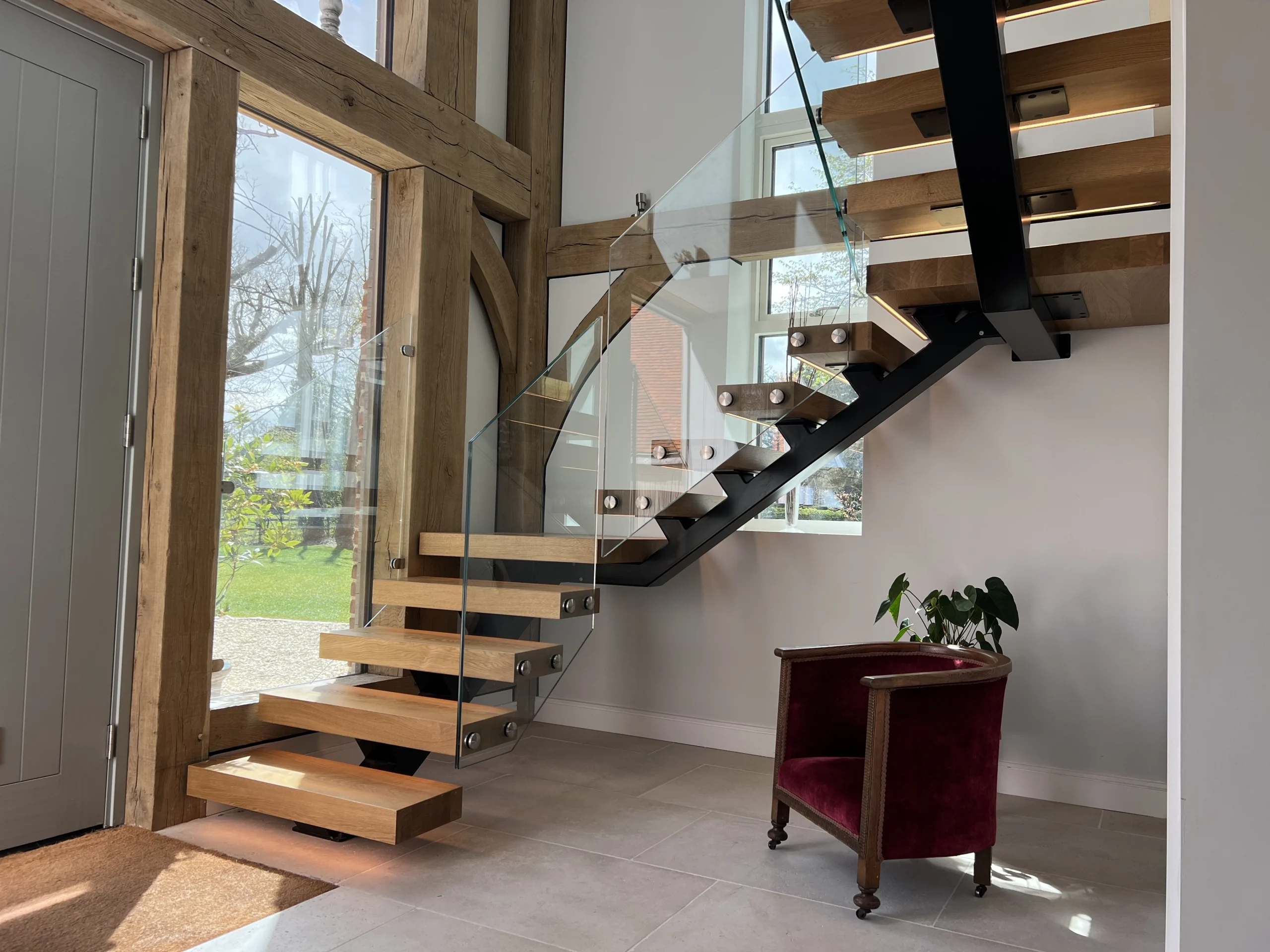
Bespoke central spine Mittelholmtreppe — typical specification for Hamburg Blankenese, Othmarschen and Nienstedten Hanseatic villa projects, satisfying HBauO §32 + DIN 18065 Wohngebäude class with frameless glass Geländer per DIN 18008-4
For Hamburg and Northern Germany architects, developers and contractors specifying bespoke modern staircases, Continox combines UK design heritage with EU manufacturing efficiency. Our facility near Kraków, Poland delivers to Hamburg via the A2–A24 motorway corridor — typical transit time 2–3 working days. Hamburg is Northern Germany's premium staircase market, with the Hanseatic villa belt — Blankenese, Othmarschen, Eppendorf, Harvestehude, Nienstedten, Wellingsbüttel — concentrating high-net-worth residential demand. Beyond Hamburg, the Norddeutsche market spans Bremen, Hannover, Kiel, Lübeck, Rostock, Oldenburg, Hannover region plus the Schleswig-Holstein lakefront and North Sea coast (Sylt, Föhr, Amrum, Timmendorfer Strand). The North Frisian Islands drive a unique market segment — premium Reetdachhäuser (thatched-roof villas) where the contemporary interior frameless staircase contrasts with the protected traditional exterior. Continox handles this via Hindenburgdamm car-train logistics for Sylt and ferry routing for Föhr/Amrum. Every supply ships with full HBauO §§ 32 / 33 / 36 compliance documentation for Hamburg projects, plus the relevant Northern German Landesbauordnung references for Bremen (BremLBO), Lower Saxony (NBauO), Schleswig-Holstein (LBO SH), Mecklenburg-Vorpommern (LBauO M-V) projects. This guide covers the Hanseatic market typology, HBauO-specific requirements, district coverage across Hamburg's 7 Bezirke, Northern German Großstädte, North Sea / Baltic coast specifics, and how Continox handles the unique character of the Norddeutsche market. For underlying technical references see our DIN 18065 Staircase Regulations Guide, Notwendige vs Nicht Notwendige Treppen Guide and Glass Balustrade Regulations DIN 18008-4 Guide; for sister regional guides see our Berlin & Brandenburg and Munich & Bayern Supply Guides; for the wider German market overview see /de/modern-staircase-germany/; for the full UK product range see /modern-staircase/, /glass-balustrade/ and /work/.
Continox supplies bespoke modern staircases across Hamburg metropolitan and Northern Germany as intra-EU B2B supply from our EN 1090-1 EXC2 facility near Kraków. Hamburg pricing €8,499–€24,000 supply-only reflects Hamburg's premium Hanseatic market position. Compliance: DIN 18065:2020-08 + HBauO §§ 32 (Treppen), 33 (Notwendige Treppenräume), 36 (Umwehrungen) for Hamburg projects + relevant Norddeutsche LBO references (BremLBO, NBauO, LBO SH, LBauO M-V) + DIN 18008-4 for glass Geländer. Top markets: Blankenese, Othmarschen, Nienstedten, Eppendorf, Harvestehude, Wellingsbüttel (Hamburg premium villa belt); Sylt (Kampen, Keitum, Wenningstedt) Reetdachhäuser; Bremen Schwachhausen, Hannover Kirchrode, Kiel Düsternbrook, Lübeck Sankt Lorenz Süd. Transit Kraków → Hamburg 2–3 working days via A2–A24 corridor. Sylt via Hindenburgdamm car-train (~3–4 days total).
- The Hamburg & Northern Germany Market
- Hanseatic Building Typologies — Backsteinexpressionismus, Hamburger Stadtvilla, Reetdach
- HBauO — Hamburg's State Code Specifics
- Hamburg's 7 Bezirke & Premium Villa Belt
- Northern Germany Großstädte — Bremen, Hannover, Kiel, Lübeck, Rostock
- Sylt & The North Sea Coast — Reetdach Specifics
- Logistics — Kraków to Hamburg & the Norden
- Pricing for Hamburg & Norddeutsche Projects
- Why Hamburg Architects Choose Continox
- FAQ — Hamburg & Norddeutsche Architects Ask
The Hamburg & Northern Germany Market
Hamburg is Germany's second-richest large city by household income (after Munich) and Europe's most important port city by tonnage. The city's bespoke staircase market reflects this distinct character: a strong tradition of Hanseatic understatement combined with substantial wealth, longer architectural specification cycles, and a well-established corporate base anchored by Beiersdorf, Olympus, Lufthansa Technik, plus the Hamburger Hafen logistics complex and the Mittelstand merchant tradition. Hamburg's staircase market is more conservative than Berlin's, more architectural than Munich's, and more material-led than Frankfurt's.
The Hanseatic villa belt forms a clear geographic concentration on the western Elbe slopes — Blankenese, Othmarschen, Nienstedten, Sülldorf, Rissen running west-to-east along the river; Eppendorf, Harvestehude, Rotherbaum in the inner premium ring; Wellingsbüttel, Volksdorf, Sasel in the northern villa belt around the Alster lake system. This is one of Germany's most established old-money residential markets, with villa stock spanning Wilhelminische Backsteinexpressionismus through 1920s Hamburger Stadtvilla to contemporary Neubau replacements.
Beyond Hamburg, Northern Germany's other major cities — Bremen, Hannover, Kiel, Lübeck, Rostock, Oldenburg — each have their own villa markets and Mehrfamilienhaus development pipelines. The North Sea coast (Schleswig-Holstein) and Baltic coast (Mecklenburg-Vorpommern) drive substantial premium villa specification on Sylt, Föhr, Amrum (North Frisian Islands), Timmendorfer Strand, Scharbeutz (Lübecker Bucht), and Heiligendamm, Boltenhagen (Mecklenburg coast).
Hamburg's bespoke staircase market is shaped by three Hanseatic distinctives: (1) Material restraint — even premium villa specifications often favour solid hardwood (oak, walnut) with discreet steel detailing rather than statement metallics. (2) Backsteinexpressionismus heritage — Hamburg's signature red-brick architectural language affects renovation projects, with interior staircase specifications complementing the brick exterior palette. (3) Reetdach tradition — Schleswig-Holstein and North Frisian Islands premium villas often present protected thatched roofs, with the contemporary interior frameless staircase serving as deliberate visual contrast to the traditional exterior.
Hanseatic Building Typologies
Northern Germany's bespoke staircase market spans several architectural typologies, each driving different specification requirements:
| Typology | Era / Region | Staircase Considerations |
|---|---|---|
| Hamburger Stadtvilla | 1880–1930s, premium suburbs | Wilhelminische to Weimar villa stock — bespoke geometry to fit existing stairwells, oak treads matching original parquet, often Denkmalschutz |
| Backsteinexpressionismus | 1910–1935, Hamburg + Bremen | Signature red-brick architectural language (Chilehaus, Sprinkenhof) — interior renovations sympathetic to brick exterior palette |
| Reetdachhaus | Sylt, Föhr, Amrum, Schleswig-Holstein | Protected thatched-roof villa — modern frameless interior contrasts with traditional exterior; specific Brandschutz for Reetdach (LBO SH) |
| Hannoveraner Wohnvilla | Hannover, Wolfsburg, Lower Saxony | Established 20th-century villa stock, contemporary Neubau replacement market, Lower Saxony NBauO compliance |
| Lübecker Hanseatenhaus | Lübeck UNESCO Old Town | Heritage merchant houses, Denkmalschutz throughout — heritage-sensitive interior modernisation |
| Hafencity / Speicherstadt Loft | Hamburg waterfront contemporary | Industrial-converted waterfront apartments, exposed steel + concrete + Maisonette duplex configurations |
| Norddeutsche Klinkerbau | Bremen, Oldenburg, Schleswig-Holstein rural | Klinkerstein (vitrified brick) typology — solid traditional aesthetic, contemporary interior modernisation |
| Modern Neubau | All Northern Germany | Communal Treppenraum specifications, F 90 tragende Teile, full HBauO/NBauO/BremLBO/LBO SH compliance |
Hamburger Stadtvilla & Backsteinexpressionismus
Hamburg's villa stock and inner-city Mehrfamilienhäuser are characterised by red-brick exterior palette. Internal staircase specifications for renovations and replacements respect this context:
- Solid oak or walnut treads — warm timber tones complementing the brick exterior
- Black powder-coated steel spine — providing visual contrast without competing with the brick
- Frameless glass Geländer — preserving sight lines through the original Treppenhaus
- Hand-finished brass detailing — increasingly specified as Hanseatic luxury accent
- Solid Eichenholz Handlauf — matching original villa parquet
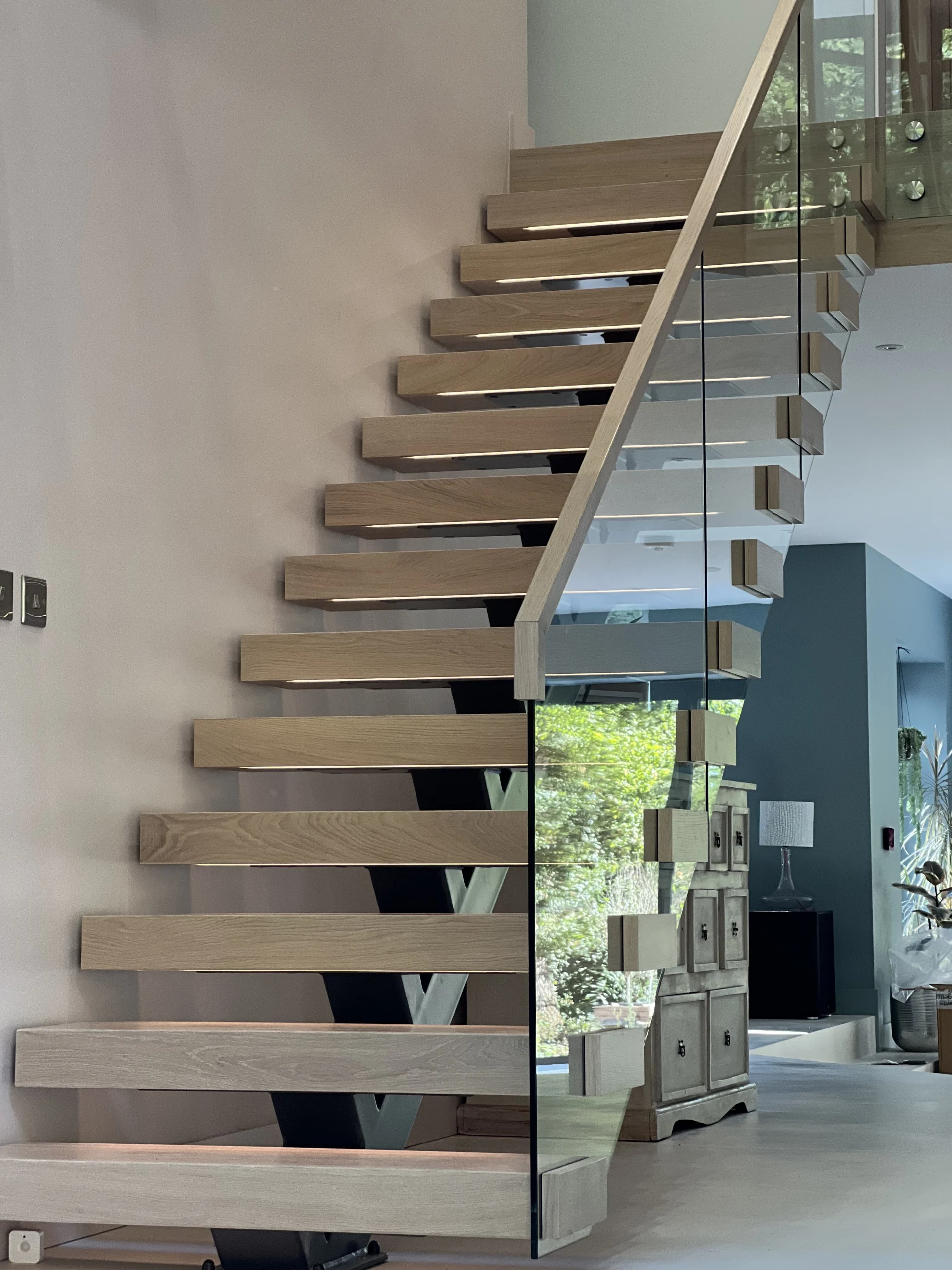
Solid light oak central spine — typical specification for Hamburg Blankenese and Othmarschen Hanseatic villa renovations, complementing red-brick Backsteinexpressionismus exterior palette with warm Eichenholz timber tones
HBauO — Hamburg's State Code Specifics
The Hamburgische Bauordnung (HBauO), originally promulgated 14.12.2005 with subsequent amendments and a recent comprehensive rewrite, governs every staircase specification in Freie und Hansestadt Hamburg. Hamburg uses §-numbering (like Berlin and Bremen) rather than Bayern's Article numbering — but with several Hamburg-specific provisions distinguishing HBauO from MBO and BauO Bln.
Article Cross-Reference: HBauO vs MBO vs Other LBOs
| Topic | Hamburg (HBauO) | MBO | Berlin (BauO Bln) | Bayern (BayBO) |
|---|---|---|---|---|
| Treppen general | § 32 | § 34 | § 34 | Art. 32 |
| Notwendige Treppenräume | § 33 | § 35 | § 35 | Art. 33 |
| Notwendige Flure, offene Gänge | § 34 | § 36 | § 36 | Art. 34 |
| Umwehrungen und Brüstungen | § 36 | § 38 | § 38 | Art. 36 |
| Erster und zweiter Rettungsweg | § 31 | § 33 | § 33 | Art. 31 |
HBauO § 32 — Treppen
Hamburg § 32 HBauO Key Provisions
- Notwendige Treppe definition: Each non-ground-floor Geschoss + benutzbarer Dachraum requires at least one notwendige Treppe (Abs. 1)
- Einschiebbare Treppen ban (Abs. 2): Pull-down loft ladders not permitted as notwendige Treppen except in Gebäudeklassen 1 und 2 to a Dachraum without Aufenthaltsraum
- One-flight rule (Abs. 3): Notwendige Treppen must run "in einem Zuge" with direct connection to Dachraum stairs
- F 90 / nichtbrennbar tragende Teile (Abs. 4): Außentreppen tragende Teile in Gebäudeklassen 3 to 5 must be aus nichtbrennbaren Baustoffen
- Beidseitige Handläufe (Abs. 6): Required where Verkehrssicherheit demands — typically for staircases serving multiple Wohnungen with non-stufenlos access, plus public-access situations
- Tür-vor-Treppe rule (Abs. 7): A staircase must not begin immediately behind a door opening towards the stairs — Treppenabsatz must intervene
HBauO § 33 — Notwendige Treppenräume, Ausgänge
Hamburg's § 33 contains several Hanseatic-specific provisions distinguishing it from MBO §35 and BauO Bln §35:
- Maisonette-Wohnung exception (§ 33 Abs. 1 Satz 3 Nr. 2): Internal staircases connecting max 2 Geschosse within the same Nutzungseinheit of total ≤200 m², with alternativer Rettungsweg per Geschoss — same as MBO and most LBOs
- Außenwand-preference rule (§ 33 Abs. 3 Satz 1): "Jeder notwendige Treppenraum muss an einer Außenwand liegen" — Hamburg explicitly prefers Treppenräume at outer walls. Innen liegende notwendige Treppenräume permitted only if Raucheintritt is demonstrably not endangering use sufficiently long
- Treppenraumwände GK4 rule (§ 33 Abs. 4 Nr. 2): Hamburg specifies Treppenraumwände in Gebäudeklasse 4 as "auch unter zusätzlicher mechanischer Beanspruchung hochfeuerhemmend" — stricter mechanical performance requirement than the basic hochfeuerhemmend specification
- Bekleidungen + Bodenbeläge in Treppenräumen (§ 33 Abs. 5): Bekleidungen, Putze, Dämmstoffe, Unterdecken, Einbauten must be aus nichtbrennbaren Baustoffen; Bodenbeläge minimum schwerentflammbar
- 35 m maximum Rettungsweg distance (§ 33 Abs. 2): From any Aufenthaltsraum or Kellergeschoss to a notwendige Treppenraum or direct exit ins Freie
The "Treppenraum an einer Außenwand" rule in Hamburg (§ 33 Abs. 3 Satz 1 HBauO) is more explicit than equivalent provisions in other Bundesländer. While most Landesbauordnungen permit innen liegende Treppenräume with appropriate Raucheintritt protection, Hamburg's HBauO explicitly states the outer-wall preference, with innen liegend as the exception requiring justification. For Continox supply, this affects positioning of Mehrfamilienhaus staircases — most projects place the notwendige Treppenraum at an Außenwand naturally, but tight-footprint Hamburg Mehrfamilienhäuser sometimes need innen liegend configuration with full Brandschutzkonzept justification.
HBauO § 36 — Umwehrungen und Brüstungen
Hamburg's § 36 governs Geländer and Brüstungen, broadly aligned with MBO §38 but with explicit cross-references:
- Mandatory Umwehrungen at all begehbare Flächen with Δh >1.0 m above lower surface
- DIN 18008-4 absturzsichernde Verglasung rules apply for glass Geländer — Kategorien A/B/C, Pendelschlagversuch, VSG mandatory for Kat A and B
- Geländerhöhe 90 cm (Δh ≤12 m), 110 cm (Δh >12 m) per DIN 18065 reference
- Lichter Abstand ≤12 cm wherever unsupervised young children may be present
Hamburg Bauamt Practice
Hamburg's Bauanträge are handled by the Bezirksämter (7 Bezirke each) with overall supervision by the Behörde für Stadtentwicklung und Wohnen (BSW). Practical observations:
- Hamburg Bauämter are methodical and comprehensive in compliance review — typical Bauantrag turnaround 12–16 weeks
- Premium villa Bezirke (Altona, Eimsbüttel, Wandsbek) handle most Continox specifications, with strong experience of Hamburger Stadtvilla renovation projects
- Hamburg's Hafencity district (under Bezirk Hamburg-Mitte) has its own architectural review processes due to the protected waterfront masterplan — engage early for Speicherstadt-area projects
- Denkmalschutz coordination through Denkmalschutzamt Hamburg required for Wilhelminische Altbau and Backsteinexpressionismus heritage projects
Hamburg's 7 Bezirke & Premium Villa Belt
Hamburg comprises 7 Bezirke (city districts), with the Hanseatic villa belt concentrated specifically:
Altona — Blankenese / Othmarschen / Nienstedten
Hamburg's most prestigious villa belt — Elbufer (river slopes), Treppenviertel Blankenese (UNESCO-style stepped streets), Wilhelminische to Bauhaus villa stock. €15,000–€22,000 typical.
Eimsbüttel — Eppendorf / Harvestehude
Premium inner-ring villa and prestige apartment market on the Alster lake. Wilhelminische Mehrfamilienhäuser with Maisonette penthouse opportunities. €12,500–€18,000.
Wandsbek — Wellingsbüttel / Volksdorf / Sasel
Villa belt north of central Hamburg, family-villa market with established stock + contemporary Neubau replacement. €11,000–€16,000.
Hamburg-Mitte — Hafencity / Speicherstadt / Rotherbaum
Hafencity loft / penthouse market, Speicherstadt waterfront apartments. Maisonette-Wohnung specifications. €10,500–€15,500.
Hamburg-Nord — Winterhude / Barmbek-Süd / Uhlenhorst
Mixed Wilhelminische Altbau renovation + contemporary Neubau, gentrified residential. €9,500–€14,500.
Harburg / Bergedorf
South-of-Elbe family-villa market, suburban Mehrfamilienhaus development. Volume specifications. €8,499–€12,500.
Altona — Sülldorf / Rissen / Iserbrook
Outer Elbufer continuation of Blankenese premium belt — modern villa Neubau, larger plot sizes, Elbe access. €13,000–€18,000.
Wandsbek — Bergstedt / Lemsahl-Mellingstedt / Duvenstedt
Northern outer suburban villa market, established family-residential. Lakeside (Bramfelder See) premium specifications. €11,500–€15,500.
Hamburg-Mitte — Rotherbaum / Pöseldorf
Old-money inner-ring premium, Pöseldorf Mehrfamilienhäuser, Universitätsviertel premium apartments. €11,000–€16,000.

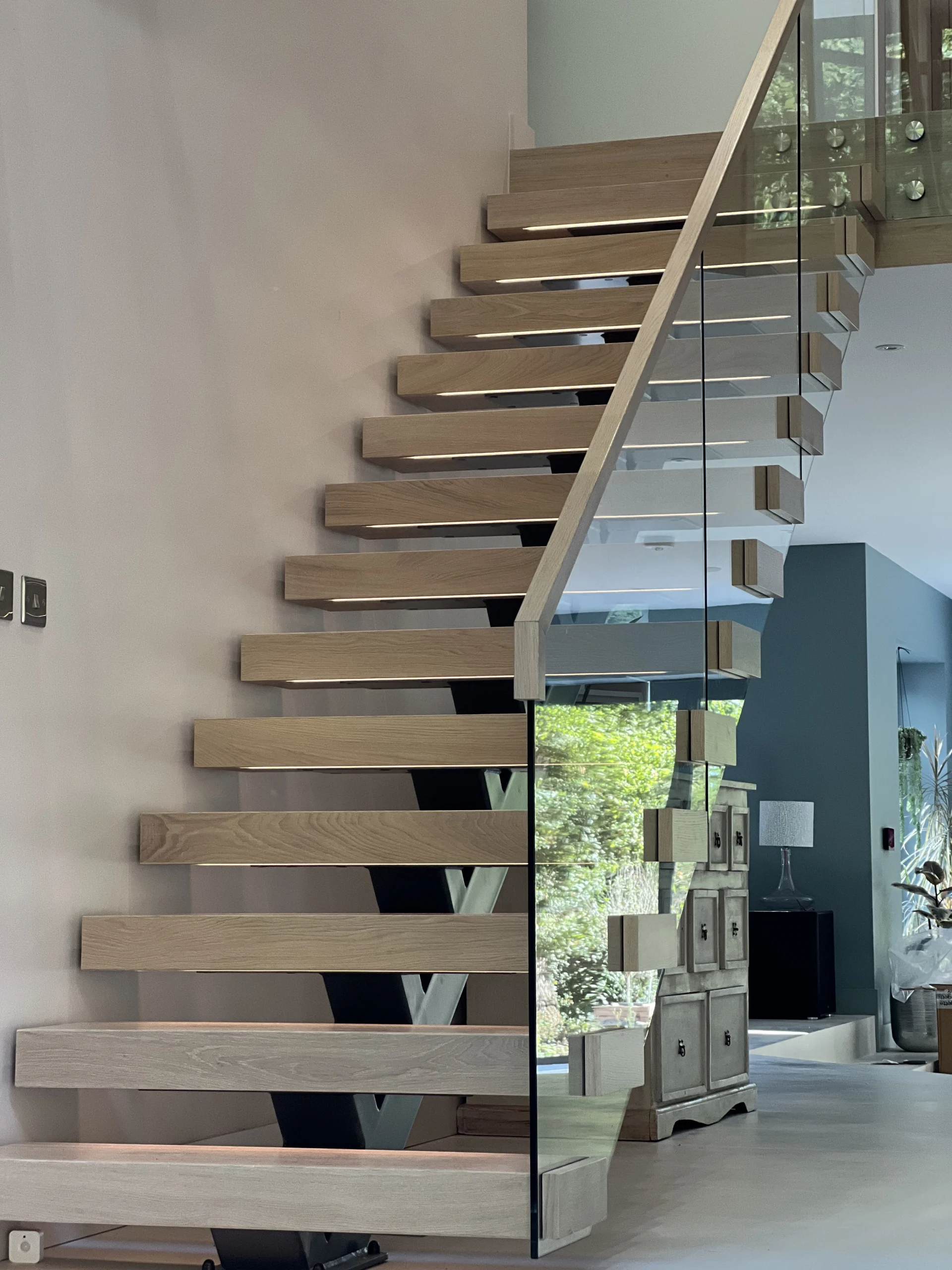
Quarter-turn central spine — typical Hamburg Blankenese, Othmarschen and Nienstedten premium villa specification, with frameless glass Geländer satisfying HBauO § 32 Abs. 4 + DIN 18008-4 Kategorie B requirements
Northern Germany Großstädte — Bremen, Hannover, Kiel, Lübeck, Rostock
Beyond Hamburg, Northern Germany's other major cities deliver substantial volume to the bespoke staircase market — each with distinct character:
Bremen
Northern Germany's second city-state, historic Hanseatic League founding member with strong Mittelstand corporate base. Premium villa concentration in Schwachhausen, Borgfeld, Oberneuland, Horn-Lehe. Wilhelminische Altbau renovation in Findorff, Östliche Vorstadt, Steintor. Bremerhaven (separate city under Bremen state) has its own coastal villa market. Bremische Landesbauordnung (BremLBO) applies — broadly similar to HBauO with some regional differences (notably the 50 cm Brüstungshöhe minimum). Typical Bremen villa spend €10,500–€15,500.
Hannover
Lower Saxony's capital, post-WWII reconstruction city with established premium suburbs in Kirchrode, Waldhausen, Großbuchholz, Bothfeld-Vahrenheide. Wolfsburg (Volkswagen executive market) and Hildesheim form an extended premium corridor. Niedersächsische Bauordnung (NBauO) applies. Typical Hannover villa spend €10,500–€15,000.
Kiel
Schleswig-Holstein's capital and major Baltic port. Premium villa concentration in Düsternbrook, Schreventeich, Wik. Landesbauordnung Schleswig-Holstein (LBO SH) applies. Substantial premium Eckernförde and Heikendorf villa market on the Kieler Förde. Typical Kiel villa spend €10,000–€14,500.
Lübeck
UNESCO World Heritage Old Town drives extensive Denkmalschutz-protected renovation activity. Premium villa belt in Sankt Lorenz Süd, Sankt Lorenz Nord, Marli-Brandenbaum. The Hanseatenhaus typology of Lübeck Altstadt requires heritage-sensitive interior modernisation — a Continox specialism. Typical Lübeck villa spend €10,500–€15,500.
Rostock
Mecklenburg-Vorpommern's largest city, major Baltic port. Premium villa concentration in Warnemünde (premium beach-front), Markgrafenheide, Brinckmansdorf. Landesbauordnung Mecklenburg-Vorpommern (LBauO M-V) applies. Mecklenburg coast villa market (Heiligendamm, Boltenhagen, Kühlungsborn) drives premium specifications. Typical Rostock villa spend €9,500–€14,000.
Other Northern Großstädte
- Oldenburg — Lower Saxony Old Town heritage market, premium suburbs in Eversten
- Wolfsburg — VW corporate executive market, post-1938 Reichsstadt heritage
- Braunschweig — established Lower Saxony university and corporate centre
- Schwerin — Mecklenburg-Vorpommern capital, Schweriner See lakefront premium
- Greifswald / Stralsund — Hanseatic UNESCO Old Towns, extensive Denkmalschutz
- Wilhelmshaven / Cuxhaven — coastal mid-size cities, North Sea villa market
- Flensburg — Schleswig-Holstein border city, Danish-influenced architectural character
Sylt & The North Sea Coast — Reetdach Specifics
The Schleswig-Holstein North Sea coast hosts Germany's most exclusive island villa market. Sylt (Kampen, Keitum, Wenningstedt, List, Westerland, Rantum) is the apex — a 38 km long North Frisian island with a unique premium residential market. Föhr and Amrum sit slightly less expensive but with similar character. The North Sea coast extends to Sankt Peter-Ording, Büsum, Cuxhaven on the mainland.
The Reetdach Imperative
Sylt and the North Frisian Islands present a distinctive architectural challenge: most premium villas are Reetdachhäuser — thatched-roof traditional fishermen's-cottage typology. The Reetdach is typically protected under Denkmalschutz or local building plan rules (especially in Kampen and Keitum). The consequences for staircase specification:
Reetdachhaus Staircase Specifics
- Reetdach Brandschutz — Schleswig-Holstein LBO has specific provisions for thatched-roof fire safety, including 12 m Abstand to neighbouring structures and special rules for tragende Teile near Reetdach
- Compact villa footprint — Reetdachhäuser are typically smaller than mainland villas; staircase specifications must fit tight envelope constraints
- Heritage-sensitive interior — protected exterior often dictates restrained interior modern intervention; frameless glass + solid timber the standard combination
- Storm-resistance considerations — North Sea exposure requires premium fixings, marine-grade stainless steel, EPDM gaskets at all glass junctions
- Salt-air corrosion resistance — A4 (316) stainless steel grade for exposed components, including Tellerhalter where relevant
- Logistics complexity — Sylt accessed via Hindenburgdamm car-train (Niebüll → Westerland), Föhr/Amrum via ferry (Dagebüll → Wyk/Wittdün)
Sylt & North Frisian Logistics
Continox handles Sylt/Föhr/Amrum logistics with established procedures:
- Sylt — A2 → A24 → A7 → A23 to Niebüll, then Hindenburgdamm Autozug (car-train) to Westerland. Adds 1 day to standard Hamburg routing → total 3–4 days from Kraków. Delivery cost €1,200–€1,500 including Autozug fee
- Föhr / Amrum — Niebüll → Dagebüll, then car-ferry to Wyk auf Föhr or Wittdün auf Amrum. Adds 1 day to mainland routing. Delivery cost €1,000–€1,400
- Sankt Peter-Ording, Büsum, Cuxhaven — mainland coastal access, no ferry/Autozug — adds 90 minutes vs Hamburg routing. Delivery cost €750–€950
Logistics — Kraków to Hamburg & the Norden
Hamburg sits further from Kraków than Berlin or Munich. The route uses the trans-European A2 corridor with A24 final segment:
Kraków → Hamburg Routing
- Distance: ~830 km via direct motorway corridor
- Route: A4 Kraków–Wrocław → A18 Wrocław–Forst → A2 Forst–Berlin Ring → A24 Berlin–Hamburg
- Border crossing: Forst–Olszyna (no customs — both EU member states)
- Transit time: 2–3 working days for dedicated freight
- Delivery cost: €700–€900 typical (Hamburg metropolitan + 50 km)
- Vehicle: Dedicated freight, typically 7.5t or 12t depending on order size
Northern Germany Routing Beyond Hamburg
Northern German projects beyond Hamburg use the same corridor with final routing:
- Bremen: A1 from Hamburg — adds 60 minutes
- Hannover: A7 from Hamburg — adds 90 minutes; or direct via A2 from Berlin Ring
- Kiel: A7 N from Hamburg — adds 75 minutes
- Lübeck: A1 N from Hamburg — adds 45 minutes
- Rostock: A24 → A20 — adds 2 hours from Hamburg, or direct A24 → A20 from Berlin Ring
- Sylt (via Hindenburgdamm Autozug): A7 → A23 → Niebüll → Westerland. Adds 1 day total — must book Autozug 3–7 days in advance
- Timmendorfer Strand / Scharbeutz: A1 N → coastal — adds 90 minutes from Hamburg
- Heiligendamm / Boltenhagen / Kühlungsborn: via Rostock routing — adds 30 minutes from Rostock
Pricing for Hamburg & Norddeutsche Projects
Hamburg pricing reflects the premium Hanseatic market — typically 5–8% higher than equivalent Berlin specifications, slightly below Munich:
| Configuration | From (Supply-Only) | Typical Hamburg/Northern Application |
|---|---|---|
| Floating Cantilever | €8,499 | Hafencity loft penthouse, Eppendorf Maisonette, compact Hannover Altbau renovation |
| Central Spine (Mittelholmtreppe) | €9,299 | Most-specified — Blankenese, Othmarschen, Nienstedten villa, Bremen Schwachhausen, Hannover Kirchrode |
| U-Shape Central Spine | €9,800 | Tight-footprint Hamburger Stadtvilla renovation, Backsteinexpressionismus context |
| L-Shape Central Spine | €9,600 | Quarter-turn villa typology — common in Othmarschen and Wellingsbüttel |
| Y-Shape Central Spine | €10,800 | Sculptural statement — Blankenese Elbufer villas, Sylt premium Reetdachhaus |
| Premium Central Spine (LED + Eichenholz) | €12,000 | Blankenese, Harvestehude, Sylt Kampen specifications |
| Fully Bespoke (helical, Brass detailing) | €13,500+ | Architect-led commission, prestige Othmarschen / Lübeck Sankt Lorenz villa |
| Glass Balustrade (frameless Kat B) | €470/m | Standard residential — DIN 18008-4 Kat B with Handlauf, VSG laminated |
| Glass Balustrade (point-fixed Kat A) | €600/m | Hafencity loft, Sylt premium Reetdachhaus, Elbufer atrium |
| Marine-grade Sylt premium spec | +12% surcharge | A4 (316) stainless steel for salt-air exposure, EPDM gaskets, premium fixings |
| Delivery Hamburg metropolitan | €700–€900 | Dedicated freight, 2–3 days transit |
| Delivery Northern Germany mainland | €750–€1,000 | Bremen, Hannover, Kiel, Lübeck, Rostock |
| Delivery Sylt (incl. Autozug) | €1,200–€1,500 | Hindenburgdamm car-train, advance booking required |
| Delivery Föhr / Amrum (incl. ferry) | €1,000–€1,400 | Dagebüll → Wyk/Wittdün car-ferry |
Typical Northern Project Spend
Combining staircase + balustrade for typical Northern projects:
- Blankenese Elbufer villa — Y-shape with LED + Eichenholz €12,500 + ~14 m frameless glass €6,580 + delivery €800 → €19,880 supply total
- Othmarschen contemporary villa — central spine €9,299 + ~12 m frameless glass €5,640 + delivery €750 → €15,689 supply total
- Sylt Kampen Reetdachhaus — central spine €9,299 + 12% Sylt surcharge + ~10 m point-fixed Kat A €6,000 + delivery €1,400 → €16,915 supply total
- Hafencity penthouse Maisonette — floating cantilever €8,499 + ~6 m frameless glass €2,820 + delivery €750 → €12,069 supply total
- Bremen Schwachhausen villa — central spine €9,299 + ~12 m frameless glass €5,640 + delivery €850 → €15,789 supply total
- Lübeck Sankt Lorenz Hanseatenhaus — bespoke heritage geometry €13,500 + ~10 m frameless glass €4,700 + delivery €800 → €19,000 supply total
Why Hamburg Architects Choose Continox
Hamburg/Northern-Specific Continox Advantages
- 2–3 day transit Kraków → Hamburg via direct A2–A24 motorway, with established Sylt Hindenburgdamm Autozug logistics for North Frisian Islands
- HBauO-specific compliance documentation — cover sheet referencing §§ 32, 33, 36 HBauO with the Hamburg-specific Außenwand-preference rule and GK4 hochfeuerhemmend mit zusätzlicher mechanischer Beanspruchung addressed
- Hanseatic material palette specialism — solid Eichenholz oak treads, hand-finished brass detailing, black powder-coated steel — matched to Hamburger Stadtvilla and Backsteinexpressionismus context
- Reetdachhaus specialism — marine-grade A4 (316) stainless steel for Sylt/Föhr/Amrum salt-air exposure, EPDM gasketing at glass junctions, Schleswig-Holstein LBO Reetdach Brandschutz integration
- Multi-LBO documentation — Continox supplies relevant Landesbauordnung-specific cover sheets for HBauO (Hamburg), BremLBO (Bremen), NBauO (Lower Saxony), LBO SH (Schleswig-Holstein), LBauO M-V (Mecklenburg-Vorpommern) projects with the respective § references
- Denkmalschutz coordination — heritage-sensitive design for Lübeck Altstadt UNESCO, Hamburg Backsteinexpressionismus, Wismar/Stralsund/Greifswald Hanseatic UNESCO projects
- Hafencity specialism — industrial-converted waterfront aesthetic for Speicherstadt Maisonette/loft specifications
- EN 1090-1 EXC2 Declaration of Performance + marcado CE plate fitted, fully recognised by all 7 Hamburg Bezirksämter and Northern German Bauämter
- Eurocode structural calculations signed by UK Chartered Structural Engineer (IStructE), with Hamburg/Norddeutsche-specific Brandschutznachweis
- 5-year warranty on all components — direct manufacturer warranty without distributor margin
Specifying for a Hamburg, Northern Germany or Sylt Project?
From €8,499 supply-only, delivered across Hamburg metropolitan, Northern German Großstädte, and the North Frisian Islands as intra-EU supply (2–3 working days; Sylt 3–4 days via Hindenburgdamm Autozug). Free 3D visualisation, fixed-price quote within 48 hours, full HBauO + DIN 18065 + DIN 18008-4 compliance pack in English and German.
Get Free Quote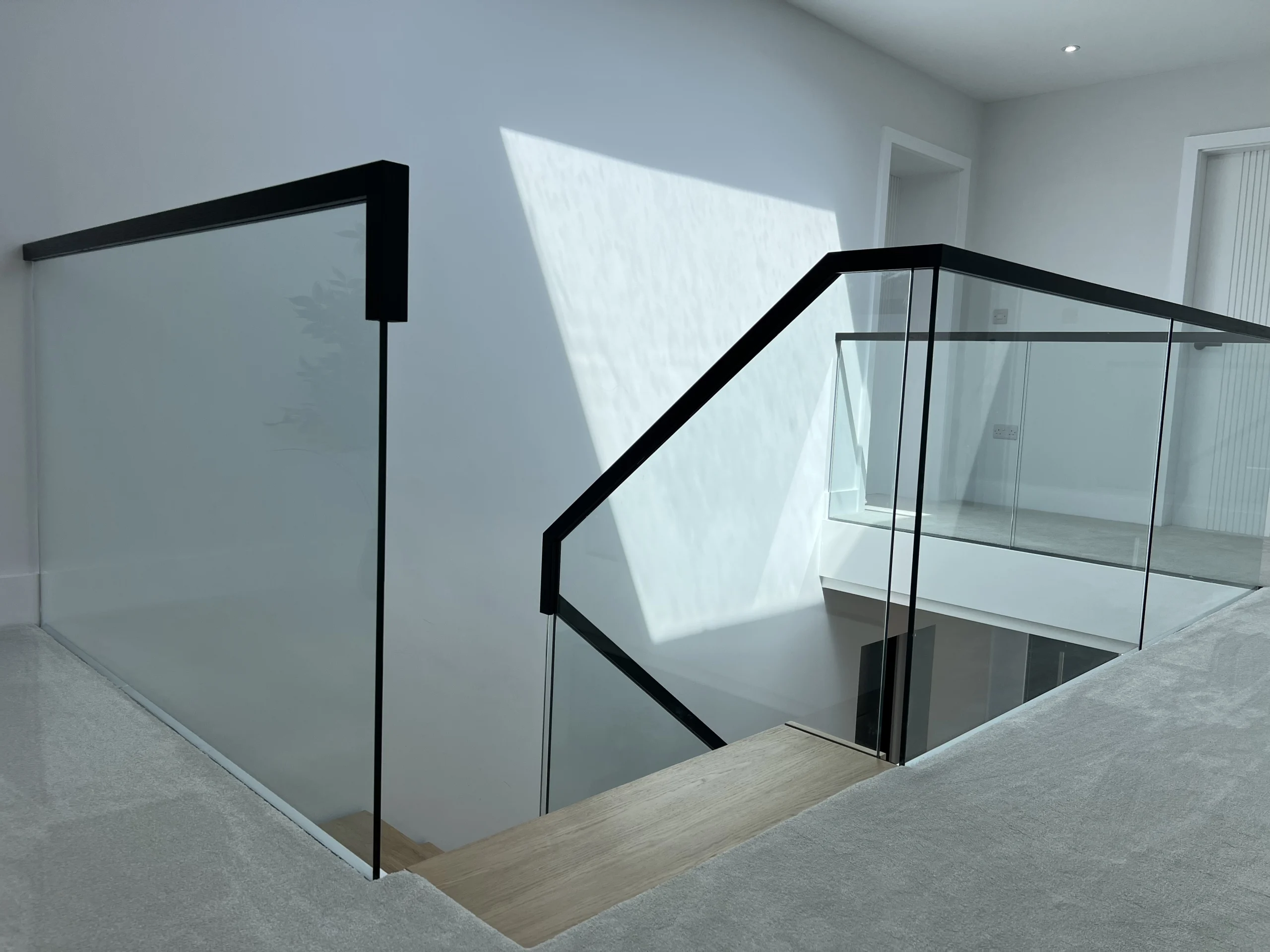
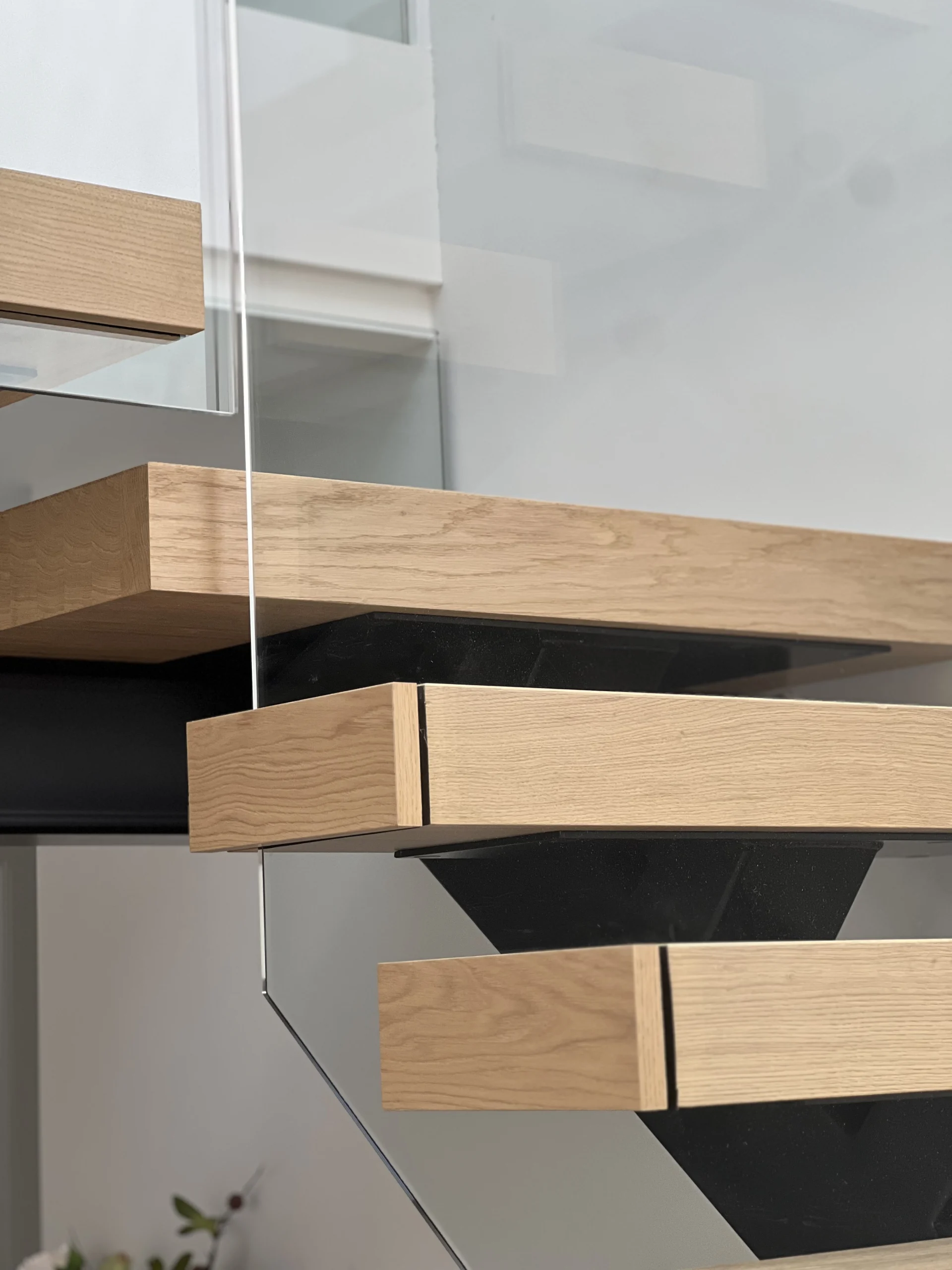
Frameless glass landing balustrade — typical Hamburg Mehrfamilienhaus Treppenraum specification, DIN 18008-4 Kategorie B with continuous Handlauf, satisfying HBauO § 33 Abs. 4 Nr. 2 hochfeuerhemmend mit zusätzlicher mechanischer Beanspruchung GK4 wall requirement
FAQ — Hamburg & Norddeutsche Architects Ask
How much does a modern staircase cost for Hamburg projects?
Continox supply for Hamburg starts at €8,499 for compact floating cantilever (typical Hafencity penthouse, Eppendorf Maisonette) to €24,000+ for fully bespoke configurations in Blankenese, Othmarschen Elbufer villas. Most Hanseatic premium villa projects (Blankenese, Othmarschen, Nienstedten, Eppendorf, Harvestehude, Wellingsbüttel) spend €13,000–€18,000 supply-only. Sylt Reetdachhaus specifications add 12% surcharge for marine-grade A4 (316) stainless steel; Sylt total typically €18,000–€25,000 including delivery via Hindenburgdamm. Bremen, Hannover, Kiel, Lübeck, Rostock villa markets €10,500–€15,500. Hamburg pricing 5–8% higher than Berlin equivalents, slightly below Munich.
How does HBauO differ from MBO and other Landesbauordnungen?
HBauO uses §-numbering (like Berlin and Bremen) but with several Hamburg-specific provisions: § 32 = Treppen (= MBO §34), § 33 = Notwendige Treppenräume (= MBO §35), § 36 = Umwehrungen (= MBO §38). Hamburg-specific: § 33 Abs. 3 Satz 1 Treppenraum-an-Außenwand preference rule (innen liegend permitted only if Raucheintritt not endangering use sufficiently long); § 33 Abs. 4 Nr. 2 Treppenraumwände GK4 "auch unter zusätzlicher mechanischer Beanspruchung hochfeuerhemmend" — stricter mechanical performance requirement; § 33 Abs. 5 Bekleidungen + Bodenbeläge nichtbrennbar / schwerentflammbar in all Treppenräume. Continox supplies HBauO-specific cover-sheet documentation matching the relevant § references.
What's the Außenwand-preference rule in Hamburg?
Per § 33 Abs. 3 Satz 1 HBauO, "Jeder notwendige Treppenraum muss an einer Außenwand liegen" — every notwendiger Treppenraum must be located at an outer wall. Innen liegende notwendige Treppenräume are permitted only when their Nutzung is demonstrably not endangered for sufficiently long by Raucheintritt. This is more explicit than equivalent provisions in other Bundesländer where the rule is typically inferred rather than stated. For Continox supply, this affects positioning of Mehrfamilienhaus staircases in tight-footprint Hamburg projects — most natural specifications place the Treppenraum at an Außenwand, but constrained sites may require innen liegend configuration with full Brandschutzkonzept justification including Druckbelüftung or equivalent rauchableitung measures.
Do you supply to Sylt and the North Frisian Islands?
Yes — Continox handles Sylt (Kampen, Keitum, Wenningstedt, List, Westerland, Rantum), Föhr (Wyk, Nieblum), and Amrum (Wittdün, Norddorf, Nebel) with established logistics. Sylt: A2 → A24 → A7 → A23 to Niebüll, then Hindenburgdamm Autozug (car-train) to Westerland — adds 1 day to standard routing, total 3–4 days from Kraków, delivery €1,200–€1,500 including Autozug fee. Föhr / Amrum: car-ferry from Dagebüll, delivery €1,000–€1,400. Reetdachhaus specifications use marine-grade A4 (316) stainless steel for salt-air corrosion resistance, EPDM gasketing at all glass junctions, and Schleswig-Holstein LBO-specific Reetdach Brandschutz compliance. 12% surcharge on standard pricing for marine-grade configuration.
Can I integrate modern bespoke into a protected Reetdachhaus?
Yes — this is a Continox specialism for Sylt, Föhr, Amrum, and the Schleswig-Holstein North Sea coast. Reetdachhäuser are typically protected under Denkmalschutz or local building plan rules (especially in Kampen and Keitum) — the protected exterior dictates a restrained, contemporary interior. Standard configurations: frameless glass Geländer + solid Eichenholz oak treads as the visual contrast against traditional exterior; compact villa footprint driving careful staircase geometry within tight envelope; storm + salt-air resistance via marine-grade A4 stainless steel and EPDM gasketing; heritage-sensitive interior coordination with Untere Denkmalschutzbehörde at concept stage. The visual contrast between protected Reetdach exterior and modern frameless interior is increasingly the architectural signature for high-end Sylt villa renovations.
How long does delivery take from Kraków to Hamburg?
Hamburg sits further from Kraków than Berlin or Munich. Transit time is 2–3 working days via the direct A2–A24 motorway corridor (~830 km). The Forst–Olszyna border crossing has no customs (both EU member states). Delivery cost €700–€900 for Hamburg metropolitan; €750–€1,000 for Northern German mainland (Bremen, Hannover, Kiel, Lübeck, Rostock); €1,200–€1,500 for Sylt including Hindenburgdamm Autozug; €1,000–€1,400 for Föhr/Amrum including ferry. Total order-to-site lead time 5–9 weeks: 1 week design sign-off + 4–7 weeks fabrication + 2–4 days transit (longer for North Frisian Islands).
Do you handle Hafencity / Speicherstadt loft conversions?
Yes. Hamburg Hafencity (under Bezirk Hamburg-Mitte) hosts a distinctive market for industrial-converted waterfront apartments and Speicherstadt loft Maisonette specifications. The architectural character — exposed steel, concrete, brick, large open-plan volumes — drives a specific Continox configuration: black powder-coated steel central spine harmonising with industrial palette, open-tread oak or walnut treads, frameless glass Geländer with point-fixed Tellerhalter for maximum transparency, large-aperture single-flight geometries for the typical double-height Hafencity volume. Hafencity specifications typically benefit from the Maisonette-Wohnung exception under § 33 Abs. 1 Satz 3 Nr. 2 HBauO (≤200 m² + alternativer Rettungsweg). Hafencity Bezirksamt review processes are particularly thorough — engage early.
Do you supply to Bremen, Hannover, Kiel, Lübeck and Rostock?
Yes. Bremen (Schwachhausen, Borgfeld, Oberneuland premium suburbs): €10,500–€15,500, BremLBO compliance with the 50 cm Brüstungshöhe minimum. Hannover (Kirchrode, Waldhausen, Großbuchholz): €10,500–€15,000, NBauO compliance, A7/A2 routing from Hamburg adds 90 minutes. Kiel (Düsternbrook, Schreventeich): €10,000–€14,500, LBO SH compliance, A7 N from Hamburg adds 75 minutes. Lübeck (Sankt Lorenz Süd/Nord, Marli-Brandenbaum, plus UNESCO Old Town Hanseatenhaus heritage): €10,500–€15,500, LBO SH compliance, A1 N from Hamburg adds 45 minutes. Rostock (Warnemünde, Brinckmansdorf): €9,500–€14,000, LBauO M-V compliance. All projects supplied with relevant Landesbauordnung-specific cover-sheet documentation referencing the appropriate § numbers.
Can you handle Lübeck and Wismar UNESCO Old Town renovations?
Yes. Lübeck Altstadt (full UNESCO World Heritage), Wismar Altstadt and Stralsund Altstadt (UNESCO Hanseatic Old Towns), Greifswald Old Town present substantial Denkmalschutz-protected renovation opportunities. The Hanseatenhaus typology — narrow merchant houses with vertical organisation — drives specific Continox specifications: bespoke geometry to fit existing narrow stairwell dimensions, oak or walnut treads matching original floor levels and parquet, frameless glass Geländer preserving sight lines through the original Treppenhaus, heritage-sensitive design supporting Untere Denkmalschutzbehörde approval. Heritage approval typically adds 6–10 weeks to overall Bauantrag timeline. Continox provides design proposals supporting the project's Denkmalschutzbehörde dialogue.
Which Hamburg Bezirke do you supply most often?
Continox supplies across all 7 Hamburg Bezirke. The highest project volumes come from: Altona (Blankenese, Othmarschen, Nienstedten, Sülldorf, Rissen — Hamburg's most prestigious villa belt along the Elbufer); Eimsbüttel (Eppendorf, Harvestehude — premium inner-ring villa and Alster lake apartment market); Wandsbek (Wellingsbüttel, Volksdorf, Sasel, Bergstedt — northern villa belt); Hamburg-Mitte (Hafencity, Speicherstadt, Rotherbaum — waterfront/luxury apartment); Hamburg-Nord (Winterhude, Barmbek-Süd, Uhlenhorst — gentrified residential). Volume Mehrfamilienhaus market in Harburg, Bergedorf. For Sylt and North Frisian Islands, Kampen, Keitum, Wenningstedt deliver the highest premium spend.
Ready to Specify a Hamburg, Norddeutsche, or Sylt Project?
From compact Hafencity Maisonette to prestige Blankenese Elbufer villa, from Bremen Schwachhausen to Sylt Kampen Reetdachhaus, from Lübeck UNESCO Hanseatenhaus to Rostock Warnemünde — Continox supplies bespoke modern staircases with full HBauO §§ 32 / 33 / 36 + relevant Norddeutsche LBO + DIN 18065 + DIN 18008-4 compliance documentation. Free 3D visualisation, fixed-price quote within 48 hours, intra-EU supply (2–3 working days mainland, 3–4 days North Frisian Islands), structural calculations signed by UK Chartered Structural Engineer (IStructE).
Get Free Quote