

External Staircase for a Basement Flat in London
A specialist guide to commissioning external access stairs for London basement flat conversions — costs, planning, lightwell drainage, Article 4, Party Wall, and the borough-specific rules that catch most homeowners unprepared.
Updated May 2026
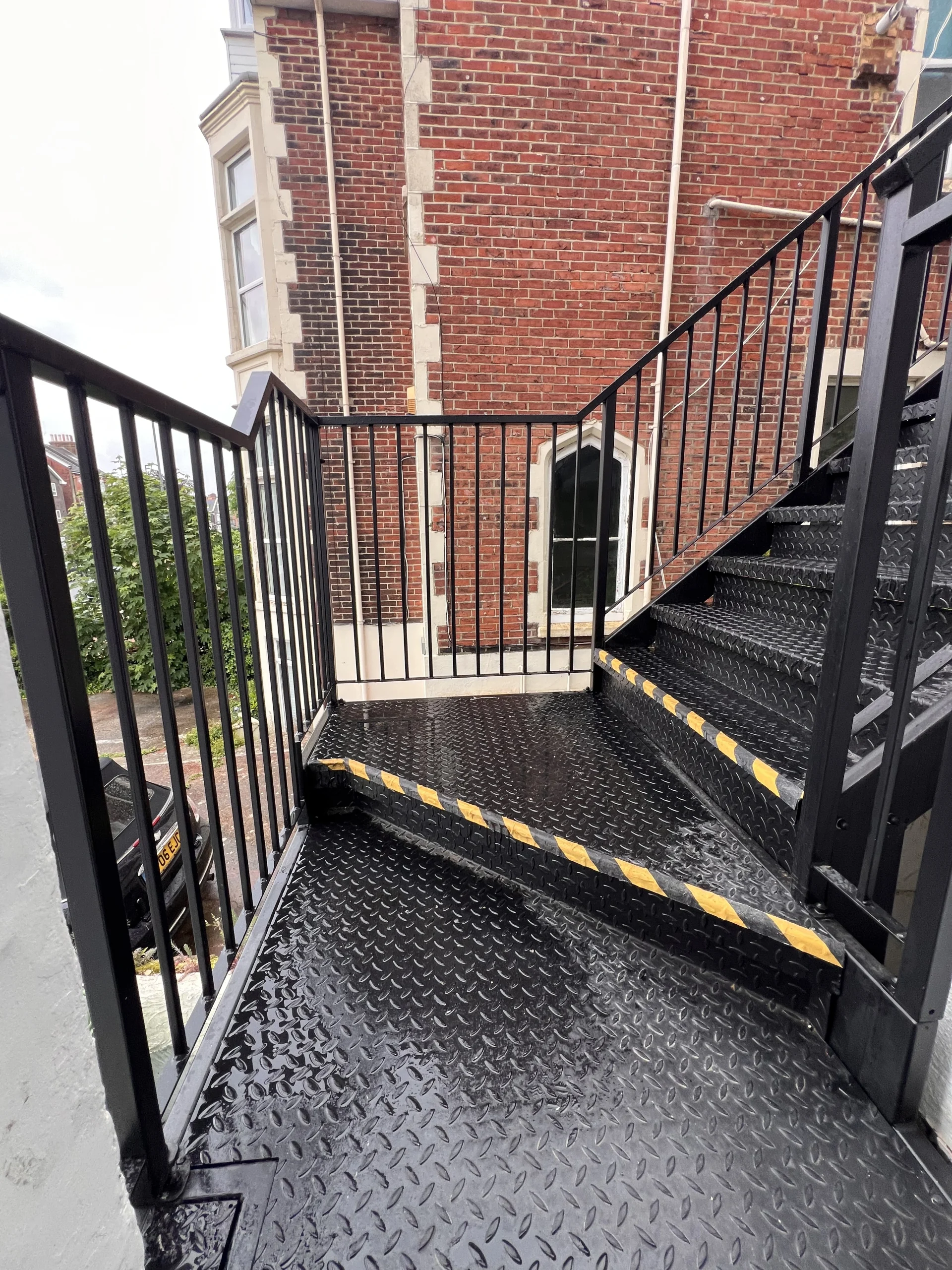


External staircases for basement flat conversions in London typically cost £8,500 to £18,000 all-in for a standard rear-elevation lightwell descent — including manufacture, foundations, drainage interaction, installation and Building Control liaison. Premium specifications with frameless glass balustrade or oak/composite treads sit in the £15,000 to £25,000+ range.
The single biggest reason London basement-flat external stairs cost more than equivalent suburban work is everything around the staircase — Party Wall agreements, build-over consent for drainage, planning permission, conservation-area or Article 4 directions, restricted site access, parking suspensions, and borough-specific basement policies. The steel itself is roughly the same; the project context isn't.
Get the planning, drainage and Party Wall picture clear before commissioning the staircase — it's the difference between a 10-week project and a 24-week one.
London basement flat conversions sit at one of the most regulated intersections in UK property — a borough-specific basement policy, a restrictive Article 4 or conservation-area designation, a Party Wall agreement with at least one neighbour, drainage that almost always needs build-over consent, and Building Control oversight from start to finish. The external access staircase is often quoted last, which is why it's the line item most likely to come in at double the homeowner's budget. This guide breaks down what a London basement flat external staircase actually costs, what's specifically different about commissioning one in the capital, and how to avoid the four common mistakes that turn a £10,000 project into a £18,000 one.
Why London Basement Stairs Cost More Than Elsewhere
Outside London, an external staircase to a basement flat is a relatively contained project — survey, design, manufacture, foundation work, install, sign-off. Inside London, the same physical staircase sits inside a much more complex regulatory and logistical envelope. Five factors push London basement-stair pricing meaningfully above the national norm:
1. Party Wall agreements are almost always required
Most London terraced and semi-detached houses have at least one neighbouring party wall — and any excavation within 3 metres of a neighbour's foundation at a depth below their foundation triggers Section 6 of the Party Wall etc. Act 1996. Almost every basement flat external staircase project requires a Party Wall surveyor and an agreement with at least one neighbour. Surveyor fees typically run £1,000–£2,500 per neighbour involved, sometimes more in prime areas where neighbours instruct their own surveyors at the homeowner's cost.
2. Drainage interaction needs build-over consent
London terraced housing has dense drainage networks, and external basement stairs often pass over, near or directly through a public sewer or shared drain. Where this happens, build-over consent from Thames Water (or the relevant water authority) is required — typically £400–£800 for the application, plus engineering input to demonstrate the new structure won't damage the sewer. Add 4–8 weeks to the programme for Thames Water response.
3. Planning policy is borough-specific
Most London boroughs have specific basement policies that go beyond standard national planning rules. RBKC restricts basements to a single storey below original lowest floor level. Camden has comprehensive subterranean development policies. Westminster places weight on heritage and conservation. Wandsworth applies basement-specific construction management plans. Each borough's quirks affect not just the basement itself but the external staircase that serves it.
4. Site access is genuinely restrictive
Most London basement flat addresses have restricted vehicle access — narrow streets, residents' parking, no off-street loading. Delivery of a fabricated steel staircase typically requires road closure permits, parking suspensions, hoarding licences, and sometimes night-time installation. Permit costs alone routinely add £800–£2,000; crane hire for awkward access can add £1,500–£3,500 more.
5. Conservation areas and Article 4 directions cover most prime postcodes
The majority of central and inner London is within a conservation area, and many high-value postcodes have Article 4 directions removing permitted development rights for external alterations. A rear-elevation external staircase that would be permitted development in suburban Manchester typically requires planning permission in central London — adding 8–12 weeks lead time and £500–£1,500 in design and submission fees.
London Basement Flat External Staircase Cost — at a Glance
The table below summarises typical London-specific pricing bands. All figures are all-in installed cost and include the London-specific overheads (Party Wall, drainage, restricted access) that don't apply elsewhere.
| Specification Tier | Configuration | London Price (Installed) | Lead Time |
|---|---|---|---|
| Standard rear lightwell | 6–8 risers, galvanised + powder-coat, mild balustrade | £8,500 – £12,000 | 8–10 weeks |
| Mid-spec lightwell | Add powder-coat custom RAL, mesh balustrade | £11,000 – £15,000 | 10–12 weeks |
| Premium lightwell ★ | 17mm laminated glass balustrade, hardwood treads option | £15,000 – £20,000 | 10–14 weeks |
| Architectural villa spec | Oak treads, frameless glass, anthracite RAL | £18,000 – £28,000+ | 12–16 weeks |
| Heritage / listed building | Period-correct detailing per consent | £15,000 – £30,000+ | 14–20 weeks |
| Front-elevation lightwell | Visible from highway, planning-led specification | £16,000 – £30,000+ | 12–18 weeks |
These bands assume a single rear-elevation lightwell access serving a self-contained basement flat. Properties requiring two means of escape (some HMO conversions, some multi-flat schemes) double the staircase work. Front-elevation lightwell stairs almost always carry planning-led specification requirements and lead time penalties.
Borough-Specific Considerations
The boroughs below contain the largest concentrations of London basement flat conversions and have either explicit basement policies or strong conservation-area protection. The list isn't exhaustive — but if your project is in one of these areas, expect additional design and consent steps.
Royal Borough of Kensington & Chelsea
Restrictive basement policy: single storey below original lowest floor only, no "iceberg" basements, maximum 50% of garden at basement level. External staircases must integrate with these volumetric limits. Heavy conservation-area coverage.
Most restrictiveCamden
Comprehensive subterranean development policy with construction management plan requirements. External lightwell stairs typically need detailed CMP showing dust, noise, and vehicle movement controls. Heavy weight on neighbour amenity.
CMP requiredWestminster
Strong heritage emphasis — listed buildings widespread, conservation areas cover most of borough. External lightwell stairs on visible elevations almost always need period-correct detailing or specific architectural consent.
Heritage-ledWandsworth
Active basement policy with construction-management requirements. Particularly strong rules on dust suppression, working hours, and lorry routing. Has formal basement working group considering specific applications.
CMP requiredHammersmith & Fulham
Conservation-area heavy, particularly Brackenbury and Olympia. Article 4 directions cover much of the borough. Most rear-elevation stairs require planning approval where they would be permitted development elsewhere.
Article 4 commonIslington
Strong conservation-area coverage in Canonbury, Barnsbury, and the Angel. Many properties listed Grade II. External staircase consent typically requires Listed Building Consent in addition to standard planning.
Listed commonOutside the prime central boroughs
Outer London boroughs (Bromley, Croydon, Barnet, Sutton, Hillingdon and similar) typically have less restrictive basement policies and lower planning sensitivity. Standard rear-elevation external lightwell stairs often fall within permitted development. Project costs in outer London typically run 10–15% lower than inner London because of easier site access and lighter regulatory overhead — but still 15–20% above equivalent suburban-county work because of London labour rates. For ongoing maintenance after install see our external staircase maintenance guide.
Planning, Consents & Sequence of Approvals
The single most common mistake on London basement flat external staircase projects is commissioning the staircase before all upstream consents are in place. The result: a fabricated staircase ready to install, but a missing Party Wall agreement or build-over consent that holds up the project for 4–8 weeks while delivery and storage charges accrue. The correct order is:
The seven-step approval sequence
- Step 1 — Planning permission (if required). Submitted with full architectural drawings showing staircase, balustrade specification and material samples. Determination: 8–13 weeks. Where the property is in a conservation area, allow longer.
- Step 2 — Listed Building Consent (if applicable). Runs in parallel with planning where the building is listed. Conservation officer involvement adds 2–6 weeks; specification often needs amendment to satisfy heritage concerns.
- Step 3 — Party Wall notice. Served on relevant neighbours 2 months before excavation begins. If a neighbour dissents, surveyors are appointed and an Award is drafted. 4–12 weeks depending on cooperation.
- Step 4 — Thames Water build-over consent. Application submitted with engineer's drawings showing the staircase's relationship to any nearby sewer. 4–8 weeks for approval; conditions may require minor design changes.
- Step 5 — Building Regulations approval. Full Plans submission to Building Control or Approved Inspector. Includes structural calculations to BS EN 1090-1 EXC2, drawings, and Declaration of Performance for UKCA marking. Where the staircase serves as means of escape, additional BS 9991 compliance applies. 5–8 weeks.
- Step 6 — Construction Management Plan. Required by most central boroughs. Covers vehicle movements, dust suppression, working hours, neighbour notification. 2–4 weeks.
- Step 7 — Road and parking permits. Crane bay suspensions, scaffolding licences, skip permits. Lead time varies by borough — RBKC typically 3 weeks, Camden 2 weeks, outer boroughs often less.
Homeowners often commission the staircase as soon as planning is granted, assuming the rest is "paperwork." In London, Party Wall and build-over consent are not paperwork — they're hard pre-conditions on excavation. Order the staircase before these are settled and you risk paying delivery and storage on a finished asset for 4–8 weeks. A reputable London-experienced manufacturer will hold off ordering steel until upstream consents are confirmed.
The 8 Cost Drivers in London Basement Flat Stairs
Borough Location
Inner-London prime postcodes (RBKC, Camden, Westminster) cost 20–35% more than outer-London equivalent work. The premium covers permit complexity, parking suspensions, and the higher labour rates across the whole project.
Highest impactLightwell Size & Geometry
A simple rectangular lightwell with straight-flight access is the budget configuration. Curved lightwells, double-sided access, or extended lightwells with two flights add structural complexity and cost. Typically £1,500–£4,500 difference.
High impactDrainage Interaction
If the stair passes over or near a public sewer, build-over consent and engineering input add £900–£2,500. Where drainage redirection is required, costs can reach £3,500–£6,000 including new drain runs.
Hidden cost riskParty Wall Scope
One amenable neighbour: £1,000–£1,500 surveyor cost. Multiple neighbours, dissenting neighbour, or appointed second surveyor: £3,000–£6,000+. Particularly material in mid-terrace properties with parties on both sides.
VariableBalustrade Specification
Mild steel vertical bar (~£200/m) is the budget option, often required for drainage compliance in lightwells. Perforated mesh, glass infill, frameless laminated glass each step pricing up — frameless glass adds £350–£500/m over baseline.
Medium-highFinish System
Hot-dip galvanising is standard. Add powder-coat in standard RAL 9005 black for £400–£800. Custom RAL (anthracite RAL 7016 is most popular in London) adds £800–£1,500. Specialty finishes (anodised bronze) add more again.
MediumSite Access
Rear access through a side passage is the easiest. Front-only access requires lifting through the property or by crane over the building. Crane access for awkward sites adds £1,500–£3,500; through-property access adds time but rarely material cost.
VariableTread Material
Galvanised steel plate is baseline. Open grating is small premium. 40mm solid oak treads add £2,500–£5,000 across a typical stair. For rear lightwells the spec choice is often pragmatic; for front-elevation visible stairs the architect-led tread choice can dominate cost.
MediumThree Worked London Examples — Real Project Costs
- Single-flight rear lightwell descent, 7 risers
- 900mm tread width
- Galvanised + black powder-coat (RAL 9005)
- Perforated mesh balustrade (drainage compliance)
- Open grating treads, slip-rated
- One Party Wall agreement (single neighbour)
- No drainage redirection required
- Rear-access site, no crane needed
- Steel manufacture: £4,400
- Galvanising + powder-coat: £700
- Structural design + calcs: £550
- Transport + permits: £450
- Foundation work: £750
- Build-over consent + drainage check: £450
- Party Wall surveyor: £1,200
- Installation (2 days, 2 fitters): £1,650
- Building Control liaison: £350
- Skip + parking permits: £350
- Rear lightwell, 8 risers + small landing
- 1000mm tread width (architect specification)
- Galvanised + custom RAL 7016 anthracite
- 17mm laminated glass balustrade
- Open grating treads, slip-rated
- Two Party Wall agreements (mid-terrace)
- Build-over consent (Thames Water)
- Conservation Area planning application
- Construction Management Plan
- Steel manufacture: £5,800
- Galvanising + custom RAL: £1,150
- 17mm laminated glass + fixings: £2,400
- Structural design + calcs: £700
- Planning application + drawings: £1,400
- Build-over consent + drainage redirection: £1,200
- Two Party Wall surveyors: £2,600
- Installation (3 days, 3 fitters): £2,200
- Permits + CMP: £950
- Rear lightwell + cantilevered landing, 9 risers
- 1100mm tread width (architect specification)
- Galvanised + custom RAL 7016 anthracite
- 40mm solid European oak treads, hardwax-oil finish
- Frameless 17mm laminated glass balustrade
- Stainless point fixings, hidden brackets
- Listed Building Consent + planning
- RBKC borough — full CMP required
- Crane access through restricted street
- Steel manufacture (precision spec): £8,400
- Galvanising + RAL 7016: £1,650
- 40mm oak treads (9 risers): £2,800
- Frameless laminated glass + point fixings: £3,400
- Structural design + engineering: £1,200
- Listed Building Consent + planning: £2,400
- Build-over consent + drainage redirection: £1,800
- Three Party Wall surveyors (corner site): £4,200
- CMP + permits + crane: £2,800
- Installation (5 days, 3 fitters): £3,400
Four Common Mistakes on London Basement Stairs
Mistake 1: Ordering steel before consents
The single most common mistake. Homeowner gets planning approval, signs the manufacturer's order, then discovers that Party Wall negotiations are stuck or build-over consent needs design amendment. Steel arrives, can't be installed, sits in a yard accruing storage charges (£200–£600 per week). Fix: hold ordering until all upstream consents are settled. A reputable London manufacturer will guide on this.
Mistake 2: Underbudgeting Party Wall
Party Wall surveyor cost is often given as "around £1,000" early in the project — and that's accurate for one cooperative neighbour. Mid-terrace London properties typically have two parties; corner sites and end-of-terrace may have multiple. Each dissenting neighbour can appoint their own surveyor (paid by the building owner). Realistic budget: £1,500–£2,500 for one cooperative neighbour, £3,500–£6,500 for complex multi-neighbour scenarios.
Mistake 3: Missing the build-over consent
Most London terraced houses have at least one shared or public sewer near the rear lightwell. Many homeowners assume the sewer is irrelevant to the staircase — until Building Control flags it during plan check. Build-over consent then needs to be obtained mid-project, adding 4–8 weeks delay. Fix: get a Thames Water sewer map at the earliest project stage and design around (or with) any sewers from day one.
Mistake 4: Solid balustrade in lightwell drainage
Lightwells flood unless drainage is good and air can move freely. A solid-panel balustrade (sometimes specified for design reasons) can trap leaves, debris and standing water at the lightwell base. Insurance and Building Control increasingly flag this. Fix: specify perforated mesh, vertical bar, or open glass balustrade for any balustrade enclosing a lightwell. Solid balustrade is fine for the staircase flight itself, problematic at the lightwell perimeter. For comparable specification advice on flat-block applications see fire escape stairs for apartments.
Why London-Experienced Manufacture Matters
Continox manufactures basement flat external staircases for London projects across the standard, premium and architectural tiers — from £8,500 standard rear lightwell through to £30,000+ prime-central architectural. The manufacturing standard is identical across the range (EN 1090-1 EXC2, UKCA marked, 5-year warranty); the difference between a £10,000 and a £25,000 project is materials, finishing, and the regulatory complexity of where the property sits. Our installers regularly work in RBKC, Camden, Westminster, Wandsworth and Hammersmith — they know how to schedule around restricted access, parking suspensions, and CMP requirements without losing the project programme.
London Basement Stair Common Questions
How much does a basement flat external staircase cost in London?
Standard rear lightwell access typically costs £8,500–£12,000 in London; premium specifications £12,000–£20,000; architectural prime-central work £20,000–£30,000+. London pricing runs 20–35% above suburban equivalent because of regulatory and site context.
Do I need planning permission for a basement lightwell stair?
Front-elevation lightwells almost always require planning. Rear-elevation stairs may fall under permitted development outside conservation areas, but most central London is in a conservation area or covered by Article 4. Always confirm with the borough.
Is a Party Wall agreement needed?
Almost always for London terraced and semi-detached houses. Excavating within 3m of a neighbour's foundation at a depth below their foundation triggers Section 6 of the Party Wall etc. Act 1996. Surveyor cost £1,000–£2,500 per neighbour, more if dissenting.
What's build-over consent and do I need it?
Where the staircase or lightwell passes near or over a public sewer, Thames Water build-over consent is required. Typically £400–£800 application fee plus engineering input. Apply at design stage to avoid mid-project delay.
How long does a London basement stair project take?
Standard projects: 8–10 weeks from order if consents are settled. Conservation area or premium spec: 10–14 weeks. Listed building or prime-central: 14–20 weeks. The variable is consent processing, not manufacturing time.
Can I install during winter?
Yes, weather rarely affects steel staircase installation in London — the work is mostly cutting, drilling and bolting onto prepared foundations. Winter constraint tends to be foundation pour conditions rather than the staircase itself.
What about HMO basement flat conversions?
HMO basement flats may need two means of escape — one internal and one external — depending on floor area and occupancy. This effectively doubles the staircase scope. Confirm with HMO licensing officer at the design stage. See our HMO fire escape requirements for detail.
How much value does a basement flat conversion add?
UK basement conversions typically add 10–15% to property value in London, though the figure depends on neighbourhood, finish quality, and whether the result is a self-contained flat or an extension of the main residence. Local agent advice is the most reliable measure.
London Basement Flat External Stair — Detailed FAQs
How much does an external staircase for a basement flat cost in London?
A London basement flat external staircase typically costs £8,500–£12,000 for a standard rear-lightwell descent, £12,000–£20,000 for a premium specification with glass balustrade or hardwood treads, and £20,000–£30,000+ for architectural prime-central installations. All ranges include manufacture, galvanising and powder-coat, structural calculations, foundations, drainage interaction, Party Wall surveyor, planning where required, installation and Building Control liaison. London pricing runs 20–35% above equivalent suburban projects because of Party Wall, build-over consent, restricted site access, parking suspensions, and borough-specific basement policy compliance — not the steel itself.
Do I need planning permission for a rear basement flat lightwell stair?
Often yes in London, despite being permitted development in many other parts of the UK. Most central and inner London is within a conservation area, and many high-value postcodes have Article 4 directions removing permitted development rights for external alterations. Front-elevation lightwell stairs almost always need planning permission. Listed buildings need Listed Building Consent in addition. Always confirm with the borough planning department before commissioning. Where planning is required, allow 8–13 weeks for determination plus longer for conservation-area or Listed Building consent.
What is a Party Wall agreement and when is one needed?
The Party Wall etc. Act 1996 governs work that affects shared structures and excavation near neighbouring foundations. For basement flat external staircase work, Section 6 of the Act applies whenever excavation goes within 3 metres of a neighbour's foundation at a depth below their foundation level — which is almost always the case for a London basement lightwell. The building owner must serve a Party Wall notice on each affected neighbour at least 2 months before work starts. If a neighbour dissents (or fails to respond), Party Wall surveyors are appointed and an Award is drafted. Surveyor costs are typically borne by the building owner — £1,000–£2,500 per cooperative neighbour, £3,000–£6,000+ where multiple surveyors are appointed.
What is build-over consent and when do I need it?
Build-over consent is approval from the local water authority (Thames Water for most of London) to build over or near a public sewer. It applies whenever a structure — including foundations for an external staircase — sits within 3 metres of a public sewer, or directly over a sewer. The application requires engineer's drawings showing the staircase's relationship to the sewer and demonstrating that the new structure won't damage or restrict access to it. Thames Water typically takes 4–8 weeks to respond. Application fee is £400–£800, plus engineering input. Where build-over consent isn't possible, drainage redirection is needed — typically £2,500–£5,000 for new drain runs.
How does the staircase fit into the wider basement conversion programme?
For a typical London basement flat conversion, the external staircase is installed in the final third of the project — after underpinning, lightwell excavation, waterproofing and main construction are largely complete, but before final landscaping and decoration. The staircase typically sits on dedicated foundations cast as part of the lightwell construction, then is delivered, lifted into place and bolted down by the manufacturer's own installers. Total staircase work on site is 1–4 days; the longer pre-work is foundation cure time and consent management. A reputable manufacturer schedules delivery to slot into the wider conversion programme rather than driving it.
Why is custom RAL 7016 anthracite so popular in London?
RAL 7016 (anthracite grey) has become the de facto premium finish for London external steelwork — staircases, balustrade, gates, garage doors and external lighting are now routinely specified in this colour. Three reasons: it sits comfortably with London's grey-and-cream Georgian and Victorian housing stock without competing with stone or brick; it's neutral enough to satisfy conservation officers in conservation areas; and it's substantially less stark than RAL 9005 black on visible elevations. The cost premium over standard black is £400–£800 — typically a small share of overall project cost on a project of any meaningful scale.
What's the realistic timeline from enquiry to installed staircase?
For a standard London basement flat external staircase project where planning isn't required (rear-elevation, outer borough, no conservation area), realistic timeline is 8–10 weeks from order: 1–2 weeks site survey and design, 4–5 weeks manufacture and finishing, 1–2 weeks foundation work and Party Wall, plus the installation itself. For a conservation-area project requiring planning: add 8–13 weeks for the planning determination at the start. For Listed Building Consent or prime-central work with full CMP requirements: 14–20 weeks from initial enquiry is realistic. The programme is dominated by consent processing, not manufacturing.
Should I consider the staircase before or after the basement excavation?
Before — at the design stage, before any excavation begins. The reason: foundations for the external staircase sit within or adjacent to the lightwell excavation, and the lightwell geometry is often shaped by where the staircase will land. Designing the staircase after excavation is complete frequently means the basement foundations are in the wrong place to take the staircase loads, requiring additional foundation work (£800–£2,500). The most efficient sequence: architect designs basement and lightwell in parallel with staircase manufacturer's input, then a single set of foundations serves both.
Can a basement flat external staircase serve as fire escape?
Yes — and in many London basement flat conversions the external lightwell stair is the primary or secondary means of escape from the flat. This typically means the staircase needs to comply with Approved Document B (means of escape) in addition to Approved Document K (geometry). For HMO basement flats, two independent means of escape are often required. Specifying the stair as means of escape from day one is straightforward; retro-fitting compliance after the fact is expensive. Confirm fire strategy at the design stage with Building Control or a fire engineer. See our fire escape cost cornerstone and designing effective fire escape staircases for fire-escape-specific specification detail.
Does Continox install in central London boroughs?
Yes — Continox installs across all London boroughs including the prime central areas (RBKC, Camden, Westminster, Hammersmith & Fulham, Islington, Wandsworth) and outer London. Our installers are familiar with borough-specific construction management requirements, parking suspension procedures, and the typical access constraints of London terraced housing. We hold the EN 1090-1 EXC2 certification, UKCA marking and Declaration of Performance documentation that London Building Control requires. See the external staircase range for typical specifications and the project portfolio for completed installations.
Get a Fixed-Price London Quote
Send us your borough, photographs and basement plans — we'll return a fixed-price quote with full London-specific specification, EN 1090-1 EXC2 certification, and a 5-year manufacture warranty. From £8,500 standard rear-lightwell to £30,000+ architectural prime-central, all engineered to the same standard.