

How Much Does a Fire Escape Staircase Cost in the UK?
A transparent breakdown of UK fire escape and external staircase pricing — from £3,500 entry-level residential to £30,000+ architectural commissions. From a manufacturer that publishes real numbers, not "request a quote" walls.
Updated May 2026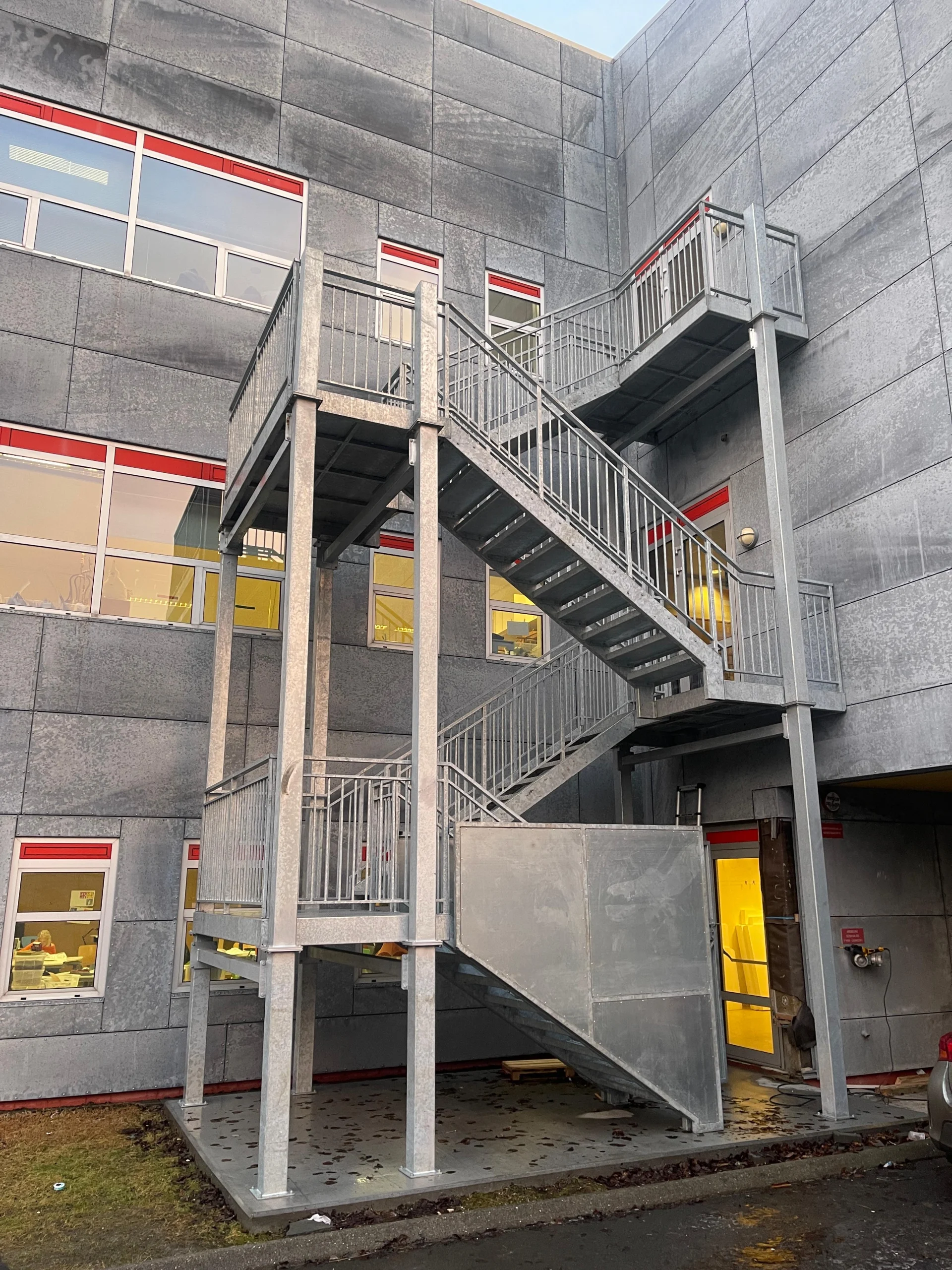
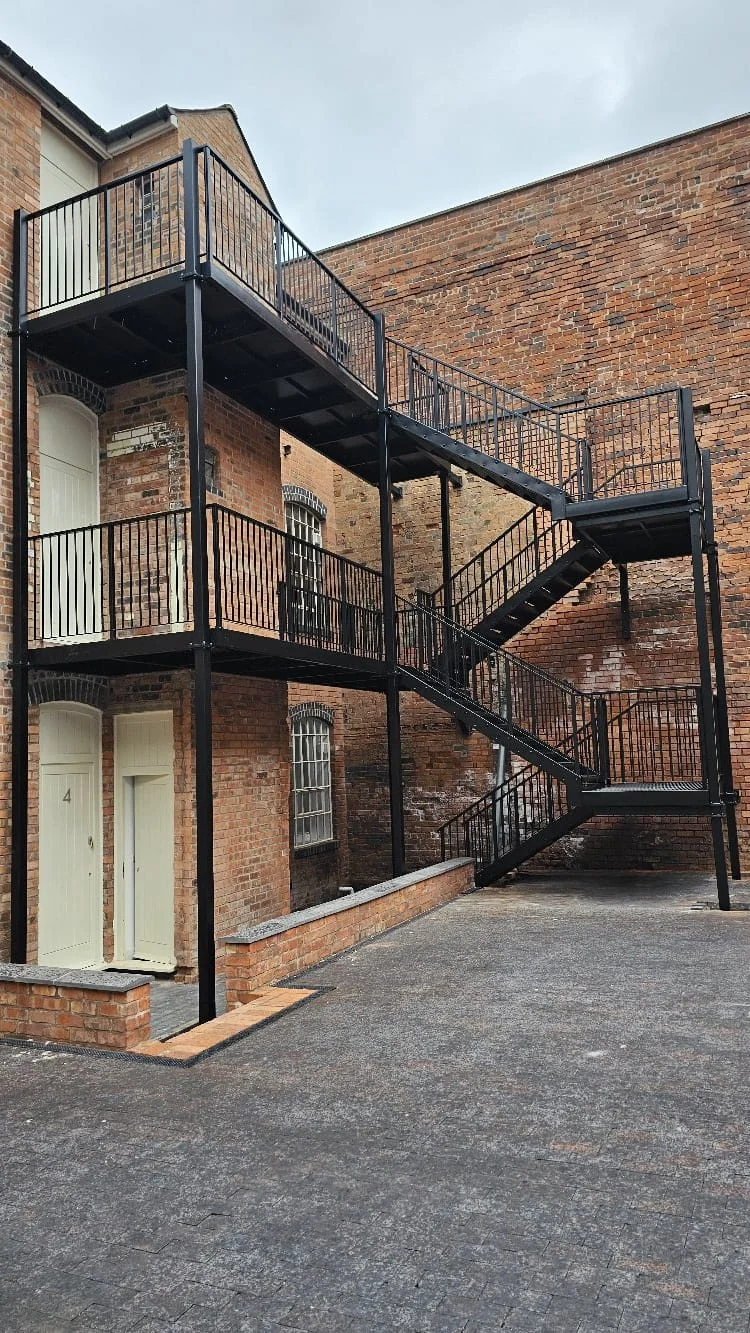
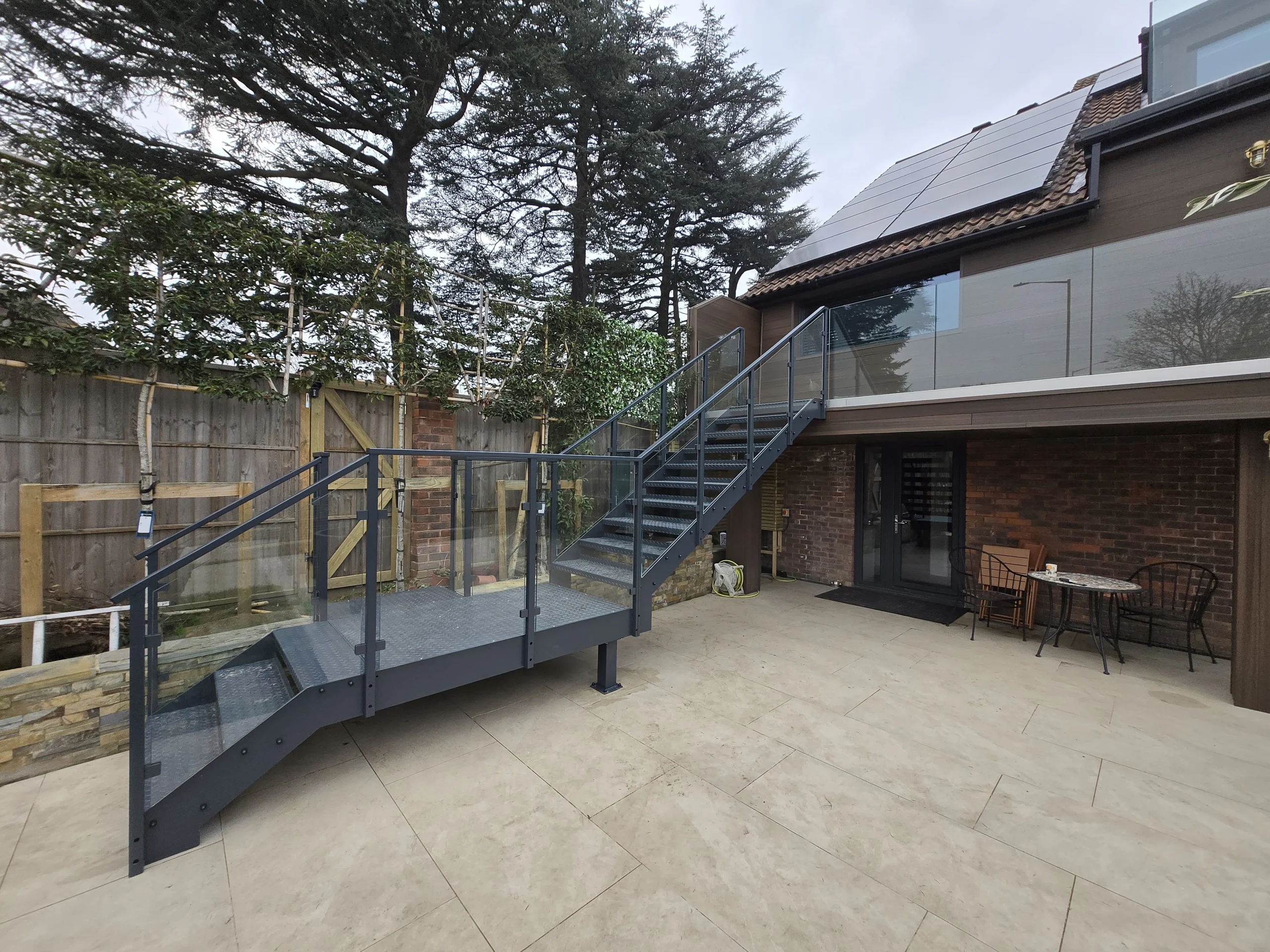
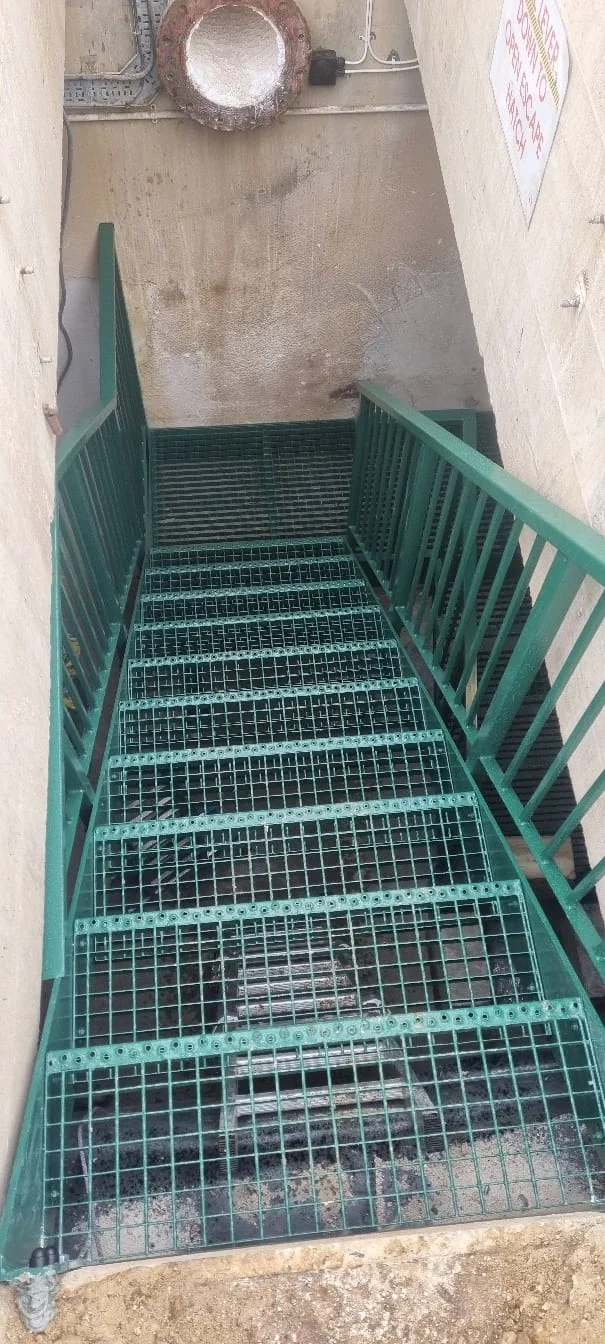
Residential fire escapes typically run from £3,500 to £11,000 for a single-flight 2–3 storey unit, including manufacture, finish, delivery and installation. Commercial fire escapes sit in the £5,500 to £20,000 band, with multi-storey HMOs, hotels and offices typically in the £8,000–£15,000 range. Industrial-scale assemblies with multiple landings, complex returns or specialist coatings start at £8,000 and reach £40,000+ for 5+ storey distribution centres.
Architectural and designer external staircases — oak treads, frameless laminated glass balustrade, custom RAL finishes, helical or curved geometry — range from £20,000 to £50,000+. These are featured external installations on premium villas, listed building extensions, hotels and design-led commercial schemes — not utilitarian fire escapes.
Continox publishes fixed prices because most UK projects can be scoped accurately from a few measurements and photographs — buyers should not need to chase three quotes to learn what a compliant staircase costs.
Asking "how much does a fire escape staircase cost in the UK?" is the right question — but most online answers give vague ranges, hide behind "request a quote" forms, or quote bare steelwork without installation. This guide breaks down the real all-in cost for residential, commercial and industrial fire escapes, explains the eight cost drivers that actually move the price, walks through three worked examples, and shows where buyers commonly get stung by hidden costs. All pricing reflects a fully compliant staircase to BS EN 1090-1 EXC2, designed and engineered to Approved Document B and BS 9999 / BS 9991 as applicable.
Fire Escape Staircase Cost at a Glance
The table below summarises typical UK pricing bands for fully compliant fire escape staircases, including manufacture, hot-dip galvanising or powder-coat finish, transport, and installation by a competent installer. Prices reflect the all-in fixed quote model — not "from £x" headline figures that exclude balustrade, landing, fixings, or installation.
| Building Type | Typical Configuration | Price Band (Installed) | Lead Time |
|---|---|---|---|
| Single dwelling — 1st floor escape | One flight, galvanised, mild handrail | £3,500 – £6,500 | 4–6 weeks |
| Domestic conversion (HMO) | Two flights + landing, galvanised + powder-coat | £6,500 – £11,000 | 4–8 weeks |
| Small commercial — 2 storey | Single flight + half landing, full balustrade | £5,500 – £9,500 | 5–7 weeks |
| Commercial — 3–4 storey | Multiple flights, intermediate landings | £11,000 – £20,000 | 6–10 weeks |
| Industrial / 5+ storey | Multi-flight, complex returns, specialist coating | £15,000 – £40,000+ | 8–12 weeks |
| Architectural / Designer External ★ | Oak + laminated glass, custom RAL, helical | £20,000 – £50,000+ | 8–14 weeks |
| Replacement of existing | Like-for-like, removal + install | +£800 – £2,500 disposal | +1–2 weeks |
These bands assume reasonable site access, standard ground conditions for foundation pads, and no specialist finishes (such as marine-grade paint or stainless steel). Premium finishes, bespoke balustrade infill (glass, perforated mesh, custom RAL), and difficult access can each push pricing toward the upper end of the band.
Residential Fire Escape Cost — £3,500 to £11,000
Residential fire escape staircases are required when a dwelling — most commonly a flat conversion, basement annexe, granny flat or HMO — needs an alternative means of escape from upper floors. The cost depends on whether the escape is a simple ground-to-first-floor unit, or a multi-storey assembly serving converted maisonettes or houses in multiple occupation.
Single dwelling — first floor escape (£3,500–£6,500)
The simplest configuration is a straight-flight staircase from a first-floor window, door or balcony down to a garden, courtyard or driveway. A galvanised steel staircase with mild steel balustrade and a powder-coat finish typically falls in this band. Most projects in this category include around 13–14 risers, a width of 800–900mm, and a single landing platform at the upper level.
HMO and converted property (£6,500–£11,000)
Houses converted into multiple flats — particularly three-storey conversions in London and the Home Counties — require multi-flight escapes with intermediate landings serving each storey. Costs rise because of additional steel tonnage, more complex foundations, and the need for compliant balustrade across multiple landings. HMO fire escape requirements are governed by the relevant local authority's HMO licensing standards alongside Approved Document B.
What's included in residential pricing
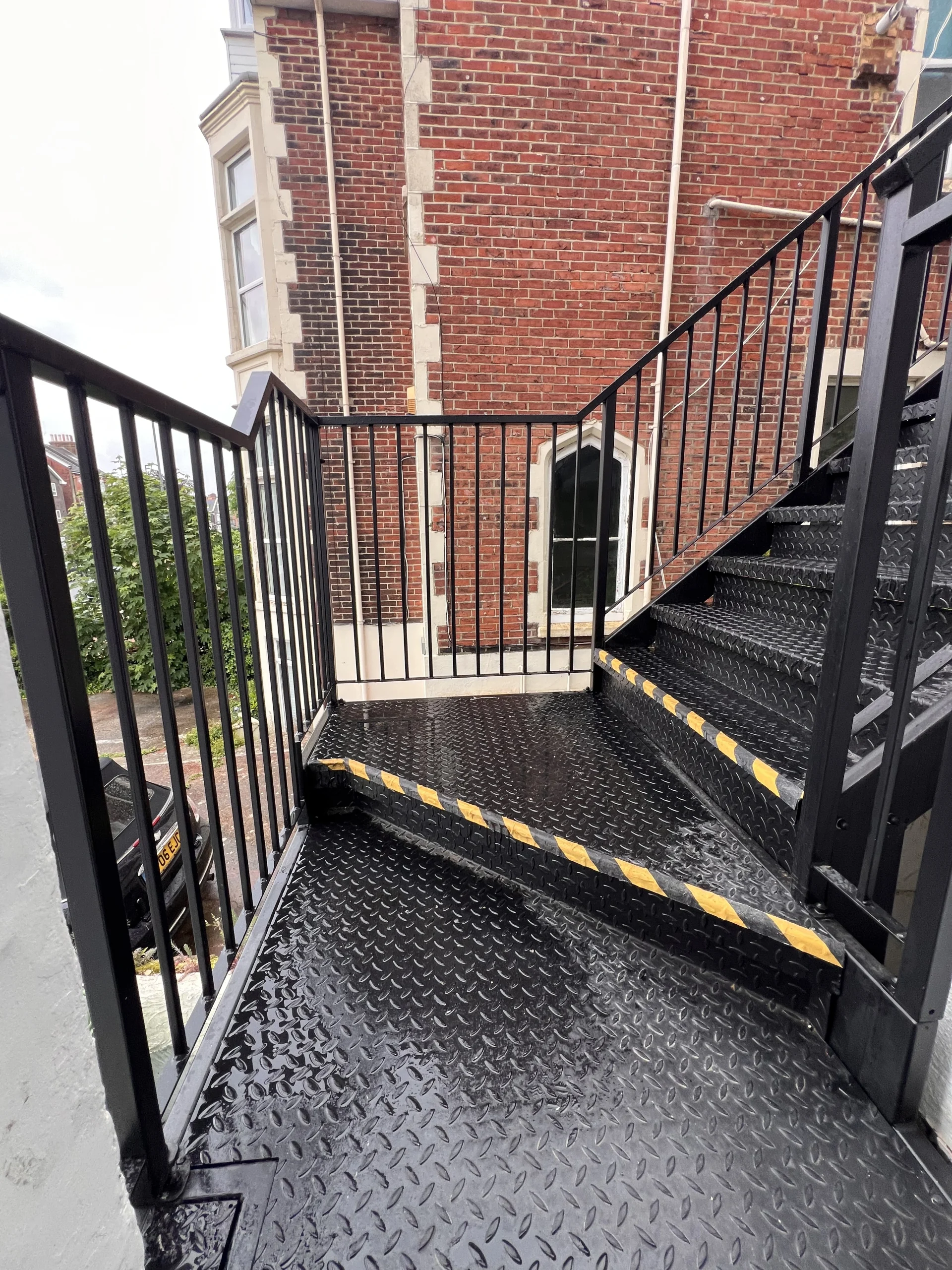
A properly costed residential fire escape includes: structural design and calculations to BS EN 1090-1 EXC2, manufactured steel components, hot-dip galvanising (and powder-coat where specified), balustrade and handrail to Approved Document K, fixings to wall or ground, transport to site, installation by a competent crew, and handover documentation. What it should not exclude (but often does in cheap quotes) is foundation work, structural fixings into the host building, and waste removal.
Commercial Fire Escape Cost — £5,500 to £20,000
Commercial fire escape staircases serve buildings governed by the Regulatory Reform (Fire Safety) Order 2005 — offices, shops, restaurants, hotels, care homes, schools, places of assembly. They are designed to BS 9999 (commercial life safety) and must accommodate higher occupancy loads, wider treads, and more demanding handrail and balustrade requirements than residential.
2-storey commercial (£5,500–£9,500)
A typical small-shop, restaurant or 2-storey office fire escape with a single flight plus half-landing, full compliant balustrade, and galvanised + powder-coat finish sits in this band. Width is typically 900–1100mm to accommodate occupancy load.
3–4 storey commercial (£11,000–£20,000)
This is the most common commercial bracket — boutique hotels, mid-size offices, restaurants over multiple floors. Pricing scales with the number of flights, intermediate landings, and balustrade run. Buildings within scope of BS 9991 (residential life safety) for mixed-use developments may have additional design requirements.

Hospitality and care home (£11,000–£18,000)
Hotels, restaurants, and care homes have specific code obligations that influence cost: travel distances under BS 9999 may dictate two means of escape, care homes under CQC and HTM 05-02 guidance require generous tread widths and handrail on both sides for ambulant disabled users, and hotels typically need fully enclosed protected escape routes. Hotel fire escape design often involves higher-spec balustrade infill — typically perforated mesh or laminated glass to maintain protected route requirements.
Industrial Fire Escape Cost — £8,000 to £40,000+
Industrial fire escape staircases serve warehouses, factories, distribution centres, and tall commercial buildings beyond four storeys. They are designed to BS 9999 with reference to BS 5395-3 for industrial stair geometry, and frequently include load-rated grating treads, kicker plates, and heavier-section steelwork.
Simple industrial access (£8,000–£12,000)
A single-flight industrial access staircase serving a mezzanine, plant deck or external loading area. Galvanised steel with open grating treads and standard industrial balustrade.
Multi-storey industrial (£15,000–£40,000+)
Five-storey-plus warehouse fire escapes, factory secondary escapes, and large-scale distribution hubs require substantial steel tonnage, multiple landings, and often specialist coatings (marine-grade for coastal sites, intumescent paint where local fire engineering requires). At this scale, external staircase design is typically tied into the building's fire engineering strategy. A 6-storey distribution centre with full perimeter balustrade, kicker plates, and marine-grade coating routinely lands at £30,000–£40,000.

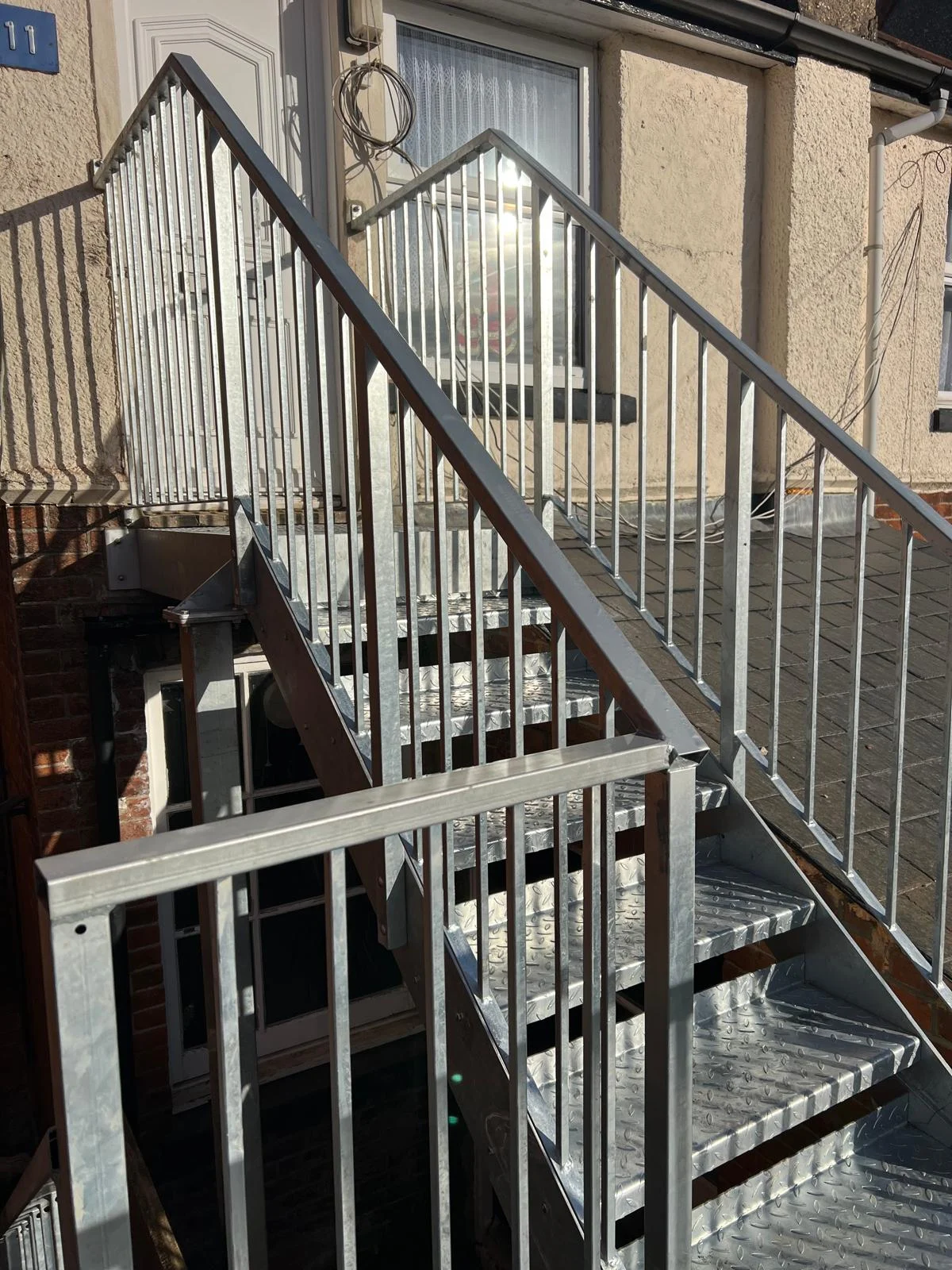
Two industrial projects of the same height can differ by £8,000+ based on tread type alone. Solid plate treads with anti-slip nosings cost less than perforated grating; cast-iron tread inserts and bolt-on anti-slip plates add cost again. Balustrade specification (mild steel mesh vs. stainless wire vs. solid plate kick) is the second-largest variable.
Architectural & Designer External Staircases — £20,000 to £50,000+
Beyond the standard fire escape and industrial categories sits a distinct premium tier: external staircases designed primarily as architectural features. These projects share full life-safety compliance with their utilitarian counterparts, but specification, materials and design intent push pricing into a separate band. Continox routinely delivers projects in this range — design-led external installations for high-end residential, boutique hospitality and signature commercial schemes.
What defines this tier
Five characteristics set architectural external staircases apart from standard fire escape pricing — and together they explain why a 3-storey external can cost £30,000+ while a comparable utilitarian fire escape costs £15,000:
- Tread material upgrade — Solid European oak (40–50mm), thermally-modified ash, IPE hardwood, or precision-cut steel plate with hidden fixings instead of standard galvanised grating. Tread upgrade alone adds £2,500–£6,000 across a typical staircase.
- Frameless or minimal-frame glass balustrade — 17mm toughened laminated glass with stainless point fixings or slot channels, replacing mild steel mesh. Adds £350–£500 per linear metre over standard.
- Custom RAL or anodised finish — Anthracite RAL 7016, anodised bronze, or other architect-specified finishes. Custom RAL adds £1,500–£3,000; specialty finishes more.
- Curved, helical or sculptural geometry — CNC-formed strings, segmental landings, true cantilever returns. Geometry alone can add £4,000–£12,000.
- Hidden structural connections — Engineered brackets concealed behind oak fascia or stone cladding rather than exposed bolted plates. Requires additional engineering and finishing time.


Where this tier sits in the UK market
The architectural external staircase market is small relative to standard fire escapes — perhaps 5–8% of UK external staircase commissions — but commercially significant because project values are 2–3× higher than standard. Most installations fall into one of four categories:
- Premium residential — listed-building extensions, contemporary new-builds with substantial garden access, basement-flat conversions in prime London. £20,000–£35,000 typical.
- Boutique hospitality — small hotels, restaurants and members' clubs where the external staircase is a visible architectural element of the scheme. £25,000–£45,000 typical.
- Design-led commercial — co-working spaces, retail flagship buildings, gallery and museum extensions. £30,000–£50,000+ typical.
- Helical and curved external — sculptural staircases serving roof terraces, mezzanine extensions or entry features. £35,000–£60,000+; the technical complexity sets the floor price high regardless of project size.
Continox delivers in all four categories from our EN 1090-1 EXC2 workshop, with the same engineering standard, UKCA marking and 5-year warranty as standard fire escape work. The pricing premium reflects materials and finishing time, not a different quality system. See the external staircase range and project portfolio for examples.
When the staircase is visible from the principal elevation, when it forms part of a design-led architectural scheme (not just a code-driven fire escape), or when the brief specifies materials and geometry incompatible with utilitarian galvanised assemblies. A standard 4-storey commercial fire escape rarely justifies this band; a 3-storey villa extension with floor-to-ceiling glass and oak treads routinely does.
The 8 Cost Drivers That Actually Move the Price
If you understand these eight drivers, you can move from "I have no idea what this should cost" to "I can sense-check any quote I receive." The drivers are listed in approximate order of cost impact — the first two typically dominate, while the last two are often invisible in initial estimates.
Number of Storeys Served
The single largest variable. Each additional storey adds a flight, an intermediate landing, additional balustrade run, and steel tonnage. Roughly 30–40% of total cost scales with storey count.
Highest impactTread Width
Building Regulations dictate minimum widths by occupancy. Going from 800mm domestic to 1100mm commercial increases steel and balustrade by roughly 20–25%. Width above 1200mm typically requires intermediate handrail.
High impactBalustrade Specification
Mild steel infill is the budget option. Perforated mesh adds ~15%; vertical bar with kick plate adds ~20%; powder-coated mesh ~25%; laminated glass infill can double the balustrade line cost.
High impactFinish System
Hot-dip galvanising is included in baseline pricing. Adding powder-coat in a standard colour (RAL 9005 black) typically adds £400–£800. Custom RAL adds £800–£1,500. Marine-grade systems for coastal sites cost more again.
Medium-highTread Type
Solid plate with anti-slip nosing is most economical. Open grating is a small premium. Cast tread inserts, bolt-on anti-slip plates, and timber-clad treads each push cost upward in 10–20% increments.
MediumSite Access
Cherry-picker access vs. crane lift. Restricted urban sites needing road closure permits and night-time installation can add £1,500–£3,500 to install costs alone. Pedestrian-only access with manual handling adds time.
VariableFoundation Requirements
Concrete pad foundations on virgin ground are standard. Existing concrete may need cores. Soft ground or slopes require enlarged pads or piling. This is the most commonly missed line in cheap quotes — easily £800–£3,000.
Hidden cost riskGeographic Location
London and the South East attract a 10–20% installation premium over the North and Midlands due to labour, parking suspensions, and access constraints. Rural or remote sites add transport cost.
MediumHidden Costs Buyers Routinely Miss
Many UK suppliers quote a "from £X" headline number that excludes critical components. Understanding what is — and isn't — in a quote is the difference between a £6,500 budget and a £9,000 final invoice.
Common exclusions in cheap quotes
- Structural calculations and engineer's sign-off — typically £400–£900 if priced separately, often required by Building Control.
- Fixings into the host building — chemical or expansion anchors into masonry, structural connection plates to steel frame.
- Foundation pads — excavation, formwork, concrete, reinforcement. Easily £800–£2,500.
- Waste removal — packaging, off-cuts, and removal of any existing structure.
- Balustrade returns and finials — the bits that close off the ends of a balustrade. Sometimes priced as "extras."
- Compliance with the Construction (Design and Management) Regulations 2015 — for notifiable projects, the principal contractor obligations and CDM documentation.
- Building Control submissions — drawings, calculations, sign-off liaison.
The "request a quote" trap
Roughly 95% of UK fire escape suppliers operate on a quote-only basis with no published pricing. This makes price discovery slow and uneven — buyers often gather three quotes that vary by £4,000+ on identical specifications because each supplier is including (and excluding) different things. Transparent price bands exist to short-circuit this.
Four Worked Examples — Real Project Costs
- 3-storey rear escape
- 2 flights + intermediate landing
- 900mm tread width
- Galvanised + black powder-coat (RAL 9005)
- Vertical bar balustrade with kick plate
- Solid plate treads with anti-slip nosing
- Concrete pad foundation, 2 chemical anchors to brick
- South London, suburban access
- Steel manufacture: £4,200
- Galvanising + powder-coat: £900
- Structural design + calcs: £450
- Transport: £350
- Foundation work: £950
- Installation (2 days, 2 fitters): £1,400
- Building Control liaison: £150
- 4-storey external escape
- 3 flights + 3 landings
- 1100mm tread width (occupancy load)
- Galvanised + custom RAL 7016 anthracite
- Perforated mesh balustrade infill
- Open grating treads, slip-rated
- Existing concrete substrate, structural fixings to steel frame
- Central London, restricted access, road closure
- Steel manufacture: £8,800
- Galvanising + custom RAL: £1,650
- Structural design + calcs: £750
- Transport: £450
- Crane hire + road closure permit: £2,200
- Installation (3 days, 3 fitters): £2,400
- Building Control + fire engineering liaison: £550
- 6-storey external industrial escape
- 5 flights + 5 landings
- 1200mm tread width with intermediate handrail
- Heavy-section galvanised steelwork
- Vertical bar + perforated mesh balustrade
- Open grating treads, kicker plates
- Reinforced concrete pad foundations
- Manchester, accessible site
- Steel manufacture: £14,200
- Galvanising: £1,800
- Structural design + calcs: £1,100
- Transport (oversize loads): £950
- Foundations (5 reinforced pads): £2,400
- Installation (4 days, 4 fitters + crane): £2,650
- Building Control + fire engineering: £400
- 3-storey rear villa external
- 2 flights + cantilevered landing
- 1100mm tread width
- Galvanised steel + custom RAL 7016 anthracite
- 40mm solid European oak treads
- 17mm laminated frameless glass balustrade
- Hidden structural connections, oak fascia
- Stainless point-fix detail
- Surrey, premium residential
- Steel manufacture (precision spec): £11,800
- Galvanising + RAL 7016 anthracite: £2,200
- 40mm solid oak treads (17 risers): £4,800
- 17mm laminated glass + point fixings: £4,500
- Structural design + engineering: £1,400
- Foundations + concealed brackets: £1,650
- Installation (5 days, 3 fitters): £3,200
- Transport + access logistics: £550
Replacement vs New — What's Different?
A significant share of UK fire escape projects are replacements rather than new installations. The most common drivers are corrosion of older galvanised assemblies (typical lifespan 25–40 years depending on exposure), failed inspection by the responsible person under the Regulatory Reform (Fire Safety) Order, or substantial alterations to the building that invalidate the existing escape geometry. Galvanised lifespan varies considerably by exposure environment.
Like-for-like replacement
Where the new staircase matches the geometry of the old, existing foundations can usually be reused after inspection. This saves £800–£1,500 on foundation work. The replacement premium covers controlled removal, disposal of the old steelwork (often recycled, sometimes with a small scrap credit), and the additional installation day.
Upgrade replacement
Many replacements involve specification upgrades — wider treads to meet current occupancy, balustrade infill changes (open bar to mesh), or a switch from galvanised-only to galvanised + powder-coat for aesthetics. Upgrade replacements rarely reuse foundations because the geometry changes. Galvanised vs powder-coated finish choice is one of the most common upgrade decisions.
Lead Times — 4 Weeks to 12 Weeks
Lead time is often as commercially important as price — particularly for fire escapes triggered by a Fire Safety Order enforcement notice or a stop-notice from Building Control. The UK industry standard is 8–12 weeks; manufacturers operating on a streamlined design-to-fabrication workflow can routinely deliver in 4–8 weeks for standard-spec projects.
What drives lead time
- Design and engineering — typically 1–2 weeks for residential, 2–3 weeks for commercial.
- Manufacture — 2–4 weeks depending on complexity and queue at the fabricator.
- Galvanising — adds 7–10 days; powder-coat adds another 5–7 days.
- Site readiness — foundations, host building preparation, access permits.
- Installation slot — typically 1–2 days for residential, 3–5 days for commercial.
Compressed timelines
Where lead time is critical (Fire Safety Order notice, insurance-driven replacement), some manufacturers can compress to 3–4 weeks for residential projects by parallelising design and manufacture. Compressed timelines typically carry a 10–15% premium and require fully accessible sites with no build-up issues.
Why Transparent Pricing Matters for Fire Escapes
Continox publishes fixed prices for fire escape staircases — £3,500 residential, £5,500 commercial entry points — because most UK projects can be scoped from a few measurements, photographs, and a written brief. The "request a quote" model serves the supplier, not the buyer. We design and manufacture every fire escape at our EN 1090-1 EXC2-certified workshop, install with our own crews, and back every project with a 5-year warranty on manufacture and finish. UKCA-marked, BS EN 1090-1 compliant, and engineered to Approved Document B / BS 9999 / BS 9991 as your project requires.
Common Fire Escape Cost Questions
Is a fire escape cheaper than a refurbished internal stair?
Often yes, particularly for HMO conversions. An external fire escape avoids structural alteration to the host building and can cost 30–50% less than creating a new compliant internal protected route.
Do I need planning permission for a fire escape?
Often not for rear elevations on dwellings, but Article 4 directions, Listed Building consent, and conservation areas frequently require permission. Always confirm with your local authority before ordering.
What's the cheapest compliant fire escape?
A single-flight galvanised steel escape from a first-floor window or balcony to a garden, with mild steel balustrade and no powder-coat. Typically around £3,500–£4,500 installed for straightforward sites.
How long does a galvanised fire escape last?
A hot-dip galvanised fire escape typically lasts 25–40 years depending on exposure environment. Coastal and industrial atmospheres reduce life; sheltered suburban locations extend it. Powder-coat over galvanise adds further protection.
Why do some external staircases cost £30,000+?
Premium architectural external staircases — featuring oak treads, frameless laminated glass balustrade, custom RAL finishes or curved/helical geometry — sit in the £20,000–£50,000+ band. Materials, finishing time, and concealed structural connections drive the premium, not utility.
Can I install a fire escape myself?
Strongly inadvisable. Most fire escapes are notifiable under CDM 2015, require structural calculations, and need Building Control sign-off. DIY kits on the market rarely satisfy current Building Regulations for habitable buildings.
What ongoing costs should I budget for?
Annual visual inspection, repainting of any powder-coated areas every 8–12 years, balustrade fixing checks, and replacement of any rubber tread inserts. Typically £100–£300 per year for a residential unit.
Are oak treads suitable for outdoor use?
Yes, with the right specification. Solid European oak at 40mm+ with end-grain sealing and a UV-stable hard-wax oil finish performs reliably for 15–25 years on UK external installations. Thermally-modified oak or IPE hardwood extends this further. Suitable for premium architectural external staircases, not for utilitarian fire escapes.
Fire Escape Cost — Detailed FAQs
What is the average cost of a fire escape staircase in the UK?
The average cost depends heavily on building type and storeys. Typical UK pricing bands are: residential single-flight £3,500–£6,500; HMO multi-storey £6,500–£11,000; small commercial £5,500–£9,500; commercial 3–4 storey £11,000–£20,000; industrial £15,000–£40,000+; and architectural designer external (oak + laminated glass + custom finishes) £20,000–£50,000+. These figures include manufacture, finish, transport, and installation, and assume a fully compliant staircase to BS EN 1090-1 EXC2 with structural design and Building Control liaison included.
How much does a 2-storey fire escape staircase cost?
A 2-storey fire escape typically costs £3,500–£6,500 for a single-dwelling residential application and £5,500–£9,500 for commercial use. The difference reflects wider tread requirements (1100mm vs 800mm), heavier-spec balustrade, and the structural calculations required for higher occupancy loads under BS 9999.
What's included in a fixed-price fire escape quote?
A complete fixed-price quote should include: structural design and engineer's calculations, manufactured steel components to BS EN 1090-1 EXC2, hot-dip galvanising, any specified powder-coat finish, balustrade and handrail to Approved Document K, transport to site, foundation pads (where applicable), installation by a competent crew, structural fixings, waste removal, and Building Control liaison. If any of these are listed as "extra," the headline price is misleading.
Do I need Building Regulations approval for a fire escape staircase?
Yes, in almost all cases. A fire escape forms part of the means of escape under Approved Document B (Volume 1 for dwellings, Volume 2 for non-domestic buildings). Building Regulations approval covers structural adequacy, geometry (rise, going, headroom), balustrade, and integration with the building's fire strategy. Some minor like-for-like replacements may fall outside notifiable work, but the responsible person should always confirm with Building Control before ordering.
What standards does a UK fire escape staircase need to meet?
Manufacture: BS EN 1090-1 (CE/UKCA marking) at execution class EXC2 minimum for fire escape applications. Geometry and balustrade: Approved Document K (England), with parallel guidance in Scotland and Wales. Means of escape: Approved Document B with reference to BS 9999 (commercial life safety) and BS 9991 (residential life safety). Industrial stair geometry may also reference BS 5395-3. Materials traceability and welder qualification fall under EN 1090-2 for executed steelwork.
Why do fire escape quotes vary so widely between suppliers?
Three reasons. First, scope: cheap quotes often exclude foundations, fixings, design calculations, or installation. Second, certification: not all suppliers operate to EN 1090-1 EXC2, and lower-tier execution classes carry materially lower manufacturing costs but may not satisfy Building Control for fire escape applications. Third, supply model: trade-only fabricators selling through resellers add a margin layer that direct-to-end-user manufacturers avoid. Always compare like-for-like specifications and confirm the EN 1090 execution class before judging price.
Is powder-coat worth the extra cost over plain galvanised?
For residential and commercial visible installations, almost always yes. Powder-coat over hot-dip galvanise extends life, improves appearance, and offers a wide colour palette to coordinate with the host building. The £400–£800 premium for a standard colour (RAL 9005 black) typically represents 5–10% of total cost and is one of the highest-value upgrades available. For purely industrial applications where appearance is not a factor, plain galvanised remains cost-effective.
How long does it take from order to installation?
Standard residential fire escapes typically deliver and install in 4–6 weeks from signed order; commercial and industrial in 6–10 weeks. The breakdown is roughly: 1–3 weeks design and engineering, 2–4 weeks manufacture, 1–2 weeks galvanising and finishing, plus a scheduled installation slot. Compressed 3–4 week timelines are achievable for residential at a 10–15% premium where site access is straightforward.
Can a fire escape be designed to look architectural rather than industrial?
Yes. Modern bespoke fire escape design uses laser-cut tread profiles, perforated mesh or laminated glass balustrade, custom RAL finishes, and slimmer-section steelwork to deliver staircases that meet full life-safety standards while reading as architectural features. Cost typically lands at the upper end of the relevant band. External staircase range includes both standard industrial and design-led options.
What makes an external staircase cost £30,000 or more?
Five characteristics push pricing into the £20,000–£50,000+ architectural band: (1) tread material upgrade — solid oak, thermally-modified hardwoods or precision-cut steel plate with hidden fixings instead of standard galvanised grating (£2,500–£6,000 added); (2) frameless or minimal-frame laminated glass balustrade replacing mild steel mesh (£350–£500 per linear metre over standard); (3) custom RAL or anodised finishes (£1,500–£3,000+); (4) curved, helical or sculptural geometry requiring CNC-formed strings (£4,000–£12,000); (5) hidden structural connections behind oak fascia or stone cladding rather than exposed plates. These features stack on premium villa, listed-building, boutique hospitality and design-led commercial schemes — not utilitarian fire escapes. A standard 4-storey commercial fire escape rarely justifies this band; a 3-storey villa extension with oak treads and full glass balustrade routinely does.
Does Continox manufacture premium architectural external staircases?
Yes. The same EN 1090-1 EXC2 workshop that produces standard fire escape and industrial assemblies also delivers premium architectural external staircases — oak-and-glass external installations, custom RAL finishes, helical and curved geometry. These projects routinely run £25,000–£50,000+ depending on specification and complexity, with the same engineering standard, UKCA marking and 5-year warranty as utilitarian work. Project examples sit across premium residential, boutique hospitality and design-led commercial categories. See the external staircase range for indicative specifications and the project portfolio for completed installations.
Are there any government grants for fire escape installations?
Generally no for compliance-driven installations — a fire escape required by Building Regulations is the building owner's responsibility and is not typically grant-funded. Some local authorities offer assistance for HMO licensing improvements; some heritage funding bodies support compliance work in Listed Buildings; and certain insurance policies may contribute toward replacement of failed assemblies. Always confirm with the relevant body before assuming funding is available.
Get a Fixed-Price Fire Escape Quote
Send us your measurements, photographs, and a brief — we'll return a fixed-price quote with full specification, EN 1090-1 EXC2 certification, and a 5-year manufacture warranty. No "request a quote" runaround.