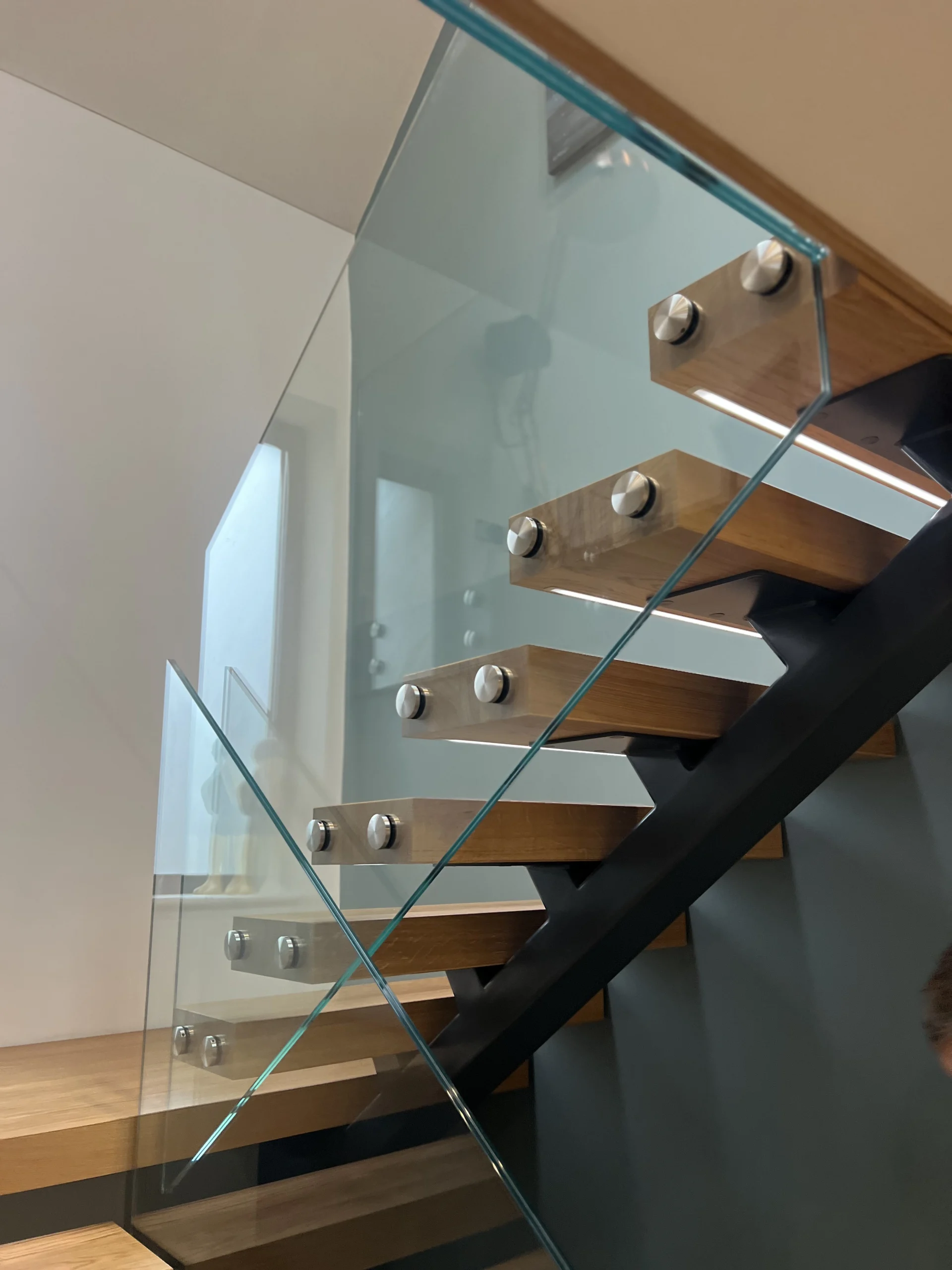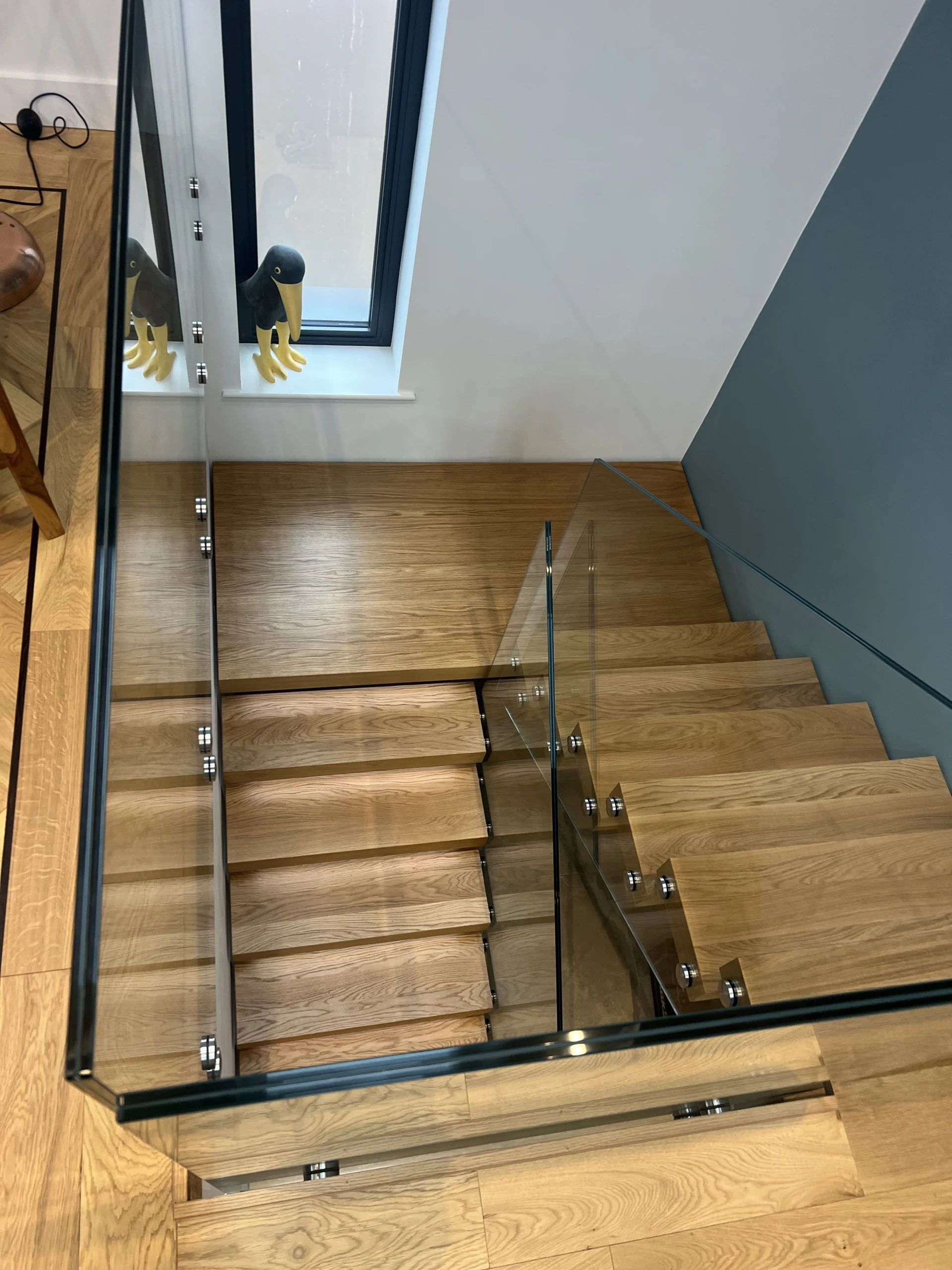

Around 40,000 UK homeowners convert their loft each year — and for the vast majority, the staircase is the single element that determines whether the project feels like a natural extension of the home or an awkward afterthought. This guide covers every practical loft conversion staircase idea that works in real UK properties, from compact terraced houses to detached period homes. We focus on what actually gets approved by Building Control, what each option costs in 2026, and which design choices add the most value to your home.
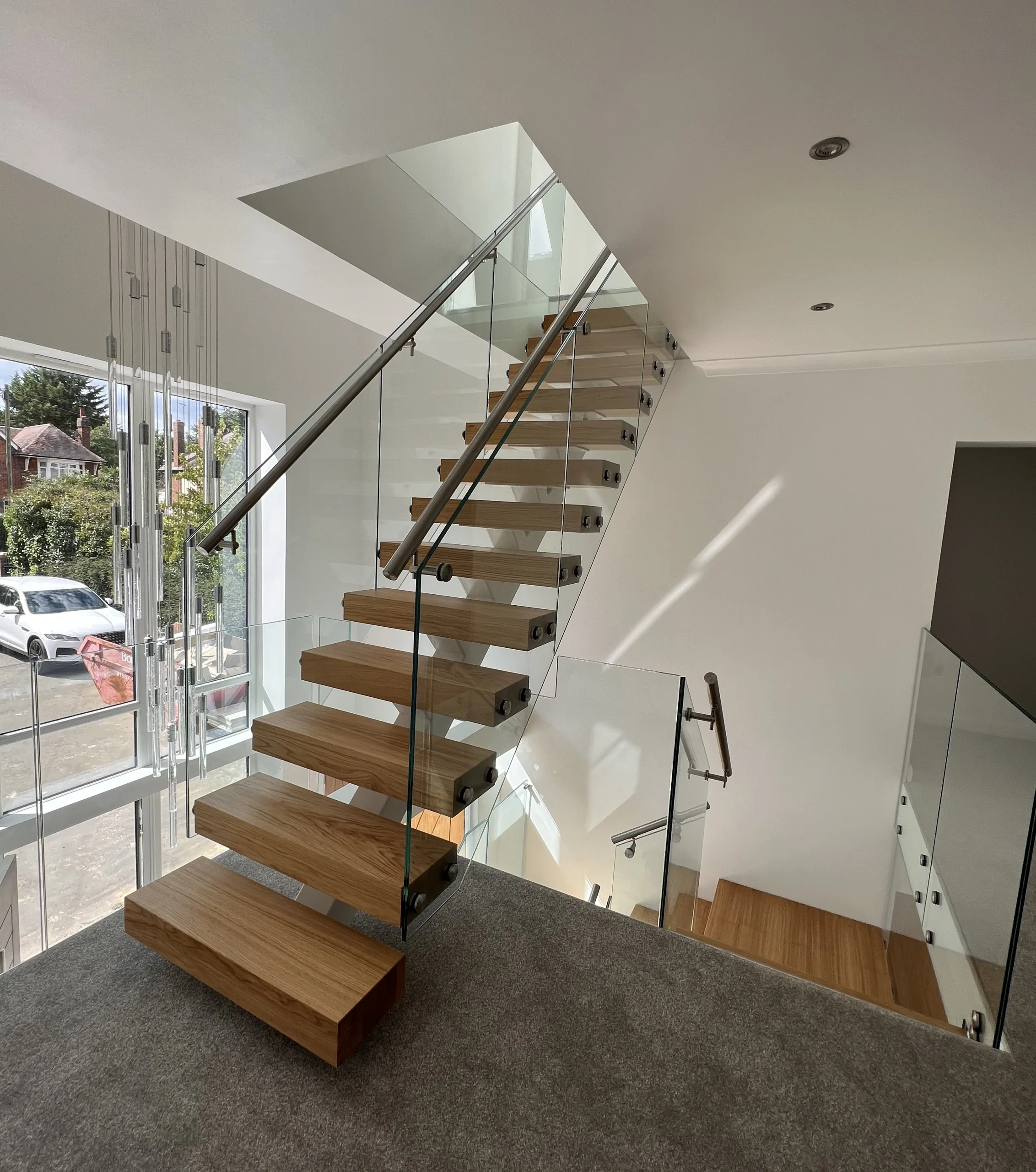
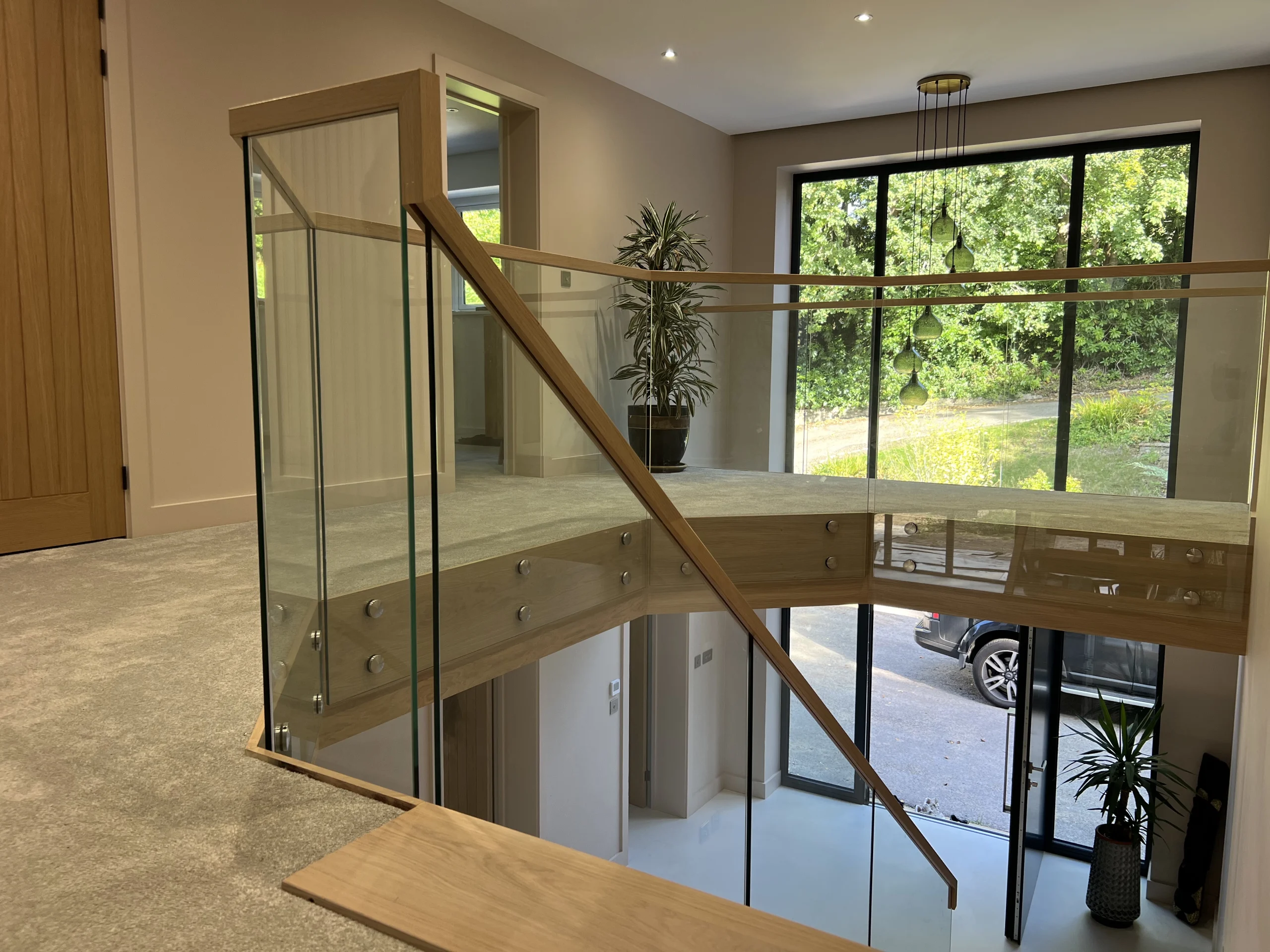
A bespoke loft conversion staircase with oak treads and frameless glass balustrade — designed and installed by Continox
The best loft conversion staircase ideas for UK homes include straight flights (most affordable at £1,500–£3,000), quarter-turn winder stairs (ideal for tight landings), L-shaped and U-shaped configurations (best headroom management), space-saving paddle stairs (last resort under Part K), and spiral or helical staircases (compact footprint from £2,000–£6,000). Every loft staircase must achieve minimum 2,000mm headroom (reduced to 1,800mm at the low side under a sloping ceiling), maximum 42° pitch, and consistent rise of 150–220mm. A bespoke steel-and-timber design from a specialist manufacturer typically costs £5,000–£10,000+ and adds the most value.
Why Your Loft Staircase Makes or Breaks the Conversion
The staircase is the single most underestimated element of a loft conversion. Homeowners spend weeks deliberating over dormer windows and en-suite layouts, then treat the stairs as an afterthought — which is precisely why so many loft conversions feel disconnected from the rest of the house.
A well-designed loft staircase does three things simultaneously. It provides safe, comfortable access that meets Building Regulations. It integrates visually with the existing stairwell so the loft feels like it was always part of the home. And it preserves — or even improves — the usable floor space on the level below.
Get this wrong, and you end up with a cramped corridor carved out of a bedroom, or a steep flight that Building Control refuses to sign off. Get it right, and the staircase becomes a genuine design feature that adds between 10% and 20% to your property's market value.
Continox perspective: As a bespoke staircase manufacturer, we see loft conversion projects where the staircase was specified last — and it shows. The best results come from designing the staircase first, then arranging the loft layout around it. This is especially true for compact terraced properties where every millimetre of headroom matters.
Building Regulations You Must Know Before Choosing a Design
Every loft conversion staircase in England and Wales must comply with Approved Document K (Part K) of the Building Regulations. Building Control will inspect the staircase at key stages, and if it fails, you will not receive a completion certificate — which means problems when you try to sell the property.
The core requirements are straightforward but non-negotiable. Maximum pitch is 42°. Rise per step must be between 150mm and 220mm, and going (tread depth) must be at least 220mm. Every step within a single flight must have identical rise and going — no variation allowed. Headroom above the staircase must be at least 2,000mm.
Loft conversions get a specific concession: where the staircase passes under a sloping ceiling and achieving 2,000mm is not possible, headroom can reduce to a minimum of 1,800mm at the lowest point and 1,900mm at the centre line of the stair width. This exception exists only for loft stairs — you cannot apply it to any other staircase in the house.
Critical: Alternating tread (paddle) stairs are permitted only in loft conversions and only where Building Control agrees there is genuinely no space for a standard staircase. They are a last resort, not a design choice. If you can fit a conventional staircase, Building Control will not approve paddle stairs.
Fire safety — the regulation most people forget
Approved Document B requires every loft conversion staircase to achieve 30-minute fire resistance. This applies to the staircase structure itself, any glazing within the stairwell enclosure, and all doors opening onto it. You will also need mains-powered, interlinked smoke alarms with battery backup on every level. Existing internal doors along the escape route must be replaced with FD20 or FD30 fire doors — or alternatively, the loft room must have an escape window meeting minimum requirements (0.33m² opening area, minimum 450mm height and width).
| Requirement | Standard Loft Stair | Notes |
|---|---|---|
| Maximum pitch | 42° | Same as all private stairs |
| Rise per step | 150–220mm | Consistent throughout flight |
| Going (tread depth) | ≥220mm | Measured nosing to nosing |
| Headroom | 2,000mm (1,800mm low side) | Loft concession for sloping ceilings |
| Handrails | 900–1,000mm height | Both sides if stair >1,000mm wide |
| 2R + G formula | 550–700mm | Comfort check: (2 × rise) + going |
| Fire resistance | 30 minutes | Structure, glazing, and doors |
| Balustrade / guarding | 900mm min height | 100mm sphere rule applies |
For the complete Part K staircase guide including spiral, helical, and alternating tread requirements, see our full UK staircase regulations guide.
8 Loft Conversion Staircase Ideas That Actually Work in UK Homes
Not every staircase design works in every property. The right choice depends on your available floor space, floor-to-floor height, roof type, and whether you are willing to sacrifice space from an existing room. Here are the eight most practical options, ranked from the most common to the most specialised.
1 Straight Flight Extension
The simplest and most cost-effective approach: extending your existing staircase straight up from the first-floor landing to the loft. This works best in properties where the existing stairs terminate below the highest point of the roof, giving you maximum headroom at the top.
A straight flight needs the most horizontal floor space — typically 2.5m to 3.5m of run for a standard floor-to-ceiling height of around 2.4m. But because it continues the existing stairwell, it creates the most natural flow and makes the loft feel like an integral part of the house rather than an add-on.
Cost: £1,500–£3,000 for a standard timber staircase. Bespoke designs with hardwood treads and glass balustrade start from around £5,000.
2 Quarter-Turn Winder Staircase
A quarter-turn staircase changes direction by 90° using tapered winder treads instead of a flat landing. This is the single most popular configuration for UK loft conversions because it navigates around obstacles — chimney breasts, bathroom walls, load-bearing partitions — while consuming less floor area than a straight flight.
The winder treads must still comply with Part K going requirements, measured at the centre line of the tread. Building Control will pay particular attention to the narrow end of winder treads: they must not be less than 50mm wide at the narrow end. A well-designed quarter-turn winder can fit into a footprint as compact as 1.6m × 2.0m.
Cost: £2,000–£4,000 standard. From £6,000 for bespoke steel-and-timber with glass infill panels.
3 L-Shaped Staircase with Half Landing
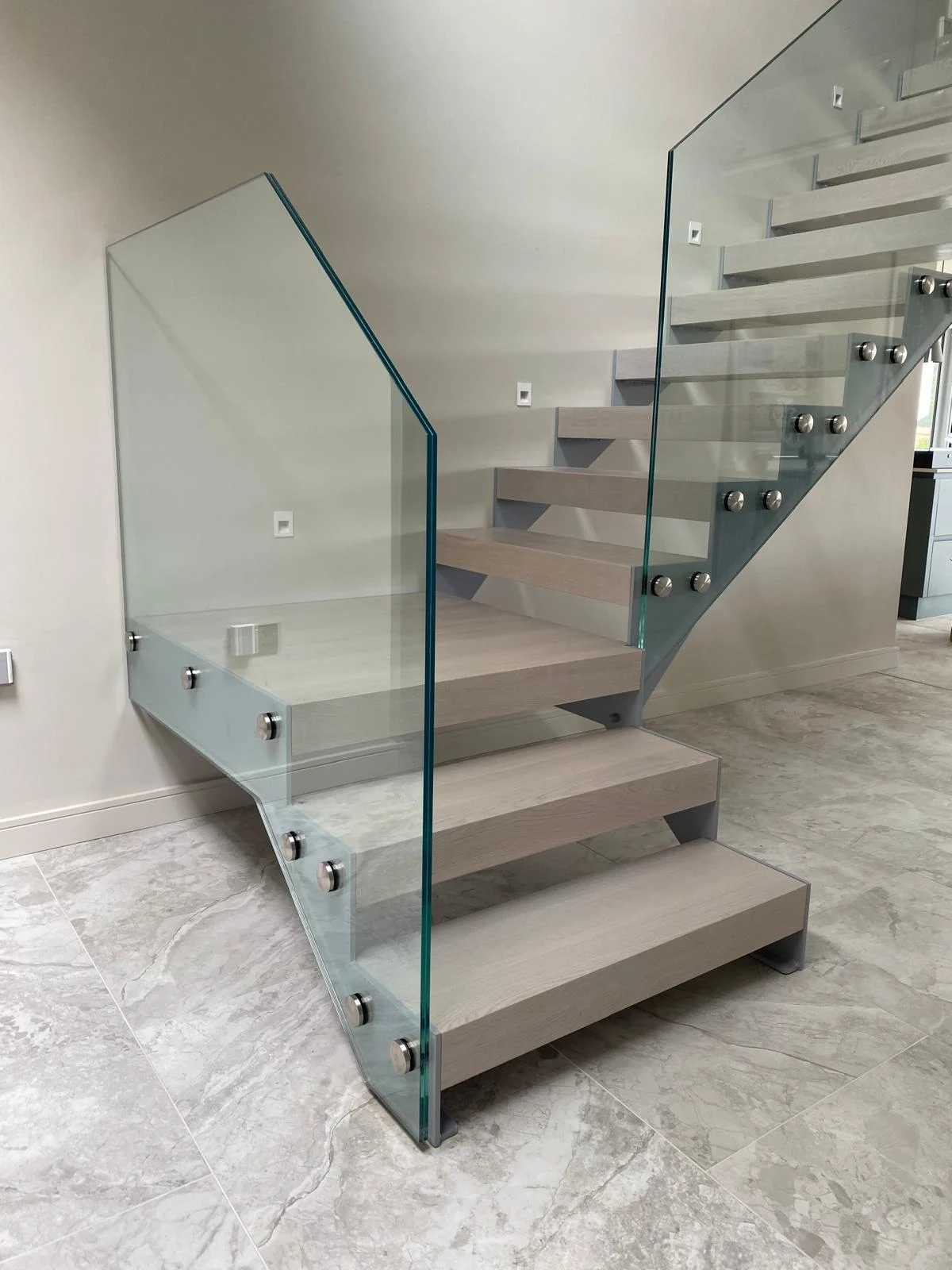
Similar to the quarter-turn but with a flat intermediate landing instead of winder treads. The landing provides a comfortable turning point, makes carrying furniture up to the loft significantly easier, and gives you a natural place to position a skylight or window for natural light in the stairwell.
The trade-off is footprint: a half landing adds approximately 800mm × 800mm of floor area compared to a winder configuration. In properties with generous first-floor landings — typically detached houses and larger semis — the L-shape is often the most comfortable option.
Cost: £2,500–£5,000 standard. Bespoke with open risers and a modern staircase design from £7,900.
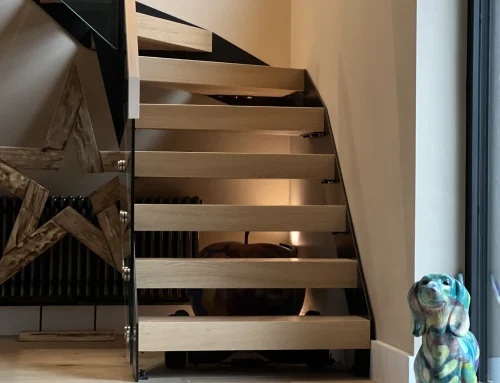
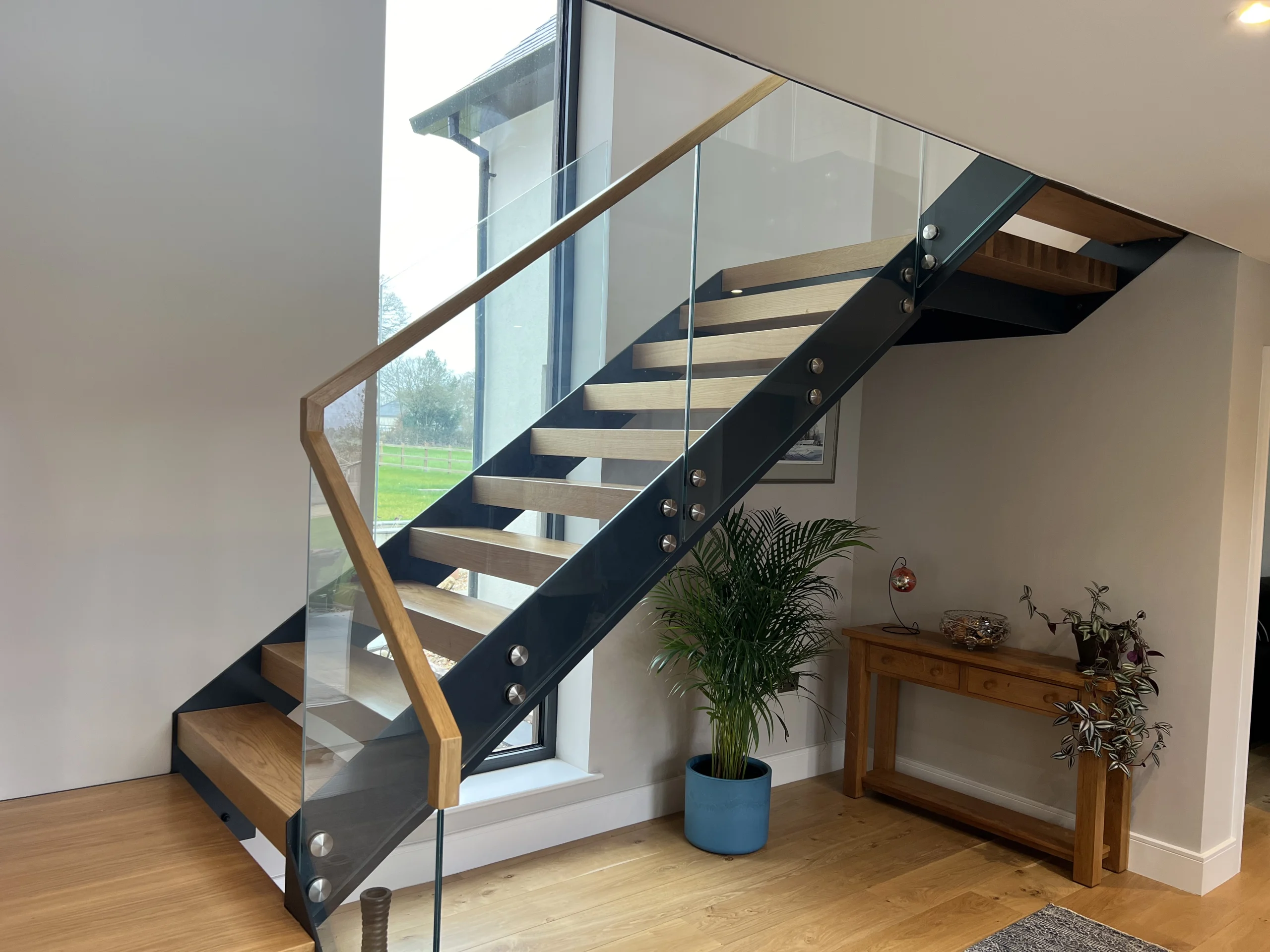 Bespoke steel-and-oak staircase — ideal for loft conversion continuation
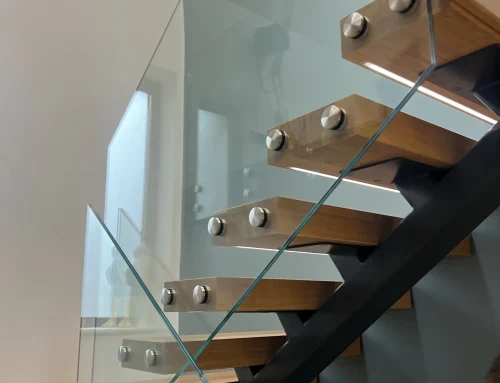
 Open-plan staircase with frameless glass — maximises light flow to the loft
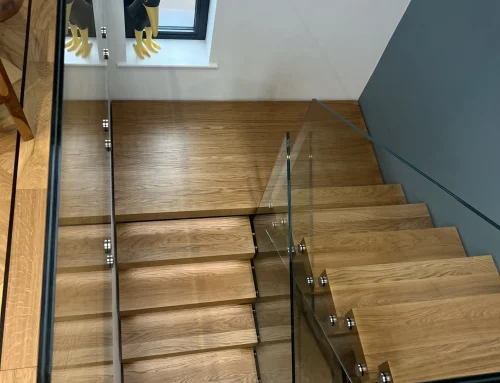
 Steel-and-oak central spine — the most requested loft conversion design
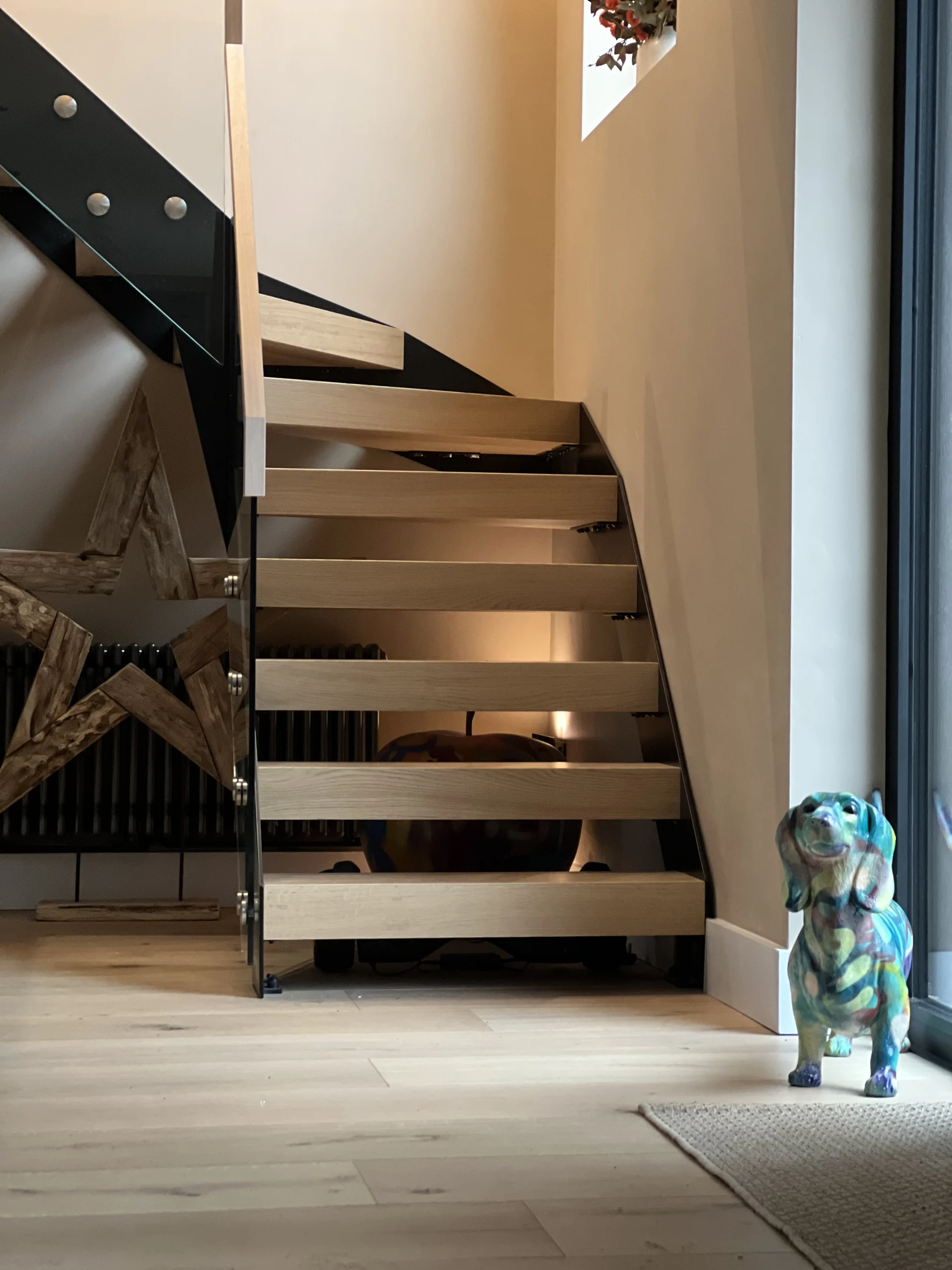
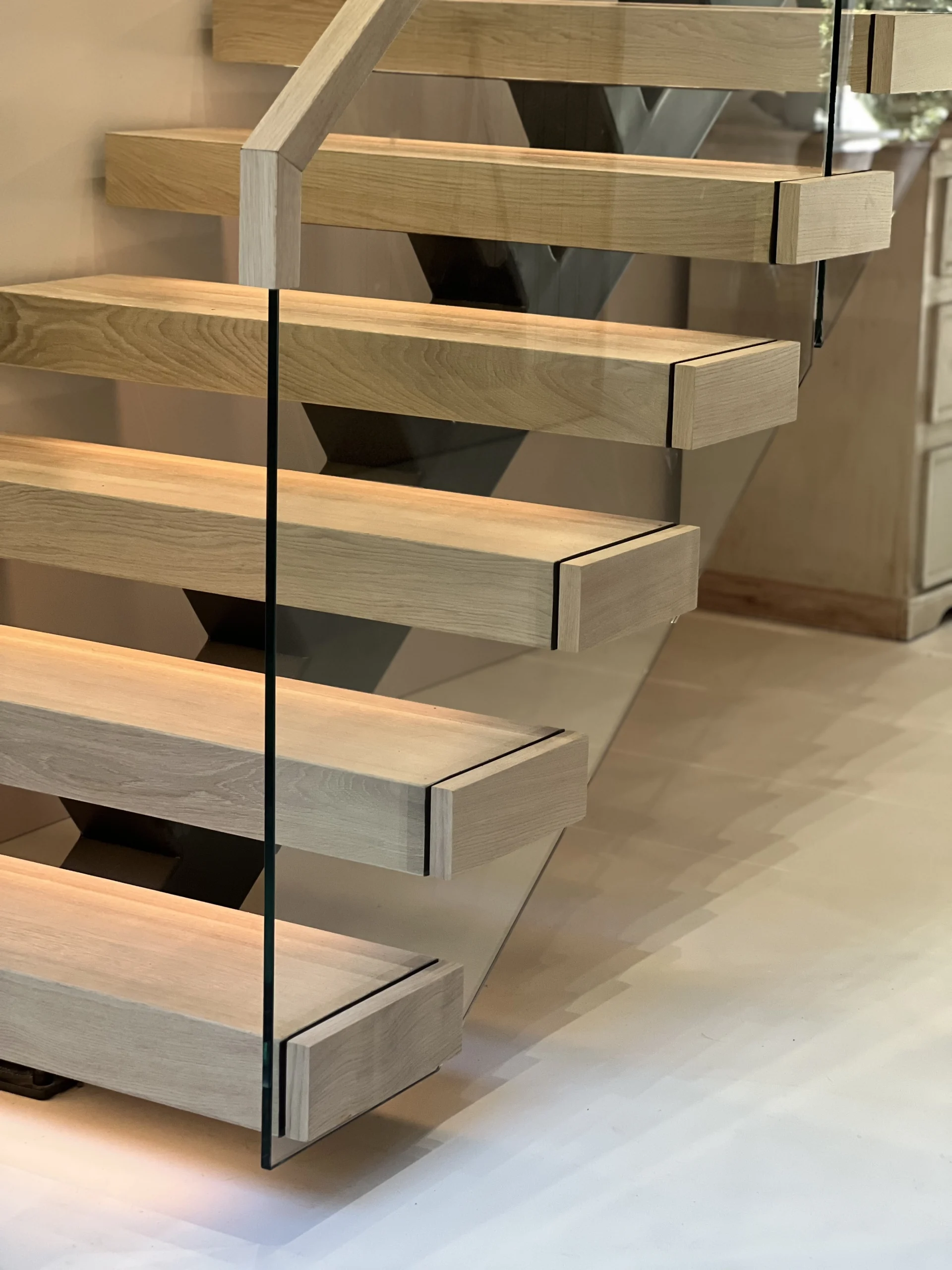
 Floating staircase — open risers flood the stairwell with natural light
4 U-Shaped (Switchback) Staircase
A U-shaped staircase reverses direction by 180°, with two parallel flights connected by a half landing. This configuration occupies the smallest horizontal footprint of any conventional staircase — because it stacks two flights vertically within the same floor area.
In loft conversions, a U-shape works particularly well when you are building above the existing stairwell. The new flight folds back over the lower flight, which means the opening in the loft floor can be positioned directly above the existing landing. This minimises disruption to the rooms below.
Cost: £3,000–£6,000. A bespoke U-shape central spine staircase with glass balustrade from £9,500.
5 Spiral Staircase
Spiral staircases occupy the smallest floor area of any staircase type — typically requiring a circular opening of just 1,400mm to 2,000mm diameter. For properties where sacrificing bedroom floor space is not an option, a spiral staircase can be the difference between a viable loft conversion and one that does not get off the drawing board.
Under BS 5395 Part II, a spiral staircase serving as primary access in a private dwelling must be Category B with a minimum width of 1,000mm (measured from the centre pole to the outer edge). The treads must provide adequate going at the walking line, which is measured 270mm from the inner edge.
The practical reality: spiral staircases are harder to use than conventional flights, especially for carrying furniture, laundry baskets, or anything bulky. They are best suited to loft rooms used as home offices, dressing rooms, or occasional guest bedrooms rather than primary master suites.
Cost: £2,000–£6,000 for standard designs. Bespoke steel-and-glass spiral from £8,000+.
6 Helical (Sweeping Curve) Staircase
A helical staircase follows a continuous curve without a central pole — unlike a spiral, which wraps around a vertical column. Helical designs are the sculptural option: they create a dramatic visual statement and offer a wider, more comfortable walking line than a spiral of equivalent diameter.
Helical staircases are significantly more expensive than spirals because the curved steel stringers require precision engineering and fabrication. They are best suited to open-plan properties where the staircase is a deliberate design centrepiece.
Cost: From £11,500 for a fully bespoke helical staircase with hardwood treads and glass balustrade.
7 Floating (Cantilevered) Staircase
Floating staircases use concealed structural fixings — either embedded in the wall or supported by a hidden steel mono-stringer — so the treads appear to hover without visible support. The result is a staircase that takes up minimal visual weight and allows light and sightlines to pass through freely.
For loft conversions, a floating staircase is a particularly strong choice when the stairwell is visible from the main living area. Open risers combined with a frameless glass balustrade prevent the stairwell from feeling like a dark shaft — a common complaint with traditional enclosed loft stairs.
The structural requirements are significant. Wall-mounted cantilever treads need a solid masonry or reinforced steel frame wall to anchor into — stud walls are not sufficient. Your structural engineer must confirm the wall can take the point loads before this option is viable.
Cost: Floating staircases from £7,900. With LED-integrated treads from £8,500+.
Pro tip: If your loft conversion staircase will be visible from the hallway or living room, open risers and glass balustrade transform the stairwell from a necessary passage into an architectural feature. This is where the value uplift comes from — estate agents consistently report that a premium staircase is the single feature buyers remember during viewings.
8 Space-Saving Paddle (Alternating Tread) Stairs
Paddle stairs — also called alternating tread stairs or space-saver stairs — have treads where alternating halves are cut away, so your left and right feet land on different-shaped steps. This allows a steeper pitch in a shorter horizontal run.
Under Part K, paddle stairs are only permitted in loft conversions where Building Control is satisfied that no other staircase configuration will fit. They are explicitly a last resort. They cannot serve more than one habitable room (plus optional bathroom and WC, provided it is not the only WC in the dwelling). Fixed handrails are required on both sides.
Paddle stairs are not comfortable for daily use, are difficult for children and elderly residents, and make carrying objects awkward. If your architect or builder suggests paddle stairs as a first option rather than a fallback, question whether the staircase position has been properly optimised.
Cost: £800–£2,000 for standard timber paddle stairs. Not available as bespoke steel designs — the aesthetic does not justify it.
Warning: A loft conversion with paddle stairs as the only access will not add as much value as one with a conventional staircase. Estate agents and surveyors consistently note that paddle stairs reduce the appeal of a loft room, particularly for families. If space is genuinely tight, consider whether a spiral staircase (which takes similar floor area but is fully compliant as a primary stair) would be a better long-term investment.
Loft Conversion Staircase Costs 2026 UK Guide
Staircase costs for loft conversions vary enormously depending on whether you choose an off-the-shelf standard design or commission a bespoke staircase from a specialist manufacturer. The table below reflects real 2026 pricing for supply and installation in England.
| Staircase Type | Cost Range (Supplied & Fitted) | Best For |
|---|---|---|
| Standard straight flight (softwood) | £1,500–£3,000 | Budget-conscious projects |
| Quarter-turn winder (softwood) | £2,000–£4,000 | Tight landings, terraced homes |
| L-shaped with half landing | £2,500–£5,000 | Comfort, furniture access |
| U-shaped switchback | £3,000–£6,000 | Minimal horizontal footprint |
| Spiral staircase | £2,000–£6,000 | Smallest floor area |
| Paddle / space-saver | £800–£2,000 | Last resort only (Part K restricted) |
| Bespoke floating (steel + oak) | £7,900+ | Design statement, open risers |
| Bespoke central spine (steel + oak + glass) | £9,500+ | Premium loft conversions |
| Bespoke helical (fully custom) | £11,500+ | Sculptural centrepiece |
These prices include supply and standard installation. Additional costs may apply for structural modifications to the floor opening, fire-rating the stairwell enclosure, and replacing existing doors with fire doors. Budget an additional £1,000–£3,000 for these ancillary works.
Choosing the Right Material Combination
The material palette of your loft staircase should follow from the existing house rather than exist in isolation. A Victorian terrace with original turned spindles looks jarring with an ultra-modern frameless glass balustrade on the loft flight — and conversely, a contemporary open-plan home loses coherence with a traditional timber staircase bolted on top.
Oak treads on steel
The most popular combination for bespoke loft stairs in 2026. Solid European oak treads (40mm thick, hard-wax oil finish) mounted on a powder-coated steel frame — either as a central spine, twin-stringer, or wall-mounted cantilever. Oak is warm, durable, and ages gracefully. Budget £130–£180 per tread for oak, or £190–£270 for walnut if you want a darker, richer tone.
Glass balustrade
Frameless glass balustrade (from £450 per linear metre) is the single most effective way to prevent a loft stairwell from feeling enclosed. The glass allows light to flow between floors and makes the staircase appear less imposing. For loft conversions, 10mm toughened glass in a framed system (from £350/m) offers a more cost-effective alternative while still providing transparency.
Steel with powder coating
All Continox staircases use structural steel frames finished with a two-stage primer and powder-coat system. The standard colour is RAL 9005 (jet black), but any RAL colour is available. For loft stairs visible from the living areas, a matte black or anthracite grey (RAL 7016) finish complements both contemporary and traditional interiors.
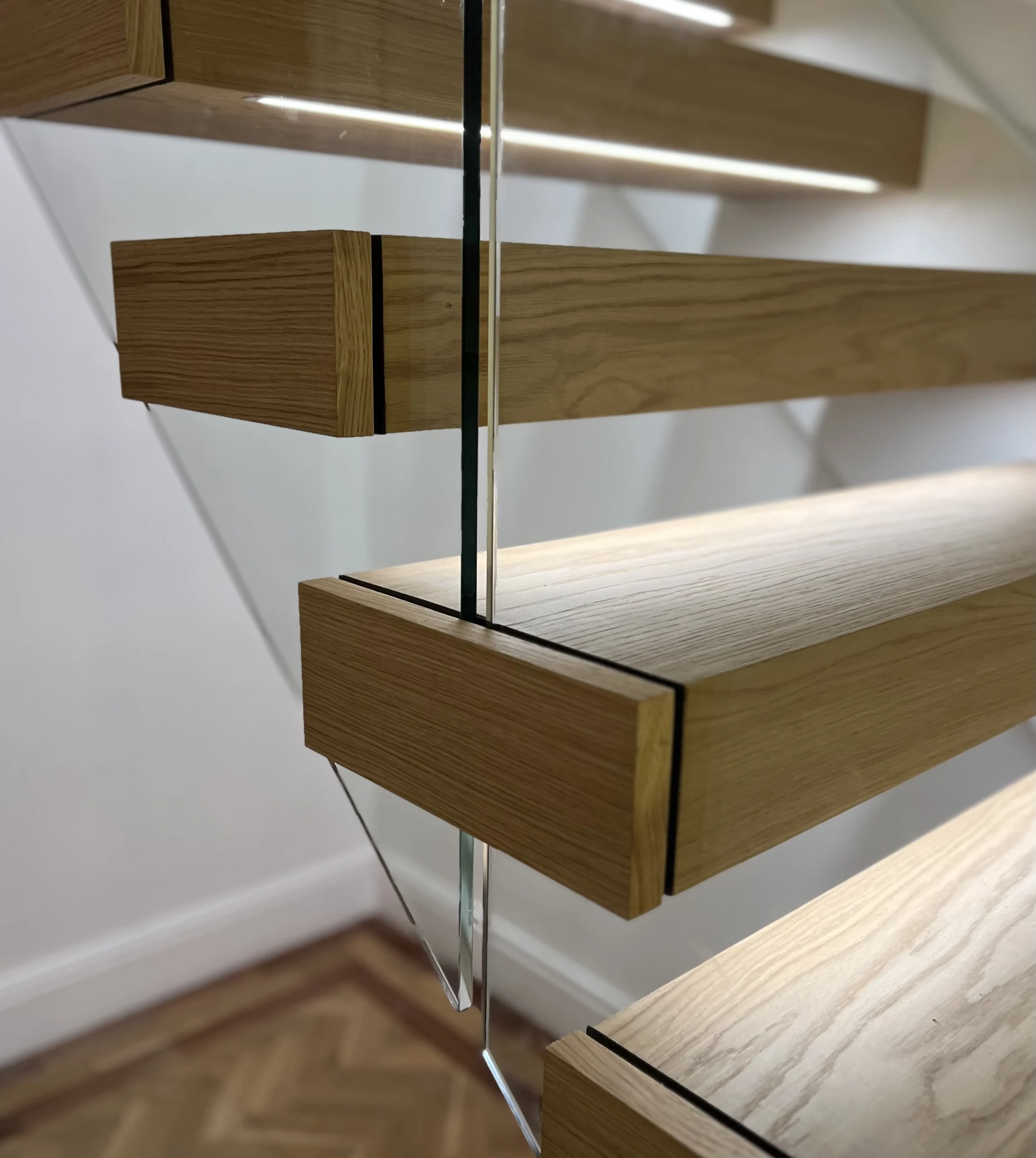
 Walnut treads with integrated LED — premium upgrade for loft conversions
 Under-tread LED lighting — practical and dramatic in a loft stairwell
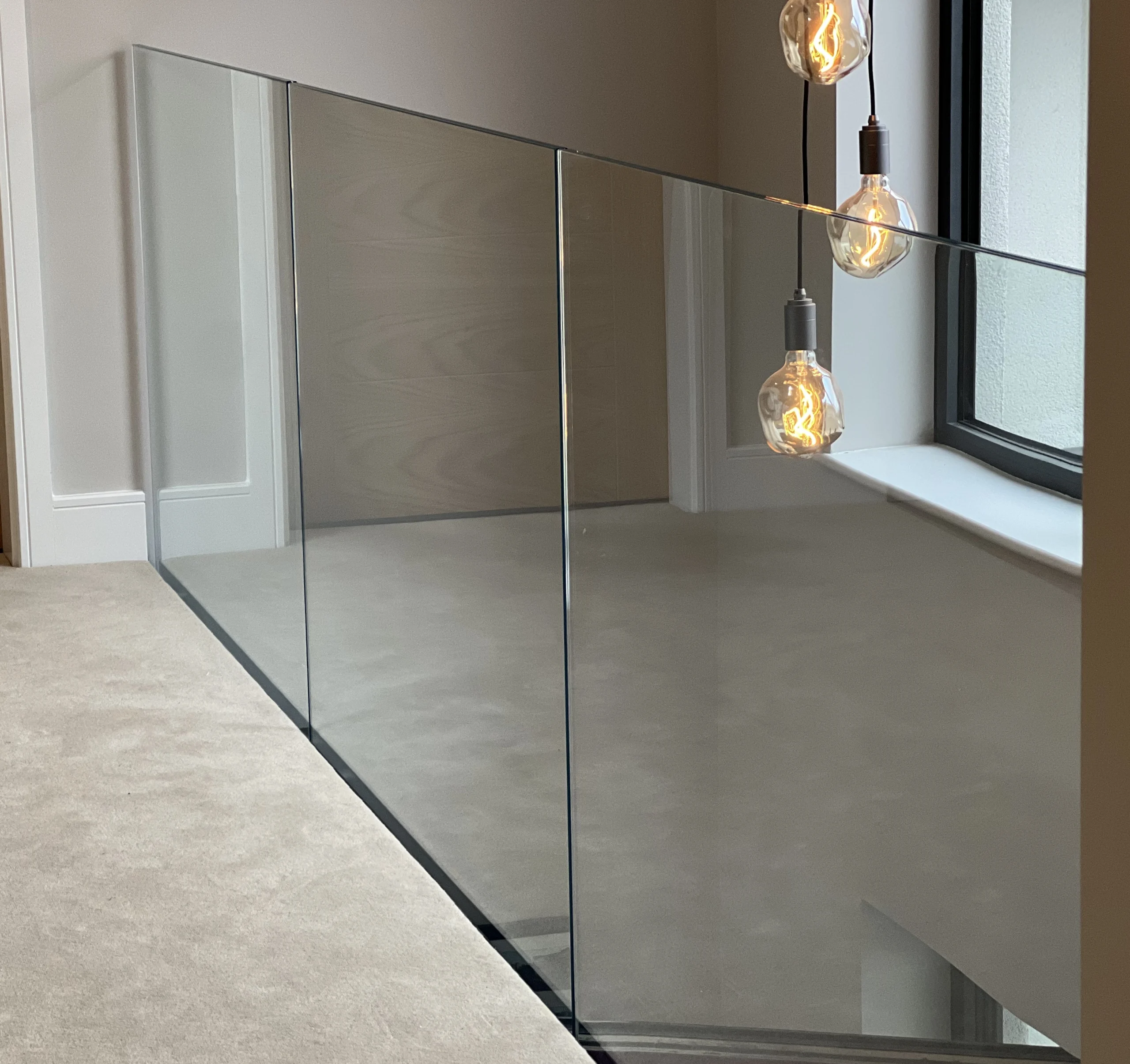 Frameless glass balustrade — the most requested upgrade for loft stairs
 U-shaped central spine — ideal configuration for loft conversion access
The Headroom Problem — And How to Solve It
Insufficient headroom kills more loft conversion staircase designs than any other single issue. The standard requirement is 2,000mm clear above every tread. Under a sloping roof, this becomes the primary constraint: the staircase must terminate at or near the highest point of the roof to achieve compliant headroom.
If your loft does not naturally provide 2,000mm headroom above the staircase position, you have several options — each with different cost and planning implications.
Option 1: Dormer extension
Adding a dormer above the stairwell creates additional headroom by replacing the sloping roof with a flat or raised section. This is the most common solution and usually falls within permitted development rights (no planning permission required for most properties). Cost: £5,000–£12,000 as part of a wider dormer conversion.
Option 2: Hip-to-gable conversion
For properties with a hipped (sloping) roof at the side, converting the hip to a vertical gable wall creates substantially more usable loft space — including room for the staircase to terminate with full headroom. This is a major structural intervention but often the right answer for semi-detached houses.
Option 3: Rooflight above the stairwell
A rooflight in the pitched roof above the stairwell cannot increase headroom, but it can create a visual impression of space and flood the staircase with natural light. In borderline cases where headroom is adequate but feels tight, a skylight can make the difference between a stairwell that feels comfortable and one that feels oppressive.
Option 4: Reposition the staircase
Sometimes the answer is not to modify the roof but to move the staircase to a different position where headroom is naturally adequate. This may mean starting the loft flight from a different room or corridor — which affects the floor below but can be the most cost-effective solution.
Where to Position Your Loft Staircase
Staircase positioning involves trade-offs. The ideal position balances four factors: headroom at the top, impact on rooms below, structural feasibility, and compliance with fire escape requirements.
The most common and generally best approach is to continue the staircase directly above the existing stairwell. This preserves the natural circulation pattern of the house, minimises disruption to bedrooms on the first floor, and usually provides the best headroom because the stairwell is already positioned in a central part of the roof.
However, this is not always possible. In some houses, the existing stairwell sits under the lowest part of the roof, chimney breasts obstruct the logical path, or the first-floor landing is too small to accommodate a turn. In these situations, the staircase may need to start from a bedroom — which means losing some floor area from that room.
Design principle: If the loft staircase must start from a bedroom, position it so the remaining room shape is still regular (rectangular). Losing a corner of a bedroom to a staircase opening is far less disruptive than carving a strip through the middle. Your architect or staircase manufacturer can advise on the optimal opening position based on a site survey.
Integrating Under-Stair Storage Into Your Loft Design
Every loft staircase creates a triangular void underneath it. In a standard conversion with 2.4m floor-to-ceiling height and a comfortable pitch, this void is approximately 3–4 cubic metres — enough for a useful built-in wardrobe, bookshelf, or home office nook.
The most practical storage solutions include pull-out drawers built into the stair risers (ideal for shoes, toys, and small items), a full-height cupboard under the upper part of the flight (coats, vacuum cleaner, ironing board), and open shelving under the lower section where the ceiling height is less than 1.2m.
If you are commissioning a bespoke staircase, discuss storage integration at the design stage. Adding under-stair storage after the staircase is installed is significantly more expensive and usually results in a compromised finish.
Lighting Your Loft Stairwell
A loft stairwell is typically the darkest part of the house — sandwiched between floors with no external wall for windows. Good lighting transforms a potentially gloomy passage into a welcoming transition space.
LED strip lighting under the tread nosings is the most popular option for bespoke loft stairs. It provides functional illumination of each step (a safety benefit at night) while creating a dramatic floating effect. Budget £600–£1,200 for a full LED integration with dimmer control.
Rooflights or skylights above the stairwell provide natural light during the day and make the entire circulation space feel more open. A single Velux window positioned directly over the staircase landing can eliminate the need for artificial lighting during daylight hours.
How Your Staircase Choice Affects Property Value
A loft conversion typically adds 10–20% to a property's market value. On a £300,000 home, that represents £30,000–£60,000 of added equity — often exceeding the entire cost of the conversion. But the staircase plays a disproportionate role in where you land within that range.
A standard softwood staircase with painted MDF balustrade gets the conversion signed off but adds minimal visual impact. A bespoke staircase with oak treads, steel frame, and glass balustrade turns the stairwell into a feature that estate agents photograph for the listing and buyers remember during viewings.
The investment math works strongly in favour of upgrading the staircase. The difference between a £2,000 standard flight and a £7,900 bespoke floating staircase is £5,900. If that upgrade moves your property value uplift from 12% to 16% on a £300,000 home, you have generated an additional £12,000 of equity for a £5,900 outlay.
Upgrade path: If budget is tight now, consider specifying the steel frame and structural fixings for a bespoke design but fitting temporary softwood treads. You can upgrade to oak or walnut treads later without modifying the structure — a practical compromise that keeps costs down initially while preserving the option for a premium finish.
Frequently Asked Questions — Loft Conversion Staircases
Yes — every loft conversion staircase must comply with Approved Document K (Part K) and be inspected by Building Control. This is mandatory regardless of whether the wider loft conversion requires planning permission. Without a Building Regulations completion certificate, the conversion is classed as non-compliant and will cause problems when you sell the property.
The standard requirement is 2,000mm clear headroom above every tread. Loft conversions receive a specific concession: where the staircase passes under a sloping ceiling, headroom can reduce to 1,800mm at the lowest point and 1,900mm at the centre line of the stair width. This concession only applies to loft stairs — not to any other staircase in the house.
A standard softwood staircase costs £1,500–£3,000 supplied and fitted. Quarter-turn winder designs run £2,000–£4,000. Spiral staircases cost £2,000–£6,000. Bespoke steel-and-oak designs with glass balustrade start from £7,900 for a floating staircase or £9,500 for a central spine design. Budget an additional £1,000–£3,000 for structural modifications to the floor opening and fire-rating the stairwell.
Yes — spiral staircases are fully compliant as primary access to a loft conversion, provided they meet Category B requirements under BS 5395 Part II. This means a minimum width of 1,000mm measured from the centre pole to the outer edge. The treads must provide adequate going at the walking line (measured 270mm from the inner edge). Spiral stairs are ideal where floor space is extremely limited but daily comfort is less critical.
Paddle stairs are permitted only in loft conversions — and only where Building Control agrees there is genuinely no space for any other type of staircase. They are a last resort, not a design preference. They can only serve one habitable room (plus an optional bathroom or WC, provided it is not the only WC in the dwelling). Both sides must have fixed handrails. Building Control will reject them if a conventional staircase could reasonably fit.
Yes — Approved Document B requires the staircase structure, any glazing within the stairwell enclosure, and all doors opening onto the stairwell to achieve 30-minute fire resistance. Mains-powered, interlinked smoke alarms with battery backup must be installed on every level. Existing internal doors along the escape route must be replaced with FD20 or FD30 fire doors.
A bespoke staircase with hardwood treads (oak or walnut), a steel frame, and frameless glass balustrade consistently adds the most value. Estate agents report that buyers remember a premium staircase during viewings — it signals quality throughout the conversion. The upgrade cost of £4,000–£6,000 over a standard flight typically generates £10,000–£15,000 of additional property value.
A standard staircase installation typically takes 1–3 days on site. Bespoke steel-and-timber staircases may take 2–5 days depending on complexity and site access. The main disruption comes from cutting the floor opening and fire-rating the stairwell enclosure — this work is usually completed in the first day. The overall lead time from order to installation is 4–8 weeks for bespoke designs.
Ready to Design Your Loft Conversion Staircase?
Continox designs and manufactures bespoke staircases for loft conversions across Southern England. From a single floating flight to a full central spine design with glass balustrade — every staircase is built in-house at our workshop in Gosport, Hampshire, and installed by our own team.