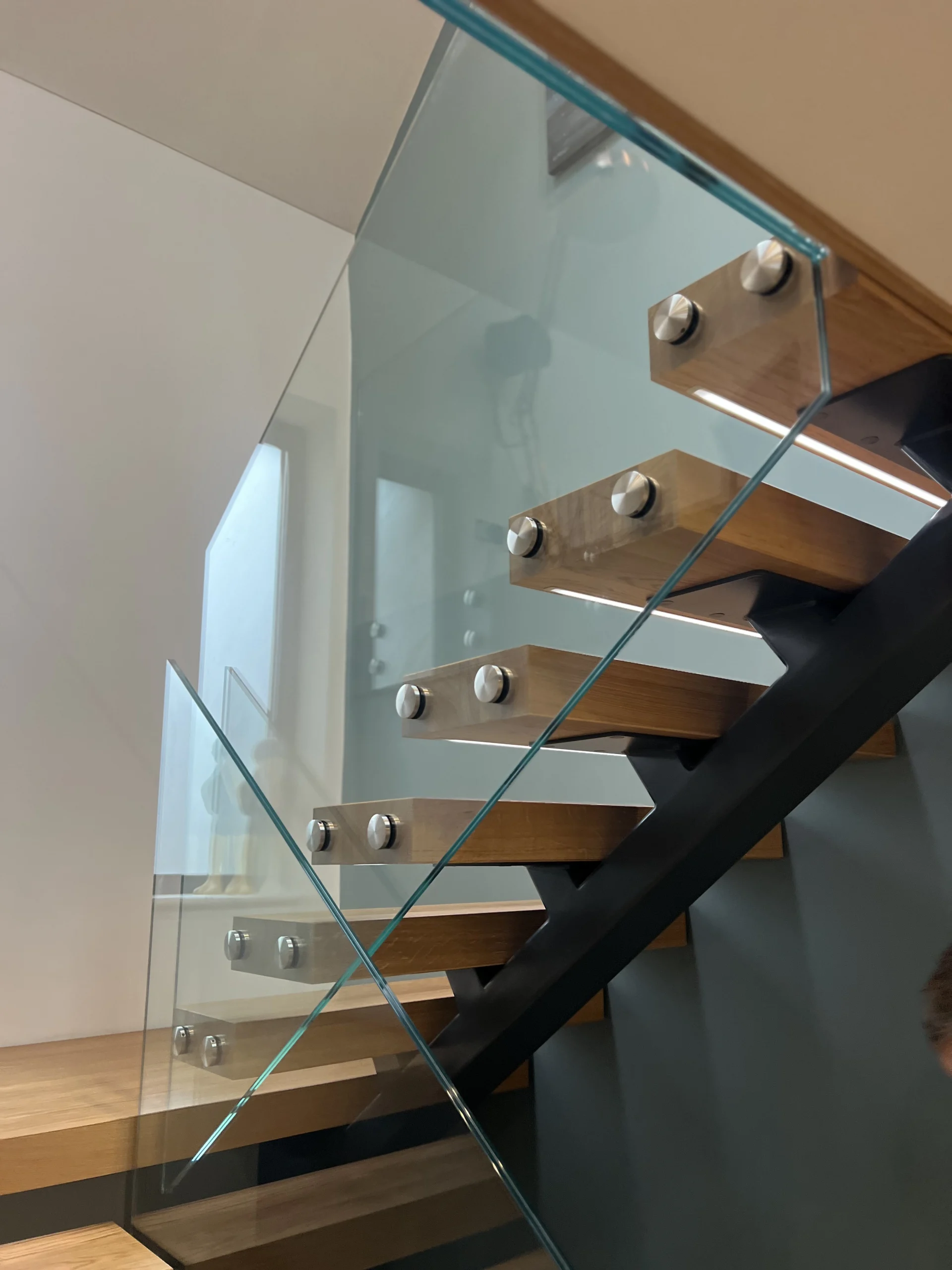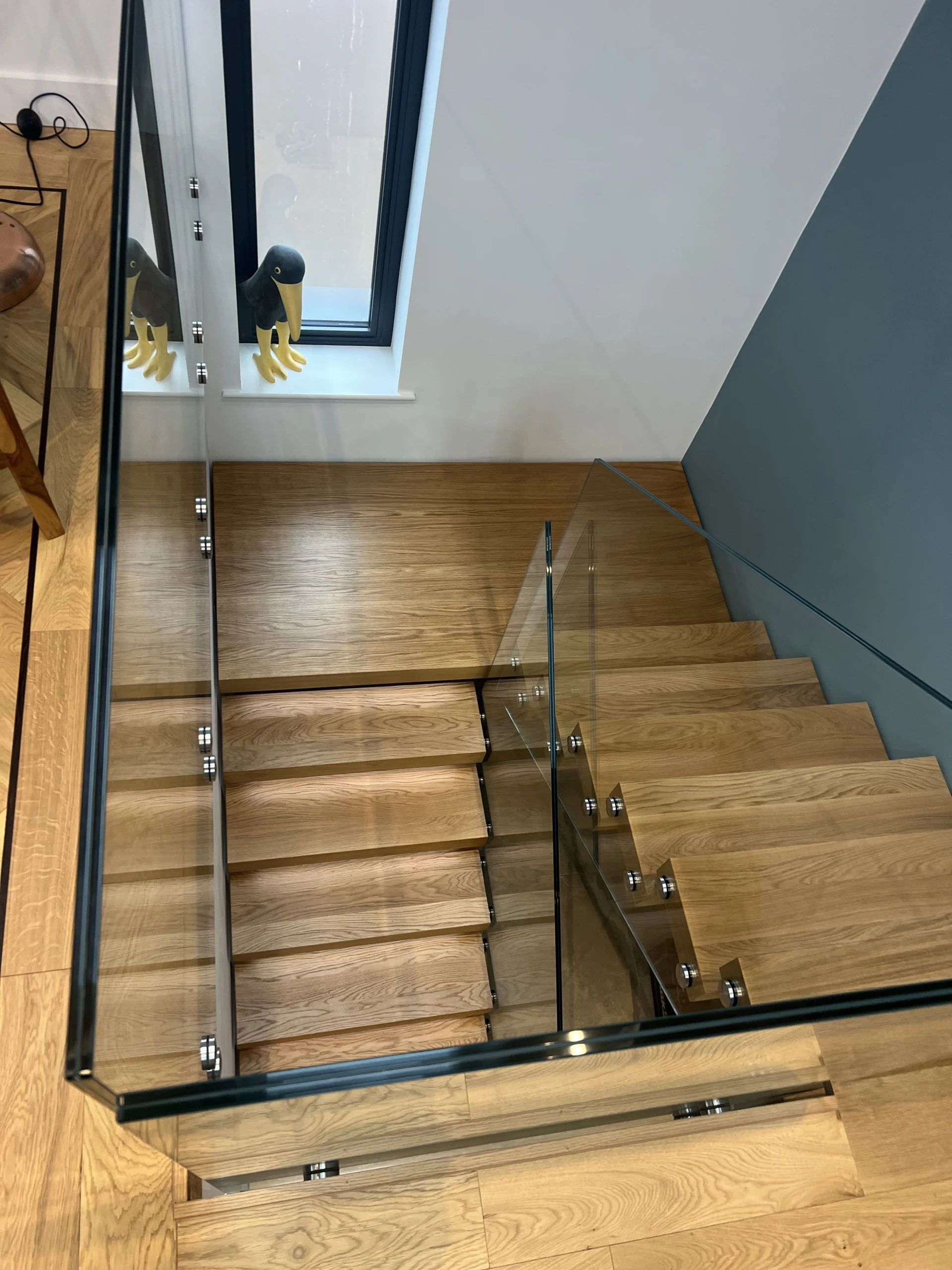

Paddle staircases — officially called alternating tread stairs under Approved Document K — are the most misunderstood staircase type in UK building regulations. Some homeowners see them as a clever space-saving solution. Building Control sees them as a last resort. This guide explains exactly what paddle stairs are, when they are permitted, what the regulations require, who they suit, who they do not suit, and whether you should be exploring better alternatives before committing to one.
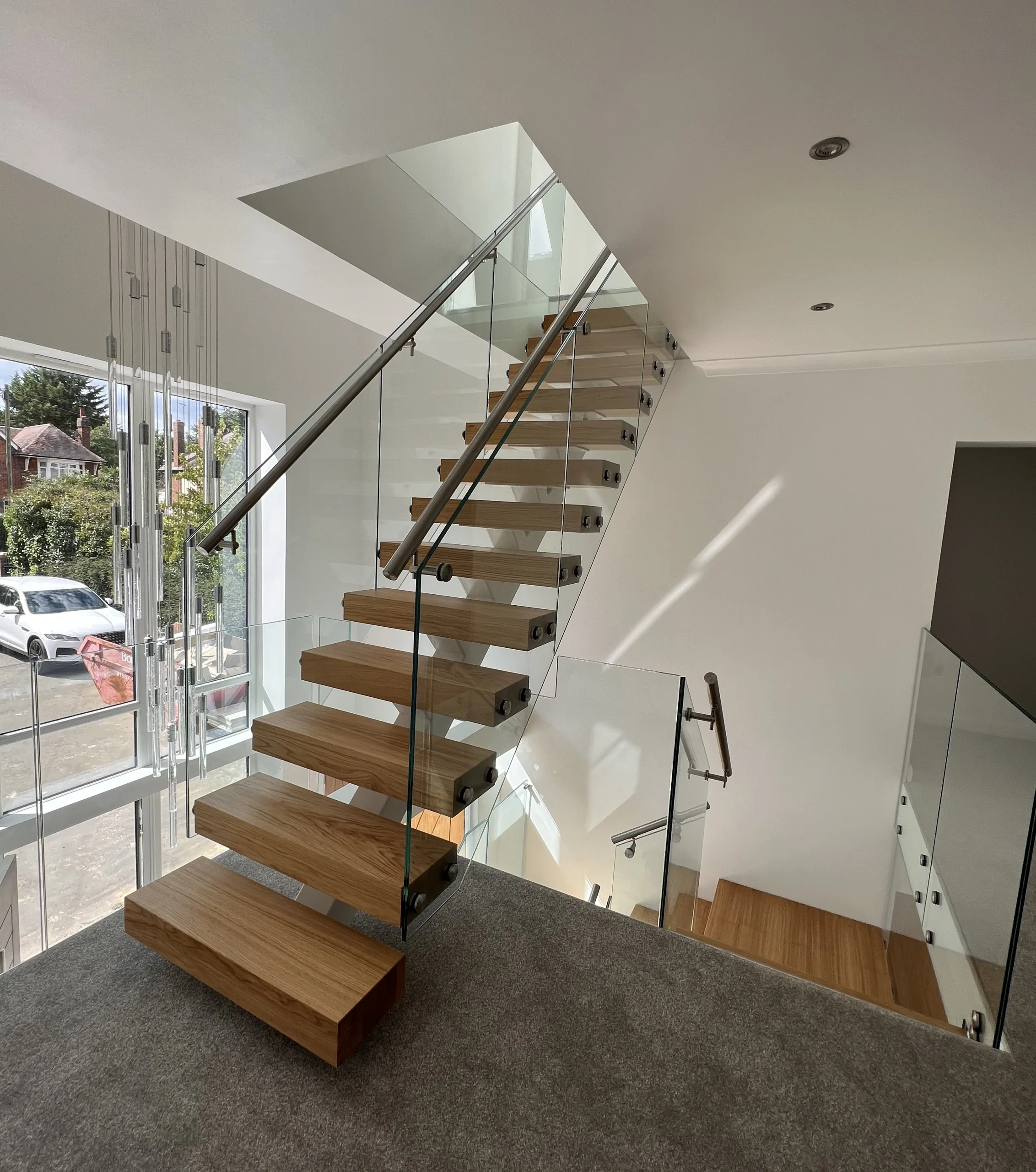
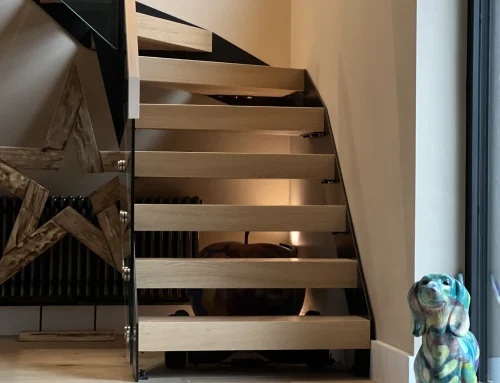
A standard bespoke loft staircase — what Building Control prefers over paddle stairs whenever space allows
A paddle staircase (alternating tread stair) has treads where alternating halves are cut away, allowing a steeper pitch in a shorter horizontal run. Under Part K paragraph 1.29, paddle stairs are permitted only in loft conversions, only in straight flights, only when Building Control agrees no standard staircase will fit, and only to access one habitable room (plus optionally a bathroom and WC — not the dwelling's only WC). Handrails are required on both sides, treads must be uniform with parallel nosings and non-slip surfaces, and a 100mm sphere must not pass through open risers. Cost: £800–£2,000. Footprint: as small as 1.8m × 0.6m. Verdict: functional but uncomfortable for daily use — always explore compact winder or spiral staircases first.
What Is a Paddle Staircase — And How Does It Work?
A paddle staircase is a staircase where alternating treads have half their width cut away. Looking down from above, the treads form a distinctive paddle or keyhole shape — the full-width section on each tread alternates from left to right on consecutive steps. This design means each foot lands on a different side of the staircase as you climb.
The engineering principle is simple. On a standard staircase, every tread is the same full width, and you can place either foot anywhere on any tread. The going (tread depth) must be at least 220mm, which means the staircase needs a certain minimum horizontal run to achieve the required number of steps. On a paddle staircase, because each foot only uses half the tread width, the effective going per foot is maintained while the overall pitch of the staircase can be steeper — fitting more vertical rise into a shorter horizontal distance.
The result: a paddle staircase can fit into a footprint as small as 1.8m long × 0.6m wide, versus approximately 2.8m × 0.9m for a standard straight flight. That is roughly 1.1m² versus 2.5m² — a significant space saving in a tight loft conversion.
The trade-off is real: Paddle stairs require conscious attention to your foot placement on every step. You must start with the correct foot (matching the wider section of the first tread) and maintain the alternating pattern throughout. Descending requires the same concentration. For healthy adults, this becomes automatic after a few uses. For children, elderly residents, anyone carrying objects, and anyone unfamiliar with the staircase, paddle stairs are significantly harder to use than a conventional flight.
Part K Regulations — The Complete Rules
Approved Document K paragraphs 1.29–1.30 set out the complete regulatory framework for alternating tread stairs. These are not guidelines — they are mandatory requirements that Building Control will enforce.
1 Loft conversions only
Paddle stairs may only be used in a loft conversion. They cannot be used for access to a basement, mezzanine, or any other level of the dwelling. Building Control will reject any application to use paddle stairs outside of a loft conversion context.
2 Last resort only
Paddle stairs are permitted only when Building Control is satisfied that there is not enough space for a staircase that meets the standard requirements of paragraphs 1.2–1.24. This means you must demonstrate that a standard straight flight, quarter-turn winder, L-shape, U-shape, and spiral staircase have all been considered and cannot fit. Building Control will not approve paddle stairs if a conventional staircase could reasonably be accommodated.
3 One habitable room
Paddle stairs may serve only one habitable room. If desired, they may also serve a bathroom and/or a WC — but the WC must not be the only WC in the dwelling. If the loft conversion creates two or more rooms (for example, a bedroom and a separate home office), paddle stairs cannot be used — a standard or spiral staircase is required.
4 Straight flights only
Paddle stairs must be in one or more straight flights. Part K does not explicitly permit winder treads within a paddle staircase, although some Building Control officers have accepted quarter-turn paddle configurations on a case-by-case basis. To be safe, design paddle stairs as a straight flight unless your Building Control officer has confirmed otherwise in writing.
5 Construction requirements
Part K paragraph 1.30 specifies the construction standards. All alternating steps must be uniform with parallel nosings. Treads must have non-slip surfaces. The tread sizes over the wider part of the step must comply with the standard going requirements in Table 1.1 (minimum 220mm). A 100mm sphere must not be able to pass through open risers. Fixed handrails are required on both sides of the staircase.
| Requirement | Value | Notes |
|---|---|---|
| Permitted use | Loft conversion only | Not basements, mezzanines, or other levels |
| Condition | Last resort | Only when no standard staircase will fit |
| Rooms served | 1 habitable room (+ optional bath/WC) | WC must not be the dwelling's only WC |
| Flight configuration | Straight flights only | Turns are case-by-case with Building Control |
| Going (wider part) | ≥220mm | Measured on the full-width section of tread |
| Rise | 150–220mm | Same as standard stairs |
| Nosings | Uniform, parallel | All treads must be identical |
| Tread surface | Non-slip | Applied or integral anti-slip coating |
| Handrails | Both sides, 900–1,000mm | Mandatory — not optional |
| Open riser gaps | 100mm sphere must not pass through | Same rule as standard open risers |
| Headroom | ≥2,000mm (loft concession: 1,800mm low side) | Same concession as standard loft stairs |
For the complete Part K requirements including standard staircases, spiral stairs, and the Building Control process, see our UK staircase regulations guide.
How to Use a Paddle Staircase — The Learning Curve
Using a paddle staircase correctly is not intuitive. Unlike a conventional staircase where you can place either foot on any tread, a paddle staircase requires you to start with the correct foot and maintain the alternating pattern.
Going up
Identify which side of the first tread has the wider section (the full-width paddle). Place that foot on the wider section. Step up with the opposite foot onto the wider section of the next tread (which will be on the opposite side). Continue alternating. If you start with the wrong foot, you will find yourself stepping onto the narrow (cut-away) section of each tread — uncomfortable and potentially dangerous.
Coming down
Descending is harder than ascending. You need to look at the treads and identify which side of each step is wider, then place the corresponding foot there. Going down paddle stairs with objects in your hands — blocking your view of the treads — is where most of the discomfort and safety concern arises.
The adaptation period
Most healthy adults adapt to paddle stairs within 2–3 days of regular use. After that, the foot placement becomes automatic — similar to how you unconsciously alternate feet on a normal staircase. The problem is not the regular user but the occasional user: visitors, children staying with grandparents, delivery personnel, or anyone using the stairs for the first time. For them, paddle stairs require explanation and concentration every time.
Who Paddle Stairs Work For — And Who They Don't
| Suitable For | Not Suitable For |
|---|---|
| Single adults with no mobility issues | Families with young children |
| Loft home office / study (light daily use) | Primary master bedroom (heavy daily use) |
| Occasional guest bedroom | Loft with multiple rooms |
| Properties where no other staircase fits | Properties where a winder or spiral could fit |
| Homeowners who will stay long-term | Properties being prepared for sale |
| Storage loft with occasional access | Loft en-suite bathroom (daily trips) |
Resale impact: Estate agents consistently report that paddle stairs reduce the perceived value and appeal of a loft conversion. Buyers — especially families — view them as a compromise rather than a feature. If you plan to sell the property within the next few years, investing in a compact winder or spiral staircase (even at 2–3× the cost of paddle stairs) will typically return more in property value than the additional outlay.
Paddle Staircase Costs — 2026 UK Pricing
Paddle stairs are the cheapest loft staircase option available, which is part of their appeal for budget-conscious projects.
| Option | Supply Cost | Installed Cost |
|---|---|---|
| Flat-pack softwood kit (DIY assembly) | £250–£500 | £500–£900 (with joiner) |
| Standard softwood paddle (supplied assembled) | £400–£800 | £800–£1,500 |
| Hardwood paddle (oak treads) | £800–£1,500 | £1,200–£2,000 |
| Paddle with glass balustrade | £1,200–£2,000 | £1,800–£2,500 |
These prices are for the staircase only. Add £1,000–£3,000 for the structural floor opening, fire doors, smoke alarms, plastering, and Building Control fees — these costs apply regardless of which staircase type you choose. For a full breakdown of all ancillary costs, see our staircase cost guide.
The false economy: A paddle staircase at £1,000 plus £2,000 in ancillary costs totals £3,000. A compact quarter-turn winder at £3,000 plus £2,000 in ancillary costs totals £5,000. The additional £2,000 for a proper staircase buys you a dramatically better daily experience and a more valuable property. On a £300,000 home where the loft conversion adds 10–20% value (£30,000–£60,000), the £2,000 difference is marginal — but the impact on buyer perception is significant.
5 Alternatives to Paddle Stairs — What to Try First
Building Control operates a clear hierarchy: standard staircase (preferred) → spiral staircase → alternating tread stairs → fixed ladder (most restricted). Before committing to paddle stairs, work through these alternatives in order.
1 Compact quarter-turn winder
A winder staircase with three tapered treads at the turn fits into a footprint as small as 1.6m × 2.0m — only slightly larger than a paddle staircase. It is fully compliant with Part K (no restrictions on rooms served), comfortable for daily use, and does not require Building Control to agree it is a "last resort." This should always be the first alternative to explore.
2 Six-winder (double quarter-turn)
Two consecutive 90° turns using six winder treads, fitting into approximately 1.6m × 1.6m. Slightly less comfortable than a single winder turn, but fully compliant with no restrictions. Cost: £2,500–£5,000.
3 Spiral staircase
A spiral staircase with a 1,600mm diameter requires approximately 2.0m² of floor area — comparable to a paddle staircase. Under BS 5395 Part II, spiral staircases are fully compliant as primary access (Category B, minimum 1,000mm width) with no restriction on the number of rooms served. Cost: £2,000–£6,000.
4 Reposition the staircase
Moving the staircase starting point by even 300mm can transform the available space for a standard staircase. A staircase manufacturer or architect assessing the property on site can often identify positions that are not obvious from plan drawings alone. The cost of repositioning (additional plastering, making good) is typically less than the long-term cost of living with paddle stairs.
5 Add a dormer above the stairwell
If the constraint is headroom rather than floor area, a small box dormer above the stairwell creates full-height headroom — enabling a standard staircase that would otherwise fail the headroom requirement. A dormer costs £5,000–£12,000 as part of a wider conversion but eliminates the need for a compromised staircase design entirely.
For a full comparison of all space-saving options with footprint dimensions and comfort ratings, see our modern staircase design guide.
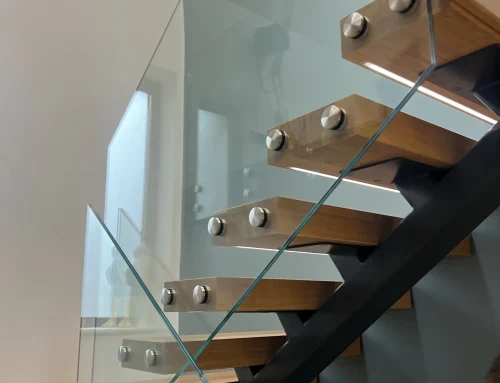
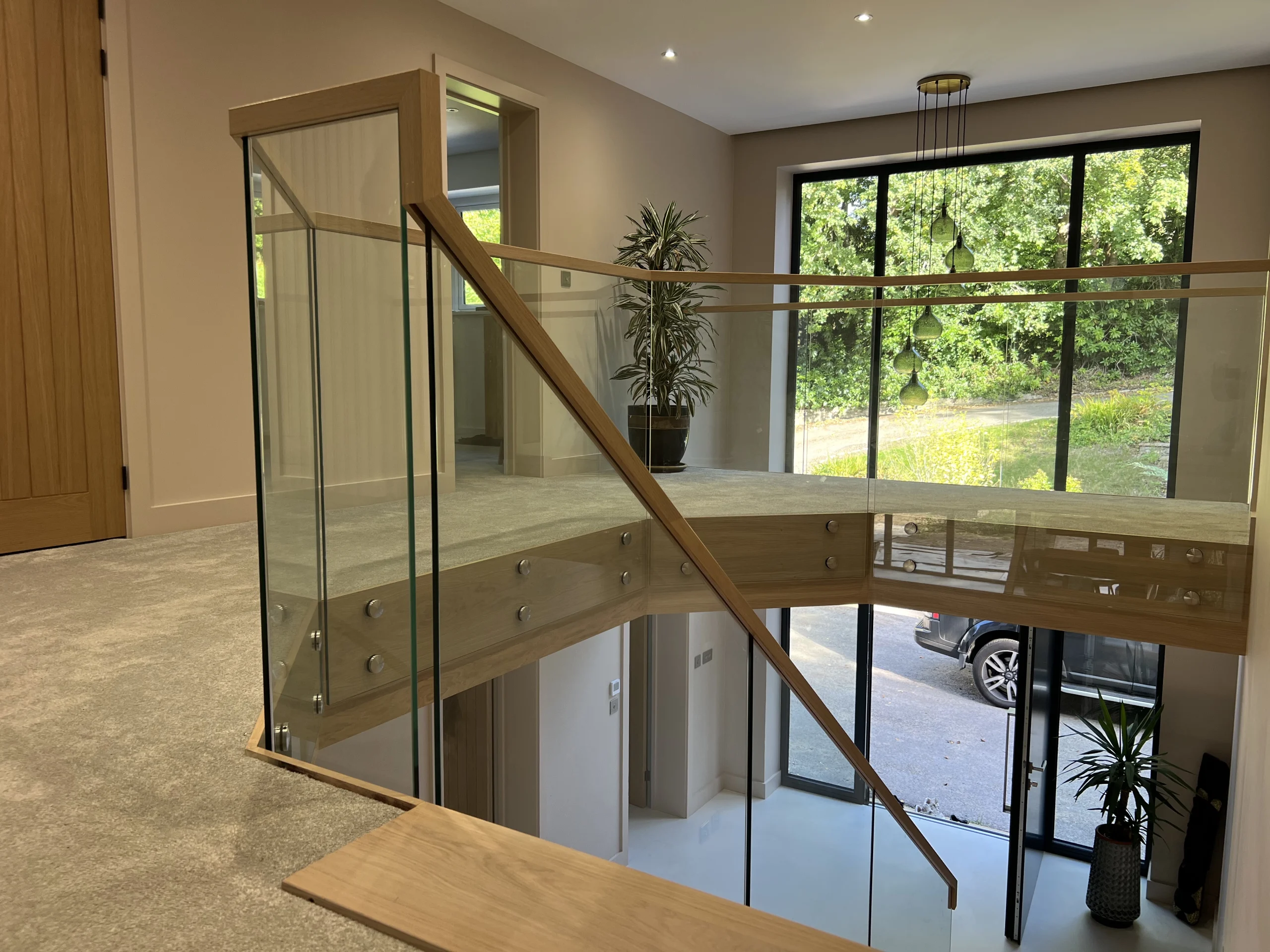 Compact winder with glass — the preferred alternative to paddle stairs
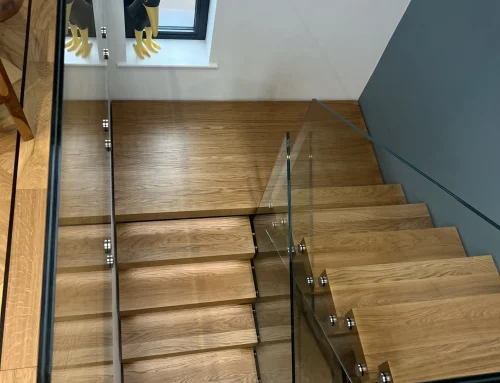
 U-shaped central spine — similar footprint, dramatically better comfort
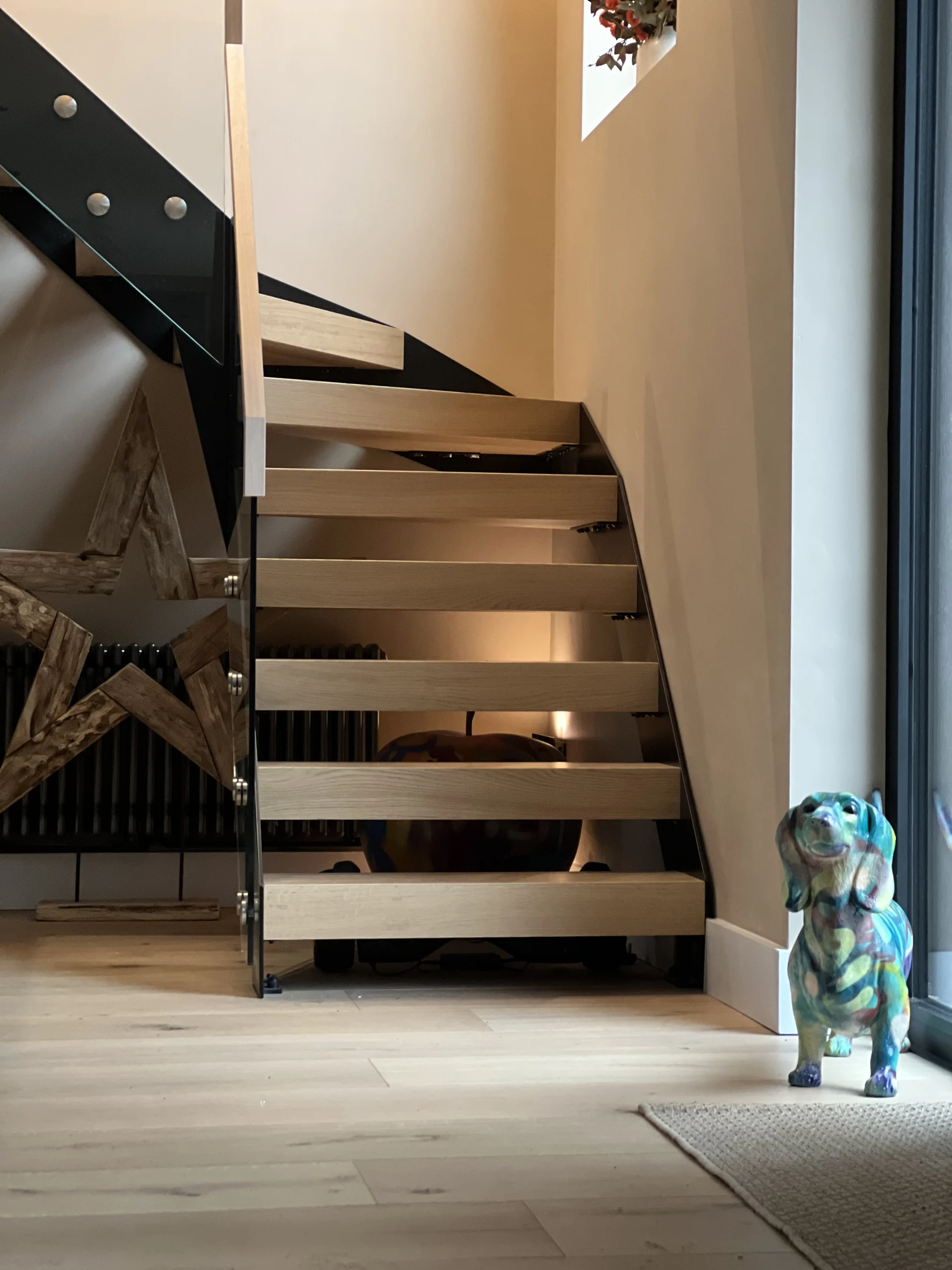
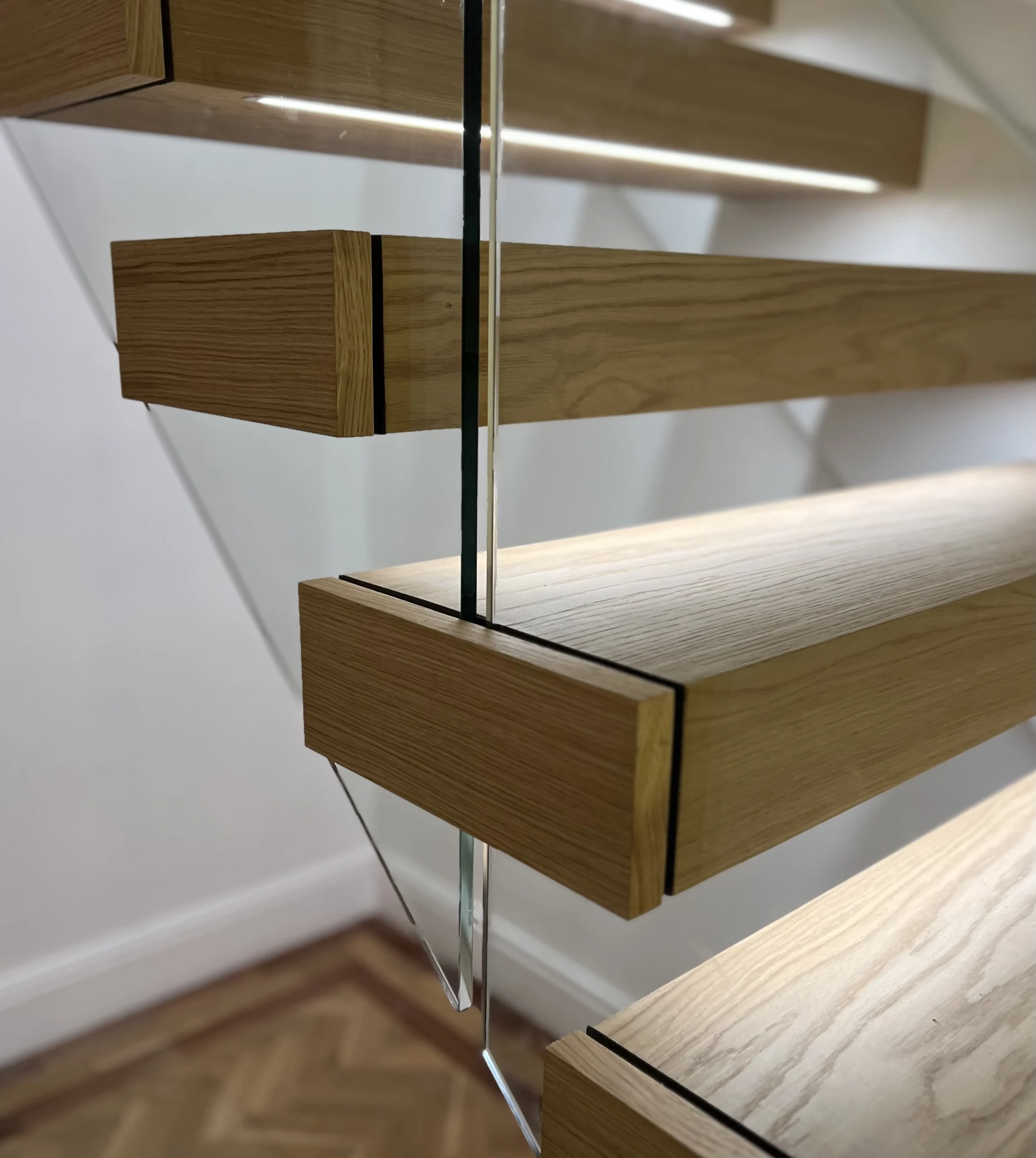 Floating staircase — open risers maximise light in the same space
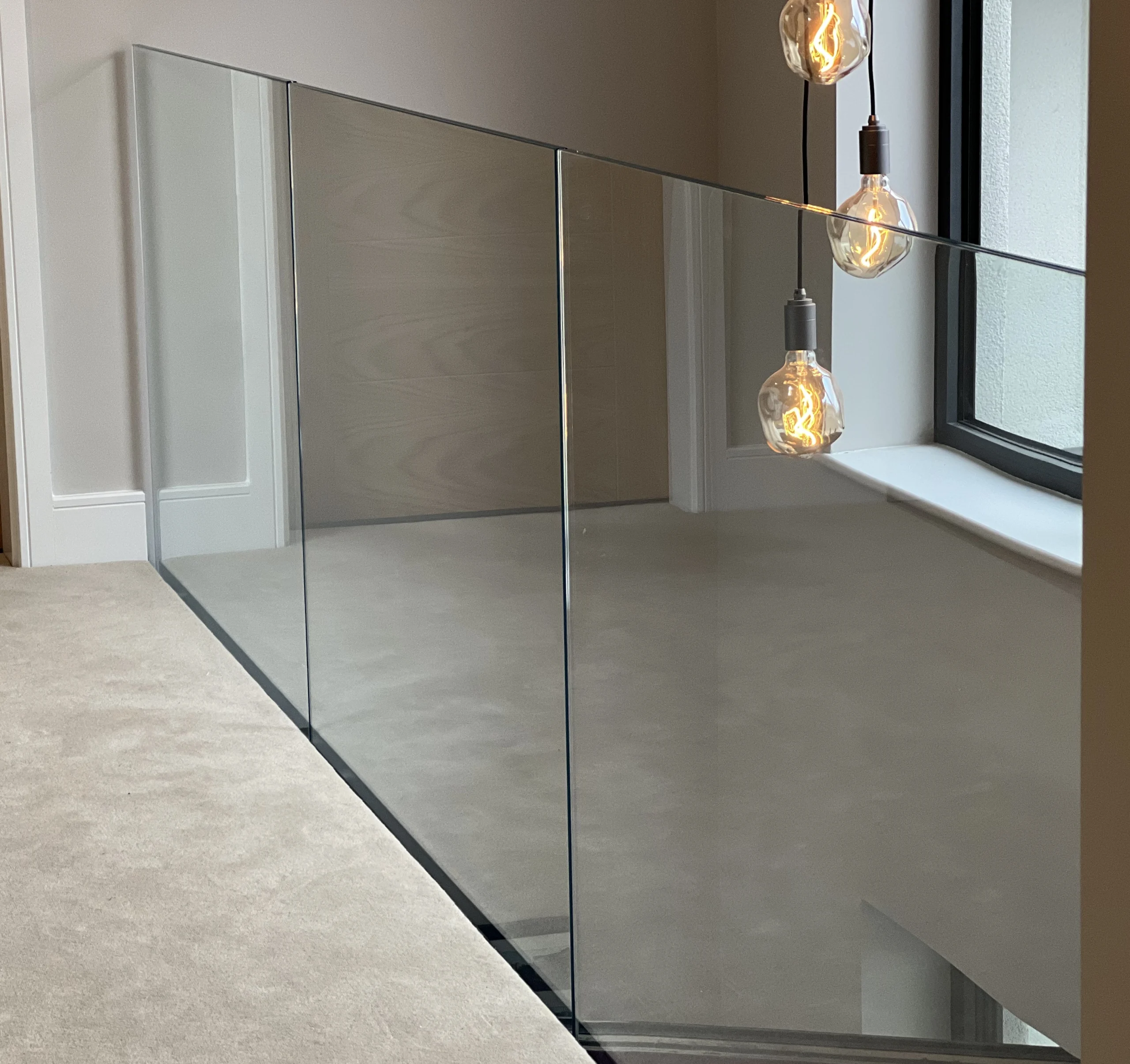 Frameless glass — even a compact staircase feels spacious with glass
Fixed Ladders — The Step Below Paddle Stairs
Below paddle stairs in the Building Control hierarchy sits the fixed ladder — the most restricted access option under Part K. A fixed ladder (paragraph 1.32) may only be used in a loft conversion containing one habitable room, and only when there is not enough space without altering the existing space for any type of staircase (including paddle stairs).
The key distinction: paddle stairs require that no standard staircase will fit. Fixed ladders require that not even a paddle staircase will fit. Fixed ladders must have fixed handrails on both sides and must not be retractable — Approved Document B explicitly prohibits retractable ladders as a means of escape.
In practice, fixed ladders are extremely rare in habitable loft conversions. They are steep (typically 60–75° from horizontal), uncomfortable, and essentially limit the loft room to occasional use. If your project reaches the point where a fixed ladder is the only access option, the conversion may not be viable as a habitable room — and you should discuss this honestly with your architect and Building Control officer before proceeding.
Installation Considerations — What to Expect
Floor opening
A paddle staircase requires a minimum floor opening of approximately 1,400mm × 650mm — the smallest of any staircase type. The opening must be formed with timber trimmers (typically double trimmers), sized by a structural engineer and inspected by Building Control before the staircase is installed.
Starting foot
When ordering a paddle staircase, you must specify whether the first (bottom) tread should be left-foot or right-foot leading. This determines which side of the first tread has the wider section. Most right-handed people prefer a right-foot start, but the choice should be based on the natural approach to the staircase from the room below. Some manufacturers offer the option to reverse the bottom tread on site — check before ordering.
Handrails
Both sides of a paddle staircase must have fixed handrails at 900–1,000mm above the pitch line. If the staircase is between two walls, wall-mounted handrails on both sides fulfil this requirement. If one or both sides are open, a full balustrade with guarding (minimum 900mm, 100mm sphere rule) is required.
Non-slip treads
Part K requires non-slip surfaces on all paddle staircase treads. This can be achieved with non-slip paint, applied non-slip strips, or carpet. Polished timber treads without non-slip treatment will fail a Building Control inspection. If using hardwood treads with an oil or lacquer finish, non-slip nosing strips are the most practical solution.
Getting Paddle Stairs Approved — Practical Tips
Building Control officers have varying attitudes to paddle stairs. Some accept them pragmatically as a reasonable solution for tight spaces. Others actively seek reasons to reject them in favour of a standard staircase. The following approach maximises your chances of a smooth approval.
1 Demonstrate that alternatives were considered
Include in your application a brief statement showing that standard straight flight, winder, L-shape, U-shape, and spiral staircase options have been assessed and cannot fit within the available space. Include plan drawings showing why each fails. This removes the officer's most common objection.
2 Consult early
Contact Building Control at the design stage — before ordering the staircase. A pre-application discussion (often free) will confirm whether they will accept paddle stairs in your specific situation. Getting agreement in writing before committing prevents the costly scenario of a rejected staircase after installation.
3 Specify compliant dimensions
Ensure the going over the wider part of each tread meets the 220mm minimum in Table 1.1. Ensure the rise is within 150–220mm. Ensure handrails are specified on both sides. Building Control officers will measure these dimensions on the final inspection — non-compliance at this stage means the staircase must be modified or replaced.
Continox recommendation: We do not manufacture paddle staircases because we believe that in the vast majority of cases, a compact winder, spiral, or bespoke floating staircase can be designed to fit the same space — delivering a dramatically better experience for the homeowner. If your builder or architect has recommended paddle stairs, we are happy to assess whether an alternative design would work. Our site surveys are free and include a full dimensional assessment of all viable staircase options for your property.
Frequently Asked Questions — Paddle & Alternating Tread Stairs
Yes — paddle stairs (alternating tread stairs) are legal in the UK under Part K of the Building Regulations. However, they are heavily restricted: permitted only in loft conversions, only when Building Control agrees that no standard staircase will fit, and only to access one habitable room (plus an optional bathroom/WC that is not the dwelling's only WC). They must be in straight flights with handrails on both sides.
No — paddle stairs cannot be used as a main staircase. They are permitted only in loft conversions and only as a last resort when no other staircase type will fit. They cannot be used for access to basements, mezzanines, or between any other levels of a dwelling. Building Control will reject any application to use paddle stairs outside of a loft conversion.
Paddle stairs cost £800–£2,000 supplied and installed in 2026. Flat-pack kits start from £250 (supply only). Hardwood paddle stairs with glass balustrade run up to £2,500. Add £1,000–£3,000 for structural opening, fire doors, smoke alarms, and Building Control fees — these ancillary costs apply to all loft staircase types.
Paddle stairs meet Building Regulations safety requirements when properly installed with handrails on both sides and non-slip treads. However, they are objectively less safe than standard staircases for certain users — particularly children, elderly residents, and anyone carrying objects. The alternating foot pattern requires concentration, especially when descending. This is why Part K restricts them to a last resort rather than a design choice.
Part K specifies that paddle stairs must be in straight flights. Some Building Control officers have accepted quarter-turn paddle configurations on a case-by-case basis, but this is not guaranteed. Two short straight flights connected by a small quarter landing is more likely to be accepted than winder treads within the paddle flight itself. Always confirm with your Building Control officer before ordering a non-straight paddle staircase.
Yes — paddle stairs consistently reduce the perceived value and appeal of a loft conversion. Estate agents report that families in particular view paddle stairs as a negative feature. A loft conversion with paddle stairs is typically valued at the lower end of the 10–20% property value uplift range, while a conversion with a conventional or spiral staircase achieves the higher end. The £2,000–£4,000 additional cost of a proper staircase is typically recovered in property value.
The minimum floor opening for a straight paddle staircase is approximately 1,400mm × 650mm. This is the smallest opening of any staircase type. The opening must be formed with timber trimmers or steel beams designed by a structural engineer. Building Control will inspect the structural work before the staircase is installed.
They are the same thing. "Paddle staircase," "space-saver staircase," "alternating tread staircase," and "space-saving stairs" all refer to the same design — a staircase with treads where alternating halves are cut away. The official term in Approved Document K is "alternating tread stair." Manufacturers and homeowners use the other terms interchangeably.
Explore Proper Staircase Options for Your Loft
Before committing to paddle stairs, let Continox assess whether a compact winder, spiral, or bespoke floating staircase could fit your space. Free site surveys across Southern England — we will measure everything and present all viable options with fixed pricing.