
Second Staircase Cost UK 2026 — Floor Plate Impact & Build Cost Guide
The financial impact of the second staircase requirement from 30 September 2026 is bigger than the construction cost of the additional staircase fabric — and most developer cost models in 2025 underestimated both. The DLUHC impact assessment estimated £2.679 billion of compliance cost across the UK over 10 years, with the bulk falling on lost saleable floor area rather than build cost. This guide breaks down exactly where the money goes: fabric and installation cost per stair, lost net sellable area, ventilation and lift coordination, design fee escalation, and the indirect costs that catch developers off guard. Pricing is based on current UK market rates for 2026 and reflects what Continox sees on tendered fire escape and protected staircase packages. For the underlying regulatory framework see our second staircase requirements guide and UK staircase regulations overview.
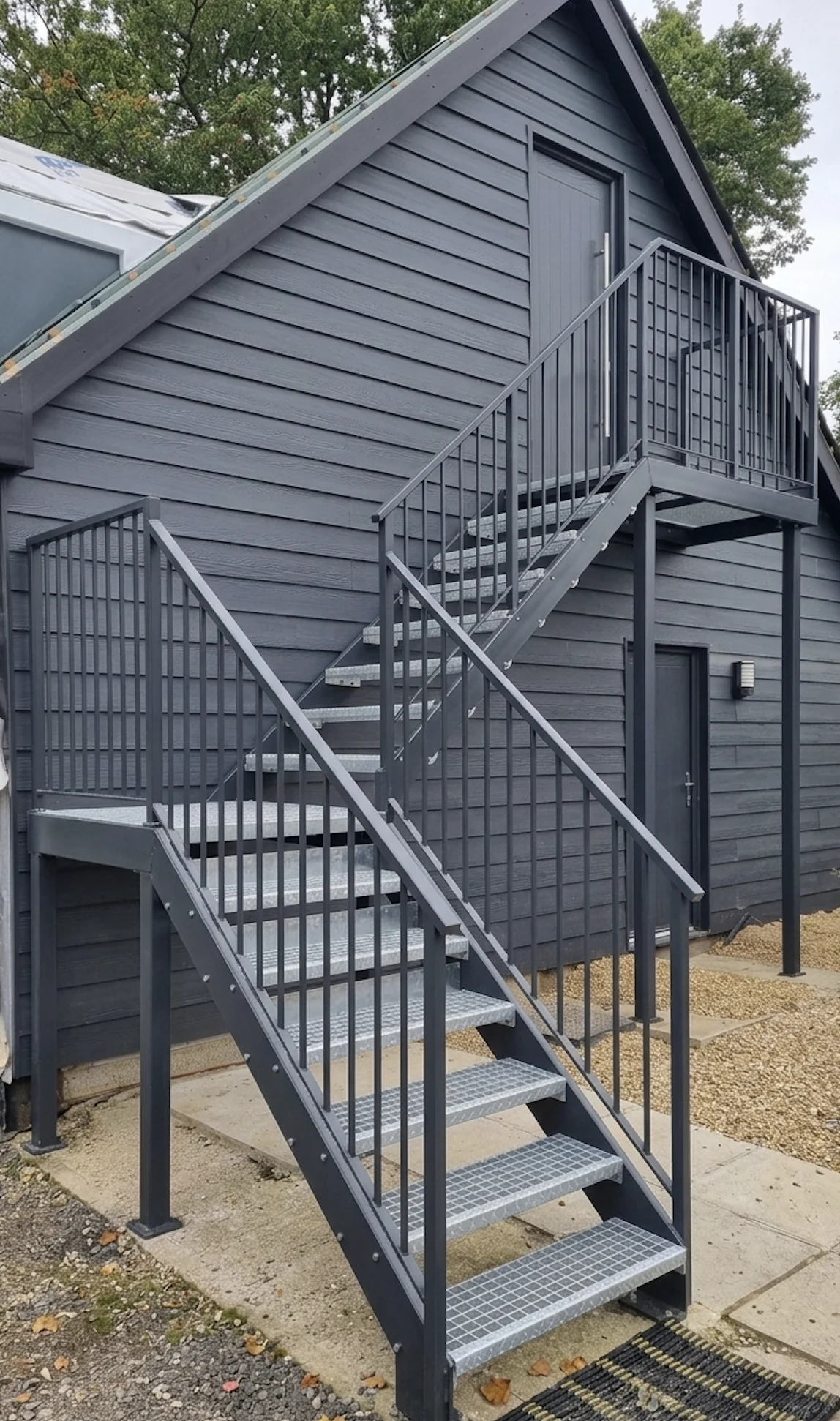
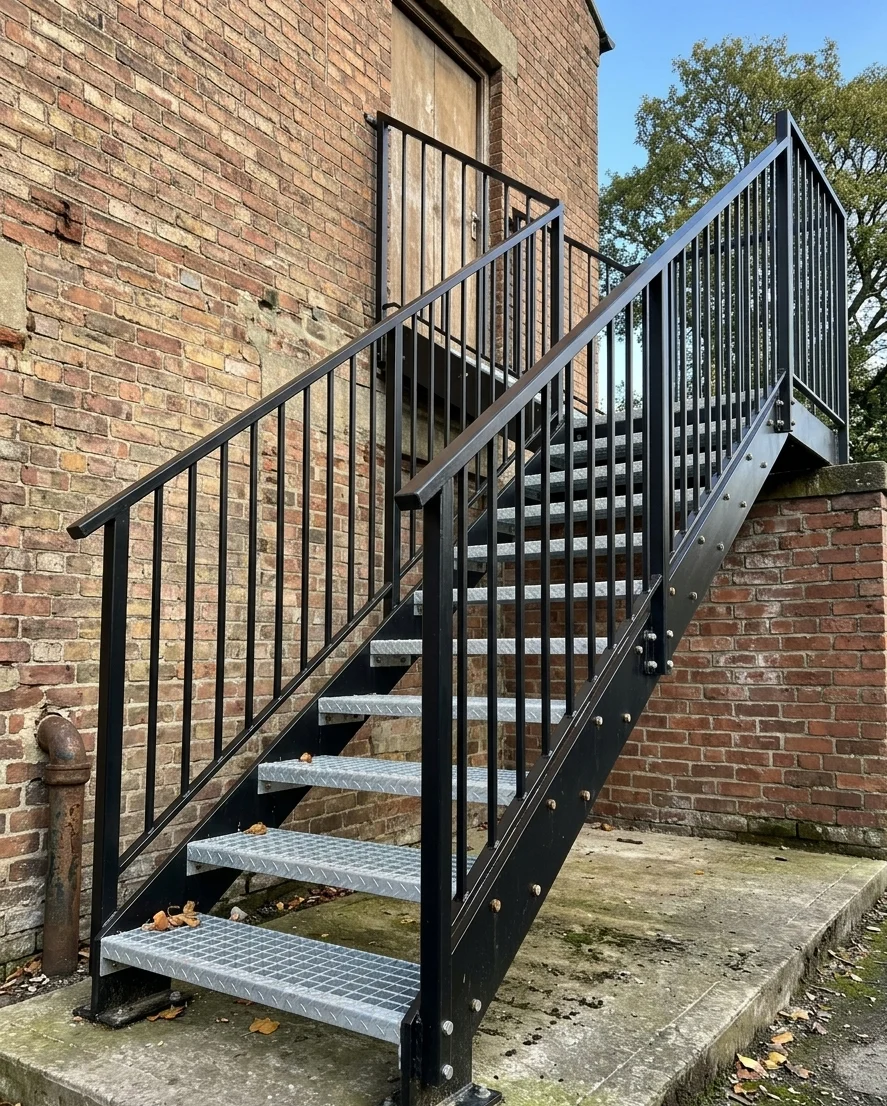
Steel external escape staircase by Continox — manufactured to BS 9991 for residential and commercial premises, with full structural calculation and BCB documentation included.
The total cost of adding a second staircase to a typical UK residential tower from 30 September 2026 falls in three layers. Fabric and installation cost ranges from £80,000 for a 6-storey building to £250,000+ for a 30-storey tower depending on staircase type, materials, and access. Lost net sellable area is the larger cost on most schemes — at 12–18m² per floor, a 30-storey tower forfeits 360–540m² of saleable floor (typically 4–6 flats), worth £3.5m–£5.5m in central London or £1.5m–£2.5m in regional UK. Indirect costs (additional smoke ventilation, structural redesign, design fees, BCB resubmission) typically add another £40,000–£120,000. For developers, the practical impact is approximately £4–6 million per tower scheme.
Cost Breakdown — Three Layers
The total cost impact of the second staircase requirement falls in three distinct layers. Most developer cost models capture only the first; the second is the largest; the third is the most variable.
Layer 1 — Fabric & Installation Cost
The direct construction cost of adding a second protected staircase varies with building height, staircase type, and whether the staircase is internal (concrete or steel within the building envelope) or external (steel escape stair attached to the facade).
For most new residential towers the second staircase is internal — concrete in-situ for buildings over approximately 12 storeys, structural steel with composite stair flights below that height. The fabric cost includes the structural shell, the stair flights themselves, lobby walls, fire-resisting doorsets, smoke ventilation provision, and finishes. Installation cost reflects access difficulty (taller buildings need crane access for higher levels) and programme integration with the wider build.
| Building Height | Internal Stair Cost | External Steel Cost | Typical Stair Type |
|---|---|---|---|
| 6 storeys (~18m) | £80,000–£120,000 | £60,000–£90,000 | Steel composite |
| 10 storeys (~30m) | £120,000–£170,000 | £90,000–£130,000 | Steel composite |
| 15 storeys (~45m) | £160,000–£210,000 | £120,000–£170,000 | Concrete in-situ |
| 20 storeys (~60m) | £190,000–£240,000 | n/a — internal only | Concrete in-situ |
| 25 storeys (~75m) | £220,000–£270,000 | n/a — internal only | Concrete in-situ |
| 30 storeys (~90m) | £250,000–£310,000 | n/a — internal only | Concrete in-situ |
| 40 storeys (~120m) | £320,000–£420,000 | n/a — internal only | Concrete in-situ + pressurisation |
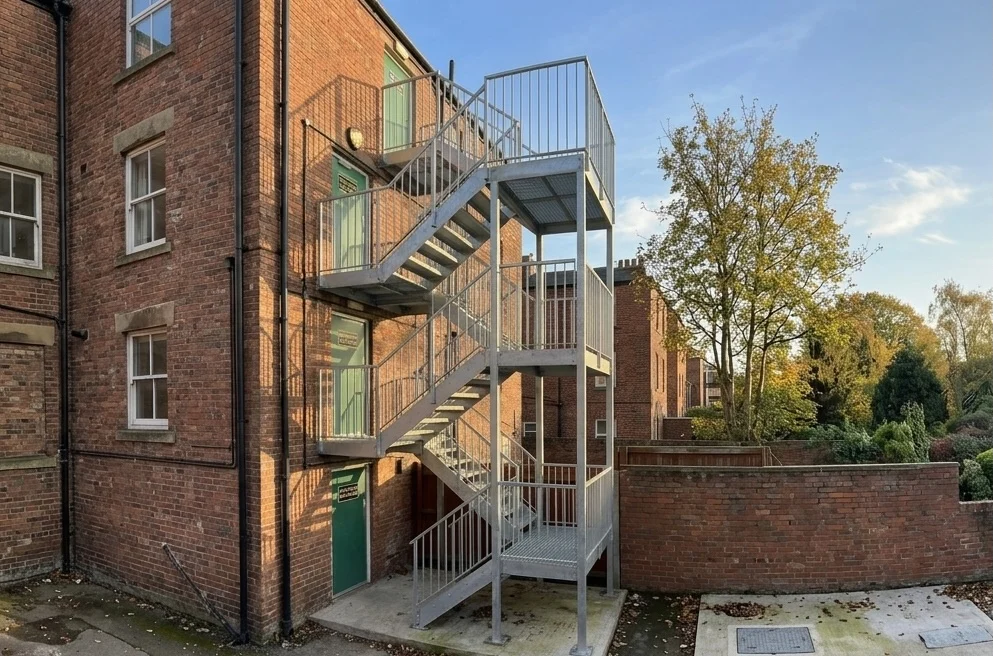
External steel staircases under 45m only. For buildings up to approximately 15 storeys, an external steel escape stair is a viable alternative to an internal protected staircase — typically cheaper, faster to install, and easier to phase against the wider construction programme. Above 45m, external stairs become impractical due to wind loading on the unsupported steel and the difficulty of weather-protecting the escape route. Continox manufactures BS 9991-compliant external steel staircases for residential and commercial premises up to typical mid-rise heights, with full structural calculation and BCB documentation included.
Layer 2 — Lost Net Sellable Area
The largest financial impact on most schemes is the floor area opportunity cost. Each protected staircase consumes 12–18m² per floor, depending on the staircase type, lobby arrangement, and fire-resisting wall thickness. A 30-storey tower with a second staircase loses 360–540m² of saleable floor area — typically four to six flats removed from the development.
Worked example — 30-storey London tower
Scheme: 30-storey new residential tower, central London, average flat size 75m², GIA-to-NSA efficiency 75% under existing single-stair design.
Worked example — 12-storey Manchester scheme
Scheme: 12-storey new residential block, Manchester city centre, average flat size 65m², regional sale prices.
Worked example — 8-storey regional development
Scheme: 8-storey BTR development, Leeds, average unit 55m², monthly rent £1,250 (capitalised at 5% yield = £300,000 unit value).
The regional variation is significant. London schemes — with sale prices typically £1,000–£1,500 per square foot in central locations — see disproportionately high opportunity costs. Regional cities (Manchester, Birmingham, Bristol) at £350–£500/sq.ft see costs roughly one-third the London level for equivalent floor area loss. BTR developments calculate lost value through capitalised rental income rather than sales price.
Layer 3 — Indirect Costs
Beyond the staircase fabric and the lost floor area, four indirect cost categories add to the total impact:
Each protected staircase requires its own independent smoke ventilation system. For natural ventilation systems (typical on buildings up to 30m), this means openable vents at each level with a roof-level exhaust — adding approximately £15,000–£35,000 per staircase. For mechanical pressurisation systems (taller buildings, or where natural ventilation is impractical), the cost is higher: £40,000–£120,000 for a fully pressurised stair core including fans, ductwork, controls, and emergency power supply.
The cost premium for the second stair is not double the first — there are economies of scale in shared controls and mechanical plant — but is typically 70–80% of the cost of the first stair's ventilation system.
Adding a second vertical core to a structural design is rarely a like-for-like exchange. The two-staircase floor plate typically needs structural revision to accommodate the new core load paths, lateral stability strategy, and floor framing. Structural engineering fees for the redesign typically run £15,000–£40,000 on schemes that were already at planning approval stage.
Where the redesign is identified late — typically when the project is already in BCB review — the structural impact can be more significant. Existing foundations may need re-engineering, and the cost premium versus designing for two stairs from the outset can reach £80,000–£200,000 on a substantial tower scheme.
Architectural and consultant design fees scale with the redesign effort. For schemes already at RIBA Stage 4 (Technical Design) or beyond when the second-staircase requirement is identified, the design rework typically costs £10,000–£30,000 in additional architectural fees, plus services engineering coordination of approximately £8,000–£20,000.
Earlier identification — at Stage 2 (Concept Design) or Stage 3 (Spatial Coordination) — significantly reduces the rework cost. Schemes designed from the outset for two-staircase compliance see no fee uplift versus single-stair designs.
Resubmission of Building Control approval applications under the new rules typically costs £3,000–£8,000 in BCB fees (depending on scheme size and chosen approval route), plus the programme cost of the additional review cycle. Building Control Bodies are processing high volumes of pre-deadline applications and decision lead times have extended; programme delay of 6–12 weeks is realistic for resubmissions.
For schemes financed at 6–10% per annum, a 3-month programme delay on a £50m development costs roughly £625,000–£1,250,000 in financing costs alone — typically the largest single indirect cost on substantial schemes that miss the transitional window.
Total Cost Impact — By Building Type
Combining the three cost layers gives an indicative total impact across typical UK residential building types. Figures assume central UK locations and mid-range specifications; high-end London schemes will see materially higher impacts driven by lost floor area value.
| Building Type | Fabric Cost | Lost Area Value | Indirect | Total Impact |
|---|---|---|---|---|
| 6-storey block (regional) | £80–120k | £300–500k | £40–60k | £420–680k |
| 8-storey block (regional) | £100–140k | £400–700k | £40–70k | £540–910k |
| 12-storey tower (regional) | £140–180k | £600k–1.0m | £50–90k | £790k–1.27m |
| 20-storey tower (London) | £220–290k | £2.8–4.2m | £70–120k | £3.1–4.6m |
| 30-storey tower (London) | £280–340k | £4.5–6.0m | £80–140k | £4.9–6.5m |
| 40-storey tower (London) | £380–490k | £6.5–9.0m | £100–180k | £7.0–9.7m |
The financing cost is what catches developers out. A 30-storey scheme typically carries £40–80m in development financing at 6–10% annual interest. A six-month programme delay through redesign and resubmission costs £1.2–4m in financing alone — comparable to the entire fabric and floor area cost of the second staircase combined. This is why early identification of the second-staircase requirement matters more than the cost itself: the indirect financial drag of late-stage redesign is what sinks scheme viability, not the construction cost of the additional staircase.
Floor Plate Efficiency — Where the Money Hides
The biggest single design lever for managing the second-staircase cost is floor plate efficiency. A poorly arranged two-staircase floor plate can lose 18m² per floor; a well-arranged one can lose just 12m². On a 30-storey tower the difference is 180m² of saleable floor — typically £2–3m of revenue.
What drives floor plate efficiency on two-stair schemes:
Staircase positioning. Stairs at opposite corners of the floor plate (rather than adjacent or central) give the shortest travel distances and the smallest lobby areas. Corner positioning also exposes two external walls per stair core, reducing the cost of weather-tight fire-resisting construction.
Lobby integration. Where flat entrance lobbies and stair lobbies share wall lines (rather than projecting independently), the combined floor area is significantly smaller than separately-arranged lobbies. Saves typically 1–2m² per floor on a well-coordinated layout.
Lift core consolidation. Combining the lifts and at least one of the staircases into a single shared core reduces the total vertical circulation footprint. Some schemes cluster all vertical movement (lifts + both stairs + lobby) into a single central core, with corridor access to flats around the core perimeter.
Service riser routing. Mechanical and electrical service risers should follow the staircase cores rather than occupying separate dedicated risers. Doubles the use of the unproductive staircase footprint and reduces overall non-saleable area.
For projects assessing two-staircase impact, an early floor plate efficiency review with the architect typically pays back many times over. The time to do this is at RIBA Stage 2 (Concept Design) — by Stage 4 the structural and services coordination has typically locked in floor plate constraints that are expensive to change.
Where the Costs Hit — By Project Stage
The total cost impact varies significantly by the stage at which the second-staircase requirement is identified. Earlier is dramatically cheaper.
| Identification Stage | Total Impact (30-storey scheme) | Primary Cost Driver |
|---|---|---|
| RIBA Stage 1 (Pre-Concept) | £3.5–4.5m | Lost area only — designed for from outset |
| RIBA Stage 2 (Concept) | £3.6–4.6m | Lost area + minor design rework |
| RIBA Stage 3 (Spatial) | £4.0–5.2m | Lost area + structural redesign |
| RIBA Stage 4 (Technical) | £4.5–6.0m | Above + services rework, drawings reissued |
| Pre-construction (post-tender) | £5.2–7.0m | Above + procurement re-let, programme delay |
| Post-foundation (worst case) | £7.0–10.0m+ | Above + foundation rework, financing escalation |
Alternative Strategies — When Two Stairs Aren't Viable
For sites where two-staircase compliance is genuinely difficult — typically constrained urban infills, listed building conversions, or very small floor plates — three alternative strategies are available:
1. Stay below the 18m threshold. Designing the building to fall below 18m at the highest occupied storey avoids the requirement entirely. On a typical 3.0m floor-to-floor scheme this means six storeys maximum. The lost height capacity has its own opportunity cost (fewer flats per square metre of site) but for some sites this is the most viable route.
2. Mixed-use with non-residential top floors. The 18m measurement is to the highest residential storey. Topping out the building with office, plant, or amenity floors above 18m doesn't trigger the requirement, providing the residential portion stays below the threshold. This works on schemes where commercial demand exists above the residential.
3. Transitional protection acceleration. For projects that can realistically deliver concrete pours by 30 March 2028, accelerating the BCB submission to qualify for transitional protection retains the existing single-stair rules. This typically requires committing significant pre-development cost early (planning conditions discharge, ground investigation, structural design, demolition) but for the right scheme can save the £4–6m total impact.
For sites where neither approach is viable, the second-staircase requirement effectively becomes a fixed cost on the scheme that needs to be absorbed in the development appraisal. For staircase fabrication see our external staircase and fire escape staircase ranges, both compliant with BS 9991 and Approved Document B.
Frequently Asked Questions
Fixed-Price Quotations for Tender
Continox manufactures BS 9991-compliant external and internal escape staircases for residential, commercial, and mixed-use buildings under Approved Document B. Full structural calculations, BCB documentation, fixed-price tender quotations, manufactured and installed by our own team. Hampshire-based, working across the UK.