
Space is the defining constraint of every loft conversion staircase. The staircase must be steep enough to fit the available footprint, comfortable enough for daily use, and compliant with Building Regulations — three requirements that frequently conflict with each other. This guide compares every space-saving loft staircase option available to UK homeowners in 2026, with real footprint dimensions, costs, and an honest assessment of which options actually work for daily living versus which are acceptable only as a last resort.
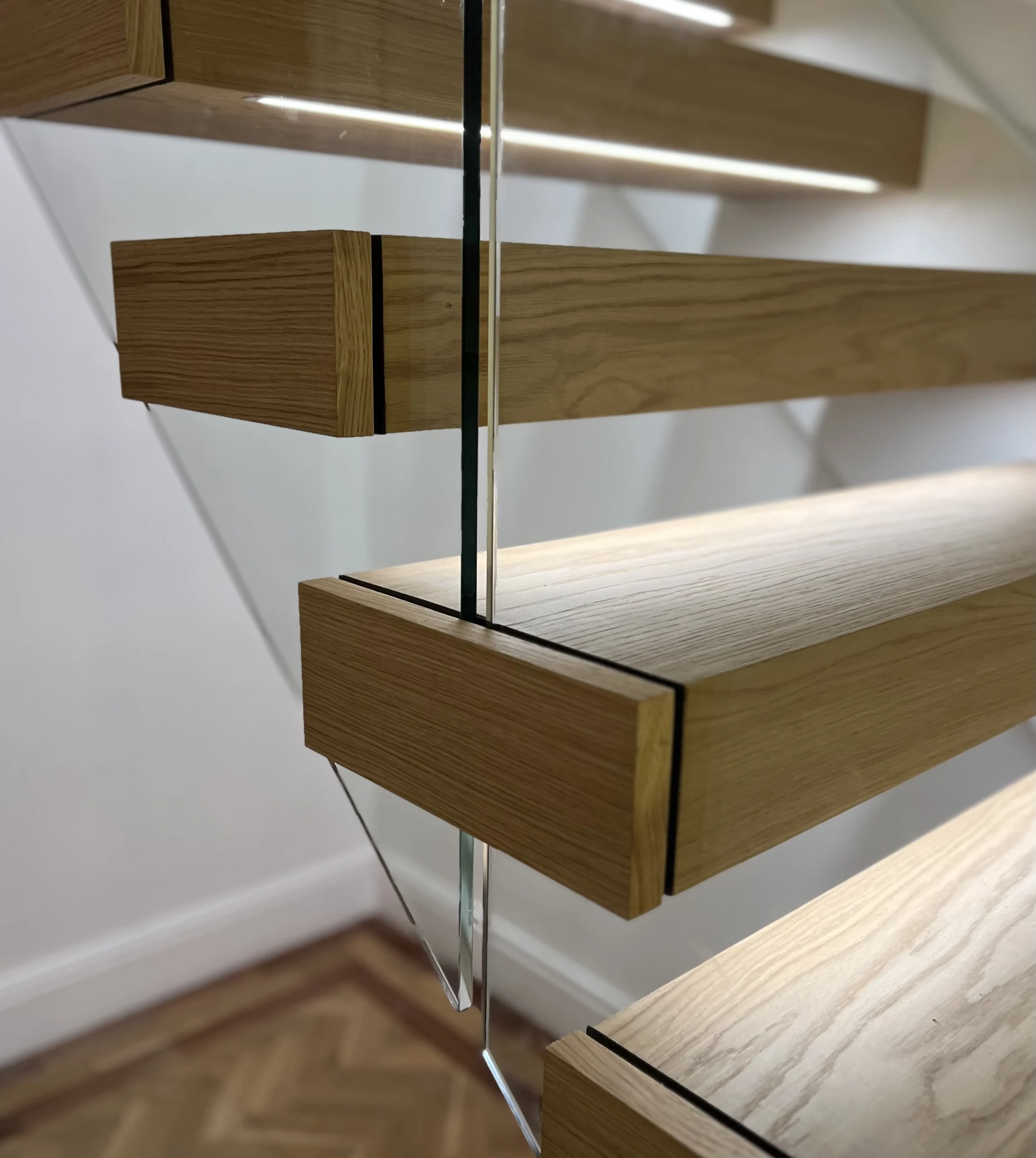
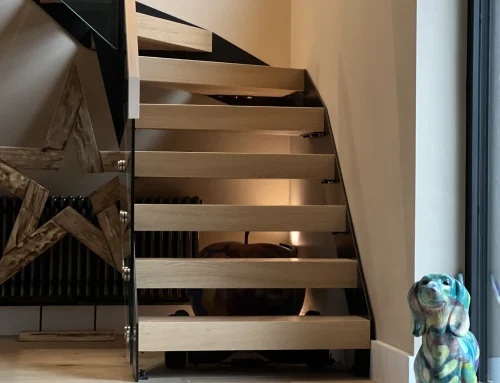
A floating staircase with open risers — minimal visual footprint while maintaining full Part K compliance
The most effective space-saving loft staircases for UK homes are: compact winder stairs (footprint from 1.6m × 1.6m for a six-winder), spiral staircases (1.5–2.0m diameter circle), and U-shaped switchback stairs (smallest conventional footprint by stacking two flights). Alternating tread (paddle) stairs offer the absolute smallest footprint (1.8m × 0.6m) but are a Building Control last resort — permitted only when no other staircase type will fit. The best approach is to optimise the position and configuration of a standard staircase before considering restricted types. A well-designed quarter-turn winder or compact spiral saves nearly as much space as a paddle staircase while being dramatically more comfortable, safer, and better for property value.
Why Space-Saving Matters — But Comfort Matters More
Every loft conversion staircase requires floor space from the level below. In a typical UK terraced house, that means sacrificing part of a bedroom, landing, or corridor to create the stairwell opening and the run of the staircase. The natural instinct is to make the staircase as small as possible — but this is where many homeowners make a costly mistake.
A staircase that saves 0.5m² of floor area but is uncomfortably steep, awkward to climb with shopping bags, or difficult for children and elderly visitors is a false economy. Estate agents report that an awkward loft staircase is one of the top reasons buyers discount the value of a loft conversion. The goal is not the smallest staircase — it is the smallest staircase that feels like a natural, comfortable part of the house.
This guide ranks the options from the most practical space-savers (which you should consider first) to the most extreme (which exist for situations where nothing else will work).
The real question: Before choosing a space-saving staircase type, ask whether the staircase position has been fully optimised. Moving the staircase to a different starting point — even by 300mm — can often accommodate a standard design that would not fit in the original position. A bespoke staircase manufacturer or architect can assess this during a site survey, potentially eliminating the need for a compromised design entirely.
6 Space-Saving Options Compared
The table below compares every viable space-saving staircase type for UK loft conversions. Footprint assumes a standard floor-to-floor height of approximately 2.4–2.6m (typical for UK properties with a loft conversion).
| Staircase Type | Typical Footprint | Cost Range | Building Control Status |
|---|---|---|---|
| Compact winder (quarter-turn) | 1.6m × 2.0m | £2,000–£4,000 | Fully compliant — preferred option |
| Six-winder (double quarter-turn) | 1.6m × 1.6m | £2,500–£5,000 | Fully compliant — tight spaces |
| U-shaped switchback | 1.8m × 1.6m | £3,000–£6,000 | Fully compliant — smallest conventional |
| Spiral staircase | Ø1.5–2.0m circle | £2,000–£6,000 | Compliant under BS 5395 Pt II |
| Floating / cantilever | 2.5m × 0.9m (straight) | £7,900+ | Fully compliant — visual space saver |
| Alternating tread (paddle) | 1.8m × 0.6m | £800–£2,000 | Last resort only — Part K restricted |
Option 1: Compact Winder Staircase
1 The most practical space-saver
A compact winder staircase changes direction using tapered winder treads instead of a flat landing, eliminating the floor area that a landing would consume. A single quarter-turn (90°) with three winder treads at the top or bottom of the flight can fit into a footprint as small as 1.6m × 2.0m — roughly 40% less floor area than a straight flight with a landing.
Winder stairs are the default recommendation for space-constrained loft conversions because they are fully compliant with Part K, comfortable for daily use, and familiar to users. They feel like a normal staircase with a turn, which is exactly how most people prefer their loft access to work.
The key design constraint is the going measurement at the walking line. Part K requires a minimum going of 220mm measured at the centre of the tread (or 270mm from the inner edge for stairs under 1,000mm wide). A well-designed winder achieves this comfortably even in compact configurations — but budget designs sometimes fail this check, so always verify with your manufacturer or Building Control.
Cost: £2,000–£4,000 standard softwood. Bespoke steel-and-oak with glass balustrade from £6,000.
2 Six-winder (double quarter-turn)
A six-winder staircase makes two 90° turns using six winder treads — essentially an L-shape or U-shape constructed entirely from winders rather than straight treads with a landing. This configuration can fit into a remarkably compact footprint of approximately 1.6m × 1.6m, making it one of the smallest fully-compliant conventional staircases available.
The trade-off is comfort. Six consecutive winder treads feel tighter than a design with a flat landing separating two short flights. The narrow ends of the winder treads are less comfortable to step on, and carrying bulky items around two consecutive turns requires careful manoeuvring. For a loft room used as a home office or occasional guest bedroom, this is acceptable. For a primary master suite used daily, a design with at least one flat landing is preferable.
Cost: £2,500–£5,000 standard. Bespoke from £7,000.
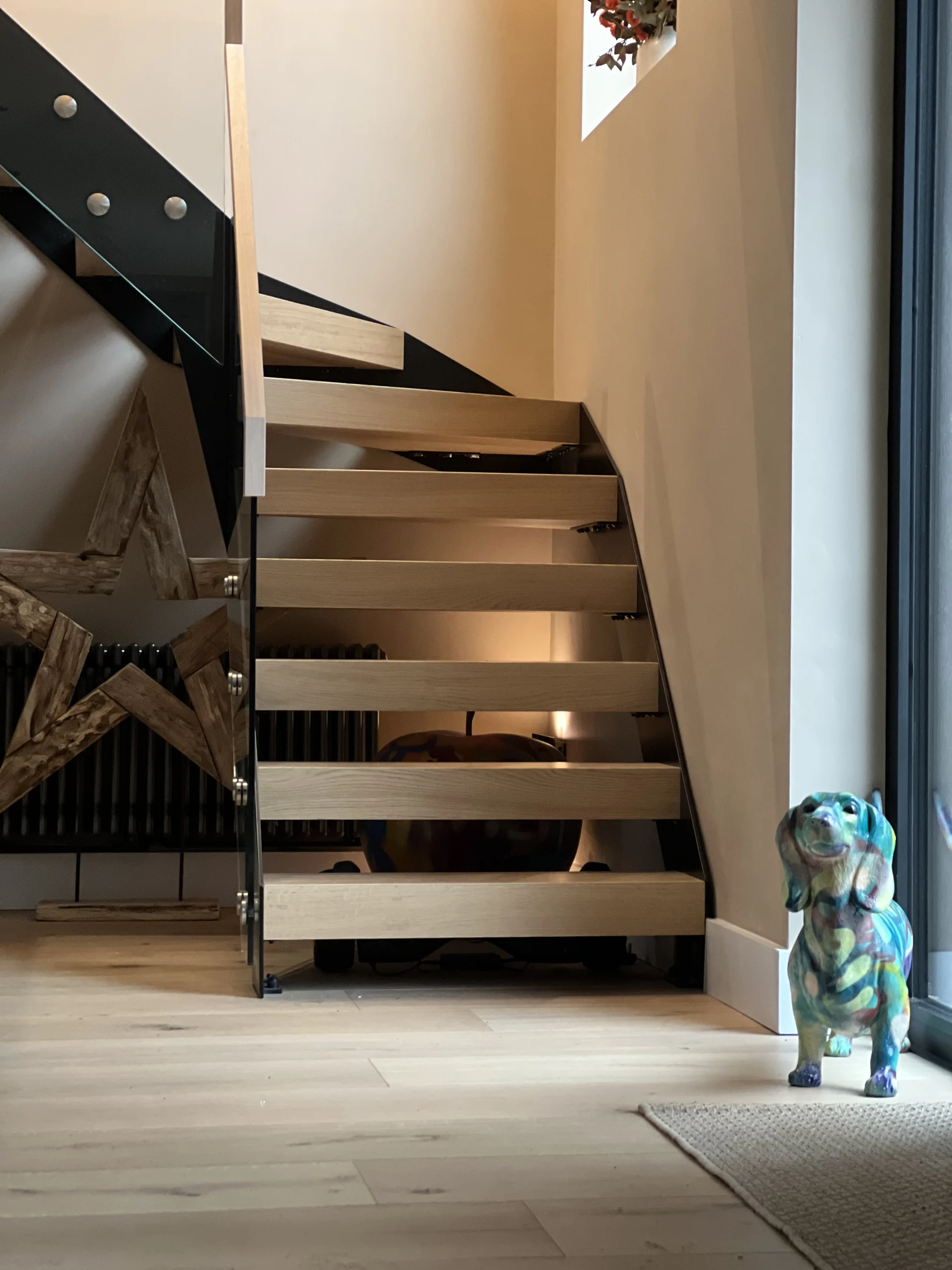
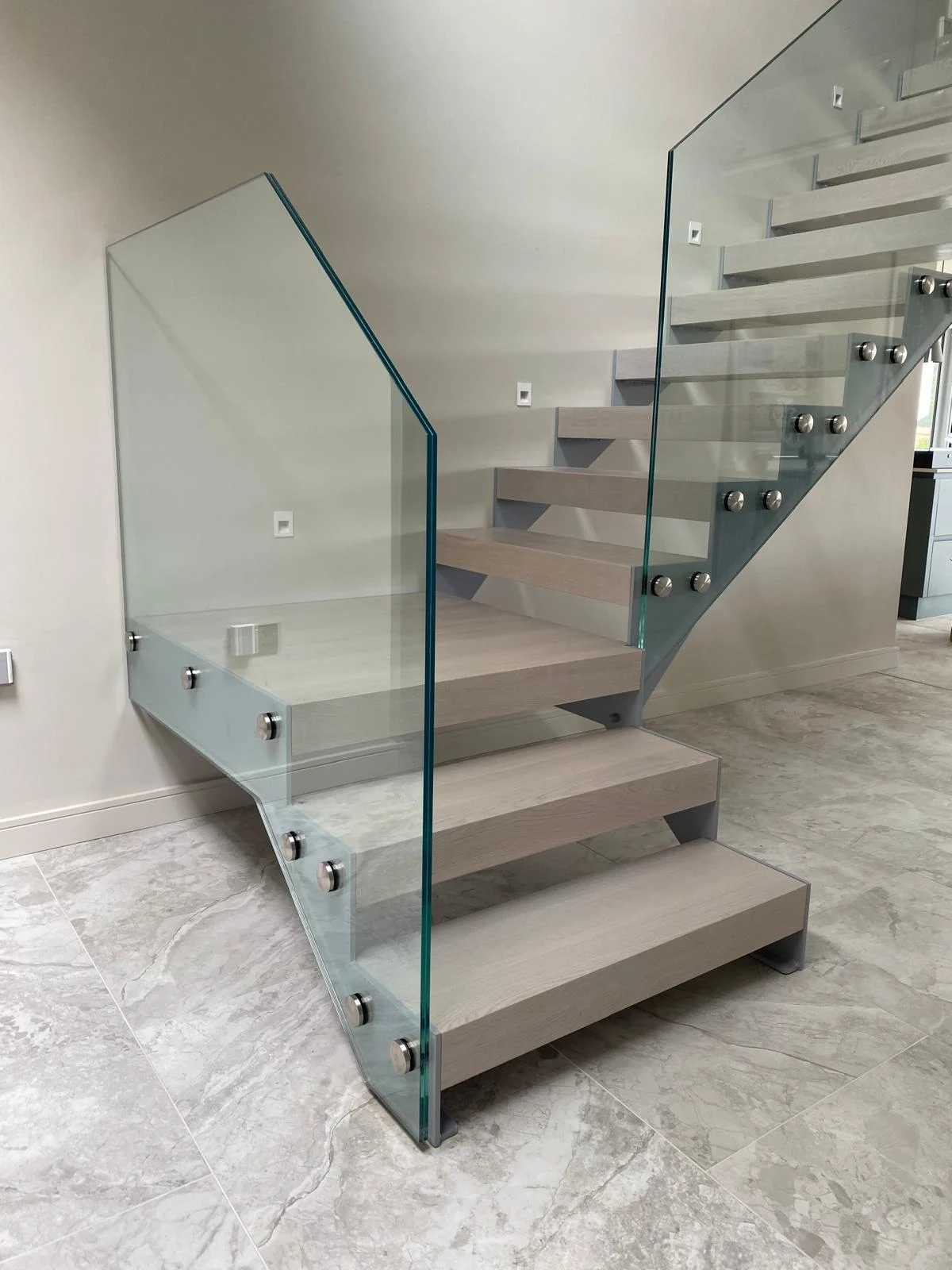 Steel-and-oak winder — compact footprint, full Part K compliance
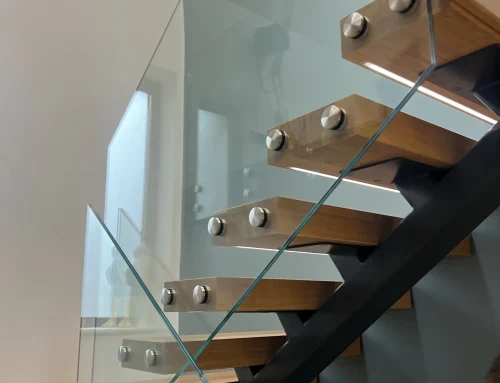
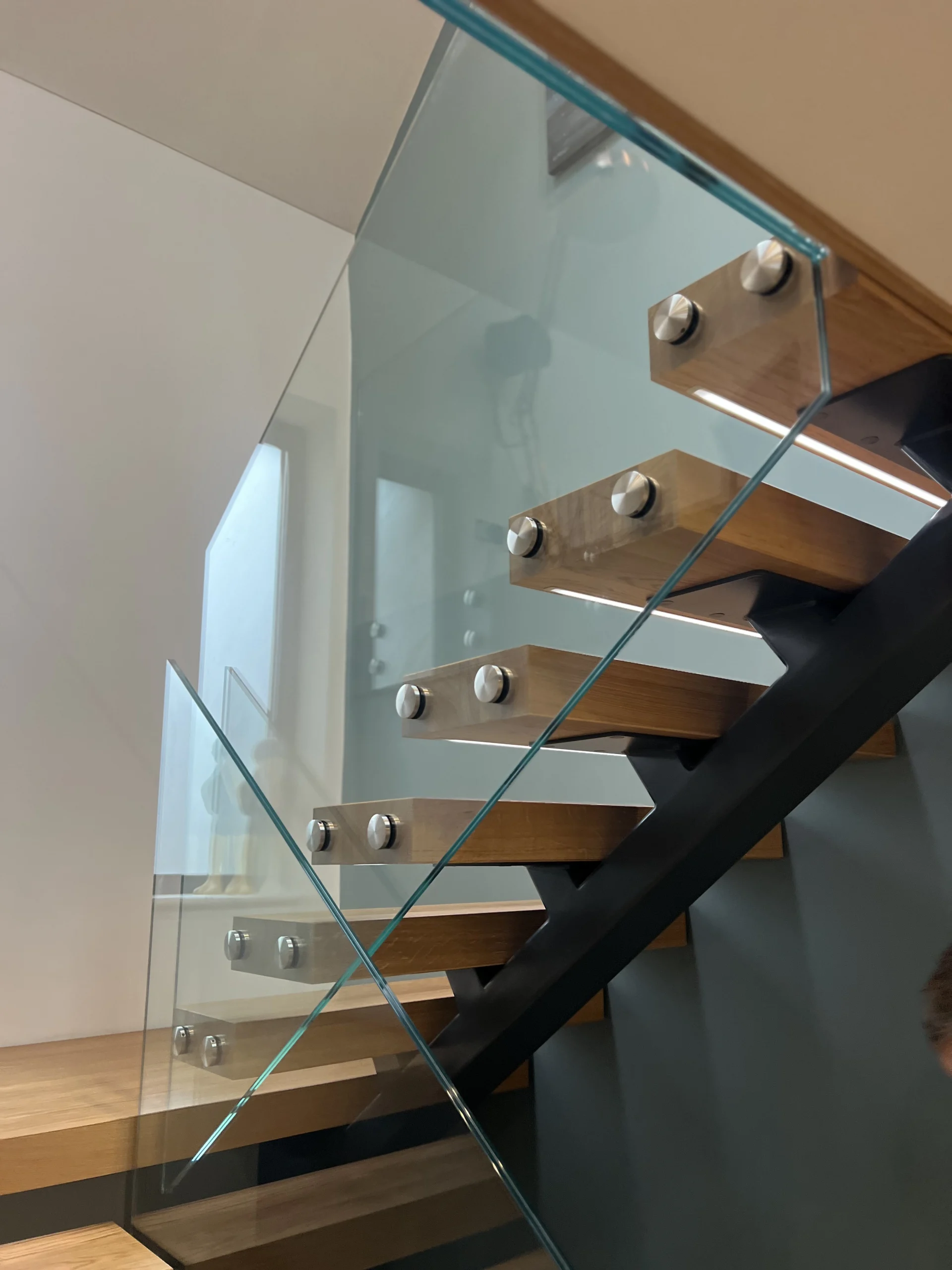
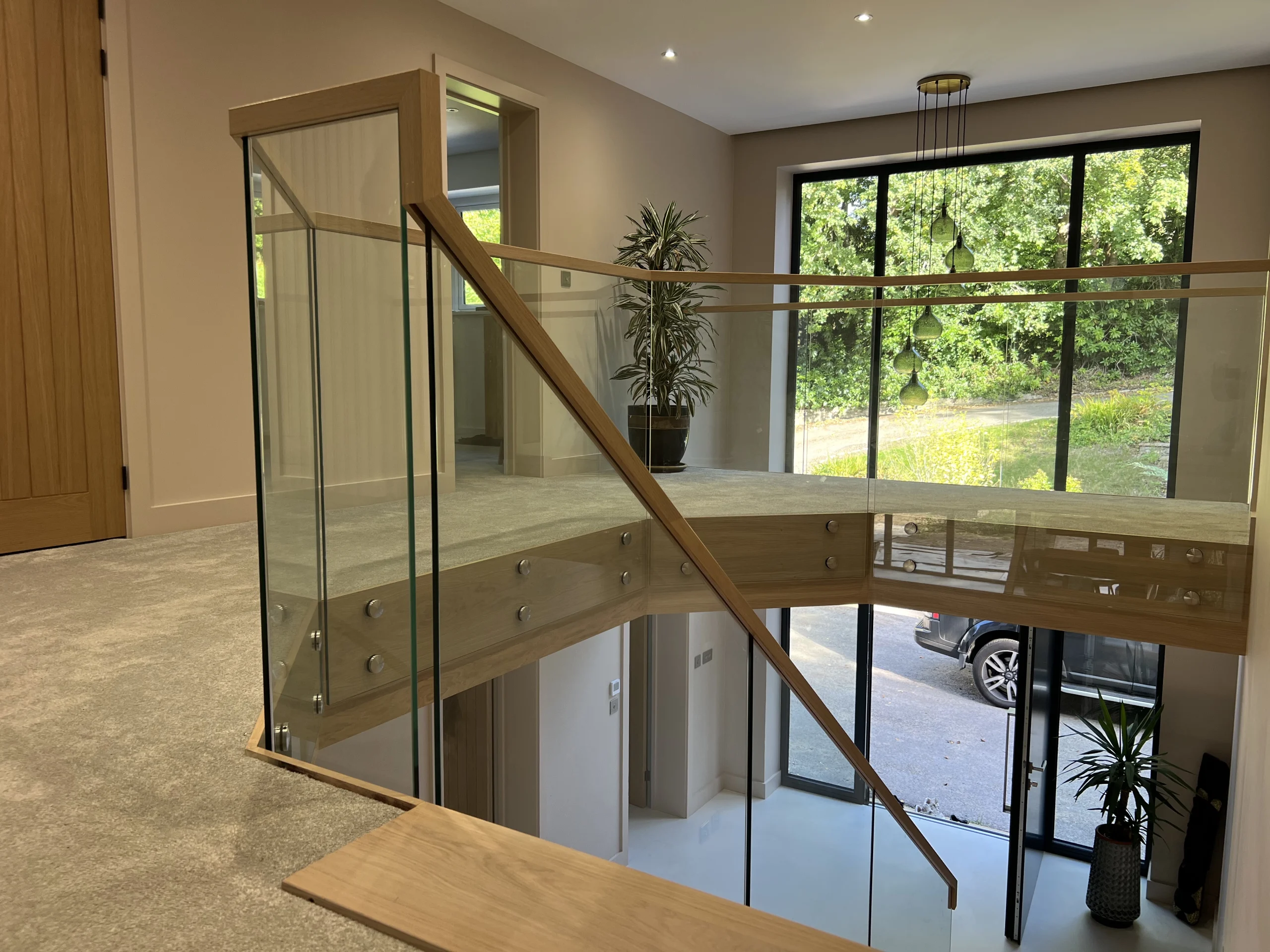 Open risers + glass balustrade — the visual space-saving effect
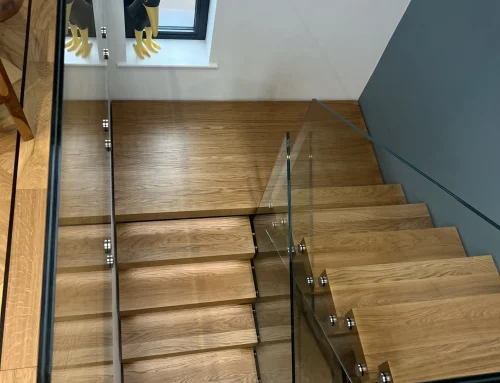
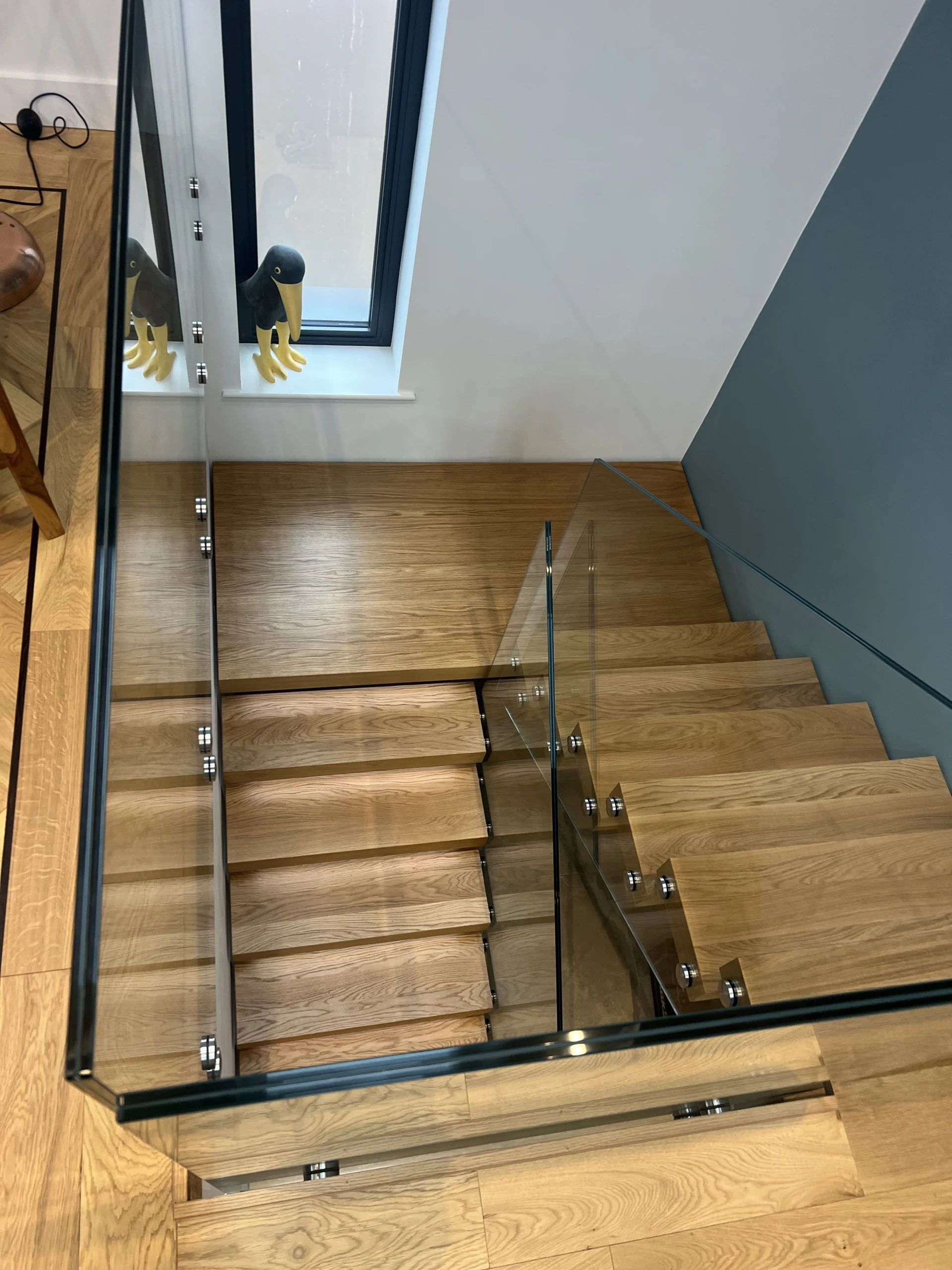
 U-shaped central spine — two flights stacked in one compact area
 LED-integrated treads — light flow prevents the stairwell feeling enclosed
Option 3: U-Shaped Switchback
3 Smallest conventional footprint
A U-shaped staircase reverses direction by 180°, with two parallel flights connected by a half landing. Because the two flights are stacked vertically within the same floor area, the horizontal footprint is remarkably small — typically 1.8m × 1.6m for a comfortable design, or tighter with winder treads replacing the half landing.
The U-shape is the strongest option when the loft staircase is positioned directly above the existing stairwell. The new flight folds back over the lower flight, and the opening in the loft floor sits directly above the existing landing. This minimises disruption to the rooms below — you are not carving floor area out of a bedroom.
A bespoke central spine staircase in a U-shape configuration is one of the most space-efficient premium options for loft conversions. The single central steel spine eliminates the visual bulk of twin stringers, making the staircase appear to float within its compact footprint.
Cost: £3,000–£6,000 standard. Bespoke central spine with glass from £9,500.
Option 4: Spiral Staircase
4 Smallest floor opening
A spiral staircase requires only a circular opening in the floor — typically 1,500mm to 2,000mm in diameter. In terms of raw floor area, that is 1.77m² to 3.14m², which is comparable to or smaller than a compact winder configuration.
Under BS 5395 Part II, a spiral staircase serving as primary access in a private dwelling must meet Category B requirements: minimum width of 1,000mm from the centre pole to the outer edge. This means a minimum external diameter of approximately 2,000mm plus the centre pole width. At this minimum size, the spiral is tight but compliant and usable.
The practical reality: spiral staircases are harder to use than conventional flights for carrying objects, doing laundry runs, or moving furniture. They work best for loft rooms that are not the primary bedroom — home offices, dressing rooms, teenage bedrooms, and guest suites. If the loft will be your master bedroom with daily use by the whole family, a compact winder or U-shape is almost always the better long-term choice.
Cost: £2,000–£6,000 standard. Bespoke steel-and-glass from £8,000+.
Spiral vs winder footprint comparison: A 2,000mm diameter spiral occupies roughly 3.14m² of floor area. A compact quarter-turn winder occupies approximately 3.2m² (1.6m × 2.0m). The spiral is marginally smaller — but the winder is dramatically more comfortable for daily use. The space saving from a spiral over a winder is often less than 0.1m², which rarely justifies the trade-off in usability.
Option 5: Floating (Cantilever) Staircase
5 Visual space-saver
A floating staircase does not necessarily occupy less physical floor area than a conventional staircase — a straight floating flight still needs approximately 2.5m of horizontal run. What it saves is visual space. Open risers, concealed structural fixings, and a frameless glass balustrade allow light and sightlines to pass through the staircase, preventing the stairwell from feeling like a dark enclosed shaft.
In loft conversions where the stairwell is visible from the main living area, a floating staircase transforms what would otherwise feel like a cramped corridor into an architectural feature. The room below does not feel smaller because the staircase does not visually block the space — even though it physically occupies the same footprint as a conventional flight.
The structural requirement is significant. Wall-mounted cantilever treads need a solid masonry or reinforced steel frame wall. Stud walls are not sufficient. A hidden mono-stringer (a single steel beam concealed within the wall or beneath the treads) is the alternative for properties without suitable masonry walls.
Cost: Floating staircases from £7,900. With LED from £8,500+.
Option 6: Alternating Tread (Paddle) Stairs
6 Last resort only
Alternating tread stairs — where alternating halves of each tread are cut away — achieve the smallest possible footprint: as little as 1.8m × 0.6m. The reduced tread depth allows a steeper pitch in a shorter horizontal run, consuming less floor area below than any other staircase type.
However, Part K paragraph 1.29 is unambiguous: alternating tread stairs are permitted only in loft conversions and only when Building Control agrees that no other staircase configuration will fit. They can serve only one habitable room (plus an optional bathroom and WC, provided it is not the only WC in the dwelling). Fixed handrails are required on both sides, and every tread must have a non-slip surface.
The honest assessment: Paddle stairs are uncomfortable for daily use. They require conscious attention to which foot goes on which step — second nature for healthy adults after a few days, but genuinely difficult for children, elderly visitors, anyone carrying objects, and anyone who has had a drink. They dramatically reduce the usability and resale appeal of a loft room. If your builder suggests paddle stairs as a first option rather than an absolute last resort, get a second opinion from a staircase specialist — in most properties, a compact winder or spiral can be made to fit with better positioning.
Cost: £800–£2,000 for standard timber paddle stairs.
Footprint Comparison — Real Dimensions
The table below provides specific footprint dimensions for each option, assuming a floor-to-floor height of 2,500mm (typical UK loft conversion) and standard rise of 190mm with 13 treads.
| Staircase Type | Floor Area Used | Opening Size (Min) | Daily Comfort |
|---|---|---|---|
| Straight flight | ~3.2m² (2.8m × 0.9m + landing) | 2,800mm × 900mm | ★★★★★ Excellent |
| Quarter-turn winder | ~3.2m² (1.6m × 2.0m) | 2,000mm × 900mm | ★★★★☆ Very good |
| Six-winder (double turn) | ~2.6m² (1.6m × 1.6m) | 1,800mm × 900mm | ★★★☆☆ Acceptable |
| U-shaped switchback | ~2.9m² (1.8m × 1.6m) | 1,800mm × 1,600mm | ★★★★☆ Very good |
| Spiral (Ø1.6m) | ~2.0m² (circle) | Ø1,700mm circle | ★★★☆☆ Acceptable |
| Spiral (Ø2.0m) | ~3.1m² (circle) | Ø2,100mm circle | ★★★½☆ Good |
| Paddle / alternating tread | ~1.1m² (1.8m × 0.6m) | 1,400mm × 650mm | ★★☆☆☆ Difficult |
5 Design Techniques That Save Space Without Compromising
Before resorting to a restricted staircase type, apply these design techniques to reduce the footprint of a standard staircase.
1 Steepen the pitch (within limits)
Increasing the rise from 175mm to 200mm and reducing the going from 250mm to 230mm reduces the horizontal run of each tread by 20mm. Over 13 treads, that saves 260mm of total run — enough to make a staircase fit where it would not at a shallower pitch. The 2R + G formula at this combination gives 630mm, which is within the compliant range of 550–700mm. The trade-off is a steeper staircase (approximately 41° versus 35°), which is noticeable but acceptable for most users.
2 Replace the landing with winder treads
A flat quarter landing typically adds 800mm × 800mm to the staircase footprint. Replacing it with three winder treads eliminates this area entirely while maintaining the 90° turn. The winder treads must comply with Part K going requirements at the walking line, but a well-designed set of winders is comfortable and compliant.
3 Build over the existing stairwell
Positioning the loft staircase directly above the existing ground-to-first-floor stairwell is the single most effective way to avoid sacrificing bedroom floor area. The new flight starts from the existing first-floor landing and folds back or continues upward within the same vertical column. This approach works particularly well with a U-shaped switchback configuration.
4 Use open risers and glass balustrade
Open risers and a frameless glass balustrade do not reduce the physical footprint of a staircase, but they dramatically reduce the visual footprint. Light passes through the staircase structure, preventing the stairwell from making the room below feel smaller. This is a legitimate space-saving technique for the perception of the room, even though the actual dimensions are unchanged.
5 Add a dormer above the stairwell
If the constraint is headroom rather than floor area, a dormer above the stairwell position solves the problem without changing the staircase design. A small box dormer over the stairwell creates full-height headroom, allowing a standard staircase to terminate under a flat ceiling instead of a sloping roof. This is often less expensive than switching to a spiral or paddle staircase, and the result is a dramatically better user experience.
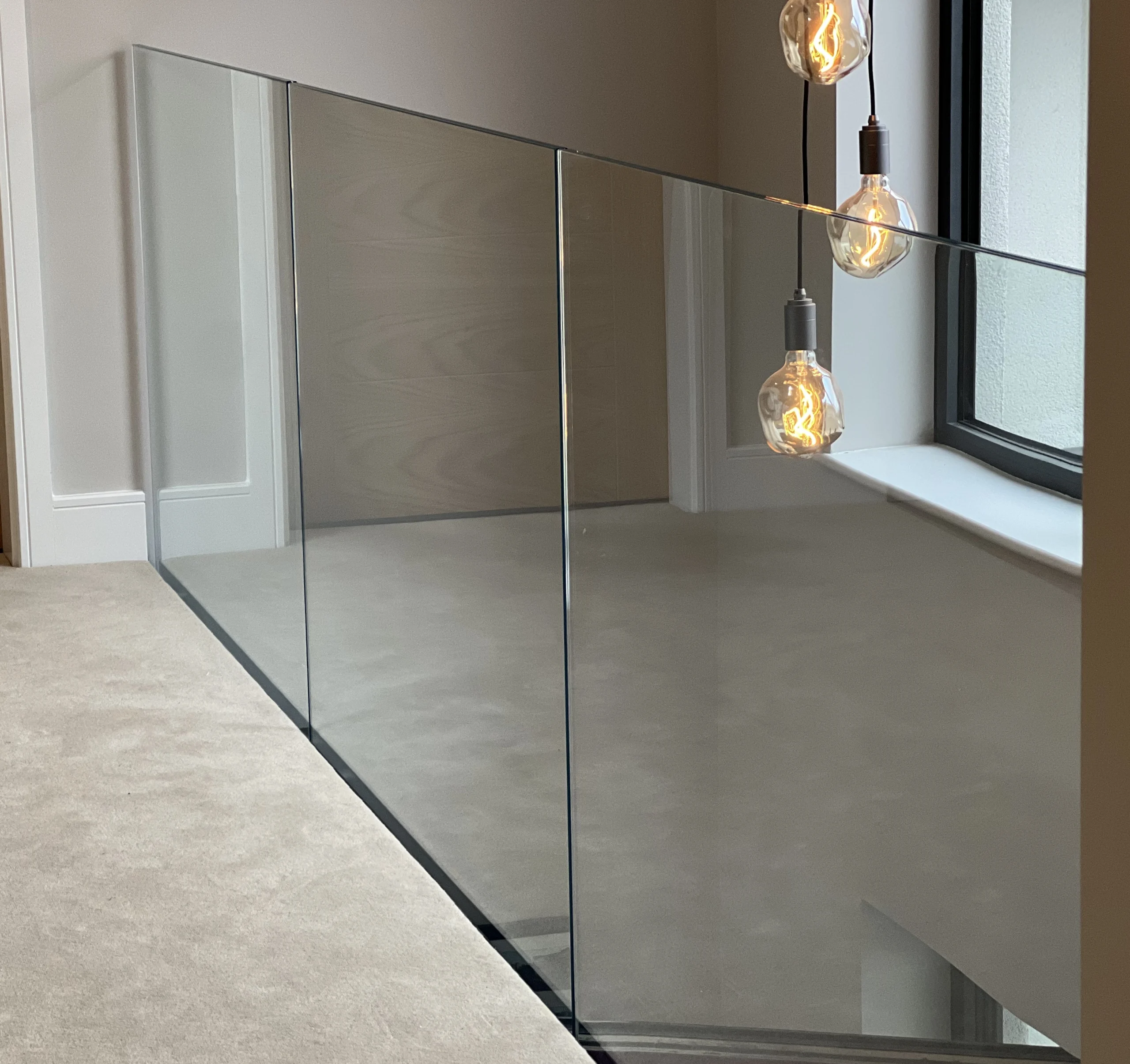 Frameless glass — visual transparency makes the stairwell feel twice as large
 Glass landing balustrade — compliant guarding without visual bulk
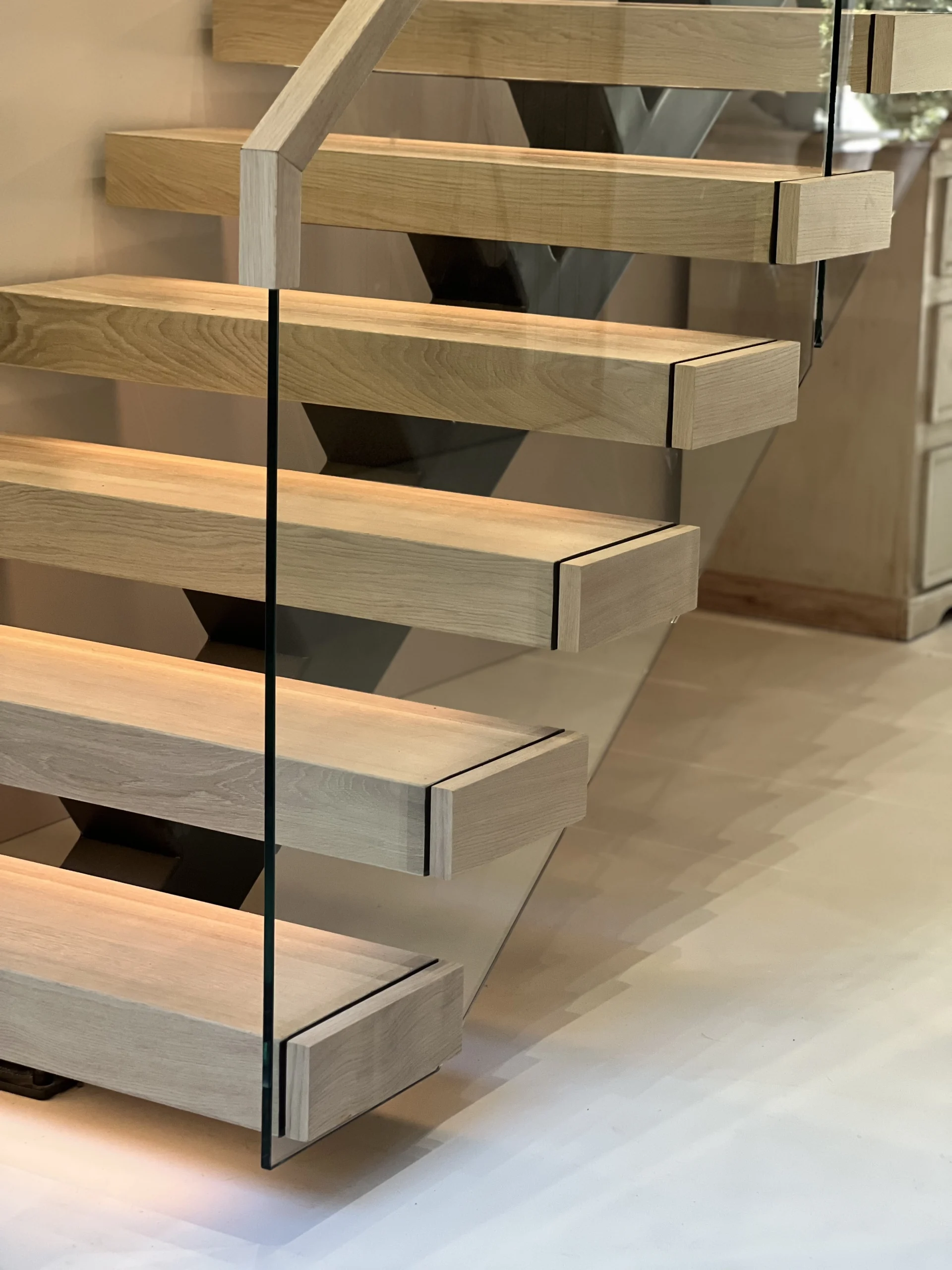 Under-tread LED — transforms a dark stairwell into a feature
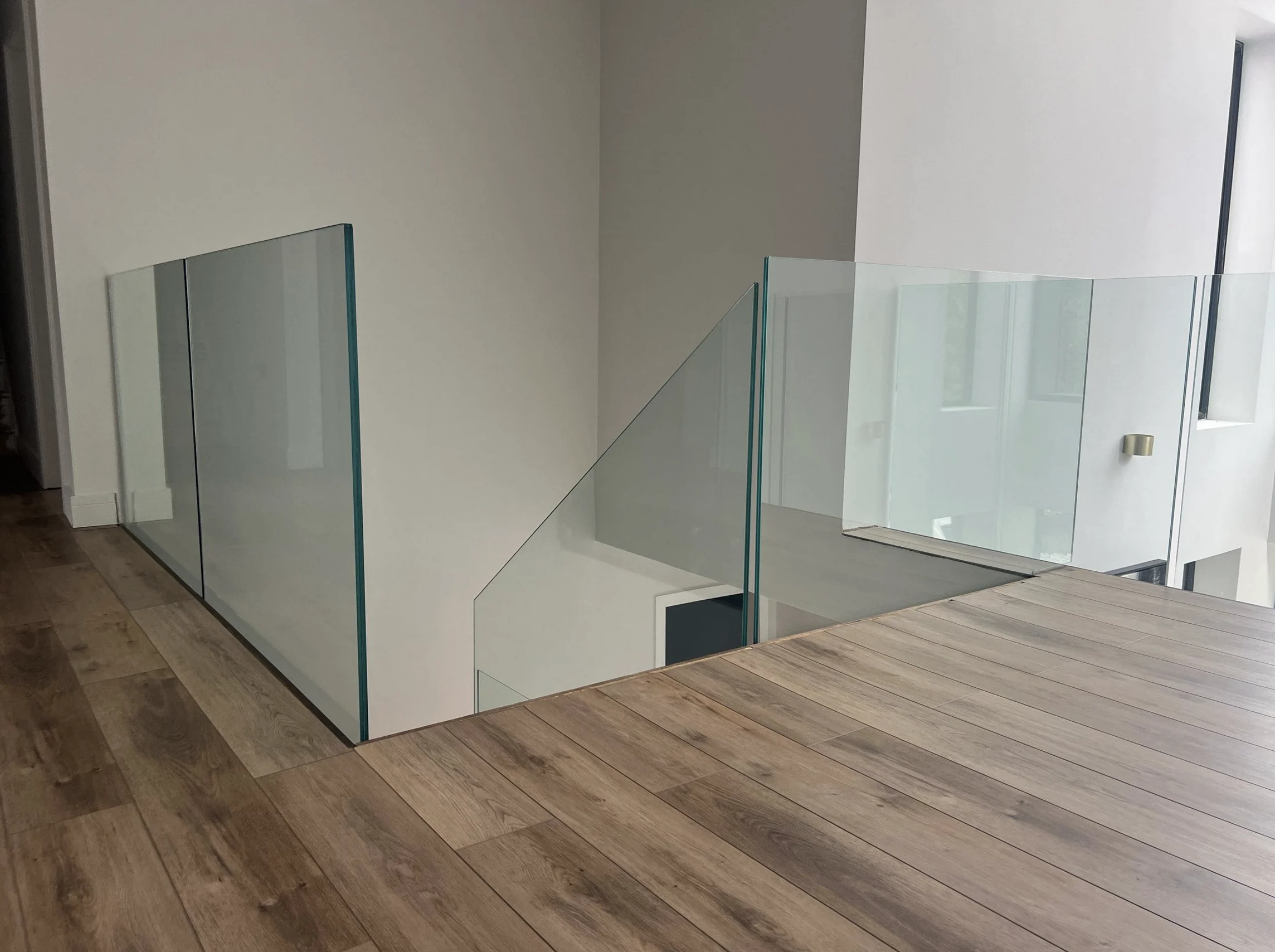 Combined stair and landing glass — seamless transition to the loft
Reclaiming Space Under the Loft Staircase
Every loft staircase creates a triangular void underneath. In a compact design, this void is smaller — but still usable. The most effective under-stair storage solutions for compact loft stairs include pull-out drawers built into the riser faces (ideal for shoes, seasonal items, and children's toys), a full-height cupboard under the upper section of the flight (coats, ironing board, cleaning supplies), and open shelving under the lower section where the ceiling height is below 1.2m.
If you are commissioning a bespoke staircase, discuss storage integration at the design stage. Retrofitting under-stair storage after installation is more expensive and produces a less refined finish. A well-designed under-stair storage system can effectively offset the floor area consumed by the staircase — you lose 2–3m² of floor area to the staircase but gain 2–3m³ of integrated storage.
Decision Guide — Which Option for Your Property?
The right space-saving staircase depends on three factors: the available floor area on the level below, the room the loft will be used for, and the property's existing layout.
| Your Situation | Best Option | Why |
|---|---|---|
| Standard terraced house, room above existing stairwell | U-shaped switchback or quarter-turn winder | Uses existing stairwell, no bedroom floor area lost |
| Tight landing, no room for conventional staircase | Compact six-winder or small spiral | Smallest compliant conventional options |
| Open-plan home, stairwell visible from living area | Floating staircase with glass balustrade | Visual space-saving; staircase becomes design feature |
| Loft home office / occasional guest room | Spiral staircase (Ø1.6–2.0m) | Smallest floor opening, acceptable for light daily use |
| Primary master bedroom with daily family use | Quarter-turn winder or L-shape with landing | Comfort, furniture access, family-friendly |
| Genuinely no space for any other type | Paddle stairs (Building Control must agree) | Last resort — significant usability trade-off |
For more design ideas and inspiration across all loft staircase types, see our comprehensive modern staircase gallery, or explore the specific options in our staircase ideas guide.
Space-Saving Loft Staircases — 2026 Cost Summary
The table below shows the full cost range for each space-saving option, including supply and installation. Structural works (floor opening, trimmers) and fire-rating the stairwell are additional — budget £1,000–£3,000 for these ancillary costs.
| Option | Standard (Softwood) | Bespoke (Steel + Hardwood) |
|---|---|---|
| Compact winder (quarter-turn) | £2,000–£4,000 | From £6,000 |
| Six-winder (double turn) | £2,500–£5,000 | From £7,000 |
| U-shaped switchback | £3,000–£6,000 | From £9,500 (central spine + glass) |
| Spiral staircase | £2,000–£6,000 | From £8,000 |
| Floating / cantilever | N/A | From £7,900 |
| Paddle / alternating tread | £800–£2,000 | Not recommended for bespoke |
Value perspective: The difference between a £2,000 paddle staircase and a £6,000 bespoke winder is £4,000. On a £300,000 property where the loft conversion adds 10–20% value (£30,000–£60,000), this £4,000 investment in a comfortable, attractive staircase pays for itself many times over. A loft with paddle stairs is consistently valued lower than one with a proper staircase — the saving on the staircase often costs more in lost property value.
Frequently Asked Questions — Space-Saving Loft Stairs
The smallest fully-compliant standard staircase is a six-winder (double quarter-turn) at approximately 1.6m × 1.6m. The absolute smallest option is an alternating tread (paddle) staircase at 1.8m × 0.6m — but this is only permitted as a last resort under Part K when no other design will fit. A compact spiral staircase (1.5m diameter) offers a floor area of approximately 1.77m² and is a more comfortable alternative to paddle stairs in most situations.
Yes — space-saving stairs including alternating tread (paddle) stairs, spiral staircases, and compact winder designs are all legal in the UK. However, paddle stairs and fixed ladders are restricted under Part K: they can only be used in loft conversions, only when Building Control agrees no other staircase will fit, and only to access a single habitable room. Spiral staircases and compact winder designs have no such restrictions and can be used as primary access.
Budget paddle stairs cost £800–£2,000. Standard compact winder designs run £2,000–£4,000. Spiral staircases cost £2,000–£6,000. Bespoke steel-and-oak space-saving designs with glass balustrade start from £6,000–£9,500 depending on configuration. Installation, structural opening, and fire-rating the stairwell add £1,000–£3,000.
Yes — spiral staircases are fully compliant as primary access to a habitable loft room under BS 5395 Part II, provided they meet Category B requirements (minimum 1,000mm width from centre pole to outer edge). Unlike paddle stairs and fixed ladders, spiral staircases are not restricted to single-room conversions and can serve multiple loft rooms.
Yes — the staircase type significantly affects how buyers perceive the loft conversion. Paddle stairs and fixed ladders consistently reduce the appeal and perceived value of a loft room compared to a conventional or spiral staircase. Estate agents report that a comfortable, well-designed staircase is one of the key features buyers remember during viewings. Investing in a proper space-saving staircase (winder, spiral, or bespoke floating) rather than defaulting to paddle stairs typically adds more in property value than the additional cost.
The minimum opening depends on the staircase type. A paddle staircase needs a minimum opening of approximately 1,400mm × 650mm. A compact winder requires approximately 2,000mm × 900mm. A spiral staircase needs a circular opening of 1,700–2,100mm diameter. The opening must be formed with timber trimmers or steel beams, designed by a structural engineer and approved by Building Control before work begins.
A floating staircase saves visual space rather than physical space — the footprint is similar to a conventional staircase, but open risers and frameless glass balustrade allow light and sightlines to pass through, preventing the stairwell from making the room below feel smaller. For loft conversions where the stairwell is visible from the main living area, the visual impact of a floating design is substantial. Floating staircases from Continox start from £7,900.
Yes — Building Control can reject any staircase that does not meet Part K requirements, and they can specifically reject paddle stairs or fixed ladders if they believe a conventional or spiral staircase could reasonably fit in the available space. Building Control operates a hierarchy: standard staircase (preferred), then spiral, then paddle, then fixed ladder (most restricted). Always confirm your proposed design with Building Control at the plan-check stage before ordering the staircase.
Need a Compact Staircase for Your Loft Conversion?
Continox designs bespoke space-saving staircases for loft conversions across Southern England. From compact winders to central spine U-shapes — every staircase is precision-engineered at our workshop in Gosport, Hampshire, to fit your exact space and meet every Building Regulation.