
School staircases are classified as "general access stairs" under the Building Regulations — a category with significantly stricter requirements than private domestic stairs. With hundreds of children using them during lesson changeovers, fire drills, and emergency evacuations, the dimensional, structural, and fire safety standards reflect the duty of care owed to some of the most vulnerable building users. This guide covers every regulation that applies to school staircases in England, from Part K dimensional requirements and BB100 fire safety design through to Part M accessibility, DDA compliance, and the practical specifications for new builds, refurbishments, and external fire escape stairs.
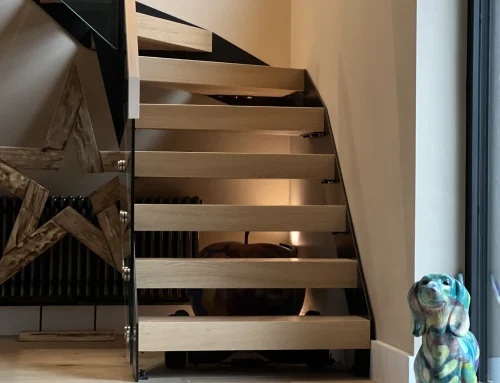
A steel-framed staircase meeting general access stair requirements — the specification standard for school buildings
School staircases in England are classified as general access stairs under Approved Document K, with preferred dimensions of 150mm rise and 280mm going — shallower and more generous than domestic stairs. Minimum clear width is 1,200mm for primary schools and 1,200–1,800mm for secondary schools (depending on occupancy and fire escape calculations). Solid risers are mandatory — open risers are not permitted. Handrails are required on both sides at 900–1,000mm height, with a secondary handrail at 600mm for younger children. Balustrade height is 1,100mm at landing level. Contrasting nosings are mandatory under Part M. Multi-storey schools must have at least two staircases (BB100), and all staircases forming part of the means of escape must be enclosed in 30/60-minute fire-resistant construction with FD30S fire doors.
Which Regulations Apply to School Staircases?
School staircases sit at the intersection of five separate regulatory frameworks. Understanding which requirements come from which document is essential for architects, estates managers, and contractors working on school building projects.
1 Approved Document K — Staircase dimensions
Part K classifies school staircases as "general access stairs" — stairs intended for all users of a building on a day-to-day basis. The dimensional requirements for general access stairs are stricter than for private domestic stairs: the permitted rise range is narrower (150–170mm versus 150–220mm), the minimum going is greater (250mm versus 220mm), and additional requirements apply for nosing profiles, flight lengths, and landings.
2 Approved Document B — Fire safety
Part B Volume 2 (buildings other than dwellings) governs fire safety in schools. It specifies the number of staircases required, staircase widths for evacuation, fire resistance of the stairwell enclosure, and the performance of fire doors. For schools, the staircases are the primary means of vertical escape — their design directly determines whether the building can be evacuated within the target time.
3 Building Bulletin 100 (BB100) — Fire safety design for schools
BB100 is the DfE's specific fire safety design guidance for school buildings. It supplements Approved Document B with school-specific advice on escape route planning, staircase provision, compartmentation, and fire detection. BB100 recommends that all multi-storey schools have at least two staircases — single escape stairs are not acceptable. The revised BB100 also recommends evacuation lifts in new multi-storey school buildings.
4 Approved Document M — Accessibility
Part M requires school staircases to be designed so they can be used safely and independently by as wide a range of users as possible — including pupils with visual impairments, mobility difficulties, and other disabilities. This means contrasting nosings, corduroy tactile paving at the top of each flight, handrails that extend 300mm beyond the top and bottom treads, and handrails of contrasting colour to the background.
5 Equality Act 2010 / DDA
The Equality Act 2010 (which replaced the Disability Discrimination Act) places a duty on schools to make reasonable adjustments to ensure that disabled pupils are not placed at a substantial disadvantage. For staircases, this means the design must go beyond the minimum Part M requirements where necessary — for example, providing additional handrails, colour-contrasted step edges, or alternative level access where a staircase cannot be made accessible.
Dimensional Requirements — The Complete Specification
School staircases use the "general access stair" specification under Part K Table 1.2. These dimensions are significantly more generous than domestic stairs — reflecting the need to accommodate high footfall, varying ages and physical abilities, and emergency evacuation.
| Requirement | School Staircase Value | Domestic (Comparison) |
|---|---|---|
| Rise per step | 150–170mm (preferred 150mm) | 150–220mm |
| Going (tread depth) | 250–400mm (preferred 280mm) | 220–300mm |
| 2R + G formula | 550–700mm | 550–700mm |
| Maximum pitch | 33° | 42° |
| Maximum risers per flight | 16 | No limit (domestic) |
| Minimum clear width | 1,200mm (typical school) | No minimum specified |
| Maximum clear width | 1,800mm (without central handrail) | No maximum |
| Headroom | ≥2,000mm | ≥2,000mm |
| Risers | Solid only — open risers not permitted | Open risers permitted (16mm overlap) |
| Handrail height | 900–1,000mm (+ 600mm secondary) | 900–1,000mm |
| Balustrade / guarding height (landing) | 1,100mm | 900mm |
| 100mm sphere rule | Applies — no climbable elements | 100mm sphere only |
| Nosings | Contrasting colour (55mm on tread, 55mm on riser) | Not required (domestic) |
| Tactile warning surface | Corduroy paving at top of each flight | Not required |
The school-specific preference: While Part K permits a rise of 150–170mm and going of 250–400mm for general access stairs, the DfE's design guidance for schools specifies a preferred rise of 150mm and preferred going of 280mm. These preferred dimensions produce a gentle 28° pitch — substantially shallower than a domestic staircase (typically 35–42°). New school builds are expected to use the preferred dimensions unless site constraints make this impractical.
Staircase Width — Capacity and Evacuation
Staircase width in schools is determined by the greater of two calculations: the capacity needed for comfortable day-to-day use during lesson changeovers, and the width needed for fire evacuation.
Day-to-day width
A minimum clear width of 1,200mm is standard for school staircases. This allows two pupils to pass comfortably. For secondary schools with high pupil numbers, widths of 1,500–1,800mm are common. If the staircase exceeds 1,800mm in clear width, a central handrail is required to divide the staircase into two separate flows — preventing the crowd from spreading to an uncontrollable width.
Evacuation width
Approved Document B calculates the required staircase width based on the number of people the staircase serves, the number of storeys, and the simultaneous evacuation strategy. The formula produces a minimum width that ensures the entire building population can be evacuated within the target time — typically 2–3 minutes for a school. BB100 requires at least two staircases in all multi-storey schools, which means the evacuation capacity is divided between two (or more) escape routes.
Practical guidance: For a standard two-storey primary school (one form entry, approximately 210 pupils), two staircases at 1,200mm clear width will comfortably meet both day-to-day and evacuation requirements. For a three-storey secondary school with 1,200+ pupils, staircases of 1,500–1,800mm are typical, with three or more escape staircases distributed across the building.
Solid Risers, Nosings, and Anti-Slip Requirements
Part K mandates solid risers for all non-domestic staircases — including schools. Open risers (where there is a gap between consecutive treads) are not permitted because they create a trip hazard for walking aids, canes, and small children's feet. This is one of the most significant differences between school and domestic staircase specifications.
Contrasting nosings
Part M requires that the leading edge (nosing) of each tread is visually distinct from the rest of the tread surface. The contrasting strip must cover at least 55mm of the tread surface and 55mm of the riser face, in a colour that provides a luminance contrast ratio of at least 30 points (measured against the tread and riser respectively). This helps visually impaired users identify where each step begins and ends.
Tactile warning surfaces
Corduroy hazard warning tactile paving must be installed at the top of each flight of stairs, set back 400mm from the nosing of the top step. This provides a tactile warning for visually impaired users approaching the staircase from the landing. The requirement applies to all new non-domestic buildings including schools.
Anti-slip treads
All stair treads in school buildings must provide adequate slip resistance. BS 8300 recommends a minimum pendulum test value (PTV) of 36 for internal stair treads. For steel staircases, this is achieved through chequer plate, open-mesh treads, or applied anti-slip coatings. For concrete or terrazzo treads, profiled nosing strips with carborundum inserts are the standard solution.
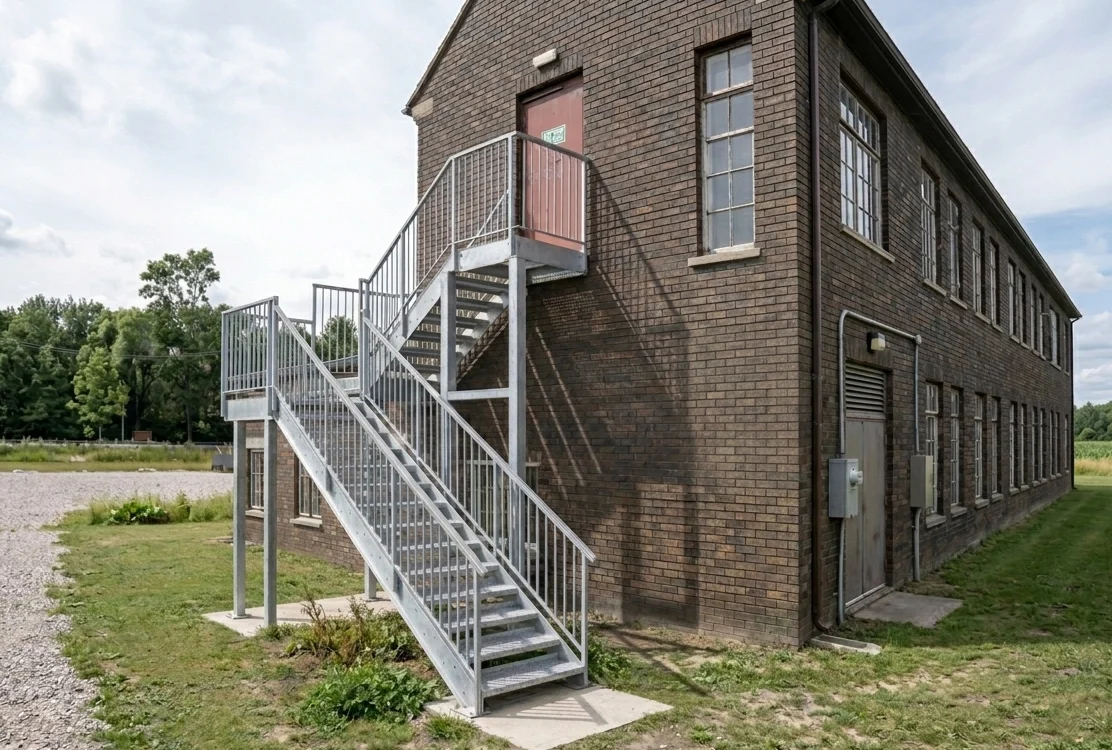
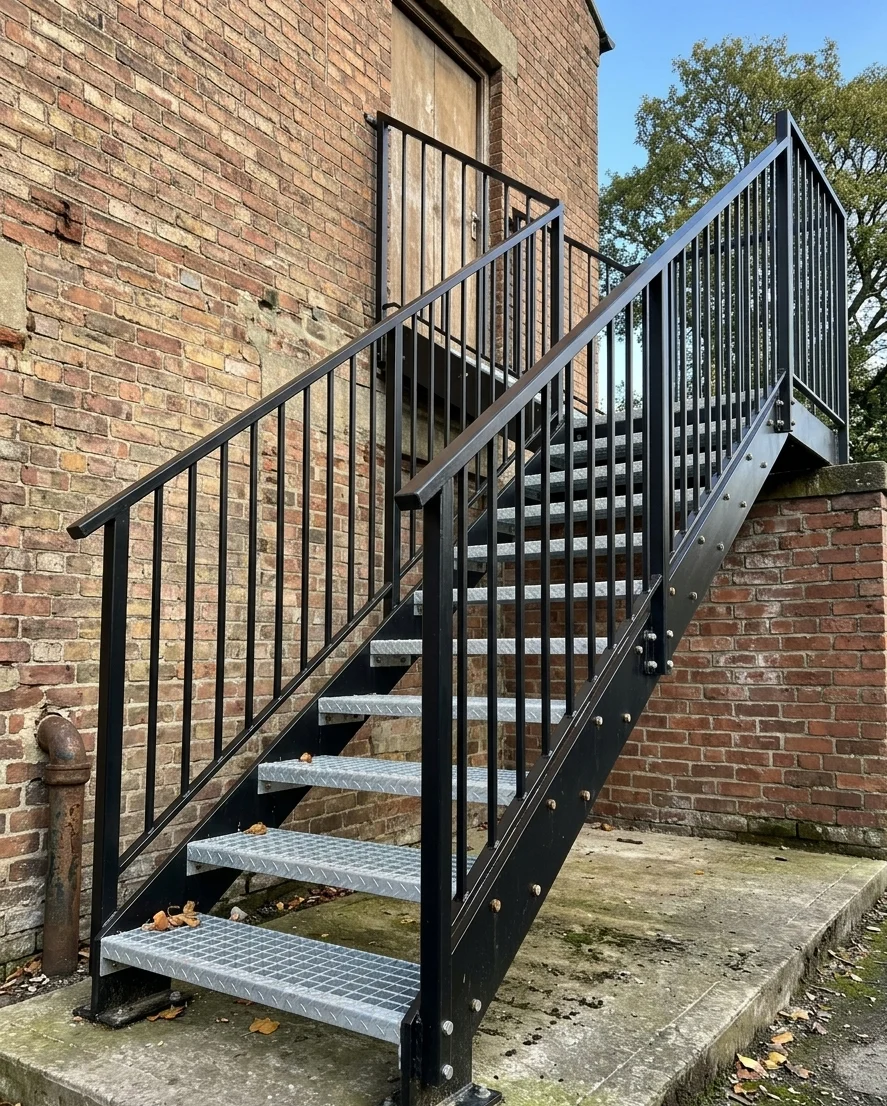
 External fire escape — galvanised steel, BB100 compliant for school use
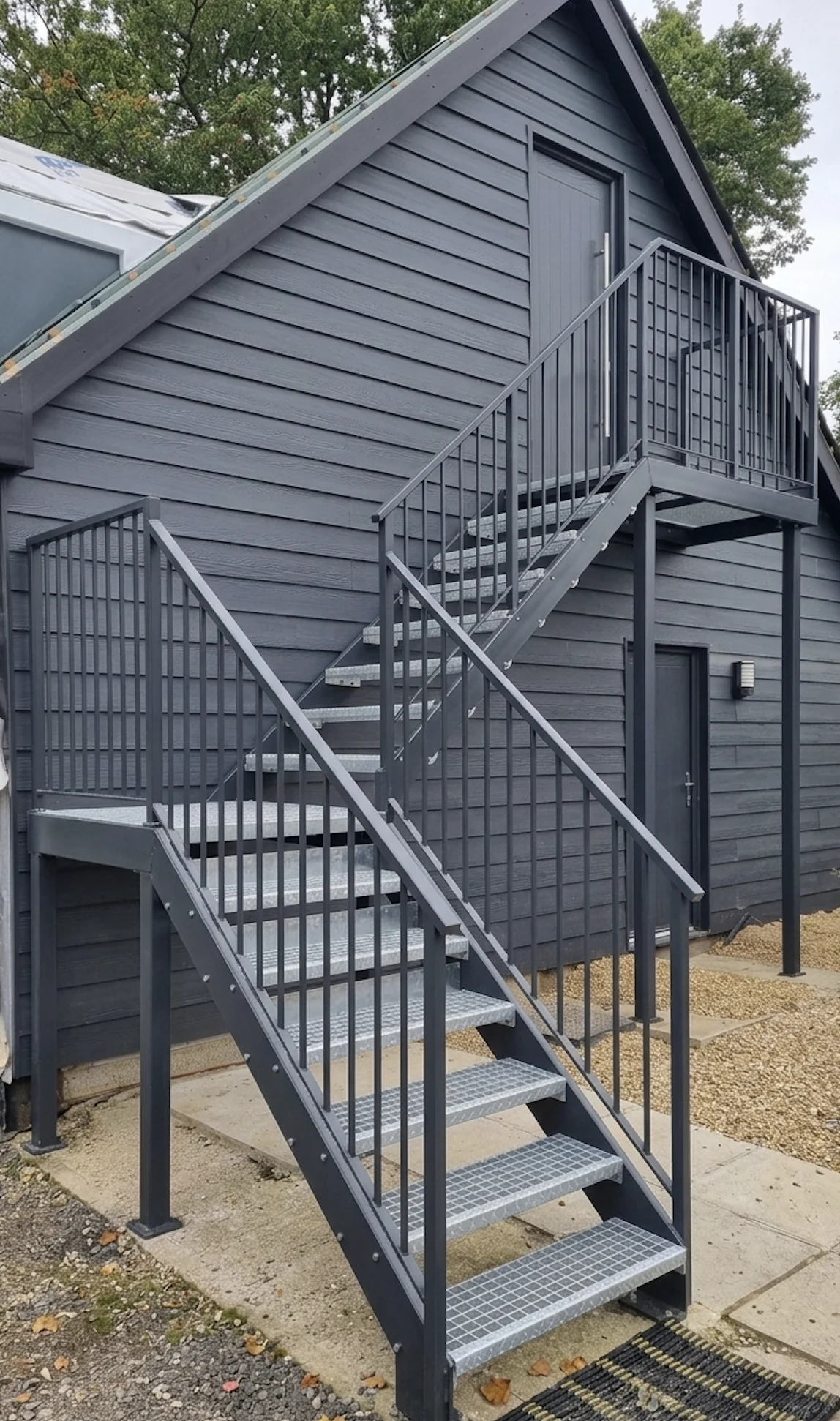 Multi-landing configuration — landing at each floor for safe evacuation
 Powder coated external staircase — aesthetically integrated with school buildings
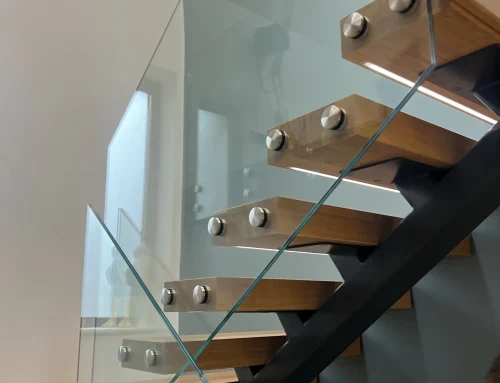
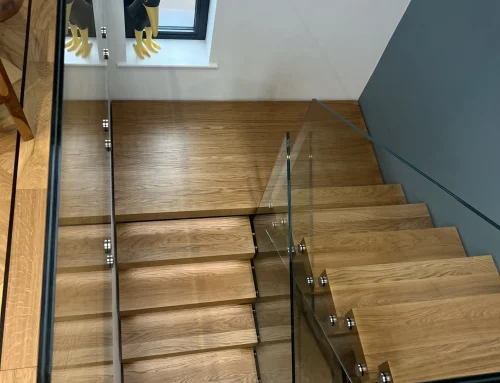
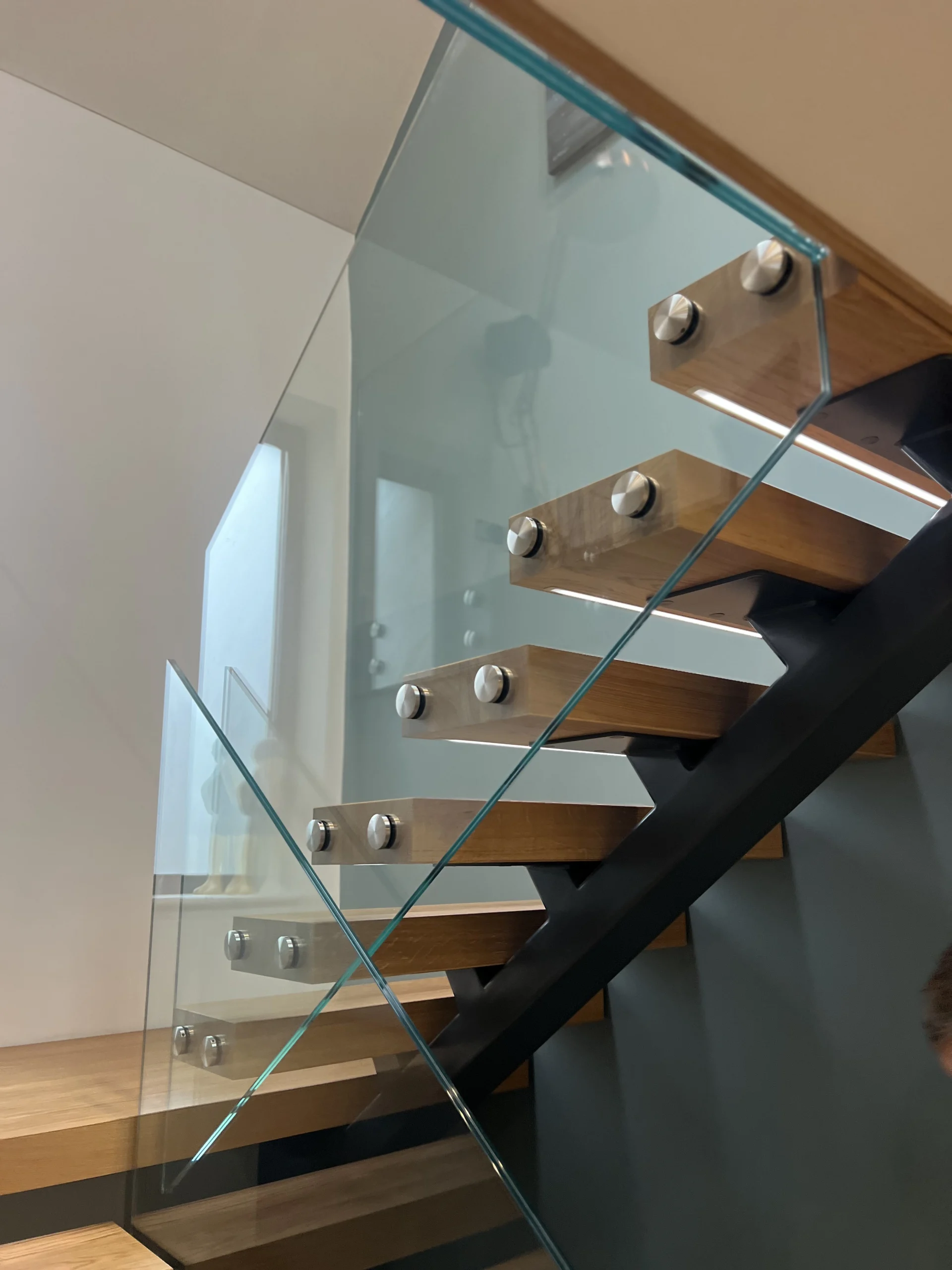
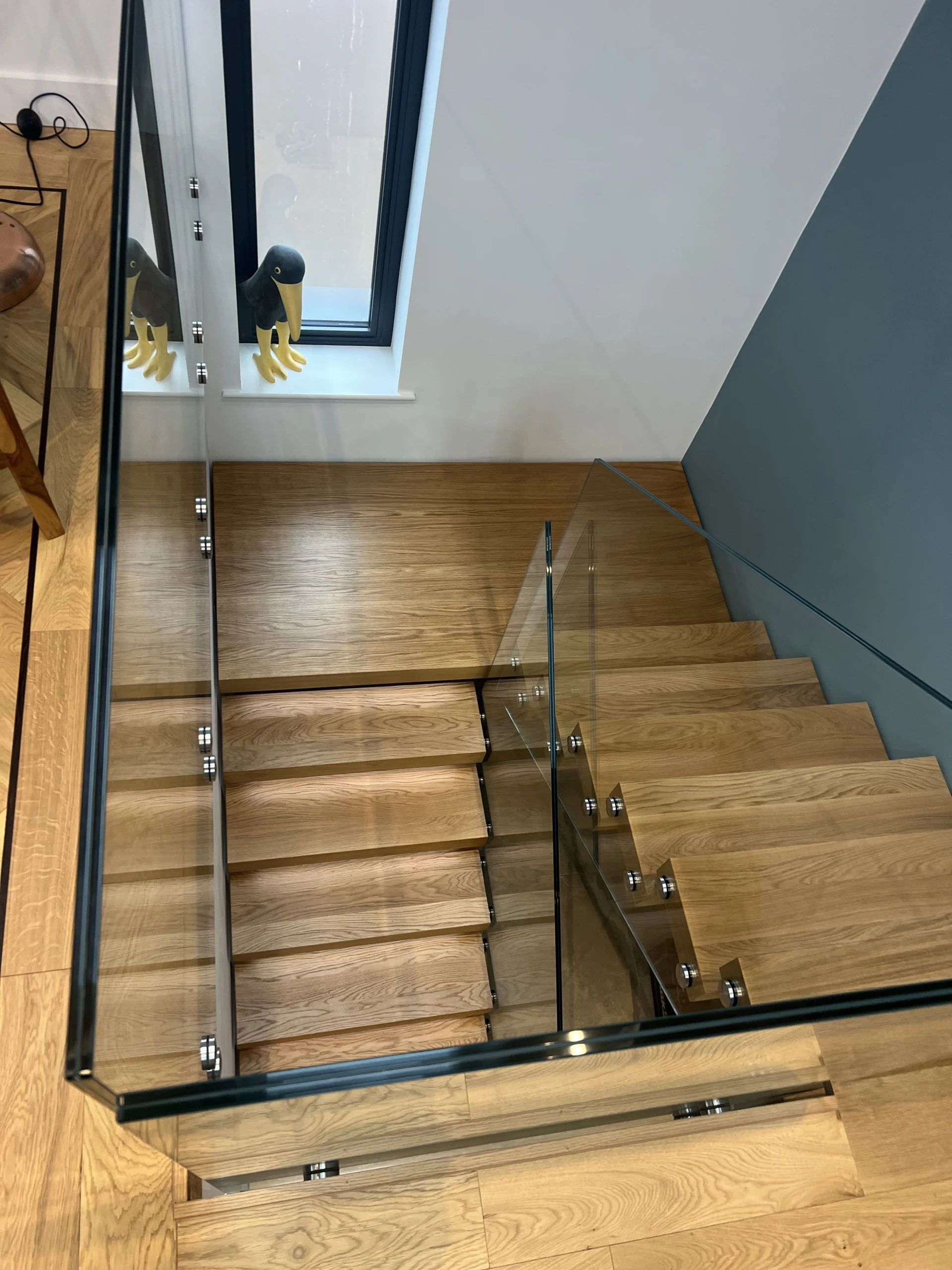
 Glass balustrade at 1,100mm — meeting non-domestic guarding requirements
Handrails and Balustrading — School-Specific Requirements
School staircases have more demanding handrail and balustrading requirements than domestic stairs. The combination of young users (some as young as 4), high footfall, and evacuation duties means every detail of the guarding specification matters.
Primary handrails
Handrails are required on both sides of the staircase at a height of 900–1,000mm above the pitch line. The handrail profile must allow a secure grip — a continuous, smooth, round or oval section of 40–50mm diameter is ideal. Handrails must extend 300mm beyond the top and bottom nosings to allow users to steady themselves before and after the flight.
Secondary handrails for younger children
In primary schools and early years settings, a secondary handrail at 600mm height is recommended to provide a gripping surface appropriate for younger children. This is not explicitly required by Part K but is recommended by Part M and is standard practice in all new primary school builds.
Balustrade height
Guarding on school staircases and landings must be at least 1,100mm high — compared to 900mm for domestic buildings. The 100mm sphere rule applies (no gap allowing a 100mm sphere to pass through), but additionally, the balustrade must be designed to resist climbing. Horizontal rails, mesh patterns that create footholds, and designs with ledges that encourage climbing are not acceptable in school environments.
Anti-climb design: School balustrades must be designed to discourage climbing — this is a safeguarding requirement as much as a building regulation. Vertical infill bars (maximum 100mm spacing), solid panels, or frameless glass balustrade are all compliant options. Horizontal wire or cable systems — popular in contemporary residential design — should not be used in school buildings because they create climbing rungs.
Fire Safety — BB100 and Approved Document B
Fire safety is the area where school staircase regulations are most demanding. Schools are classified as "assembly and recreation" or "institutional" buildings under Approved Document B, and the fire safety requirements reflect the need to evacuate large numbers of children — including those with disabilities — quickly and safely.
Number of staircases
BB100 recommends that all multi-storey school buildings have at least two staircases. Single escape stairs are explicitly stated as not acceptable. The two staircases should be separated by sufficient distance that a fire in one part of the building does not simultaneously compromise both escape routes. For larger schools, three or more staircases may be required based on the fire escape width calculation.
Stairwell enclosure
All staircases forming part of the means of escape must be enclosed in a protected stairwell. The enclosing construction (walls, floors, ceilings) must achieve 30-minute fire resistance in buildings up to 18m in height, or 60-minute fire resistance in buildings over 18m. Fire doors to the stairwell enclosure must be FD30S (30-minute fire-resisting, smoke-sealed, self-closing).
Evacuation of disabled pupils
Schools have a specific duty to plan for the evacuation of disabled pupils. Personal Emergency Evacuation Plans (PEEPs) must be in place for any pupil or staff member who cannot use the stairs independently. Refuge areas — level areas of safety within or adjacent to a protected stairwell — must be provided on every floor above ground level. BB100 now recommends evacuation lifts in all new multi-storey school buildings as the preferred method for evacuating pupils with mobility impairments.
External Fire Escape Stairs — When Schools Need Them
External fire escape staircases are required in school buildings where the internal escape routes are insufficient — typically in existing buildings being extended, buildings with complex layouts, or properties where the fire risk assessment identifies a need for an alternative escape route.
External fire escape stairs on school buildings must meet the same general access stair dimensions as internal stairs (150–170mm rise, 250mm+ going, 1,200mm+ clear width). Additionally, the external staircase must be constructed from non-combustible materials (structural steel is standard), protected from the weather (drainage, anti-slip treads), and separated from any window or door openings in the building wall by a minimum distance or fire-rated construction.
For schools, the balustrade on external staircases must be at least 1,100mm high with anti-climb infill. All landings must be at least as wide as the staircase and at least 1,200mm deep, providing adequate standing space for pupils waiting to descend during an evacuation.
Cost: External steel fire escape staircases for school buildings typically range from £5,500 to £15,000+ depending on the number of storeys, width, and finish specification. For detailed pricing on external staircases and fire escape stairs, see our dedicated product pages.
Internal Staircase Materials — What Works in Schools
The choice of staircase material in a school is driven by durability, maintenance, fire resistance, and lifecycle cost — aesthetics are secondary to performance in this environment.
Structural steel
Steel-framed staircases are the standard for new school builds and refurbishments. Structural steel (S275 or S355 grade) inherently exceeds 30-minute fire resistance requirements without additional fire protection. It is strong enough to handle the concentrated loading from high footfall, resistant to vandalism, and maintenance-free with an appropriate surface finish (powder coat or galvanising).
Concrete with steel balustrade
Pre-cast concrete stairs with a steel balustrade system are common in larger school buildings. The concrete provides excellent fire resistance and acoustic performance (reducing noise transfer between floors), while the steel balustrade delivers compliant guarding with low maintenance.
Glass balustrade
Toughened and laminated glass balustrade is increasingly specified in school atrium and reception areas where natural light and visual openness are design priorities. Glass automatically satisfies the 100mm sphere rule and the anti-climb requirement (no footholds). Laminated glass (two layers bonded with a PVB interlayer) is mandatory in schools — toughened-only glass can shatter and is not acceptable where children are present.
Refurbishment and Replacement — When Regulations Apply
If you are replacing an existing staircase in a school with a like-for-like replacement using the same materials and dimensions, Building Regulations approval may not be required — although the replacement must still meet current Part K standards. However, if the replacement involves structural alterations (changing the staircase position, modifying the floor opening, or changing the staircase type), full Building Regulations approval is required.
For refurbishments that change the use of the building or increase the occupancy — for example, converting a single-storey school to two storeys, or converting a non-school building for educational use — the entire staircase and fire escape provision must be designed to current standards, including BB100, Part K, Part B, and Part M.
Condition surveys: The DfE's Condition Data Collection (CDC) programme assesses the physical condition of school buildings across England. Staircases flagged as "poor" or "bad" in a CDC survey may qualify for Condition Improvement Fund (CIF) funding or School Rebuilding Programme inclusion. Estates managers should reference the CDC data when making the case for staircase replacement or refurbishment.
Costs — School Staircase Pricing 2026
| Item | Cost Range | Notes |
|---|---|---|
| Internal steel staircase (1,200mm wide, single flight) | From £6,500 | S275 steel, powder coated, solid risers |
| Internal steel staircase (1,500mm wide, multi-flight) | From £9,500 | With landings at each floor level |
| External fire escape (1,200mm wide, 2 landing) | From £5,500 | Galvanised steel, anti-slip treads |
| External fire escape (1,500mm wide, 3+ landing) | From £9,000 | Multi-storey, heavier structural spec |
| Glass balustrade (laminated, school spec) | From £450/m | 11.5mm laminated, 1,100mm height |
| Steel balustrade (vertical bar infill) | From £180/m | Anti-climb, 1,100mm, powder coated |
| Contrasting nosing strips (per tread) | £15–£30 | Carborundum insert, Part M compliant |
| Tactile warning surface (per flight top) | £80–£150 | Corduroy paving, 400mm setback |
For a complete overview of staircase design options suitable for educational buildings, including material specifications and finish options, explore our commercial staircase range.
Frequently Asked Questions — School Staircase Regulations
School staircases must comply with Approved Document K (general access stair dimensions: 150–170mm rise, 250–400mm going, preferred 150mm/280mm for schools), Approved Document B and BB100 (fire safety: at least two staircases in multi-storey buildings, 30/60-minute fire-resistant stairwell enclosure), and Approved Document M (accessibility: contrasting nosings, tactile warnings, handrails on both sides). Solid risers are mandatory — open risers are not permitted. Balustrade height is 1,100mm with anti-climb infill.
A minimum clear width of 1,200mm is standard for school staircases. Secondary schools with high pupil numbers typically use 1,500–1,800mm widths. If the staircase exceeds 1,800mm, a central handrail is required to divide the flow. The exact width is determined by fire evacuation calculations under Approved Document B, based on the number of occupants the staircase serves.
No — open risers are not permitted in school staircases or any non-domestic building staircase. Part K mandates solid risers for all buildings other than private dwellings. This prevents walking aids, canes, and small children's feet from getting caught beneath the treads.
BB100 (DfE fire safety design guidance) recommends that all multi-storey school buildings have at least two staircases — single escape stairs are not acceptable. Larger schools may need three or more staircases based on fire evacuation width calculations. The staircases must be separated by sufficient distance so a fire cannot compromise both escape routes simultaneously.
Guarding on school staircases and landings must be at least 1,100mm high — compared to 900mm for domestic buildings. The balustrade must satisfy the 100mm sphere rule and be designed to resist climbing. Horizontal wires, rails, or mesh that creates footholds are not acceptable. Vertical bar infill, solid panels, or frameless glass are the compliant options.
Yes — Approved Document M requires contrasting nosing strips on every tread, covering at least 55mm on the tread surface and 55mm on the riser face. The nosing must provide a luminance contrast ratio of at least 30 points against the surrounding surface. Corduroy tactile warning paving is also required at the top of each flight, set back 400mm from the first nosing.
An internal steel staircase at 1,200mm width starts from approximately £6,500. Wider multi-flight configurations (1,500mm+) start from £9,500. External fire escape stairs for schools start from £5,500 (1,200mm wide, two landings). Glass balustrade meeting the 1,100mm school specification costs from £450 per linear metre. Anti-climb steel balustrade starts from £180 per linear metre.
A secondary handrail at 600mm height is recommended (but not explicitly mandated by Part K) for primary schools and early years settings. Part M recommends it, and it is standard practice in all new primary school builds. The secondary handrail provides a gripping surface at the appropriate height for children aged 4–7 who cannot comfortably reach the primary handrail at 900–1,000mm.
Need a Staircase for Your School Building?
Continox designs and manufactures steel staircases for school buildings — internal and external, new build and refurbishment. Full Part K, Part M, Part B, and BB100 compliance. Based in Gosport, Hampshire, serving Southern England.