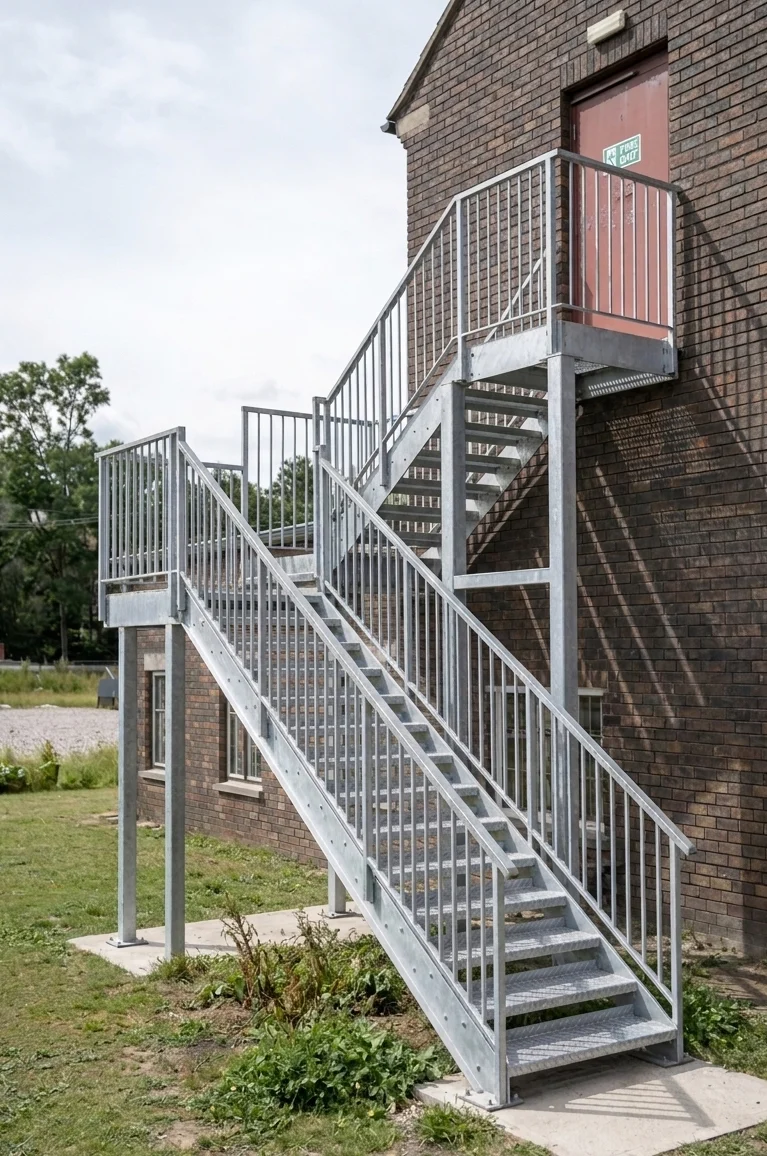

A staircase in a retail environment is not a domestic staircase with a different finish. It is a piece of public infrastructure that must handle unpredictable footfall from shoppers of all ages and abilities — many distracted by phones, carrying bags, managing children, or unfamiliar with the building layout. The regulations that apply to retail staircases are categorically different from domestic standards, covering everything from shallower pitch and wider treads to mandatory solid risers, contrasting nosings, anti-slip surfaces, and balustrade heights that reflect public rather than private use. This guide covers every requirement for staircases and balustrading in retail units in England, from Part K dimensional compliance through to Part M accessibility, Part B fire safety, and the practical considerations that shopfitters and retail estates teams need to get right.
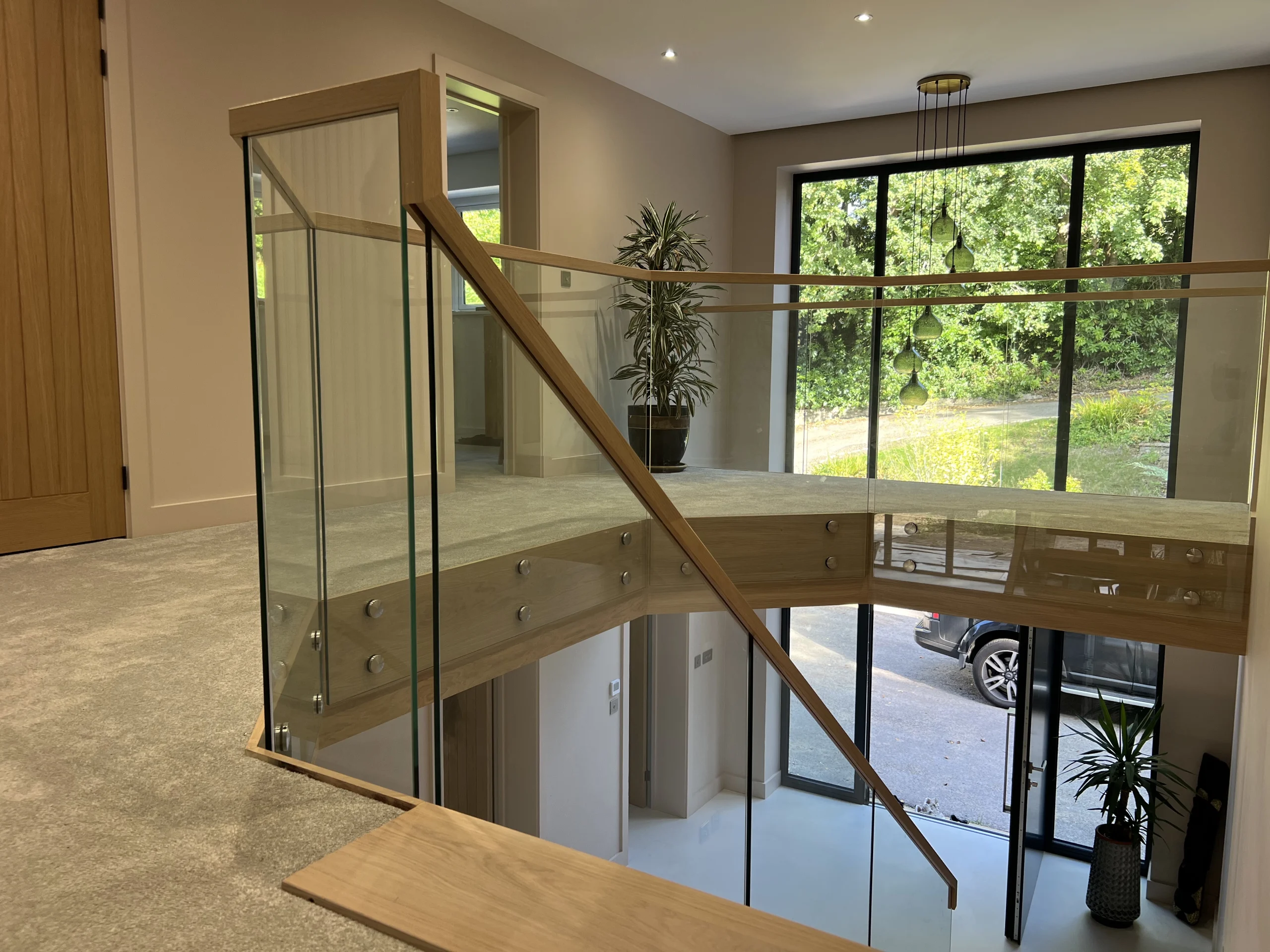
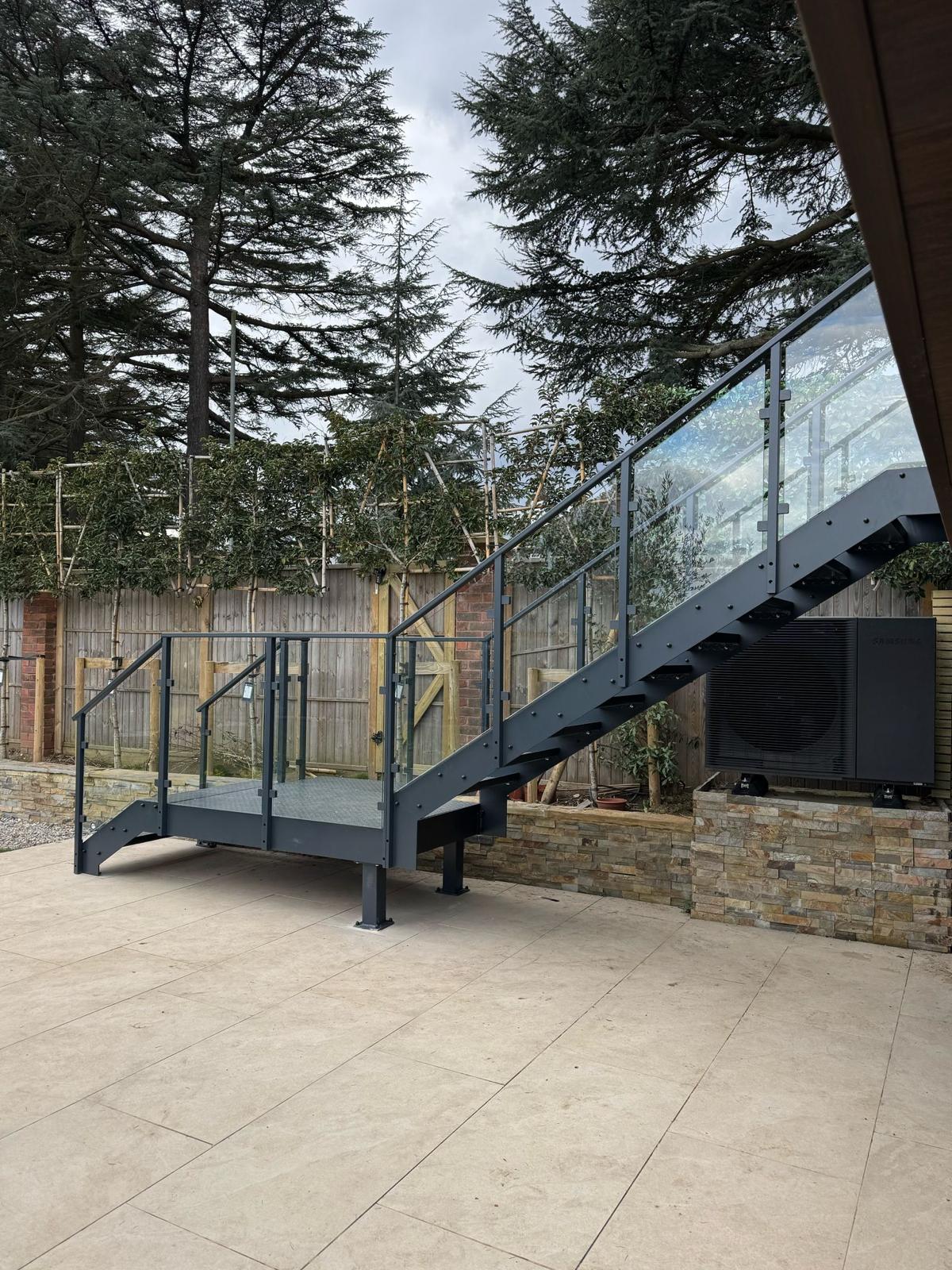
A steel-and-glass staircase designed for high-footfall commercial environments — the specification standard for retail units
Retail staircases are classified as general access stairs (or assembly stairs for larger stores) under Approved Document K. Key requirements: rise 150–170mm, going 250–400mm, maximum pitch 33° (assembly) or 38° (general access), maximum 16 risers per flight, solid risers mandatory (no open risers), minimum 1,000mm clear width (wider for fire evacuation), handrails on both sides at 900–1,000mm, balustrade height 1,100mm at landings, contrasting nosings (Part M), tactile warning surfaces at the top of each flight, and anti-slip treads throughout. Fire escape staircases must be enclosed in 30/60-minute fire-resistant construction with FD30S doors. Glass balustrade must use laminated glass (not toughened-only) and meet a 1.5 kN/m horizontal line load for public areas.
Why Retail Staircases Have Stricter Rules
Domestic staircase regulations assume a known user — the homeowner and their family, who are familiar with the staircase and use it daily. Retail staircases assume an unknown user — a member of the public who has never been in the building before, may be distracted, may be elderly, may be visually impaired, and may be carrying shopping bags that obscure their view of the steps.
This is why Part K classifies retail staircases as "general access" or "assembly" stairs depending on the store's occupancy, and applies significantly stricter requirements than for private domestic stairs. The pitch is shallower (33° for assembly versus 42° for domestic), the treads are deeper (250mm+ versus 220mm), risers must be solid (no open risers), and the maximum flight length is limited to 16 risers to ensure a landing breaks up long runs.
For shopfitters, architects, and retail estates managers, understanding these differences is essential — a staircase designed to domestic standards will fail a Building Control inspection in a retail environment.
Dimensional Requirements — Retail vs Domestic Comparison
| Requirement | Retail / Commercial | Domestic (Comparison) |
|---|---|---|
| Rise per step | 150–170mm | 150–220mm |
| Going (tread depth) | 250–400mm | 220–300mm |
| 2R + G formula | 550–700mm | 550–700mm |
| Maximum pitch — general access | 38° | 42° |
| Maximum pitch — assembly (shops) | 33° | N/A |
| Maximum risers per flight | 16 | No limit |
| Risers | Solid only — no open risers | Open risers permitted (16mm overlap) |
| Minimum clear width | 1,000mm (wider for evacuation) | No minimum specified |
| Maximum clear width (without central rail) | 1,800mm | N/A |
| Handrails | Both sides, 900–1,000mm | One side if <1,000mm wide |
| Balustrade height (landing / mezzanine) | 1,100mm | 900mm |
| Headroom | ≥2,000mm | ≥2,000mm |
| Contrasting nosings | Mandatory (Part M) | Not required |
| Tactile warning surface | Mandatory at top of each flight | Not required |
For the complete Part K reference covering all staircase classifications — private, utility, general access, assembly, and fire escape — see our UK staircase regulations guide.
Assembly vs general access: Part K distinguishes between "general access" stairs (offices, smaller shops) and "assembly" stairs (larger retail units, places of public assembly). The critical difference is pitch: 38° maximum for general access, 33° maximum for assembly. If your retail unit falls into an assembly classification under the Building Regulations (typically occupancy above a certain threshold), the shallower pitch requirement significantly increases the horizontal footprint of the staircase. Confirm the classification with Building Control at the design stage.
Solid Risers — The Non-Negotiable Rule
In all buildings other than private dwellings, Part K mandates solid risers. Open risers — where there is a gap between consecutive treads — are not permitted in retail environments. The reason is straightforward: open risers create a risk of walking aids, canes, shoe heels, and small children's feet getting caught beneath the tread, and the visual transparency of open risers can cause vertigo in users who are uncomfortable with heights.
This is one of the requirements that most frequently catches shopfitters off guard. A contemporary floating staircase with open risers — which is perfectly compliant in a domestic setting — will fail a Building Control inspection in a retail unit. If a contemporary aesthetic is required, use closed risers with minimal visual profile (thin steel plate risers painted to match the tread colour) or glass risers that are visually transparent but physically solid.
Design workaround: If your retail concept requires the visual lightness of open risers, consider a steel plate riser finished in the same colour as the tread (creating a near-invisible solid riser) or a glass riser panel (solid but transparent). Both solutions are Part K compliant while maintaining the open, contemporary aesthetic that many retail brands require. At Continox, our modern staircase designs use these techniques for retail and commercial clients.
Balustrade Requirements — Height, Load, and Material
The balustrade on a retail staircase serves two functions: it prevents falls, and it contributes to the store's visual identity. The regulations allow considerable design freedom within strict performance parameters.
Height
On the stair flight itself, balustrade height must be at least 900mm measured from the pitch line. On landings, mezzanines, and gallery edges where there is a change of level of 600mm or more, the balustrade height increases to 1,100mm. This is higher than the domestic requirement (900mm on landings) and reflects the public nature of the building.
Horizontal line load
Balustrades in retail environments must withstand a horizontal line load of 1.5 kN per linear metre, applied at the top of the balustrade. This is significantly higher than the 0.74 kN/m domestic requirement. The increased loading reflects the possibility of crowd pressure — shoppers leaning against the balustrade while queuing, during sales events, or in emergency situations. Your structural engineer must confirm the balustrade system meets this load requirement.
Glass balustrade specification
Glass balustrade in retail environments must use laminated glass — not toughened-only glass. If a toughened-only panel shatters (from impact or nickel sulphide inclusion), the entire panel disintegrates instantly, leaving a completely unguarded edge. Laminated glass (two toughened layers bonded with a PVB interlayer) holds together even when broken, maintaining the barrier function. For retail applications, 17.5mm laminated glass (two layers of 8mm toughened glass with 1.52mm PVB) is the standard specification for frameless structural glass balustrade at 1,100mm height.
The 100mm sphere rule — plus anti-climb
No gap in the balustrade construction should allow a 100mm sphere to pass through. Additionally, in retail environments frequented by children, the balustrade design should discourage climbing — horizontal rails that create rungs, mesh with footholds, and designs with ledges should be avoided. Vertical bar infill, solid panels, and frameless glass are the safest options.
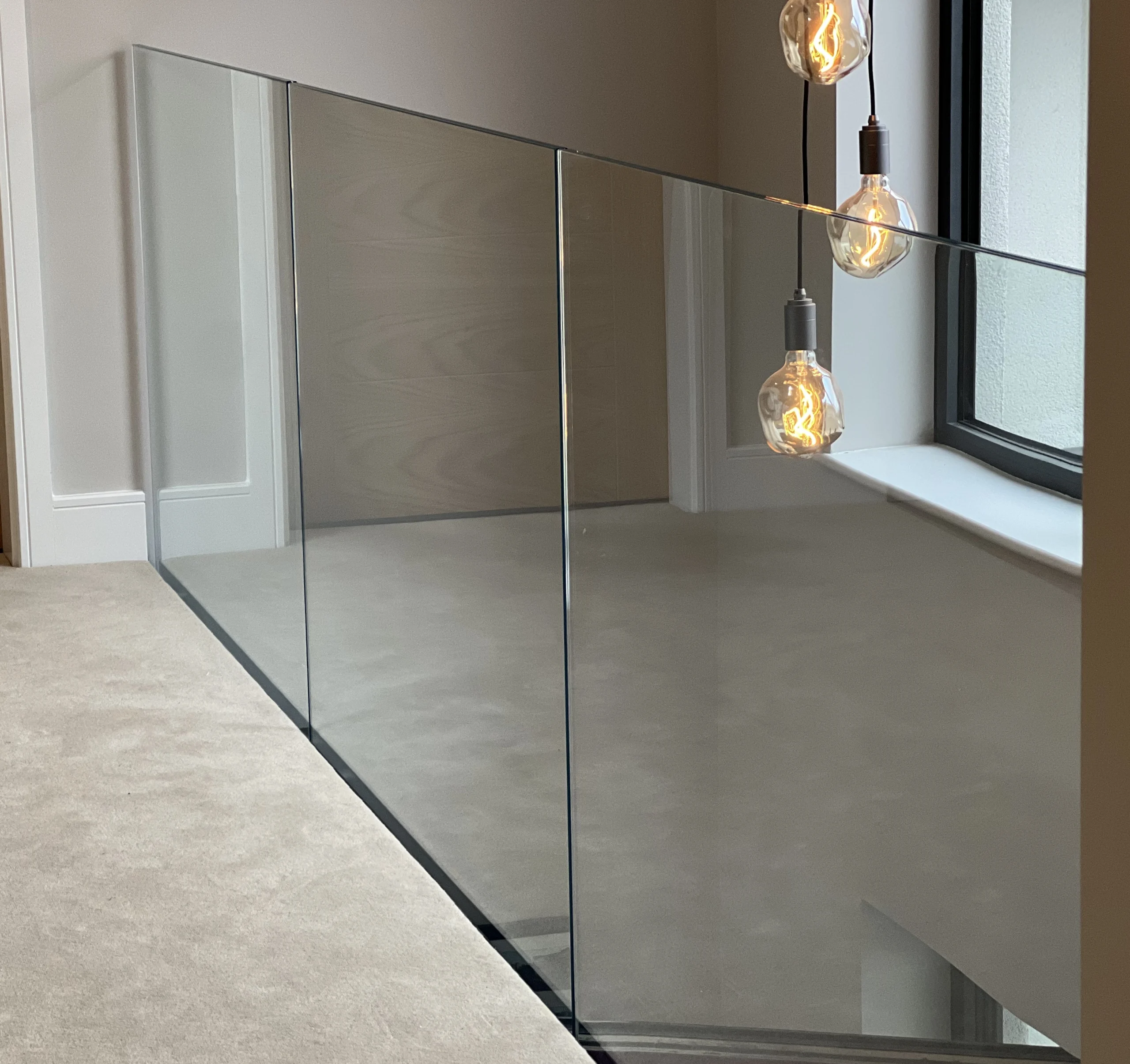 Frameless glass at 1,100mm — retail mezzanine specification
 Laminated glass on steel frame — meeting 1.5 kN/m load requirement
 Gallery edge protection — 1,100mm balustrade with anti-climb design
 LED-integrated treads — functional safety lighting for retail stairwells
Part M Accessibility — Contrasting Nosings, Tactile Warnings, Handrails
Approved Document M requires every retail staircase to be designed for use by as wide a range of people as possible — including those with visual impairments, mobility difficulties, and other disabilities. The key requirements are specific and non-negotiable.
Contrasting nosings
Every tread must have a visually contrasting nosing strip — a minimum of 55mm on the tread surface and 55mm on the riser face. The contrast must provide a luminance contrast ratio of at least 30 points against the adjacent surface. This helps visually impaired users identify where each step begins. In retail environments, aluminium or stainless steel anti-slip nosing inserts with a contrasting colour are the standard solution.
Tactile warning surfaces
Corduroy hazard warning tactile paving must be installed at the top of each flight, set back 400mm from the nosing of the top step. The corduroy profile runs perpendicular to the direction of travel and provides a tactile warning underfoot for visually impaired users approaching the stairs from the landing. This requirement applies to all new non-domestic buildings and material alterations.
Handrail extensions
Handrails must extend 300mm beyond the top and bottom nosings of each flight. This allows users to steady themselves before starting and after finishing the flight. The handrail profile should be continuous, smooth, and grippable — a round or oval section of 40–50mm diameter. Handrails must contrast visually with the background wall or balustrade.
Fire Safety — Approved Document B for Retail
Fire safety in retail environments is governed by Approved Document B Volume 2. The staircase requirements depend on the store's occupancy, floor area, and number of storeys.
Number of staircases
For retail units with a sales floor above ground level, the number of escape staircases is determined by the occupancy calculation (floor area divided by occupancy factor — typically 2m² per person for retail sales areas). If the calculation produces more than 60 people on an upper floor with only one available direction of escape, a second staircase is required. For larger department stores and multi-level retail, two or more staircases are standard.
Staircase width for evacuation
The required escape staircase width is calculated from the number of people the staircase must evacuate. Approved Document B provides width tables based on occupancy — for retail, a 1,050mm wide staircase serves approximately 160 people per storey. Wider staircases serve proportionally more. The calculation must account for simultaneous evacuation of all floors.
Fire resistance
Stairwells in retail buildings must be enclosed in construction with 30-minute fire resistance (for buildings up to 18m in height) or 60-minute fire resistance (above 18m). Fire doors to the stairwell must be FD30S (30-minute, smoke-sealed, self-closing). The stairwell must discharge directly to a final exit at ground level.
Mezzanine floors
Retail mezzanines — commonly used for additional sales area, stockroom, or office space — require their own compliant staircase access. If the mezzanine is open to the floor below (a gallery design), the fire safety strategy differs from an enclosed mezzanine. Open mezzanines may be treated as part of the ground floor for fire purposes if the area is small enough, but enclosed mezzanines above a certain size require a protected stairwell and potentially a separate escape route. Always confirm the fire strategy with Building Control at the design stage.
For fire escape staircase specifications for other commercial building types, see our guides on HMO fire escape requirements, school staircase regulations, and care home fire escape requirements.
Mezzanine Staircases — The Retail-Specific Challenge
Mezzanine floors are ubiquitous in UK retail — used for additional sales area, customer seating (particularly in food retail and hospitality-retail hybrids), stockrooms, and back-of-house offices. The staircase connecting the ground floor to the mezzanine is subject to the same Part K, Part M, and Part B requirements as any other staircase in the building, but with specific design considerations unique to the retail mezzanine context.
Visibility and flow
In retail, the staircase to the mezzanine is often positioned to draw customers upward — it is a sales tool as much as a functional element. A visually prominent staircase with glass balustrade, well-lit treads, and clear sightlines to the upper level encourages footfall to the mezzanine. This design intent must be balanced against compliance — the staircase must still have solid risers, contrasting nosings, tactile warnings, and a maximum of 16 risers per flight.
Under-stair retail space
The triangular void beneath a mezzanine staircase is valuable retail floor area. If it is enclosed as a storage cupboard, the enclosure must achieve 30-minute fire resistance and the door must be kept locked shut (with appropriate signage). If it is used as display or sales area, it must be kept clear of items that could obstruct the base of the staircase or the landing area.
Balustrade at mezzanine edge
The balustrade at the open edge of the mezzanine (overlooking the ground-floor sales area) must be at least 1,100mm high and meet the 1.5 kN/m horizontal load requirement. Frameless glass is the most popular option for retail mezzanines because it preserves sightlines to the sales floor below, allows natural light to flow between levels, and creates a contemporary aesthetic that enhances the shopping environment.
Material Choices — What Works in Retail
Steel frame with hardwood treads
The most popular specification for branded retail environments. A powder-coated steel frame (any RAL colour) with solid oak, walnut, or engineered hardwood treads provides a premium look with commercial-grade durability. Typical cost: from £9,500 for a single-flight staircase with glass balustrade.
All-steel with anti-slip treads
For back-of-house, stockroom, and warehouse-to-sales-floor access, an all-steel staircase with chequer plate or perforated treads is the practical choice. Powder coated or galvanised. Cost: from £4,500.
Glass balustrade
Frameless structural glass at 1,100mm height with laminated panels is the retail standard. From £450 per linear metre for frameless glass balustrade. Framed glass (from £350/m) is a cost-effective alternative that retains most of the visual transparency.
Steel balustrade with vertical infill
For retailers who prefer a more industrial or minimalist aesthetic — vertical steel bars at maximum 100mm spacing, powder coated. From £180 per linear metre. Compliant with the 100mm sphere rule and anti-climb requirements.
Costs — Retail Staircase Pricing 2026
| Item | Cost Range | Notes |
|---|---|---|
| Steel mezzanine staircase (1,000mm wide) | From £4,500 | All-steel, powder coated, solid risers |
| Steel + hardwood staircase (1,200mm wide) | From £9,500 | Branded retail specification |
| Feature staircase (central spine + glass) | From £11,500 | Flagship store centrepiece |
| Frameless glass balustrade (1,100mm) | From £450/m | 17.5mm laminated, structural |
| Framed glass balustrade (1,100mm) | From £350/m | 10mm toughened in steel frame |
| Steel vertical bar balustrade | From £180/m | Powder coated, 100mm max spacing |
| Contrasting nosing strips (per tread) | £15–£30 | Aluminium / carborundum, Part M |
| Tactile warning surface (per flight) | £80–£150 | Corduroy paving, 400mm setback |
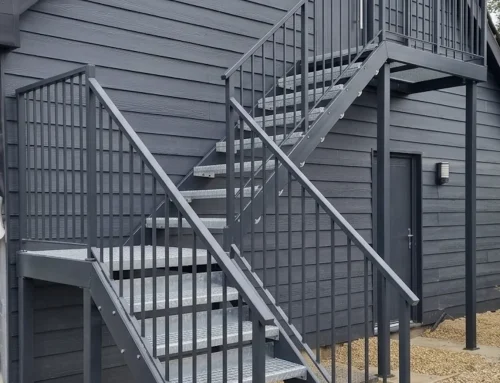
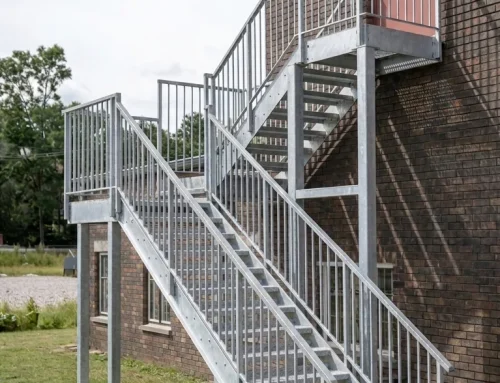
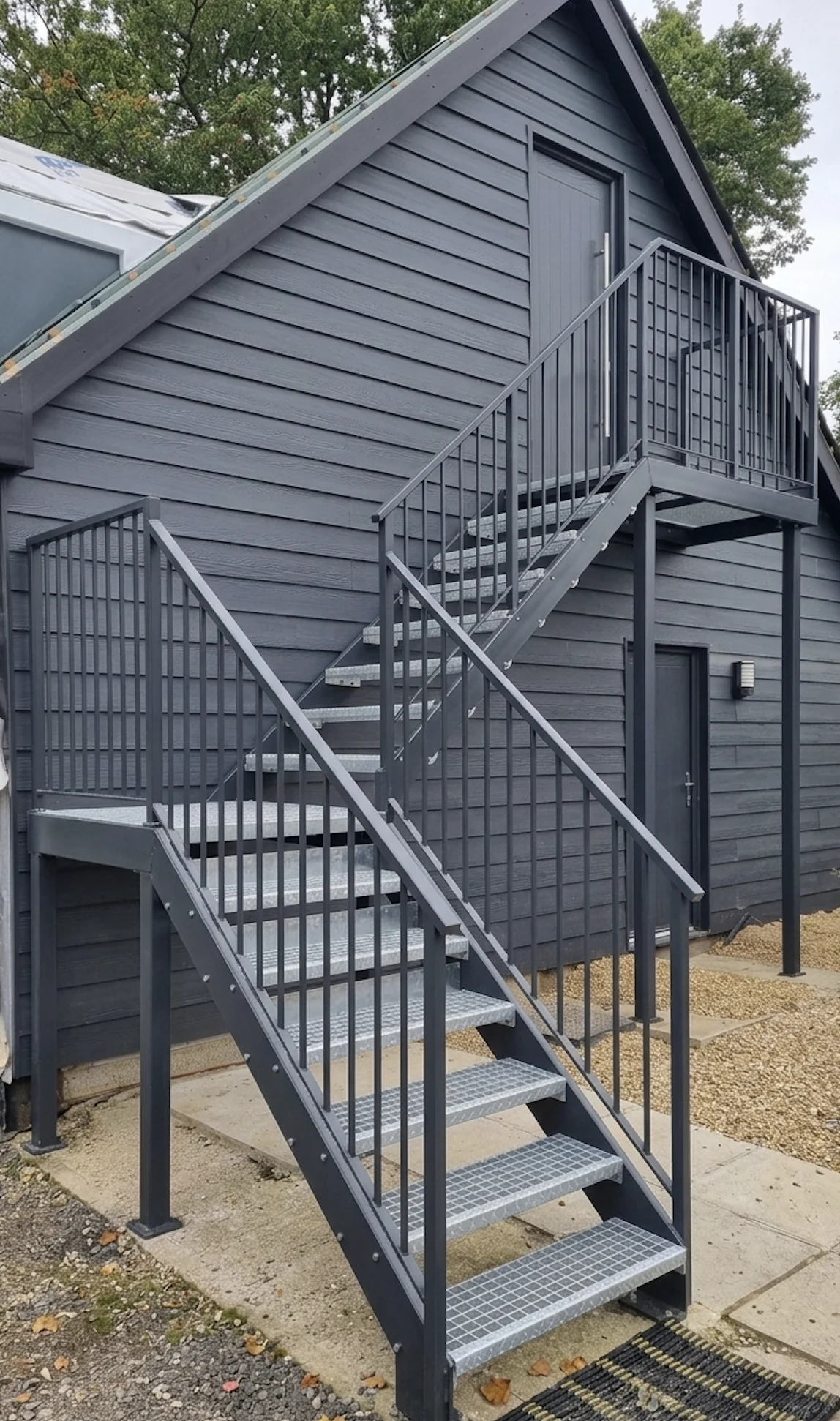
| External fire escape (retail building) | From £5,500 | Galvanised, 1,000mm+ width |
Shopfit timeline: Retail staircase projects typically run on tight shopfit schedules — 4–8 weeks from order to installation for a bespoke steel-and-glass design. If the staircase is on the critical path of a store opening, agree the specification and place the order before the main fit-out begins. Late staircase orders are the most common cause of delayed store openings in multi-level retail. For our bespoke staircase pricing and lead times, see our cost guide.
Common Compliance Failures — What Building Control Rejects
1 Open risers in a commercial setting
The most common failure. A floating staircase designed to domestic standards with open risers will be rejected. Solid risers are mandatory for all non-domestic buildings.
2 Balustrade height at 900mm instead of 1,100mm
Landing and mezzanine balustrade at 900mm (domestic height) instead of the required 1,100mm for non-domestic buildings. This applies to both the staircase landing and the mezzanine gallery edge.
3 Missing contrasting nosings
Part M contrasting nosings omitted — especially common in refurbishments where the shopfitter installs a new staircase but does not add the nosing strips. Building Control and access consultants will flag this immediately.
4 Toughened-only glass in balustrade
Using toughened-only glass panels (which shatter completely on failure) instead of laminated glass. In a retail environment with public access, laminated glass is essential — a shattered panel leaves a completely unguarded edge at height.
5 More than 16 risers in a single flight
Exceeding the 16-riser maximum per flight. This is specific to non-domestic stairs and does not apply to domestic buildings. A landing must break up the flight after 16 risers.
6 Staircase width undersized for evacuation
The staircase width meets day-to-day comfort requirements but falls short of the fire evacuation width calculation. Always run the Approved Document B occupancy and width calculation before finalising the staircase dimensions.
For a detailed breakdown of all UK staircase regulations — including domestic, commercial, and fire escape specifications — see our comprehensive staircase regulations pillar page.
Frequently Asked Questions — Retail Staircase Compliance
Retail staircases must comply with Approved Document K (general access or assembly stair dimensions: 150–170mm rise, 250–400mm going, solid risers, max 16 risers per flight), Approved Document M (contrasting nosings, tactile warnings, handrail extensions, accessibility), and Approved Document B Volume 2 (fire safety: stairwell enclosure, evacuation width, fire doors). The Equality Act 2010 also requires reasonable adjustments for disabled access.
No — Part K mandates solid risers for all non-domestic buildings including retail units. Open risers create a trip hazard for walking aids and small children. If a contemporary open aesthetic is desired, use thin steel plate risers painted to match the tread, or transparent glass riser panels — both provide a solid barrier while maintaining visual lightness.
On the stair flight: 900mm minimum from the pitch line. On landings and mezzanine edges: 1,100mm minimum. The balustrade must withstand a 1.5 kN/m horizontal line load (compared to 0.74 kN/m in domestic settings). Glass balustrade must use laminated glass — toughened-only glass is not acceptable for public areas.
Yes — Approved Document M requires contrasting nosings on every tread (55mm on tread surface, 55mm on riser face, minimum 30-point luminance contrast). Corduroy tactile warning paving is also required at the top of each flight, set back 400mm from the first nosing. These requirements apply to all new non-domestic buildings and material alterations.
An all-steel mezzanine staircase starts from £4,500. A branded retail specification (steel frame + hardwood treads + glass balustrade) starts from £9,500. Feature staircases for flagship stores start from £11,500. Frameless glass balustrade at 1,100mm costs from £450 per linear metre. External fire escape stairs from £5,500.
16 risers maximum per flight for any staircase serving a shop or assembly area. This is a Part K requirement for non-domestic buildings. After 16 risers, a landing must break up the flight. If the total rise requires more than 36 risers, the staircase must include at least one change of direction.
Yes — installing a mezzanine floor and its staircase is a material alteration that requires Building Regulations approval. The staircase must meet full Part K, Part M, and Part B requirements. The mezzanine structure itself must comply with structural loading requirements, and the fire strategy for the mezzanine (whether open or enclosed) must be agreed with Building Control before work begins.
Yes — glass riser panels are a compliant alternative to steel solid risers, provided the glass physically closes the gap between consecutive treads. The glass must be laminated (not toughened-only) and must be sufficiently robust to prevent a foot or walking aid from passing through. Glass risers maintain the visual transparency of an open-riser design while meeting the Part K solid riser requirement.
Need a Staircase for Your Retail Unit?
Continox designs and manufactures bespoke staircases for retail environments — from mezzanine access to flagship feature stairs. Full Part K, Part M, and Part B compliance. Steel-framed, precision-engineered, manufactured in-house in Gosport, Hampshire.