
Staircase width is one of the most under-considered dimensions in residential design — and one of the most consequential. Get it wrong and the staircase is uncomfortable to use, fails Building Control, or makes furniture removal impossible. Get it right and you have a flight that feels generous, accommodates everyday use, and meets the requirements of Approved Document Part K. This guide covers the actual UK width requirements for every staircase type — domestic, loft, fire escape, commercial — with the comfort dimensions Continox specifies on bespoke projects.
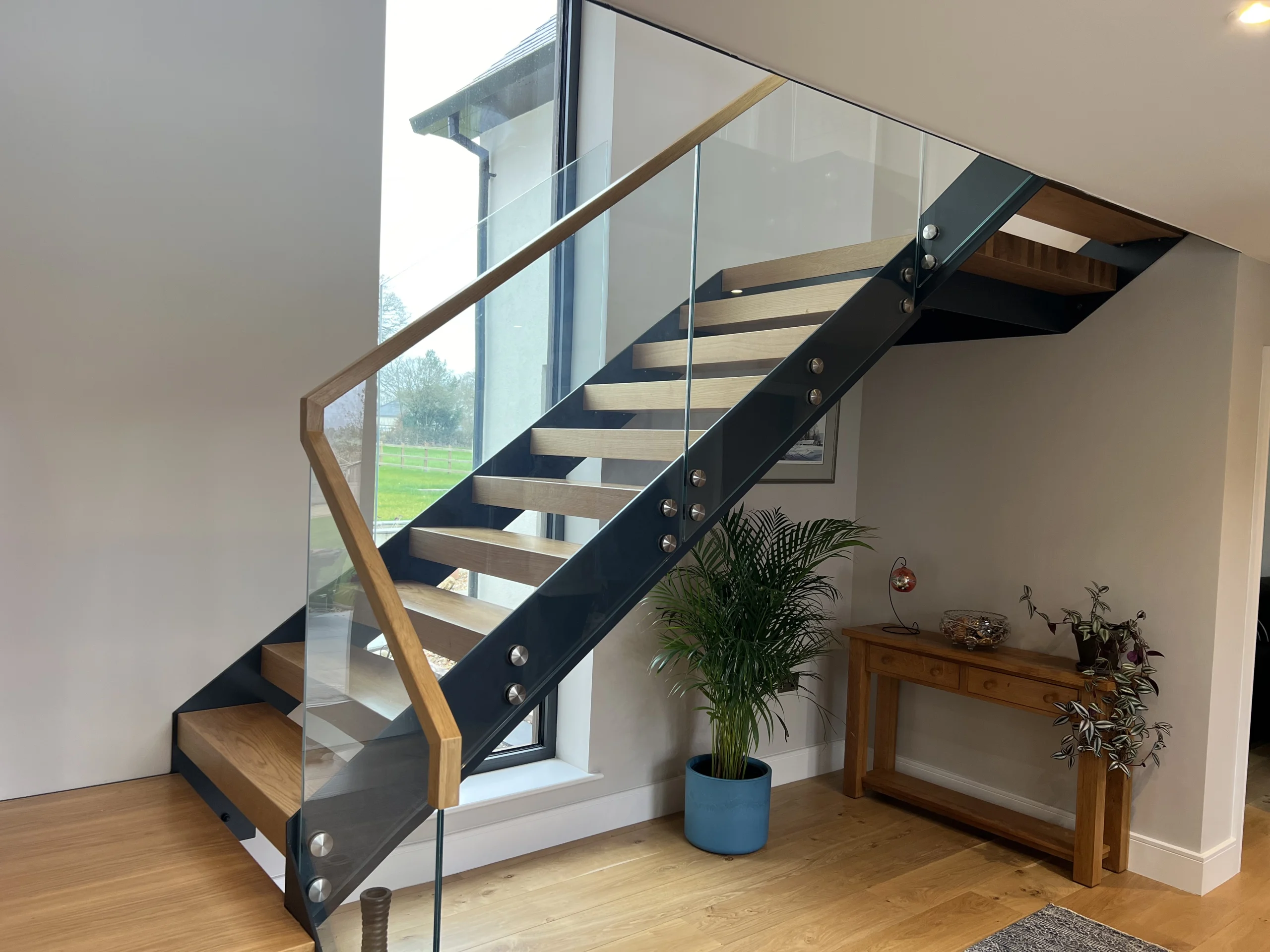
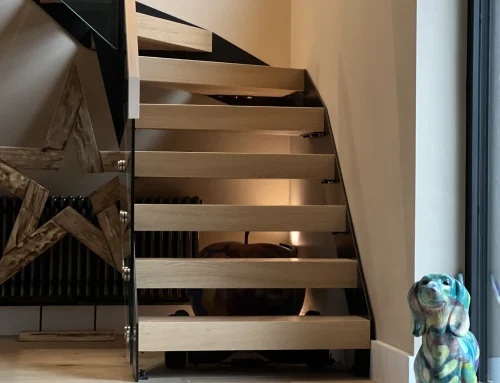
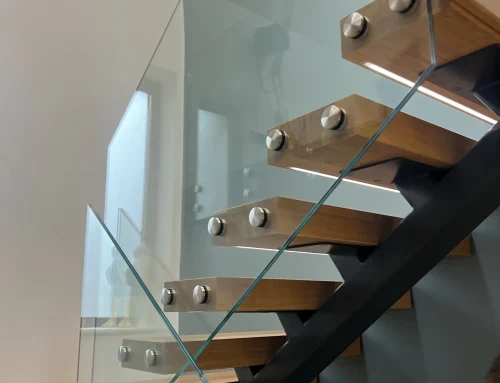
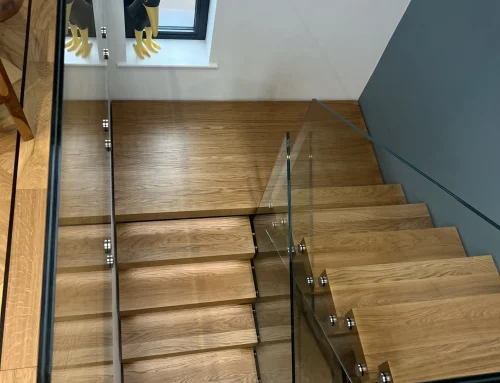
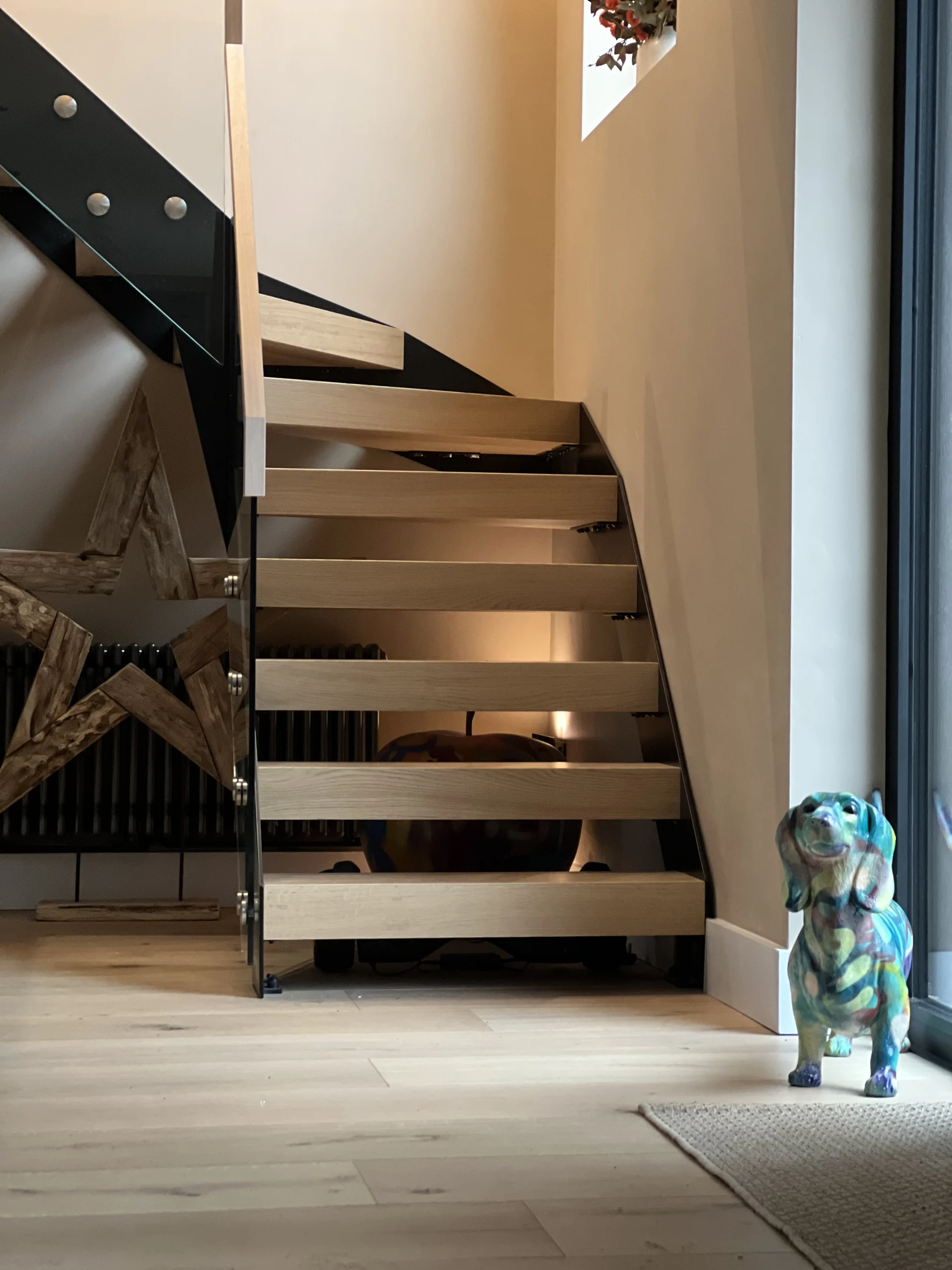
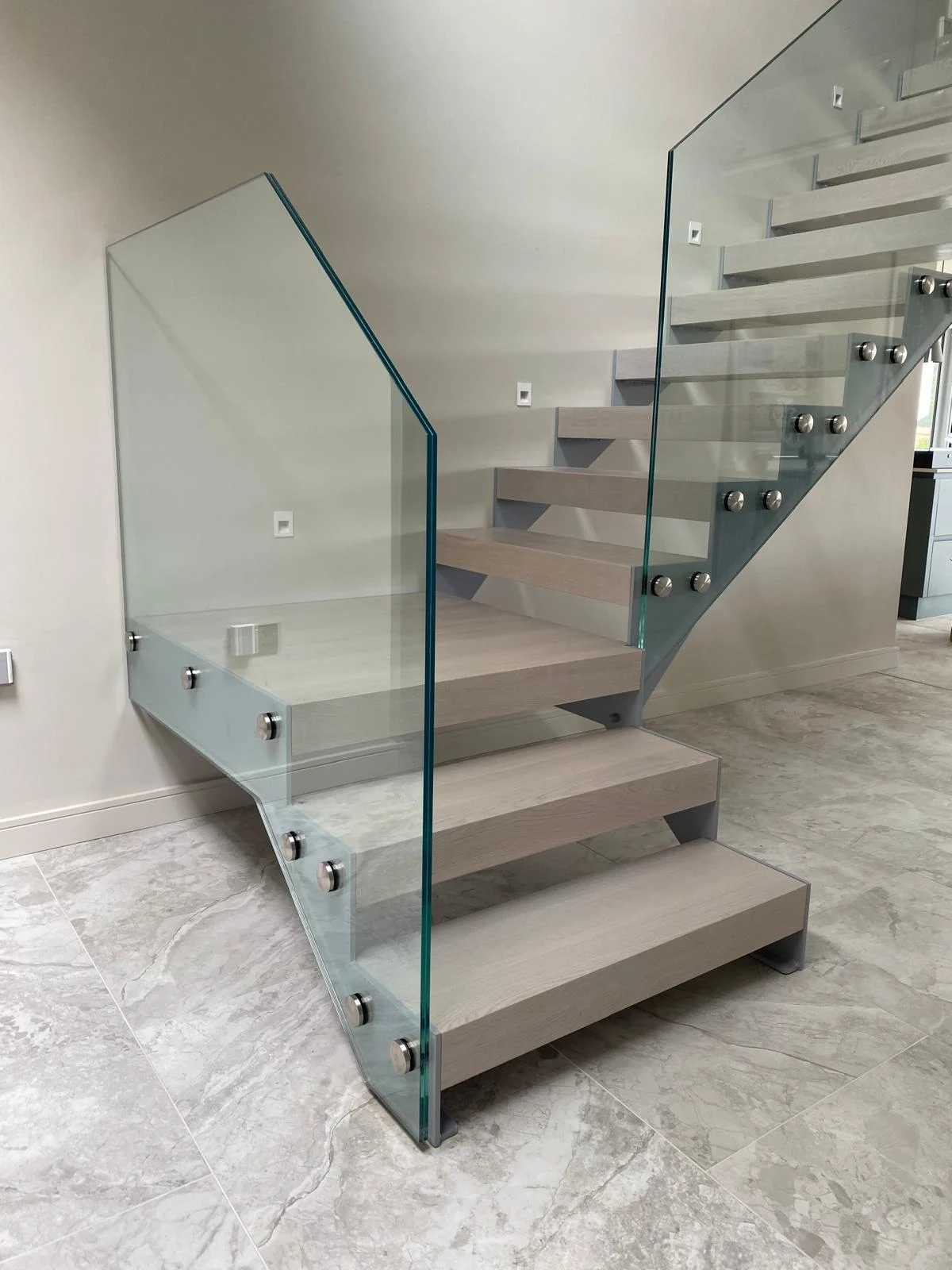
Bespoke contemporary staircase by Continox — 900mm clear width between balustrade and wall, the comfort specification for premium domestic projects.
For a private domestic UK staircase, Approved Document Part K does not set an absolute minimum width — the practical minimum is around 600mm for loft conversions and 800mm for primary household stairs. The British Standard BS 5395 recommends 900mm for new domestic flights as a comfort target. Fire escape and common stairs in flats require a minimum 1,000mm clear width under BS 9991. Width is measured between handrails, walls, or balustrades — whichever encroaches on the going.
Why Staircase Width Matters
Width affects four things at once: regulatory compliance, everyday comfort, furniture access, and resale value. A staircase narrow enough to satisfy minimum building regs can still feel cramped, fail to allow two people to pass, and prevent a sofa or king-size mattress from reaching the upper floor without dismantling.
The number that gets quoted most often online — "800mm minimum" — is a useful rule of thumb for primary domestic staircases, but Approved Document Part K does not actually specify an absolute width minimum for private dwellings. It does require an unobstructed clear width measured between any obstructions (handrail, balustrade, or wall), and references BS 5395-1 for typical specifications. The result is a system that gives the designer flexibility on private stairs but tightens up significantly for fire escapes and common stairways serving multiple dwellings.
The width that actually matters in everyday life is the clear walking width — measured between handrails or balustrades at handrail height, not between walls. A staircase with 900mm wall-to-wall and a 100mm-projecting timber handrail has just 800mm clear width, which is the figure Building Control will measure if questioned.
Width Requirements by Staircase Type
UK staircase width requirements vary by use class — what's permitted in a loft conversion would fail in a block of flats, and what's required for a fire escape would feel oversized in a private home. The seven categories below cover almost every domestic and commercial situation.
The primary staircase in a single-occupancy dwelling — the flight that everyone uses every day. Approved Document Part K sets no absolute minimum width, but BS 5395-1 recommends 900mm for new staircases in private homes, and 800mm is the widely-accepted practical floor. Below 800mm the flight feels cramped, two people cannot pass on the stairs, and standard furniture (sofas, mattresses, wardrobes) becomes difficult to move.
For a comfortable specification on new builds and major renovations, Continox specifies 900–1,000mm clear width as standard — this is the dimension that delivers a generous-feeling flight without consuming excessive floor area. For an open-plan layout where the staircase is a feature, 1,100–1,400mm is common on bespoke projects.
Loft conversion stairs are the one situation where Approved Document Part K explicitly relaxes the geometry. Where space is genuinely constrained, the minimum clear width drops to around 600mm, with corresponding allowances on headroom (1,800mm at the centre / 1,900mm at the sides) and pitch up to 42°. In practice, most successful loft conversions deliver 700–800mm width — wide enough to feel acceptable and allow a single mattress to be carried up.
The 600mm figure is genuine — it's not a misprint or an outdated number — but it's a hard minimum, not a target. A staircase at 600mm feels narrow even for one person, and prevents most furniture from reaching the loft. For a comfortable loft staircase, specify 750mm minimum where the existing structure allows. For more on loft staircase design see our loft conversion staircase ideas and space-saving loft options.
A staircase serving two or more dwellings — typical block of flats, converted house in multiple occupation, or any building where the stairs form the means of escape for residents who don't share a household. The minimum clear width steps up sharply: 1,000mm under BS 9991 for residential common stairs, with no relaxation for tight footprint constraints. This is the dimension Building Control measure on flat conversions and HMO compliance inspections.
The 1,000mm minimum recognises that common stairs serve simultaneous use by multiple unrelated people during normal occupancy and emergency escape, and must accommodate stretcher movement. For HMO-specific requirements see our guide to HMO fire escape stairs requirements.
Dedicated escape stairs serving commercial premises, HMOs, schools, care homes, and any building where the structure is part of the formal means of escape under Approved Document Part B. Minimum clear width is 1,000mm under BS 9991, increasing to 1,100–1,200mm for higher-occupancy buildings calculated on escape capacity. Width is calculated on people-per-minute throughput — a 1,000mm flight handles approximately 80 persons per minute, scaling roughly linearly with width.
For projects below 1,000mm width — common on older retrofits — Continox recommends rebuilding to current standards rather than negotiating a relaxation. The cost difference is small relative to the liability exposure of an undersized escape stair. See our external staircase range and fire escape staircase product pages.
Offices, retail premises, restaurants, hotels — buildings used by staff, customers, or visitors during normal occupancy. Minimum clear width depends on the calculated escape capacity from the floor it serves, but the practical baseline is 1,100mm for primary stairs and 1,000mm for secondary escape routes. The 1,200mm specification is common for shopping centres, restaurants with high occupant capacity, and any building where the calculated escape population exceeds 220 persons.
Commercial staircases also have to accommodate intuitive two-way pedestrian flow during normal use — an architect specifying a 1,000mm primary flight in a busy office will typically be advised to upgrade to 1,200mm during planning review. For sector-specific guidance see our posts on school staircase regulations and retail staircase compliance.
Where the available footprint cannot accommodate a conventional flight, paddle (alternating tread) staircases provide a regulated solution — but only as a secondary stair to a single room of limited use, typically a loft study or storage room. Minimum width drops to 550–600mm with strict conditions: alternating treads, fixed handrails on both sides, and use restricted to one habitable room with no other access. See our paddle staircase guide for full specifications.
Spiral staircases similarly have minimum diameter (not width) requirements — 1,400mm diameter for primary domestic use, 1,200mm for secondary access only. Width on a spiral is measured radially from the central column to the outer edge of the treads, with a usable walking width of approximately 600–700mm at the centre line.
Where a staircase must accommodate users with mobility impairments — typically in public buildings, but also in some new-build dwellings under Part M Category 2 and Category 3 — the clear width must be 1,200mm minimum with handrails to both sides at 900mm and 1,000mm height. The width allows assisted ascent (one carer alongside the user), and the dual handrails support users with one-sided mobility limitations.
Part M Category 3 (wheelchair-accessible dwellings) typically eliminates the staircase from the daily-use circulation by providing a stairlift route or platform lift, but the staircase itself still needs to comply with the 1,200mm width for emergency evacuation use.
UK Staircase Width Requirements — Complete Reference Table
The following table summarises minimum and recommended widths across the most common UK building types. All measurements are clear unobstructed width measured between handrails, balustrades, or walls — whichever encroaches.
| Building Type | Min Width | Recommended | Standard |
|---|---|---|---|
| Private dwelling — primary stair | 800mm | 900–1,000mm | BS 5395-1 |
| Loft conversion | 600mm | 750–800mm | Part K |
| Common stairs — flats/HMOs | 1,000mm | 1,100mm | BS 9991 |
| External fire escape | 1,000mm | 1,100–1,200mm | BS 9991 |
| Commercial — primary stair | 1,100mm | 1,200mm+ | Part B / BS 9999 |
| Paddle/alternating tread | 550mm | 600mm | Part K |
| Spiral — domestic primary | 1,400mm Ø | 1,500mm Ø | BS 5395-2 |
| Accessibility (Part M) | 1,200mm | 1,200mm | Part M |
How to measure staircase width correctly: Measure horizontally at handrail height, between the inside face of any handrail, balustrade, stringer, or wall — whichever projects furthest into the going. A staircase between two walls 900mm apart, with a 75mm-projecting timber handrail on one side and a 100mm-deep stringer on the other, has a clear width of 725mm. Building Control measure clear walking width, not stringer-to-stringer. Always measure on completed installation, not from the drawing.
Minimum vs Comfort Specification
The minimum widths listed above keep a project legal. They don't keep it comfortable. The dimensions Continox specifies on bespoke residential projects sit above the minimum for clear functional reasons:
900mm clear (comfort minimum) — two people can pass on the stairs without one stopping. Standard sofas, mattresses, and double-door wardrobes can be carried up the flight without disassembly. Children can carry laundry baskets without tilting the basket sideways.
1,000mm clear (recommended) — one adult can pass another carrying a child or large object. Bedside tables, single beds, and most flatpacked furniture move easily. The flight feels generous in a typical hallway.
1,200mm clear (premium) — assisted ascent is possible (one helper alongside an unsteady user), and the flight reads as architectural rather than purely functional. This is the specification for floating staircases, central spine designs, and any project where the staircase is a focal feature.
The cost difference between an 800mm minimum-spec flight and a 1,000mm comfort-spec flight on a bespoke staircase is typically £600–£1,200 — primarily in the additional steel for wider treads and brackets. For full pricing see our bespoke staircase cost guide.
Common width measurement mistakes: measuring between stringer faces (overstates width by 50–100mm) instead of handrail-to-handrail; quoting wall-to-wall on plan rather than clear walking width on completed installation; assuming the loft conversion 600mm minimum applies to primary domestic stairs (it doesn't); using BS 6206 (withdrawn) instead of current BS EN 12150 for glass balustrade specs. Building Control will measure clear width on the as-built flight, including any handrail, balustrade, or finish.
Width and Headroom — The Combined Calculation
Width is one dimension in a system. The Approved Document Part K minimum clear walking width has to be delivered simultaneously with the minimum headroom of 2,000mm on primary stairs (1,800mm at the centre line of a loft conversion stair, 1,900mm at the sides). It's surprisingly common for a flight to deliver compliant width on plan but fail headroom where the upper floor structure projects across the flight — the result is a Building Control failure that requires structural intervention to fix.
The 2R + G comfort formula (2 × Rise + Going = 550–700mm) is also independent of width. A staircase can be the correct width but uncomfortable in use if the rise/going relationship sits outside the comfort band — typically because the going has been compressed to fit a tight overall length, producing a steep flight at the regulatory limit. For full Part K geometry requirements see our complete UK staircase regulations guide.
Why Width is Easier on Bespoke
The width problem on conventional staircases — particularly off-the-shelf and pre-fabricated flights — is that the dimensions are fixed at production. A standard residential flight at 860mm wall-to-wall delivers approximately 760mm clear walking width once the stringer projection is included, which is below the 800mm comfort minimum and forces compromise on furniture access. The only way to widen a stock flight is to specify a non-standard size, which removes most of the cost advantage of off-the-shelf.
On a bespoke staircase the width is set at the design stage to the available footprint and the comfort target — there is no penalty for specifying 1,050mm instead of 950mm beyond the marginal additional material cost. This is one of the underrated reasons that bespoke staircases feel different in use: every dimension is set to suit the project, not the manufacturer's standard production sizes. See our bespoke modern staircase range and floating staircase product pages for the full specification options.
Frequently Asked Questions
Width Set to Your Footprint, Not Ours
Continox designs every staircase from scratch — width, rise, going, and pitch optimised to the available footprint and your comfort target. Compliant with Part K, BS 5395-1, and BS 9991. Free site survey across the UK, photorealistic 3D visuals, fixed-price quotation within 24 hours. Bespoke staircases from £7,900.