
Second Staircase Requirements UK 2026 — Complete Building Regulations Guide
From 30 September 2026, all new residential buildings in England over 18 metres in height must be designed and built with two separate staircases. The change to Approved Document B brings England in line with Scotland, the rest of Europe, North America, and Australasia — and follows years of post-Grenfell consultation, expert lobbying, and developer uncertainty. This guide covers exactly what the new requirement involves, the transitional rules for projects already in progress, the design implications for staircase specification on tall residential buildings, and the practical consequences for developers, architects, and building control teams. For complete UK staircase regulations see our Part K and Part B guide.
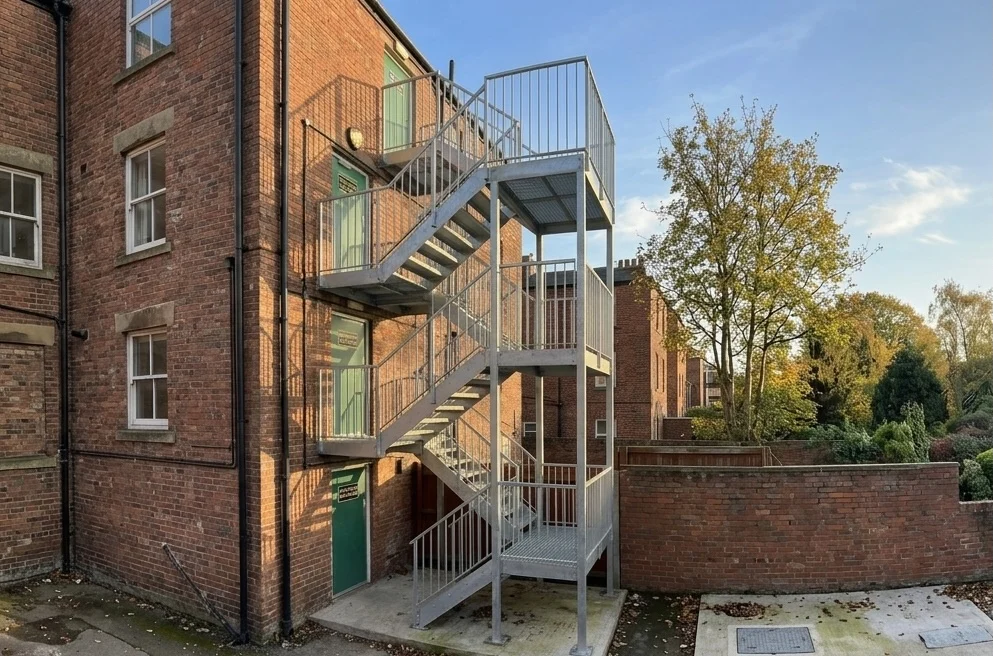
Steel external escape staircase by Continox — manufactured to BS 9991 and Approved Document B requirements for residential and commercial premises.
From 30 September 2026, all new residential buildings in England over 18 metres in height must be designed and built with two separate staircases under amended Approved Document B (Fire Safety). The 18m threshold typically equates to buildings of six storeys or more. The change does not affect existing buildings — it applies to new construction, with a transitional provision for projects where a building notice, initial notice, or building control approval application with full plans was submitted before 30 September 2026 and the work is sufficiently progressed by 30 March 2028. The amendment also tightens travel distance requirements (7.5m maximum in a single direction, 30m in multiple directions) and addresses lobby separation between flats and the common stair.
Why the Second Staircase Requirement
The change follows the post-Grenfell building safety reforms and brings England into line with the rest of the United Kingdom and most comparable jurisdictions. Scotland has banned single-stair towers above 18m for decades; the rest of Europe, North America, and Australasia all require redundant means of escape on residential buildings of this height. England has been the international outlier — and the 2017 Grenfell Tower fire, in which 72 people died in a single-staircase residential block, made the regulatory inconsistency politically untenable.
The technical case is straightforward. A single staircase is the only escape route from the floors above ground level in a tall residential block. If that staircase is compromised by smoke, fire, or fire service operations, residents are trapped. A second protected staircase provides redundancy — if one route is unavailable, the other remains usable. The Royal Institute of British Architects (RIBA), the Royal Institution of Chartered Surveyors (RICS), the National Fire Chiefs Council (NFCC), and the Chartered Institute of Building (CIOB) all formed a coalition lobbying for the lower 18m threshold (the government's original proposal was 30m). Their position prevailed.
The change also reflects Building Safety Act 2022 alignment. The Act defines "higher-risk buildings" as residential buildings of at least 18 metres or seven storeys with two or more residential units, plus hospitals and care homes meeting the height threshold. Aligning Approved Document B with the same 18m definition produces a coherent regulatory framework where height triggers consistent fire safety, structural, and design obligations.
The 18m Height Threshold
The 18-metre threshold is measured from ground level to the floor level of the highest occupied storey. Buildings below 18m can continue with a single staircase under the existing rules; buildings at or above 18m require two. The threshold typically equates to six storeys, depending on floor-to-floor heights — a typical 3.0m floor-to-floor produces 18m at the sixth-storey floor, while a more generous 3.5m floor-to-floor reaches 18m at the fifth-storey floor.
UK 18m height threshold — single-staircase compliant below 18m, two-staircase mandatory above 18m from 30 September 2026.
The measurement methodology matters. The 18m is taken to the highest occupied storey, not to the roof or to the top of any plant room or rooftop terrace. A six-storey building with a roof terrace at 19m typically counts as the height to the sixth-storey floor (around 17m) and falls below the threshold; a seven-storey building with no rooftop accommodation but a top-floor flat at 19m exceeds the threshold and requires two staircases.
How the 18m is measured: The relevant height is the vertical distance from ground level (or the lowest external level adjoining the building) to the floor level of the highest occupied storey containing residential accommodation. Roof plant rooms, rooftop terraces, lift overruns, and other ancillary spaces above the highest occupied storey do not contribute to the threshold calculation. This is the same measurement methodology used by the Building Safety Act 2022 to define "higher-risk buildings" — ensuring consistency across the regulatory framework.
The Transitional Provisions
The 30 September 2026 effective date is a hard line for projects starting after that point — but a transitional provision protects projects already in train. The amendment confirms that buildings can continue under the existing single-staircase rules where:
1. A building notice, initial notice, or building control approval application with full plans was submitted to the relevant authority before 30 September 2026, AND
2. The work is "sufficiently progressed" by 30 March 2028 (the 18-month transitional cutoff).
"Sufficiently progressed" is defined in the amendment: for new construction, this means the pouring of concrete for permanent foundations (trench, pad, or raft) has started, or the permanent placement of piling has started. For work to existing buildings, sufficient progress means the work has started. For change-of-use projects, it means work to effect the change of use has started.
Government proposes second staircases mandatory for residential buildings over 30m in England.
285 responses received. RIBA, RICS, NFCC, and CIOB lobby for 18m threshold.
Housing Secretary Michael Gove confirms lower threshold following expert pressure.
Government commits to providing further guidance on transitional arrangements.
DLUHC publishes detailed technical guidance — confirming 18m threshold and 30 September 2026 effective date.
All new residential buildings over 18m must be designed with two separate staircases.
Pre-existing applications must be "sufficiently progressed" by this date or re-submit under new rules.
Design Requirements — Beyond Two Staircases
The amendment to Approved Document B does more than mandate a second staircase. The technical guidance also addresses three additional requirements that affect tall residential design from 30 September 2026:
The amended guidance tightens travel distance limits to staircases. From any flat entrance door, the maximum distance in a single direction to a protected staircase is 7.5 metres; the maximum distance in multiple directions (i.e. where two staircases are accessible from the same lobby) is 30 metres. Exceeding either limit triggers the second-staircase requirement regardless of building height.
This has practical implications for floor plate design. A long thin floor plate with flats at both ends and a single staircase at the centre may exceed 7.5m single-direction travel even on a building under 18m, requiring either floor plate redesign or addition of a second staircase. The amendment effectively makes single-staircase design impractical for floor plates over approximately 60m long.
The amendment requires a second staircase where flats are not separated from the common stair by a protected lobby. This addresses the failure mode where smoke from a fire in one flat enters the staircase directly through an unprotected route, compromising the escape route for all residents above the affected floor.
The technical solution is a fire-resisting lobby between every flat entrance and the staircase shaft, providing a smoke-tight buffer that maintains the staircase as a viable escape route during a fire in any individual flat. Where the lobby provision is not feasible (typically older retrofits or constrained floor plates), the second-staircase requirement applies.
The two staircases must be independent escape routes — physically separated, served by independent ventilation, and accessible by independent travel paths from each flat. A pair of staircases sharing a lobby, ventilation system, or access corridor does not satisfy the requirement; if a fire compromises the shared element, both staircases are compromised simultaneously and the redundancy is illusory.
This typically translates to staircases at opposite ends of the floor plate, served by separate lobbies with separate ventilation, and accessed through independent fire-resisting routes from each flat. The design implication is significant — the second staircase is not just an additional vertical core, but an entirely separate fire safety strategy that influences floor plate layout, lift positioning, services routing, and refuse/recycling provision.
Implications by Building Type
The amendment affects different building types in different ways. The table below summarises the main scenarios and how the 30 September 2026 change applies.
| Building Type | Status from 30 Sep 2026 | Action Required |
|---|---|---|
| New residential block over 18m | Two staircases required | Full redesign or transitional protection |
| New residential block under 18m | Single staircase OK | Verify travel distance limits |
| Existing residential block over 18m | Not retrospectively affected | None — existing rules apply |
| Material change of use over 18m | Two staircases required if work starts after 30 Sep 2026 | Plan for second staircase or accelerate to transitional |
| Hotel / care home over 18m | Reviewed separately (Doc B Vol 2) | Check sector-specific guidance |
| Office building over 18m | Not subject to residential rules | BS 9999 commercial requirements apply |
| Mixed-use with residential over 18m | Residential portion requires two staircases | Coordinate stair strategy across uses |
| Listed/conservation residential over 18m | Two staircases required for new construction | Listed building consent + Building Regs |
Design and Cost Implications
The Department for Levelling Up, Housing and Communities (DLUHC) impact assessment estimated total compliance cost at £2.679 billion over 10 years, the bulk of which is capital cost to physically build residential towers with two staircases. In London alone, the uncertainty around the threshold has been estimated to have delayed delivery of at least 38,000 homes — a figure that captures both the direct compliance cost and the secondary cost of redesigning projects mid-development.
The design implications fall into three areas:
1. Floor area efficiency
Each staircase consumes approximately 12–18m² per floor depending on the staircase type and lobby arrangement. On a 30-storey residential tower, a second staircase removes 360–540m² of saleable or rentable floor area — typically equivalent to four to six additional flats. This is the primary cost driver: the £2.679bn impact assessment is largely lost development value, not increased construction cost.
2. Floor plate layout
Designing efficient two-staircase floor plates requires the staircases at opposite ends of the floor plate, with the lift core and lobbies positioned to achieve the 7.5m / 30m travel distance limits. Tall thin tower designs are more affected than broader rectangular plates — the architectural fashion for slender, sculptural towers is compromised by the floor plate constraints of dual-staircase compliance.
3. Building services coordination
Each staircase requires independent smoke ventilation (typically natural via openable vents at each level, with a roof-level exhaust, or mechanical pressurisation systems for taller buildings). The second staircase doubles the ventilation provision, increases the structural penetration requirements, and adds capital cost beyond just the staircase fabric itself.
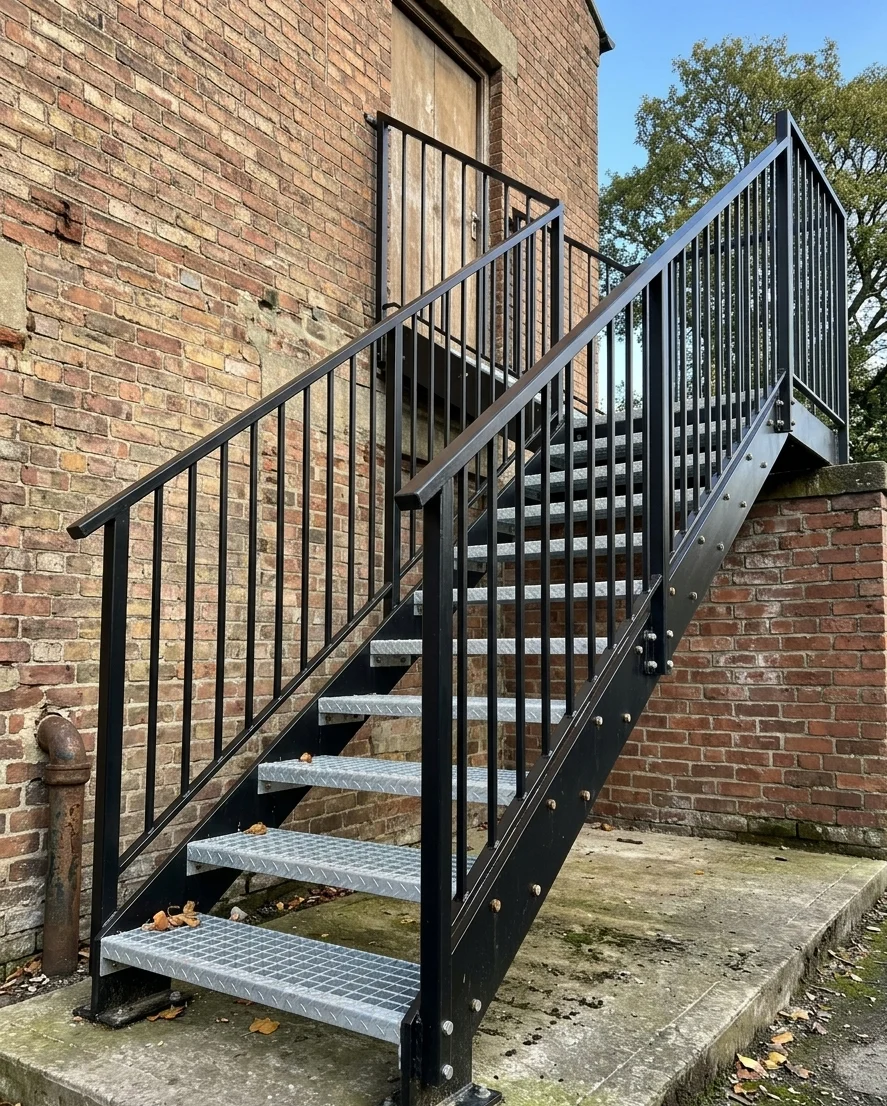
For staircase manufacturers and installers, the change creates significant additional capacity requirement on tall residential projects. Continox manufactures bespoke compliant external staircase systems and fire escape staircases for residential, commercial, and mixed-use applications under BS 9991 and Approved Document B.

The 18-month grace period is shorter than it looks. Pre-30 September 2026 applications retain the existing single-staircase rules only if work is "sufficiently progressed" by 30 March 2028 — meaning permanent foundation pours or piling has started. Projects that obtain Building Regulations approval but stall through site acquisition delays, planning conditions, or financing setbacks will lose transitional protection and require resubmission under the new rules. Developers with land-banked schemes designed under existing rules need to plan delivery sequencing carefully, or accept that some sites will require redesign.
How Developers and Architects Should Prepare
Five practical steps for projects approaching the 30 September 2026 transition:
1. Audit current pipeline. Identify any residential projects above 18m where Building Regulations approval has not yet been obtained. These projects require either accelerated submission to qualify for transitional protection, or redesign to incorporate a second staircase. The audit needs to cover not just submitted projects but pre-application discussions and design-stage schemes.
2. Assess transitional protection viability. For projects with submissions under existing rules, check whether site progress can realistically reach "sufficiently progressed" by 30 March 2028. Land assembly, demolition, ground investigation, and foundation start are the critical path — financing and planning conditions can extend timelines unexpectedly.
3. Engage early with Building Control. Building Control Bodies (BCBs) are processing high volumes of pre-deadline applications, and decision lead times have extended. Submitting now (rather than at the September 2026 deadline) provides margin for revisions and avoids the queue at the deadline.
4. Plan for floor plate redesign. Projects that cannot qualify for transitional protection need redesign to incorporate two-staircase layouts. The redesign typically requires structural engineering review (additional staircase loads, alternative bracing strategies), services coordination (doubled smoke ventilation, additional refuge provisions), and revised commercial appraisal (lost lettable area, increased build cost).
5. Coordinate with staircase fabricators. Demand for fire escape and protected staircase fabrication is increasing as the deadline approaches. Securing fabricator commitments early — particularly for bespoke or non-standard configurations — avoids procurement delays at the construction stage. For BS 9991-compliant fabrication see our fire escape staircase and external staircase product pages.
Relationship to Other UK Regulations
The second-staircase requirement sits within a wider framework of UK building safety regulation. Understanding how it interacts with related regulations is essential for compliant design:
Approved Document Part K (Protection from Falling). Part K continues to govern the geometry of every staircase regardless of building height — rise, going, pitch, headroom, balustrade specifications, and width requirements all apply to both staircases on a tall residential building. See our headroom requirements and staircase width guides for the dimensional specifications.
BS 9991 (Fire Safety in Residential Buildings). BS 9991 is the British Standard governing fire safety design for residential buildings. The Approved Document B amendment aligns with BS 9991 on travel distances, lobby separation, and escape stair specification. For projects designed to BS 9991 the second-staircase requirement is integrated with the wider fire strategy.
Building Safety Act 2022. The Act defines "higher-risk buildings" using the same 18m threshold and creates the three-gateway approval process for HRBs through the Building Safety Regulator. Projects affected by the second-staircase requirement are also subject to the BSR three-gateway regime — Gateway 1 at planning, Gateway 2 before construction, Gateway 3 before occupation.
Fire Safety Act 2021. The Fire Safety Act extends Fire Safety Order responsibilities to external walls, flat entrance doors, and structural fire protection of common parts. The second-staircase requirement complements this by ensuring redundant escape routes regardless of the structural fire protection performance.
Real-world delivery context. Continox manufactures BS 9991-compliant external and internal escape staircases for residential, HMO, and commercial premises. Recent projects include the Shady Bower residential block in Salisbury (six balcony assemblies for a multi-occupancy residential development) and various fire escape installations across South England. For sector-specific guidance see our posts on HMO fire escape requirements and care home fire escape requirements.
Frequently Asked Questions
Compliant Escape Staircases Manufactured to Standard
Continox manufactures BS 9991-compliant external and internal escape staircases for residential, commercial, and mixed-use buildings. Designed to Approved Document B, structural calculations to BS EN 1993, fabrication to BS EN 1090. Free site survey, fixed-price quotation, manufactured and installed by our own team. UK-wide delivery from our Hampshire workshop.