
Approved Document B 2026 Changes — What Developers Need to Know
The 2026 amendments to Approved Document B represent the most substantial update to UK fire safety guidance since the post-Grenfell Building Safety Act came into force. From 30 September 2026, the changes affect how every new residential building over 18 metres is designed — but the implications go beyond the headline second-staircase requirement. Travel distances are tightened, evacuation alert systems become mandatory in higher-risk buildings, sprinklers are extended to a wider class of premises, and the relationship between Approved Document B and BS 9991 is formally aligned. This guide covers all the technical changes, what they mean in practice, and the documentation developers and architects need to update before the deadline. For the regulatory context see our second staircase requirements guide and cost impact analysis.
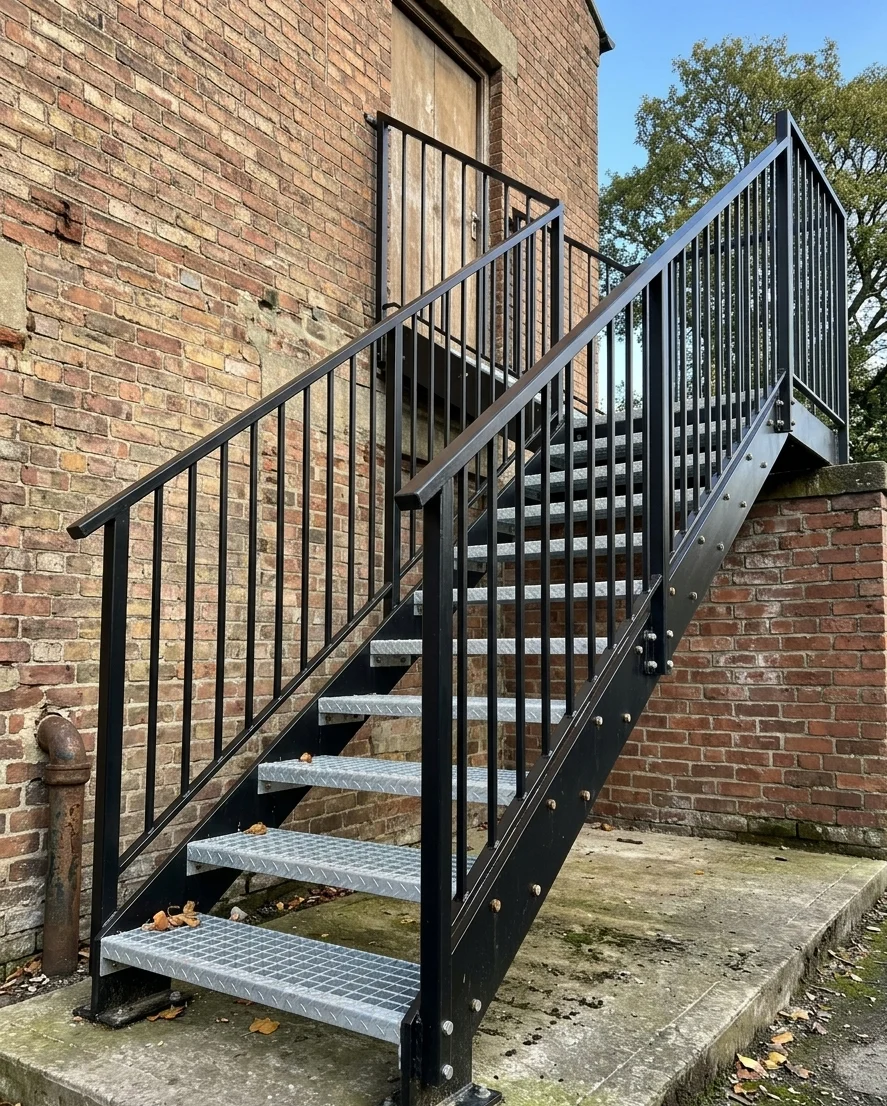
External steel escape staircase by Continox — manufactured to revised Approved Document B 2026 requirements and BS 9991 fire safety standards.
The 2026 amendments to Approved Document B introduce seven major changes that take effect from 30 September 2026. The headline change is the mandatory second staircase for new residential buildings over 18m. Other changes include tightened travel distance limits (7.5m single direction, 30m multiple directions), mandatory evacuation alert systems in residential buildings over 18m, extended sprinkler requirements for care homes regardless of height, formal alignment with BS 9991:2024, revised protected lobby requirements, and updated guidance on external wall fire performance. The amendments apply to new construction in England — Scotland, Wales, and Northern Ireland have separate building regulation frameworks. Transitional protection applies to projects with Building Regulations submissions before 30 September 2026 that reach "sufficiently progressed" status by 30 March 2028.
The Seven Major Changes
Approved Document B is split into two volumes — Volume 1 covers dwellinghouses, Volume 2 covers buildings other than dwellinghouses. The 2026 amendments affect both volumes, with most of the substantive changes falling on Volume 1 (residential buildings) where the post-Grenfell reforms are concentrated. The seven changes below cover the main updates relevant to developers, architects, and building control teams.
All new residential buildings exceeding 18m to highest occupied storey require two separate protected staircases.
Maximum 7.5m single-direction travel, 30m multi-direction. Triggers second-staircase regardless of building height.
Mandatory in new residential buildings over 18m. Provides direct alert to flat occupants when evacuation needed.
Automatic sprinkler systems required in all new care homes regardless of height — previously only over 30m.
Document B references BS 9991:2024 as the design standard for residential fire safety, replacing earlier 2015 version.
Fire-resisting lobby between flat entrance and common stair becomes mandatory in all multi-flat residential buildings.
Updated guidance on external wall fire classification, cavity barriers, and balcony specifications post-Grenfell.
Change 01 — Second Staircase Over 18m
The headline change. From 30 September 2026, every new residential building in England exceeding 18 metres to the floor level of the highest occupied storey must be designed with two separate protected staircases. The 18m threshold typically equates to six storeys at standard 3.0m floor-to-floor heights, or five storeys at more generous 3.5m floor-to-floor.
Single staircase permitted for residential buildings up to 30m, with travel distance limits and protected lobby requirements. Below 18m: single stair on most schemes; over 30m: two stairs typically specified by best practice but not mandatory.
Second staircase mandatory above 18m. Threshold matches Building Safety Act "higher-risk building" definition. Aligns with Scotland (banned single-stair towers above 18m for decades) and most international jurisdictions.
The full requirements, transitional provisions, and design implications are covered in detail in our second staircase requirements guide. The cost impact — typically £4–6 million per tower scheme through fabric cost, lost floor area, and indirect impacts — is analysed in our second staircase cost guide.
Change 02 — Travel Distance Limits
Approved Document B 2026 confirms tightened travel distance limits from any flat entrance door to a protected staircase. The limits trigger second-staircase requirements regardless of building height — making the change relevant to schemes well below 18m as well as the high-rise residential covered by Change 01.
From any flat entrance door, the maximum permitted distance to a protected staircase is:
Single direction applies where the only route to a staircase passes a fire door (typical dead-end corridor). Multi-direction applies where two protected staircases are accessible from the same lobby, allowing escape in either direction. Exceeding either limit triggers the second-staircase requirement — making single-staircase compliance impractical for residential floor plates over approximately 60m total length.
The practical effect is that long thin residential blocks — typical of mid-rise schemes on narrow urban infill sites — now require two staircases even where the building is below the 18m height threshold. Architects designing constrained floor plates need to verify travel distances at concept stage rather than discovering the constraint at technical design.
Change 03 — Evacuation Alert Systems
One of the post-Grenfell reforms. Approved Document B 2026 requires evacuation alert systems in all new residential buildings over 18 metres in England. The system provides a means for the fire and rescue service to alert occupants of individual flats when evacuation is required — addressing the failure mode at Grenfell Tower where the "stay put" strategy could not be reversed once the fire spread externally.
An evacuation alert system is not the same as a fire alarm. It is a separate system, typically operated by the fire and rescue service from a control panel at the building entrance, that delivers an audible and visible alert to occupants of selected flats or all flats. The system supports the fire service's evolving incident strategy — allowing them to instruct evacuation of specific floors or the entire building as conditions change.
The technical specification is set out in BS 8629:2019 + A1:2023 (Code of practice for the design, installation, commissioning and maintenance of evacuation alert systems for use by fire and rescue services in buildings containing flats). Key requirements include independent power supply, audible 75 dB(A) at the bedhead in each flat, and visual alert provision for hearing-impaired residents.
Evacuation alert systems are a notable additional cost on tall residential schemes — typically £15,000–£40,000 on a 30-storey tower depending on flat count, plus ongoing maintenance and quarterly fire service testing. The system is a permanent fixture of the building, not a Phase 2 addition.
Change 04 — Sprinklers in Care Homes
Approved Document B 2026 extends mandatory automatic sprinkler systems to all new care homes regardless of height. Previously, sprinklers were required only in care homes over 30m or with specific risk profiles; the 2026 amendment removes the height threshold and makes sprinklers a baseline requirement for the building type.
The change reflects the elevated fire risk in care home settings — residents typically have reduced mobility, may have cognitive impairments, and are dependent on staff-led evacuation that becomes problematic if multiple residents need simultaneous assistance. Sprinklers control the fire at source and dramatically reduce evacuation complexity.
Care home definition: A care home for the purposes of Approved Document B includes residential premises providing personal or nursing care to one or more residents — not just CQC-registered nursing homes but also smaller residential care settings, supported living for adults with significant care needs, and similar premises. The definition is functional rather than registration-based, and developers should verify their scheme's classification at the planning stage. For sector-specific guidance see our care home fire escape requirements guide.
Change 05 — BS 9991:2024 Alignment
Approved Document B 2026 formally references BS 9991:2024 (Fire safety in the design, management and use of residential buildings — Code of practice) as the recognised standard for residential fire safety design. This replaces the earlier 2015 version of BS 9991 in the regulatory framework.
The 2024 update to BS 9991 was published specifically to align with the post-Grenfell building safety reforms — incorporating the 18m height threshold, two-staircase provisions, evacuation alert systems, and updated travel distance methodology. By formally referencing BS 9991:2024 in Approved Document B 2026, the government creates a coherent design standard hierarchy:
Approved Document B 2026 sets the regulatory minimum requirements. BS 9991:2024 provides detailed design guidance to achieve compliance. Building Safety Act 2022 creates the procedural framework (Gateway 1, 2, 3) for higher-risk buildings. All three documents now use consistent terminology, height thresholds, and definitions.
For projects designed to BS 9991:2024, compliance with Approved Document B 2026 is automatically achieved provided the design is implemented faithfully. For projects following alternative design routes (typically fire engineered solutions), the principal designer must demonstrate equivalent or better fire safety performance through a fire safety strategy document.
Change 06 — Protected Lobby Requirements
The amendment makes protected fire-resisting lobbies mandatory between every flat entrance door and the common staircase shaft in all new multi-flat residential buildings. The lobby provides a smoke-tight buffer that maintains the staircase as a viable escape route during a fire in any individual flat.
The design intent of a protected lobby is fire compartmentation — preventing smoke and heat transfer from a flat in fire condition into the common staircase. The lobby creates a two-door barrier: the flat entrance door (typically FD30s, 30 minutes integrity with smoke seals) opens into the lobby, and the lobby door (typically FD30s) opens into the staircase. Smoke from a flat fire is contained within the flat plus lobby compartment, not transferred directly into the staircase shaft.
Where the lobby provision is genuinely impractical — typically older retrofit conversions where existing structural constraints prevent lobby creation — the second-staircase requirement applies under Change 01, providing redundant escape regardless of lobby integrity. The relationship between Changes 01 and 06 is therefore complementary: lobby provision avoids the second-staircase requirement on buildings that would otherwise need it on lobby grounds alone.
Lobby ventilation matters as much as the doors. A smoke-tight lobby is only effective if it stays smoke-tight under fire conditions. The 2026 amendment includes specific requirements for lobby ventilation — typically natural ventilation through an openable vent at high level (1m² minimum free area) connected to the lobby ceiling, or mechanical pressurisation of the staircase forcing air outward into the lobby. Mechanical pressurisation requires independent power supply, fire-rated ductwork, and quarterly testing — adding operational complexity but providing more reliable performance under fire conditions.
Change 07 — External Wall Performance
The 2026 amendment incorporates the post-Grenfell external wall reforms into Approved Document B's main text. The technical content is largely a consolidation of guidance issued in advice notes and consultation papers since 2017, but the formal incorporation into Approved Document B creates a single authoritative reference point for designers and building control teams.
External wall fire classification
Materials forming the external wall of relevant buildings (residential over 18m, hospitals, care homes, and student accommodation over 18m) must be classified European Class A2-s1, d0 or better — non-combustible or limited combustibility under BS EN 13501-1. The change effectively bans combustible external cladding materials on the regulated building types, replacing the previous "Class 0" standard which had been criticised as inadequate.
Cavity barriers
Cavity barriers within external walls must restrict smoke and fire spread within the cavity. The 2026 amendment provides updated detailing for cavity barrier installation, including the requirement for continuous horizontal cavity barriers at every floor level and around openings (windows, doors, ventilation penetrations). Cavity barrier failures were a significant factor in the Grenfell fire, and the updated guidance reflects forensic investigation findings.
Balcony specifications
Balconies on residential buildings over 18m must be constructed of materials meeting the same A2-s1, d0 classification as the external wall, with no combustible decking, balustrade, or surface finish. Glass and metal balcony components are typically compliant; timber decking and combustible privacy screens are not. For BS 9991-compliant balcony railings see our balcony railings product page and Salisbury residential block case study on a recent multi-occupancy delivery.

Transitional Provisions
All seven changes share a common transitional structure. Projects with Building Regulations submissions before 30 September 2026 retain the existing rules only if work is "sufficiently progressed" by 30 March 2028. The transitional definitions match those for the second-staircase change:
For new construction: permanent foundation concrete pours or piling has started by 30 March 2028. For work to existing buildings: the work has commenced. For change-of-use projects: work to effect the change of use has started.
Projects failing the 30 March 2028 cutoff lose transitional protection across all seven changes simultaneously — not just the second-staircase requirement. This means a tower scheme that loses transitional protection needs comprehensive redesign covering second staircase, evacuation alert systems, lobby provision, BS 9991:2024 compliance, and updated external wall specifications.
Compliance Implications — By Building Type
Different building types are affected by different combinations of the seven changes. The table below summarises which changes apply to common scheme types in 2026.
| Building Type | Changes That Apply | Key Action Required |
|---|---|---|
| New residential block over 18m | 1, 2, 3, 5, 6, 7 | Full design review against all six changes |
| New residential block 11–18m | 2, 5, 6, 7 | Travel distance + lobby + external wall review |
| New residential block under 11m | 2, 5, 6 | Travel distance + lobby compliance |
| New care home (any height) | 4, 5, 6, 7 | Sprinkler installation mandatory |
| HMO conversion (existing building) | 2, 6 (where structurally feasible) | Travel distance + lobby provision review |
| Office/commercial new build | 5, 7 (limited) | BS 9999 commercial standards primarily apply |
| Mixed-use residential + retail | 1–7 for residential portion | Compartmentation + escape strategy alignment |
| Listed building residential conversion | 1–7 + Listed Building Consent | Comprehensive heritage + safety coordination |
Documentation Updates Required
The 2026 amendments require updates to the design documentation produced for Building Control submissions and Building Safety Regulator gateway approvals. The seven document updates below are typically required for residential schemes affected by the changes:
1. Fire safety strategy document. Updated to reference BS 9991:2024 and address the seven changes specifically. The fire strategy is the principal document for Gateway 2 approval under the Building Safety Act, and outdated 2015-era strategies will be rejected.
2. Floor plate drawings with travel distance annotations. Travel distances must be shown on plans at every level, with the worst-case travel distance from each flat entrance noted. This becomes a verification document for Building Control.
3. Staircase strategy. For schemes over 18m, the staircase strategy document explains how the two-staircase provision is achieved — independence of escape routes, ventilation strategy for each stair, lobby arrangement, and integration with lift core.
4. External wall specification. Materials schedule with European fire classifications (A2-s1, d0 minimum), cavity barrier details, balcony specifications, and any approved deviations. This is the document that replaces the previous "Class 0" certifications that became invalid post-Grenfell.
5. Evacuation alert system design. For schemes over 18m, BS 8629:2019 design including control panel location, sounder/visual alert provision in each flat, power supply arrangements, and quarterly testing protocol.
6. Sprinkler design (care homes). For new care homes, sprinkler system design to BS 9251:2021 (residential) including coverage area, water supply, control system, and zone arrangements.
7. Building Safety Act gateway documentation. Higher-risk buildings (over 18m) require Gateway 1, 2, and 3 submissions to the Building Safety Regulator. The Gateway 2 submission incorporates the fire safety strategy, all design documentation, and competent person declarations.
What to Do Now
Five actions developers, architects, and project managers should take in 2026 to prepare for the changes:
1. Audit all live residential schemes to identify which projects fall within the scope of the changes. The audit should cover schemes over 11m as well as over 18m, since travel distance limits affect lower-rise developments too.
2. Update fire safety strategies on all live projects to reference BS 9991:2024 and the 2026 amendments. Outdated strategies will be rejected at Gateway 2 review for higher-risk buildings.
3. Verify transitional protection eligibility on schemes designed under existing rules. Confirm the Building Regulations submission date and assess whether "sufficiently progressed" status is achievable by 30 March 2028.
4. Engage Building Control early. BCB approval lead times have extended significantly as the deadline approaches. Submit revisions and queries now rather than at the September 2026 deadline.
5. Coordinate with specialist subcontractors. Evacuation alert systems, sprinkler installers, and fire-rated balcony fabricators have lengthening lead times. Securing commitments early avoids procurement delays at construction stage. For BS 9991-compliant fabrication see our fire escape staircase and external staircase ranges.
Real-world delivery context. Continox manufactures BS 9991:2024-compliant external and internal escape staircases for residential, HMO, and commercial premises. Recent projects include the Shady Bower residential block in Salisbury — six balcony assemblies for a multi-occupancy residential development meeting Approved Document B post-Grenfell external wall requirements (Class A2-s1, d0 powder-coated galvanised steel, no combustible balustrade or decking components). For sector-specific guidance see HMO fire escape requirements and care home fire escape requirements.
Frequently Asked Questions
Compliant Escape Staircases for 2026 Schemes
Continox manufactures BS 9991:2024 and Approved Document B 2026 compliant external and internal escape staircases for residential, commercial, mixed-use, and care home schemes. Class A2-s1, d0 external wall components, full structural calculations to BS EN 1993, fabrication to BS EN 1090. Free site survey, fixed-price tender quotations, manufactured and installed by our own team across the UK.