
Juliet Balcony Cost UK 2026 — Complete Pricing Breakdown
A Juliet balcony is one of the most cost-effective ways to add architectural impact and flood-light to an upper-floor room — but published prices online vary wildly, from £200 supply-only on a basic steel railing to £3,000+ on a fully bespoke frameless glass installation. This guide gives the actual UK 2026 pricing with full breakdown by material, size, and installation requirements, including the costs that catch homeowners off guard: French door conversion, scaffolding, planning permission for properties with restrictions, and the difference between a stock product and a Continox bespoke fabrication. For the wider product context see our balcony railings range and complete UK Juliet balcony guide.
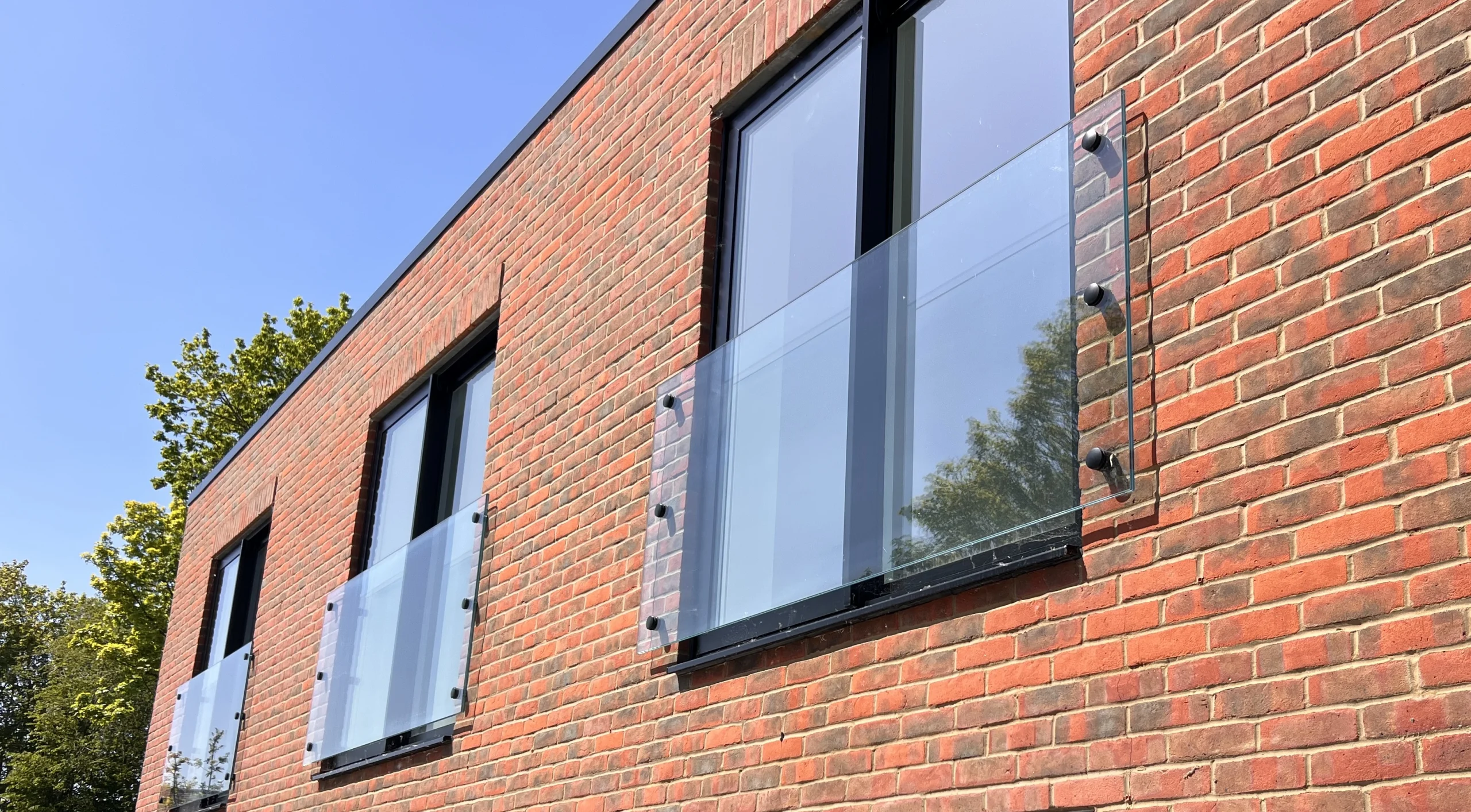
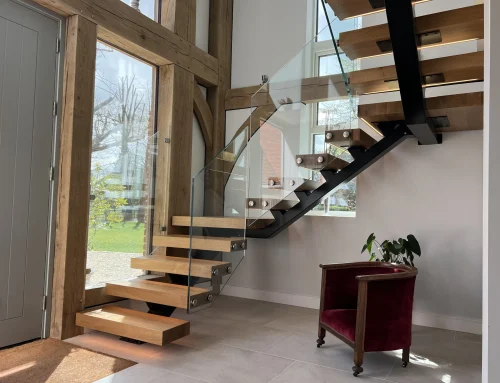
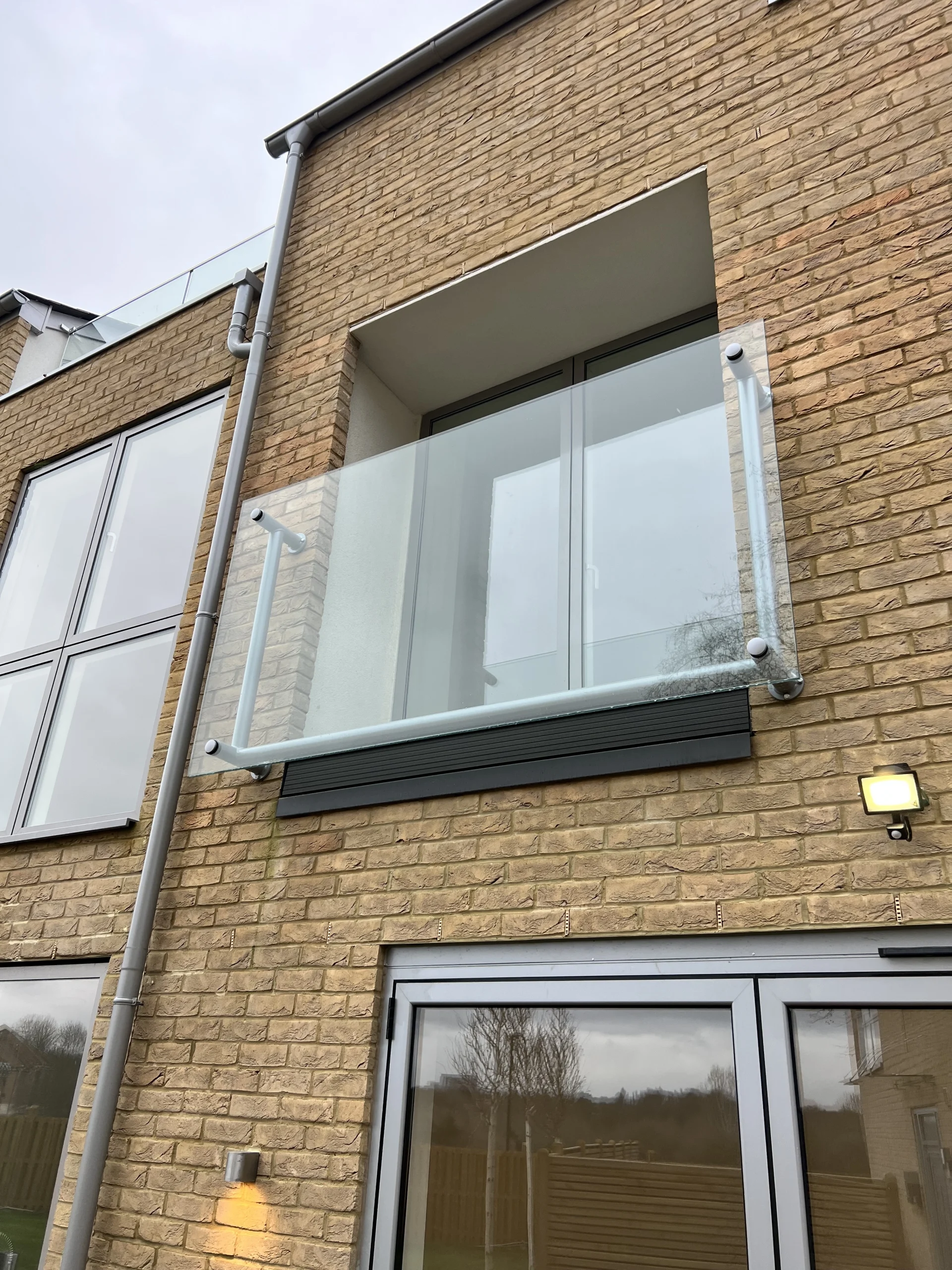
Bespoke frameless glass Juliet balcony by Continox — 17.5mm toughened laminated glass with stainless steel point fixings, manufactured to BS EN 12150 and BS EN 14449 standards.
A Juliet balcony in the UK costs £300–£1,500+ in 2026 depending on material, size, and specification. Standard steel railing Juliet balconies cost £300–£600 supplied; framed glass with steel handrail runs £450–£900; bespoke frameless glass with stainless steel point fixings is £800–£1,500+. Installation typically adds £200–£500 for accessible openings, more if external scaffolding or platform access is required. The main hidden cost is converting an existing window to French doors — typically £1,500–£4,000 additional for the doors, lintel, structural alterations, and making good. Building Regulations require minimum height of 1,100mm above finished floor level, no gaps exceeding 100mm, and toughened or laminated safety glass on glazed installations.
Three Price Tiers — Steel, Glass, Bespoke
Juliet balcony pricing falls into three clear tiers, separated by material specification and fabrication method. The price gap between tiers is significant — typically 50–80% jump between adjacent tiers — but the visual and functional difference is also significant.
The traditional specification — a steel or wrought iron railing fitted across a French door opening, typically with vertical balusters at standard 100mm centres. Stock sizes are widely available from suppliers like Juliet Balcony Centre and C&R Direct at £200–£400 supply-only for sizes up to 1,500mm wide. Powder-coated finishes (RAL 9005 jet black is the most popular) add £40–£80 to the supply cost; hot-dip galvanised coating before powder coating extends service life from 15 to 30+ years and adds approximately £60–£100.
Cast iron or decorative wrought iron designs are typically priced higher — £500–£900 supplied for ornate Victorian-style railings — and suit period properties where the Juliet replaces a historic feature. For modern minimalist properties, plain vertical bar steel at the lower end of the price range is the standard choice.
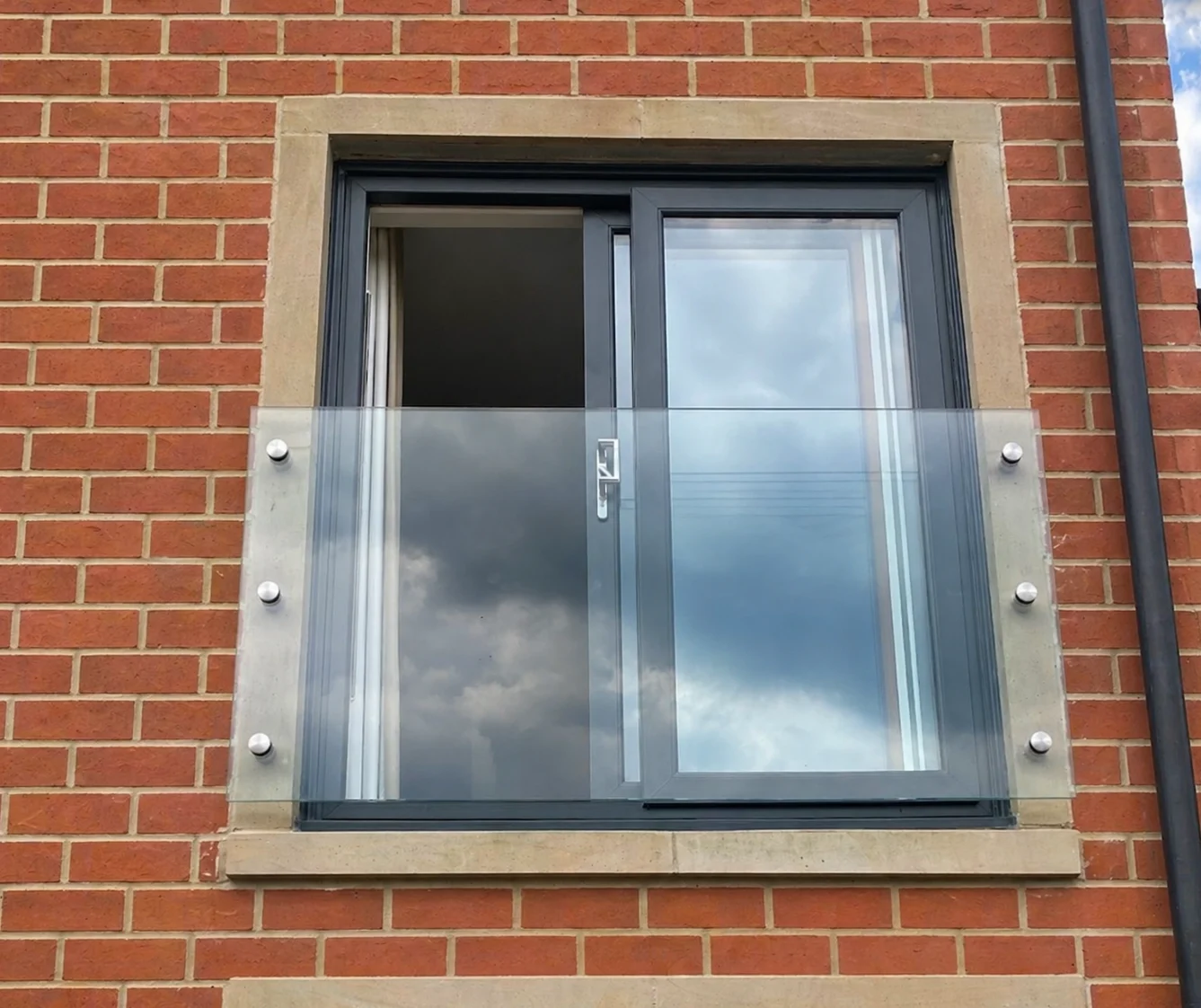
The most popular specification in modern UK new-build housing. A glass infill panel — typically 10–12mm toughened glass to BS EN 12150 — held in a steel U-channel base shoe with a top rail handrail in stainless steel or powder-coated steel. The frame provides the primary structural strength, with the glass acting as the visible barrier and infill.
Pricing for framed glass Juliet balconies in 2026 runs £450–£900 supplied for standard widths up to 2,000mm. The price spans the difference between off-the-shelf systems (Balconette, Balconette Aerofoil, similar branded products at the lower end) and bespoke fabricated framed systems with custom RAL colour and non-standard widths. At Continox, framed glass Juliet balconies are bespoke-fabricated to suit each opening, with full structural calculation and BS 6180 compliance documentation.
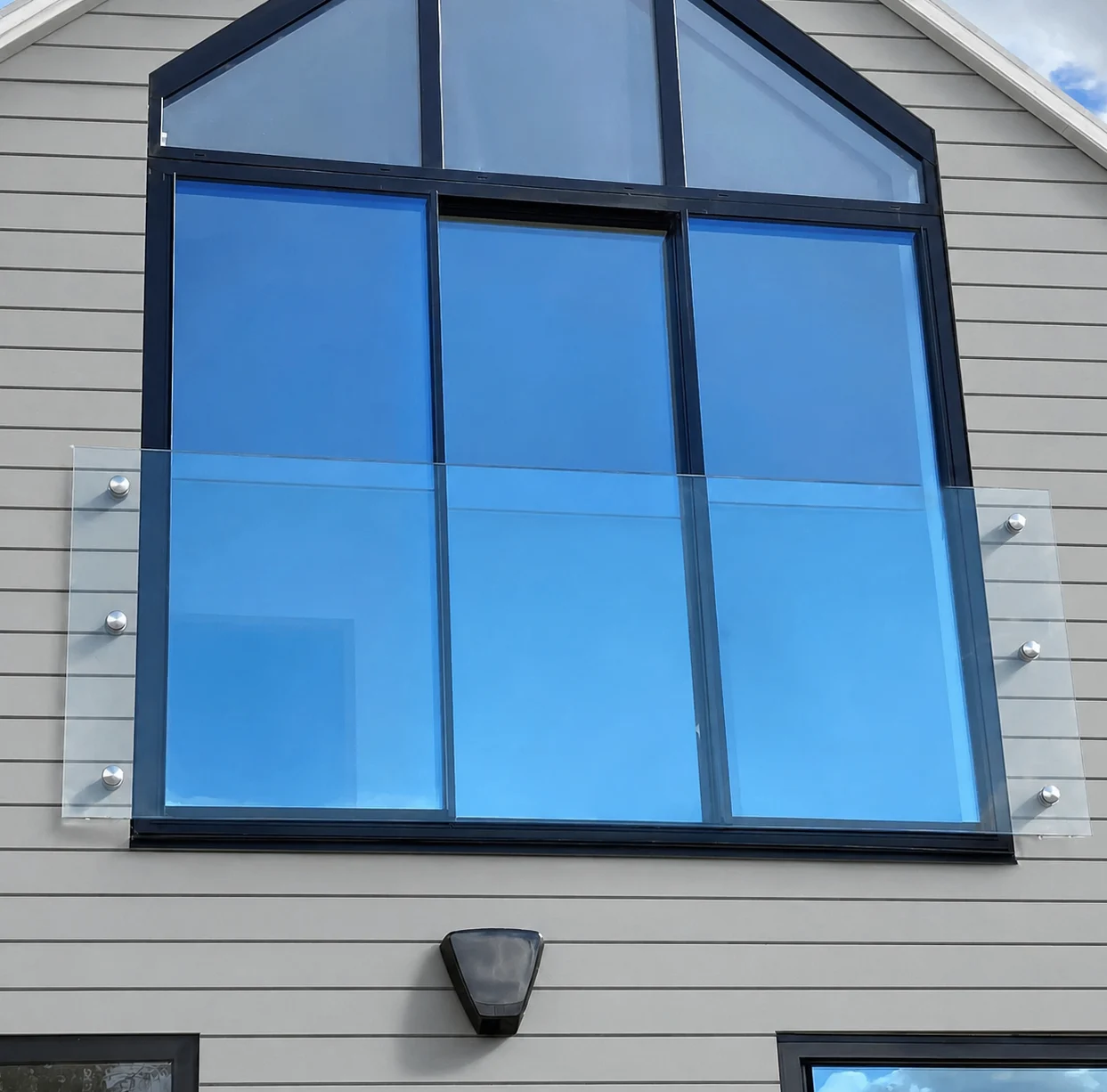
The premium specification. A single panel of toughened laminated safety glass (typically 17.5mm or 21.5mm to BS EN 14449) held in place by minimalist stainless steel point fixings — also called "spider" or "patch" fixings — set into the structural masonry. No frame, no top rail in basic specifications, just glass and the four fixing points. The visual effect is uninterrupted: glass appears to float in front of the French doors, with maximum light transmission and zero visual obstruction.
Pricing for bespoke frameless glass Juliet balconies in 2026 typically runs £800–£1,500 supplied for standard residential widths up to 2,500mm, and £1,500–£3,000+ for larger spans, low-iron glass (extra-clear), or specifically architectural designs with custom fixing geometry. The premium reflects the laminated safety glass specification (more expensive than toughened-only), the precision required in fixing point setting-out (within 2mm tolerance for the glass to seat correctly), and the bespoke fabrication of the stainless steel hardware.
Detailed Pricing Table — By Width and Specification
The table below gives indicative supply-only prices for typical UK Juliet balcony widths in 2026. Prices are inclusive of standard fixings and structural calculations but exclude installation and any French door / opening alterations.
| Width (mm) | Steel Railing | Framed Glass | Frameless Glass |
|---|---|---|---|
| 1,200mm (standard French door) | £300–£450 | £450–£700 | £800–£1,100 |
| 1,500mm (wide French door) | £350–£550 | £550–£850 | £950–£1,300 |
| 1,800mm (bi-fold or oversized) | £450–£650 | £650–£1,000 | £1,100–£1,600 |
| 2,000mm (large opening) | £500–£750 | £750–£1,150 | £1,300–£1,900 |
| 2,500mm (panoramic) | £600–£900 | £900–£1,400 | £1,600–£2,400 |
| 3,000mm (full bi-fold span) | n/a — needs intermediate post | £1,200–£1,800 | £2,000–£3,200 |
Why frameless glass costs more at wider spans: A single panel of frameless glass over 2,500mm wide requires 21.5mm laminated specification (versus 17.5mm at narrower widths) to maintain structural performance under the 0.74 kN/m horizontal line load required by BS 6180 for residential applications. The thicker glass costs roughly 40% more per square metre, and the larger panel mass requires upgraded fixings rated for the increased loading — both factors compounding the price increase at wider spans.
Installation Costs — Beyond the Supply Price
Installation cost is the largest variable on most Juliet balcony projects. The factors that drive it are access type, fixing complexity, and geographic location. The base installation (assuming accessible opening, solid masonry, no surrounding obstructions) typically costs £200–£500 for a competent installer; the upper end of the range applies in London and the South East where labour rates are highest.
Standard installation — accessible opening
An accessible opening means the Juliet can be installed from inside the building through the French door opening, with the installer reaching out to attach the fixings. For a typical 1,200–1,500mm width on a first-floor opening: £200–£400 for a two-person installation, completed in 2–4 hours.
Scaffolding-required installation
Some Juliet specifications — particularly frameless glass with point fixings — require external access during installation to set the fixings, glaze the panel, and align everything correctly. Tower scaffolding for one or two days adds £200–£500 depending on height and access. Cherry picker / MEWP hire adds £300–£600 per day. For higher-floor installations (third floor and above), platform access becomes mandatory regardless of Juliet specification, and the cost adds proportionally.
Cavity wall fixing complications
Where the external wall is cavity construction (most UK housing built since 1930), the Juliet fixings must penetrate to the inner structural leaf — never just to the external skin. This requires longer fixings, more complex installation, and often the use of resin anchors rather than mechanical expansion bolts. Adds approximately £100–£200 to standard installation.
The Hidden Cost — French Door Conversion
Most Juliet balcony installations involve converting an existing window opening to a full-height French door opening. This is the single largest hidden cost on Juliet projects — and the one most homeowners underestimate at the planning stage.
The cost of converting a window to French doors in the UK in 2026 typically runs:
uPVC French doors: £800–£2,000 for the door supply, £400–£800 for installation including lintel adjustment and making good, total approximately £1,200–£2,800.
Aluminium French doors: £1,500–£3,500 for the door supply (premium specification, slim sightlines), £500–£1,000 for installation, total approximately £2,000–£4,500.
Timber French doors: £1,200–£3,000 for the door supply (depending on hardwood specification), £500–£1,000 for installation, total approximately £1,700–£4,000. Listed buildings and conservation areas typically require timber to maintain heritage character.
Structural alterations: Replacing a window with French doors requires removing a section of brickwork below the existing window, installing a new lintel above (where the existing lintel is too narrow), and rebuilding any side reveals. Typical structural cost: £600–£1,500 on a standard residential property; significantly more on listed buildings or where structural calculation is required.
Plan the doors and the Juliet together. The most cost-efficient approach is specifying both at the same time, with the same trade. A Juliet balcony installer working alongside the French door fitter avoids duplicate scaffolding, sequenced site visits, and the risk of fixing positions clashing with the door frame. Doing the door conversion first and adding the Juliet later typically adds 20–30% to the combined cost. For projects where Continox is supplying both glass elements (Juliet plus glass balustrade on internal stairs), see our glass balustrade product page for the integrated specification.


Total Project Cost — Three Real Scenarios
The headline supply price is rarely the total. Three worked examples below show the realistic budget for Juliet balcony projects at different specifications.
Scenario 1 — Standard new-build, Juliet only (existing doors)
French doors already installed during construction, just adding a Juliet balcony to the upper-floor master bedroom. Width 1,500mm, framed glass with steel handrail.
Juliet supply: £650 / Installation: £350 / Total: £1,000
Scenario 2 — Period property conversion with French doors
Victorian terrace, converting a sash window to timber French doors and adding a frameless glass Juliet. Width 1,200mm.
Juliet supply: £950 / Installation: £450 / Timber French doors: £2,200 / Structural alterations: £900 / Total: £4,500
Scenario 3 — High-end new-build, bespoke frameless
Contemporary detached home, three Juliet balconies on master suite and two guest bedrooms. Frameless glass with low-iron specification, 2,000mm wide each.
3× Juliet supply: £4,800 / Installation: £900 / Cherry picker hire: £600 / Total: £6,300
UK Building Regulations — What's Mandatory
Juliet balconies are classified as guarding under Approved Document Part K, not as balconies in the structural sense. The compliance requirements are therefore identical to other forms of guarding to a French door opening:
Minimum height: 1,100mm above finished floor level. This applies at all points across the Juliet, measured from the inside floor surface to the top of the railing or glass. The 1,100mm requirement is the same for all upper-floor residential applications and reflects the fall height risk.
Sphere rule: maximum 100mm gap. No gap in the Juliet should permit a 100mm sphere to pass through — the standard child safety provision. This affects baluster spacing on steel railings (typically set at 100mm centres) and fixing arrangements on frameless glass installations.
Horizontal line load: 0.74 kN/m for residential. The Juliet must resist a horizontal force of 0.74 kN per metre length (approximately 75 kg per metre) applied at handrail height under BS 6180. This drives glass thickness specification (10–12mm toughened minimum, 17.5mm laminated for frameless), fixing arrangement, and structural calculation requirements.
Safety glass: BS EN 12150 (toughened) or BS EN 14449 (laminated). Both are recognised as safety glass under UK regulations. Laminated is required where the glass is the primary structural element (frameless point-fixed); toughened is acceptable where a structural frame supports the glass. For full glass balustrade specifications see our glass balustrade regulations guide.
Planning Permission — When You Need It
For most Juliet balcony installations on standard residential properties, planning permission is not required. The Juliet itself sits flush with the building exterior and does not project beyond the wall plane — so it falls within permitted development. However, four scenarios commonly require planning permission:
1. Listed buildings. Any external alteration to a listed building requires Listed Building Consent, regardless of whether it would be permitted development on a non-listed property. Adding a Juliet typically requires consent because it changes the building's external appearance.
2. Conservation areas. Article 4 directions in conservation areas often remove permitted development rights for external alterations. Local authority confirmation is essential before installation.
3. Article 4 designations. Some non-conservation areas have specific Article 4 directions affecting elevation alterations. Check with the local planning authority.
4. New flats / multi-occupancy buildings. Buildings with multiple flats (typically definable as flat conversions of houses, or purpose-built blocks) may require planning permission for any elevational change. Freeholder consent is also required where the property is leasehold.
For detailed planning guidance see our Juliet balcony planning permission guide and installation guide.

Juliet vs Walkout Balcony — The Cost Difference
The single biggest cost decision in balcony specification is whether to install a Juliet (no platform) or a walkout balcony (projecting platform you can step onto). The cost difference is significant — typically 10x — and so are the regulatory implications.
| Feature | Juliet Balcony | Walkout Balcony |
|---|---|---|
| Total cost (typical) | £500–£3,000 | £5,000–£20,000+ |
| Planning permission | Usually not required | Almost always required |
| Structural engineer | Not required | Required |
| Installation time | 1 day | 1–3 weeks |
| External platform | None | Yes (typically 600–1,500mm projection) |
| Property value uplift | 1–2% | 3–7% |
| Building regulations | Part K (guarding) | Part K + Part A structural |
For full Juliet vs walkout comparison see our Juliet balcony vs walkout balcony guide.
Frequently Asked Questions
Fixed-Price Quotation Within 24 Hours
Continox manufactures bespoke steel, framed glass, and frameless glass Juliet balconies to suit any opening width and architectural style. Full structural calculation, BS 6180 / BS EN 12150 / BS EN 14449 compliance documentation, manufactured and installed by our own team. Free site survey across the UK, fixed-price quotation within 24 hours, no obligation.